
2027 Best Accelerated Online Bachelor's in Health Sciences Programs

Co-Founder and Chief Data Scientist
If you're aiming to fast-track your entry into the healthcare sector, an accelerated online Bachelor's in Health Sciences program offers a flexible and efficient pathway. These programs are designed for individuals eager to complete their degrees swiftly while balancing other commitments.
In this article, we'll delve into the benefits of such programs, what you can expect during your studies, potential career opportunities, and the earning potential upon graduation. By understanding these aspects, you can make an informed decision about pursuing a career in health sciences.
What are the benefits of completing an accelerated online Bachelor's in Health Sciences program?
- Graduates can earn a median salary of $83,090 per year.
- Employment of medical scientists is projected to grow 11% from 2023 to 2033, much faster than the average for all occupations.
- Opportunities span across various roles such as health educators, clinical research coordinators, and healthcare administrators.
What can I expect from an accelerated online Bachelor's in Health Sciences program?
Accelerated online Bachelor's in Health Sciences programs are structured to provide comprehensive knowledge in a condensed timeframe. Students can expect a rigorous curriculum covering subjects like anatomy, physiology, healthcare ethics, and public health. The online format offers flexibility, allowing learners to balance studies with personal and professional responsibilities.
Interactive modules, virtual labs, and real-world case studies are commonly integrated to enhance learning outcomes. Upon completion, graduates are well-equipped to pursue various roles in the healthcare industry or advance to graduate studies.
Where can I work with an accelerated online Bachelor's in Health Sciences program?
Graduates of accelerated online Bachelor's in Health Sciences programs have a wide array of employment opportunities across multiple sectors. The versatility of the degree allows for roles in both clinical and non-clinical settings.
Top-Employing Industries:
- Hospitals and Health Systems: Positions in patient care coordination, health education, and administrative roles.
- Public Health Organizations: Roles in community health promotion and disease prevention programs.
- Research Institutions: Opportunities as clinical research coordinators or laboratory managers.
- Healthcare Administration: Positions in healthcare management, policy analysis, and health services coordination.
Top-Employing States:
- California
- New York
- Texas
- Florida
- Pennsylvania
These states have a high concentration of healthcare facilities and research institutions, offering ample job opportunities for graduates.
How much can I make with an accelerated online Bachelor's in Health Sciences program?
Earning potential for graduates varies based on factors such as location, experience, and specific job roles. According to the U.S. Bureau of Labor Statistics, the median annual wage for healthcare practitioners and technical occupations was $83,090 in May 2024. Community health workers and health education specialists earn $51,030 and $63,000 per year, respectively.
Salary Estimates from Various Sources:
- Zippia: Reports an average salary of $47,683 for health sciences and services majors.
- Salary.com: Indicates that health science specialists with a bachelor's degree earn between $68,632 and $72,461 annually.
- ZipRecruiter: Lists the average salary for health sciences degree holders at $109,580 per year.
- Indeed: Offers a range of job listings with salaries varying based on position and location.
- PayScale: Provides salary data for various health sciences roles, with figures depending on job title and experience.
These figures illustrate the diverse earning potential within the health sciences field, emphasizing the value of an accelerated online bachelor's degree in this area.
- Best Accelerated Online Bachelor's in Health Sciences Programs for 2027 List of Programs
- How long does it take to complete an accelerated online Bachelor's in Health Sciences program? Program Duration
- How does an accelerated online Bachelor's in Health Sciences compare to an on-campus program? Online vs Campus Programs
- What is the average cost of an accelerated online Bachelor's in Health Sciences program? Program Cost
- What are the financial aid options for students enrolling in an accelerated online Bachelor's in Health Sciences program? Program Cost
- What are the prerequisites for enrolling in an accelerated online Bachelor's in Health Sciences program? Financial Aid
- What courses are typically in an accelerated online Bachelor's in Health Sciences program? Admission Requirements
- What types of specializations are available in accelerated online Bachelor's in Health Sciences programs? Curriculum
- How do you choose the best accelerated online Bachelor's in Health Sciences program? How do you choose the best accelerated online Bachelor's in Health Sciences program?
- What career paths are available for graduates of accelerated online Bachelor's in Health Sciences programs? What career paths are available for graduates of accelerated online Bachelor's in Health Sciences programs?
- What is the job market like for graduates with an accelerated online Bachelor's in Health Sciences? What is the job market like for graduates with an accelerated online Bachelor's in Health Sciences?
- What challenges should I anticipate in an accelerated online Bachelor's in Health Sciences program? What challenges should I anticipate in an accelerated online Bachelor's in Health Sciences program?
- Can additional certifications enhance my career prospects? Can additional certifications enhance my career prospects?
- What is the return on investment of an accelerated online Bachelor's in Health Sciences program? What is the return on investment of an accelerated online Bachelor's in Health Sciences program?
- How can I verify the accreditation and quality of my accelerated online Bachelor's in Health Sciences program? How can I verify the accreditation and quality of my accelerated online Bachelor's in Health Sciences program?
Best Accelerated Online Bachelor's in Health Sciences Programs for 2027
An accelerated online bachelor’s in health sciences can help students finish a healthcare-focused degree faster without relocating or leaving work. The trade-off is intensity: shorter terms, heavier weekly workloads, and fewer built-in campus routines. This guide is for transfer students, working adults, allied health professionals, and first-time undergraduates who want a flexible path into healthcare administration, public health, clinical support, wellness, research coordination, or graduate study.
Below, you will find a rebuilt, decision-focused guide to accelerated online health sciences bachelor’s programs: how the programs work, how long they take, what they cost, what to check before enrolling, which career paths they can support, and how to compare schools without relying on rankings alone.
Quick answer: What is the best accelerated online bachelor’s in health sciences?
The best accelerated online bachelor’s in health sciences is the program that matches your transfer credits, budget, career goal, accreditation needs, and weekly availability. Students with many prior credits may finish fastest in degree-completion programs, while first-time students should compare full 120-credit options, course length, tuition per credit, student support, and whether the curriculum fits healthcare administration, public health, clinical advancement, or graduate school preparation.
Before choosing any program, confirm institutional accreditation, ask how many credits will transfer, calculate the total program price—not only the per-credit rate—and verify whether the degree supports any future licensure, certification, or graduate admission plans.
How these programs were selected and ranked
Research.com evaluates accelerated online health sciences programs using a structured ranking methodology that considers institutional credibility, program availability, student outcomes, affordability signals, and online learning access. Rankings are designed to help students build a shortlist, not to replace personal fit research.
Institutional and program data are reviewed through sources such as the IPEDS database from the National Center for Education Statistics, Peterson’s database, including distance learning data, and the College Scorecard database. These sources help compare accreditation, program structure, costs, financial aid availability, and student outcome indicators.
Because accelerated online programs vary widely, students should use the ranking as a starting point. The fastest option on paper may not be the best option if transfer credits do not apply, required courses are unavailable when needed, or the curriculum does not support the student’s career target.
Best accelerated online bachelor’s in health sciences programs at a glance
| Rank | School | Online degree | Program cost | Typical completion time | Credits | Accreditation |
| 1 | Indiana University Bloomington | B.S. in Applied Health Science | $257/credit (in-state) | 4 years | 120 credits | HLC |
| 2 | Clarkson College | B.S. in Healthcare Management (Healthcare Business) | $650/credit | 3.5–5 years | 120 credits | HLC |
| 3 | Florida Gulf Coast University | B.S. in Health Science | ~$204/credit (in-state) | 2 years for qualified upper-division students | 120 credits | SACSCOC |
| 4 | Old Dominion University | B.S. in Health Sciences | $444/credit | 4 years, or less with transfer credits | 120 credits | SACSCOC |
| 5 | Nova Southeastern University | B.H.Sc. (Bachelor of Health Science) | $415/credit | 2 years with maximum transfer credits | 120 credits | SACSCOC |
| 6 | Northern Kentucky University | B.S. in Health Science | $359/credit | 1 year for qualified students with an A.S. | 120 credits, with up to 90 transferable | SACSCOC |
| 7 | Alvernia University | B.S. in Healthcare Science | $650/credit | 2–4 years | 123 credits | MSCHE |
| 8 | University of North Alabama | B.S. in Health Sciences | $340/credit | 4 years, with accelerated options available | 120 credits | SACSCOC |
| 9 | Southern New Hampshire University | B.S. in Health Science | $342/credit | 4 years, with accelerated options available with up to 90 transfer credits | 120 credits | NECHE |
| 10 | University of Missouri | BHS in Health Science | $355/credit | 4 years, with accelerated options available | 120 credits | HLC |
1. Indiana University Bloomington – B.S. in Applied Health Science
Indiana University Bloomington, founded in 1820, is Indiana’s flagship public research university. Its online B.S. in Applied Health Science is a strong fit for students who want a broad health-focused undergraduate degree from a large research institution with extensive academic resources. The program may appeal to students interested in wellness, public health, healthcare services, or preparation for additional study.
- Program cost: $257/credit (in-state)
- Program duration: 4 years
- Total credits: 120 credits
- Accreditation: HLC
2. Clarkson College – B.S. in Healthcare Management (Healthcare Business)
Clarkson College is a private healthcare-focused institution in Omaha, Nebraska, founded in 1888 as Nebraska’s first nursing school. Because the college centers its academic mission on healthcare education, its online healthcare business management pathway may be useful for students who want a management-oriented degree connected to healthcare operations rather than a general health sciences curriculum.
- Program cost: $650/credit
- Program duration: 3.5–5 years (can be accelerated with transfer credits)
- Total credits: 120 credits
- Accreditation: HLC
3. Florida Gulf Coast University – B.S. in Health Science
Florida Gulf Coast University is a public university in Fort Myers, Florida. Established in 1991 and opened in 1997, FGCU is part of Florida’s state university system and has grown to over 15,000 students. Its Marieb College of Health & Human Services offers an online health science pathway that can be especially practical for students who already have lower-division coursework and want to complete upper-division requirements online.
- Program cost: ~$204/credit (in-state)
- Program duration: 2 years (upper-division online coursework for those with prior credits)
- Total credits: 120 credits (includes lower-division prerequisites)
- Accreditation: SACSCOC
4. Old Dominion University – B.S. in Health Sciences
Old Dominion University is a public research university in Norfolk, Virginia, founded in 1930 as an extension of William & Mary. ODU has long experience in distance education and may be a good match for transfer students, military-connected learners, and working adults looking for a health sciences degree with flexible online delivery.
- Program cost: $444/credit (ODUGlobal rate for out-of-state distance learners)
- Program duration: 4 years (less with transfer credits)
- Total credits: 120 credits
- Accreditation: SACSCOC
5. Nova Southeastern University – B.H.Sc. (Bachelor of Health Science)
Nova Southeastern University is a private research university in Fort Lauderdale-Davie, Florida, founded in 1964. NSU is known for its large health professions division, which includes medical, dental, nursing, and other healthcare programs. The online B.H.Sc. is designed for allied health professionals and transfer students who want to advance academically while continuing to work.
- Program cost: $415/credit
- Program duration: 2 years (for students transferring maximum credits)
- Total credits: 120 credits
- Accreditation: SACSCOC
6. Northern Kentucky University – B.S. in Health Science
Northern Kentucky University, founded in 1968, is a public university in Highland Heights, Kentucky, near Cincinnati. Its online B.S. in Health Science is structured as a completion pathway for students who already hold an associate degree or significant transfer credits. The 7-week course format can help motivated students progress quickly, but it requires steady weekly engagement.
- Program cost: $359/credit (with scholarship for new online students)
- Program duration: 1 year (accelerated completion for students with an A.S.)
- Total credits: 120 credits (up to 90 transferable)
- Accreditation: SACSCOC (Southern Association of Colleges & Schools Commission on Colleges)
7. Alvernia University – B.S. in Healthcare Science
Alvernia University is a private Catholic university in Reading, Pennsylvania, founded in 1958 by the Bernardine Franciscan Sisters. Its online B.S. in Healthcare Science is part of the university’s adult education offerings and is intended for students who want a values-informed healthcare curriculum that combines technical knowledge, ethics, communication, and applied learning.
- Program cost: $650/credit
- Program duration: 2–4 years (depending on transfer credits)
- Total credits: 123 credits
- Accreditation: MSCHE
8. University of North Alabama – B.S. in Health Sciences
The University of North Alabama, founded in 1830, is Alabama’s oldest four-year public university. Its online B.S. in Health Sciences is built for students seeking an accessible public-university option with flexible online coursework and potential accelerated completion routes.
- Program cost: $340/credit
- Program duration: 4 years (accelerated options available)
- Total credits needed to graduate: 120 credits
- Program/School Accreditation: SACSCOC (Southern Association of Colleges and Schools Commission on Colleges)
9. Southern New Hampshire University – B.S. in Health Science
Southern New Hampshire University is a private, non-profit university founded in 1932. SNHU is widely known for online education and career-oriented program delivery. Its online B.S. in Health Science can be practical for students who want multiple start dates, broad online student support, and the possibility of applying up to 90 transfer credits.
- Program cost: $342/credit
- Program duration: 4 years (accelerated options available with up to 90 transfer credits)
- Total credits: 120 credits
- Accreditation: NECHE (New England Commission of Higher Education)
10. University of Missouri – BHS in Health Science
The University of Missouri, established in 1839, is Missouri’s largest public research university. Its online BHS in Health Science can suit students who want a public research university credential and a flexible health science curriculum that may support roles in healthcare services, public health, administration, or preparation for advanced study.
- Program cost: $355/credit
- Program duration: 4 years (accelerated options available)
- Total credits needed to graduate: 120 credits
- Program/School Accreditation: HLC (Higher Learning Commission)
How long does it take to complete an accelerated online Bachelor's in Health Sciences program?
Most accelerated online bachelor’s in health sciences programs take less time when students bring transfer credits. A traditional bachelor’s degree is commonly structured around 120 credits and may take 4 years, but accelerated degree-completion options can shorten the timeline for students who already have an associate degree, allied health coursework, or substantial prior college credit.
Many accelerated programs use shorter academic terms, such as 8-week sessions, so students can complete courses more frequently throughout the year. However, the faster pace does not mean less work. A course that would normally unfold over a longer semester may compress readings, assignments, discussions, labs, exams, or projects into a tighter schedule.
| Student situation | Likely timeline | Best program type | What to verify |
| First-time bachelor’s student | 4 years, depending on course load | Full 120-credit online bachelor’s program | General education requirements, course sequencing, and annual tuition |
| Student with some college credit | Less than 4 years if credits transfer | Transfer-friendly online bachelor’s program | Official transfer evaluation before enrollment |
| Associate degree holder | Often 1–2 years in completion programs | Upper-division degree-completion pathway | Maximum transferable credits and missing prerequisites |
| Working allied health professional | Varies based on transfer credit and workload | Flexible or part-time accelerated format | Whether clinical credentials or prior training earn credit |
If you are comparing nearby healthcare fields, the best online nutrition degrees may be worth reviewing if your goals center on wellness, food systems, dietetics preparation, or community nutrition rather than broad health sciences.
How does an accelerated online Bachelor's in Health Sciences compare to an on-campus program?
An accelerated online bachelor’s in health sciences usually offers more scheduling flexibility than an on-campus program, while campus-based study offers more face-to-face structure. The better choice depends on how you learn, how much time you can dedicate weekly, whether you need campus labs or networking, and how important fixed class meetings are to your success.
| Factor | Accelerated online program | On-campus program | Best fit |
| Schedule | Often asynchronous or partially asynchronous, with shorter terms | Fixed class times and campus attendance | Online works well for working adults; campus works well for students who need routine |
| Pace | Condensed courses require consistent weekly work | Traditional semesters may spread assignments over more time | Accelerated formats suit highly organized students |
| Interaction | Discussion boards, video meetings, email, and virtual advising | In-person faculty access, labs, clubs, and peer contact | Campus may help students who want immediate face-to-face support |
| Cost considerations | May reduce relocation and commuting expenses | May include housing, commuting, parking, and campus fees | Compare total cost, not only tuition |
| Career preparation | Can be strong if career services, projects, and internships are available | May offer local networking and campus-based experiential learning | Choose the format with stronger support for your target role |
Students evaluating accelerated learning in other fields may also compare options such as the shortest master’s degree in early childhood education online to understand how compressed online formats differ by discipline. For healthcare leadership goals specifically, an online degree in healthcare management may provide a more administration-focused alternative to a broader health sciences degree.
What is the average cost of an accelerated online Bachelor's in Health Sciences program?
The cost of an accelerated online bachelor’s in health sciences depends on the school, residency rules, transfer credit, required fees, and course load. Published tuition rates for health sciences programs range from $9,354 to $27,205 per year. Many online programs charge tuition by the credit, and rates commonly appear between $300 and $600 per credit in the programs listed above.
Acceleration can lower total opportunity cost if it helps you finish sooner and enter or advance in the workforce earlier. However, a faster program is not automatically cheaper. A student who takes too many courses at once and has to withdraw, repeat classes, or reduce work hours may end up spending more.
| Cost item | Why it matters | Question to ask |
| Tuition per credit | This is the main advertised price, but it is not the full cost | Is the rate different for online, in-state, out-of-state, or military students? |
| Transfer credits | Accepted credits can reduce the number of courses you must pay for | Can I receive a written transfer evaluation before committing? |
| Fees | Online, technology, graduation, and course fees can raise the final bill | What fees are mandatory for every online student? |
| Books and materials | Healthcare courses may require digital platforms or specialized resources | Are course materials included in tuition or billed separately? |
| Time away from work | Accelerated terms can affect income if the workload is too heavy | How many weekly hours should I expect per course? |
Students comparing tuition across online degree types may also review the shortest master’s in educational counseling online programs to see how total cost changes when program length, credential level, and specialization differ.
The chart below highlights the average tuition and fees for health sciences programs at different educational levels for the 2024–2025 academic year. It can help students benchmark bachelor’s tuition against vocational, graduate, and out-of-state cost patterns.
What are the financial aid options for students enrolling in an accelerated online Bachelor's in Health Sciences program?
Students in accredited online bachelor’s programs may qualify for many of the same financial aid options as campus students, as long as they meet eligibility rules. The key step is to complete the FAFSA early and confirm that the program and enrollment status qualify for aid.
- Federal Grants: Pell Grants provide need-based aid for eligible undergraduates. For the 2023–2024 academic year, Pell Grants range from $750 to $7,395. Graduate and professional students comparing other accelerated paths, such as the shortest online master's of legal studies programs, should note that aid rules may differ by degree level and student status.
- Federal Student Loans: Eligible students may use subsidized or unsubsidized Direct Loans, with interest rates set annually by Congress.
- Work-Study Programs: Federal work-study can provide part-time employment for students with financial need, although availability varies by school and student circumstances.
- Institutional Aid: Colleges may offer scholarships, grants, tuition discounts, or GPA-based awards. Some institutions provide non-competitive scholarships ranging from $1,000 to $7,500 annually based on GPA.
- Employer Tuition Assistance: Some employers support degree completion through reimbursement or direct payment programs. Companies like Amazon, Starbucks, and Walmart have programs that can cover a significant portion of tuition costs.
To avoid unexpected costs, ask the financial aid office how aid is disbursed in accelerated terms. Short sessions can affect enrollment intensity, refund timing, and whether you remain eligible each term.
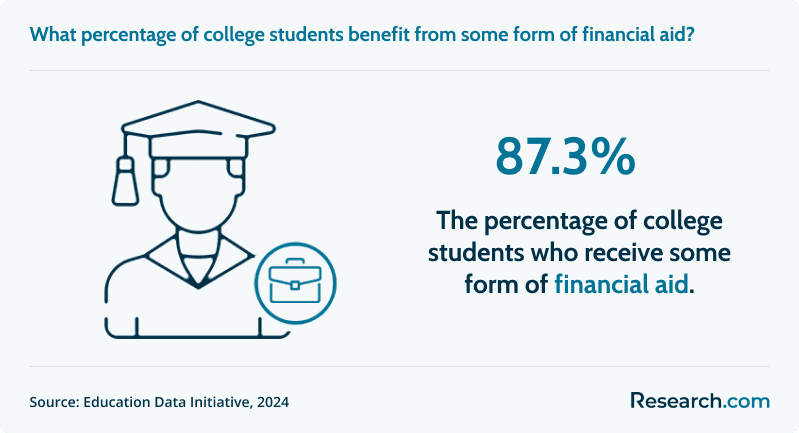
The visual below reinforces the role financial aid plays in college access. According to the Education Data Initiative (2024), 87.3% of college students receive some form of financial aid, which is why students should compare aid packages before deciding whether a program is affordable.
What are the prerequisites for enrolling in an accelerated online Bachelor's in Health Sciences program?
Admission requirements vary by school, but accelerated online health sciences programs often expect students to be academically ready for science, healthcare systems, statistics, and writing-intensive courses. Degree-completion programs may have stricter transfer-credit requirements than full bachelor’s programs.
- Educational Background: Most programs require a high school diploma or equivalent. Some accelerated or completion pathways require prior college coursework or an associate degree. Students comparing the shortest online public safety degree programs will see similar differences between first-time student pathways and degree-completion options.
- Minimum GPA: Many schools set minimum GPA standards, often around 2.5 to 3.0, especially for transfer or upper-division admission.
- Prerequisite Courses: Programs may require or recommend biology, chemistry, anatomy, physiology, math, statistics, writing, or other foundational courses.
- Standardized Tests: SAT or ACT scores may be requested by some institutions, but test-optional policies are increasingly common.
- Technical Requirements: Online students need reliable internet access, a suitable computer, webcam or microphone access if required, and the ability to use the school’s learning management system.
Do not assume that all healthcare-related online programs have the same prerequisites. For example, an online pharmacy technician course may have different entry requirements, career outcomes, and credential expectations than a bachelor’s in health sciences.
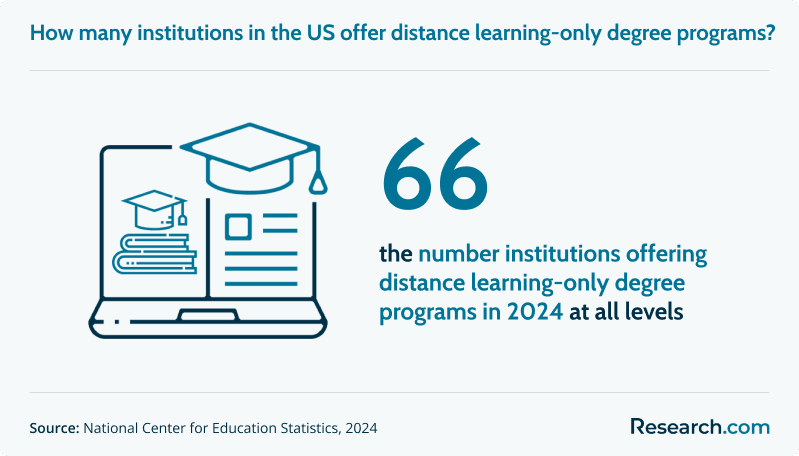
The image below shows that as of 2024, 66 institutions in the U.S. offer distance learning-only degree programs at all levels (National Center for Education Statistics, 2024). This illustrates how fully online education has become more common, but students should still check accreditation, curriculum quality, and support services carefully.
What courses are typically in an accelerated online Bachelor's in Health Sciences program?
A bachelor’s in health sciences usually combines healthcare foundations, science, communication, ethics, population health, research, and administration. The exact curriculum depends on whether the program is designed for general healthcare careers, allied health advancement, public health, health education, or management.
| Course area | What students learn | Why it matters |
| Introduction to Health Sciences | How healthcare systems, providers, policies, and patient services connect | Builds a foundation for non-clinical and clinical support roles |
| Anatomy and Physiology | Human body structure, function, and major systems | Supports understanding of disease, wellness, and patient care contexts |
| Medical Terminology | Healthcare vocabulary used in records, communication, and documentation | Helps graduates communicate accurately in healthcare settings |
| Epidemiology | Patterns, causes, and effects of disease in populations | Useful for public health, prevention, and research-related work |
| Health Policy and Ethics | Healthcare laws, regulations, professional responsibilities, and ethical issues | Prepares students to evaluate decisions that affect patients and organizations |
| Research Methods in Health Sciences | Study design, data interpretation, evidence evaluation, and applied research | Strengthens analytical skills for healthcare improvement and graduate study |
| Healthcare Management | Leadership, operations, finance, quality improvement, and organizational behavior | Supports administrative and supervisory career paths |
| Community and Public Health | Health promotion, prevention strategies, community needs, and outreach | Prepares students for population health and community-facing roles |
| Nutrition and Wellness | How lifestyle, nutrition, and prevention influence health outcomes | Useful for wellness, education, and prevention-focused careers |
| Capstone Project | Application of health sciences knowledge to a real-world issue or project | Provides portfolio evidence of applied learning |
Because accelerated courses move quickly, students should review sample syllabi when available. A program with heavy science, statistics, and writing requirements may be manageable, but only if the student has enough time each week to keep pace.
What types of specializations are available in accelerated online Bachelor's in Health Sciences programs?
Specializations help students align a broad health sciences degree with a clearer career direction. Not every program offers formal concentrations, but many allow electives or tracks that emphasize administration, public health, education, informatics, or preparation for graduate study.
| Specialization | Best for students interested in | Typical career direction |
| Healthcare Management | Operations, supervision, healthcare business, and leadership | Administrative coordinator, healthcare manager, department support roles |
| Public Health | Prevention, community health, epidemiology, and population health | Community health worker, health educator, public health program support |
| Health Education | Teaching individuals and communities about healthy behaviors | Health education, outreach, wellness programming |
| Pre-Professional Tracks | Graduate study in medicine, dentistry, physical therapy, or related fields | Preparation for advanced admissions requirements |
| Health Informatics | Healthcare data, systems, records, and technology-supported care | Health information, data coordination, clinical systems support |
If your goal is specifically healthcare leadership, compare the curriculum with a healthcare management degree or healthcare administration pathway. A health sciences program may be broader, while an administration degree may provide more focused training in finance, policy, operations, and organizational leadership.
How to choose the best accelerated online Bachelor's in Health Sciences program?
The right program should fit your academic record, transfer credits, budget, schedule, and career target. A strong school on a ranking list may still be a poor fit if it does not accept your credits, lacks the specialization you need, or uses a course pace that is unrealistic for your work and family obligations.
- Confirm institutional accreditation. Check whether the college or university is accredited by a recognized accrediting body. Accreditation affects credit transfer, financial aid eligibility, graduate school recognition, and employer confidence.
- Request a transfer-credit review. Do this before enrolling. Ask which credits apply to general education, major requirements, electives, and upper-division coursework.
- Compare total cost. Add tuition, fees, textbooks, technology costs, and any lost income from reduced work hours.
- Match the curriculum to your goal. Public health, health education, healthcare administration, informatics, wellness, and pre-professional tracks can lead to different outcomes.
- Check course format. Ask whether classes are asynchronous, synchronous, self-paced, cohort-based, or offered in 7-week or 8-week terms.
- Evaluate support services. Look for academic advising, online tutoring, library access, career services, writing support, disability services, and technical help.
- Ask about experiential learning. Projects, capstones, internships, practicums, and employer-connected assignments can strengthen your resume.
- Verify career and graduate school alignment. If you plan to pursue licensure, certification, or graduate admission, ask whether the program meets prerequisite expectations.
Questions to ask before enrolling
- How many of my credits will transfer, and will I receive the decision in writing?
- Are online students charged the same rate regardless of state residency?
- How often are required major courses offered?
- What happens if I need to pause for a term?
- Are there clinical, internship, or in-person requirements?
- Does the degree prepare students for a specific certification, graduate program, or career pathway?
- What student support is available during evenings or weekends?
- What percentage of students complete the program, and how long do they typically take?
What career paths are available for graduates of accelerated online Bachelor's in Health Sciences programs?
A bachelor’s in health sciences is a flexible healthcare degree, but it is not the same as a clinical license. It can support roles in health education, healthcare administration, public health, outreach, research coordination, wellness, and healthcare operations. Some clinical roles still require separate licensure, certification, supervised training, or graduate education.
| Career stage | Example roles | Common responsibilities | Additional preparation that may help |
| Entry-level | Community Health Worker; Health Educator | Connect people with services, deliver health information, support wellness and prevention programs | Communication skills, public health coursework, bilingual ability, community outreach experience |
| Mid-level | Healthcare Administrator; Clinical Research Coordinator | Support department operations, manage records or projects, coordinate studies, monitor compliance | Healthcare management courses, project management experience, research methods, regulatory knowledge |
| Advanced | Public Health Program Manager; Healthcare Consultant | Lead programs, analyze systems, improve performance, advise organizations | Graduate degree, leadership experience, data analysis, specialized certifications |
Students planning medical, public health, or other graduate study should map prerequisites early. A broad health sciences degree can be useful preparation, but graduate programs may require specific science labs, statistics, direct patient care hours, entrance exams, or documented experience. Students comparing pre-med and public health options may also want to review whether public health is a good pre-med major.
The chart below highlights 2024 median earnings for key roles in health science, from community health workers to healthcare managers. It shows how career outcomes can differ widely depending on role, experience, location, and whether a graduate pursues additional credentials.
What is the job market like for graduates with an accelerated online Bachelor's in Health Sciences?
The healthcare labor market remains broad, but opportunity depends on the role. According to the U.S. Bureau of Labor Statistics, employment in healthcare occupations is projected to grow 13% from 2023 to 2033, much faster than the average for all occupations. This growth is expected to add about 2 million new jobs.
For community-facing roles, the outlook is also favorable. Health educators and community health workers are projected to see 13% employment growth from 2023 to 2033. Graduates may find roles in hospitals, clinics, public health departments, nonprofit organizations, insurance settings, research environments, long-term care, and wellness programs.
Students interested in movement science, rehabilitation support, wellness, or fitness-related roles may also compare jobs with an exercise science degree, since some career paths overlap with health promotion and preventive care.
The chart below illustrates projected job growth from 2023 to 2033 for key health science careers. It also shows that Medical and Health Services Managers are expected to grow by 29%, which may be relevant for students choosing healthcare administration or management-focused coursework.
What challenges should I anticipate in an accelerated online Bachelor's in Health Sciences program?
Accelerated online study is convenient, but it is not easier than campus learning. The most common challenges are time pressure, isolation, technology issues, unclear transfer-credit expectations, and the need to manage school around work or family responsibilities.
| Common challenge | Why it causes problems | Better strategy |
| Taking too many courses at once | Short terms compress assignments and exams into fewer weeks | Start with a manageable load, then increase after you understand the pace |
| Assuming online means self-paced | Many programs have weekly deadlines even if lectures are asynchronous | Ask whether courses are asynchronous, synchronous, self-paced, or cohort-based |
| Ignoring support services | Students may fall behind before asking for help | Use tutoring, advising, library support, and instructor office hours early |
| Underestimating technology needs | Poor internet or unfamiliar platforms can disrupt exams and assignments | Confirm hardware, software, webcam, and internet requirements before classes begin |
| Choosing only by sticker price | Low tuition may not mean low total cost if few credits transfer | Compare total cost after transfer credits, fees, and aid |
If your goal is a faster, lower-cost healthcare credential rather than a bachelor’s degree, compare shorter workforce options such as low cost medical billing and coding certification programs. These may be more narrowly career-focused, while a bachelor’s degree can provide broader advancement and graduate study options.
Can additional certifications enhance my career prospects?
Certifications can strengthen a health sciences graduate’s resume when they align with a specific job function. They are most useful when they provide practical proof of skills in areas such as coding, health information, project coordination, data systems, community health, or healthcare quality.
Before paying for any certification, check job postings in your target region and ask employers which credentials they actually value. For students interested in revenue cycle, coding, or records-related roles, accredited medical billing and coding schools online with financial aid may offer a more targeted add-on credential.
Here's What Graduates Have to Say About Their Accelerated Online Bachelor's in Health Sciences Programs
- Sinead: "I needed a new direction professionally, and the accelerated health sciences degree gave me a practical way to move into healthcare. The coursework introduced me to healthcare systems, public health, and research, and it helped me feel ready for graduate study. I am now working toward a master’s in epidemiology."
- Darnell: "The online setup was what made the degree possible for me. I kept working full-time and caring for my children while completing classes. My instructors answered questions quickly, and the program helped me build both administrative and healthcare-related skills. It created opportunities I had not expected before."
- Maricel: "Finishing faster helped me move into the healthcare field sooner than I thought I could. I completed my path from coursework to career in under three years. The pace was demanding, but the structure kept me focused, and the assignments connected directly to real healthcare issues. I now work in health outreach and find the work meaningful."
What is the return on investment of an accelerated online Bachelor's in Health Sciences program?
The return on investment of an accelerated online bachelor’s in health sciences depends on total cost, transfer credits, career target, time to completion, and whether the degree helps you qualify for better roles or graduate study. A shorter timeline can improve ROI if it lowers tuition, reduces time out of the workforce, or helps you move into a higher-paying role sooner.
However, ROI is not guaranteed. A student pursuing a general health sciences degree without a clear career plan may see a weaker return than a student who selects a concentration, gains experience, and adds relevant certifications. Compare the degree with alternatives such as affordable online programs in health care administration if your primary goal is management rather than broad health sciences preparation.
How to estimate your ROI before enrolling
- Calculate the total remaining credits after transfer evaluation.
- Multiply remaining credits by tuition per credit, then add fees and materials.
- Subtract grants, scholarships, employer aid, and other non-loan funding.
- Estimate how the course load will affect your work income.
- Compare the degree with job postings that list preferred or required qualifications.
- Check whether your target roles require certification, licensure, or graduate education beyond the bachelor’s degree.
How can I verify the accreditation and quality of my accelerated online Bachelor's in Health Sciences program?
Accreditation should be checked before you apply, not after you enroll. Confirm that the institution is accredited by an agency recognized through the U.S. Department of Education or the Council for Higher Education Accreditation (CHEA). Regional institutional accreditors such as HLC, SACSCOC, MSCHE, and NECHE are commonly listed by the schools in this guide.
Quality also depends on curriculum depth, faculty experience, transfer policies, student support, career services, graduation requirements, and whether the program has clear outcomes. Students interested in records, data, or information systems may also compare an affordable health information management program online to decide whether a more specialized degree would better match their goals.
Common mistakes to avoid
- Choosing a program without checking accreditation. This can affect financial aid, credit transfer, graduate school eligibility, and employer recognition.
- Looking only at tuition per credit. Fees, transfer-credit limits, repeated courses, and materials can change the final cost.
- Assuming every online program is licensure-friendly. A health sciences degree is broad and may not satisfy clinical licensure requirements by itself.
- Ignoring transfer policies. A generous transfer policy can shorten the degree; a restrictive policy can add time and cost.
- Relying only on rankings. Rankings can help you start, but program fit depends on your credits, goals, budget, and schedule.
- Overloading accelerated terms. Faster courses require more weekly discipline, not less academic effort.
References:
- Alvernia University. Bachelor of Science in Healthcare Science (Online).
- Bureau of Labor Statistics. Community Health Workers.
- Bureau of Labor Statistics. Health Educators.
- Bureau of Labor Statistics. Healthcare Occupations.
- Clarkson College. Bachelor’s Degree in Health Care Business Management.
- College Tuition Compare. Health Services/Allied Health/Health Sciences.
- Drexel University Online. Online Degree vs Traditional Degree.
- Education Data Initiative. Average Cost of College.
- Florida Gulf Coast University. Bachelor of Science in Health Science.
- Indiana University Online. Bachelor of Science in Applied Health Science.
- Missouri Online (University of Missouri). Bachelor of Health Science.
- National Center for Education Statistics (NCES). IPEDS Financial Aid Trends Table.
- Northern Kentucky University. BS in Health Science.
- Nova Southeastern University. Bachelor of Health Science.
- Old Dominion University Online. Health Sciences Program.
- Southern California University of Health Sciences. Bachelor of Science in Health Sciences (BSHS).
- Southern New Hampshire University. BS in Health Science.
- University of North Alabama. BS in Health Sciences.
Key Insights
- An accelerated online bachelor’s in health sciences is most valuable when it matches a clear career goal, such as healthcare administration, public health, health education, research coordination, wellness, or graduate school preparation.
- Transfer credits are often the biggest factor in completion speed. Students with an associate degree or prior college coursework may finish much faster than first-time bachelor’s students.
- Published tuition is only part of the cost. Compare fees, materials, transfer-credit limits, financial aid, and the effect of accelerated coursework on your work schedule.
- Online and on-campus programs can lead to similar academic outcomes, but they require different learning habits. Online accelerated students need strong time management and comfort with digital platforms.
- A health sciences bachelor’s is broad and flexible, but it does not automatically qualify graduates for licensed clinical roles. Always verify certification, licensure, or graduate school requirements before enrolling.
- Rankings can help narrow your search, but the best program is the one that is accredited, affordable after aid, transfer-friendly, realistic for your schedule, and aligned with your next career step.
Other Things You Should Know About Accelerated Online Bachelor's in Health Sciences Programs
Most accelerated online health sciences bachelor's programs accept up to 90 transfer credits, with a minimum of 30 upper-division credits earned at the degree-granting institution. Final transfer approval comes from the registrar or admissions office, and official transcripts are required before evaluation.
Admission requirements for the 2027 Best Accelerated Online Bachelor's in Health Sciences Programs typically include a high school diploma or equivalent, a minimum GPA, and completion of prerequisite courses in biology and chemistry. Some schools may require standardized test scores, letters of recommendation, and a personal statement outlining career goals in health sciences.


