2027 What Can You Do With an Exercise Science Degree

Co-Founder and Chief Data Scientist
An exercise science degree is for students who want to turn an interest in fitness, sport, movement, rehabilitation, and preventive health into a structured career path. The decision matters because exercise science sits at the intersection of healthcare, athletics, wellness, and behavior change. Recent CDC-linked reporting cited in this guide notes that only about 23% of adults in the U.S. meet physical activity guidelines, which helps explain why employers continue to need professionals who can design safe, evidence-based activity programs.
This guide explains what an exercise science degree covers, how long it takes, what it can cost, which careers it can support, and how to compare online and campus-based programs. It also highlights exercise science degree options, common specializations, certifications, financial aid routes, and questions to ask before enrolling.
Quick answer: Is an exercise science degree worth considering?
An exercise science degree can be a practical choice for students who want careers in fitness instruction, exercise physiology, athletic training, wellness programming, rehabilitation support, sports performance, or graduate study in related health fields. According to 2025 data cited in this guide, graduates may enter roles with median annual salaries such as $46,180 for fitness instructors and $58,160 for exercise physiologists. The degree is most valuable when students choose an accredited program, complete hands-on experiences, pursue relevant certifications, and match their specialization to a clear career goal.
What are the main benefits of earning an exercise science degree?
- Multiple career directions: Graduates may pursue work as fitness instructors, exercise physiologists, health education specialists, athletic trainers, wellness coordinators, strength and conditioning coaches, or rehabilitation-focused professionals.
- Useful foundation for health careers: The curriculum often supports preparation for graduate study in physical therapy, occupational therapy, physician assistant studies, public health, exercise physiology, and related fields.
- Flexible study formats: Online exercise science degrees can make the field more accessible for working adults, athletes, parents, and students who need to study outside a traditional campus schedule.
- Hands-on skill development: Strong programs include labs, assessments, simulations, fieldwork, internships, or practicums so students can practice applying movement science rather than only studying theory.
What can I expect from an exercise science degree?
An exercise science degree studies how the body moves, adapts to exercise, responds to training, and recovers from stress or injury. Students learn the science behind physical activity, performance, health promotion, and safe exercise programming.
Most programs combine classroom learning with applied practice. Students typically study anatomy, physiology, biomechanics, nutrition, kinesiology, exercise testing, program design, injury prevention, and behavior change. Many programs also include labs, simulations, capstone projects, or supervised field experiences that let students assess fitness, design exercise plans, and work with real or simulated clients.
An exercise science degree can be completed in as quick as 2 years, depending on the credential level, transfer credits, enrollment status, and program structure.
| Program level | Typical focus | Best fit for |
| Associate degree | Introductory exercise science, anatomy, fitness basics, and entry-level preparation | Students seeking a faster route into support roles or planning to transfer into a bachelor’s program |
| Bachelor’s degree | Human movement, exercise physiology, program design, biomechanics, nutrition, assessment, and applied practice | Students pursuing fitness, wellness, sports performance, rehabilitation support, or graduate school pathways |
| Master’s degree | Advanced physiology, research, clinical exercise science, performance, or leadership-focused study | Professionals seeking specialized or higher-responsibility roles |
| Doctorate | Research, advanced clinical knowledge, teaching, or leadership in exercise science-related fields | Students targeting academic, research, or advanced professional paths |
Where can I work with an exercise science degree?
Exercise science graduates can work wherever physical activity, performance, rehabilitation, or health promotion is part of the mission. The right setting usually depends on the student’s specialization, practicum experience, certifications, and long-term career plan.
- Gyms and fitness centers
- Clinics and hospitals
- Rehabilitation centers
- Athletes and sports teams
- Corporate wellness centers
- Community health organizations
- Schools
- Research institutions
- Private practice
For example, a student focused on strength and conditioning may be better aligned with sports teams, athletic departments, or performance facilities. A student focused on exercise assessment, clinical exercise physiology, or rehabilitation science may be better suited to hospitals, clinics, cardiac rehabilitation programs, or rehabilitation centers.
How much can I make with an exercise science degree?
Salary depends on job title, education level, credentials, location, employer type, experience, and whether the role is clinical, fitness-based, educational, or sports-focused. According to the United States Bureau of Labor Statistics (BLS) figures cited in this guide, fitness instructors earn a median annual salary of $45,380; exercise physiologists earn $51,350; health education specialists earn $59,990; and athletic trainers receive $53,840.
Several of these median salaries are slightly above the collective average of all US professions, listed here as $46,310. However, students should not treat any salary figure as guaranteed. Before accepting a job or choosing a specialization, ask employers about advancement paths, continuing education support, certification expectations, overtime requirements, and whether the role offers progression into senior, supervisory, clinical, or program management positions.
| Career | Median annual salary cited | What affects earnings most |
| Fitness instructor | $45,380 | Client base, certifications, employer type, class volume, specialization, and location |
| Exercise physiologist | $51,350 | Clinical experience, degree level, certifications, healthcare setting, and patient population |
| Health education specialist | $59,990 | Public health experience, program management skills, grant work, employer, and credentials |
| Athletic trainer | $53,840 | Licensure or certification requirements, sport level, employer, travel demands, and experience |
- Best Exercise Science Degrees for 2027
- How long does it take to complete an exercise science degree?
- How does an online exercise science degree compare to an on-campus program?
- What is the average cost of an exercise science degree?
- What are the financial aid options for students enrolling in an exercise science degree?
- What are the prerequisites for enrolling in an exercise science degree?
- What courses are typically included in an exercise science degree?
- What types of specializations are available in an exercise science degree?
- How do I choose the best exercise science degree?
- What certifications can boost my career prospects in exercise science?
- How can I finance my exercise science degree?
- What is the return on investment of an exercise science degree?
- What career paths are available for graduates with an exercise science degree?
- Can integrating healthcare administration enhance my exercise science career?
- Can online healthcare education boost my exercise science career?
- How can career support and industry partnerships accelerate my exercise science career?
- What challenges do exercise science professionals face in transitioning to leadership roles?
- What is the job market for graduates with an exercise science degree?
- What are the emerging trends in exercise science careers?
- How can I balance a busy schedule while pursuing an exercise science degree?
- Can further education in complementary health fields enhance my career prospects?
- How to choose the right exercise science degree program?
- Key Insights
Best Exercise Science Degrees for 2027
How do we rank our schools?
Because an exercise science degree can affect both career options and long-term education costs, the Research.com team reviewed program information using dependable education data sources, including the IPEDS database, Peterson’s Database, the College Scorecard database, and the National Center for Education Statistics. These sources help verify institutional data, costs, and program characteristics. Readers who want a deeper explanation of the ranking process can review our methodology.
| Rank | School and program | Program length | Cost | Accreditation |
| 1 | Maryville University Online Bachelor’s in Exercise Science | 4 years | $525 per credit | Higher Learning Commission (HLC) |
| 2 | Xavier University Exercise Science Major | 4 years | $48,125 per year | HLC |
| 3 | Cleveland University BS in Exercise Science | 3 years | $600 per credit | HLC |
| 4 | Rutgers University Exercise Science Major | 4 years | $6,450 per semester | Middle States Commission on Higher Education (MSCHE) |
| 5 | University of Pittsburgh Bachelor of Science in Exercise Science | 2 years | $10,077 per semester | Commission for Accreditation of Allied Health Education Programs (CAAHEP) |
| 6 | Rice University Bachelor of Arts (BA) Degree with a Major in Sports Medicine and Exercise Physiology | 4 years | $57,210 per year | Southern Association of Colleges and Schools Commission on Colleges |
| 7 | University of Michigan-Ann Arbor Applied Exercise Science Major | 4 years | $1,055 per credit (in-state); $2,701 per credit (out-of-state) | HLC |
| 8 | Concordia University, St Paul Bachelor of Science in Exercise Science | 4 years | $25,000 per year | HLC |
| 9 | University of Iowa Bachelor of Science in Exercise Science | 4 years | $10,964 per year (in-state); $32,927 per year (out-of-state) | American College of Sports Medicine |
| 10 | University of Wisconsin-La Crosse Exercise & Sport Science Undergraduate Program | 4 years | $10,196 per semester (in-state); $19,576 per semester (out-of-state) | Commission on Accreditation of Athletic Training Education |
1. Maryville University Online Bachelor’s in Exercise Science
Maryville University’s online bachelor’s program emphasizes applied learning through projects, simulations, and supervised practical experience. Students can use remote resources connected to the Human Performance Lab, including app-based and video tools for studying movement, training, fitness, and performance. The program includes a capstone project and a 400-hour practicum.
- Program Length: 4 years
- Tracks/concentrations: Wellness Management, Strength and Conditioning
- Cost per credit: $525
- Required credits to graduate: 128 credits
- Accreditation: Higher Learning Commission (HLC)
2. Xavier University Exercise Science Major
Xavier University’s Bachelor of Science in Exercise Science focuses on the scientific study of movement, exercise, physical activity, and therapeutic rehabilitation. The program is housed in the Sports Studies Department and includes study in anatomy, physiology, biochemistry, and biophysics. Students prepare for work in health promotion, fitness facilities, clinical rehabilitation, sports conditioning, and other health-related settings.
- Program Length: 4 years
- Tracks/concentrations: Kinesiology, Nutrition for Sport & Exercise, Fitness Assessment & Design
- Cost per year: $48,125
- Required credits to graduate: 119 credits
- Accreditation: HLC
3. Cleveland University BS in Exercise Science
Cleveland University-Kansas City offers a Bachelor of Science in Exercise Science using focused 8-week courses year-round. The format can allow students to complete the degree in as little as three years. The curriculum follows American College of Sports Medicine standards and combines theoretical study with on-campus and field-based learning.
- Program Length: 3 years
- Tracks/concentrations: Embryology, Medicinal Chemistry, Histology
- Cost per credit: $600
- Required credits to graduate: 124 credit hours
- Accreditation: HLC
4. Rutgers University Exercise Science Major
Rutgers University’s Exercise Science Major provides a science-centered curriculum for students planning either graduate study or employment in areas connected to exercise physiology, biomechanics, sports medicine, rehabilitation, and fitness. The program is designed to support preparation for advanced certifications and related exercise science careers.
- Program Length: 4 years
- Tracks/concentrations: Testing and Prescription, Physiology, Biomechanics
- Cost per semester: $6,450
- Required credits to graduate: 73.5 credits
- Accreditation: Middle States Commission on Higher Education (MSCHE)
5. University of Pittsburgh Bachelor of Science in Exercise Science
The University of Pittsburgh’s Bachelor of Science in Exercise Science prepares students for health and fitness careers as well as clinical settings such as cardiac and pulmonary rehabilitation. It can also serve as preparation for physical therapy, occupational therapy, physician assistant programs, graduate study in exercise science or exercise physiology, public health, and related disciplines.
- Program Length: 2 years
- Tracks/concentrations: Fitness Assessment & Exercise, Principles of Strength & Conditioning, Considerations for Health & Fitness Programming
- Cost per semester: $10,077
- Required credits to graduate: 120 credits
- Accreditation: Commission for Accreditation of Allied Health Education Programs (CAAHEP)
6. Rice University Bachelor of Arts (BA) Degree with a Major in Sports Medicine and Exercise Physiology
Rice University’s Sports Medicine and Exercise Physiology major emphasizes human anatomy, physiology, and sports medicine applications related to injury treatment and prevention. Rather than dividing students into several concentrations, the program uses a generalist model with electives that allow students to shape the degree around their goals. Core courses include Human Physiology, Nutrition, Human Anatomy with Lab, and Biomechanics.
- Program Length: 4 years
- Tracks/concentrations: None
- Cost per year: $57,210
- Required credits to graduate: 120
- Accreditation: Southern Association of Colleges and Schools Commission on Colleges
7. University of Michigan-Ann Arbor Applied Exercise Science Major
The University of Michigan-Ann Arbor’s Applied Exercise Science Undergraduate Program gives students flexibility through elective options. Students dedicate 15 credits to electives in areas such as healthcare, health promotion, and athletic training. The program also emphasizes experiential learning, laboratory skill development, research, and internship experience.
- Program Length: 4 years
- Tracks/concentrations: None
- Cost per credit: $1,055 (in-state); $2,701 (out-of-state)
- Required credits to graduate: 120
- Accreditation: HLC
8. Concordia University, St Paul Bachelor of Science in Exercise Science
Concordia University, St Paul offers a Bachelor of Science in Exercise Science built around human movement, exercise, and wellness. The program follows a broad exercise science approach and includes 12 units of electives. Required courses include Foundations of Exercise and Sports Science, Sport and Exercise Psychology, Functional Anatomy, and Exercise Assessment.
- Program Length: 4 years
- Tracks/concentrations: None
- Cost per year: $25,000
- Required credits to graduate: 72 (major), 120 (program)
- Accreditation: HLC
9. University of Iowa Bachelor of Science in Exercise Science
The University of Iowa’s Bachelor of Science in Exercise Science includes four major areas of study: physical activity, physical fitness, sport conditioning, and sport nutrition. The program integrates these areas into the broader curriculum rather than presenting them as separate concentrations. It also supports preparation for American College of Sports Medicine and National Strength and Conditioning Association certifications.
- Program Length: 4 years
- Tracks/concentrations: None
- Cost per year: $10,964 (in-state); $32,927 (out-of-state)
- Required credits to graduate: 120
- Accreditation: American College of Sports Medicine
10. University of Wisconsin-La Crosse Exercise & Sport Science Undergraduate Program
The University of Wisconsin-La Crosse Exercise & Sport Science Undergraduate Program offers four concentrations: Exercise Science: Fitness Track, Exercise Science: Pre-Professional Track, Sport Management, and Physical, Adapted, & School Health Education. The program stresses applied experience, faculty collaboration, and exposure to instructors and researchers with backgrounds in sport and healthcare.
- Program Length: 4 years
- Tracks/concentrations: Exercise Science: Fitness Track, Exercise Science: Pre-Professional Track, Sport Management, and Physical, Adapted, & School Health Education
- Cost per semester: $10,196 (in-state); $19,576 (out-of-state)
- Required credits to graduate: 120
- Accreditation: Commission on Accreditation of Athletic Training Education
Key Findings
- Exercise science degrees commonly take two to six years, depending on whether the student pursues an associate, bachelor’s, master’s, or doctoral program.
- Based on Research.com team observations, in-state tuition at a public university can range from $5,000 to $15,000 per year, while out-of-state tuition can range from $15,000 to $25,000.
- Private university tuition for an exercise science major can average $20,000 to $40,000 or more per year.
- Around 86.7% of first-time and full-time undergraduate students are granted financial aid, according to the cited data.
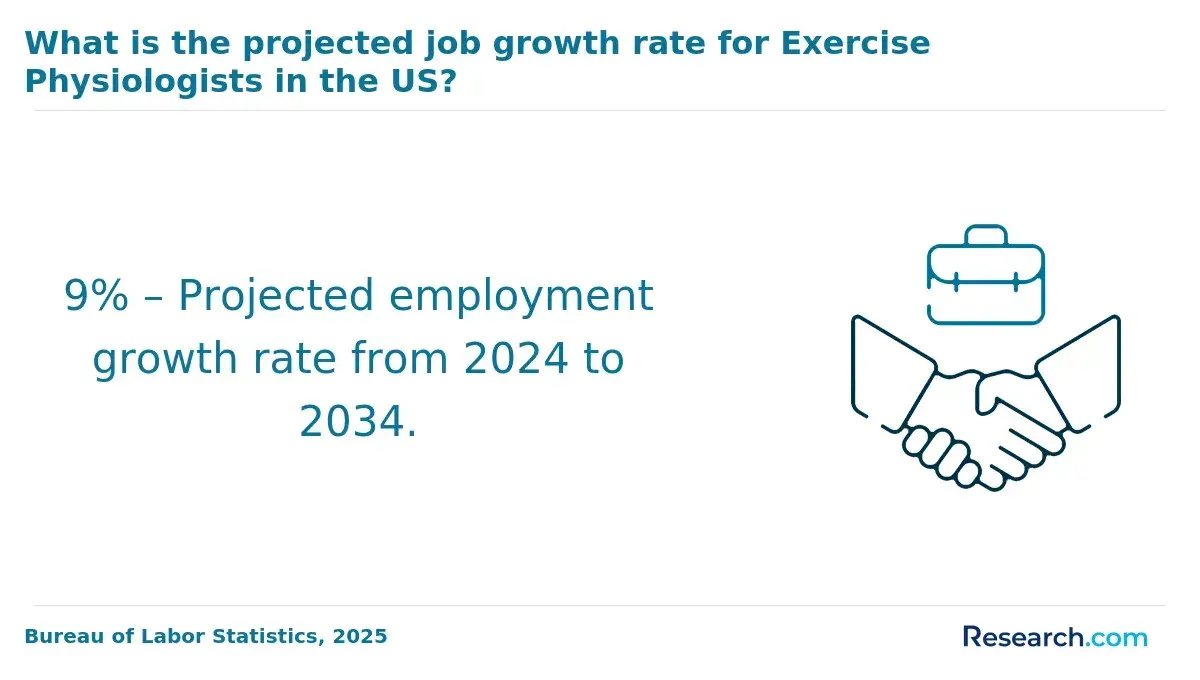
- For employment growth from 2024 to 2034, the cited outlooks show fitness instructors and athletic trainers at 11%, exercise physiologists at 9%, and health education specialists at 4%.
How long does it take to complete an exercise science degree?
Most students finish an exercise science degree in two to six years. The exact timeline depends on the degree level, enrollment pace, transfer credits, practicum requirements, and whether the program uses traditional semesters, accelerated terms, or part-time scheduling.
- Associate Degree in Exercise Science: 2 years
- Bachelor's Degree in Exercise Science: 4 years
- Master's Degree in Exercise Science: 1 to 2 years
- Doctorate in Exercise Science: 3 to 5 years
An associate degree may support entry-level work or transfer into a four-year program. A bachelor’s degree is the more common foundation for many exercise science roles. Students who want senior positions, clinical specialization, research roles, or competitive athletic training opportunities may need graduate education. Some jobs, such as athletic trainers for reputable sports teams, may also require graduate-level preparation in exercise science or a closely related field.
How does an online exercise science degree compare to an on-campus program?
The best format depends on how much flexibility you need and how important in-person labs, facilities, networking, and campus-based field experiences are to your goals. Online programs can be more convenient, while campus programs may offer easier access to training spaces, laboratories, athletic facilities, and face-to-face faculty support.
| Factor | Online exercise science degree | On-campus exercise science degree |
| Schedule | Often includes asynchronous coursework and more control over when students study | Usually follows fixed class times and in-person attendance expectations |
| Hands-on learning | May use simulations, local placements, remote assessments, or scheduled in-person requirements | Usually offers direct access to campus labs, gyms, fields, and equipment |
| Cost considerations | Can reduce commuting, relocation, and meal expenses | May involve higher personal costs for housing, transportation, and campus fees |
| Networking | Depends on virtual forums, online advising, social platforms, and limited events | Often provides easier access to faculty, peers, athletic departments, and local employers |
| Best for | Working students, parents, competitive athletes, and learners who cannot relocate | Students who want regular face-to-face labs, campus life, and nearby internship connections |
On-campus programs
Campus-based exercise science programs give students regular access to school facilities such as classrooms, laboratories, gyms, athletic fields, and performance spaces. They typically use a set schedule and require students to attend classes in person. The total cost can be higher once housing, transportation, campus meals, and facility-related fees are included. The trade-off is stronger in-person networking and easier access to campus-based practical learning.
Online programs
Online exercise science programs, much like online nursing programs, allow students to complete coursework from any location with reliable internet access. Many include partially asynchronous formats, which can help students manage work, family, training schedules, or other responsibilities. Students should still confirm whether the program requires in-person labs, local internships, practicums, or proctored assessments.
What is the average cost of an exercise science degree?
Exercise science degree costs vary widely by institution type, residency status, delivery format, required credits, fees, and whether students need to relocate. Based on the Research.com team’s observations, in-state tuition for an exercise science degree at a public university can range from $5,000 to $15,000 per year, while out-of-state tuition can range from $15,000 to $25,000 per year.
Private universities generally charge higher tuition regardless of residency. The average annual tuition for an exercise science major at a private university can range from $20,000 to $40,000 or more.
| Cost item | Why it matters | Question to ask |
| Tuition | This is usually the largest listed cost, but it does not show the full price of attendance. | Is tuition charged per credit, per semester, or per year? |
| Fees | Online, lab, technology, student service, and graduation fees can raise the total cost. | What mandatory fees are not included in advertised tuition? |
| Books and materials | Science courses may require textbooks, software, equipment, or lab materials. | What should students budget for course materials each term? |
| Clinical, lab, or practicum expenses | Some programs require background checks, uniforms, travel, site fees, or equipment. | Are there additional costs for internships, practicums, or fieldwork? |
| Living and transportation costs | Campus programs may require commuting or relocation, while online programs may reduce these costs. | What is the total cost of attendance, not just tuition? |
What are the financial aid options for students enrolling in an exercise science degree?
Exercise science students may use several forms of financial aid, including grants, loans, scholarships, work-study, employer assistance, and payment plans. These options are similar to aid routes available to students in a nurse practitioner program online. The National Center for Education Statistics (NCES) figure cited in this guide states that around 85% of first-time and full-time undergraduate students are granted financial aid.
- Federal Aid: Students should begin by completing the Free Application for Federal Student Aid (FAFSA) to determine eligibility for federal grants, loans, and work-study programs.
- State and Local Aid: Some state and local agencies provide need-based or merit-based grants and scholarships for residents.
- School Aid: Colleges may offer scholarships, grants, tuition discounts, and institutional awards. This can also apply to students comparing related healthcare routes, such as an online second degree BSN.
- Employer Assistance: Working students should ask their HR department whether tuition reimbursement or professional development funding is available.
- Work-Study Programs: Some eligible students can work part time through school or federal work-study programs and use earnings to help cover education costs.
- Tuition Payment Plans: Some institutions allow students to divide tuition into installments instead of paying the full term balance upfront.
What are the prerequisites for enrolling in an exercise science degree?
Admissions requirements vary by school and degree level, but most programs want evidence that applicants can handle college-level science, writing, and quantitative coursework. Similar document requirements may apply in other allied health programs, such as a pharmacy technician associate degree.
- High School Diploma or Equivalent: Undergraduate applicants usually need a high school diploma or GED certificate.
- Transcripts: Schools generally require official transcripts from high school and any previous college coursework. Students transferring from programs such as the best diagnostic medical sonography schools should request official records from each institution attended.
- Grade Point Average (GPA): Many institutions review GPA to evaluate academic readiness and may set minimum GPA requirements.
- Standardized Tests: Some schools may request SAT or ACT scores, although policies vary by institution.
- Letters of Recommendation: Applicants may need recommendations from teachers, counselors, supervisors, coaches, or others who can speak to academic ability, character, and work ethic.
- Personal Statement or Essay: Some programs ask students to explain their motivation for studying exercise science, career goals, and relevant experiences.
- Extracurricular Activities and Volunteer Work: Sports participation, coaching, community service, healthcare volunteering, and wellness-related activities can strengthen an application.
What courses are typically included in an exercise science degree?
Exercise science courses examine physical activity, movement mechanics, fitness programming, and how the body responds to exercise. Just as a healthcare administration course can be central in healthcare management programs, science and assessment courses form the backbone of exercise science curricula.
- Human anatomy and physiology
- Speech and language development
- Biomechanics and kinesiology
- Exercise physiology
- Nutrition and exercise metabolism
- Exercise prescription and program design
- Fitness assessment and testing
- Sports psychology and behavior change
- Injury prevention and rehabilitation
- Exercise and special populations
These courses prepare students to understand movement, measure fitness, support performance, reduce injury risk, and design exercise plans for different populations. Students interested in the mental and behavioral side of performance and recovery may also explore how a sports psychology degree can help professionals support athletes and clients coping with injury, motivation, stress, or performance pressure.
What types of specializations are available in an exercise science degree?
Exercise science is broad, so specialization matters. The right concentration can affect internship options, certifications, graduate school preparation, and the type of employer a graduate is most competitive for. The distinction between specializations is similar in importance to understanding the difference between nurse practitioner and physical assistant roles in healthcare decision-making.
| Specialization | What students study | Best career fit |
| Strength and Conditioning | Strength training, conditioning plans, injury prevention, biomechanics, and sports nutrition | Athletic performance, coaching, team settings, and sport-specific training |
| Exercise Physiology | Physiological responses to exercise, testing methods, research, and physical activity adaptation | Clinical exercise, research, wellness programs, and graduate health pathways |
| Fitness Training and Management | Exercise programming, business principles, marketing, leadership, and facility operations | Fitness center leadership, personal training management, and wellness business roles |
| Kinesiology | Human movement, biomechanics, motor control, physiology, and movement analysis | Performance, rehabilitation support, research, and broader movement science careers |
| Sports Performance | Advanced training methods, athlete monitoring, sport-specific program design, and performance testing | Athletes, sports teams, training centers, and performance facilities |
| Rehabilitation Science | Therapeutic exercise, functional movement assessment, injury recovery, and rehabilitation principles | Rehabilitation centers, clinics, hospitals, and preparation for graduate health programs |
| Corporate and Community Wellness | Health promotion, wellness program planning, behavior change, and community health strategies | Employer wellness, public health, community programs, and health education |
| Sports Nutrition | Nutrition science, performance fueling, recovery, and exercise metabolism | Athletic settings, wellness coaching, and performance support roles |
Students who want a deeper movement science curriculum may also compare an exercise science program with a kinesiology online degree.
How do I choose the best exercise science degree?
The best exercise science degree is not always the highest-ranked or most expensive option. It is the program that matches your career goal, learning format, budget, accreditation needs, and required hands-on experience.
- Check accreditation first: Look for institutional accreditation and, when relevant, programmatic accreditation from recognized organizations such as the Commission on Accreditation of Allied Health Education Programs (CAAHEP) or professional alignment with organizations such as the National Strength and Conditioning Association (NSCA).
- Match specializations to your target role: A student aiming for sports performance should not choose a program with no strength and conditioning or athlete-focused coursework unless internships fill that gap.
- Review hands-on requirements: Ask whether the program includes labs, practicum hours, internships, fieldwork, client assessments, or capstone projects.
- Compare total cost, not tuition only: Include fees, books, transportation, housing, lab expenses, and lost work time.
- Look at faculty access: Smaller class sizes and lower student-to-faculty ratios can improve mentoring, research involvement, and recommendation quality.
- Ask about certification preparation: Strong programs often align coursework with respected industry credentials.
- Evaluate career services: Prioritize schools with internship placement support, employer partnerships, alumni networks, and resume or interview coaching.
| Common mistake | Why it can hurt you | Better approach |
| Choosing only by ranking | A highly ranked program may not fit your budget, schedule, or career path. | Use rankings as a starting point, then compare accreditation, fieldwork, cost, and specialization fit. |
| Ignoring accreditation | Weak accreditation can affect transfer credits, aid eligibility, graduate school options, and employer confidence. | Confirm accreditation through official school and accreditor sources before applying. |
| Assuming online means fully remote | Some online programs still require in-person labs, internships, or field placements. | Ask about every in-person requirement before enrolling. |
| Focusing only on tuition | Fees, travel, equipment, and practicum costs can change the real price. | Compare full cost of attendance and available aid. |
| Delaying certifications | Some employers prefer or require credentials beyond the degree. | Identify target certifications early and choose courses or internships that help prepare for them. |
What certifications can boost my career prospects in exercise science?
Certifications can help exercise science graduates demonstrate job-ready skills in a specific area, especially fitness training, strength and conditioning, exercise testing, wellness coaching, or clinical exercise support. Credentials from organizations such as the American College of Sports Medicine (ACSM) or the National Strength and Conditioning Association (NSCA) can signal that a graduate understands evidence-based practice and professional standards.
Students should choose certifications based on their target role, not simply collect credentials. A future strength and conditioning coach needs a different credential strategy than someone aiming for corporate wellness, cardiac rehabilitation, or personal training. Working adults who need flexible continuing education may also want to compare programs through resources such as the best online colleges for working adults.
How can I finance my exercise science degree?
Financing an exercise science degree starts with comparing the full cost of each program and then reducing out-of-pocket expense through aid. Submit the FAFSA, ask schools about institutional scholarships, search for state grants, check employer tuition assistance, and compare online or transfer-friendly programs when flexibility matters.
Students trying to control costs should also compare broader affordable degree options, including the cheapest online bachelor's degree routes, while confirming that any lower-cost program still has the coursework, accreditation, and hands-on experience needed for exercise science careers.
What is the return on investment of an exercise science degree?
The return on investment of an exercise science degree depends on tuition, debt, time to completion, certification costs, salary potential, and whether the degree supports the student’s intended career. A lower-cost program with strong internship placement and certification preparation may produce better practical value than a more expensive program with limited applied experience.
To evaluate ROI, compare program price against realistic salaries for your target roles, not the highest salary you see online. Include costs for certifications, graduate school prerequisites, commuting, and unpaid fieldwork if applicable. Some students may also broaden employability through related healthcare training; for example, comparing options such as medical billing school near me may help identify lower-cost ways to add healthcare administrative skills.
What career paths are available for graduates with an exercise science degree?
Exercise science graduates can enter careers in fitness, athletics, health education, rehabilitation support, wellness, research, and performance training. Career outcomes depend heavily on degree level, certifications, practical experience, and state or employer requirements.
| Career path | What the role does | Good fit for students who like |
| Exercise Physiologist | Creates exercise plans for individuals with specific health, fitness, or rehabilitation needs, often focusing on cardiovascular fitness, strength, endurance, flexibility, and function. | Clinical exercise, assessment, physiology, and health improvement |
| Personal Trainer | Coaches clients through individualized workouts, teaches proper form, tracks progress, and adjusts plans to support fitness goals. | Client coaching, motivation, fitness programming, and entrepreneurship |
| Strength and Conditioning Coach | Develops performance programs for athletes and teams with attention to strength, conditioning, injury reduction, and sport-specific demands. | Sports performance, training design, and athlete development |
| Corporate Wellness Specialist | Plans employee wellness initiatives, health assessments, activity programs, nutrition education, and workplace health events. | Program planning, prevention, health promotion, and communication |
| Cardiac Rehabilitation Specialist | Supports individuals recovering from cardiac events or procedures through monitored exercise and progress tracking. | Clinical settings, patient support, and cardiovascular health |
| Exercise Scientist/Researcher | Studies the effects of exercise on physical and psychological outcomes and contributes to evidence-based practice. | Research, data, physiology, and graduate study |
| Health and Fitness Consultant | Advises individuals or organizations on wellness, fitness planning, assessment, and health improvement strategies. | Consulting, communication, program design, and problem solving |
Can integrating healthcare administration enhance my exercise science career?
Healthcare administration skills can help exercise science graduates move beyond direct service roles into program coordination, operations, wellness management, rehabilitation administration, or corporate health leadership. This combination is useful for professionals who want to manage budgets, staff, compliance, scheduling, quality improvement, or multi-site wellness initiatives.
Students who want administrative training without slowing their path may compare options such as a fast healthcare administration degree online.
Can online healthcare education boost my exercise science career?
Online healthcare coursework can add useful context for exercise science graduates who want to work in clinical, wellness, patient engagement, or healthcare operations settings. It may help students understand terminology, patient systems, administrative workflows, and interdisciplinary care.
Before adding another credential, compare the time, cost, and career value. A student can start by reviewing What kind of healthcare degrees can you get online? to understand which healthcare programs are commonly available in distance formats.
How can career support and industry partnerships accelerate my exercise science career?
Career support can make a major difference in exercise science because employers often value applied experience. Programs with strong partnerships may help students access internships, practicums, mentorship, employer events, alumni networks, and job leads in fitness centers, clinics, rehabilitation facilities, athletic departments, community organizations, and wellness companies.
Students who want to diversify into adjacent patient-facing skills may also research targeted credentials such as medical assistant certification online 6 weeks, but only if that training supports a clear career goal.
What challenges do exercise science professionals face in transitioning to leadership roles?
Exercise science professionals often begin in technical, coaching, training, or support roles. Moving into leadership can be difficult when a professional has strong movement science knowledge but limited experience with budgeting, staffing, operations, compliance, marketing, or strategic planning.
Professionals aiming for management should build skills in communication, supervision, program evaluation, data reporting, and financial decision-making. Those considering healthcare leadership may explore how administrative education connects to outcomes discussed in masters in healthcare administration jobs salary.
What is the job market for graduates with an exercise science degree?
The cited BLS outlooks show positive employment growth for several exercise science-related careers from 2024 to 2034. Fitness instructors and athletic trainers are projected at 11%, exercise physiologists at 9%, and health education specialists at 4%. These figures are above the cited collective growth rate for all US professions, listed as 3%.
The annual openings cited in this guide also suggest steady hiring activity: fitness trainers and instructors show a projected 69,000 annual openings, followed by health education specialists at 6,600, athletic trainers at 2,700, and exercise physiologists at 1,200. Still, job availability varies by region, credential requirements, employer type, and experience. Students should use labor market data as one input, not a promise of employment.
Projected Annual Job Openings for Key Sports Occupations

What are the emerging trends in exercise science careers?
Exercise science is changing as technology, preventive health, online coaching, and interdisciplinary care reshape how professionals deliver services. Students who understand these trends can choose electives, internships, and certifications more strategically.
- Technology-driven training and health monitoring: Wearable devices, fitness apps, motion sensors, and AI-powered health tools are changing how professionals assess performance, track activity, monitor recovery, and adjust training plans.
- Online coaching and virtual wellness: Remote work and digital education have made virtual coaching and app-supported wellness programs more common. Graduates who can communicate effectively online and use digital tools may reach wider client populations.
- Preventive health and wellness: Community programs, workplace wellness, and public health initiatives increasingly emphasize physical activity as part of chronic disease prevention and overall well-being.
- Sports and rehabilitation specialization: Rehabilitation science and sports performance remain important areas, especially for professionals who can collaborate with physical therapists, athletic staff, and healthcare teams. Students comparing flexible study options may also review an online exercise science degree.
How can I balance a busy schedule while pursuing an exercise science degree?
Students with jobs, families, athletic commitments, or irregular schedules should look for programs built around flexibility. Asynchronous courses, part-time plans, online advising, evening options, and local field placements can make degree completion more realistic.
Online study can be especially useful for learners who cannot commute or relocate. Related flexible programs, such as an online physical education degree, can help students compare how different movement-focused fields structure distance learning.
- Build a weekly study block: Treat coursework like a job shift and reserve consistent time for readings, assignments, and exam preparation.
- Plan around labs and practicums early: Ask when hands-on requirements occur so you can coordinate work schedules and transportation.
- Use advisor support: Confirm course sequencing so you do not delay graduation by missing prerequisites.
- Stay connected: Participate in virtual discussions, instructor office hours, and peer groups so online learning does not become isolating.
Can further education in complementary health fields enhance my career prospects?
Further education can help exercise science graduates move into specialized clinical, research, administrative, or interdisciplinary roles. The key is to choose a complementary path that adds a capability employers value rather than repeating skills already covered in the exercise science degree.
For some professionals, advanced healthcare or pharmaceutical education may support broader collaboration in clinical or academic environments. Students considering that direction can compare options such as an online PharmD, while carefully weighing time, cost, prerequisites, and career fit.
How to choose the right exercise science degree program?
Choosing the right program requires more than reading a ranking list. Use a decision process that starts with your career target, then checks whether each program can realistically get you there.
- Define your target role. Decide whether you are aiming for fitness training, sports performance, rehabilitation support, clinical exercise physiology, wellness programming, graduate school, or research.
- Verify accreditation. Confirm institutional accreditation and any relevant programmatic accreditation or professional alignment.
- Compare specializations. Make sure the curriculum includes the courses and applied experiences required for your intended path.
- Review online, campus, and hybrid formats. If flexibility matters, consider an online exercise science degree, but verify any in-person lab or practicum requirements.
- Calculate total cost. Include tuition, fees, books, equipment, housing, transportation, and certification expenses.
- Ask about hands-on learning. Prioritize programs with internships, labs, fieldwork, practicums, or capstone projects that create real portfolio value.
- Evaluate career outcomes. Look for internship placement support, employer relationships, alumni outcomes, and certification pass preparation when available.
- Confirm transfer and graduate school policies. If you plan to transfer or continue into physical therapy, occupational therapy, physician assistant studies, or another graduate pathway, make sure prerequisites align.
| Question to ask before enrolling | Why it matters |
| Is the program accredited by a recognized accreditor? | Accreditation can affect financial aid, transfer credits, graduate admissions, and employer trust. |
| What certifications does the curriculum prepare students for? | Certifications may improve competitiveness for specific roles. |
| Are internships or practicums required? | Applied experience is often critical in fitness, sports, wellness, and rehabilitation settings. |
| Can online students complete fieldwork near home? | This affects feasibility for students who cannot relocate or commute. |
| What is the full cost of attendance? | Tuition alone does not show the true financial commitment. |
| Will this degree meet graduate school prerequisites? | Students planning physical therapy, occupational therapy, or physician assistant routes need specific prerequisite courses. |
Key Insights
- An exercise science degree is strongest when it combines science coursework with applied experience in labs, internships, practicums, or capstone projects.
- Career fit matters more than program popularity. Choose a specialization that matches your goal, whether that is sports performance, rehabilitation, wellness, fitness management, exercise physiology, or graduate study.
- Costs vary widely. Public in-state tuition can range from $5,000 to $15,000 per year, out-of-state public tuition from $15,000 to $25,000, and private university tuition from $20,000 to $40,000 or more per year.
- Financial aid can reduce the net cost. The cited data reports around 86.7% of first-time and full-time undergraduate students receiving financial aid, with NCES-related wording also noting around 85%.
- Do not assume every online program is fully remote. Exercise science often requires hands-on practice, so ask about labs, practicums, local placements, and travel requirements.
- Employment outlooks cited for 2024 to 2034 are positive for several related roles, including 11% for fitness instructors and athletic trainers, 9% for exercise physiologists, and 4% for health education specialists.
- Salary outcomes are not automatic. Credentials, experience, employer type, location, and specialization strongly influence earnings and advancement.
References
- BLS (2025, December 3). Athletic Trainers. BLS
- BLS (2025, August 28). Exercise Physiologists. BLS
- BLS (2025, August 28). Fitness Trainers and Instructors. BLS
- BLS (2025, August 28). Health Education Specialists. BLS
- Coursera (2025, October 15). Exercise Science: Definition, Degrees, and Jobs. Coursera
- Hanson, M. (2025, February 3). Financial Aid Statistics. Education Data Initiative
- CDC physical activity guideline source cited in this guide. CDC
Other Things You Should Know About Exercise Science Degrees
According to the BLS, the exercise science job with the highest median annual pay is that of a physical therapist (PT), who normally earns around $97,720 each year. However, to become a PT, a student must finish a doctorate in physical therapy. The same goes for occupational therapists ($93,180), whose job often requires a master's degree. The highest paid direct entry job for those who earned an undergraduate degree in exercise science is that of a health education specialist, with a median annual salary of $59,990.
As of 2027, the skills required for an exercise science degree typically include a strong understanding of human anatomy, physiology, and biomechanics. Analytical skills, proficiency in technology used for fitness assessments, and the ability to develop effective fitness programs are also crucial. Communication and motivational skills are important for working with clients or patients.
Yes. Clinical roles such as cardiac rehabilitation, strength and conditioning, or medical exercise require employer or specialty certification, and some states require a license for exercise physiologists. Common credentials include ACSM-EP or ACSM-CEP, plus CPR/AED certification before patient contact.
US exercise science programs offer diverse lab experiences, providing hands-on training in various aspects of human performance and health. Students typically work in biomechanics labs, where they study movement patterns using advanced motion capture systems. Physiology labs allow students to analyze cardiovascular, respiratory, and metabolic responses to exercise using equipment like treadmills, ergometers, and metabolic carts. Additionally, nutrition labs focus on dietary assessments and their effects on performance and health. Many programs also include strength and conditioning labs, where students learn to design and implement training programs. These lab experiences are crucial for developing practical skills and applying theoretical knowledge.