2027 Most Affordable Online Exercise Science Degree Programs

Co-Founder and Chief Data Scientist
Online exercise science degree programs provide a versatile and accessible path for individuals passionate about fitness, health, and human performance to pursue higher education. However, with the increasing number of online exercise science degree programs available, choosing the right one can be a daunting task.
This article aims to guide readers through the critical factors to consider when selecting an online exercise science degree program. By highlighting key aspects such as accreditation, program length, requirements, and possible costs, we will provide practical insights to help students find a program that aligns with their professional aspirations.
What are the benefits of getting an online degree in exercise science?
- Online exercise science programs allow students to learn at their own pace and on their schedule, making it easier to balance studies with work, family, and other commitments.
- Students with a bachelor’s degree in exercise science can work as exercise physiologists and earn around $54,860 per year.
- Online degrees often come with lower tuition fees and eliminate the need for commuting or relocating, making higher education more affordable.
What can I expect from an online degree program in exercise science?
An online degree program in exercise science offers a comprehensive and flexible education designed to equip you with essential knowledge and skills in the field. You can expect a curriculum that covers foundational topics such as anatomy, physiology, kinesiology, and biomechanics, ensuring a deep understanding of how the human body functions and moves. Additionally, you will delve into specialized areas like exercise physiology and nutrition, learning how physical activity and dietary choices impact health and performance. The program often includes research methods and health promotion courses, preparing you to design effective exercise programs and promote healthy behaviors.
Where can I work with an online degree in exercise science?
An online degree in exercise science opens doors to various career opportunities across multiple sectors. Here are some potential workplaces:
- Fitness and wellness centers
- Rehabilitation Clinics
- Sports organizations
- Corporate wellness programs
- Educational institutions
- Public health organizations
- Private practice
- Research institutions
How much can I make with an online degree in exercise science?
According to our research, the salary you can earn with an online degree in exercise science varies based on several factors. This includes your specific job role, level of experience, geographic location, and the industry in which you work. For example, exercise physiologists earn an average of $54,860 annually, athletic trainers earn about $57,930, and chiropractors earn an average of $76,530. There are more similar occupations that you can apply to with an online degree in exercise science and there are numerous opportunities to explore. These figures reflect national averages and can vary depending on regional demand, employer type, and individual qualifications such as certifications or advanced degrees.
- 2027 List of the Most Affordable Online Exercise Science Degree Programs Best Programs
- How long does it take to complete an online exercise science program? Completion Time
- How does an online exercise science program compare to an on-campus program? How does an online exercise science program compare to an on-campus program?
- What is the average cost of an online exercise science program? Average Cost
- What are the financial aid options for students enrolling in online exercise science programs? Financial Aid
- What are the prerequisites for enrolling in an online exercise science program? Requirements
- What courses are typically in an online exercise science program? What courses are typically in an online exercise science program?
- How are technological tools used in exercise science education? How are technological tools used in exercise science education?
- What types of specializations are available in an online exercise science program? What types of specializations are available in an online exercise science program?
- Financial Planning for Online Exercise Science Degrees Financial Planning for Online Exercise Science Degrees
- Are online exercise science programs accredited by recognized bodies? Are online exercise science programs accredited by recognized bodies?
- How can online exercise science programs support students with family and career commitments? How can online exercise science programs support students with family and career commitments?
2027 Most Affordable Online Exercise Science Degree Programs
Choosing an online exercise science degree is not only a question of price. The right program should match your career goal, transfer-credit situation, need for flexibility, internship access, certification plans, and long-term return on investment. This guide is designed for students comparing affordable online bachelor’s programs in exercise science, kinesiology, sports and health sciences, and related areas.
Below, you will find a rebuilt, decision-focused look at affordable online exercise science degrees: program options, costs, timelines, accreditation, online versus campus trade-offs, common courses, financial aid, certifications, career paths, job-market expectations, and mistakes to avoid before enrolling.
Quick answer: Is an online exercise science degree worth considering?
An online exercise science degree can be a practical option if you want a flexible path into fitness, wellness, coaching, rehabilitation support, strength and conditioning, health promotion, or preparation for graduate study. It is most useful when the school is accredited, the curriculum includes science-based coursework, and the program helps you complete local internships or hands-on requirements. Students should compare total cost, transfer-credit policies, certification alignment, and whether the degree supports their intended career path.
How do we rank schools?
Research.com evaluates schools using our ranking methodology and education data sources that help readers compare programs with more confidence. Our process draws from institutional and government datasets, including:
- IPEDS database
- Peterson's database, including the Distance Learning Licensed Data Set
- College Scorecard database
- National Center for Education Statistics
Affordable online exercise science programs at a glance
| School | Online program | Cost per credit/tuition | Credits | Typical length | Accreditation listed |
| Pennsylvania Western University | Online bachelor’s and master’s degree in exercise science | $626 | 120 | Four Years | Middle States Commission on Higher Education (MSCHE) |
| University of North Dakota | Online bachelor’s degree in kinesiology | $384.88 | 120 | Four Years | HLC |
| Concordia University- Saint Paul | Online BA in exercise science | $420 | 120 | Two to four years | HLC |
| Maryville University | Online bachelor’s in exercise science | $540 | 128 | Four Years | HLC |
| Franklin University | Online BS in exercise science | $398 | 120 | Four Years | Higher Learning Commission (HLC) |
| University of Kansas | Online BAS in exercise science | $485 | 120 | Four Years | HLC |
| East Central University | Online BS in kinesiology | $321.80 | 124 | Two to four years | HLC |
| United States Sports Academy | Online bachelor’s degrees in sports leadership | $525 (online), $250 (active military rate) | 120 | Four Years | Southern Association of Colleges and Schools Commission on Colleges |
| University of Saint Mary | Online BS in exercise science | $425 | 120 | Two to four years | HLC |
| American Public University | Online BS in sports and health sciences | $350 and $250 (military rate) | 120 | Four Years | HLC |
1. Pennsylvania Western University
Pennsylvania Western University offers online exercise science options at both the bachelor’s and master’s levels. Through PennWest Global Online, students can study areas tied to youth fitness, fitness for aging individuals, and fitness for special needs populations. The program may be a strong fit for students who want multiple concentration choices and a curriculum connected to professional certification preparation in exercise science.
- Program Length: Four Years
- Tracks/concentrations: applied sports science, sports psychology, nutrition, wellness coaching, rehabilitation science, tactical strength and conditioning, and many more.
- Cost per Credit/Tuition: $626
- Required Credits to Graduate: 120
- Accreditation: Middle States Commission on Higher Education (MSCHE)
2. University of North Dakota
The University of North Dakota offers an online bachelor’s degree in kinesiology for students interested in physical education, athletic coaching, and human movement. UND’s industry and professional relationships may help students locate internship opportunities and build career connections. The kinesiology program is accredited by the Council for Accreditation of Educator Preparation (CAEP) as a teacher education program, which gives students an option to pursue teaching-related pathways.
- Program Length: Four Years
- Tracks/concentrations: N/A
- Cost per Credit/Tuition: $384.88
- Required Credits to Graduate: 120
- Accreditation: HLC
3. Concordia University- Saint Paul
Concordia University- Saint Paul provides an online BA in exercise science with coursework in kinesiology, physiology, applied exercise prescription, and the broader health and fitness industry. Students complete an internship matched to their interests, making the program useful for learners who want career-connected experience before graduating. Possible directions include coaching, fitness, personal training, and rehabilitation-related roles.
- Program Length: Two to four years
- Tracks/concentrations: N/A
- Cost per Credit/Tuition: $420
- Required Credits to Graduate: 120
- Accreditation: HLC
4. Maryville University
Maryville University offers an online bachelor’s in exercise science for students interested in helping individuals improve or maintain health. The curriculum covers exercise science foundations such as nutrition, counseling and coaching, movement, behavioral strategies, and sports management. Students also study fitness-related technologies, including streaming exercise classes and wellness apps, which can matter in a field where digital fitness tools are increasingly common.
- Program Length: Four Years
- Tracks/concentrations: N/A
- Cost per Credit/Tuition: $540
- Required Credits to Graduate: 128
- Accreditation: HLC
5. Franklin University
Franklin University offers an online BS in exercise science that may appeal to transfer students because it accepts up to 75% maximum transfer credit from accredited institutions. The program emphasizes evidence-based exercise design for specialized populations and includes topics such as strength training, conditioning, resistance training, plyometrics, and safe exercise techniques. Franklin states that its curriculum is aligned with the American College of Sports Medicine (ACSM), which may help students who are thinking about ACSM-related credentials.
- Program Length: Four Years
- Tracks/concentrations: athletic administration, athletic coaching leadership, health promotion, public health, and sports performance and fitness business ownership.
- Cost per Credit/Tuition: $398
- Required Credits to Graduate: 120
- Accreditation: Higher Learning Commission (HLC)
6. University of Kansas
The University of Kansas offers an online BAS in exercise science and an on-campus BS in exercise science. Online coursework can include topics connected to coaching, corporate wellness, personal training, and law enforcement force readiness. KU also offers a strength and conditioning undergraduate certificate for students who want focused preparation in areas such as personal training and tactical strength and conditioning.
- Program Length: Four Years
- Tracks/concentrations: N/A
- Cost per Credit/Tuition: $485
- Required Credits to Graduate: 120
- Accreditation: HLC
7. East Central University
East Central University offers an online BS in kinesiology for students who want to study human movement and the effects of physical activity on the body. The program includes 80 hours of hands-on training and covers subjects such as sports nutrition, first aid, anatomy, coaching theory, and psychology of sports. Courses are delivered in 8-week online sessions, which may help students who prefer shorter academic terms.
- Program Length: Two to four years
- Tracks/concentrations: N/A
- Cost per Credit/Tuition: $321.80
- Required Credits to Graduate: 124
- Accreditation: HLC
8. United States Sports Academy
The United States Sports Academy offers online bachelor’s degrees in sports leadership for students seeking roles in the sports sector. Students work with advisors to build academic plans, and the curriculum includes an internship requirement for applied experience. The program has no mandatory on-campus residency and includes four core courses, two required courses, 14 optional courses, and a final internship.
- Program Length: Four Years
- Tracks/concentrations: sports management, sports coaching, exercise science, and sports studies.
- Cost per Credit/Tuition: $525 (online), $250 (active military rate).
- Required Credits to Graduate: 120
- Accreditation: Southern Association of Colleges and Schools Commission on Colleges
9. University of Saint Mary
The University of Saint Mary offers an online BS in exercise science with coursework and internships intended to support several career directions. Students study topics such as nutrition strategies, life-saving emergency care, biomechanics, anatomy and physiology, motor development, human kinetics, psychology, and nutrition and wellness. Students who have already completed general education coursework may finish in just two years, and the program allows up to 90 transfer credits.
- Program Length: Two to four years
- Tracks/concentrations: N/A
- Cost per Credit/Tuition: $425
- Required Credits to Graduate: 120
- Accreditation: HLC
10. American Public University
American Public University offers an online BS in sports and health sciences. The curriculum introduces students to exercise science, exercise testing and programming, fitness, nutrition, human movement, and human behavior. Coursework also includes anatomy and physiology, sports psychology, kinesiology, and other allied-health foundations. APU states that the bachelor’s degree is affiliated with the guidelines of the American Sports Education Program (ASEP).
- Program Length: Four Years
- Tracks/concentrations: N/A
- Cost per Credit/Tuition: $350 and $250 (military rate).
- Required Credits to Graduate: 120
- Accreditation: HLC
Graduate perspectives on online exercise science degrees
-
: "
"Online study made it possible for me to keep working full time and care for my family while finishing my exercise science degree. I could use new concepts right away with personal training clients, which made the coursework feel directly connected to my business." - Sarah
"
-
: "
"An online program gave me access to instructors outside my local area. The discussion tools and virtual collaboration helped me learn sports nutrition and physiology with classmates who had different backgrounds." - Jason
"
-
: "
"The virtual labs, simulations, and advising support helped me understand difficult topics without needing to be on campus every week. I finished the program feeling prepared to pursue work related to cardiac rehabilitation." - Emily
"
Key findings
- Most online undergraduate exercise science programs require about 120 credit hours and can take two to four years to complete.
- Exercise physiologists can earn around $54,860, and the role typically requires a bachelor’s level degree.
- Online programs can reduce costs tied to commuting and housing, but students should still review tuition, fees, books, software, and internship expenses.
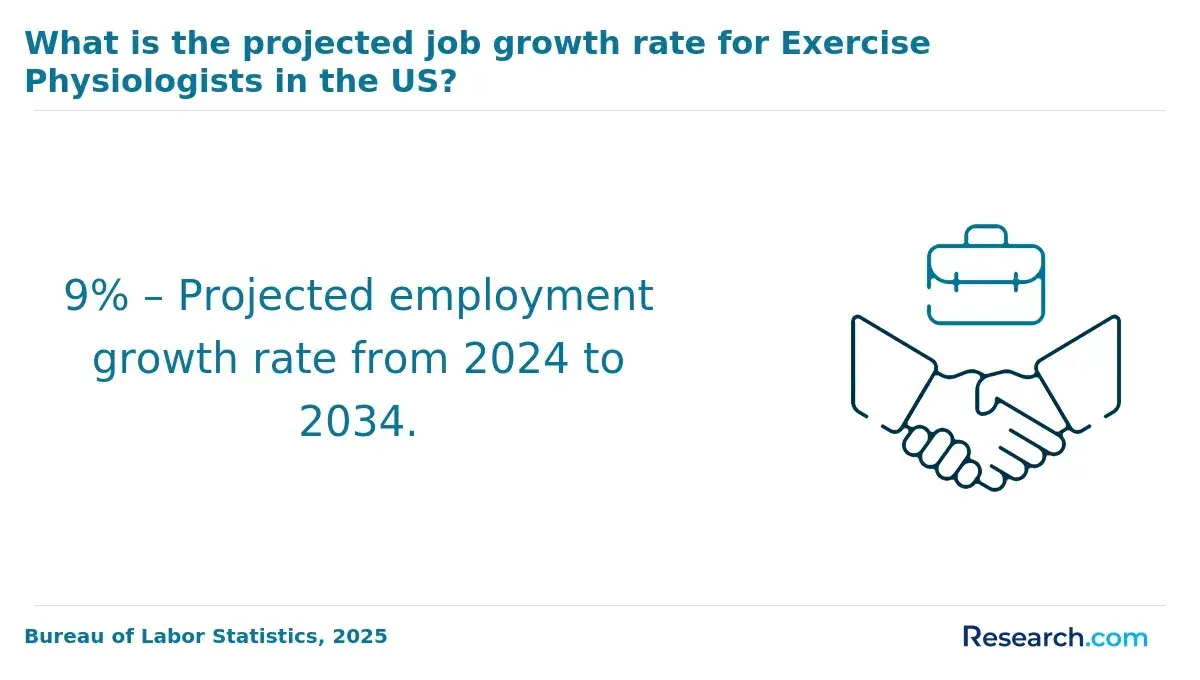
- The demand for exercise physiologists is expected to increase by 9% from 2024 to 2034, which is much faster than average.
- Employers generally focus on whether the institution is accredited, whether the graduate has relevant skills, and whether the applicant has practical experience or certifications.
How long does it take to complete an online exercise science program?
An online undergraduate exercise science degree commonly requires 120 credit hours and takes about two to four years, depending on transfer credits, full-time or part-time enrollment, and the school’s course schedule. Students entering with an associate degree or substantial general education credits may finish faster, while working adults who take fewer courses each term may need more time.
| Student situation | Typical timeline | What to check before enrolling |
| First-time full-time student | Four Years | Course sequencing, lab requirements, internship timing, and summer course availability |
| Transfer student | Two to four years | Maximum transfer credits, accepted course equivalents, and residency-credit rules |
| Part-time working student | Often longer than full-time study | Whether required courses are offered every term and whether internships can be completed locally |
| Military or adult learner | Varies by transfer and credit policies | Military rate, prior learning credit, employer tuition reimbursement, and academic advising access |
How does an online exercise science program compare to an on-campus program?
Online and campus exercise science programs can lead to similar academic outcomes when they are properly accredited and include comparable coursework. The better choice depends on how you learn, where you live, and how much hands-on access you need to facilities, labs, equipment, and faculty.
| Comparison point | Online exercise science program | On-campus exercise science program | Best fit |
| Schedule | More flexible, especially when courses are asynchronous | More structured with set class and lab times | Online for working adults; campus for students who want daily structure |
| Hands-on learning | May use virtual labs, local internships, simulations, and arranged fieldwork | Often provides direct access to labs, fitness centers, and equipment | Campus for students who need frequent in-person practice |
| Networking | Relies on video meetings, discussion boards, virtual groups, and local placements | Offers more face-to-face interaction with classmates, faculty, and campus partners | Campus for traditional networking; online for geographically flexible learners |
| Cost | Can reduce commuting, relocation, and housing costs | May involve transportation, housing, and campus-related expenses | Online for students trying to limit non-tuition expenses |
| Access | Available to students who cannot relocate or commute | Best for students near campus or willing to move | Online for remote learners; campus for those seeking a residential experience |
Flexibility and convenience
- Online program: Usually offers more control over when and where students complete lectures, assignments, and discussions.
- On-campus program: Provides a set schedule that may help students who prefer in-person accountability and routine.
Interaction and networking
- Online program: Uses virtual communication, which can be effective but may require more initiative from the student.
- On-campus program: Makes it easier to build relationships through labs, clubs, athletic departments, and faculty office hours.
Learning resources and facilities
- Online program: Often relies on digital materials, virtual labs, multimedia lessons, and locally arranged practical experiences.
- On-campus program: Gives students regular access to physical labs, exercise equipment, campus fitness facilities, and in-person demonstrations.
Cost and accessibility
- Online program: May lower expenses by removing relocation, housing, and commuting costs, but students should still budget for fees and materials.
- On-campus program: Can provide a more traditional college experience but may carry additional living and transportation costs.
What is the average cost of an online exercise science program?
Online exercise science program costs vary by school, credit requirement, tuition rate, residency policy, fees, transfer credits, and military or employer benefits. Based on the programs reviewed here, tuition examples include $321.80 per credit at East Central University, $350 at American Public University, $398 at Franklin University, $420 at Concordia University- Saint Paul, $425 at University of Saint Mary, $485 at University of Kansas, $525 at United States Sports Academy, $540 at Maryville University, and $626 at Pennsylvania Western University.
For total program examples, an online bachelor's degree in sports leadership at USSA costs about $63,000, while active military benefits can reduce the cost to $30,000. At USM, an online BS in exercise science program can cost around $51,000. An online BAS in exercise science at KU can cost around $58,200, and a BA in exercise science at CSP can cost around $50,400. These figures may not include every expense, so students should request a full cost sheet from each school.
| Cost item | Why it matters | Question to ask the school |
| Tuition per credit | This is the largest advertised cost, but it does not always show the full bill. | Is the online tuition rate the same for in-state and out-of-state students? |
| Required credits | A lower per-credit price can still lead to a higher total if the program requires more credits. | How many credits will I personally need after transfer evaluation? |
| Technology and online fees | These can add recurring costs each term. | Are online course fees included in the listed tuition? |
| Books, software, and equipment | Exercise science courses may require textbooks, apps, or measurement tools. | Can you provide an estimated materials cost by term? |
| Internship or fieldwork expenses | Students may need background checks, travel, uniforms, or site-specific materials. | Can I complete my internship near where I live? |
What financial aid options are available for online exercise science students?
Students in accredited online exercise science programs may qualify for several forms of financial aid. The right mix depends on enrollment status, school participation, income, military status, employer support, and scholarship eligibility.
- Federal financial aid: Pell Grants, Federal Student Loans, and Federal Work-Study may be available after completing the Free Application for Federal Student Aid (FAFSA).
- State financial aid: Some states offer grants, scholarships, or tuition assistance, often with residency requirements.
- Private scholarships: Professional associations, nonprofit organizations, community groups, and employers may fund students pursuing health, wellness, sports, or allied-health fields.
- Institutional aid: Colleges may offer merit scholarships, need-based grants, tuition discounts, or transfer-student awards.
- Military benefits: Veterans and active-duty service members may be able to use GI Bill benefits or tuition assistance programs.
- Work-study and assistantships: Some opportunities may provide wages, stipends, or tuition support, although availability varies by degree level and institution.
Financial planning for online exercise science degrees
A realistic budget should include more than tuition. Plan for technology fees, books, software, certification exam preparation, internship expenses, and possible travel. If you need federal aid, start by confirming that the school participates in federal student aid programs. You can also compare online accredited colleges that accept financial aid if FAFSA eligibility is central to your decision.
Students who are employed in fitness, healthcare, education, coaching, or recreation should also ask about tuition reimbursement. Some employers help pay for coursework when the degree supports job performance or advancement. Payment plans may also help spread costs across a term instead of requiring a larger upfront payment.
What are the prerequisites for enrolling in an online exercise science program?
Most online bachelor’s programs in exercise science, kinesiology, or sports and health sciences use standard undergraduate admissions requirements. Some programs may also ask for science readiness, placement testing, or transfer transcripts.
- High School Diploma or GED: Applicants generally need to have completed high school or earned a GED. Similar baseline requirements apply to many undergraduate healthcare pathways, including online accelerated BSN programs.
- College preparatory courses: Coursework in biology, chemistry, mathematics, and sometimes physics can help students prepare for exercise science classes.
- Minimum GPA: Many programs expect a competitive high school GPA, typically around 2.5 or higher on a 4.0 scale.
- Standardized test scores: Some colleges may request SAT or ACT scores, although policies vary by institution.
- Technical requirements: Online students need a reliable computer, stable internet access, and comfort using learning platforms and digital communication tools. This is also important in other online health programs, such as online FNP schools.
What courses are typically included in an online exercise science program?
Online exercise science programs usually combine foundational science, human movement, health behavior, and applied fitness coursework. Many programs also include an internship, practicum, capstone, or hands-on experience requirement.
| Course area | What students learn | Why it matters professionally |
| Kinesiology | Human movement, biomechanics, and principles of motion | Supports coaching, training, rehabilitation support, and movement analysis |
| Exercise physiology | How the cardiovascular, respiratory, muscular, and metabolic systems respond to physical activity | Helps graduates design safer and more effective exercise plans |
| Biomechanics | Mechanical principles behind movement, performance, and injury risk | Useful for performance coaching, injury prevention, and rehabilitation settings |
| Nutrition | Nutrients, health, performance, recovery, and diet planning for different populations | Important for wellness, fitness coaching, and sports performance roles |
| Anatomy and physiology | Structure and function of muscles, bones, organs, and body systems | Forms the science base for allied-health and exercise careers; it is also common in an online nursing degree for non-nurses |
| Sports psychology | Mental and behavioral factors that affect performance and well-being | Helps trainers and coaches support motivation, confidence, and adherence |
| Strength and conditioning | Resistance training, endurance, power, and conditioning methods | Prepares students for athletic training environments and performance roles |
| Health promotion and wellness | Behavior change, disease prevention, and physical-activity promotion | Supports corporate wellness, community health, and lifestyle coaching |
| Injury prevention and rehabilitation | Risk reduction, return-to-activity concepts, and recovery support | Useful for sports medicine, fitness, and rehabilitation-related workplaces |
How are technological tools used in exercise science education?
Technology is now a major part of exercise science education and professional practice. Online programs may use wearable fitness trackers, motion-analysis tools, virtual labs, video-based movement assessments, wellness apps, and simulated case studies to help students connect theory with applied decision-making. Students comparing undergraduate and graduate options may also explore a cheap online master’s degree in USA if they plan to deepen their technical or clinical knowledge later.
Wearables can help students analyze heart rate, steps, activity patterns, and calorie expenditure. Motion-analysis tools can support biomechanics instruction by helping students evaluate movement quality and performance. Virtual reality and simulation platforms may be used to show exercise environments or clinical scenarios that are difficult to reproduce in a fully online classroom.
Technology skills are especially useful for students who want to work in personal training, corporate wellness, sports performance, rehabilitation support, or health coaching. When comparing programs, ask whether technology is included only as a lecture topic or whether students actually practice using tools, data, and assessments.
What types of specializations are available in an online exercise science program?
Specializations help students shape an exercise science degree around a career direction. Not every school offers formal concentrations, but many allow students to choose electives, certificates, or internship placements that build focused expertise.
- Sports performance: Focuses on athletic training methods, performance analysis, and sports nutrition. This path can support work in strength and conditioning, coaching, and athletic performance settings.
- Clinical exercise physiology: Emphasizes exercise programming for people with chronic diseases, rehabilitation needs, or health limitations. Students interested in behavioral health connections may also compare related pathways such as online graduate programs in counseling.
- Kinesiology: Centers on body mechanics, movement, performance, and health. It can support careers tied to biomechanics, ergonomics, research support, and human movement analysis.
- Rehabilitation science: Covers exercise and movement strategies used in injury recovery and prevention. It is commonly chosen by students considering physical therapy, occupational therapy, sports medicine, or clinical support roles.
- Nutrition: Examines how food, nutrients, and dietary patterns affect health, fitness, recovery, and performance. Students should verify whether additional licensure or credentialing is required for nutrition practice in their state.
How should students plan financially for an online exercise science degree?
Financial planning should start before the application, not after admission. Compare the full cost of attendance, not just the tuition rate. A program with a lower per-credit price may become more expensive if it accepts fewer transfer credits or adds significant fees.
- Complete the FAFSA early. This determines eligibility for federal grants, loans, and work-study.
- Ask for a transfer-credit evaluation. Transfer credit can reduce time and cost, especially for students with general education credits.
- Request a program fee list. Ask about online fees, technology charges, graduation fees, books, software, and internship-related costs.
- Compare military, employer, and institutional discounts. Some schools publish reduced rates for active military students.
- Build a certification budget. If you plan to pursue personal training, strength and conditioning, or exercise physiology credentials, factor in exam and preparation costs.
Students focused on overall affordability may also compare broader cheapest online college bachelor degree options, but they should not choose a cheaper program if it does not support their career goal or accreditation needs.
Are online exercise science programs accredited by recognized bodies?
Accreditation is one of the most important checks before enrolling. Institutional accreditation affects financial aid eligibility, credit transfer, graduate-school recognition, and employer confidence. Students should verify that the college or university is accredited by an agency recognized by the U.S. Department of Education or the Council for Higher Education Accreditation.
Program-level accreditation may also matter depending on the student’s intended path. For example, students interested in clinical exercise physiology, allied health, or education-related roles should ask whether the program meets any certification, licensure, or graduate-school prerequisites they may need later. Do not assume that every online exercise science degree meets requirements for teaching, physical therapy graduate admission, or clinical credentialing.
How can online exercise science programs support students with family and career commitments?
Online exercise science programs can be a strong match for working adults, parents, military students, and career changers because they often offer asynchronous coursework, remote advising, online tutoring, and locally arranged field experiences. Students with caregiving responsibilities should look for predictable course calendars, part-time options, and responsive faculty support.
Nontraditional students may also want to compare programs built for flexible scheduling, including online courses for stay at home moms. The key is to confirm how much of the program is truly asynchronous and whether labs, exams, or internships require specific times or locations.
How can an exercise science degree complement healthcare administration careers?
An exercise science background can be useful in healthcare administration when the role involves wellness programming, rehabilitation services, patient engagement, population health, or fitness-related operations. Graduates who understand both human performance and healthcare systems may be better prepared to coordinate programs that support prevention, chronic-disease management, or patient wellness.
Students who want to move toward administrative work can strengthen their profile with additional knowledge in health records, billing, coding, compliance, and operations. For example, coursework through a medical billing and coding school may help students understand the administrative side of healthcare delivery.
What is the return on investment for an online exercise science degree?
ROI depends on total cost, time to completion, transfer credits, financial aid, career target, certification plans, and whether the degree is a stepping stone to graduate study. Students should not evaluate ROI using salary alone. A lower-cost program that accepts more transfer credits and supports local internships may produce better value than a higher-priced program with limited flexibility.
Ask whether the degree is meant to lead directly to employment, support advancement in an existing fitness or wellness job, or prepare for graduate study. Some students may compare related healthcare pathways, including the cheapest PharmD programs, to understand how education costs and career outcomes differ across health fields.
| ROI factor | Why it matters | Better decision strategy |
| Transfer credits | Accepted credits can reduce both tuition and time. | Get a written transfer evaluation before committing. |
| Career goal | Some roles require certification, licensure, or graduate school. | Match the curriculum to the exact role you want. |
| Accreditation | Accreditation affects aid, transfer, and recognition. | Verify institutional and program-specific accreditation needs. |
| Internship access | Experience can improve employability. | Ask how online students secure local placements. |
| Total cost | Fees, materials, and lost work time affect affordability. | Compare full cost of attendance, not only tuition. |
How do I choose the best online exercise science program?
The best online exercise science program is the one that fits your career goal, budget, schedule, and required credentials. A ranking can narrow your list, but it should not replace your own due diligence.
- Verify accreditation. Confirm institutional accreditation and ask whether program-level accreditation, such as Commission on Accreditation of Allied Health Education Programs (CAAHEP), matters for your goal.
- Compare curriculum depth. Look for anatomy, physiology, kinesiology, biomechanics, nutrition, exercise prescription, health promotion, and practical experience.
- Review faculty qualifications. Check whether instructors have advanced degrees, certifications, clinical experience, coaching experience, or research backgrounds.
- Ask about practical experience. Find out whether internships, practicums, labs, or capstones are required and how online students complete them.
- Calculate the real cost. Include tuition, required credits, fees, books, software, technology, travel, and certification expenses.
- Check career services. Ask whether the school supports resume building, internship placement, certification planning, and employer connections.
- Confirm transfer policies. Transfer rules can dramatically affect cost and timeline.
| Common mistake | Why it can hurt you | Better approach |
| Choosing based only on tuition | Fees, transfer limits, and extra credits can raise the final cost. | Compare total cost after transfer evaluation. |
| Ignoring accreditation | It can affect financial aid, credit transfer, graduate admissions, and employer recognition. | Verify accreditation before applying. |
| Assuming online means no hands-on work | Exercise science often requires applied learning. | Ask how labs, internships, or fieldwork are completed. |
| Assuming the degree automatically qualifies you for every role | Some jobs require certification, licensure, teaching credentials, or graduate study. | Map the degree to the exact job requirements. |
| Relying only on rankings | A highly ranked program may not fit your schedule, state, or career path. | Use rankings as a shortlist, then compare fit. |
What career paths are available for graduates of online exercise science programs?
Graduates can pursue roles in fitness, wellness, coaching, sports performance, education, rehabilitation support, and health promotion. Actual job eligibility depends on the employer, state rules, certifications, experience, and whether the role requires graduate education.
| Career path | Typical responsibilities | Important requirement or consideration |
| Personal Trainer | Creates individualized exercise plans, coaches clients, and tracks fitness progress | Certification is commonly expected by employers or clients |
| Fitness Center Manager | Oversees facility operations, staff, customer service, programs, and marketing | Business or management experience can help; students interested in administration may compare cheapest MHA programs online |
| Strength and Conditioning Coach | Builds training programs to improve athlete strength, power, speed, and conditioning | Sports performance certifications may be important |
| Exercise Physiologist | Assesses fitness and develops exercise plans, often for individuals with chronic conditions or rehabilitation needs | A bachelor’s degree is commonly required, and clinical settings may prefer certification |
| Physical Education Teacher | Teaches physical education and promotes activity in elementary, middle, or high schools | Requires a teaching certification and a degree in physical education or a related field |
| Sports Nutritionist | Advises athletes and active individuals on nutrition for performance and recovery | Nutrition credentials or licensure may be required depending on the state and role |
| Clinical Researcher | Supports or conducts research involving exercise, health, performance, or rehabilitation | Advanced education is often expected; research-focused students may explore paths such as a doctor in leadership degree if their interests include leadership and research administration |
Related occupations and salaries cited in this field include athletic trainers ($57,930), chiropractors ($76,530), physical therapists ($99,710), fitness trainers ($46,480), and health education specialists ($62,860). These figures are examples and should not be treated as guaranteed outcomes. Earnings vary by location, employer, credentials, experience, and job responsibilities.
Exercise science is not the right fit for every student. If you are still exploring healthcare, behavioral health, or allied-health options, compare alternatives carefully before committing. Budget-conscious students may also review:
- affordable online graduate programs in clinical psychology - especially if you already have a related undergraduate degree
- cheapest online marriage and family therapy degrees
- cheap online LPN programs
- affordable online associate's degree in radiology
What is the job market for graduates with an online degree in exercise science?
The job market for exercise science graduates is shaped by interest in preventive health, aging populations, fitness technology, corporate wellness, sports performance, and chronic-disease management. The demand for exercise physiologists is expected to increase by 9% from 2024 to 2034, which is much faster than average. However, job availability and pay can vary widely by region, employer, work setting, certification, and experience.
Graduates who combine the degree with practical experience, internships, recognized certifications, and technology skills may be more competitive. Students seeking clinical roles should pay close attention to credential requirements, because some positions require advanced certification, supervised experience, or graduate education.
What certifications can enhance my career with an exercise science degree?
Certifications can strengthen an exercise science graduate’s employment prospects by validating specific skills. They are especially important in personal training, strength and conditioning, clinical exercise physiology, sports nutrition, and corrective exercise. Requirements vary by credential, so students should review eligibility rules before choosing courses or internships.
| Certification | Provider | Best for |
| Certified Exercise Physiologist (EP-C) | American College of Sports Medicine (ACSM) | Students interested in clinical settings, personal training, corporate wellness, fitness assessment, exercise programming, and lifestyle modification |
| Certified Strength and Conditioning Specialist (CSCS) | National Strength and Conditioning Association (NSCA) | Students pursuing sports performance, coaching, strength training, conditioning, and athlete development |
| Certified Personal Trainer (CPT) | National Academy of Sports Medicine (NASM) or American Council on Exercise (ACE) | Students who want to work in gyms, fitness centers, private training, or client-based coaching |
| Certified Clinical Exercise Physiologist (CEP) | ACSM | Students targeting cardiac rehabilitation, chronic disease management, clinical wellness, and healthcare settings |
| Sports Nutrition Certification (CISSN) | International Society of Sports Nutrition (ISSN) | Students interested in athlete nutrition, recovery, performance fueling, and active-population dietary strategies |
| Corrective Exercise Specialist (CES) | NASM | Students focused on movement dysfunction, injury prevention, rehabilitation support, and corrective training |
Emerging trends in exercise science
Exercise science is changing as technology, healthcare priorities, and employer expectations evolve. Students choosing a program should look for coursework and field experiences that reflect how the profession is being practiced now.
- Technology integration in fitness and rehabilitation: Wearables, virtual fitness platforms, motion tracking, and AI-supported exercise tools are changing how professionals monitor activity and adjust programs.
- Preventive healthcare: Healthcare systems are placing more emphasis on reducing chronic-disease risk through exercise, wellness, and behavior change.
- Sports performance analytics: Data tools are increasingly used to assess workload, recovery, movement quality, and injury risk.
- Clinical applications: Exercise science continues to connect with cardiac rehabilitation, obesity management, wellness programs, and chronic-disease support.
- Flexible graduate education: Students who want advanced preparation may compare quickest cheapest masters degree options after completing a bachelor’s degree.
Other things you should know about online exercise science programs
What is the highest degree in exercise science?
The highest degree in exercise science is typically the Doctor of philosophy (Ph.D.) or doctor of science (Sc.D.) in exercise science or a closely related discipline. These doctoral programs focus on advanced research, theory, and specialized expertise in areas such as biomechanics, exercise physiology, sports nutrition, or rehabilitation sciences. Graduates may work in academia, research institutions, healthcare environments, or sports organizations.
What is another name for exercise science?
Exercise science is often closely associated with kinesiology. Kinesiology focuses on human movement and physical activity, including physiological, biomechanical, and psychological dimensions. Depending on the school, kinesiology programs may prepare students for exercise physiology, sports medicine, biomechanics, physical therapy preparation, and other movement-related fields.
Can I complete internship requirements locally if I study online from another location?
Many online exercise science programs allow students to complete internships or practical experiences near where they live. Students should confirm this before enrolling because policies differ by school. Ask who approves sites, whether the school helps locate placements, what supervision is required, and whether any travel or in-person residency is mandatory.
What is the highest-paying job in exercise science?
The highest-paying path can vary by specialization, education, experience, employer, and location. Roles such as sports medicine physicians, orthopedic surgeons specializing in sports medicine, and exercise physiologists in elite sports or clinical environments may offer higher compensation. Research, academia, management, and healthcare leadership roles can also provide competitive pay for professionals with advanced degrees and specialized expertise.
Questions to ask before enrolling
- Is the institution accredited by a recognized accrediting agency?
- Does the program meet requirements for my intended certification, graduate program, or teaching credential?
- How many credits will transfer, and will I receive the evaluation in writing?
- Are labs, internships, practicums, or field experiences required?
- Can I complete hands-on requirements in my local area?
- What is the full estimated cost, including fees, books, software, and certification expenses?
- Does the program offer career support for online students?
- Are courses asynchronous, synchronous, or a mix of both?
- How often are required courses offered?
- What jobs have recent graduates pursued, and what credentials did they need?
Key insights
- An affordable online exercise science degree is most valuable when it is accredited, career-aligned, and includes meaningful applied experience.
- Program cost should be judged by total price after transfer credits, not by tuition rate alone.
- Students who want clinical, teaching, nutrition, or rehabilitation careers should verify credential and licensure requirements before enrolling.
- Online programs can work well for adults with jobs or family responsibilities, but students must confirm how internships and hands-on learning are handled.
- Certifications such as EP-C, CSCS, CPT, CEP, CISSN, and CES can help graduates target specific roles in fitness, sports performance, wellness, and clinical exercise settings.
- The demand for exercise physiologists is expected to increase by 9% from 2024 to 2034, but individual outcomes depend on location, experience, credentials, and employer needs.
Resources:
- Concordia University- Saint Paul. (n.d.). B.A. in Exercise Science. https://online.csp.edu/programs/ba-bachelors-exercise-science
- East Central University. (2026). Bachelor of Science in Kinesiology. https://online.ecok.edu/online-degrees/bs-bachelors-kinesiology
- Kansa University. (n.d.). Edwards Campus Tuition & Fees. https://edwardscampus.ku.edu/edwards-campus-tuition-fees
- U.S. Bureau of Labor Statistics. (2025). Occupational Outlook Handbook: Exercise Physiologists. https://www.bls.gov/ooh/healthcare/exercise-physiologists.htm#tab-1
- United States Sports Academy. (n.d.). COSTS AND FINANCIAL AID. https://ussa.edu/admissions/costs-aid
- University of St. Mary. (n.d.). Online B.S. in Exercise Science Program. https://stmary.edu/online-programs/exercise-science
Other things you should know about online exercise science program
Most online exercise science programs accept up to 90 transfer credits toward a 120-credit bachelor’s degree. Schools usually require official transcripts, a minimum 2.0 GPA, and course-by-course evaluation before approving credits. Lab science, major, and capstone courses are often required to be completed at the enrolling institution.
In 2027, completing an online exercise science degree typically requires around 120 credit hours. These programs often include coursework in kinesiology, nutrition, and physiology, alongside general education credits, to ensure a well-rounded education in exercise science.
Online exercise science degree programs in 2027 often require prerequisite courses such as human anatomy, physiology, and biology. These foundational courses ensure students have the necessary background in life sciences to succeed in advanced topics related to exercise science.