2027 CMAA vs. CCMA Certification: Explaining the Difference

Co-Founder and Chief Data Scientist
In 2024, there were 793,460 medical assistants and 830,760 medical secretaries and administrative assistants employed in the U.S. These allied health professionals are crucial to the healthcare workforce and help physicians, nurses, and other providers in their daily responsibilities.
Credentials for medical assistants can be classified into two groups based on primary functions. A Certified Medical Administrative Assistant or CMAA certification focuses on the administrative side of healthcare.
Meanwhile, a Certified Clinical Medical Assistant or CCMA certification emphasizes hands-on patient care. Both certifications, offered by the National Healthcareer Association (NHA), validate an individual’s skills and knowledge in their respective areas.
In this guide, we will explain the key differences between CMAA and CCMA certifications, their eligibility requirements, and career paths. We will also discuss exam coverage, study tips, and other essential information to introduce you to the growing field of medical assisting.
Key Things You Should Know About CMAA vs. CCMA Certification
- Earning either the CMAA or CCMA credential demonstrates a verified understanding of essential administrative or clinical skills.
- Certification is not legally required to work as a medical assistant, but many employers strongly prefer candidates who hold one.
- Medical assistants earn around $45,000, with slight variations based on location, additional credentials, experience level, and employer type.
- What is the difference between a CMAA certification vs. a CCMA certification? CMAA vs. CCMA Certificates
- What are the responsibilities of medical assistants with a CMAA certification vs. CCMA certification? Responsibilities
- What are the education requirements for a CMAA certification vs. a CCMA certification? Education Requirements
- What topics are covered in the CMAA certification vs. CCMA certification exams? Exam Coverage
- What is the best way to prepare for the CMAA certification and CCMA certification exams? What is the best way to prepare for the CMAA certification and CCMA certification exams?
- What is the job outlook for medical assistants with a CMAA certification and a CCMA certification? Job Outlook
- What are the continuing education requirements for a CMAA certification vs. a CCMA certification? What are the continuing education requirements for a CMAA certification vs. a CCMA certification?
- What advancement opportunities are available for medical assistants with a CMAA certification vs. CCMA certification? What advancement opportunities are available for medical assistants with a CMAA certification vs. CCMA certification?
- CMAA vs. CCMA: Which Should You Choose? Selection Tips
- Is it worth getting both the CMAA certification and the CCMA certification? Is it worth getting both the CMAA certification and the CCMA certification?
CMAA vs. CCMA Certification: What Is the Difference?
If you want to become a medical assistant, one of the first decisions you may face is whether to pursue the Certified Medical Administrative Assistant (CMAA) credential or the Certified Clinical Medical Assistant (CCMA) credential. Both are offered by the National Healthcareer Association (NHA), but they prepare you for different types of work inside healthcare settings.
The short answer: CMAA certification is designed for front-office and administrative medical assisting roles, while CCMA certification is built for patient-facing clinical support roles. A CMAA is more likely to manage scheduling, billing, records, phone calls, and office workflows. A CCMA is more likely to take vital signs, assist with exams, perform basic testing, document clinical information, and support physicians or nurses during patient care.
This guide explains how the two credentials compare in responsibilities, eligibility, exam content, salary, job outlook, renewal requirements, and advancement options. It also helps you decide which certification fits your strengths, preferred work environment, and long-term healthcare career goals.
Quick Answer: CMAA vs. CCMA
| Category | CMAA Certification | CCMA Certification |
| Main focus | Administrative and front-office healthcare operations | Clinical and patient-care support |
| Best for | Students who prefer organization, scheduling, records, billing, communication, and office systems | Students who want hands-on patient interaction, clinical procedures, vitals, testing, and care coordination |
| Common work settings | Physician offices, outpatient clinics, healthcare administration offices, medical practices | Clinics, urgent care centers, outpatient care settings, physician offices, and other patient-care environments |
| Exam length | 110 scored items; generally completed in two hours and 15 minutes | 150 items; completed within three hours |
| Career direction | Medical office administration, billing, coding support, practice management, healthcare operations | Nursing, phlebotomy, EKG, clinical assisting, health sciences, patient care, physician assistant pathways |
Students often begin with a medical assisting program that teaches both administrative and clinical skills. Some programs also explain how to earn a medical assistant certificate online, which may help candidates prepare for either NHA exam depending on the program’s curriculum and eligibility alignment.
CMAA vs. CCMA Job Duties: What Does Each Medical Assistant Do?
The biggest practical difference between CMAA and CCMA certification is the type of work you will perform each day. CMAAs keep the healthcare office running. CCMAs support patient care. In smaller practices, however, one medical assistant may handle both administrative and clinical tasks, so the distinction is not always rigid.
Certified Medical Administrative Assistant Responsibilities
According to the NHA, about 79% of CMAAs handle patient appointment scheduling. That single task reflects the administrative nature of the role: CMAAs help patients, providers, and office staff stay organized and connected.
A CMAA certification prepares candidates for duties such as:
- Answering and routing incoming calls from patients, providers, insurers, and other healthcare contacts
- Using office software, scheduling systems, and electronic health record platforms to complete daily administrative work
- Preparing, reviewing, and responding to routine office correspondence
- Greeting patients, confirming appointments, and helping visitors navigate the check-in process
- Maintaining electronic health records, insurance information, forms, and other patient documentation
- Preparing operational reports, including timekeeping, attendance, and office workflow records
- Supporting billing, insurance, and revenue-cycle tasks under workplace policies
Certified Clinical Medical Assistant Responsibilities
CCMAs spend more time in direct contact with patients. The NHA reports that 55% of CCMAs perform phone triage screening, which shows how often clinical medical assistants help evaluate patient needs before or during care.
A CCMA certification prepares candidates for duties such as:
- Taking vital signs and responding to basic patient questions within the assistant’s scope of practice
- Helping physicians and patients during exams, treatments, and routine procedures
- Assisting with medications or injections when directed and permitted by workplace policy and state rules
- Performing EKGs, phlebotomy, point-of-care testing, and other basic diagnostic or laboratory procedures
- Documenting patient encounters and entering clinical information into health records
- Using electronic health records to update charts, generate reports, and support care coordination
- Following infection control, safety, privacy, and clinical workflow procedures
Many jobs available with an associate degree in medical assisting combine office and clinical responsibilities because medical assisting programs commonly train students in both areas. Still, knowing the CMAA and CCMA distinction helps you choose a credential that matches the work you actually want to do.
This chart shows the typical tasks of administrative medical assistants.
CMAA and CCMA Education Requirements
The eligibility requirements for the CMAA and CCMA exams are the same. Candidates can qualify through an approved training pathway or through supervised work experience.
How to Qualify for Either Exam
- Have a high school diploma or GED, or be scheduled to graduate within 12 months, and complete an approved medical assisting training or education program, such as one of the online medical assistant associate degree programs, within the last five years
- Have a high school diploma or GED and complete either one year of supervised medical assisting work experience within the last three years or two years of supervised experience within the past five years
These requirements make medical assisting a relatively accessible healthcare pathway because candidates do not need a bachelor’s degree to begin preparing for certification. The route can appeal to students who want to enter healthcare without committing immediately to a long professional degree program.
Training Options to Compare Before You Enroll
| Training path | When it may make sense | What to check before choosing |
| Certificate or diploma program | You want a focused, shorter route into medical assisting and plan to sit for certification soon after training | Confirm that the curriculum matches NHA exam eligibility and includes hands-on or practical skill preparation |
| Associate degree | You want broader academic preparation, possible transfer credit, and a stronger foundation for future healthcare education | Review total cost, transfer policies, clinical requirements, graduation timeline, and career services |
| Work-experience pathway | You are already working in medical assisting under supervision and can document qualifying experience | Verify that your experience falls within the required time window and matches the exam you plan to take |
| Online or hybrid program | You need schedule flexibility because of work, family, or location constraints | Make sure any required labs, externships, or clinical experiences can be completed in your area |
Salary Comparison
Salary should not be the only reason to choose a certification, but it is an important factor when weighing cost, time, and career direction. With the CCMA certification, graduates are positioned to make $44,720 annually, with salaries typically ranging between $35,020 and $57,830. Medical administrative assistants earn slightly more, at $45,580, with incomes ranging from $35,050 to $60,050.
Based on BLS data, both types of professionals earn the highest wages in the grantmaking and giving services sector, where annual salaries average around $58,000. In those roles, medical assistants may support nonprofit and community health organizations by coordinating outreach, assisting with services for underserved groups, and helping collect or report public health information.
The Health Resources and Services Administration reports that most medical assistants, or 62.5%, work in ambulatory healthcare settings such as physician offices and outpatient clinics. These are common environments for both administrative and clinical medical assistants because they depend on reliable patient flow, documentation, and support staff.
This chart shows the salaries of medical assistants.
CMAA vs. CCMA Exam Content
The NHA publishes exam outlines so candidates can understand what each certification test measures. The CMAA exam focuses on administrative knowledge and office workflow. The CCMA exam covers a broader set of clinical and patient-care topics, while still including some administrative and communication content.
CMAA Exam Topics
The CMAA certification exam includes 110 scored items and can generally be completed within two hours and 15 minutes. It assesses whether candidates understand the administrative responsibilities that support patient access, documentation, billing, compliance, and daily medical office operations.
- Foundational Knowledge
- Communication and Professionalism
- Medical Law, Ethics, and Compliance
- Scheduling
- Patient Encounter
- Billing and Revenue Cycle
- Medical Practice Administrative Procedures and Logistics
These categories reflect the precision required in administrative medical assisting. O*NET OnLine reports that 62% of administrative medical assistants say performing the same routine tasks every day is important to the role. That makes consistency, accuracy, and organization especially valuable for CMAA candidates.
CCMA Exam Topics
The CCMA exam includes 150 items and is completed within three hours. It emphasizes clinical reasoning, basic science, safe patient care, diagnostic support, and communication with patients and healthcare teams.
- Foundational Knowledge and Basic Science
- Anatomy and Physiology
- Clinical Patient Care, including Patient Intake and Vitals, General Patient Care, Infection Control and Safety, Point of Care Testing and Laboratory Procedures, Phlebotomy, EKG, and Cardiovascular Testing
- Patient Care Coordination and Education
- Administrative Assisting
- Communication and Customer Service
- Medical Law and Ethics
Because clinical medical assistants work closely with patients and providers, collaboration matters. O*NET OnLine reports that 20% of professionals emphasize contributing to a team as an important part of their work.
Technology Skills Both Credentials Require
Both CMAA and CCMA candidates should be comfortable with healthcare technology. Clinical medical assistants often use electronic health records and document management systems to record patient-care information. Administrative medical assistants may rely more heavily on databases, scheduling tools, billing systems, and office software.
Both roles benefit from practical knowledge of billing, bookkeeping, accounting tools, email, word processing, and presentation software. Healthcare employers increasingly expect entry-level workers to learn digital workflows quickly and protect patient information carefully.
Students comparing CMAA and CCMA may notice similarities to other healthcare credential decisions, such as the difference between AHIMA and AAPC certifications. In both cases, the right credential depends on whether your career interests lean more toward administrative systems, documentation, and compliance or toward patient-facing work.
How to Prepare for the CMAA or CCMA Certification Exam
The NHA reports that about 85% of employers say they are more likely to interview and hire applicants who have a professional certification. Certification does not guarantee a job, but it can help demonstrate that you have completed training, understand core competencies, and are serious about working in healthcare.
Step-by-Step Exam Preparation Plan
- Start with the NHA exam outline. Treat the official content outline as your study map. Use it to identify the topics you already know and the areas where you need more review.
- Use study guides and practice tests strategically. Practice questions can help you understand exam wording, pacing, and topic coverage. Review explanations instead of only counting correct answers.
- Connect study topics to real tasks. For CMAA candidates, connect billing, scheduling, privacy, and patient communication to front-office workflow. For CCMA candidates, connect anatomy, vitals, infection control, and testing to patient scenarios.
- Build hands-on experience when possible. Classroom learning is stronger when paired with supervised practice, externships, simulations, or workplace exposure.
- Join a focused study group. A small group can improve accountability and help you talk through difficult topics, especially clinical scenarios or revenue-cycle concepts.
- Use free review tools carefully. Videos, library resources, flashcards, and professional-group materials can help with targeted review, but make sure they align with the current NHA exam outline.
- Take timed practice exams. Simulating test conditions helps you improve pacing, reduce anxiety, and identify weak areas before exam day.
Common Study Mistakes to Avoid
| Mistake | Why it hurts candidates | Better approach |
| Studying only from random online quizzes | Questions may be outdated, inaccurate, or misaligned with the NHA exam | Use the exam outline first, then supplement with reliable review materials |
| Ignoring weak areas | Comfortable topics can create false confidence while lower-scoring domains remain unprepared | Track missed questions by topic and schedule extra review time for weak domains |
| Memorizing without understanding workflow | Medical assisting exams often test how knowledge is applied in patient or office scenarios | Practice explaining what you would do, why, and in what order |
| Waiting until the final week | Cramming increases stress and leaves little time to fix gaps | Create a weekly study schedule that includes review, practice, and rest |
| Choosing a certification without career reflection | You may pass the exam but end up in a role that does not fit your strengths | Compare daily duties before committing to CMAA, CCMA, or both |
The same decision logic applies to credentials in other fields. For example, students comparing TEFL, TESOL, and ESL pathways must also match a credential to the kind of work they want to do and where they want to work.
Job Outlook for CMAA and CCMA Medical Assistants
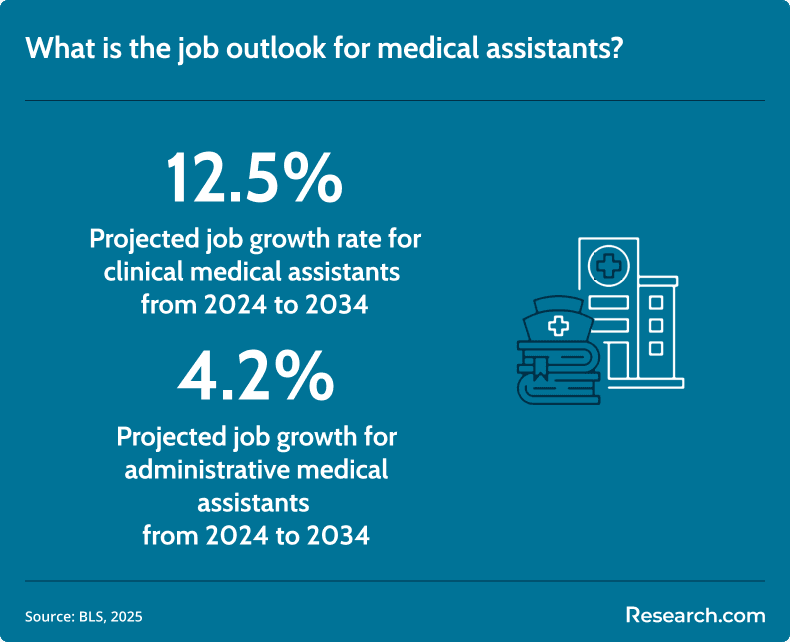
The employment outlook differs by role focus. Administrative medical assistants are expected to see steady need, while clinical medical assistants are projected to grow faster because healthcare providers continue to need hands-on support for patient care.
CMAA Job Outlook
From 2024 to 2034, professionals with a CMAA certification can expect a 4.2% job growth rate, with an estimated 85,900 annual job openings. This reflects continued demand for administrative staff who can support scheduling, patient records, billing, communication, and compliance-related office functions.
AI and automation may change parts of the administrative medical assisting role. Routine scheduling reminders, form processing, and repetitive documentation tasks may become more automated, but that does not eliminate the need for trained administrative staff. Instead, CMAAs may spend more time helping patients navigate systems, correcting errors, coordinating information, and supporting compliance.
CCMA Job Outlook
Professionals with a CCMA certification can expect stronger projected growth of around 12.5%, with roughly 112,300 yearly job openings. Demand is connected to the need for clinical support, especially as the number of primary care providers declines. The aging U.S. population also contributes to the need for healthcare workers who can support preventive care and routine clinical services.
Challenges to Consider Before Entering the Field
Medical assisting offers accessible entry into healthcare, but candidates should understand the pressures of the job. The NHA reports that 53% of employers identify retention as their greatest concern over the next five years. Pay is one factor because the average medical assistant wage remains slightly below the national median of $49,500. Staffing shortages, heavier workloads, and burnout can also affect the day-to-day experience.
Before choosing either credential, ask whether you prefer a busy front desk, a clinical exam-room role, or a hybrid position. Credentials can open doors, but job satisfaction depends heavily on the setting, team culture, workload, and opportunities for advancement. That principle is similar in other credential decisions, including the difference between CFA and CFP certification, where credentials may overlap but lead to different daily work.
CMAA and CCMA Continuing Education and Renewal Requirements
Both the CMAA and CCMA credentials require ongoing renewal. Continuing education helps medical assistants keep up with changes in patient safety, healthcare technology, administrative procedures, communication expectations, and clinical practice standards.
Renewal Requirements
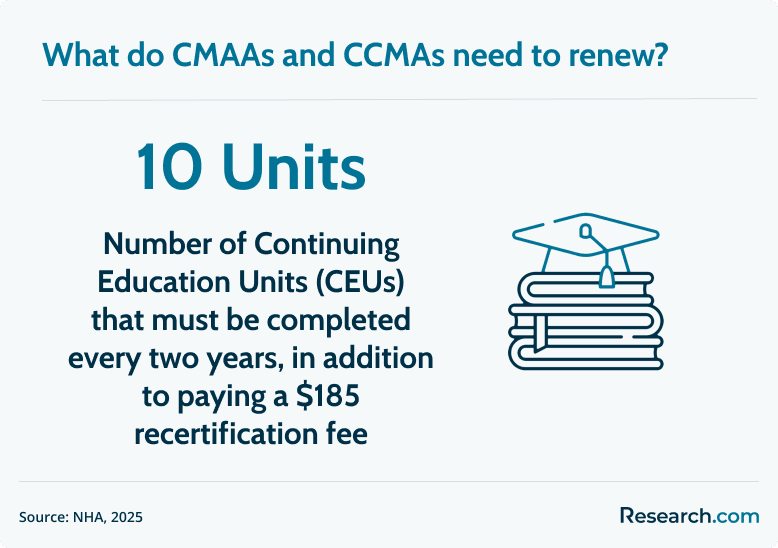
Individuals with either a CCMA or CMAA certification must renew every two years and complete 10 continuing education units related to their practice. The NHA describes this as about two hours per NHA CEU. Professionals must also pay a $185 recertification fee. NHA members typically have access to free CE courses, while non-members may take courses for approximately $10 to $20 per course.
| Renewal item | CMAA | CCMA |
| Renewal cycle | Every two years | Every two years |
| Continuing education | 10 CE units related to practice | 10 CE units related to practice |
| Recertification fee | $185 | $185 |
| Typical CE topics | Patient experience, communication, health insurance, medical coding, administrative workflow | Patient experience, team-based care, specimen collection, analysis, phlebotomy, mental health awareness |
NHA continuing education offerings include topics such as patient experience, communication, team-based care, mental health awareness, and self-care for healthcare workers. Some modules are more role-specific, including health insurance and medical coding for administrative medical assistants and specimen collection, analysis, and phlebotomy for clinical medical assistants.
These continuing education choices can also help professionals explore whether to expand into related healthcare roles. For example, some medical assistants compare options such as medical assistant and physician assistant career paths when planning long-term advancement.
What Happens If Your Certification Expires?
Medical assistants should track renewal dates carefully. Professionals who miss the renewal deadline by less than 30 days can still renew without late fees. If the credential has lapsed for less than one year, they must complete 15 CE units and pay both the $277.50 renewal fee and a $99 reinstatement fee. If the certification has been expired for more than one year, the professional must retake the NHA certification exam.
Advancement Opportunities After CMAA or CCMA Certification
CMAA and CCMA credentials can serve as entry points into healthcare, but they do not have to be final career destinations. Advancement depends on your experience, employer, additional education, certifications, performance, and willingness to take on new responsibilities.
Advancement Paths for CMAA-Certified Professionals
Professionals with CMAA certification often move toward healthcare administration, medical office leadership, billing, coding support, practice operations, or supervisory roles. Some pursue bachelor’s degrees in healthcare leadership, business management, or related fields to qualify for broader administrative opportunities.
Others build skills in accounting, marketing and sales, or operations management. These areas can support roles that combine healthcare knowledge with business functions, such as practice management or healthcare project coordination. Depending on experience and setting, these paths may lead to annual salaries ranging between $70,000 and $100,000 or more.
Advancement Paths for CCMA-Certified Professionals
CCMA-certified professionals may use their clinical experience as a foundation for more advanced patient-care careers. Some pursue medical assistant to RN online bridge programs to become registered nurses, while others continue into health sciences, public health, laboratory technology, radiology, or physician assistant programs.
Some CCMAs also move into health information roles, especially because 24% of CCMAs already serve as EHR Super Users. Others transition into medical office management, where they supervise clinical operations, coordinate staff, and support compliance. Depending on the route, salaries may range from $60,000 to $90,000 or more.
Employer-Supported Upskilling
Advancement does not always require leaving your current employer. The NHA reports that 78% of employers offer training or upskilling programs to help staff move into new roles, while 76% provide apprenticeship opportunities. These employer-supported options can help medical assistants build leadership, technical, administrative, or clinical skills while continuing to gain workplace experience.
This chart shows the usual tasks of clinical medical assistants.
CMAA vs. CCMA: Which Certification Should You Choose?
The right choice depends less on which credential is “better” and more on which role fits your strengths. CMAA is usually better for people who want to support healthcare through organization, communication, scheduling, records, and billing. CCMA is usually better for people who want direct patient contact and clinical responsibilities.
| Choose this path | If you prefer | Long-term direction |
| CMAA | Structured office work, scheduling, billing, records, patient intake, communication, and administrative systems | Healthcare administration, medical billing and coding support, practice management, office supervision, operations |
| CCMA | Hands-on patient care, vitals, EKGs, phlebotomy, clinical documentation, procedures, and provider support | Nursing, clinical assisting, phlebotomy, EKG, health sciences, physician assistant preparation, clinical leadership |
| Both | A mix of front-office and clinical responsibilities, especially in smaller practices or flexible healthcare teams | Hybrid medical assisting roles, practice coordination, office management, broader employability across settings |
Choose CMAA Certification If You:
- Prefer organized, process-driven work such as scheduling, billing, patient records, and office communication
- Are detail-oriented and comfortable multitasking in a front-office setting
- Want to build a career in healthcare administration, medical office operations, billing, or coding support
- Plan to move toward management, supervision, or business-related healthcare roles
Choose CCMA Certification If You:
- Want to work directly with patients and help providers during exams and procedures
- Enjoy hands-on clinical tasks such as taking vitals, performing EKGs, or collecting specimens
- See medical assisting as a stepping stone toward nursing, physician assisting, or another clinical career
- Work well in fast-paced patient-care environments such as urgent care centers, clinics, or outpatient settings
In 2025, 47% of medical group leaders identified medical assistants as the most difficult role to recruit. That hiring pressure can benefit well-prepared candidates, but applicants should still evaluate local employers, wages, schedules, benefits, training support, and advancement opportunities before committing to a role.
Is It Worth Getting Both CMAA and CCMA Certification?
Getting both credentials can be worthwhile if you want flexibility across administrative and clinical roles. A CMAA certification demonstrates office and administrative competence, which matters because 47% of employers require certification for medical administrative assistants. It shows readiness for scheduling, billing support, records management, patient communication, and front-office workflows.
A CCMA certification validates clinical readiness, aligning with the 72% of employers who prefer certified clinical medical assistants. It signals that you can support physicians and nurses, assist with patient assessments, document clinical care, and perform basic diagnostic tasks within scope and workplace policy.
The trade-off is time and cost. Earning both certifications requires additional preparation, exam fees, and ongoing renewal work. However, it can make sense if you want to work in smaller practices, outpatient clinics, or settings where medical assistants are expected to shift between front-office and exam-room responsibilities.
Questions to Ask Before Pursuing Both
- Does your training program already prepare you for both administrative and clinical certification exams?
- Do employers in your area prefer one credential, both credentials, or a different medical assisting credential?
- Will a second certification improve your job options, pay potential, schedule flexibility, or advancement path?
- Can you afford the additional exam preparation, testing, and renewal requirements?
- Do you actually want hybrid work, or would you rather specialize in administrative or clinical responsibilities?
Students weighing practical career paths often compare employability, hands-on work, and advancement potential in the same way they might ask whether forensic science is a good career. The best answer depends on the work environment, required education, job market, and fit with your strengths.
What Graduates Say About CMAA and CCMA Career Paths
- Carole: "I went with the CMAA credential because I knew I wanted the administrative side of healthcare. Preparing for the exam pushed me to understand scheduling, billing, and patient communication in more detail. After certification, I felt more confident managing front-office responsibilities and supporting the practice’s daily flow."
- Dante: "The CCMA exam made me nervous because of the clinical scenarios, so I studied with a group. That helped me stay consistent and talk through the topics I struggled with. After passing, I received offers from two urgent care centers, and the credential helped me compete for roles I probably would not have been considered for before."
- Noelle: "I chose CCMA certification because I wanted patient-care experience before applying to an RN program. The work is demanding, but it has helped me understand real clinical situations and patient needs. Certification gave me a practical first step toward becoming a stronger healthcare provider."
Common Mistakes When Choosing Between CMAA and CCMA
- Choosing based only on salary. Pay matters, but the better credential is the one that fits the work you can see yourself doing every day.
- Assuming all medical assisting jobs are the same. Duties vary by employer, state rules, setting, and staffing model. Read job postings carefully.
- Ignoring local employer preferences. Some employers may prefer CCMA, some may value CMAA, and others may train for hybrid responsibilities.
- Enrolling without checking eligibility. Before paying for a program, confirm that it prepares you for the NHA exam pathway you plan to use.
- Overlooking hands-on requirements. Online coursework can be convenient, but clinical skills often require in-person practice, externships, or supervised experience.
- Forgetting renewal obligations. Certification requires continuing education, fees, and deadline tracking every two years.
- Assuming certification guarantees employment. Certification can strengthen an application, but hiring also depends on experience, interview performance, location, references, and employer needs.
Key Insights
- CMAA and CCMA are not interchangeable credentials. CMAA focuses on administrative medical assisting, while CCMA focuses on clinical patient-care support.
- The eligibility pathways are the same, but the exams test different competencies. CMAA candidates should prepare for scheduling, billing, compliance, and office procedures; CCMA candidates should prepare for anatomy, vitals, infection control, phlebotomy, EKG, and patient-care topics.
- Job fit matters more than the credential name. Choose CMAA if you prefer front-office structure and healthcare operations. Choose CCMA if you want direct patient interaction and hands-on clinical work.
- Both credentials can support advancement. CMAA may lead toward healthcare administration or practice management, while CCMA may support nursing, health sciences, EHR leadership, or other clinical pathways.
- Getting both can be useful, but not always necessary. Dual certification is most valuable if you want hybrid roles or work in settings where assistants handle both administrative and clinical tasks.
- Before enrolling, verify program alignment. Check NHA eligibility, curriculum coverage, externship options, total cost, transfer policies, employer recognition, and local job-posting requirements.
References:
- Health Workforce Analysis. (2024, November). State of the U.S. Health Care Workforce, 2024. https://bhw.hrsa.gov/sites/default/files/bureau-health-workforce/state-of-the-health-workforce-report-2024.pdf
- National Healthcareer Association. (2025). 2025 Industry Outlook. https://info.nhanow.com/hubfs/Marketing/Campaigns/Industry%20Outlook/2025/9-NHA-HS-Q125-industry-outlook-2025.pdf
- O*NET OnLine. (2025a, August 26). Medical Assistants. Retrieved October 7, 2025, from https://www.onetonline.org/link/summary/31-9092.00
- O*NET OnLine. (2025b, August 26). Medical Secretaries and Administrative Assistants. Retrieved October 7, 2025, from https://www.onetonline.org/link/summary/43-6013.00
- U.S. Bureau of Labor Statistics. (2024). Medical assistants [Interactive data]. Occupational Employment and Wage Statistics (OEWS) Profiles. Retrieved October 7, 2025, from https://data.bls.gov/oesprofile
- U.S. Bureau of Labor Statistics. (2025, August 28). Occupational projections, 2024–2034, and worker characteristics, 2024 (Employment in thousands). Employment Projections. https://www.bls.gov/emp/tables/occupational-projections-and-characteristics.htm
Other Things You Should Know About CMAA vs. CCMA Certification
The CMAA exam fee is typically paid to the Certiport testing provider, while the CCMA exam fee is set by the National Healthcareer Association. In 2027, candidates should confirm the exact amount on the official exam site before registering, because testing and retake fees can change.
To sit for the CMAA or CCMA exam in 2027, candidates typically need a high school diploma or equivalent. Completing a medical administrative or clinical assistant program, though not always mandatory, significantly enhances preparation. Some employers may also require hands-on experience in a healthcare setting.
The CMAA certification is overseen by the National Healthcareer Association (NHA), while the CCMA is administered by the American Medical Technologists (AMT). Both bodies set the standards and requirements for their respective certifications and ensure the credentials maintain industry relevance in 2027.