2027 Best Online Medical Assistant Associate Degree Programs

Co-Founder and Chief Data Scientist
In 2023, there were approximately 608,000 medical assistants working across the US, and the field experienced a 3.2% growth from the previous year, an encouraging sign for those looking to enter healthcare field (Data USA, 2023). This steady rise in demand highlights the value of a role that supports both patients and physicians in a wide range of clinical settings.
Online Medical Assistant associate degree programs are ideal for students who want a flexible, affordable, and structured path into the medical field. Whether you're new to healthcare or looking to formalize your experience, these programs can help you start strong.
I’ve created this guide to walk you through everything you need to know, including program requirements, career options, certification, and long-term opportunities.
What are the benefits of getting an online medical assistant associate degree?
- The job outlook for medical assistants is strong, with a projected growth of 15% from 2023 to 2033, much faster than the average for all occupations (BLS, 2024).
- Salaries vary, with the lowest 10% earning under $35,020 and the top 10% earning more than $57,830 annually.
- Pursuing this degree online allows for flexible scheduling, making it ideal for working adults, parents, or anyone needing to balance school with other commitments.
What can I expect from an online medical assistant associate degree?
Students enrolling in an Online Medical Assistant Associate Degree program can expect a comprehensive curriculum that prepares them for both clinical and administrative responsibilities in healthcare settings.
These programs typically include courses in medical terminology, anatomy and physiology, pharmacology, medical law and ethics, and electronic health records. In addition to online coursework, most programs require completion of a supervised externship or practicum at an approved healthcare facility to gain hands-on experience.
Students benefit from the flexibility of online learning, which allows them to complete assignments and attend lectures according to their own schedule. Although lectures, quizzes, and discussions are delivered virtually, the clinical component must be completed in person to meet graduation and certification requirements.
Upon graduation, students are often eligible to sit for national certification exams, such as the Certified Medical Assistant (CMA) or Registered Medical Assistant (RMA), which enhance job prospects.
Where can I work with an online medical assistant associate degree?
Graduates of an Online Medical Assistant Associate Degree program are qualified to work in a wide range of healthcare environments. These include physician offices, outpatient clinics, urgent care centers, and specialty practices such as pediatrics, cardiology, dermatology, and orthopedics. Their dual training in clinical and administrative duties makes them valuable team members in fast-paced healthcare settings.
Additional employment opportunities can be found in hospitals, long-term care facilities, community health centers, and telemedicine services. Some graduates also find roles with insurance companies, laboratories, and public health agencies, where their knowledge of medical records and procedures is essential. With experience, many medical assistants pursue advanced roles or specialize in fields such as phlebotomy, EKG technology, or medical office management.
How much can I make with an online medical assistant associate degree?
The salary of Medical Assistants varies based on factors such as geographic location, years of experience, type of healthcare facility, and whether the individual holds certifications. According to ZipRecruiter (2025), the average annual salaries of medical assistants in the United States are:
- Medical Assistant: $41,370 Medical Administrative Assistant: $44,460
- Specialty Medical Assistant: $41,370
- Ophthalmic Medical Assistant: $40,971
- List of the Best Online Medical Assistant Associate Degree Programs for 2027 List of Programs
- How long does it take to complete an online medical assistant associate degree? Completion Time
- How does an online medical assistant associate degree compare to an on-campus program? How does an online medical assistant associate degree compare to an on-campus program?
- What is the average cost of an online medical assistant associate degree program? Program Costs
- What are the financial aid options for students enrolling in an online medical assistant associate degree program? What are the financial aid options for students enrolling in an online medical assistant associate degree program?
- What are the prerequisites for enrolling in an online medical assistant associate degree program? Prerequisites
- What courses are typically in an online medical assistant associate degree program? What courses are typically in an online medical assistant associate degree program?
- What types of specializations are available in online medical assistant associate degree programs? What types of specializations are available in online medical assistant associate degree programs?
- How to choose the best online medical assistant associate degree program? How to choose the best online medical assistant associate degree program?
- What career paths are available for graduates of online medical assistant associate degree programs? Career Paths
- What is the job market for graduates with a medical assistant associate degree? Job Market
- How do accreditation and quality standards impact online medical assistant programs? How do accreditation and quality standards impact online medical assistant programs?
- How can I advance my academic career after earning an online medical assistant associate degree? How can I advance my academic career after earning an online medical assistant associate degree?
- How Do Career Support Services and Networking Opportunities Enhance Success? How Do Career Support Services and Networking Opportunities Enhance Success?
Best Online Medical Assistant Associate Degree Programs for 2027
An online medical assistant associate degree can be a practical route into healthcare if you want more than a short certificate but do not want to spend four years in school. The key decision is not simply “Which program is online?” It is whether the program prepares you for certification, includes credible hands-on training, fits your schedule, and has a total cost you can justify.
This guide is for students comparing online medical assistant associate degree programs, working adults who need flexible coursework, and career changers who want a healthcare role with both clinical and administrative responsibilities. You will learn how long these programs take, what they cost, what accreditation matters, what courses and externships usually involve, and how to compare online programs without being misled by tuition-only pricing or “fully online” claims.
Quick answer: Is an online medical assistant associate degree worth considering?
Yes, an online medical assistant associate degree can be worth considering if you want formal healthcare training, eligibility for entry-level medical assisting roles, and a credential that may support future advancement into supervision, medical office administration, billing and coding, or nursing pathways. Most programs combine online coursework with an in-person externship because clinical skills cannot be learned entirely online. Students who need the fastest possible route may prefer a certificate, while students who want broader general education and transfer potential may benefit more from an associate degree.
How Research.com evaluates schools
Choosing a medical assistant program affects your time, budget, certification options, and job readiness. Research.com rankings are built to help students compare schools using measurable indicators instead of advertising claims.
Our ranking process uses a data-based evaluation of academic quality, affordability, student outcomes, and institutional reputation. The Research.com ranking methodology draws from trusted education data sources, including the IPEDS database, Peterson’s database, College Scorecard, and the National Center for Education Statistics (NCES). Students should still verify program-specific accreditation, externship rules, certification alignment, and tuition directly with each school before enrolling.
Program comparison at a glance
| School | Program focus | Typical length | Credits | Cost per credit | Accreditation listed |
| Herzing University | Medical assisting services with clinical, administrative, and general education training | Approximately 20 months | 60 | Approximately $515 | Higher Learning Commission (HLC) |
| Keiser University | Medical assisting science with patient care, office procedures, and lab techniques | 12–20 months | 60 | Approximately $450 | Southern Association of Colleges and Schools Commission on Colleges (SACSCOC) |
| East Ohio College | Clinical medical assisting with phlebotomy, EKG, labs, and externship training | Approximately 18–20 months | Approximately 60 | Contact the school for more information | Accrediting Bureau of Health Education Schools (ABHES) |
| American National University | Medical assisting with virtual labs, home lab kits, and local externship | Approximately 20 months | 96 | Contact the school for more information | Distance Education Accrediting Commission (DEAC) |
| Penn Foster College | Self-paced medical assisting with a required 160-hour externship | Self-paced; typically completed in 18–24 months | 60 | Approximately $109 | Distance Education Accrediting Commission (DEAC) |
| Dakota College at Bottineau | Medical assistant AAS with clinical procedures, pharmacology, terminology, and administration | 2 years | 60 | Approximately $139 | Higher Learning Commission (HLC) |
| Bryan University | Medical assisting AAS with career-focused preparation for the CCMA exam | Approximately 20 months | Approximately 60 | Contact the school for more information | Accrediting Commission of Career Schools and Colleges (ACCSC) |
| U.S. Career Institute | Medical specialties degree emphasizing medical assisting, coding, and administrative roles | Self-paced; typically completed in 16–20 months | 60 | Approximately $125 | Distance Education Accrediting Commission (DEAC) |
| Liberty University | Medical office administration for non-clinical healthcare support roles | 1.5 to 2 years | 60–64 | Approximately $390 | Southern Association of Colleges and Schools Commission on Colleges (SACSCOC) |
1. Herzing University
Herzing University offers an Associate of Science in Medical Assisting Services with online academic coursework and an in-person supervised externship. The curriculum combines clinical skills, administrative procedures, and general education courses, making it a strong fit for students who want medical assisting preparation plus a broader associate-level credential. Students should confirm local externship placement options before enrolling, especially if they live far from a major healthcare market.
- Program Length: Approximately 20 months
- Cost per Credit: Approximately $515
- Required Credits to Graduate: 60
- Accreditation: Higher Learning Commission (HLC)
2. Keiser University
Keiser University provides an Associate of Science in Medical Assisting Science through its online division. Students study patient care, medical office operations, and laboratory procedures online, then complete a required externship at an approved site. The program may appeal to students who want a structured path that can be finished in under two years, but applicants should ask how externship sites are approved and whether certification exam preparation is included in tuition.
- Program Length: 12–20 months
- Cost per Credit: Approximately $450
- Required Credits to Graduate: 60
- Accreditation: Southern Association of Colleges and Schools Commission on Colleges (SACSCOC)
3. East Ohio College
East Ohio College offers an online Clinical Medical Assistant associate degree that pairs remote coursework with scheduled in-person labs and externship requirements. The program emphasizes clinical skills such as phlebotomy, EKG, and laboratory procedures, along with administrative competencies used in clinics and physician offices. Because the program includes hands-on components, students should verify lab scheduling, travel expectations, and local healthcare site availability.
- Program Length: Approximately 18–20 months
- Cost per Credit: Contact the school for more information
- Required Credits to Graduate: Approximately 60
- Accreditation: Accrediting Bureau of Health Education Schools (ABHES)
4. American National University
American National University offers an Associate Degree in Medical Assisting with online instruction, virtual lab activities, home lab kits, and a required local externship. The program is built for students who need remote coursework but still want hands-on preparation for clinical and administrative medical assistant duties. Since the degree requires 96 credits, applicants should compare the total credit load, transfer policy, and full program cost against shorter 60-credit options.
- Program Length: Approximately 20 months
- Cost per Credit: Contact the school for more information
- Required Credits to Graduate: 96
- Accreditation: Distance Education Accrediting Commission (DEAC)
5. Penn Foster College
Penn Foster College offers a self-paced online Associate Degree in Medical Assisting with online assessments and a required 160-hour in-person externship. The curriculum covers patient care, medical billing, laboratory procedures, and other core medical assisting competencies. This option may work well for independent learners who need a lower listed cost per credit, but students should be realistic about self-paced study discipline and should confirm externship support before committing.
- Program Length: Self-paced; typically completed in 18–24 months
- Cost per Credit: Approximately $109
- Required Credits to Graduate: 60
- Accreditation: Distance Education Accrediting Commission (DEAC)
6. Dakota College at Bottineau
Dakota College at Bottineau offers an Associate of Applied Science in Medical Assistant that can be completed online apart from the required in-person externship. Courses include clinical procedures, pharmacology, medical terminology, and medical office administration. The program may be a good match for students who want a public-college option with a clearly defined 2-year structure and a comparatively low listed cost per credit.
- Program Length: 2 years
- Cost per Credit: Approximately $139
- Required Credits to Graduate: 60
- Accreditation: Higher Learning Commission (HLC)
7. Bryan University
Bryan University offers an Associate of Applied Science in Medical Assisting with online clinical and administrative coursework plus an in-person externship. Students study areas such as anatomy, healthcare law, and patient communication while preparing for the Certified Clinical Medical Assistant (CCMA) exam. Applicants should ask whether certification exam fees, externship coordination, and job search support are included or billed separately.
- Program Length: Approximately 20 months
- Cost per Credit: Contact the school for more information
- Required Credits to Graduate: Approximately 60
- Accreditation: Accrediting Commission of Career Schools and Colleges (ACCSC)
8. U.S. Career Institute
U.S. Career Institute offers a self-paced Medical Specialties Associate Degree that includes medical assisting, coding, and administrative healthcare training. Unlike many clinical medical assisting programs, this option does not require an externship, which makes it more flexible but less focused on hands-on patient care. It is best suited for students aiming at administrative healthcare roles rather than positions requiring direct clinical practice.
- Program Length: Self-paced; typically completed in 16–20 months
- Cost per Credit: Approximately $125
- Required Credits to Graduate: 60
- Accreditation: Distance Education Accrediting Commission (DEAC)
9. Liberty University
Liberty University offers an online Associate of Applied Science in Medical Office Administration. This program is more administrative than clinical, so it is better aligned with medical office support, billing, coding, scheduling, and healthcare office coordination than with hands-on medical assisting. Students who want clinical medical assistant certification should ask whether additional externship or clinical requirements would be needed.
- Program Length: 1.5 to 2 years
- Cost per Credit: Approximately $390
- Required Credits to Graduate: 60–64
- Accreditation: Southern Association of Colleges and Schools Commission on Colleges (SACSCOC)
How long does an online medical assistant associate degree take?
Most online medical assistant associate degree programs take 16 to 24 months, depending on the school calendar, course load, transfer credits, and whether the student studies full time or part time. Some self-paced programs advertise faster progress, but students should account for externship scheduling, background checks, immunization documentation, and any required labs.
This timeline is longer than the best 4-week medical assistant certification program online options because an associate degree usually includes general education courses in addition to medical assisting content. A certificate may be the fastest credential for students who need immediate entry-level training, while an associate degree can provide a broader academic foundation and may be more useful for transfer or advancement.
| Path | Typical purpose | Best for | Trade-off |
| Short medical assistant certificate | Rapid preparation for basic clinical or administrative duties | Students who need the quickest workforce entry | Less general education and often fewer transfer options |
| Online associate degree in medical assisting | Clinical and administrative preparation plus general education | Students who want a stronger academic credential and possible advancement path | Longer timeline and usually higher total cost |
| Administrative healthcare associate degree | Office, billing, coding, records, and healthcare operations | Students who prefer non-clinical healthcare work | May not meet clinical medical assistant certification expectations without extra training |
Demand for medical assistants is tied to how primary care practices organize care teams. According to the data below, most adult primary care practices (56.6%) had one medical assistant per primary care clinician, 11.4% had two or more MAs per clinician, 27.6% had less than a 1:1 MA-to-PCC ratio, and 4.3% employed no medical assistants.
Online vs. on-campus medical assistant associate degree: Which format is better?
An online medical assistant associate degree is usually best for students who need schedule flexibility but can still complete in-person clinical requirements. Online courses may use recorded lectures, live sessions, discussion boards, digital simulations, quizzes, and virtual lab activities. However, programs that prepare students for clinical medical assisting generally require an externship or hands-on experience in a healthcare setting.
An on-campus program may be better for students who prefer direct instructor access, structured class meetings, and regular lab practice with classmates. Campus-based formats can make it easier to build routine and receive immediate feedback during clinical skill demonstrations.
Students should be careful with the phrase “fully online.” In medical assisting, it often means the classroom portion is online, not that the entire degree can be completed remotely. If a program includes phlebotomy, injections, EKGs, vital signs, or direct patient care, expect a local externship or clinical experience.
| Factor | Online associate degree | On-campus associate degree |
| Schedule | Often more flexible, with asynchronous or hybrid coursework | More structured, with set class and lab times |
| Clinical practice | Usually completed through an in-person externship or local site | Often practiced in campus labs before externship placement |
| Best fit | Working adults, parents, rural students, and self-directed learners | Students who want face-to-face support and predictable routines |
| Main risk | Weak externship coordination or limited local placement options | Less flexibility for work and family schedules |
| What to ask | Who finds the externship site, and what happens if no local site is available? | How much lab time is included before clinical placement? |
Online learning quality varies by field and program design. If you are comparing formats across unrelated online degrees, such as a bachelor's degree in mathematics online, remember that healthcare programs have a key difference: clinical competencies may require in-person verification.
How much does an online medical assistant associate degree cost?
The total cost of an online medical assistant associate degree generally ranges from $10,000 to $25,000 for the full program, depending on the school type, tuition rate, fees, residency status, credit requirements, and financial aid. Cost per credit hour typically falls between $100 and $500. Public colleges, private nonprofit institutions, and for-profit career colleges can have very different pricing structures.
Students should look beyond the headline tuition number. When asking, “How much is a medical assistant program?”, also ask whether books, scrubs, lab kits, background checks, drug screening, immunizations, technology fees, certification exam prep, and certification exam fees are included. A lower tuition rate can become less attractive if required extras are billed separately.
| Cost item | Why it matters | Question to ask the school |
| Tuition per credit | This is the base price, but not always the full cost. | Is tuition charged per credit, per term, or by program? |
| Fees and supplies | Online programs may still require lab kits, software, books, uniforms, or testing fees. | Can you provide a full program cost sheet? |
| Externship costs | Students may pay for transportation, health records, background checks, or drug screening. | What costs are required before externship placement? |
| Certification preparation | Certification can improve hiring competitiveness, but exam costs may not be included. | Which certification exam does the program prepare students for? |
| Transfer credit policy | Accepted transfer credits can reduce time and tuition. | How many credits can I transfer into the program? |
Education levels among current medical assistants vary. The chart below shows that 233,794 medical assistants have some college education without a degree, 123,737 entered the field with a high school diploma or equivalent, and 139,080 have completed an associate degree. These figures show that an associate degree is not the only route into the occupation, but it can strengthen a candidate’s formal preparation.
Financial aid options for online medical assistant associate degree students
Students in eligible online medical assistant associate degree programs may qualify for the same types of financial aid available to many campus-based students. The most common starting point is the Free Application for Federal Student Aid (FAFSA), which schools use to determine eligibility for federal grants and loans.
Federal aid may include Pell Grants, Federal Supplemental Educational Opportunity Grants (FSEOG), and Direct Subsidized and Unsubsidized Loans. Pell Grants are especially helpful because they do not have to be repaid if the student meets the grant requirements. Aid eligibility depends on the school, program, enrollment status, and the student’s financial circumstances.
Students should also compare online schools for medical assistant with financial aid, state grants, institutional scholarships, employer tuition assistance, military or workforce funding, and interest-free payment plans. Some professional associations, nonprofits, community foundations, and healthcare organizations may also offer scholarships for allied health students.
Do not assume all online programs qualify for federal financial aid. The school and program must meet eligibility requirements, and some short-term or non-degree programs may not qualify. This is also why comparing aid rules across unrelated programs, such as a Christian leadership program online, can be misleading; healthcare programs may include different fees, externship expenses, and certification-related costs.
Admissions requirements and prerequisites
Most online medical assistant associate degree programs are designed for entry-level students, but admissions requirements still matter. Schools may require academic documents, health clearance, technology readiness, and screening steps before externship placement.
- High school diploma or GED: Applicants usually need proof of high school completion or an equivalent credential. Official transcripts are commonly required. Similar baseline academic requirements apply to many online degrees, including an online bachelor's degree in sociology, but medical assisting adds healthcare-specific screening before clinical placement.
- Basic academic preparation: Biology, algebra, English, and computer literacy can help students succeed, even when these courses are not strict prerequisites.
- Placement or readiness assessment: Some colleges use reading, writing, or math assessments to determine whether students need academic support before college-level coursework.
- Health and immunization records: Externship sites often require proof of immunizations, health forms, and sometimes a physical exam before students can work around patients.
- Background check and drug screening: Clinical sites commonly require screening to comply with healthcare workplace policies. A past offense may affect externship eligibility, so students should ask about policies before enrolling.
- Technology access: Online learners need reliable internet, a computer that meets program requirements, and comfort with learning platforms, email, video tools, and digital assignments.
Typical courses in an online medical assistant associate degree
Online medical assistant associate degree programs usually combine three areas: clinical medical assisting, administrative healthcare operations, and general education. The exact course list varies, but students can expect training that prepares them to support physicians, nurses, office managers, and patients in outpatient healthcare settings.
| Course area | What students learn | Why it matters in practice |
| Medical terminology and anatomy | Healthcare vocabulary, body systems, and basic structure and function of the human body | Medical assistants must communicate accurately with providers, patients, and records systems. |
| Clinical procedures and lab techniques | Vital signs, specimen collection, injections, phlebotomy, EKG basics, and exam room preparation | These are core patient-care skills often practiced during labs or externships. |
| Medical office administration | Scheduling, patient intake, electronic health records, insurance processes, and front-desk workflow | Many medical assistants split time between clinical and administrative duties. |
| Pharmacology and medication administration | Common medications, dosage concepts, safety procedures, and prescription-related support tasks | Medication-related work requires accuracy, attention to detail, and adherence to scope-of-practice rules. |
| General education | English composition, psychology, basic math, communication, and related college-level courses | These courses support documentation, patient communication, critical thinking, and transfer potential. |
| Internship or externship | Supervised work in a healthcare setting, often involving patient histories, vital signs, exam room setup, and procedure support | Most online medical assistant associate degree programs require an externship, typically 160 to 200 hours. |
Specializations and focus areas in medical assistant associate programs
Many programs use a general medical assisting curriculum, but some offer electives or tracks that point students toward specific workplace roles. Before choosing a focus, review medical assistant specialties and compare them with your preferred work environment.
- Clinical medical assisting: This path emphasizes direct patient care, including EKGs, phlebotomy, injections, rooming patients, and assisting with exams. It is best for students who want patient-facing work.
- Administrative medical assisting: This focus centers on scheduling, records, billing support, insurance paperwork, and front-office communication. It fits students who prefer office-based healthcare work.
- Medical office management: This area introduces leadership, compliance, budgeting, staffing, and clinic operations. It can support advancement after experience in the field.
- Billing and coding: Students study coding systems, insurance claims, medical terminology, and reimbursement processes. This may appeal to students interested in administrative or potentially remote healthcare work.
- Medical specialties: Some programs combine medical assisting, coding, transcription, and patient service coursework. This broader approach may be useful for administrative flexibility but may offer less intensive clinical preparation.
How to choose the best online medical assistant associate degree program
The best program is the one that matches your career goal, prepares you for the credential employers expect, provides legitimate hands-on training, and fits your budget. Rankings can narrow your list, but your final choice should come from direct questions to each school.
- Check institutional and program accreditation: Confirm that the school is accredited by a recognized accreditor and ask whether the medical assisting program has programmatic accreditation when relevant. Accreditation affects quality assurance, transfer options, employer confidence, financial aid eligibility, and sometimes certification eligibility. This step matters in every field, including an anthropology online degree, but it is especially important in healthcare because clinical training and certification rules can affect employability.
- Match the curriculum to your career goal: Choose a clinical program if you want direct patient care. Choose an administrative medical office program if you prefer scheduling, billing, coding, or records work.
- Verify externship support: Ask whether the school places students, helps students find sites, or requires students to secure their own externship. This can be the difference between finishing on time and facing delays.
- Compare total cost, not only tuition: Include fees, books, supplies, lab kits, exam prep, externship expenses, background checks, and travel.
- Ask which certification exam the program prepares for: Common options include Certified Medical Assistant (CMA), Registered Medical Assistant (RMA), and Certified Clinical Medical Assistant (CCMA), depending on program design and eligibility rules.
- Evaluate student support: Look for tutoring, instructor access, externship advising, technical support, resume help, interview preparation, and employer connections.
- Review transfer and advancement options: If you may pursue nursing, healthcare administration, health information, or another allied health pathway later, ask how credits transfer.
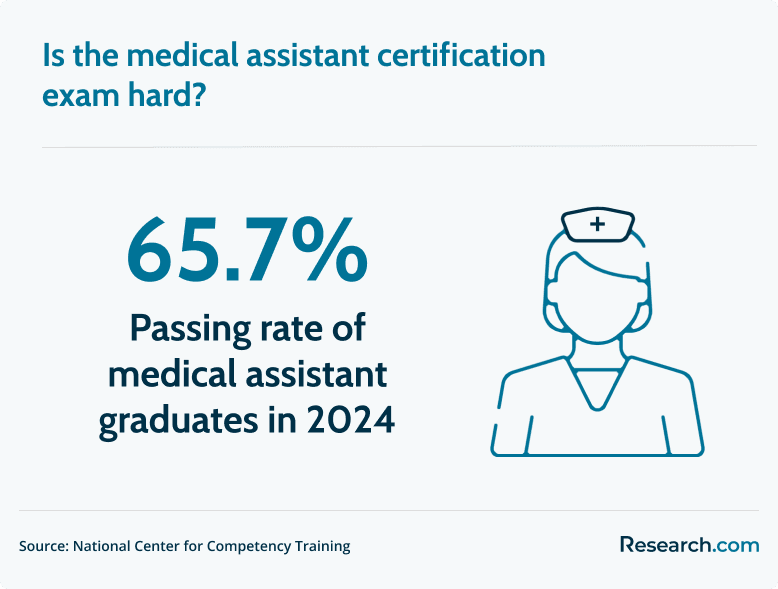
Certification preparation should be treated as a core program feature, not a bonus. According to the National Center for Competency Testing (NCCT), out of 3,819 individuals who completed a certification or degree in medical assisting, only 65.7% passed. That makes exam alignment, practice testing, and skills preparation important when comparing programs.
| Common mistake | Why it can hurt you | Better approach |
| Choosing the cheapest listed tuition | Fees, supplies, and externship costs may raise the real price. | Request a full cost breakdown before applying. |
| Assuming “online” means no in-person work | Clinical medical assisting usually requires hands-on externship experience. | Ask exactly which requirements must be completed in person. |
| Ignoring accreditation | Accreditation may affect aid, transfer, certification, and employer acceptance. | Verify school and program accreditation through official sources. |
| Not checking certification eligibility | A program may teach useful skills but not align with the credential you want. | Ask which exam graduates are prepared or eligible to take. |
| Waiting too long to plan externship logistics | Site availability, health records, and screening can delay graduation. | Discuss placement timelines with an advisor early. |
| Relying only on rankings | A highly ranked program may still be a poor fit for your location, budget, or schedule. | Use rankings as a shortlist, then compare program details directly. |
Career paths after an online medical assistant associate degree
Graduates can pursue entry-level clinical, administrative, and specialty support roles in healthcare settings. Exact duties depend on state rules, employer policies, certification, and workplace type. An associate degree may also support advancement after experience, especially when paired with certification and strong workplace performance.
- Clinical medical assistant: Clinical medical assistants record vital signs, prepare exam rooms, document patient information, and assist providers during routine procedures. They commonly work in physician offices, outpatient clinics, and similar settings.
- Administrative medical assistant: Students asking what a medical administrative assistant does should expect duties such as appointment scheduling, patient communication, records management, insurance coordination, and front-office workflow support.
- Specialty medical assistant: Specialty medical assistants work in areas such as pediatrics, dermatology, cardiology, or other focused clinical environments. Additional training may be needed depending on the specialty.
- Ophthalmic medical assistant: These professionals support eye care providers with patient intake, vision testing, exam preparation, and procedure assistance. Certification may help with advancement.
- Clinical team lead or supervisor: Experienced medical assistants may move into lead roles, helping train staff, coordinate schedules, and support clinic workflow.
- Medical office manager: Graduates with strong administrative skills may eventually oversee scheduling, billing processes, records, and daily office operations. Business or healthcare administration training can help.
- Medical billing and coding specialist: Programs with coding coursework can support entry into claims, coding, reimbursement, or insurance-related roles. Advancement may require additional credentials such as Certified Professional Coder (CPC).
- Health information technician: With additional coursework or certification, some graduates move toward health records, patient data, and information management roles.
- Licensed Practical Nurse (LPN) or Registered Nurse (RN): Some medical assistants later apply to LPN programs, Associate Degree in Nursing (ADN) programs, or Medical Assistant-to-RN bridge programs where available.
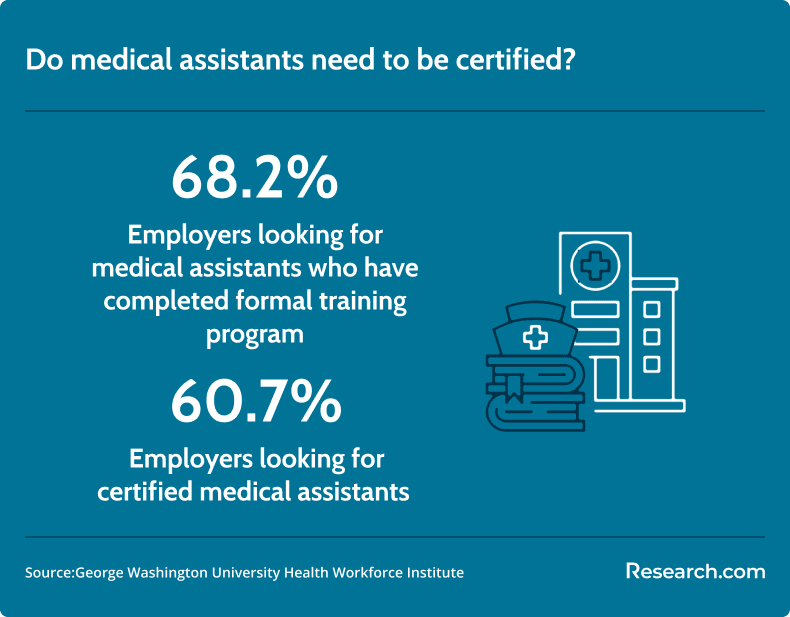
Employer expectations increasingly favor formal preparation. According to a George Washington University Health Workforce Institute survey (2025), 68.2% of healthcare organizations reported requiring medical assistants to complete a formal training program, and 60.7% said they look for candidates with medical assistant certification. An associate degree can help address both expectations when the program is aligned with certification requirements.
Job outlook and salary considerations for medical assistant graduates
The medical assistant job outlook remains strong because medical assistants support patient flow, documentation, routine clinical tasks, and administrative coordination in outpatient and physician practice settings. Aging populations, preventive care, and expanded healthcare access contribute to demand, but job availability still varies by region, employer type, certification, and experience.
According to the U.S. Bureau of Labor Statistics (BLS), employment of medical assistants is projected to grow 15% from 2023 to 2033, which is much faster than the average for all occupations. The BLS also reports about 119,800 job openings for medical assistants each year, on average, over the decade.
Pay can differ by workplace. Based on the chart below, medical assistants in outpatient care centers earned the highest median annual wage at $47,560, followed by hospitals at $45,930. Medical assistants in physicians’ offices earned a median of $43,880, while those in offices of other health practitioners earned $37,510. These differences show why students should consider where they want to work, not just whether they can enter the field.
Why accreditation and quality standards matter
Accreditation is one of the most important quality checks for an online medical assistant associate degree. It can influence federal financial aid eligibility, transfer credit acceptance, employer trust, and access to certain certification exams. Students should confirm both institutional accreditation and any program-level accreditation or approval that applies to medical assisting.
Quality also depends on more than accreditation. Strong programs disclose certification alignment, externship expectations, student support services, faculty qualifications, lab requirements, and graduate outcomes where available. Students comparing broader healthcare pathways, including PharmD online programs, should use the same principle: healthcare education must be evaluated by accreditation, clinical requirements, licensure or certification relevance, and student support.
Academic pathways after a medical assistant associate degree
A medical assistant associate degree can be a stepping stone if the credits transfer into a higher-level program. Graduates may consider healthcare administration, health information management, public health, nursing, or related allied health fields. Before enrolling, ask whether the associate degree has transfer agreements and whether general education credits will count toward a future bachelor’s degree.
Students who want to combine patient-care experience with another healthcare discipline may later explore programs such as bachelors of science in nutrition online. Others may move toward healthcare operations, billing leadership, clinic management, or nursing. The best next step depends on whether you prefer direct care, administration, data, leadership, or specialized clinical training.
How career support and networking can improve outcomes
Career services can make a real difference in an online medical assistant program because many students are entering healthcare for the first time. Useful support includes resume review, interview coaching, externship placement help, certification exam guidance, employer referrals, alumni connections, and job search workshops focused on healthcare settings.
Students should ask for specifics. Does the school help identify externship sites? Are there employer partnerships? Are graduates connected with local clinics or hospitals? Is job support available after graduation? Students planning to move from medical assisting into management may also consider a health administration degree online after gaining experience.
What graduates say about online medical assistant associate degrees
- Julia: "The online format made the degree possible for me. I was parenting full time and working part time, so I needed evening and weekend study time. The externship gave me the in-person practice I needed, while the online classes kept school manageable."
- Eric: "My associate degree helped me move into a bachelor’s program in healthcare administration. Courses in anatomy, ethics, and psychology gave me a stronger foundation than I expected, and my transfer process was easier because I had planned ahead."
- Melanie: "I started at a clinic front desk, then used my associate degree to qualify for a certified medical assistant role. The credential helped me feel prepared, and after gaining experience, I was promoted to a lead MA position."
Questions to ask before enrolling
- Is the school accredited, and is the medical assisting program accredited or approved by a relevant healthcare education body?
- Which certification exam does the program prepare students for, and are graduates eligible to sit for it?
- Does the program include an externship, and who is responsible for finding the site?
- What happens if there is no approved externship site near my location?
- What is the full program cost, including fees, books, lab kits, screening, and certification expenses?
- Are courses live, asynchronous, self-paced, or term-based?
- Can I transfer previous college credits into the program?
- Will the associate degree transfer into a bachelor’s program later?
- What student support is available for online learners?
- What career services are available before and after graduation?
Key Insights
- An online medical assistant associate degree is not usually 100% remote. Most clinically focused programs require an in-person externship or hands-on component, even when coursework is online.
- The typical timeline is 16 to 24 months. Self-paced options may be flexible, but externship scheduling and health clearance can affect completion time.
- Total cost matters more than tuition per credit. Students should add fees, supplies, background checks, immunizations, lab kits, exam preparation, and transportation before comparing programs.
- Accreditation and certification alignment are essential. They can affect financial aid, transfer options, employer acceptance, and eligibility for professional credentials.
- Clinical and administrative programs lead to different outcomes. Choose a clinical medical assisting program for patient-facing work and an administrative program for billing, coding, scheduling, records, or office operations.
- The job outlook is favorable but not guaranteed. The BLS projects 15% employment growth from 2023 to 2033 and about 119,800 annual openings, but local demand, certification, experience, and setting influence hiring and pay.
- Ask about externship placement before enrolling. A strong online program should clearly explain how clinical sites are approved, who arranges placement, and what happens if placement is delayed.
- Use the associate degree strategically. It can support entry-level employment now and provide a foundation for later pathways in nursing, healthcare administration, health information, billing and coding, or clinic supervision.
References:
- Annals of Family Medicine. (2024). Medical assistant staffing ratios in primary care practices. Annals of Family Medicine, 22(3), 233–236. https://doi.org/10.1370/afm.3100
- Data USA. (2023). Medical assistants profile. Retrieved from https://datausa.io/profile/soc/medical-assistants
- George Washington University Health Workforce Institute. (2025, April). Survey on the use of medical assistants in primary care. Retrieved from https://www.gwhwi.org/uploads/4/3/3/5/43358451/survey_on_use_of_mas_in_primary_care_april_2025.pdf
- National Center for Competency Testing. (2024). NCCT 2024 pass rates report. Retrieved from https://www.ncctinc.com/Documents/Pass%20Rates.pdf
- U.S. Bureau of Labor Statistics. (2024). Medical assistants: Occupational employment and wages, May 2024. In Occupational Employment and Wage Statistics. Retrieved from https://www.bls.gov/ooh/healthcare/medical-assistants.htm
- ZipRecruiter. (2025). Medical Administrative Assistant salary data. Retrieved from https://www.ziprecruiter.com/Salaries/Medical-Administrative-Assistant-Salary
- ZipRecruiter. (2025). Medical Assistant salary data. Retrieved from https://www.ziprecruiter.com/Salaries/Medical-Assistant-Salary
- ZipRecruiter. (2025). Ophthalmic Medical Assistant salary data. Retrieved from https://www.ziprecruiter.com/Salaries/Ophthalmic-Medical-Assistant-Salary
- ZipRecruiter. (2025). Specialty Medical Assistant salary data. Retrieved from https://www.ziprecruiter.com/Salaries/Specialty-Medical-Assistant-Salary
Other Things You Need to Know About an Online Medical Assistant Associate Degree
In 2027, recognized accrediting bodies for online medical assistant associate degree programs include the Commission on Accreditation of Allied Health Education Programs (CAAHEP) and the Accrediting Bureau of Health Education Schools (ABHES). Accreditation ensures programs meet specific educational standards.
Yes. Many online medical assistant associate degree programs require an in-person externship of 160 to 180 hours in a clinic, hospital, or physician’s office. Students usually complete coursework online first, then arrange the supervised placement through the school or an approved local site.
Enrollment in 2027's best online medical assistant programs typically requires a high school diploma or GED, completion of prerequisite courses in anatomy and physiology, and sometimes healthcare-related experience. Check each program’s specific requirements for detailed prerequisites and additional recommendations.