
2027 Best Online Anthropology Degree Programs

Co-Founder and Chief Data Scientist
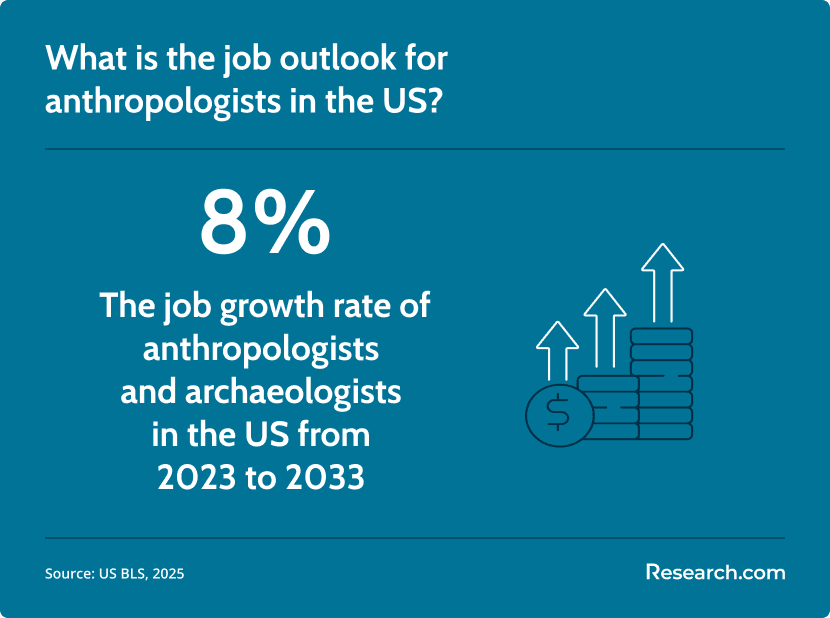
Venturing into anthropology can open you up to several professional roles and provide you with decent income potential. From 2023 to 2033, employment for anthropologists and archaeologists is expected to increase by 8%, which is faster than the average job growth rate for all occupations in the United States (US) [US Bureau of Labor Statistics (BLS), 2025]. Moreover, the median annual wage of these professionals is much higher than that of all US occupations in May 2024.
To help you learn more about this field, I created this in-depth guide to online anthropology degree programs. I will go over key information such as program curricula, common courses, tuition rates, salary potential, and career outlooks to help you decide whether this program is right for you.
What are the benefits of completing an online anthropology degree program?
- An online anthropology degree can help you become eligible for several relevant roles, including anthropologist, archaeologist, sociologist, historian, and curator.
- In May 2024, anthropologists and archaeologists in the US had a median annual wage of $64,910 (US BLS, 2025).
- Earning an anthropology degree online can provide you with flexibility. The online delivery format allows individuals to go through the program while employed or tending to personal obligations. Moreover, the format develops students’ self-discipline and technology skills.
What can I expect from an online anthropology degree program?
Online anthropology degree programs offer curricula that are similar to on-campus offerings. Courses usually cover cultural, biological, archaeological, and linguistic anthropology, with opportunities to specialize as they advance. Interactive learning tools, such as discussion forums, virtual labs, and video lectures, foster collaboration and critical thinking.
Despite the remote format, students can get strong faculty support and access to digital research resources. Assignments may include ethnographic studies, case analyses, and virtual fieldwork simulations. Moreover, flexibility is a key advantage in online anthropology degree programs. It allows learners to study at their own pace while balancing work or personal responsibilities.
Students can expect to graduate with a solid foundation in human diversity, research skills, and cultural awareness that is applicable to various careers.
Where can I work with an online anthropology degree?
In 2023, 8,700 anthropologists and archeologists worked in the US. The following industries employed the largest shares of these professionals in the same year (US BLS, 2025):
- Research and Development in the Social Sciences and Humanities (27%): Anthropologists conduct in-depth studies on human societies, behaviors, and cultural trends and contribute to scholarly knowledge.
- Management, Scientific, and Technical Consulting Services (22%): They advise businesses and organizations on cultural practices and help improve communication, diversity, and project outcomes.
- Federal Government (Excluding Postal Service) (21%): Anthropologists support policymaking, cultural preservation, and, sometimes, forensic investigations related to human remains or historical findings.
- Engineering Services (6%): They evaluate land use to ensure that development projects respect and preserve archaeological and cultural resources.
- Colleges, Universities, and Professional Schools (State) (5%): Anthropologists teach, mentor students, and lead research projects that deepen understanding of human culture and history.
How much can I make with an online anthropology degree?
Anthropologists and archaeologists in the US had a median annual wage of $64,910 in May 2024. The figure is higher than the $49,500 median annual wage of all occupations across the country (US BLS, 2025).
To give you a better idea of the potential salary range of anthropologists and archaeologists, I've listed down the average annual wages for the top industries for this discipline (US BLS, 2025):
- Federal Government (Excluding Postal Service): $89,460
- Engineering Services: $63,410
- Research and Development in the Social Sciences and Humanities: $60,940
- Management, Scientific, and Technical Consulting Services: $59,990
- Colleges, Universities, and Professional Schools (State): $57,010
In comparison to the above values, historians had a median annual wage of $74,050, and sociologists had $101,690 (US BLS, 2025). Notably, these occupations require aspirants to have earned at least a master’s degree in relevant fields. Professionals with a higher educational attainment level may be able to have increased income potential and improved employability.
- List of Online Anthropology Degree Programs for 2027 List of Programs
- How long does it take to complete an online anthropology degree program? Completion Time
- How does an online anthropology degree program compare to an on-campus program? How does an online anthropology degree program compare to an on-campus program?
- What is the average cost of an online anthropology degree program? Program Cost
- What are the financial aid options for students enrolling in an online anthropology degree program? Financial Aid
- What are the prerequisites for enrolling in an online anthropology degree program? Requirements
- What courses are typically in an online anthropology degree program? What courses are typically in an online anthropology degree program?
- What types of specializations are available in online anthropology degree programs? What types of specializations are available in online anthropology degree programs?
- How do you choose the best online anthropology degree program? How do you choose the best online anthropology degree program?
- Can an online anthropology degree boost your digital interdisciplinary expertise? Can an online anthropology degree boost your digital interdisciplinary expertise?
- What career paths are available to graduates of online anthropology degree programs? Career Paths
- What is the job market like for graduates of online anthropology degree programs? Job Outlook
Online Anthropology Degree Programs for 2027: How to Compare Your Options
An online anthropology degree can be a practical fit if you want to study human culture, language, evolution, archaeology, and social behavior without relocating or pausing work. The challenge is that anthropology programs can look similar on the surface, while costs, fieldwork expectations, transfer policies, online support, and specialization options vary widely.
This guide is designed for students comparing online anthropology bachelor’s programs, adults returning to college, transfer students, and learners considering anthropology as a path into research, museums, cultural resource management, public service, education, or graduate study. You will find featured programs, cost details, common course requirements, career outcomes, financial aid options, and decision questions to help you choose a program with fewer surprises.
Quick answer: Is an online anthropology degree worth considering?
An online anthropology degree can be worth considering if you need scheduling flexibility and want broad training in culture, research, writing, critical analysis, and human behavior. Most featured bachelor’s programs require 120 credits and are commonly structured for about 4 years of full-time study, though transfer credits, part-time enrollment, and accelerated pacing can change the timeline. Before enrolling, confirm accreditation, total cost, online student support, fieldwork or lab expectations, and whether the curriculum fits your intended career or graduate school plans.
How this list was developed
The programs below were selected using Research.com’s school ranking methodology. Our team reviewed recent information from the IPEDS database, Peterson's database, the College Scorecard database, and the National Center for Education Statistics. Use this list as a starting point, then verify current admissions rules, tuition, course availability, and graduation requirements directly with each institution.
| School | Online anthropology degree | Credits required | Cost per credit | Accreditation |
| University of Florida | Online Bachelor of Arts in Anthropology | 120 credits | $129.18 (Resident); $552.62 (Non-resident) | Southern Association of Colleges and Schools Commission on Colleges (SACSCOC) |
| University of Central Florida | Online Bachelor of Arts in Anthropology | 120 credits | $179.19 (Resident); $769.45 (Non-resident) | SACSCOC |
| Arizona State University | Online Bachelor of Arts in Anthropology | 120 credits | $671 | Higher Learning Commission (HLC) |
| Southern New Hampshire University | Online Bachelor of Arts in Anthropology | 120 credits | $342 | New England Commission of Higher Education (NECHE) |
| Oregon State University | Online Bachelor of Science or Bachelor of Arts in Anthropology | 180 quarter credits | $384 | Northwest Commission on Colleges and Universities (NWCCU) |
1. University of Florida
The University of Florida online anthropology program awards a Bachelor of Arts and covers major areas such as cultural anthropology, language and culture, biological anthropology, and world archaeology. Freshman applicants need a high school diploma or equivalent, a minimum high school GPA of 2.5, and test scores if they graduated from high school less than 5 years ago.
- Program length: 4 years
- Subfields available: Cultural Anthropology; Archaeology; Biological Anthropology; Linguistics
- Cost per credit: $129.18 (Resident); $552.62 (Non-resident)
- Credits required: 120 credits
- Accreditation: Southern Association of Colleges and Schools Commission on Colleges (SACSCOC)
2. University of Central Florida
The University of Central Florida online anthropology degree is a Bachelor of Arts program with courses such as Blood and Valor in the Viking World, Human Biological Diversity, and An Archaeology of Walt Disney World. UCF Online also provides more than 20 additional bachelor’s programs, along with graduate degrees and certificate options, which may be useful for students comparing interdisciplinary study paths.
- Program length: 4 years
- Subfields available: Archaeology; Cultural Anthropology; Linguistics; and Physical Anthropology
- Cost per credit: $179.19 (Resident); $769.45 (Non-resident)
- Credits required: 120 credits
- Accreditation: SACSCOC
3. Arizona State University
Arizona State University’s online BA in anthropology introduces students to key areas of the discipline through courses including Introduction to Cultural Anthropology, Buried Cities and Lost Tribes, and Bones, Stones, and Human Evolution.
- Program length: 4 years
- Course requirements: Major Core Courses; Sociocultural Anthropology Course; Archaeology Course; Physical/Evolutionary Anthropology Course
- Cost per credit: $671
- Credits required: 120 credits
- Accreditation: Higher Learning Commission (HLC)
4. Southern New Hampshire University
Southern New Hampshire University’s online anthropology BA includes foundational coursework in cultural anthropology, foundations in archaeology, biological anthropology, ethics in anthropology, and research literacy in the social sciences.
- Program length: 4 years
- Areas of concentration: Anthropology; Environmental Sustainability
- Cost per credit: $342
- Credits required: 120 credits
- Accreditation: New England Commission of Higher Education (NECHE)
5. Oregon State University
Oregon State University’s online anthropology program offers either a Bachelor of Science or Bachelor of Arts. Required core topics include indigenous anthropology, anthropological theories, cultural anthropology, biological anthropology, and archaeology.
- Program length: 4 years
- Subfields available: Contact the university for information on subfields.
- Cost per credit: $384
- Credits required: 180 quarter credits
- Accreditation: Northwest Commission on Colleges and Universities (NWCCU)
How long does an online anthropology degree take?
A bachelor’s degree in anthropology is commonly planned as a 4-year program for full-time students. Part-time students may need 5 to 6 years, depending on how many courses they take each term and whether they stop out for work, family, or financial reasons. Students with substantial transfer credit may finish sooner, while students who need developmental coursework or change majors may need more time.
Some programs use faster course schedules or accept generous transfer credits, which can shorten completion time in ways similar to the shortest online bachelor's in sociology degree pathways. In these cases, completion may take around 2 to 3 years for eligible students.
At the graduate level, a full-time master’s student can often complete an anthropology program in 1 to 2 years. Doctoral study is much longer and can take 4 to 7 years because of advanced research, fieldwork, language preparation, comprehensive exams, and dissertation requirements.
| Student situation | Typical timeline | What can change the timeline |
| First-time, full-time bachelor’s student | About 4 years | Course availability, general education requirements, summer enrollment, and advising |
| Part-time bachelor’s student | 5 to 6 years | Work schedule, family obligations, and number of credits taken each term |
| Transfer student | Potentially shorter than 4 years | Transfer credit acceptance, residency requirements, and major prerequisites |
| Full-time master’s student | 1 to 2 years | Thesis, applied project, internship, or research requirements |
| Doctoral student | 4 to 7 years | Fieldwork, dissertation progress, funding, and research design |
Online anthropology degree vs. on-campus anthropology degree
Online and campus-based anthropology programs often teach the same core concepts, but the experience can feel very different. The right format depends on your schedule, learning style, need for in-person mentoring, and access to field or lab experiences.
| Factor | Online anthropology program | On-campus anthropology program |
| Schedule | Often better for working adults, caregivers, military students, and learners outside commuting distance | Better for students who want a fixed weekly routine and face-to-face accountability |
| Classroom experience | Uses discussion boards, recorded or live lectures, virtual collaboration, and digital research tools | Relies more on in-person seminars, labs, campus lectures, and direct peer interaction |
| Fieldwork and lab access | May use local field assignments, digital archives, virtual simulations, or arranged experiences | May provide easier access to campus labs, collections, excavation opportunities, or faculty-led projects |
| Networking | Can include virtual advising, online research events, remote career services, and geographically diverse classmates | Can offer stronger in-person ties through clubs, faculty office hours, guest talks, and campus events |
| Best fit | Students who need flexibility and can stay organized without daily campus structure | Students who want immersive campus life and regular in-person support |
Online anthropology has become more interactive as programs use digital archives, video-based discussion, mapping tools, and collaborative research platforms. Like the best online cybersecurity bootcamps, stronger online programs do not simply post readings; they build structured learning activities, feedback loops, and applied projects into the digital format.
How much does an online anthropology degree cost?
Tuition varies significantly by school, residency status, and credit system. Among the featured programs, listed per-credit tuition ranges from $129.18 for University of Florida residents to $769.45 for University of Central Florida non-residents. These figures do not necessarily represent the full cost of attendance because fees, books, technology requirements, transfer credits, and financial aid can change the final amount a student pays.
- University of Florida: $129.18 (Resident); $552.62 (Non-resident)
- University of Central Florida: $179.19 (Resident); $769.45 (Non-resident)
- Arizona State University: $671
- Southern New Hampshire University: $342
- Oregon State University: $384
If cost is your primary concern, compare these programs with the cheapest online anthropology degree options. A lower tuition rate can help, but it should not be the only factor. A program that accepts more transfer credits, offers stronger advising, or helps you avoid unnecessary courses may be more affordable in practice.
Online students may avoid some campus-related expenses, such as housing, commuting, and meal plans. However, they may still pay technology fees, online learning fees, textbooks, software costs, and occasional travel expenses if a program requires fieldwork, residencies, or in-person activities.
Cost factors to check before enrolling
- Institution type: Public universities may charge lower rates to in-state students, while private institutions may have higher sticker prices but different financial aid models.
- Residency rules: Some online programs charge separate resident and non-resident tuition, so verify your rate before applying.
- Credit requirements: Most featured programs require 120 credits, while Oregon State University lists 180 quarter credits.
- Transfer credit policy: Accepted credits can reduce both time and cost, but schools differ in how they evaluate prior coursework.
- Fees and materials: Ask about technology fees, course materials, digital tools, exam proctoring, fieldwork costs, and graduation fees.
The chart below visualizes the cost of online anthropology degree programs using current tuition data from the featured institutions.
Financial aid options for online anthropology students
Online anthropology students may be eligible for financial aid, scholarships, grants, employer tuition benefits, and payment plans, depending on the school and the student’s circumstances. Start by asking each program whether online students have the same financial aid access as campus students and whether enrollment status affects eligibility.
- BigFuture Scholarship by The College Board: The College Board offers $40,000 and $500 scholarships through BigFuture. There are no essay or GPA requirements. Students complete six qualifying steps to receive entries in monthly drawings.
- SoFi Scholarship Giveaway: Social Finance, Inc. (SoFi), a US financial technology company, provides a $2,500 scholarship monthly. Applicants register by providing their name, email address, and school.
- Beinecke Scholarship Program: The Sperry Fund sponsors the Beinecke Scholarship for eligible students pursuing graduate study in the arts, humanities, and social sciences. Scholars receive $5,000 before entering graduate school and $30,000 during graduate study.
Questions to ask about financial aid
- Are online students eligible for the same institutional scholarships as campus students?
- Does part-time enrollment reduce aid eligibility?
- Can transfer credits lower my total tuition bill?
- Are there separate online program fees that are not included in the advertised tuition?
- Does the anthropology department offer research assistantships, paid internships, or travel support for fieldwork?
Admission requirements for online anthropology degree programs
Admission requirements vary by institution and degree level. Bachelor’s programs generally focus on high school completion, transcripts, and college readiness. Graduate programs usually require a completed bachelor’s degree, academic writing ability, and a clear research or professional goal.
- Educational background: Bachelor’s applicants usually need a high school diploma or equivalent. Helpful preparation includes courses in social sciences, history, English, writing, or world cultures. Graduate applicants generally need a bachelor’s degree, though the required major may vary.
- Transcripts and GPA: Schools commonly request official transcripts and may set a minimum GPA to confirm that applicants are prepared for college-level work.
- Application materials: Some programs ask for a personal statement, recommendation letters, a resume, or standardized test scores such as the GRE, especially at the graduate level.
Admissions requirements serve a practical purpose: they help schools determine whether students are ready for the reading, writing, research, and analysis expected in anthropology. In the same way the best online dog obedience training trade school programs define entry expectations for applied learning, anthropology programs use prerequisites to confirm academic readiness.
Common courses in an online anthropology degree
Anthropology programs usually begin with broad survey courses, then move into research methods, theory, and electives. Strong programs should teach students how to analyze evidence, write clearly, evaluate cultural assumptions, and understand human behavior across time and place.
- Cultural Anthropology: Students examine customs, social systems, beliefs, identity, kinship, power, and cultural change across societies.
- Biological Anthropology: This course studies human evolution, genetics, primates, adaptation, and biological diversity.
- Archaeology: Students learn how researchers interpret artifacts, sites, landscapes, and material evidence to understand past societies.
- Linguistic Anthropology: This course explores how language shapes culture, identity, communication, social relationships, and meaning.
- Anthropological Research Methods: Students practice techniques such as ethnography, interviewing, observation, data interpretation, qualitative analysis, and research ethics.
If your interests lean toward applied human services, community health, or behavioral research, an accelerated behavioral health science degree online may be another path to compare with anthropology.
Anthropology specializations available online
Specializations help you shape an anthropology degree around specific career or graduate school goals. Not every online program offers every subfield, so review the catalog carefully before enrolling.
| Specialization | What you study | Good fit for students interested in |
| Cultural Anthropology | Contemporary and historical cultures, social structures, traditions, institutions, belief systems, and cultural change | Community research, international work, nonprofits, policy, education, or graduate study |
| Biological Anthropology | Human evolution, genetics, biological variation, primates, adaptation, and sometimes forensic applications | Forensics, human biology, research support, museums, or advanced study |
| Archaeology | Material culture, excavation, artifact analysis, preservation, landscapes, and ancient societies | Cultural resource management, museums, heritage preservation, or field research |
| Linguistics | Language, communication, identity, culture, meaning, and social interaction | Language documentation, cross-cultural communication, education, research, or applied social science |
Students who want a broader interdisciplinary foundation may also compare anthropology with an accelerated social sciences online degree, which may combine anthropology with sociology, psychology, political science, or related fields.
The chart below shows employment levels for occupations connected to anthropology in the US in 2023, based on 2025 data from the US BLS.
How to choose the best online anthropology degree program
Higher education is a huge financial commitment, so choosing an anthropology program should involve more than scanning tuition and rankings. The best program is the one that fits your goals, budget, schedule, transfer history, and preferred learning format.
Use this checklist before applying
- Verify accreditation: Choose an institution accredited by a recognized agency. Accreditation can affect credit transfer, financial aid eligibility, graduate school admission, and employer confidence. Examples from the featured schools include HLC, SACSCOC, NECHE, and NWCCU.
- Review the curriculum: Make sure the program includes the anthropology areas you care about, such as cultural anthropology, archaeology, biological anthropology, or linguistics.
- Ask about fieldwork: Online does not always mean entirely remote. Some courses may require local research, field assignments, internships, or site visits.
- Compare total cost, not just tuition: Include fees, textbooks, transfer credit, technology, travel, and expected time to graduation.
- Check flexibility: Determine whether courses are asynchronous, synchronous, part-time, accelerated, or term-based. Some students may prefer structures similar to the shortest online liberal arts degrees if finishing quickly is a priority.
- Evaluate support services: Look for online tutoring, library access, writing support, career advising, faculty availability, internship guidance, and research resources.
Who should choose an online anthropology degree?
- Students who want to study human culture, society, language, archaeology, or evolution.
- Working adults who need a flexible degree format.
- Transfer students who want to complete a bachelor’s degree remotely.
- Learners planning for graduate school in anthropology, archaeology, museum studies, public policy, education, or social science research.
- Students who want versatile writing, research, and analytical skills rather than training for one narrow occupation.
Who may want a different degree?
- Students who want a direct path to a licensed profession should confirm whether anthropology meets their requirements or consider a more specialized major.
- Students who need extensive hands-on lab or excavation experience may prefer a campus program or a program with strong field placement support.
- Students focused primarily on clinical mental health, software development, business analytics, or healthcare licensure may find another degree more aligned with their goals.
Can an online anthropology degree build digital and interdisciplinary skills?
Yes, but the level of digital training depends on the program. Some online anthropology courses incorporate digital archives, mapping tools, qualitative data analysis, virtual collections, online collaboration, or data visualization. These tools can help students connect anthropological thinking with digital humanities, user research, museum technology, community documentation, and applied social science work.
Students who want deeper technical preparation may pair anthropology electives with coursework in data analysis, geographic information systems, statistics, communication, or technology. Those considering a stronger technology pivot can compare anthropology with affordable online software engineering degrees to see whether a technical or social science path better fits their career goals.
Common mistakes to avoid when choosing an online anthropology program
| Mistake | Why it matters | Better approach |
| Choosing based only on tuition | The cheapest per-credit rate may not be the lowest total cost if many credits do not transfer or fees are high. | Calculate total estimated cost through graduation. |
| Ignoring accreditation | Accreditation can affect financial aid, credit transfer, graduate school options, and employer acceptance. | Confirm institutional accreditation before applying. |
| Assuming online means no fieldwork | Anthropology may involve observation, interviews, local field assignments, lab-style work, or applied projects. | Ask how online students complete research and field requirements. |
| Overlooking specialization options | A program strong in cultural anthropology may not be the best fit for archaeology or biological anthropology interests. | Compare required courses, electives, faculty interests, and capstone options. |
| Relying only on rankings | Rankings can help narrow choices but cannot tell you whether a program fits your schedule, budget, or goals. | Use rankings with advising conversations, curriculum review, cost analysis, and student support checks. |
| Assuming salary outcomes are guaranteed | Anthropology career outcomes depend on location, experience, graduate education, industry, and role. | Compare realistic job paths and build applied skills while enrolled. |
Career paths for online anthropology degree graduates
Anthropology graduates can apply their training in research, writing, cultural analysis, interviewing, evidence interpretation, and communication. Some roles may require graduate education, field experience, or specialized technical skills, so students should plan early for internships, research projects, language study, or museum and archival experience.
- Anthropologists: Anthropologists study human societies, culture, behavior, and biological development. They may work in research, policy, applied anthropology, or academic settings. In May 2024, anthropologists and archaeologists across the US had a median annual wage of $64,910 (US BLS, 2025).
- Archaeologists: Archaeologists analyze artifacts, sites, and material evidence to understand past cultures. Common settings include cultural resource management, museums, government agencies, and academic research.
- Sociologists: Sociologists study social groups, institutions, relationships, and patterns using data and observation. They may work in government, nonprofits, research organizations, or education. In May 2024, sociologists employed in the US had a median annual wage of $101,690 (US BLS,2025).
- Historians: Historians research, interpret, and communicate information about the past. They often work in archives, museums, education, publishing, or research. In May 2024, historians across the US had a median annual wage of $74,050 (US BLS, 2025).
- Curators: Curators oversee collections, exhibitions, interpretation, and educational programming for museums and cultural institutions. In May 2024, curators working in the US had a median annual wage of $57,100 (US BLS, 2025).
The chart below visualizes median annual wages for occupations related to anthropology in the US in May 2024, based on 2025 data from the US BLS. Like graduates of the best online energy policy degree programs, anthropology graduates may find opportunities across government, research, nonprofit, museum, and education settings.
Job outlook for anthropology-related careers
The labor market for anthropology-related roles is positive but specialized. From 2023 to 2033, employment for anthropologists and archaeologists is projected to grow by 8%, which is faster than the average growth rate for all US occupations. This equals an average of about 800 job openings each year over the decade (US BLS, 2025).
In 2023, 21% of anthropologists and archaeologists working in the US were employed by the federal government, excluding postal service. The federal government was also the highest-paying employer for these professionals in May 2024 by median annual wage, at $89,460 (US BLS, 2025).
Research and development organizations in the social sciences and humanities were the largest employers of anthropologists and archaeologists in the US. This sector employed 27% of these professionals in 2023 and reported a median annual wage of $60,940 for them in May 2024 (US BLS, 2025). Students interested in research-oriented humanities work may also compare anthropology with an accelerated humanities degree online.
For students who want to move into academic administration, student services, institutional research, or education leadership, the best online master's in higher education programs may complement an anthropology background.
Other anthropology-adjacent occupations also had projected growth from 2023 to 2033 (US BLS, 2025):
- Archivists, Curators, and Museum Workers: 11%
- Sociologists: 7%
- Historians: 6%
Current trends affecting anthropology students
- Digital research is becoming more important: Students may benefit from learning digital mapping, archival tools, qualitative analysis software, and data visualization.
- Applied skills matter: Employers often value research design, interviewing, writing, project management, ethics training, and cross-cultural communication.
- Graduate study can expand options: Some anthropology careers, especially academic research and advanced archaeology roles, may require a master’s degree or doctorate.
- Online learning is more accepted when quality is clear: Accreditation, rigorous coursework, faculty engagement, and strong student support matter more than whether the degree was earned online or on campus.
What students say about studying anthropology online
- : "My online anthropology program let me keep working while still taking challenging courses. The format was flexible, but the expectations were serious. I also learned from classmates in different places, which made discussions about culture and society feel more immediate. — Angela"
- : "As someone balancing parenting and full-time employment, I needed a program that did not require me to be on campus several days a week. Online discussions, responsive instructors, and structured assignments helped me stay engaged without giving up my other responsibilities. — Clyde"
- : "I expected online study to feel distant, but the projects, lectures, and peer conversations made the subject come alive. I left the program with stronger research skills and a much deeper understanding of cultural diversity. — Shane"
Key Insights
- An online anthropology degree is best for flexible, research-oriented learners. It works well for students interested in culture, archaeology, language, human evolution, museums, research, public service, or graduate study.
- Most featured bachelor’s programs require 120 credits. Oregon State University lists 180 quarter credits, so compare credit systems carefully when estimating time and cost.
- Tuition varies widely. Featured per-credit rates range from $129.18 for University of Florida residents to $769.45 for University of Central Florida non-residents, before considering fees, aid, and transfer credits.
- Accreditation should be non-negotiable. Confirm that the institution is accredited by a recognized agency such as SACSCOC, HLC, NECHE, or NWCCU before enrolling.
- Career outcomes depend on more than the degree title. Fieldwork, internships, research experience, writing samples, technical tools, and graduate education can strongly influence job options.
- The job outlook is positive but specialized. Anthropologists and archaeologists are projected to see 8% employment growth from 2023 to 2033, with about 800 job openings per year on average (US BLS, 2025).
- Do not choose a program by ranking alone. The strongest choice is the program that fits your budget, transfer credits, specialization interests, schedule, and long-term career plan.
References:
- National Center for Education Statistics. (2024, May). Undergraduate Degree Fields. https://nces.ed.gov/programs/coe/indicator/cta
- US Bureau of Labor Statistics. (2025, April 18). Anthropologists and Archeologists. Occupational Outlook Handbook. https://www.bls.gov/ooh/life-physical-and-social-science/anthropologists-and-archeologists.htm
- US Bureau of Labor Statistics. (2025, April 18). Archivists, Curators, and Museum Workers. Occupational Outlook Handbook. https://www.bls.gov/ooh/education-training-and-library/curators-museum-technicians-and-conservators.htm
- US Bureau of Labor Statistics. (2025, April 18). Historians. Occupational Outlook Handbook. https://www.bls.gov/ooh/life-physical-and-social-science/historians.htm
- US Bureau of Labor Statistics. (2025, April 18). Sociologists. Occupational Outlook Handbook. https://www.bls.gov/ooh/life-physical-and-social-science/sociologists.htm
Other Things You Need to Know about Online Anthropology Degree Programs
Yes, but only if the receiving university accepts the credits and the courses were completed at a regionally accredited school. Graduate anthropology programs often require upper-division or graduate-level coursework with grades of B or higher, and some cap transfer limits at 6 to 12 credits.
Online anthropology programs in 2027 should be recognized by reputable accrediting bodies like the American Anthropological Association (AAA) or comparable regional accrediting agencies. Accreditation ensures the program meets high educational standards and enhances employment prospects.


