2027 Master's Degree in Compliance Program: Courses, Concentrations, Cost & Careers

Co-Founder and Chief Data Scientist
According to Drata, 100% of organizations without higher compliance maturity still see its value, and 99% plan to implement continuous compliance within five years. This highlights a growing demand for experts who can guide organizations in meeting evolving standards. A master's degree in compliance provides the specialized training needed to lead in this field.
This article explains the key aspects of compliance master’s programs—including courses, concentrations, costs, and career outcomes—to help prospective students make informed decisions.
What are the benefits of getting a master's degree in compliance?
- Opens the door to roles such as compliance officer, risk manager, regulatory affairs director, and chief compliance officer.
- Provides access to competitive salaries, with median pay often exceeding $80,000 annually, depending on specialization and industry.
- Establishes credibility in a highly regulated job market where advanced credentials are increasingly sought after.
What can you do with a master's degree in compliance?
A master's degree in compliance prepares graduates for leadership roles in industries where regulatory oversight is critical. Students gain expertise in corporate governance, risk management, ethics, and legal frameworks, positioning them to influence organizational decision-making.
With this credential, graduates may work in sectors ranging from healthcare and finance to technology and energy. They may oversee compliance programs, manage audits, or advise on corporate risk strategies. The degree also enhances career mobility by aligning with global standards and professional certifications that elevate long-term opportunities.
Where can you work with a master's degree in compliance?
Graduates with a master's degree in compliance often work in industries that operate under strict regulatory requirements. Common sectors include healthcare, banking, financial services, government, and energy. These industries require compliance professionals to mitigate risks, ensure ethical practices, and protect organizations from legal or financial penalties.
Employment opportunities are also strong within multinational corporations, consulting firms, and non-profit organizations. In these settings, compliance experts develop frameworks to align operations with domestic and international laws, manage cross-border regulations, and address emerging issues such as cybersecurity and data privacy.
How much can you earn with a master's degree in compliance?
According to the U.S. Bureau of Labor Statistics (BLS), compliance officers earn a median annual salary of approximately $78,420, while top earners in corporate compliance and financial services may exceed $130,000. Salaries vary depending on industry, geographic location, and years of experience.
Specialized roles such as healthcare compliance managers or chief compliance officers often command higher pay. In large organizations or highly regulated industries, professionals with this credential may see earnings rise above $150,000, reflecting both expertise and leadership responsibility.
- What is a master’s degree in compliance? Degree Overview
- What are the typical courses in a master’s in compliance curriculum? Courses
- What concentrations are available in master’s in compliance programs? Concentrations
- How much does a master’s in compliance cost in 2027? Program Cost
- How do online master’s in compliance degrees compare to on-campus programs? How do online master’s in compliance degrees compare to on-campus programs?
- What skills do students gain from a compliance master’s program? Core Skills
- How long does it take to complete a master’s degree in compliance? Completion Time
- What careers can you pursue with a master’s degree in compliance? Careers
- Is there a growing demand for compliance officers in 2027? Job Outlook
- What is the average salary for master’s in compliance graduates? Salary
- What factors should you consider when selecting a master’s in compliance program? What factors should you consider when selecting a master’s in compliance program?
Master’s Degree in Compliance: What It Is, Who It Helps, and When It Makes Sense
A master’s degree in compliance is designed for professionals who want to help organizations follow laws, regulations, internal policies, and ethical standards. It is most useful for people moving into compliance leadership, risk management, regulatory affairs, healthcare compliance, financial services compliance, data privacy, or corporate governance roles.
The degree matters because organizations face constant pressure to prove that they manage risk responsibly. Compliance teams now deal with privacy rules, cybersecurity expectations, anti-money laundering controls, healthcare regulations, environmental standards, financial reporting obligations, and global trade requirements. A graduate program can help students learn how to interpret rules, build compliance systems, investigate problems, train employees, and advise executives before mistakes become legal or financial liabilities.
This guide explains what students study in a compliance master’s program, how online and campus formats compare, what the degree may cost, how long it takes, what careers it can support, and which factors matter most when choosing a program. It also highlights decision points students should consider before enrolling, including accreditation, curriculum fit, career goals, flexibility, and return on investment.
Because compliance draws from law, business, ethics, finance, technology, and operations, many programs include topics similar to business law coursework and concentration areas. The goal is not only to understand regulations, but also to apply them in real organizations where business decisions, legal obligations, and operational risks intersect.
Quick Answer: Is a Master’s in Compliance Worth Considering?
A master’s in compliance can be worth considering if you already work in business, finance, accounting, healthcare, legal operations, audit, cybersecurity, human resources, or risk management and want to move into a more specialized or senior compliance role. It may also be useful for career changers who need structured training in regulatory systems and corporate governance.
The degree is less likely to be the best first step if you have no related work experience and are unsure which industry you want to enter. In that case, an entry-level compliance, audit, operations, or regulatory support role may help you clarify your path before investing in graduate school.
| Choose a master’s in compliance if... | Consider another path if... |
| You want to lead compliance programs, audits, investigations, or regulatory reporting. | You are looking for a broad management credential with less regulatory specialization. |
| Your target industry is heavily regulated, such as healthcare, finance, technology, energy, government, or global trade. | You are not yet sure which field or compliance specialty interests you. |
| You already have business, accounting, finance, legal, healthcare, cybersecurity, or operations experience. | You need basic business foundations before pursuing graduate-level compliance training. |
| You want a credential that signals advanced knowledge of governance, ethics, risk, and regulatory systems. | Your target role requires a law degree, licensure, or a different professional credential. |
What You Study in a Master’s in Compliance Curriculum
A compliance master’s curriculum usually combines legal interpretation, risk analysis, ethics, auditing, management, and communication. Students learn how regulations affect business operations and how organizations design controls to prevent violations. The structure is similar in some ways to the core subjects in business administration programs, but with a stronger focus on regulatory systems, internal controls, governance, and accountability.
Programs may be housed in law schools, business schools, public policy schools, or professional studies divisions. That placement can influence the curriculum. A law-school-based program may emphasize statutes, enforcement, and legal reasoning, while a business-school-based program may focus more on risk management, governance, and operational controls.
| Common Course Area | What Students Learn | Why It Matters in the Workplace |
| Corporate Governance and Ethics | Board oversight, accountability, transparency, conflicts of interest, and ethical decision-making. | Compliance professionals often advise leaders on responsible decision-making and organizational culture. |
| Risk Management and Internal Controls | How to identify, assess, monitor, and reduce legal, financial, operational, and reputational risks. | Strong controls help organizations prevent violations rather than only respond after problems occur. |
| Regulatory Law and Policy | How rules are created, interpreted, enforced, and applied across industries such as healthcare, finance, energy, and technology. | Compliance staff must translate complex rules into practical organizational procedures. |
| Compliance Auditing and Monitoring | Audit planning, testing controls, documentation, reporting, corrective action, and continuous monitoring. | Audits help organizations prove compliance and detect weaknesses before regulators or customers do. |
| Data Privacy and Cybersecurity Regulations | Privacy obligations, digital risk, data protection practices, incident response, and cybersecurity-related compliance issues. | Data governance is now a major compliance responsibility in technology, healthcare, finance, and consumer-facing organizations. |
| Leadership in Compliance Programs | Team leadership, training, reporting structures, executive communication, and culture-building. | Senior compliance roles require influence, judgment, and the ability to make regulations understandable to non-specialists. |
Master’s in Compliance Concentrations and How to Choose One
Many programs allow students to tailor the degree through a concentration, elective track, or industry-specific certificate. This matters because compliance roles differ sharply by sector. Healthcare compliance, financial compliance, cybersecurity compliance, and trade compliance may share core principles, but they involve different laws, agencies, documentation requirements, and risk scenarios.
Choosing a concentration is similar to selecting a specialized path in an online MBA in general business: the best option depends on your background, target industry, and long-term role. A general compliance track can work well for students who want broad flexibility, while a specialized concentration may be better for those who already know the field they want to enter.
| Concentration | Best Fit | Typical Focus |
| Healthcare Compliance | Students targeting hospitals, insurers, clinics, pharmaceutical organizations, or healthcare technology companies. | HIPAA, patient privacy, billing compliance, fraud prevention, clinical documentation, and healthcare regulatory standards. |
| Financial Services Compliance | Professionals interested in banking, securities, insurance, fintech, investment firms, or anti-money laundering roles. | Banking rules, securities compliance, reporting obligations, anti-money laundering laws, consumer protection, and internal controls. |
| Cybersecurity and Data Privacy Compliance | Students with technology, privacy, IT audit, cybersecurity, or data governance interests. | Digital risk, data protection, cybersecurity regulations, privacy programs, vendor risk, and breach response. |
| Corporate Governance and Risk Management | Professionals seeking roles in enterprise risk, internal audit, board advisory, ethics, or executive compliance leadership. | Governance systems, internal controls, board accountability, ethics programs, enterprise risk, and reporting structures. |
| International and Trade Compliance | Students interested in multinational companies, logistics, import-export operations, sanctions, or cross-border transactions. | Global regulations, trade controls, customs obligations, sanctions compliance, export controls, and supply chain risk. |
According to Zippia, 26% of compliance officers hold a business degree, while many others come from finance or accounting backgrounds. That background mix shows why compliance programs often appeal to people who already understand organizational operations but need deeper training in regulation, risk, and governance.
How Much Does a Master’s in Compliance Cost in 2027?
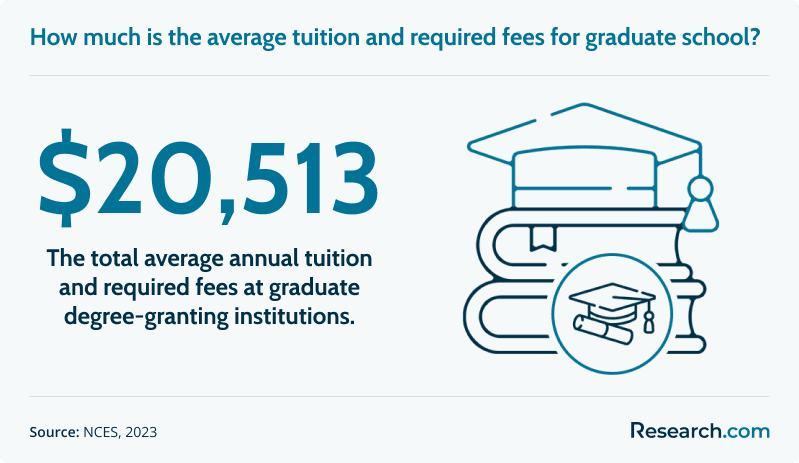
The cost of a master’s in compliance depends on the institution, program length, credit requirements, residency status, delivery format, and whether the school is public or private. According to NCES, the average graduate tuition and required fees at degree-granting institutions total $20,513 annually. Individual programs may cost less or substantially more, so students should compare the full price of attendance rather than relying only on advertised tuition per credit.
Online programs may reduce some costs, especially commuting and relocation expenses, but they are not automatically cheaper. Some online degrees charge technology fees, residency fees, graduation fees, or separate course materials costs. Students comparing affordability should also look at employer tuition assistance, scholarships, payment plans, military benefits, transfer credit policies, and whether the program can be completed faster.
Students who prioritize speed and cost control often compare compliance degrees with other efficient graduate options, such as fast-track online master’s programs in taxation management. The same cost logic applies: a shorter program can reduce time away from career advancement, but only if the curriculum, accreditation, and career relevance are strong.
| Cost Factor | Why It Matters | Question to Ask the School |
| Tuition and required fees | This is usually the largest direct cost, but the published tuition may not include every required expense. | What is the total estimated cost to complete the degree, not just the cost per credit? |
| Program length | A longer program may increase total tuition and delay career benefits. | How many credits are required, and can working students finish on a predictable schedule? |
| Online or campus format | Online study can reduce relocation and commuting costs, while campus study may offer stronger in-person networking. | Are online students charged different fees than campus students? |
| Transfer credits or prior learning | Accepted credits can reduce both time and cost. | Does the program accept graduate transfer credits or relevant professional training? |
| Employer support | Many compliance students are working professionals who may qualify for tuition reimbursement. | Does the school provide documentation needed for employer tuition assistance? |
| Career services | A lower-cost program may be less valuable if it does not support job mobility. | What career support is available to online, part-time, and working students? |
Online vs. On-Campus Master’s in Compliance Programs
Online and on-campus compliance master’s programs can lead to similar academic outcomes when they are offered by reputable, accredited institutions. The better choice depends on how you learn best, whether you are working full time, how important in-person networking is to your goals, and whether the program provides access to faculty, career services, and practical projects.
Flexibility and Access
Online compliance programs are often designed for working professionals who need to study around full-time jobs, family responsibilities, or unpredictable schedules. Like many online DBA in management programs, they may use asynchronous courses, virtual discussions, digital libraries, and remote advising. This format can be especially useful for students who do not live near a university with a strong compliance program.
Learning Environment and Networking
Campus programs may be a better fit for students who want regular face-to-face discussion, direct access to faculty, in-person events, and local employer connections. Online programs can still offer networking, but students may need to be more intentional about attending virtual events, reaching out to classmates, and using career services.
Employer Perception
Employers generally focus more on the institution’s reputation, accreditation, curriculum relevance, and the candidate’s experience than on whether the degree was earned online or on campus. The key is to choose a legitimate program that clearly lists faculty, curriculum, admissions standards, student support services, and career resources.
| Program Format | Main Advantages | Possible Drawbacks | Best For |
| Online | Flexible scheduling, no relocation, easier to maintain employment, broader school options. | Requires self-discipline; networking may be less organic; some courses may have live attendance requirements. | Working professionals, career changers, students outside major university areas, and those balancing family or travel demands. |
| On Campus | In-person faculty access, campus events, stronger local networking, structured routine. | Less schedule flexibility; commuting or relocation may increase costs. | Students who prefer classroom learning, want local employer connections, or can study full time. |
| Hybrid | Combines online flexibility with periodic in-person learning or networking. | Residencies or campus visits may add travel costs and scheduling complications. | Students who want flexibility but still value some face-to-face engagement. |
Skills Students Build in a Compliance Master’s Program
A strong compliance master’s program should develop more than knowledge of regulations. Effective compliance professionals need judgment, communication, documentation discipline, analytical thinking, and the ability to influence people who may see compliance as an obstacle rather than a business safeguard.
Data USA shows that compliance officers require higher-than-average levels of social perceptiveness, negotiation, and scientific analysis compared to many other professions. That combination reflects the reality of the work: compliance professionals must understand evidence, interpret complex rules, identify risk patterns, and communicate clearly with employees, executives, auditors, regulators, and legal teams.
The skill set overlaps with broader management and operations training. Students exploring an MBA in operations management, for example, may recognize the importance of process improvement, risk control, documentation, and cross-functional leadership. Compliance applies those capabilities to regulatory and ethical obligations.
- Regulatory analysis: Reading complex rules and translating them into policies, procedures, checklists, and training materials.
- Risk assessment: Identifying where an organization is most exposed to legal, financial, operational, or reputational harm.
- Auditing and monitoring: Testing whether controls work, documenting findings, and recommending corrective actions.
- Communication: Explaining requirements to employees, managers, executives, vendors, and external stakeholders in plain language.
- Negotiation and conflict resolution: Balancing business goals with regulatory obligations when stakeholders disagree.
- Ethical judgment: Recognizing when a technically legal action may still create governance, trust, or reputational problems.
- Leadership: Managing compliance teams, training programs, reporting systems, and enterprise-wide risk initiatives.
- Technology awareness: Understanding compliance software, reporting platforms, data privacy tools, and digital risk controls.
Students who continue into executive, consulting, or doctoral-level management paths may also compare compliance leadership with broader careers connected to a DBA in management, especially if they want to move into senior strategy, governance, or organizational leadership roles.
How Long Does It Take to Earn a Master’s Degree in Compliance?
Most full-time students complete a master’s degree in compliance in about two years. Part-time students often take three to four years, especially if they are balancing coursework with full-time employment. Accelerated or online formats may allow students to finish in as little as 12 to 18 months, depending on course availability, credit load, transfer policies, and program design.
The timeline can vary for the same reasons it does in other career-focused graduate degrees, including an MBA in sport management. Students should look beyond the advertised completion time and ask whether the schedule is realistic for someone with their job, family responsibilities, and prior academic preparation.
Program length may also depend on internships, capstone projects, concentrations, prerequisites, or whether the school accepts transfer credits. Many institutions offer flexible scheduling, but students should confirm how often required courses are offered and whether missing one course can delay graduation.
| Enrollment Pattern | Typical Completion Time | Trade-Off |
| Full time | About two years | Faster progress, but may be difficult for students working full time. |
| Part time | Three to four years | More manageable workload, but longer time to completion. |
| Accelerated or intensive online | As little as 12 to 18 months | Quicker completion, but heavier workload and less room for schedule disruptions. |
Career Paths With a Master’s Degree in Compliance
Compliance graduates work in industries where organizations must follow complex rules, document their actions, and respond to oversight. These include finance, healthcare, energy, technology, insurance, higher education, manufacturing, government, and global trade. A guide to highly regulated industries can help students understand why compliance expertise is especially important in sectors with frequent audits, reporting obligations, privacy concerns, or public safety responsibilities.
| Role | What the Role Does | Good Fit For |
| Compliance Officer | Helps an organization follow laws, regulations, internal policies, and reporting requirements. | Students seeking a direct entry or advancement path in compliance operations. |
| Risk Manager | Identifies, evaluates, and reduces operational, financial, legal, and reputational risks. | Professionals with analytical, audit, finance, operations, or governance backgrounds. |
| Healthcare Compliance Manager | Oversees privacy, billing, documentation, and regulatory standards in healthcare organizations. | Students interested in hospitals, insurers, clinics, healthcare technology, or patient privacy. |
| Corporate Governance Specialist | Advises leaders and boards on accountability, ethics, policies, oversight, and internal controls. | Professionals interested in board relations, ethics programs, or enterprise governance. |
| Chief Compliance Officer | Leads the organization’s overall compliance strategy, reporting structure, training, and risk response. | Experienced compliance professionals aiming for executive leadership. |
| Regulatory Affairs Director | Manages compliance with government rules, industry regulations, submissions, and international obligations. | Professionals targeting highly regulated industries or organizations with complex approval processes. |
A master’s degree alone does not guarantee a leadership position. Employers often weigh industry experience, technical knowledge, communication skills, certifications, and a track record of handling audits, investigations, policy development, or regulatory reporting.
Job Outlook for Compliance Officers in 2027
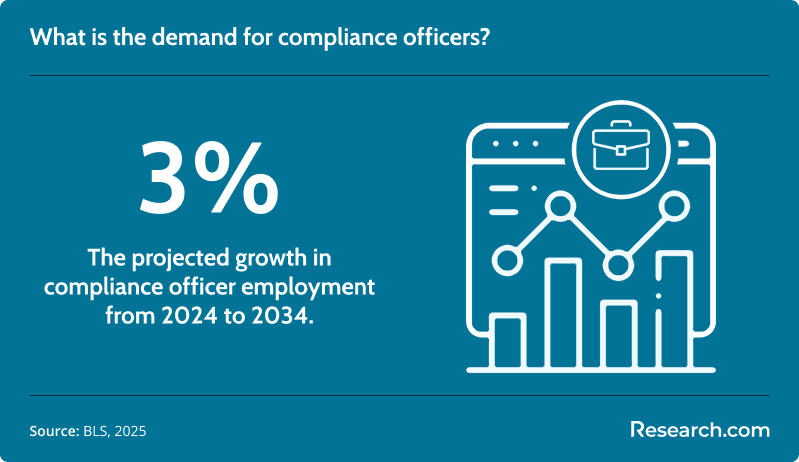
Compliance remains a steady career area because organizations continue to face regulatory scrutiny, data privacy expectations, financial controls, ethics obligations, and industry-specific oversight. According to BLS, employment of compliance officers is expected to grow by 3% from 2024 to 2034, which keeps pace with the average for all occupations.
BLS also projects an average of 33,300 compliance officer openings each year over the decade. These openings may come from new jobs as well as retirements, career changes, and workforce movement. For students evaluating graduate education, this outlook suggests stable demand, but not automatic career advancement. The strongest candidates usually combine education with relevant experience, practical compliance projects, industry knowledge, and strong communication skills.
When comparing the degree’s value, students should look at likely earnings in their target industry, local job markets, and how the credential fits with their previous experience. It may also help to compare compliance outcomes with broader data on the average salary associated with a master’s degree, while remembering that salaries vary widely by role, employer, region, and seniority.
Average Salary for Compliance Master’s Graduates
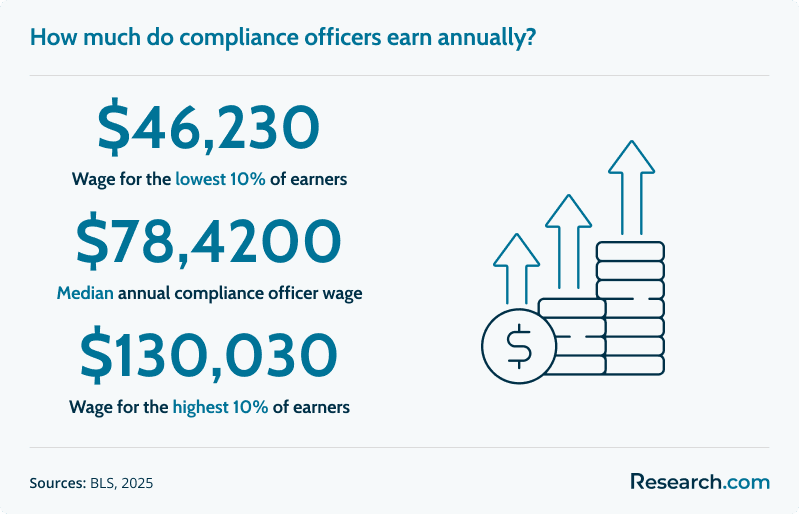
BLS reports that the median annual wage for compliance officers was $78,420 in May 2024. The median is the midpoint, meaning half of workers earned more and half earned less. Earnings vary by industry, employer size, location, experience, job level, and the complexity of the compliance responsibilities.
BLS also reports that the lowest 10% earned less than $46,230, while the highest 10% earned over $130,030. The upper end of the range is more likely to apply to experienced professionals in senior, specialized, or high-risk compliance environments. A master’s degree may help with advancement, but it should be viewed as one part of a broader career strategy that may include certifications, industry experience, audit exposure, and leadership responsibilities.
Credential quality matters. Just as students in counseling may look for COAMFTE-accredited programs when evaluating professional credibility, compliance students should confirm institutional accreditation, curriculum relevance, faculty qualifications, and employer recognition before assuming a degree will improve earnings.
Student Perspectives on a Master’s Degree in Compliance
- : "I came from an accounting background and wanted to move into regulatory work. The master’s program helped me connect audit, risk management, governance, and policy in a way I could apply at work. After graduating, I moved into a compliance officer role at a large company, and the transition felt much more realistic because I had already practiced analyzing controls and documenting risk findings. Rose"
- : "My goal was to specialize in healthcare compliance, and the degree gave me a clearer understanding of how law, ethics, privacy, and operations overlap. Courses covering patient privacy and regulatory expectations helped me speak more confidently with clinical and administrative teams. I now manage compliance responsibilities in a healthcare setting and use the program’s training regularly. James"
- : "I chose an online compliance master’s because I could not pause my full-time job. The format let me finish in 18 months while continuing to gain experience. The most useful parts were auditing, data privacy, and practical policy work, because those topics matched the risks my technology employer was already facing. Lucy"
How to Choose the Right Master’s in Compliance Program
The best compliance program is not always the most expensive, the fastest, or the highest ranked. The right choice is the one that fits your career target, schedule, budget, academic background, and preferred industry. Students comparing programs should focus on evidence of quality and career alignment rather than marketing language.
Start with accreditation. Confirm that the institution is properly accredited and that the degree is recognized by employers in your target field. Then review the curriculum closely. A student aiming for healthcare compliance should not choose a program with only one healthcare elective, just as a student targeting data privacy should look for meaningful coursework in cybersecurity, data governance, and privacy regulation.
Flexibility also matters. Students looking for fast online degrees should make sure an accelerated format is realistic, not just advertised. Ask how courses are scheduled, whether classes are asynchronous, how group work is handled, and what happens if you need to pause for a term.
| Selection Factor | What to Check | Why It Matters |
| Accreditation | Institutional accreditation and any relevant school-level recognition. | Accreditation affects credibility, transfer options, employer perception, and financial aid eligibility. |
| Curriculum fit | Required courses, electives, concentrations, capstone options, and industry coverage. | The program should match the compliance roles you actually want. |
| Faculty expertise | Instructor backgrounds in compliance, law, risk, audit, privacy, healthcare, finance, or governance. | Experienced faculty can connect regulations to real workplace problems. |
| Practical learning | Case studies, simulations, audits, policy projects, internships, or applied capstones. | Employers value candidates who can apply rules, not only describe them. |
| Format and schedule | Online, campus, hybrid, asynchronous, synchronous, full-time, part-time, or accelerated options. | The program must fit your actual life, especially if you work full time. |
| Career support | Employer connections, resume support, alumni network, internship guidance, and compliance job resources. | Career services can affect how effectively you translate the degree into advancement. |
| Total cost | Tuition, fees, books, technology costs, travel, lost work time, and available aid. | ROI depends on the full cost, not just tuition per credit. |
Common Mistakes to Avoid Before Enrolling
| Mistake | Why It Can Hurt You | Better Approach |
| Choosing a program without checking accreditation. | An unrecognized credential may limit employer trust, financial aid options, or transfer opportunities. | Verify accreditation through official school and accreditor sources before applying. |
| Looking only at tuition per credit. | Fees, required residencies, books, and longer completion times can change the real cost. | Request the total estimated cost to complete the degree. |
| Assuming every compliance program covers your industry. | A general curriculum may not prepare you for specialized areas such as healthcare, finance, trade, or data privacy. | Compare required courses and electives against job descriptions in your target field. |
| Ignoring practical experience. | A degree without projects, audits, casework, or workplace application may be less persuasive to employers. | Prioritize programs with applied assignments, capstones, internships, or employer-connected projects. |
| Choosing the fastest option automatically. | An accelerated program can be difficult to manage with full-time work and may reduce time for networking or deeper learning. | Ask current students or advisors how many hours per week the program realistically requires. |
| Assuming salary gains are guaranteed. | Earnings depend on experience, industry, location, role level, and employer demand. | Use salary data as a benchmark, not a promise, and evaluate the degree alongside your career plan. |
Current Trends Affecting Compliance Education and Careers
Compliance work is becoming more technology-driven, more cross-functional, and more visible to executive leadership. Data privacy, cybersecurity, third-party vendor risk, artificial intelligence governance, financial controls, and global regulatory complexity are increasing the need for professionals who can connect legal requirements with business operations.
AI and automation may change how compliance teams monitor transactions, review documents, flag anomalies, and manage reporting. However, these tools do not remove the need for human judgment. Compliance professionals still need to interpret context, evaluate ethical concerns, communicate with stakeholders, and decide how policies should be applied in ambiguous situations.
Employer expectations are also shifting toward practical capability. A graduate credential can help, but candidates who can show experience with audits, investigations, policy writing, risk assessment, training, monitoring systems, or regulatory reporting may be more competitive than those who rely on the degree alone.
Questions to Ask Before Applying
- Is the institution accredited, and is the program respected in my target industry?
- Does the curriculum match the compliance specialty I want to pursue?
- Are courses taught by faculty with direct compliance, legal, audit, risk, or regulatory experience?
- Can I complete the program while working full time?
- What is the total cost, including fees and materials?
- Are there applied projects, internships, simulations, or capstones?
- What career services are available to online and part-time students?
- Does the program prepare students for the types of roles I see in current job postings?
- Can I speak with an advisor, graduate, or current student before enrolling?
- How will this degree fit with my existing experience, certifications, and long-term career plan?
Key Insights
- A master’s in compliance is best suited for students who want advanced training in regulation, risk, ethics, governance, auditing, and organizational accountability.
- The degree can support careers in healthcare, finance, technology, energy, government, insurance, corporate governance, and global trade, but students should choose a program aligned with their target industry.
- According to NCES, average graduate tuition and required fees at degree-granting institutions total $20,513 annually, so comparing total program cost is essential.
- BLS reports a median annual wage of $78,420 for compliance officers in May 2024, with the lowest 10% earning less than $46,230 and the highest 10% earning over $130,030.
- BLS projects 3% employment growth for compliance officers from 2024 to 2034, with an average of 33,300 openings each year over the decade.
- Online, campus, and hybrid formats can all be valid if the institution is reputable and accredited; the right format depends on schedule, learning style, networking needs, and career goals.
- Students should avoid choosing a program based only on speed, tuition, or rankings. Curriculum fit, accreditation, faculty expertise, applied learning, and career support are more important decision factors.
- A master’s degree can strengthen a compliance career, but it does not guarantee a specific salary or job title. Experience, specialization, industry knowledge, and communication skills remain critical.
References:
- BLS. (2025, August 28). Compliance officers. bls.gov.
- Data USA. (2025). Compliance officers. datausa.io.
- NCES. (2023). Average and percentiles of graduate tuition and required fees in degree-granting postsecondary institutions, by control of institution: Academic year 1989-90 through 2021-22. nces.ed.gov.
- Stevenson, R. (2025, January 20). 115 Compliance Statistics You need to know in 2025. drata.com.
- Zippia. (2025, January 8). How to become a compliance officer: what it is and career path. zippia.com.
Other Things You Should Know About Master's Degree in Compliance Programs
Most 2027 compliance master’s programs offer concentrations in healthcare compliance, financial services compliance, corporate ethics, and regulatory risk management. Some also include data privacy and anti-money laundering, with each track usually requiring 9 to 12 credit hours of specialized coursework.
A 2027 Master’s Degree in Compliance typically includes courses in regulatory frameworks, risk management, ethical practices, and industry-specific compliance. Students might also engage in case studies and hands-on projects, requiring completion of around 30-36 credit hours to graduate.