
2027 Master’s vs. PhD: Explaining the Difference

Co-Founder and Chief Data Scientist
Deciding between a Master's degree and a Doctor of Philosophy or PhD degree is one of the most significant choices for a high-achieving student. Both represent prestigious credentials that unlock superior career advancement and earning potential in a competitive global market.
Many individuals dream of pursuing these advanced degrees, and current enrollment and graduation trends indicate their growing popularity. Data from the World Population Review shows that 2% of the population in the United States holds a doctorate as of 2023. Meanwhile, 21.4% of graduates in 2022 received a master’s.
Whether you aim to advance in your field, transition into academia, or drive new discoveries, this guide will help you understand the differences between these graduate degrees. This way, you can make an informed and rewarding educational investment.
Key Points of Master's vs. PhD Degrees
- Master’s degree graduates can earn median salaries typically ranging from $70,000 to $90,000, while those with PhDs can make median salaries often exceeding $100,000, depending on the field
- PhD programs frequently offer stipends and tuition waivers, while master’s students often rely on scholarships, employer support, or self-funding.
- Choosing the right degree depends on career goals, time commitment, and whether a focus on applied skills or research mastery is the priority.
Affordable Quick Online Degree Programs With High Acceptance Rates
1. Nursing
A nursing degree opens doors to one of the most trusted and in-demand professions in healthcare. Students gain hands-on experience in patient care, leadership, and evidence-based practice, preparing them for rewarding roles in hospitals, clinics, and community health settings.
2. Computer Science
A valuable degree that offers essential tech skills in areas like coding and analysis, allowing for flexible learning to start a lucrative IT career quickly in a high-growth field. Graduates often move into roles in software engineering, cybersecurity, or data science, where innovation and demand continue to rise.
3. Healthcare Administration
This degree prepares leaders for the booming healthcare sector, covering management and policy. It is a great option for career stability and high earning potential. Students develop leadership, budgeting, and compliance skills that are essential for running efficient healthcare organizations.
4. Management
Management degree programs teach leadership and strategic thinking across various industries. Many management programs offer online flexibility, making it ideal for working professionals seeking promotions or wanting to start their own business. Graduates often pursue roles in operations, project management, or executive leadership.
5. Management Information Systems
Bridging the gap between business strategy and technology, a management information systems (MIS) degree is highly valued for teaching data analysis and IT management skills in a rapidly evolving job market. Graduates are well-positioned for roles like systems analyst, IT manager, or business consultant in virtually any industry.
6. Accounting
This degree leads to stable, high-demand careers in auditing, tax preparation, and financial analysis. Its clear career pathways and Certified Public Accountant (CPA) exam eligibility make it especially valuable. Graduates play a key role in ensuring financial accuracy, compliance, and strategic decision-making for businesses and individuals alike.
7. Business Administration
Extremely versatile, this degree provides a broad understanding of core business functions (finance, marketing, operations), offering excellent marketability and practical skills. It’s ideal for those seeking management positions or planning to launch their own ventures in a competitive business landscape.
8. Economics
An economics degree is a respected foundation for diverse high-salary careers. It develops critical thinking and quantitative analysis skills, which are transferable to finance, consulting, and policy. Graduates often excel in roles that require data-driven decision-making and strategic insight into market trends.
9. Social Work
This is a purposeful degree for making a direct, meaningful community impact, and it qualifies graduates for critical entry-level human services and advocacy roles in a growing field. The program builds strong interpersonal, crisis intervention, and case management skills that help drive positive social change.
10. Special Education
A rewarding, high-demand field focused on supporting diverse learners. The online format is popular as it allows for professional development while already teaching. Graduates are equipped to design inclusive classrooms and advocate for students with special learning needs in schools and communities.
- What are Master’s and PhD degrees? Master's vs. PhD
- How long does it take to complete a Master’s vs a PhD degree? Time to Completion
- How much coursework vs independent research is in a master’s compared with a PhD? How much coursework vs independent research is in a master’s compared with a PhD?
- How much do master’s programs cost versus PhD programs? Average Cost
- Can you skip a Master's degree and go straight to a PhD program, and is it recommended? Can you skip a Master's degree and go straight to a PhD program, and is it recommended?
- Is it easier to gain admission to master’s or PhD programs? Admission Process
- Do PhD programs offer more financial aid options than master’s programs? Financial Aid
- Does a PhD open more career doors than a master’s? Career Opportunities
- What is the earning potential difference of a Master's vs PhD salary? Earning Potential
- How do I decide whether to get a master’s or a PhD? How do I decide whether to get a master’s or a PhD?
- What are the common challenges in pursuing a master’s versus a PhD? What are the common challenges in pursuing a master’s versus a PhD?
Choosing between a master’s degree and a PhD is not just a question of academic level. It affects how long you stay in school, how much you may pay or receive in funding, the kinds of jobs you can pursue, and whether your future work is likely to be practice-focused, research-focused, or both. For many students and working professionals, the real decision is whether they need a faster, career-oriented credential or a longer doctoral pathway built around original research.
This guide explains the practical differences between a master’s and a PhD, including admissions, program length, coursework, research expectations, costs, funding, career outcomes, salary potential, and common decision mistakes. It is designed for bachelor’s degree holders, career changers, working professionals, and prospective researchers who want to choose the graduate path that fits their goals.
Quick answer: Master’s vs PhD
A master’s degree is usually the better choice if you want advanced professional skills, a faster route to career advancement, or a credential for a specialized role. A PhD is usually the better choice if your goal is university teaching, independent research, advanced scientific work, or becoming a subject-matter expert who contributes new knowledge to a field.
| Decision factor | Master’s degree | PhD degree |
| Main purpose | Build advanced knowledge and applied professional skills | Produce original research and develop deep scholarly expertise |
| Typical completion time | One to three years | Four to seven years |
| Best fit | Career advancement, career change, licensure preparation, professional specialization | Academic careers, research leadership, high-level technical specialization |
| Research expectation | Often includes a thesis, capstone, research paper, or applied project | Requires sustained independent research and a dissertation or thesis defense |
| Funding pattern | Often self-funded through loans, employer support, scholarships, or assistantships | More likely to include tuition waivers, stipends, and assistantships in research-focused fields |
| Career timing | Faster return to the labor market | Longer training period before full-time professional earnings |
What are master’s and PhD degrees?
Master’s and PhD degrees are graduate-level credentials that usually come after a bachelor’s degree. A bachelor’s degree is the standard academic foundation for most graduate programs, although admissions requirements vary by institution, field, and program type.
If your undergraduate GPA is a concern and you have not yet completed a bachelor’s degree, it may help to research colleges with low GPA requirements before planning for graduate study. Strengthening your undergraduate record can make future master’s or doctoral applications more competitive.
A master’s degree focuses on advanced knowledge in a specific discipline or profession. Many programs are designed around workplace application, leadership preparation, technical specialization, licensure preparation, or career transition. Common examples include MA, MS, MBA, MEd, MPH, MSN, and other professional graduate degrees.
A PhD, or Doctor of Philosophy, is a research doctorate. It is built around advanced theory, research methods, critical analysis, and the production of original scholarship. PhD graduates often work in academia, research institutions, laboratories, policy organizations, technology firms, consulting, healthcare research, and other specialized settings where advanced research training is valuable.
The simplest distinction is this: a master’s degree helps you master existing knowledge for professional or academic advancement, while a PhD trains you to create new knowledge through independent research.
Graduate education remains a major part of the U.S. higher education landscape. According to the National Student Clearinghouse Research Center, graduate enrollment increased by 1.5% in Spring 2025 from the prior year. Graduate enrollment totals for the last three years were:
- 2025 - 3,114,726
- 2024 - 3,068,969
- 2023 - 2,979,730
How long does it take to complete a master’s versus a PhD?
Program length is one of the most important differences between a master’s and a PhD. A master’s is usually a shorter credential that can be completed while working, while a PhD is a multi-year research commitment that can shape your career path for much longer.
- A master’s degree typically takes one to three years, depending on whether the program is full-time, part-time, accelerated, online, or cohort-based.
- Some pathways combine credentials. For example, students exploring alternative routes to earn a master’s in education may find programs that connect bachelor’s completion, teacher certification or licensure, and graduate study.
- A PhD usually takes four to seven years because students must complete advanced coursework, pass comprehensive or qualifying exams, conduct original research, write a dissertation, and defend it before a committee.
- Completion time can change based on research complexity, advisor availability, funding, field of study, institutional rules, part-time or full-time enrollment, and personal circumstances.
- Online and hybrid graduate programs can make scheduling easier for working adults, but they do not automatically reduce academic expectations.
- In the U.S., many PhD programs admit students directly after a bachelor’s degree. In some programs, students who complete early doctoral coursework and exams but do not continue to the dissertation may receive a master’s degree along the way, sometimes called a “master’s by the way.”
| Timeline stage | Master’s degree | PhD degree |
| Early stage | Core courses, foundational theory, applied assignments | Advanced coursework, research methods, field exams or qualifying preparation |
| Middle stage | Electives, practicum, project, internship, or thesis preparation | Comprehensive or qualifying exams, advisor selection, dissertation proposal |
| Final stage | Capstone, thesis, portfolio, final exam, or applied project | Original research, dissertation writing, publication work, and defense |
| Typical duration | One to three years | Four to seven years |
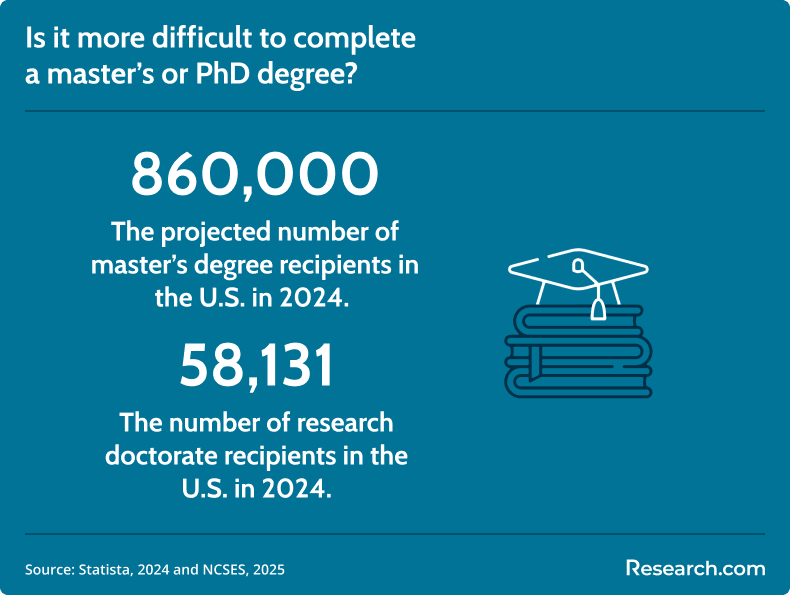
The number of master’s degrees conferred in 2021-2022 was 880,250. Statista projects the total will decline to about 860,000 in 2024 and then rise to 1,000,460 by 2031-2032.
For research doctorates, the National Center for Science and Engineering Statistics reported 58,131 recipients in 2024. The recent trend shows steady growth over the past three years.
How much coursework versus independent research is required?
The academic experience differs sharply. Master’s programs are usually structured around courses and applied learning, while PhD programs gradually move away from classes and toward independent research. This difference matters because it affects your daily routine, the skills you build, and the kind of work you are prepared to do after graduation.
- In many master’s programs, about 60% of the experience is coursework, including lectures, seminars, exams, applied assignments, case studies, labs, or fieldwork. Around 40% may involve a thesis, capstone, research project, practicum, or portfolio.
- Professional master’s degrees, including many MA, MS, and MBA programs, often emphasize job-ready skills, applied analysis, leadership, and practice-based projects.
- Many master’s programs use a capstone or major paper rather than a full research thesis. These projects are usually applied and do not have to make an original contribution to knowledge.
- A Master’s in Research, or MRes, is different from many professional master’s degrees because it is designed for research preparation and may serve as a bridge to doctoral study. A master thesis in this format can take six to 12 months to complete.
- PhD programs usually begin with coursework, but the main milestone is the shift into independent research.
- In many PhD programs, about 15% to 40% of the program is devoted to coursework and required research training. This phase often ends with comprehensive or qualifying exams.
- The longest part of a PhD is the dissertation or thesis stage, which includes research design, data collection or source analysis, interpretation, writing, revision, and an oral defense.
| Learning format | Master’s degree | PhD degree |
| Coursework | Central part of most programs | Important early phase, but not the final goal |
| Research | May be applied, limited, or optional depending on the program | Required and extensive |
| Final requirement | Thesis, capstone, exam, practicum, portfolio, or project | Dissertation or thesis based on original research |
| Student role | Advanced learner and emerging practitioner | Independent researcher and future scholar or specialist |
Students comparing academic doctorates with professional doctorates may also want to review the difference between an MD and a PhD. That comparison shows how practice-based doctoral training differs from research-based doctoral education.
How much do master’s programs cost compared with PhD programs?
Cost comparisons can be misleading if you look only at tuition. A master’s degree may have a lower sticker price because it is shorter, but many master’s students receive less institutional funding. A PhD may have a higher published tuition cost, but research-focused doctoral programs often provide assistantships, tuition waivers, stipends, or health insurance support.
- College Board data on published prices for 2024-2025 shows average tuition and fees of $9,560 for master’s degrees and $12,270 for doctoral programs at public four-year institutions.
- At private nonprofit four-year higher education institutions, average tuition and fees are $31,930 for a master’s and $51,940 for a doctorate.
- Room and board for master’s students may cost about $11,700 to $14,200.
- Doctoral students may face housing and food budgets of around $13,400 to $17,500.
- Online master’s programs are often more affordable than campus-based options, and public universities commonly charge lower tuition than private institutions.
- Many PhD programs, especially in research-intensive fields, reduce out-of-pocket costs through tuition waivers and stipends tied to teaching or research assistantships.
| Cost factor | Master’s degree | PhD degree |
| Published public four-year tuition and fees | $9,560 | $12,270 |
| Published private nonprofit four-year tuition and fees | $31,930 | $51,940 |
| Room and board or housing and food | About $11,700 to $14,200 | Around $13,400 to $17,500 |
| Common funding sources | Loans, scholarships, employer tuition support, payment plans, limited assistantships | Assistantships, tuition waivers, stipends, grants, fellowships, and health insurance support in many research programs |
| Biggest financial risk | Borrowing for a degree without confirming salary or licensure outcomes | Spending many years in training with delayed full-time earnings or uncertain academic job prospects |
The chart below shows the difference in published tuition and fee prices for master’s and PhD programs.
If you are comparing professional and academic graduate pathways, the cost structure in an MBA versus PhD decision is especially useful. MBA programs are usually shorter and career-oriented, while PhD programs often take longer but may include funding that changes the true cost calculation.
Can you skip a master’s and go straight to a PhD?
Yes. In many North American universities, students can enter a PhD program directly after completing a bachelor’s degree. Whether this is a smart move depends on your research preparation, academic record, field, career goals, and tolerance for a long program.
When direct entry to a PhD makes sense
- You have strong undergraduate research experience. Honors theses, lab work, field research, conference presentations, publications, or close faculty mentorship can strengthen a direct-entry application.
- Your field commonly admits bachelor’s-level applicants. Direct entry is common in many STEM fields and social sciences, though practices vary by department and institution.
- You are confident you want a research career. A PhD is not simply a longer master’s. It is a research apprenticeship that requires sustained motivation and independent inquiry.
- You have a clear research fit. PhD admissions often depend on whether faculty are available to supervise your area of interest.
- You are prepared for a five-to-seven-year structure. Direct-entry PhD programs usually include early coursework that functions like master’s-level training before students advance to doctoral candidacy.
When earning a master’s first may be better
- You are changing fields and need prerequisite coursework.
- Your undergraduate GPA or research background is not yet competitive for doctoral admissions.
- You want to test whether graduate-level research is right for you before committing to a PhD.
- Your target profession requires only a master’s degree, not a doctorate.
- You want a shorter credential that can improve your career options sooner.
Some PhD students earn an internal master’s during doctoral study after completing coursework, exams, or a smaller thesis-equivalent requirement. However, students should not assume every program offers this option. Ask directly before enrolling.
Students in psychology and behavioral sciences often face a similar choice when comparing a master’s versus doctorate in psychology. Some students benefit from a terminal master’s for licensure preparation or work experience, while others pursue doctoral study for research, clinical specialization, or academic careers.
Is admission easier for a master’s or a PhD?
Master’s programs are generally easier to enter than PhD programs because they often admit larger cohorts and may evaluate applicants across a wider range of academic and professional backgrounds. PhD admissions are usually more selective because they depend on faculty supervision, research alignment, and available funding.
- PhD programs often have limited seats tied to faculty capacity, grant support, lab space, and department funding.
- Faculty may spend years mentoring each doctoral student, which makes research fit and long-term potential especially important.
- PhD applicants usually need strong academic records, research experience, persuasive recommendations, and a clear statement of research interests.
- Master’s admissions often emphasize undergraduate GPA, prerequisite courses, professional goals, relevant experience, and readiness for graduate-level work.
- Both types of programs may require transcripts, recommendation letters, statements of purpose, resumes, interviews, portfolios, writing samples, or standardized test scores. Business applicants may also need to understand GMAT score expectations for MBA programs.
Can work experience help with graduate admissions?
Work experience can strengthen a graduate application, but it matters differently for master’s and PhD programs.
- Professional or applied master’s programs may value work experience because it shows maturity, motivation, leadership, industry exposure, and readiness for advanced practice.
- Career changers can use relevant work experience to explain why they are prepared for a new field, especially when paired with prerequisite coursework or certifications.
- For PhD programs, work experience is most useful when it demonstrates research ability, technical skill, publication potential, or readiness for independent scholarly work.
- Examples of especially relevant PhD preparation include research assistant roles, predoctoral fellowships, industry research and development positions, patents, publications, conference presentations, or advanced data and lab experience.
The best application strategy is to study each program’s requirements, faculty interests, funding model, and admissions priorities. A generic application is rarely competitive for a PhD and may also weaken a professional master’s application if it does not explain why the program fits your goals.
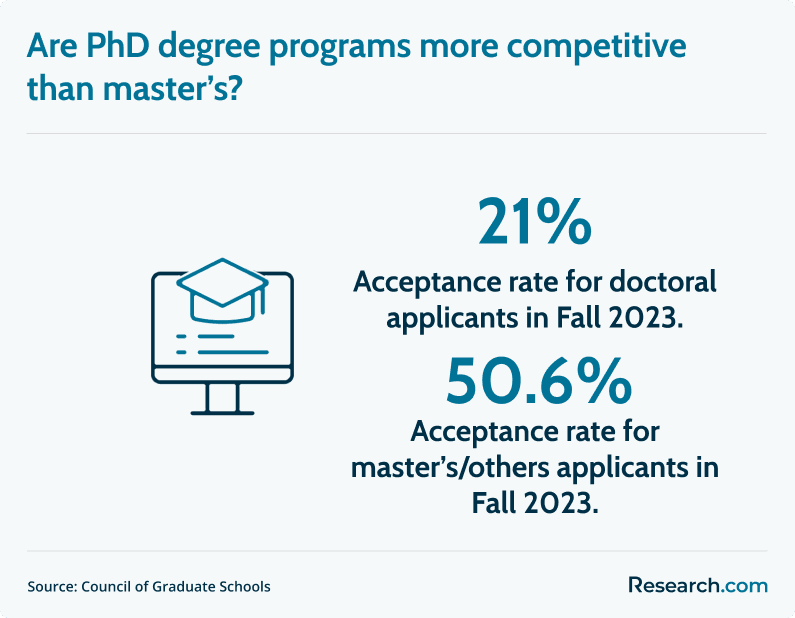
The Council of Graduate Schools reported that applications to graduate programs in Fall 2023 reached 2.7 million. More than 1.9 million applications were for master’s programs, while about 817,000 were for doctoral programs at research institutions. Among those applications, 50.6% of master’s/other applicants and 21% of doctoral applicants were accepted for admission.
The role of experience is also important in applied fields. For example, students asking whether a construction management degree is worth it should think similarly: professional background can strengthen a case for admission or advancement, but it does not automatically replace academic preparation when a program requires specific credentials.
Do PhD programs offer more financial aid than master’s programs?
In many research-focused fields, PhD programs provide more substantial funding than master’s programs. This is because doctoral students often contribute to a university’s research and teaching mission through assistantships, lab work, instruction, grading, or funded projects.
- PhD funding packages may include full tuition waivers, stipends, and health insurance, often in exchange for teaching or research responsibilities.
- Funding can allow doctoral students to focus more heavily on research, although assistantships still require time and labor.
- Master’s students more commonly rely on scholarships, employer tuition assistance, federal or private loans, payment plans, personal savings, or part-time work.
- Some master’s programs offer assistantships or tuition discounts, but full funding is less common than in many PhD programs.
That said, graduate funding is changing. Budget pressures in scientific research, the end of Grad PLUS loans, and federal student loan limits can create new challenges for students trying to finance advanced degrees. Prospective students should avoid relying on a single funding source and should request written details about tuition, fees, stipend amounts, assistantship duties, renewal conditions, and health insurance coverage.
| Funding question to ask | Why it matters |
| Is funding guaranteed, competitive, or year-to-year? | A multi-year offer is very different from a one-year award that must be renewed. |
| Does the stipend cover local living costs? | A funded PhD can still be financially difficult in high-cost cities. |
| What work is required for the assistantship? | Teaching, grading, lab work, or research assignments can affect time to degree. |
| Are fees included in the waiver? | Some students receive tuition waivers but still pay mandatory fees. |
| Can funding be lost? | Academic progress rules, advisor changes, budget cuts, or grant endings can affect support. |
Does a PhD open more career doors than a master’s?
A PhD does not automatically open “more” career doors. It opens different doors. The value of each credential depends on the field, employer expectations, required qualifications, and whether the role is built around practice, leadership, research, or teaching.
- A master’s degree can support movement into advanced practitioner roles, management roles, senior analyst positions, specialized technical work, counseling or healthcare-related licensure pathways, education leadership, public policy, data roles, and business leadership.
- Examples of roles that may align with a master’s include Data Analyst, Senior Engineer, Project Manager, mental health practitioner roles, and management positions.
- A PhD is often necessary or strongly preferred for faculty roles, principal investigator positions, advanced research scientist jobs, and leadership roles in research-intensive organizations.
- Examples of PhD-aligned roles include Principal Scientist, Director of Research & Development, Advanced Consultant, Post-Doctoral Researcher, and tenure-track Professor.
- In academia, PhD holders can pursue tenure-track faculty positions and research university leadership tracks. Master’s degree holders are more often limited to Instructor, Lecturer, or Adjunct Professor roles, depending on the institution and discipline.
- A PhD signals deep expertise in a narrow area. A master’s often provides broader career mobility and a faster return to full-time employment.
- In 2024, the unemployment rate was 1.2% for workers with a doctoral degree and 2.2% for workers with a master’s degree.
Some occupations have especially strong demand for workers with graduate-level education. Using the latest U.S. Bureau of Labor Statistics figures, the chart below shows occupations with the most openings for graduate degree holders.
What is the salary difference between a master’s and a PhD?
PhD holders generally have higher median earnings than master’s degree holders, but salary comparisons should be interpreted carefully. Field, industry, location, role, employer type, work experience, and years spent outside the full-time workforce during doctoral study can all change the return on investment.
According to the U.S. Bureau of Labor Statistics, median weekly earnings for full-time workers age 25 and older show the following pattern:
- Doctoral degree - $2,278
- Master’s degree - $1,840
- Bachelor’s degree - $1,543
Payscale reports an average yearly base salary of $87,000 for a master’s degree and $113,000 for a PhD.
However, the highest-paying path is not always the doctorate. Salary depends heavily on role and sector. For example, an Assistant Professor with a PhD earns an average of $77,567 per year, while a Vice President of Marketing with a master’s earns an average of $166,467 per year.
STEM and healthcare fields may show stronger PhD salary premiums, especially for research-intensive positions. In some business and management tracks, a master’s degree combined with experience may lead to stronger earnings than a PhD.
A U.S. hiring manager survey reported by Resume Genius also suggests that a master’s degree can improve salary performance, with one in every four hiring managers saying they would offer a 20% salary increase to candidates with a master’s.
If you are comparing graduate credentials in healthcare, our guide to the benefits of a DNP degree explains how a professional doctorate can affect nurse practitioner careers.
How do you decide whether to get a master’s or a PhD?
The best choice depends on the job you want, the credential required, the time you can invest, the funding available, and whether you prefer applied work or independent research. Start with the career outcome, not the degree title.
| Choose a master’s if... | Choose a PhD if... |
| You need a faster credential for promotion, specialization, or career change. | You want to conduct original research or become a university professor. |
| Your target job requires or prefers a graduate degree but not a doctorate. | Your target job specifically requires a doctorate or advanced research training. |
| You want structured coursework and applied projects. | You are comfortable with independent, long-term research. |
| You want to keep working while studying, especially in an online or part-time format. | You can commit several years to doctoral coursework, exams, teaching or research duties, and a dissertation. |
| You are still exploring whether graduate research is right for you. | You already have a strong research direction and faculty fit. |
- Confirm the degree required for your goal. Some roles, such as research scientist positions in many STEM fields, may require a PhD. Other roles may reward a master’s but not require doctoral training.
- Consider career flexibility. A master’s can be a practical option for career changers or professionals who need an advanced credential quickly.
- Calculate the real time and financial cost. A PhD can come with funding, but it also delays full-time earnings. A master’s can be faster, but it may require more borrowing.
- Evaluate work-life fit. Doctoral study can involve years of research uncertainty, writing, teaching, and advisor dependence. A master’s may offer more predictable structure.
- Match the format to how you learn. Students researching alternative colleges for exceptional students should also consider whether they thrive in structured coursework, independent research, online learning, or highly mentored academic environments.
Another practical consideration is whether the degree aligns with workforce demand. Current data indicates that demand for graduate-level education is projected to keep growing. The chart below provides additional detail.
What challenges should you expect in a master’s versus a PhD?
Master’s and PhD programs are difficult in different ways. Master’s programs are shorter, but the pace can be intense because students must complete advanced coursework, projects, exams, internships, or licensure-related requirements in a compressed period. Many master’s students also work while enrolled, which can make time management the biggest challenge.
PhD programs are longer and less predictable. Doctoral students must manage research setbacks, advisor relationships, publication expectations, funding uncertainty, teaching duties, dissertation isolation, and an extended timeline before entering or returning to the full-time workforce. The challenge is not only academic ability; it is persistence through ambiguity.
| Common challenge | More common in master’s programs | More common in PhD programs |
| Fast academic pace | Yes | Sometimes, especially during coursework |
| Limited funding | Yes | Varies by field and program |
| Long time to completion | Less common | Yes |
| Research uncertainty | Moderate if a thesis is required | High |
| Advisor dependence | Usually limited | High |
| Balancing school with work | Common | Possible but often difficult in funded full-time programs |
If your goal is faster career mobility rather than graduate research, you may also want to compare shorter programs or career-focused credentials, including options discussed in guides to quick degrees that pay well.
Current trends affecting master’s and PhD decisions
Graduate education decisions are being shaped by several forces: employer demand for specialized skills, rising concern about student debt, changing federal loan rules, growth in online learning, and increased scrutiny of return on investment. Students should now evaluate graduate school less as a default next step and more as a targeted investment.
- Employers are becoming more skills-focused. A degree can help, but portfolios, research output, certifications, work experience, technical skills, and internships can also influence hiring.
- Online and hybrid graduate programs are now mainstream options. They can improve access for working adults, but students should still verify accreditation, faculty access, career services, and licensure alignment.
- Funding uncertainty matters more. Research budget pressures and student loan changes make it important to compare total costs, not just tuition.
- AI is changing graduate-level work. Students in data, business, education, healthcare, engineering, and research fields should expect employers and universities to value AI literacy, data interpretation, ethical judgment, and advanced problem-solving.
- Doctoral career planning needs to start early. Tenure-track academic jobs can be competitive, so PhD students should build transferable skills for industry, government, nonprofit, and research organization roles.
Common mistakes when choosing between a master’s and a PhD
| Mistake | Better approach |
| Choosing a PhD because it sounds more prestigious | Choose a PhD only if the career outcome requires or strongly benefits from doctoral research training. |
| Looking only at tuition | Compare total cost, fees, living expenses, lost earnings, funding, loan terms, and time to completion. |
| Assuming all online programs meet licensure requirements | Confirm state-specific licensure rules before enrolling, especially in education, counseling, psychology, nursing, and healthcare fields. |
| Applying to PhD programs without faculty fit | Identify faculty whose research matches your interests and verify whether they are accepting students. |
| Using rankings as the only decision tool | Evaluate accreditation, outcomes, funding, curriculum, research fit, career support, completion rates, and alumni paths. |
| Assuming salary increases are guaranteed | Research actual roles, industries, geographic markets, and employer requirements before borrowing for graduate school. |
| Ignoring transfer credits or prerequisite rules | Ask whether prior graduate coursework, professional certifications, or work experience can reduce time or cost. |
Questions to ask before enrolling
- What exact job or career outcome am I pursuing, and which degree do employers require?
- Is the program accredited by the appropriate institutional or programmatic accreditor?
- For licensure-based fields, does the program meet requirements in the state where I plan to work?
- What is the full cost, including tuition, fees, books, technology, travel, housing, and lost income?
- What funding is guaranteed, and what conditions must I meet to keep it?
- What are the program’s completion rates, average time to degree, and career outcomes?
- Who will advise or supervise me, and how available are they?
- Can I complete the program while working, or is full-time study expected?
- Will I build a portfolio, thesis, dissertation, publication record, internship experience, or professional network?
- If I leave before finishing, what credential or credits will I have?
References
- Gulish, A. et al. (2024). Graduate Degrees: Risky and Unequal Paths to the Top. Georgetown University Center on Education and the Workforce. https://cew.georgetown.edu/wp-content/uploads/cew-graduate_degrees-fr.pdf
- Hanson, M. (January 2025). College Enrollment & Student Demographic Statistics. Education Data Initiative. https://educationdata.org/number-of-college-graduates
- Korhonen, V. (August 2024). Number of Master's degree recipients U.S. 1880-2032. Statista. https://www.statista.com/statistics/238236/masters-degree-recipients-in-the-us/
- Lanier, L. et al. (2024). Graduate Enrollment and Degrees: 2013 to 2023. Council of Graduate Schools. https://cgsnet.org/wp-content/uploads/2024/12/GED-2024-1.1.pdf
- Ma, J. et al. (2024). Trends in College Pricing and Student Aid 2024. College Board. https://research.collegeboard.org/media/pdf/Trends-in-College-Pricing-and-Student-Aid-2024-ADA.pdf
- National Center for Science and Engineering Statistics. (August 2025). Survey of Earned Doctorates (SED) 2024. https://ncses.nsf.gov/surveys/earned-doctorates/2024#data
- National Student Clearinghouse Research Center (May 2025). Current-Term Enrollment Estimates, Spring 2025. https://nscresearchcenter.org/current-term-enrollment-estimates
- Payscale (February 2025). Master's Degree Salary. https://www.payscale.com/research/US/Degree=Master%27s_Degree/Salary
- Payscale (September 2025). Doctor of Philosophy (PhD) Salary. https://www.payscale.com/research/US/Degree=Doctor_of_Philosophy_(PhD)/Salary
- Torpey, E. (September 2025). Education level and projected openings, 2024–34. U.S. Bureau of Labor Statistics. https://www.bls.gov/careeroutlook/2025/article/education-level-and-openings-2024-34.htm
- U.S. Bureau of Labor Statistics (August 2025). Education pays. https://www.bls.gov/emp/chart-unemployment-earnings-education.htm
- World Population Review (October 2024). PhD Percentage per Country 2025. https://worldpopulationreview.com/country-rankings/phd-percentage-by-country
Key Insights
- A master’s degree is usually the stronger choice for faster career advancement, career switching, professional specialization, and roles that do not require doctoral research training.
- A PhD is the better fit for students who want to conduct original research, teach at the university level, lead research teams, or qualify for highly specialized expert roles.
- Time commitment is a major difference: master’s programs typically take one to three years, while PhD programs usually require four to seven years.
- Sticker price does not tell the full cost story. Master’s programs may be shorter but less funded, while PhD programs may have higher published tuition but more assistantships, stipends, and tuition waivers.
- Admissions are usually more competitive for PhD programs because faculty fit, research experience, funding, and supervision capacity matter heavily.
- Salary potential is higher on average for doctoral degree holders, but the best financial return depends on field, role, industry, work experience, and years spent in school.
- The safest decision starts with the target career. Identify the degree required for the job you want, verify accreditation and licensure rules, compare total cost, and ask programs for clear outcome and funding data before enrolling.
Other Things You Should Know About Master's and PhD Degrees
A master's degree typically takes 1-2 years to complete, while a PhD program often requires 4-6 years. This difference reflects the more extensive research and dissertation work involved in doctoral studies compared to a master's curriculum.
No. Many PhD programs admit students directly after a bachelor’s degree, especially in the United States. Some universities require a master’s first, while others award a master’s on the way to the PhD after about 30–36 graduate credits and qualifying exams.


