
2027 LMFT Accreditation: Online COAMFTE-Accredited Programs to Consider

Co-Founder and Chief Data Scientist
The demand for skilled marriage and family therapists is growing rapidly, with the field projected to expand by 13% over the next decade. This creates incredible career opportunities, but it also leads to a confusing landscape of online degrees. How do you choose the right one?
The answer is simpler than you think. The single most important factor is ensuring the program has the proper LMFT accreditation. Specifically, COAMFTE accreditation is the gold standard that guarantees a high-quality education and a direct path to licensure. The career planning experts who created this guide have over 10 years of experience helping students find that clarity.
What are the benefits of taking an online COAMFTE-accredited LMFT program?
- You gain entry into a profession with strong job security and faster-than-average growth.
- You can expect a professional salary, with a median annual wage of $63,780 for licensed therapists.
- You get the flexibility to earn your degree and advance your career without having to relocate or put your life on hold.
What can I expect from an online COAMFTE-accredited LMFT program?
You can expect a highly rigorous and structured educational experience. COAMFTE-accredited online programs are designed to be just as challenging and comprehensive as their on-campus counterparts, so it's a mistake to assume that the online format means an easier workload.
The curriculum will cover essential topics like therapeutic theories, professional ethics, and research methods. Most importantly, every accredited program includes a demanding clinical practicum. This is not optional. You will be required to complete a significant number of supervised, direct client contact hours in a real-world setting. These standards ensure you gain the hands-on experience necessary for effective practice and are a core reason why these degrees are so respected by licensing boards and employers.
Where can I work with an online COAMFTE-accredited LMFT program?
A COAMFTE-accredited degree prepares you for a career in a wide variety of professional settings, far beyond the traditional image of solo private practice. The skills you gain are in high demand across the health and human services sectors, giving you significant flexibility in shaping your career path.
Licensed marriage and family therapists work in:
- The offices of other health practitioners, such as group medical or mental health practices.
- Individual and family services agencies, including community centers and non-profits.
- Outpatient care centers and community mental health clinics.
- State and local government agencies, in roles related to public health and family welfare.
- Hospitals, residential treatment facilities, and inpatient care settings.
This diversity reflects the growing integration of mental health into the broader healthcare system, creating stable and rewarding career opportunities in both public and private sectors.
How much can I earn with an online COAMFTE-accredited LMFT program?
Earning a COAMFTE-accredited degree positions you for a solid professional salary. The median annual wage for a licensed marriage and family therapist is $63,780.
Of course, your specific income will depend on factors like geographic location, sector, and experience. The full salary spectrum for the field typically ranges from $42,610 for entry-level positions to over $111,610 for top earners in high-demand roles. This strong earning potential confirms that a career as an LMFT is not only personally fulfilling but can also provide a stable foundation for your financial future.
- Online COAMFTE-Accredited Programs to Consider for 2027 List of Programs
- What is the process for a school to earn COAMFTE accreditation? What is the process for a school to earn COAMFTE accreditation?
- What is LMFT accreditation, and why does it matter for online counseling degrees? LMFT Accreditation
- How does the curriculum of a COAMFTE-accredited program differ from a non-accredited one? Curriculum
- How do COAMFTE-accredited programs prepare students for the national MFT exam? MFT Exam
- How much do online COAMFTE-accredited LMFT programs typically cost? Program Cost
- What GPA and prerequisites do COAMFTE-accredited LMFT programs typically require? Program Requirements
- Are online COAMFTE-accredited LMFT programs viewed differently by licensing boards? Online Programs
- How does LMFT accreditation affect licensure eligibility in different U.S. states? How does LMFT accreditation affect licensure eligibility in different U.S. states?
- How does COAMFTE accreditation impact salary and job prospects for LMFTs? Salary
- How do you compare online COAMFTE-accredited LMFT programs? How do you compare online COAMFTE-accredited LMFT programs?
- What financial aid options are available for online COAMFTE-accredited LMFT programs? What financial aid options are available for online COAMFTE-accredited LMFT programs?
Choosing an online LMFT program is not just a graduate school decision. It can affect whether you qualify for licensure, how smoothly you complete supervised clinical training, how portable your credentials are across states, and how much debt you take on before entering the field. For students comparing online marriage and family therapy programs in 2026, COAMFTE accreditation is one of the most important filters to use before looking at price, format, or school reputation.
This guide explains how online COAMFTE-accredited marriage and family therapy programs work, why accreditation matters for licensure, what these programs typically require, how to compare costs and clinical placement support, and which common mistakes to avoid before enrolling. It is written for prospective LMFT students who want a practical way to compare programs rather than a simple list of schools.
Quick Answer: What Should You Look for in an Online COAMFTE-Accredited LMFT Program?
The best online COAMFTE-accredited LMFT program for you is one that meets your state’s licensure requirements, provides strong local clinical placement support, fits your schedule, and has a total cost you can realistically manage. COAMFTE accreditation is especially important because it signals that the program has been reviewed for MFT-specific curriculum, faculty qualifications, student outcomes, and supervised clinical training.
Before applying, confirm four things: the program is currently listed in the COAMFTE directory, your state licensing board accepts the degree for LMFT eligibility, the school helps online students secure practicum or internship sites, and the full cost includes tuition, fees, travel, technology, books, and possible lost work time.
Online COAMFTE-Accredited Programs to Compare for 2026
The programs below are online or hybrid COAMFTE-accredited options that prospective LMFT students commonly review. Use this list as a starting point, not as a final ranking. Program fit depends on your state, learning style, budget, career goals, and access to approved clinical sites near where you live.
| School and Program | Format and Focus | Length | Cost | Credits | Accreditation |
| Abilene Christian University Online Master of Marriage and Family Therapy | Online coursework with systemic training, Christian principles, couples therapy, mental illness coursework, and a required internship | 2.5 to 3 years | $1,383 per credit | 60 credit hours | Commission on Accreditation for Marriage and Family Therapy Education (COAMFTE) |
| Alliant International University Online Master of Arts in Marital and Family Therapy | Online MFT training with multicultural and international emphasis and an option to transfer into the on-campus Ph.D. program | 2 to 3 years | $1,113 per credit | 60 credit hours | Commission on Accreditation for Marriage and Family Therapy Education (COAMFTE) |
| Campbellsville University Master of Marriage and Family Therapy | Hybrid instruction with a Christian worldview, Kentucky licensure alignment, lectures, case studies, and experiential learning | 2.5 to 3 years | $445 per credit | 60 credit hours | Commission on Accreditation for Marriage and Family Therapy Education (COAMFTE) |
| Capella University Master of Science in Marriage and Family Therapy | Fully online systemic MFT program covering therapy theories, grief and trauma, and multicultural populations | Students on the FlexPath option can earn their degree in 15 months | $512 per credit | 72 credit hours | Commission on Accreditation for Marriage and Family Therapy Education (COAMFTE) |
| Kairos University Master of Arts in Marriage and Family Therapy | Online integrative program with theoretical and practical skill-based training for settings such as agencies, churches, and private practice | 3.5 to 4 years | $599 | 65 credit hours | Commission on Accreditation for Marriage and Family Therapy Education (COAMFTE) |
| Loma Linda University Marital & Family Therapy, MS | Online coursework with local practicum experiences, social justice, evidence-based practice, and community mental health emphasis | 2.5 years | $25,719 (Year 1), $39,427 (Year 2), and $20,984 (Year 3) | 90 credit hours | Commission on Accreditation for Marriage and Family Therapy Education (COAMFTE) |
| National University Doctor of Philosophy in Marriage and Family Therapy (PhD-MFT) | Primarily distance-based doctoral program for students with a master’s degree in a related clinical field | 4.5 years | $450 per credit | 60 credit hours | Commission on Accreditation for Marriage and Family Therapy Education (COAMFTE) |
| Northwestern University Master of Science in Marriage and Family Therapy | Online extension of a long-standing campus program using synchronous and asynchronous learning with local clinical internship | 2.5 to 3 years | $6,506 | 25 units | Commission on Accreditation for Marriage and Family Therapy Education (COAMFTE) |
| Syracuse University Online Master of Arts in Marriage & Family Therapy | Part-time online program with synchronous and asynchronous courses and a “Self and Systems” training and supervision approach | 2.5 to 3 years | $1,196 per credit | 60 credit hours | Commission on Accreditation for Marriage and Family Therapy Education (COAMFTE) |
Abilene Christian University - Online Master of Marriage and Family Therapy
Started in 2019, the Abilene Christian University Online Master of Marriage and Family Therapy is built for students who want clinical MFT preparation grounded in Christian principles. The online curriculum trains students to understand relationship problems through a systemic lens and to intervene in family patterns, couple dynamics, and mental health concerns. Students also complete a required 500-hour internship.
- Program Length: 2.5 to 3 years
- Program Cost: $1,383 per credit
- Required Credits to Graduate: 60 credit hours
- Accreditation: Commission on Accreditation for Marriage and Family Therapy Education (COAMFTE)
Alliant International University - Online Master of Arts in Marital and Family Therapy
The Alliant International University Online Master of Arts in Marital and Family Therapy prepares students for MFT practice with attention to relational patterns, cultural context, and international perspectives. The program may appeal to students who want to serve diverse populations in hospitals, clinics, social service agencies, or similar settings. Students can also consider the option to transfer into the on-campus Ph.D. program.
- Program Length: 2 to 3 years
- Program Cost: $1,113 per credit
- Required Credits to Graduate: 60 credit hours
- Accreditation: Commission on Accreditation for Marriage and Family Therapy Education (COAMFTE)
Campbellsville University - Master of Marriage and Family Therapy
Established in the early 1970s, the Campbellsville University Master of Marriage and Family Therapy prepares students to counsel individuals, couples, and families in multiple professional environments. The curriculum is designed around Kentucky's licensure requirements, COAMFTE standards, and a Christian worldview. Students learn through on-campus and online instruction, including lectures, case analysis, and experiential activities.
- Program Length: 2.5 to 3 years
- Program Cost: $445 per credit
- Required Credits to Graduate: 60 credit hours
- Accreditation: Commission on Accreditation for Marriage and Family Therapy Education (COAMFTE)
Capella University - Master of Science in Marriage and Family Therapy
Capella University's online program, launched in 1993, is intended for students who need a flexible path into systemic therapy practice. The curriculum introduces students to major systemic therapy theories, grief and trauma work, multicultural populations, and clinical practice with individuals, couples, and families.
- Program Length: Students on the FlexPath option can earn their degree in 15 months
- Program Cost: $512 per credit
- Required Credits to Graduate: 72 credit hours
- Accreditation: Commission on Accreditation for Marriage and Family Therapy Education (COAMFTE)
Kairos University - Master of Arts in Marriage and Family Therapy
The Kairos University Master of Arts in Marriage and Family Therapy, launched in the Fall of 2020, is an online integrative program focused on both theory and hands-on therapeutic skill development. It may fit students planning to work in social service agencies, churches, private practice, or other relational care settings. The curriculum is described as meeting the requirements for licensure in most states.
- Program Length: 3.5 to 4 years
- Program Cost: $599
- Required Credits to Graduate: 65 credit hours
- Accreditation: Commission on Accreditation for Marriage and Family Therapy Education (COAMFTE)
Loma Linda University - Marital & Family Therapy, MS
The Loma Linda University MS Marital and Family Therapy online program prepares students for licensure as both a marriage and family therapist and a professional clinical counselor. The program emphasizes evidence-based practice, social justice, community mental health, and substantial practicum work in the student’s local community.
- Program Length: 2.5 years
- Program Cost: $25,719 (Year 1), $39,427 (Year 2), and $20,984 (Year 3)
- Required Credits to Graduate: 90 credit hours
- Accreditation: Commission on Accreditation for Marriage and Family Therapy Education (COAMFTE)
National University - Doctor of Philosophy in Marriage and Family Therapy (PhD-MFT)
Accredited since 2010, the National University Doctor of Philosophy in Marriage and Family Therapy (PhD-MFT) is designed for students who already hold a master’s degree in a related clinical field and want doctoral-level preparation. The primarily distance-based curriculum emphasizes advanced clinical training, research, supervision, and professional development.
- Program Length: 4.5 years
- Program Cost: $450 per credit
- Required Credits to Graduate: 60 credit hours
- Accreditation: Commission on Accreditation for Marriage and Family Therapy Education (COAMFTE)
Northwestern University - Master of Science in Marriage and Family Therapy
Northwestern University's online Master of Science in Marriage and Family Therapy extends its established campus-based training model to distance learners. Students complete synchronous and asynchronous online coursework, participate in research-informed training, and complete a clinical internship in their local area.
- Program Length: 2.5 to 3 years
- Program Cost: $6,506
- Required Credits to Graduate: 25 units
- Accreditation: Commission on Accreditation for Marriage and Family Therapy Education (COAMFTE)
Syracuse University - Online Master of Arts in Marriage & Family Therapy
Syracuse University's online Master of Arts in Marriage & Family Therapy is a part-time program for students preparing to become clinicians, scholars, or researchers in the MFT field. The program combines synchronous and asynchronous courses and uses a “Self and Systems” training and supervision approach to prepare students for professional practice.
- Program Length: 2.5 to 3 years
- Program Cost: $1,196 per credit
- Required Credits to Graduate: 60 credit hours
- Accreditation: Commission on Accreditation for Marriage and Family Therapy Education (COAMFTE)
What Is LMFT Accreditation, and Why Does It Matter for Online Counseling Degrees?
LMFT accreditation refers to the external review of a marriage and family therapy program to verify that it meets professional education standards. For MFT students, the most important programmatic accreditor is the Commission on Accreditation for Marriage and Family Therapy Education (COAMFTE). Institutional accreditation also matters, but COAMFTE accreditation focuses specifically on MFT curriculum, relational therapy training, supervised clinical experience, faculty qualifications, and student outcomes.
This is different from the way accreditation works in other graduate fields. A student comparing a clinical counseling degree with a master’s degree in compliance, for example, should understand that counseling licensure involves state boards, supervised practice hours, and exam eligibility. In MFT, accreditation is closely tied to whether your education will be accepted for licensure.
COAMFTE accreditation is especially important for online students because it helps licensing boards and employers see that the delivery format did not reduce the program’s clinical rigor. If you are still comparing professional pathways, reviewing the difference between MSW and MFT can help you decide whether relational therapy, social work, or another counseling route better fits your goals.
COAMFTE vs. CACREP and Other Counseling Accreditations
COAMFTE and CACREP are both respected, but they serve different purposes. CACREP is widely associated with counseling and related educational programs, while COAMFTE is designed specifically for marriage and family therapy. That distinction matters because MFT licensure is built around systemic and relational practice with couples, families, and individuals.
If your goal is to become an LMFT, prioritize COAMFTE-accredited programs or confirm directly with your state board that another program type will meet licensure requirements. Students looking for lower-cost options can compare marriage and family therapy masters programs online, but affordability should never come before accreditation and licensure alignment.
| Accreditation Type | Best Fit | Why It Matters |
| COAMFTE | Students pursuing marriage and family therapy licensure | Focuses on systemic, relational MFT education and clinical training |
| CACREP | Students pursuing counseling-related roles outside the MFT-specific pathway | Recognized in counseling education, but not the specialized MFT accreditor |
| Institutional accreditation | All degree-seeking students | Supports eligibility for federal aid, transfer policies, and institutional legitimacy |
How Does a School Earn COAMFTE Accreditation?
COAMFTE accreditation is not a one-time marketing label. It is a structured peer-review process that requires a program to document its curriculum, faculty qualifications, clinical training model, student support systems, diversity policies, and learning outcomes. The process is comparable in seriousness to specialized review in other professional graduate fields, such as an MBA in operations management, but the standards are specific to MFT practice and licensure preparation.
1. Eligibility and Readiness
- The program must be housed in a regionally accredited college or university.
- The curriculum must be designed around COAMFTE’s standards for marriage and family therapy education.
- Many schools complete an internal readiness review before submitting a formal application.
2. Application and Self-Study Report
- The school submits its application and required fees.
- The program prepares a detailed self-study showing how it meets standards related to faculty, curriculum, clinical training, student learning, diversity, and support services.
3. Candidacy Status
- A program may receive “Candidacy Status” after the application is accepted.
- Candidacy means the program has met initial expectations and is working toward full accreditation; it does not mean the program is fully accredited.
4. Site Visit and Peer Review
- COAMFTE sends trained peer reviewers for an on-site or hybrid review.
- Reviewers examine documents, meet with faculty and administrators, interview students and supervisors, and evaluate the program’s clinical training systems.
5. Accreditation Decision
- The review team submits its findings to COAMFTE.
- The Commission may grant initial accreditation, usually for up to 6 years, request more information, or deny accreditation.
6. Ongoing Compliance
- Accredited programs submit annual reports to show continued compliance.
- Programs undergo periodic re-accreditation, generally every 6–8 years, which may require another self-study and site visit.
How Is a COAMFTE-Accredited Curriculum Different From a Non-Accredited Program?
A COAMFTE-accredited curriculum is built specifically for MFT practice. A non-accredited counseling program may still offer valuable graduate-level training, but it may not cover the same MFT competencies, relational clinical hours, or licensure-focused requirements. If your goal is LMFT licensure, this difference can affect both your eligibility and your timeline.
COAMFTE standards require coursework in MFT theories, systemic assessment, treatment with couples and families, human development, ethics, research, and clinical practice. These requirements align with the relational framework used by marriage and family therapists rather than a purely individual counseling model. Students researching the required marriage and family therapist education level should treat curriculum alignment as a licensing issue, not just an academic preference.
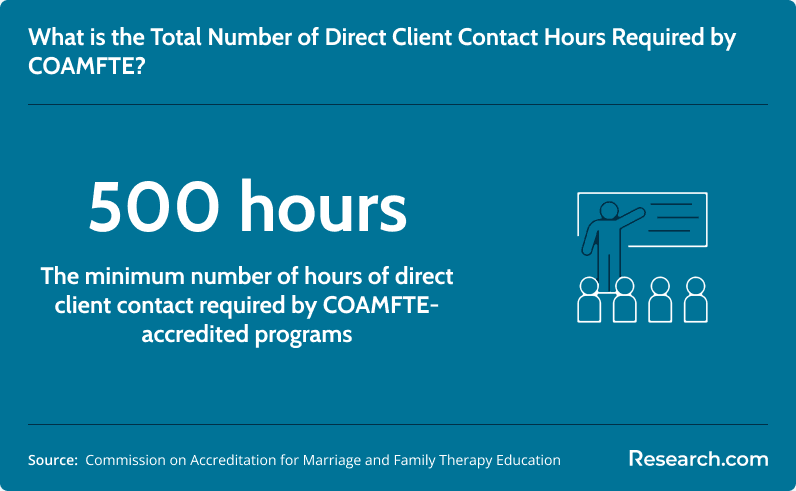
The clinical requirement is also critical. COAMFTE requires students to complete a minimum of 500 hours of direct client contact through supervised clinical practicum, with meaningful relational work involving couples or families. This supervised experience helps students build the skills reflected in what does an LMFT do in real clinical settings.
| Program Feature | COAMFTE-Accredited MFT Program | Non-Accredited Program |
| Curriculum focus | Systemic and relational therapy with individuals, couples, and families | May emphasize general counseling, psychology, or another helping profession |
| Clinical training | Includes required supervised direct client contact and relational experience | Clinical expectations may vary widely by school |
| Licensure review | Often easier for state boards to evaluate | May require course-by-course review |
| Portability | Can improve mobility across states, subject to each board’s rules | May create additional documentation or coursework requirements |
How Do COAMFTE-Accredited Programs Prepare Students for the National MFT Exam?
COAMFTE-accredited programs prepare students for the national MFT exam by organizing coursework and clinical training around the professional competencies expected of entry-level marriage and family therapists. The goal is not only to help students pass an exam, but also to prepare them to assess clients, develop treatment plans, apply MFT models, practice ethically, and work effectively with relational systems.
The Association of Marital & Family Therapy Regulatory Boards (AMFTRB) develops and administers the National MFT Exam used for licensure in most states. COAMFTE standards are designed to support preparation in the kinds of domains students encounter in licensure testing, including MFT theories, clinical assessment, ethics, treatment planning, and work with couples and families.
Students should still plan for dedicated exam study after graduation. Accreditation gives you a strong academic foundation, but passing the exam also requires review time, practice questions, familiarity with the test format, and knowledge of your state’s application process.
How Much Do Online COAMFTE-Accredited LMFT Programs Cost?
Online COAMFTE-accredited MFT programs can vary significantly in price. A full degree may cost anywhere from $30,000 to over $100,000, depending on tuition rate, credit requirements, fees, program length, institution type, and clinical placement expenses. Students comparing graduate investments, including an MBA in cyber security or another specialized professional degree, should evaluate total cost rather than looking only at tuition per credit.
Online study can reduce relocation and commuting costs, but it does not automatically make a program inexpensive. Some online programs invest heavily in live instruction, clinical coordination, student support, learning technology, and faculty supervision. You should also budget for books, background checks, liability insurance, technology, travel to any required intensives, and possible costs tied to securing or traveling to clinical sites.
The most useful cost comparison is total estimated cost to licensure, not just total tuition. That includes the degree, exam fees, post-graduate supervision if required, state application fees, and the income impact of reducing work hours during practicum or internship.
| Cost Factor | Why It Matters | Question to Ask |
| Tuition model | Per-credit, per-term, and unit-based pricing can make programs difficult to compare | What is the full tuition estimate for the entire program? |
| Clinical placement expenses | Online students may need to travel locally or pay for site-related requirements | Are there costs for background checks, insurance, onboarding, or site travel? |
| Residency or intensive requirements | Some online programs may include in-person components | Will I need to travel, and how often? |
| Time away from work | Clinical hours can affect income and scheduling | Can practicum be completed while working part-time or full-time? |
| Financial aid and scholarships | Net price may differ from listed tuition | What aid is available specifically for graduate counseling or MFT students? |
Marriage and family therapists work across several industries, and pay can vary by setting. The chart below highlights the top-paying industries for marriage and family therapists, with home heath care services on top of the list offering $122,120 annual salary.
What GPA and Prerequisites Do COAMFTE-Accredited LMFT Programs Usually Require?
Admissions standards differ by school, but most COAMFTE-accredited LMFT programs look for applicants who can handle graduate coursework, communicate clearly, reflect on their own development, and show readiness for clinical training. A relevant undergraduate background can help, but many programs review applicants holistically.
- Undergraduate GPA: Many competitive programs expect a minimum undergraduate GPA of 3.0, though some may consider provisional admission for applicants with strong experience or other strengths.
- Bachelor’s degree: A degree in psychology, sociology, social work, human development, or a related behavioral science field is common, but requirements vary by institution.
- Personal statement: Programs usually want to understand why you are pursuing MFT, how you understand systemic practice, and what experiences have prepared you for graduate clinical training.
- Letters of recommendation: Applicants typically submit two to three letters from academic or professional references who can discuss maturity, ethics, communication, and readiness for the field.
- Interview or admissions conversation: Some programs use interviews to assess interpersonal skills, self-awareness, and fit with the program’s training model.
How to Strengthen Your Application
- Gain experience in mental health, social services, crisis support, education, advocacy, or community work.
- Use your statement to explain why MFT is the right path rather than writing only about wanting to “help people.”
- Ask recommenders who can speak to your judgment, reliability, emotional maturity, and ability to receive feedback.
- Contact admissions early if your GPA is below 3.0 and ask whether supplemental materials, prerequisite courses, or provisional admission are possible.
Are Online COAMFTE-Accredited LMFT Programs Treated Differently by Licensing Boards?
In general, state licensing boards focus on whether the program meets educational and clinical training standards, not whether the courses were delivered online or on campus. An online COAMFTE-accredited program is typically reviewed as a COAMFTE-accredited program, provided it is current, legitimate, and meets that state’s rules.
Still, students should never assume automatic approval. Each state controls its own LMFT requirements, including degree standards, supervised post-graduate hours, exam rules, background checks, jurisprudence exams, and documentation. Before enrolling, contact the licensing board in the state where you plan to practice and ask whether the specific program satisfies educational requirements.
Telehealth and online education have become more familiar in behavioral health, but licensure remains state-based. The safest approach is to verify directly with the board, save written responses, and keep copies of syllabi, clinical hour records, supervision logs, and program accreditation documentation.
How Does LMFT Accreditation Affect Licensure Eligibility Across U.S. States?
COAMFTE accreditation can make licensure review easier because many state boards recognize the standards behind the degree. It does not replace state licensure rules, but it can reduce uncertainty when a board evaluates whether your coursework and clinical experience match its requirements.
This matters if you move after graduation or plan to practice in more than one state. Graduates from non-accredited programs may face a course-by-course transcript review, requests for syllabi, additional documentation, or extra coursework. That process can delay licensure and create added expense.
Students should view accreditation as one part of a licensure strategy. The other part is state-specific planning. If you are deciding where to study because of the growing demand for MFT roles, compare the licensing rules in the state where you live now and any state where you may relocate.
Licensure Questions to Ask Before You Enroll
- Is this program currently COAMFTE-accredited, and where can I verify it?
- Does my intended state board accept this degree for LMFT educational eligibility?
- Will the program provide documentation for course content and clinical hours if my board requests it?
- Does the program’s practicum structure meet my state’s required client contact and supervision rules?
- If I move, will the school help me understand portability issues?
How Does COAMFTE Accreditation Affect Salary and Job Prospects for LMFTs?
COAMFTE accreditation can support job prospects because it helps graduates qualify for licensure, and licensure is the central credential for most professional LMFT roles. Accreditation itself does not guarantee a salary, a job offer, or faster advancement, but it can make you eligible for positions that require a license or clearly documented MFT preparation.
Employers such as healthcare systems, clinics, agencies, government employers, and community mental health organizations often prefer candidates whose education is easy to verify. A COAMFTE-accredited degree can reduce questions about whether your coursework and supervised training met recognized MFT standards. Students comparing career outcomes may also want to review what jobs can you get with a marriage and family therapy degree and the broader marriage and therapy career path.
Salary depends on state, employer type, experience, licensure status, specialization, and whether you work in an agency, hospital, government setting, group practice, or private practice. Some higher-paying sectors also have stricter hiring requirements. For example, government employing 6% of all LMFTs may require clear proof of licensure eligibility and accredited graduate training.
Students comparing MFT with other professional paths, such as an MBA in sports management, should avoid judging return on investment by headline salary alone. MFT is a licensed clinical profession, so the better question is whether the program gets you to licensure efficiently, affordably, and in the state where you plan to work.
Marriage and family therapists are employed across diverse sectors, from healthcare to government agencies. The chart below shows the largest employers of marriage and family therapists, helping you see where the greatest job opportunities exist.
How Do You Compare Online COAMFTE-Accredited LMFT Programs?
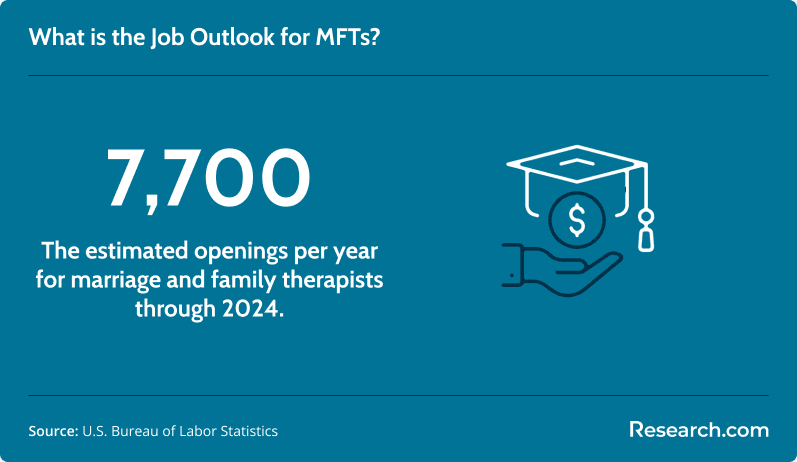
After confirming COAMFTE accreditation, compare programs based on clinical support, state alignment, schedule, cost, faculty expertise, student services, and outcomes. With 7,700 new job openings projected each year, choosing carefully can help you avoid delays between enrollment, graduation, exam preparation, and licensure.
| Comparison Factor | Why It Matters | Best Choice If... |
| Clinical placement support | Online students need approved local practicum and internship sites | The school has a clear process, staff support, and experience placing students in your state |
| Synchronous vs. asynchronous learning | Class format affects scheduling, engagement, and cohort connection | You choose live classes for structure or asynchronous learning for flexibility |
| State licensure alignment | Each state has its own rules | The program can explain how it supports students in your intended state |
| Total program cost | Tuition is only part of the investment | You have a written estimate that includes fees, travel, books, technology, and clinical costs |
| Faculty background | Practicing LMFTs can bring current clinical insight | The faculty includes licensed clinicians with experience in your areas of interest |
| Student support | Online learners need advising, tech help, library access, and career guidance | Support is available outside standard business hours or in formats that fit your schedule |
Who Should Choose an Online COAMFTE-Accredited Program?
- Students who need geographic flexibility but still want a licensure-focused MFT education.
- Working adults who can manage online coursework while planning for in-person clinical hours.
- Students who live near potential practicum sites and can complete supervised client contact locally.
- Applicants who want clearer licensure portability than a non-accredited MFT program may provide.
Who May Need a Different Option?
- Students who need extensive in-person campus support and learn best in face-to-face classrooms.
- Applicants who cannot commit to practicum or internship hours during the program.
- Students whose state does not accept the specific online program they are considering.
- People who want a broader counseling or social services pathway rather than a relational MFT focus.
Common Mistakes to Avoid
- Choosing based only on tuition: A lower per-credit rate may not mean a lower total cost if the program has more credits, added fees, or expensive travel requirements.
- Assuming online means easier: COAMFTE-accredited online programs still require rigorous coursework, supervision, and clinical hours.
- Skipping state board verification: Accreditation helps, but your state licensing board makes the final decision on eligibility.
- Ignoring clinical placement details: Ask whether the school finds placements, approves student-found sites, or expects you to secure sites independently.
- Relying only on rankings or brand names: A well-known school is not automatically the best fit for your state, budget, schedule, or clinical goals.
- Forgetting post-graduation requirements: Licensure may require supervised experience and exams after the degree is complete.
What COAMFTE-Accredited MFT Graduates Say About Their Programs
- : "I was most worried about the national MFT exam. What helped was realizing that my coursework had already covered the major areas I was reviewing: ethics, theory, clinical models, and assessment. The exam still required focused study, but I did not feel like I was starting from zero. — James"
- : "I questioned whether an online MFT degree would feel as demanding as an in-person program. It did. The live seminar courses required preparation, discussion, and clinical thinking every week. The accreditation reassured me that the expectations were the same standard I would have faced on campus. — Maria"
- : "At first, I had too many graduate programs on my list. My advisor told me to narrow the search to COAMFTE-accredited options, and that made the decision much clearer. I knew I still had to check my state’s rules, but I felt more confident that my degree would be taken seriously for licensure. — Jessica"
What Financial Aid Options Are Available for Online COAMFTE-Accredited LMFT Programs?
Graduate MFT programs can require a major financial commitment, so students should compare aid options before committing to a school. Common options may include federal student aid, institutional scholarships, counseling or behavioral health scholarships, employer tuition assistance, payment plans, and, in some cases, assistantships or work-study opportunities. Availability varies by school and student eligibility.
Start by completing the FAFSA if the institution participates in federal aid programs. Then ask each school for a full financial aid estimate, not just a tuition quote. Students looking for lower-cost counseling-related pathways can also compare the most affordable online counseling degrees, while remembering that MFT licensure requires careful accreditation and state board review.
Ways to Reduce the Cost of an Online LMFT Program
- Ask whether transfer credits are accepted and whether they reduce total tuition.
- Compare total program cost instead of only the per-credit rate.
- Look for scholarships for graduate counseling, behavioral health, rural health, or service-based careers.
- Check whether your employer offers tuition reimbursement or schedule flexibility for clinical hours.
- Ask whether practicum sites offer paid roles, stipends, or employment pathways after graduation.
- Avoid borrowing based on expected salary alone; use conservative estimates and include post-graduate supervision costs.
Practical Enrollment Checklist for Online COAMFTE LMFT Programs
- Verify accreditation: Confirm that the program is currently listed in the Directory of accredited programs.
- Contact your state board: Ask whether the program meets educational requirements for LMFT licensure in your intended state.
- Request clinical placement details: Find out who identifies sites, who approves supervisors, and what happens if placement is delayed.
- Calculate total cost: Include tuition, fees, books, technology, travel, background checks, insurance, exam fees, and reduced work hours.
- Compare learning formats: Decide whether live classes, recorded coursework, or a hybrid structure fits your life and learning style.
- Review faculty and supervision: Look for licensed MFT faculty, active clinicians, and supervisors with relevant experience.
- Ask about outcomes: Request available information about graduation, exam preparation, employment support, and licensure support.
- Save documentation: Keep syllabi, handbook policies, clinical hour logs, supervision records, and accreditation confirmations.
Current Trends Affecting Online LMFT Education
Online LMFT education is being shaped by several practical trends. Telehealth is now a familiar part of behavioral healthcare, so students may need training in ethical remote practice, privacy, digital documentation, and managing therapeutic relationships through technology. At the same time, licensing remains state-based, which means online students must be especially careful about where they complete clinical hours and where they plan to practice.
Employer expectations are also shifting toward documented competencies, supervised experience, and readiness to work with diverse clients. AI tools may help with administrative tasks, documentation support, scheduling, and research, but they do not replace clinical judgment, ethical reasoning, supervision, or the relational skills central to MFT practice. Students should look for programs that teach technology awareness without treating it as a substitute for clinical training.
References
- American Association for Marriage and Family Therapy. (n.d.). Marriage and family therapy workforce study. AAMFT.
- Bureau of Labor Statistics. (2023). Occupational employment and wages, May 2023: Marriage and family therapists (21-1013). U.S. Department of Labor.
- Bureau of Labor Statistics. (2024). Marriage and family therapists. U.S. Department of Labor.
- Commission on Accreditation for Marriage and Family Therapy Education. (2023). COAMFTE 2023 end of year report.
- Commission on Accreditation for Marriage and Family Therapy Education. (n.d.). Directory of accredited programs.
- Health Resources and Services Administration. (2024). State of the behavioral health workforce report 2024. U.S. Department of Health and Human Services.
Key Insights
- COAMFTE accreditation is one of the strongest safeguards for online LMFT students because it verifies MFT-specific curriculum, clinical training, and program quality.
- Online and campus-based COAMFTE-accredited programs are generally reviewed by licensing boards based on standards, not delivery format, but each state still sets its own rules.
- The most important program comparison point for online students is clinical placement support. Without an approved site and qualified supervision, graduation and licensure can be delayed.
- Total cost matters more than tuition per credit. Include fees, clinical requirements, travel, technology, exam costs, and possible lost income during practicum.
- A COAMFTE-accredited degree can improve licensure portability, but it does not guarantee approval in every state, employment, salary, or exam success.
- The best program is the one that matches your state licensure plan, schedule, learning preferences, budget, and long-term clinical goals.
Other Things You Should Know About LMFT Accreditation
Admission prerequisites typically include a bachelor's degree in a related field, a minimum GPA as specified by the program, and completion of specific coursework like psychology or counseling. Some programs may also require relevant field experience or reference letters.
Yes, but licensure is granted by state boards, not COAMFTE. A 2027 online program must meet the state’s LMFT education rules, complete supervised clinical hours, and satisfy exam requirements such as the AMFTRB national exam before a license can be issued.


