2027 LMFT vs. AMFT Degree: Explaining the Difference

Co-Founder and Chief Data Scientist
If you are planning a career in marriage and family therapy, one of the first licensing questions you will face is whether you are looking at an AMFT stage or an LMFT career goal. The distinction matters because it affects where you can work, how much independence you have, what supervision you need, and when you can open a private practice.
An Associate Marriage and Family Therapist (AMFT) is generally a pre-licensed professional completing supervised clinical experience after graduate school. A Licensed Marriage and Family Therapist (LMFT) has completed the education, supervised hours, and exams required for independent practice. This guide explains how the two credentials compare, what steps usually come between them, and how to choose the path that fits your career timeline, budget, and long-term goals.
The field continues to attract new professionals. The MFT workforce has grown by 3.36%, reaching 4.66 million professionals, and employment for marriage and family therapists is projected to grow 16% from 2023 to 2033. That growth creates opportunity, but choosing a program or licensing route without checking state rules can still delay your progress.
Quick Answer: LMFT vs. AMFT
An AMFT is usually an associate-level, supervised role for graduates who are working toward full licensure. An LMFT is a fully licensed marriage and family therapist who can typically practice independently, manage a full caseload, and pursue private practice where state law allows. LMFTs generally have stronger job flexibility and higher earning potential; the median salary for marriage and family therapists is $63,780 per year, while AMFTs commonly earn less during the supervised training period.
Key Things You Should Know About LMFT vs. AMFT
- AMFT and LMFT are not equal license levels. AMFTs are still completing supervised experience, while LMFTs have met full licensure requirements and usually have broader authority, more independence, and higher earning potential.
- The typical education route starts with a qualifying graduate degree in Marriage and Family Therapy or a closely related field. Students can choose from over 125 COAMFTE-accredited MFT programs, but state licensing rules should guide the final program choice.
- Career outcomes differ by license stage. AMFTs usually work in supervised agency, clinic, or group-practice settings, while LMFTs can pursue independent roles, private practice, supervision, specialization, and leadership opportunities.
- What is the difference between an LMFT and an AMFT?
- What educational path should I take to become an LMFT or AMFT?
- What are the licensing requirements for AMFT vs. LMFT?
- How do job roles and responsibilities differ between LMFTs and AMFTs?
- How much do LMFTs and AMFTs earn?
- What career growth opportunities exist for LMFTs vs. AMFTs?
- How does clinical supervision work for AMFTs?
- How can I find affordable, accredited MFT programs?
- How can I stay current with continuing education and professional development?
- How can I evaluate the quality and fit of online MFT programs?
- Can advanced degrees expand my career options?
- Which degree path is better if I want to open a private practice?
- What are the pros and cons of starting as an AMFT?
- How do I decide between pursuing an AMFT or LMFT path?
- Key insights
What is the difference between an LMFT and an AMFT?
The simplest difference is license status: an AMFT is practicing under supervision, while an LMFT has full licensure for independent marriage and family therapy practice.
Both roles belong to the same professional field, but they represent different points in the licensing process. An AMFT, or Associate Marriage and Family Therapist, has usually finished a qualifying graduate program and is accumulating supervised clinical experience. An LMFT, or Licensed Marriage and Family Therapist, has completed the required supervised hours, passed the required licensing exams, and satisfied the state board’s requirements for independent practice.
| Factor | AMFT | LMFT |
| License stage | Associate or pre-licensed stage | Fully licensed professional stage |
| Supervision | Required | Usually not required for independent practice |
| Practice authority | Limited by state rules and supervisor oversight | Broader authority to diagnose, treat, and manage cases independently |
| Private practice | Cannot generally operate independently | Can usually pursue private practice if state rules are met |
| Career purpose | Build supervised experience toward full licensure | Practice independently, specialize, supervise, or lead programs |
Where each credential fits in your career path
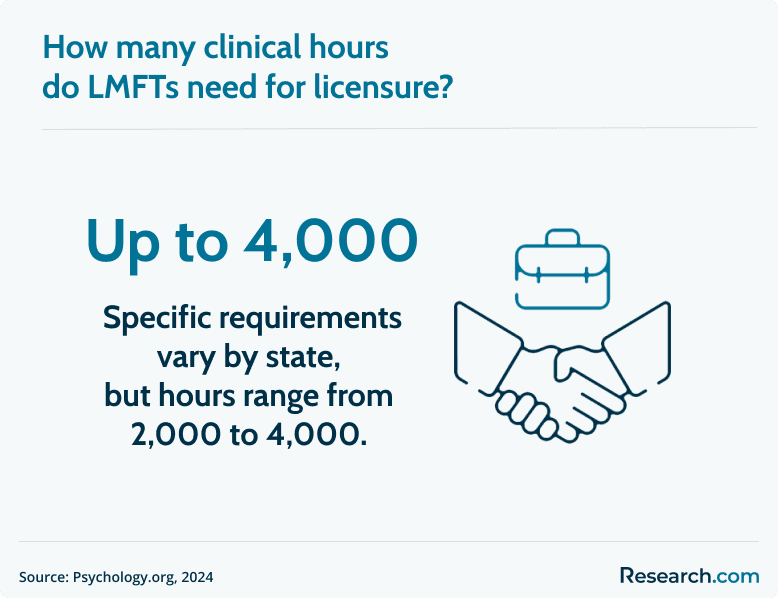
The AMFT stage is best understood as a required bridge between graduate school and full licensure. In most states, associate therapists complete 2,000 to 4,000 supervised hours before applying for LMFT licensure. The exact number, the type of qualifying hours, and the required supervisor credentials vary by state.
Interest in the field has also been rising. In 2022, 3,683 total MFT degrees were awarded, representing 8.16% growth. That growth suggests more graduates are entering the licensure pipeline, which makes program quality, supervision access, and exam preparation increasingly important.
What educational path should I take to become an LMFT or AMFT?
Most future AMFTs and LMFTs need a master’s degree in Marriage and Family Therapy or a closely related mental health field that satisfies their state board’s coursework and clinical training requirements.
The right program is not simply the one with the lowest tuition or most convenient schedule. It should align with the licensing requirements in the state where you plan to practice. Coursework commonly covers family systems, human development, assessment, diagnosis, ethics, research, cultural competence, and supervised clinical practice.
Typical education sequence
- Complete a bachelor’s degree, often in psychology, sociology, human development, social sciences, or another related field.
- Research graduate programs that prepare students for MFT licensure, including the over 125 COAMFTE-accredited MFT programs available nationwide.
- Confirm that the curriculum meets your target state’s required coursework before enrolling.
- Complete practicum or internship hours while in graduate school.
- Graduate with a qualifying MA, MS, or comparable master’s degree in Marriage and Family Therapy or an approved related field.
- Apply for associate registration or licensure if your state requires an AMFT stage before full LMFT licensure.
If you are comparing therapy, counseling, psychology, and social work careers, this guide to choosing a therapy specialization can help you understand how different mental health paths lead to different work settings and client populations.
How to choose a graduate MFT program
| Question to ask | Why it matters |
| Is the program accredited or clearly accepted by my state licensing board? | Licensure problems often begin when students enroll in programs that do not satisfy state-specific requirements. |
| Does the curriculum include all required clinical and ethics coursework? | Missing coursework may require extra classes after graduation. |
| How are practicum and internship placements arranged? | Strong placement support can reduce delays in gaining required clinical experience. |
| What are the program’s licensing exam preparation resources? | Exam readiness can affect how quickly graduates move toward full licensure. |
| Can online students complete clinical requirements in their home state? | Online format does not automatically mean the program works for every state’s licensure rules. |
Some therapists later pursue doctoral study for research, teaching, supervision, or advanced clinical work. If that is part of your long-term plan, this overview of how to get a doctorate in psychology can help you understand how doctoral pathways differ from master’s-level MFT licensure.
What are the licensing requirements for AMFT vs. LMFT?
AMFT and LMFT licensing requirements usually include graduate education, supervised clinical experience, and required exams, but the AMFT is the supervised stage and the LMFT is the independent practice stage.
Because licensure is regulated by state boards, the details are not identical everywhere. Before choosing a school, supervisor, or job, check the official licensing board in the state where you plan to work.
Common licensing steps
- Earn a qualifying master’s degree in Marriage and Family Therapy or an approved related discipline.
- Apply for associate status, registration, or provisional licensure if your state uses an AMFT-style designation.
- Work under an approved supervisor while completing the required clinical experience.
- Accumulate supervised hours, which most states set between 2,000 and 4,000 hours.
- Pass the MFT National Examination, which includes a National Exam and a Clinical Exam. The Clinical Exam often has pass rates around 70–75%.
- Submit the final LMFT application once all state requirements are complete.
| Requirement area | AMFT stage | LMFT stage |
| Graduate degree | Must already be completed or meet state eligibility rules | Must satisfy full licensure education requirements |
| Clinical hours | Actively completing required supervised hours | Required hours are completed and approved |
| Exam status | May be preparing for required licensing exams depending on state rules | Required exams have been passed |
| Client work | Performed under supervision | Performed independently within scope of practice |
| State board approval | Associate registration or license required where applicable | Full LMFT license required for independent practice |
Therapy licensure is very different from career paths built around organizational consulting or human resources. If you are still comparing people-focused careers outside clinical mental health, this guide on becoming an HR consultant offers a useful contrast.
The most important rule is simple: do not rely only on a school’s marketing language. Verify education, supervision, and exam requirements directly with your state licensing board.
How do job roles and responsibilities differ between LMFTs and AMFTs?
LMFTs can typically practice with much greater autonomy, while AMFTs work under the direction of a qualified supervisor until they complete full licensure requirements.
Both AMFTs and LMFTs may provide therapy to individuals, couples, and families, but the level of clinical independence is different. AMFTs are still developing competency through supervised practice. LMFTs can usually diagnose, treat, document, coordinate care, and manage client cases without routine supervisor approval, depending on state law and employer policy.
Common AMFT responsibilities
- Provide therapy services under an approved supervisor’s oversight.
- Document sessions and treatment plans according to agency and state requirements.
- Participate in supervision meetings and case consultation.
- Build core clinical skills in assessment, treatment planning, ethics, and family systems work.
- Prepare for required licensing exams and full LMFT application requirements.
Common LMFT responsibilities
- Assess and treat individuals, couples, and families independently within the MFT scope of practice.
- Manage a caseload without associate-level supervision.
- Develop treatment plans and coordinate with other healthcare or community providers.
- Work in private practice, outpatient clinics, hospitals, schools, community agencies, or telehealth settings.
- Specialize, supervise associates, lead clinical teams, or build a practice after meeting state requirements.
In 2023, around 76,000 marriage and family therapists were employed across several settings. Full licensure gives LMFTs more flexibility, which is reflected in the 14% who were self-employed. LMFTs also commonly work in outpatient care centers and private offices where independent clinical judgment is often expected.
AMFTs are more likely to start in structured workplaces that can provide supervision. The original employment data show many MFTs in individual and family services agencies (27%) and offices of other health practitioners (28%), both of which can offer the type of oversight associate clinicians need.
If you are comparing MFT work with other mental health professions, reviewing the pros and cons of being a psychologist can help clarify differences in training length, scope of practice, and career direction.

How much do LMFTs and AMFTs earn?
LMFTs usually earn more than AMFTs because they have completed full licensure, qualify for more independent roles, and may be able to build private practices or specialized services.
According to the Bureau of Labor Statistics, the median salary for marriage and family therapists was $63,780 per year. This number is more representative of fully licensed roles than associate-level positions because LMFTs meet broader employer and practice requirements.
AMFT pay is commonly lower during the supervised period. Earnings can vary based on location, employer type, caseload, reimbursement model, and whether the role is in a nonprofit agency, clinic, hospital, group practice, or other supervised setting.
| Factor affecting earnings | How it can influence AMFT or LMFT pay |
| License level | LMFTs generally qualify for more autonomous and higher-responsibility roles than AMFTs. |
| Work setting | Private practice, outpatient care, agencies, and healthcare offices can have different compensation models. |
| Geographic area | Pay can shift based on state rules, cost of living, demand, and local provider shortages. |
| Specialization | Focused services such as couples therapy, trauma treatment, or family systems work may affect marketability. |
| Experience | Therapists often gain access to more complex roles as they build clinical experience and professional reputation. |
After AMFTs finish supervised hours and pass the required exams, they may move into LMFT positions with stronger income potential. However, salary outcomes are never guaranteed, and private practice income depends on client volume, payer mix, business expenses, and local competition.
Compensation is only one part of the decision, but it is an important one. If you are comparing the financial logic of different graduate credentials, this discussion of the benefits of an MBA degree offers a broader view of how graduate education can affect career options and earning potential in nonclinical fields.
What career growth opportunities exist for LMFTs vs. AMFTs?
AMFTs grow by building supervised experience toward licensure. LMFTs have more room to specialize, practice independently, supervise others, lead programs, or operate a business.
Long-term growth outlook
The Bureau of Labor Statistics projects employment for marriage and family therapists to grow 16% from 2023 to 2033, which is much faster than the average for all occupations. About 7,500 openings are projected each year on average, with many resulting from workers leaving the occupation or retiring.
Career options by license level
| Career option | More typical for AMFTs | More typical for LMFTs |
| Agency-based therapy under supervision | Yes | Yes |
| Independent clinical decision-making | No, supervision is required | Yes, within state scope of practice |
| Private practice ownership | Generally no | Yes, where state rules and business requirements are met |
| Clinical supervision of associates | No | Possible after meeting supervisor requirements |
| Specialized clinical practice | Possible with supervision | More flexible after full licensure |
| Program leadership or administration | Limited | More accessible with experience |
AMFTs often use the associate period to decide which populations and treatment models fit them best. Once licensed, LMFTs can pursue more advanced clinical work in areas such as trauma, substance abuse, child and adolescent therapy, couples counseling, or family systems interventions.
Therapists who are considering related mental health pathways may find it useful to compare addiction counseling and psychology degree programs, especially if they want to work with substance use, behavioral health, or integrated treatment teams.
Some LMFTs later move into nonprofit leadership, community mental health management, or advocacy roles. A low cost master's in nonprofit management online may be relevant for licensed clinicians who want to manage programs, expand services, or lead mission-driven organizations.
How does clinical supervision work for AMFTs?
Clinical supervision is the structured training period that allows AMFTs to deliver therapy while receiving guidance, feedback, and oversight from an approved licensed professional.
After completing a qualifying graduate degree, AMFTs typically need 2,000 to 4,000 supervised clinical hours, depending on the state. Supervision usually includes regular meetings to review cases, discuss ethical concerns, refine treatment plans, strengthen documentation, and evaluate professional development.
What good supervision should include
- Clear expectations about required hours, documentation, client contact, and supervision frequency.
- Case review that connects clinical decisions to ethical standards and evidence-informed practice.
- Feedback on assessment, treatment planning, crisis response, cultural responsiveness, and boundaries.
- Support for exam preparation and state board application requirements.
- Opportunities to explore client populations, treatment approaches, and long-term specialization goals.
Questions to ask before accepting an AMFT position
- Who will be my approved supervisor, and do they meet state requirements?
- How many supervision hours are included, and is supervision paid or unpaid?
- Will the role provide enough direct client contact to progress toward licensure on schedule?
- How are hours tracked and verified for the licensing board?
- What happens if my supervisor leaves the organization?
Supervision can also help AMFTs test different clinical interests. For example, therapists drawn to faith-based or holistic care may want to learn more about how to become a spiritual counselor while still confirming that any additional training fits their licensed scope of practice.

How can I find affordable, accredited MFT programs?
To find an affordable MFT program, compare total cost, accreditation, clinical placement support, and state licensure alignment—not tuition alone. A cheaper program can become expensive if it does not meet licensing requirements or forces you to take extra coursework later.
Cost factors to compare
| Cost factor | What to check |
| Tuition and fees | Look at the full program cost, not only the per-credit rate. |
| Clinical placement expenses | Ask whether travel, background checks, liability insurance, or site fees are required. |
| Online program residency costs | Some online programs require campus visits or intensive sessions. |
| Transfer credit policy | Generous transfer rules can reduce cost, but credits must still satisfy licensure requirements. |
| Financial aid and scholarships | Confirm eligibility for federal aid, institutional scholarships, payment plans, and employer support. |
Students comparing counseling and therapy programs may also want to review online CACREP accredited counseling programs. CACREP accreditation applies to counseling programs rather than MFT programs, so use that resource for comparison only if you are also considering professional counseling as an alternative path.
How can I stay updated on continuing education and professional development?
Continuing education helps LMFTs maintain licensure, strengthen clinical judgment, and stay current with ethical, legal, and treatment developments. Requirements vary by state, so licensed therapists should track renewal deadlines and approved provider rules through their licensing board.
Good professional development is targeted. Rather than collecting random webinars, choose training that supports your client population, specialty area, supervision responsibilities, or practice setting. Useful topics may include ethics, telehealth, trauma-informed care, couples therapy, documentation, cultural competence, risk assessment, and changes in state regulations.
If you are still comparing lower-cost education options in counseling-related fields, the most affordable online colleges for counseling degrees can provide context for program affordability, though MFT licensure requirements should still be checked separately.
How can I assess the quality and fit of online MFT programs?
An online MFT program can be a good fit if it is properly accredited, accepted by your state licensing board, transparent about clinical placement expectations, and structured for strong faculty and supervisor support. Online delivery by itself does not guarantee convenience or licensure eligibility.
Online MFT program checklist
- Confirm the program’s accreditation status and whether it aligns with your state’s MFT licensure rules.
- Ask how online students secure practicum and internship sites.
- Review faculty credentials, clinical training model, and student support services.
- Look for clear information about exam preparation, graduation outcomes, and alumni support.
- Check whether required live sessions, residencies, or synchronous classes fit your schedule.
- Ask the admissions team to explain how the program supports students who plan to practice outside the school’s home state.
For a broader look at available options, compare marriage and family therapy masters programs online and evaluate each program against your licensing state, budget, preferred format, and clinical placement needs.
Can pursuing advanced degrees further amplify my career opportunities?
Advanced degrees can expand career options for some LMFTs, but they are not required for standard MFT licensure. A doctorate or additional graduate credential may make sense if your goals include university teaching, research, advanced clinical specialization, supervision leadership, psychological assessment roles where legally permitted, or executive-level administration.
The decision should be based on career return, not prestige alone. Before enrolling, compare tuition, time away from practice, licensure implications, research expectations, and whether the credential is necessary for the work you want.
Clinicians interested in doctoral-level psychology training can explore online PsyD programs. A PsyD is a different professional pathway from MFT licensure, so prospective students should evaluate scope of practice, state rules, clinical training requirements, and long-term goals carefully.
Which degree path is better if I want to open a private practice?
The LMFT path is the appropriate route if your goal is to open an independent private practice, because private practice generally requires full licensure and the legal ability to practice without associate-level supervision.
An AMFT designation is not usually a final independent-practice credential. AMFTs are gaining supervised experience and cannot generally operate their own private practice without the required oversight and state authorization.
To move toward private practice, you typically need to complete a qualifying graduate program, finish your supervised clinical hours, pass the required MFT exams, and receive full LMFT licensure. After that, you can address the business side of practice, including liability coverage, documentation systems, billing, marketing, office or telehealth setup, and compliance with state and federal rules.
Private practice readiness checklist
- Full LMFT license approved by the state board.
- Clear scope of practice and specialty focus.
- Professional liability insurance.
- HIPAA-compliant records, telehealth tools, and client communication systems.
- Referral strategy and plan for consultation or peer support.
- Understanding of payer contracts, self-pay policies, and business expenses.
Private practice can offer flexibility and autonomy, but it also adds business risk. Therapists should avoid assuming that licensure alone guarantees a full caseload or higher income.
What are the pros and cons of starting as an AMFT?
Starting as an AMFT is often a required step rather than an optional detour. It can be valuable because it gives new clinicians structured experience, but it also comes with limits on autonomy, income, and job flexibility.
| Pros of the AMFT stage | Why it can help |
| Supervised clinical learning | You receive feedback while handling real client work, which can strengthen judgment and confidence. |
| Licensure preparation | The associate period helps you build hours, prepare for exams, and document experience for the state board. |
| Exposure to varied client needs | Agency, clinic, and group settings may introduce you to diverse populations and presenting concerns. |
| Professional identity development | You can clarify whether you prefer couples work, family systems, trauma, child therapy, or another focus. |
| Cons of the AMFT stage | Why it can be challenging |
| Limited independence | You must practice under supervision and generally cannot work as an independent provider. |
| Lower earning potential | Associate roles usually pay less than fully licensed LMFT positions. |
| Time to full licensure | Completing supervised hours can take several years, depending on caseload, state rules, and job structure. |
| Dependence on supervisor and employer quality | Poor supervision or limited client hours can slow development and delay licensure. |
The AMFT stage is most useful when it is planned carefully. Choose a role that provides valid supervision, enough qualifying hours, ethical support, and experience with the client populations you hope to serve long term.
How do I decide between pursuing an AMFT or LMFT path?
For most students, the decision is not truly AMFT versus LMFT. The AMFT is commonly the supervised step on the way to becoming an LMFT. The real decision is how to choose the graduate program, state licensure route, supervision setting, and career timeline that will get you to the level of practice you want.
Decision factors to consider
- Independence: If you want to diagnose, treat, and manage clients without routine supervision, full LMFT licensure should be the goal.
- Private practice plans: If you want to own a practice, the AMFT stage is not enough; you will need to complete the LMFT requirements in your state.
- Earning expectations: LMFTs generally have stronger earning potential because they qualify for more autonomous roles, while AMFTs usually earn less during supervised practice.
- Work environment: AMFTs often need settings that provide approved supervision, while LMFTs have more flexibility across agencies, clinics, schools, healthcare offices, telehealth, and self-employment.
- Career satisfaction: Reported satisfaction can vary by setting. Studies show that 94% of LMFTs working in school, college, or university settings would recommend the career, compared with 70% of those working in agencies.
- Time commitment: The path from graduate school through AMFT supervision to LMFT licensure requires sustained planning, especially because most states require 2,000 to 4,000 supervised hours.
Common mistakes to avoid
- Choosing a graduate program before checking whether it meets your state’s MFT licensure rules.
- Assuming every online MFT program works for every state.
- Comparing tuition without calculating fees, residency costs, placement expenses, and lost income.
- Accepting an AMFT job without confirming that the supervisor is approved by the licensing board.
- Assuming the median salary for marriage and family therapists guarantees your personal earnings.
- Relying only on rankings instead of reviewing accreditation, clinical training, exam support, and placement quality.
- Waiting until graduation to learn about documentation rules for supervised hours.
If your career goals include clinic leadership, nonprofit management, or executive roles outside direct practice, you may also want to compare business and leadership degrees. This guide to masters in organizational leadership vs MBA can help you decide whether broader management training fits your long-term plans.
Here’s What Graduates Have to Say about Their LMFT or AMFT Career
During my AMFT period, supervision helped me think through difficult cases and improve my clinical judgment. Having an experienced professional review my work made the transition from school to practice much less overwhelming. – Gary
Receiving my LMFT license changed the direction of my work. I could practice with more independence, focus on trauma therapy, and build a private practice around the clients I most wanted to serve. – Troy
The AMFT stage was demanding, but it gave me the structure I needed. Regular supervision helped me grow, and full licensure gave me the confidence to take on greater responsibility. – Mimi
Key Insights
- AMFT is typically a supervised, associate-level step after graduate school; LMFT is the full license that allows much greater independence.
- The median salary for marriage and family therapists is $63,780 per year, but AMFTs often earn less while completing supervised hours.
- There were 3,683 total MFT degrees awarded in 2022, reflecting 8.16% growth and continued interest in the field.
- Employment of marriage and family therapists is projected to grow 16% from 2023 to 2033, with about 7,500 openings projected each year on average.
- Most states require 2,000 to 4,000 supervised hours before full LMFT licensure, so supervision quality can directly affect your timeline.
- Private practice usually requires LMFT licensure; AMFT status alone is generally not enough for independent practice.
- Program choice should be based on accreditation, state licensure fit, clinical placement support, total cost, and exam preparation—not convenience alone.
- The MFT National Examination includes both a National Exam and a Clinical Exam, and the Clinical Exam often has pass rates around 70-75%.
- Reported career satisfaction differs by work setting: 94% of LMFTs in school, college, or university settings would recommend the career, compared with 70% of those in agencies.
References:
- American Association for Marriage and Family Therapy. (2022). Part 2: Marriage and family therapist workforce study 2022. https://ftm.aamft.org/part-2-marriage-and-family-therapist-workforce-study-2022/
- Bureau of Labor Statistics. (2024, April 19). Marriage and family therapists. U.S. Department of Labor. https://www.bls.gov/ooh/community-and-social-service/marriage-and-family-therapists.htm#tab-1
- Counseling Degrees Online. (n.d.). Marriage and family therapy (MFT) degree programs. https://www.counselingdegreesonline.org/mft
- Data USA. (n.d.). Marriage and family therapy [Data profile]. Data USA. https://datausa.io/profile/cip/marriage-family-therapy
- Psychotherapy Notes. (2020, November 9). Differentiating passing scores and pass rates for license exams. https://www.psychotherapynotes.com/differentiating-passing-scores-pass-rates-license-exams/
Other Things You Should Know about LMFT vs. AMFT
In 2027, an LMFT degree typically requires a master's level of education, state licensure, and completion of supervised clinical hours. An AMFT degree serves as a stepping stone, often consisting of foundational coursework needed to pursue an LMFT degree, without the immediate requirement for state licensure or extensive clinical hours.
In 2027, an LMFT degree generally prepares practitioners for clinical work focused on family and marriage therapy. An AMFT degree may indicate postgraduate training or specialization within the field of marriage and family therapy, but often lacks the licensure focus of an LMFT, which is necessary for independent practice.
In 2027, the primary difference between an LMFT (Licensed Marriage and Family Therapist) and an AMFT (Associate Marriage and Family Therapist) degree is the level of licensure. An LMFT is fully licensed to practice independently, while an AMFT is generally in the process of fulfilling supervised hours or additional requirements needed to achieve full licensure.