
2027 MBA vs. Organizational Leadership Degree: Explaining the Difference

Co-Founder and Chief Data Scientist
Choosing between an MBA and a master’s degree in organizational leadership is really a choice between two different career strategies. An MBA is built for professionals who want broad business training in finance, operations, marketing, analytics, and strategy. An organizational leadership degree is designed for people who want to lead teams, improve workplace culture, guide change, and strengthen organizational effectiveness.
The better option depends on the roles you want, the cost you can justify, the time you can commit, and the skills you need to build next. This guide compares both degrees across duration, cost, admissions, curriculum, specializations, career paths, salary, job outlook, return on investment, accreditation, and common mistakes so you can choose a graduate program with clearer expectations.
Quick Answer: MBA vs. Organizational Leadership Degree
An MBA is usually the stronger fit if you want a business-generalist credential for roles in consulting, finance, product management, operations, entrepreneurship, or executive strategy. A degree in organizational leadership is often better if your goal is to manage people, lead organizational change, work in HR or nonprofit leadership, or improve team performance across complex workplaces.
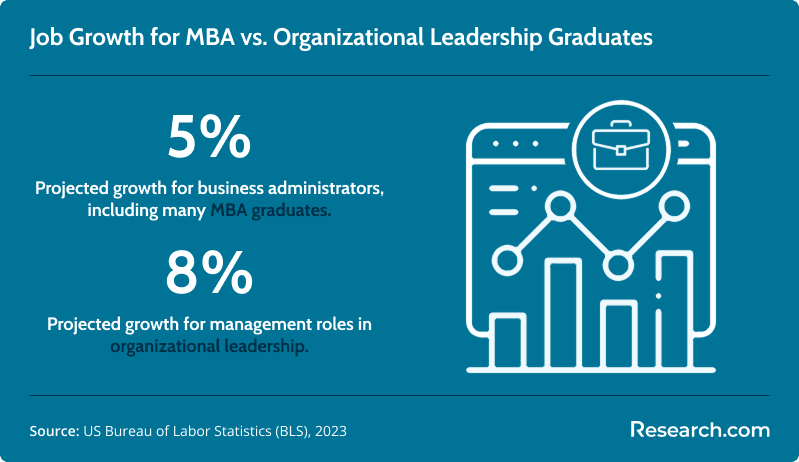
- MBA graduates are associated with a 5% job growth projection for business administrators from 2018 to 2028, while organizational leadership degree holders align with an 8% projected growth in management roles from 2023 to 2033.
- MBA degree holders earn an average annual salary of $165,372, compared with $112,050 per year for organizational leadership degree holders.
- Common MBA outcomes include business consultant, financial manager, marketing manager, operations manager, and product manager roles. Organizational leadership graduates more often pursue HR manager, executive director, leadership development specialist, organizational development consultant, and team leader positions.
- How long does an MBA take compared with an organizational leadership degree?
- Which degree costs more: MBA or organizational leadership?
- What admission requirements should applicants expect?
- How do the MBA and organizational leadership curricula compare?
- What specializations are available in each degree?
- How do day-to-day responsibilities differ after graduation?
- What careers can you pursue with each degree?
- Which degree offers the stronger long-term ROI?
- How do online, hybrid, and campus formats compare?
- Why do accreditation and school reputation matter?
- What challenges should students consider before enrolling?
- How important are alumni networks and career services?
- What skills will you build in each program?
- How do salaries compare for MBA and organizational leadership graduates?
- What is the job outlook for each path?
- What should you ask before choosing a graduate program?
What is the typical duration of an MBA vs. an organizational leadership degree?
A full-time MBA commonly takes about two years to finish. Some schools offer one-year accelerated formats, while part-time, executive, and online MBA programs may take three years or longer depending on course load and work obligations. The MBA timeline is often longer because students cover multiple business disciplines, including finance, marketing, strategy, operations, economics, analytics, and leadership.
A master’s degree in organizational leadership is often shorter, with many full-time students finishing in 12 to 18 months. These programs are frequently built for working adults and may use evening, online, or low-residency formats. The coursework tends to focus less on quantitative business functions and more on leadership behavior, communication, team development, change management, ethics, and organizational culture.
Students often compare program length before making a commitment, just as they may research how long a criminal justice degree takes before enrolling. For this decision, the key point is that both degrees can fit into a working professional’s schedule, but the MBA usually has a broader and sometimes longer course sequence, while organizational leadership programs may move faster because they are more targeted.
| Program factor | MBA | Organizational leadership degree |
| Typical full-time length | About two years | 12 to 18 months |
| Common flexible options | Accelerated, part-time, executive, online, and hybrid formats | Online, evening, part-time, and working-professional formats |
| Best for students who need | Broad business preparation across multiple functions | Focused leadership training with a shorter path to completion |
| Possible time trade-off | More comprehensive curriculum may require more time | Shorter format may offer less depth in finance, analytics, and operations |
How do the costs compare between an MBA and an organizational leadership degree?
MBA programs generally cost more than organizational leadership programs because they often include a broader business curriculum, more extensive career services, larger alumni networks, and, in some cases, a premium attached to the business school brand. Organizational leadership degrees are usually less expensive and may be a better financial fit for professionals who want leadership advancement without paying for a full graduate business curriculum.
Cost of MBA Programs
Total MBA tuition and fees commonly range from $20,000 to $200,000. The final price depends heavily on the institution, delivery format, residency status, and whether the student attends full time or part time.
- Private vs. public institutions: Private schools can charge between $60,000 and $90,000 per year, while public universities may range from $10,000 to $25,000 for in-state students and more for out-of-state students.
- In-state vs. out-of-state tuition: In-state students pay $18,309, while out-of-state students face a much higher cost of $63,019.
- Online vs. campus-based programs: Self-paced online MBA programs usually cost between $24,000 and $60,000, while some campus programs can exceed $130,000.
Cost of Organizational Leadership Degrees
Organizational leadership programs are often more affordable, with total costs commonly ranging from $9,000 to $40,000. This can make them attractive for professionals who want graduate-level leadership training but do not need the full finance, accounting, marketing, and operations sequence of an MBA.
- Private vs. public institutions: Private schools typically charge $20,000 to $40,000, while public institutions may cost between $8,000 and $25,000 for the full program.
- In-state vs. out-of-state tuition: In-state students pay $11,458, while out-of-state students pay $16,734.
- Online vs. campus-based programs: Online programs typically cost $9,000 to $25,000, while campus-based programs can cost $25,000 to $40,000.
If your main concern is minimizing debt, comparing the most affordable online master’s in organizational leadership programs can be a practical starting point. Lower tuition can improve ROI, especially for students pursuing nonprofit, education, public-sector, or internal leadership roles where salary growth may be steadier rather than immediate.
| Cost consideration | MBA | Organizational leadership degree |
| Typical total cost range | $20,000 to $200,000 | $9,000 to $40,000 |
| Most expensive formats | Private and elite campus-based programs | Private campus-based programs |
| Lower-cost options | Public universities, online programs, employer-sponsored options | Online programs, public institutions, accelerated formats |
| Financial decision point | Worth considering if the degree supports a higher-paying business role or career pivot | Worth considering if you need leadership credentials at a lower tuition level |
How do admission requirements differ between an MBA and an organizational leadership degree?
MBA admissions are often more selective, especially at well-known business schools. Applicants may need a strong undergraduate record, professional experience, standardized test scores, recommendations, essays, and evidence of leadership potential. Organizational leadership programs often use a more flexible admissions model and may place more weight on professional background, leadership experience, goals, and readiness for graduate study.
MBA Admission Requirements
Although requirements vary by institution, MBA applicants commonly need to prepare the following materials:
- Bachelor’s degree: Applicants must hold a bachelor’s degree from an accredited institution. A business major is not always required, but some programs may prefer applicants with prior coursework or experience in business-related areas. Students comparing speed and flexibility may also review the fastest online MBA programs.
- Standardized test scores: Many MBA programs request GMAT or GRE scores, although some schools offer waivers based on professional experience, academic performance, or other evidence of readiness.
- Work experience: A minimum of two years of professional experience is often expected, and some programs prefer candidates with a stronger managerial or leadership background.
- Recommendations: Applicants typically submit two or more letters from supervisors, professors, or professional contacts who can evaluate their potential for graduate business study.
- Essays or personal statement: Most programs ask candidates to explain their career goals, leadership experience, reasons for pursuing an MBA, and fit with the program.
Organizational Leadership Admission Requirements
Organizational leadership programs generally evaluate whether the applicant is prepared to study leadership, organizational behavior, and applied management. Common requirements include:
- Bachelor’s degree: Applicants usually need a bachelor’s degree from a regionally accredited institution. The undergraduate major often does not need to be in business.
- GPA requirement: Many programs require a minimum GPA of 2.75 to 3.0 on a 4.0 scale.
- Professional experience: Relevant work history is not always mandatory, but leadership, supervisory, training, HR, nonprofit, or project experience can strengthen an application.
- Application materials: Schools commonly request an application form, official transcripts, a resume, and a personal statement. Some programs also ask for recommendations.
- English proficiency: International applicants may need TOEFL or IELTS scores to demonstrate English language readiness.
| Admissions factor | MBA | Organizational leadership degree |
| Standardized testing | GMAT or GRE may be required, though waivers are available at some schools | Often test-optional or less test-focused |
| Work experience | Often expected and sometimes central to admissions | Helpful, especially if it shows leadership potential |
| Academic background | Any major may be accepted, but quantitative readiness can matter | Any major may be accepted if the applicant meets GPA and readiness standards |
| Best application strategy | Show business impact, leadership progression, and clear career ROI | Show people leadership, organizational problem-solving, and commitment to improving teams |
What are the differences in curriculum between an MBA and an organizational leadership degree?
The MBA curriculum is intentionally broad. It prepares students to understand how major business functions connect, how leaders make decisions with financial and market data, and how companies compete. Students often work through case studies, simulations, team projects, consulting-style assignments, and capstone experiences.
Common MBA courses include:
- Financial Accounting and Managerial Finance
- Marketing Management
- Operations and Supply Chain Management
- Strategic Management
- Managerial Economics
- Business Analytics and Data-Driven Decision Making
- Organizational Behavior and Leadership
- Business Ethics and Corporate Responsibility
- Information Systems Management
- Global Business Environment
- Entrepreneurship or Innovation Management
- Capstone Project or Business Simulation
An organizational leadership curriculum is narrower but deeper in the human side of leadership. Instead of training students across every major business function, these programs focus on leading people, managing change, improving communication, building ethical cultures, and helping organizations adapt.
Common organizational leadership courses include:
- Foundations of Leadership Theory
- Organizational Behavior and Development
- Strategic Leadership and Vision
- Ethics and Social Responsibility in Leadership
- Change Management
- Communication and Conflict Resolution
- Human Resource Management
- Diversity, Equity, and Inclusion in Organizations
- Research Methods and Data Interpretation
- Leadership in Global and Cultural Contexts
- Coaching and Mentoring in Organizations
- Capstone Project or Applied Leadership Practicum
| Curriculum question | MBA | Organizational leadership degree |
| What is the academic focus? | Business functions, strategy, analytics, finance, operations, markets, and leadership | Leadership theory, organizational behavior, communication, change, culture, and ethics |
| How quantitative is it? | Usually more quantitative due to finance, economics, analytics, and operations courses | Usually less quantitative, though research methods and data interpretation may be included |
| What type of student benefits most? | Someone who needs business fluency across departments | Someone who wants to improve teams, culture, communication, and organizational effectiveness |
| What is the main limitation? | May include courses that feel less relevant to people-focused leaders | May not provide enough technical business depth for finance, consulting, or product roles |
How do specializations within MBA and organizational leadership degrees differ?
MBA specializations usually help students move toward a specific business function or industry. Organizational leadership concentrations usually help students apply leadership principles to people management, organizational change, HR, project leadership, or transformation work.
MBA Specializations
MBA concentrations are useful when a student wants the credibility of a general business degree plus deeper preparation in one business area.
- Finance: Covers corporate finance, investment strategy, financial markets, and risk management for roles such as financial analyst, finance manager, or CFO-track leader.
- Marketing: Builds expertise in market research, brand strategy, customer behavior, digital campaigns, and product positioning.
- Operations Management: Focuses on logistics, process improvement, supply chains, quality control, and productivity.
- Entrepreneurship: Supports students who want to launch ventures, evaluate business models, raise capital, or advise startups.
- Information Technology Management: Combines business planning with technology leadership for roles in IT management, systems strategy, or CIO-track positions.
- International Business: Emphasizes global markets, cross-cultural leadership, international finance, and multinational business strategy.
Organizational Leadership Specializations
Organizational leadership specializations are best for students who want to strengthen their ability to lead people and guide organizations through growth, conflict, restructuring, or cultural change.
- Human Resources Management: Covers talent acquisition, employee relations, performance management, and workforce development. Professionals considering this route may also explore how to start a career in HR consulting.
- Change Management: Prepares leaders to manage transitions, mergers, restructurings, process changes, and cultural shifts.
- Project Management: Develops planning, coordination, stakeholder management, and execution skills for project manager or program director roles.
- Organizational Design and Transformation: Examines how organizations are structured and how leaders redesign systems to improve performance.
- Global Leadership: Focuses on leading across cultures, managing international teams, and communicating in global workplaces.
- Business Intelligence: Connects leadership decision-making with data interpretation and organizational insight.
Students considering finance-heavy graduate business paths may compare a master’s in accounting vs. an MBA. The MBA is broader and more management-oriented, while a master’s in accounting concentrates more heavily on advanced accounting, auditing, and financial reporting.
How do job responsibilities differ for MBA graduates vs. organizational leadership degree holders?
MBA graduates often move into roles where they are expected to make cross-functional business decisions. Their responsibilities may involve revenue, cost control, market positioning, product performance, financial planning, operational efficiency, and long-term strategy.
- Strategic planning and analysis: Evaluating business conditions and building plans that support organizational goals.
- Financial management: Managing budgets, forecasts, investment decisions, financial reports, and risk considerations.
- Marketing strategy: Designing campaigns, positioning brands, analyzing customers, and supporting revenue growth.
- Operations management: Improving processes, reducing inefficiencies, managing logistics, and strengthening productivity.
- Consulting: Diagnosing business problems and recommending practical improvements for clients or internal stakeholders.
Organizational leadership graduates are more likely to focus on the systems, people, and culture that influence performance. Their work often centers on motivating teams, improving communication, developing employees, resolving conflict, and helping organizations adapt.
- Team leadership: Helping teams stay aligned, motivated, accountable, and productive.
- Change management: Leading employees through new processes, reorganizations, culture changes, or strategic shifts.
- Employee development: Creating training, coaching, mentoring, and leadership development opportunities.
- Conflict resolution: Addressing interpersonal or organizational conflict before it damages performance and morale.
- Strategic communication: Ensuring that goals, priorities, expectations, and values are communicated clearly across the organization.
How do career paths differ with an MBA vs. an organizational leadership degree?
An MBA can support a wide range of business management careers because it signals training across finance, strategy, marketing, operations, analytics, and leadership. An organizational leadership degree is more specialized and is often most useful for people-centered leadership roles in HR, training, nonprofit management, organizational development, and team supervision.
Career Paths with an MBA
1. Business Consultant
Business consultants analyze organizational problems and recommend improvements in strategy, operations, profitability, structure, or performance. They may work independently, for consulting firms, or inside large organizations.
Median Salary: $99,275 per year
2. Financial Manager
Financial managers oversee budgets, forecasts, investment activity, reporting, and financial strategy. Their work supports business stability, profitability, and risk management.
Median Salary: $124,326 per year
3. Marketing Manager
Marketing managers plan campaigns, study customer behavior, guide brand strategy, and coordinate marketing teams to increase awareness, engagement, and sales.
Median Salary: $83,488 per year
4. Operations Manager
Operations managers coordinate daily business activity, manage resources, improve processes, supervise teams, and support efficient delivery of products or services.
Median Salary: $63,456 per year
5. Product Manager
Product managers guide the development, positioning, launch, and improvement of products. They often work across engineering, marketing, sales, finance, and customer teams.
Median Salary: $159,405 per year
Career Paths with an Organizational Leadership Degree
1. Human Resources Managers
HR managers oversee hiring, employee relations, compliance, performance systems, benefits, and workforce development. Students interested in talent acquisition can also review HR recruiter career requirements.
Median Salary: $86,139 per year
2. Executive Director
Executive directors commonly lead nonprofit or mission-driven organizations. They manage strategy, budgets, programs, staff, board relationships, fundraising priorities, and organizational growth.
Median Salary: $89,818 per year
3. Leadership Development Specialist
Leadership development specialists design training programs that identify, prepare, and support current and future leaders inside an organization.
Median Salary: $86,403 per year
4. Organizational Development Consultant
Organizational development consultants evaluate structures, culture, workflows, and communication patterns, then recommend changes that improve collaboration and effectiveness.
Median Salary: $109,958 per year
5. Team Leader
Team leaders supervise groups, coordinate work, manage communication, resolve issues, and help employees meet performance targets.
Median Salary: $53,524 per year
MBA students targeting finance careers often ask what you can do with an MBA in finance. This specialization can support paths in investment banking, corporate finance, financial strategy, and related fields that are usually outside the main focus of organizational leadership programs.
| Career goal | Degree that usually fits better | Why |
| Move into consulting, finance, product, or operations | MBA | These roles usually require broad business, financial, analytical, and strategic training. |
| Advance in HR, training, coaching, or leadership development | Organizational leadership degree | The curriculum centers on people, teams, communication, culture, and development. |
| Launch or manage a business | MBA | Students study finance, marketing, operations, entrepreneurship, and strategy. |
| Lead change inside an organization | Organizational leadership degree | Programs often include change management, organizational behavior, conflict resolution, and ethics. |
| Prepare for senior executive roles | Depends on background | An MBA may help with enterprise strategy, while organizational leadership may help with culture, teams, and transformation. |
What is the long-term ROI of an MBA compared to an organizational leadership degree?
Long-term ROI is not just the difference between tuition and first-year salary. It also includes career mobility, employer recognition, network access, promotion potential, opportunity cost, debt burden, and whether the degree helps you reach roles you could not access otherwise.
An MBA may deliver stronger financial upside for students who use it to enter higher-paying fields such as consulting, finance, technology, product management, or corporate leadership. It may also be more valuable for career changers who need a recognized business credential. However, the higher tuition range means students should be realistic about debt, salary expectations, and the strength of the school’s recruiting pipeline.
An organizational leadership degree can produce a strong return when the student’s goal is internal advancement, HR leadership, nonprofit leadership, training and development, or change management. Its lower cost range may reduce financial risk, especially for professionals who plan to remain in public service, education, nonprofit organizations, or people-focused management roles.
Students who want a business credential but need flexibility and cost control may compare affordable online MBA programs before assuming a campus MBA is the only serious option.
How do delivery formats and learning experiences differ between MBA and Organizational Leadership programs?
MBA programs may be offered on campus, online, hybrid, full time, part time, or in executive formats. Many emphasize case studies, financial modeling, team-based projects, business simulations, internships, consulting projects, and networking events. These experiences can be especially useful for students who want to change industries or compete for roles where employer recruiting matters.
Organizational leadership programs are frequently designed around working professionals. Many use online courses, applied projects, leadership assessments, simulations, coaching exercises, group discussions, and workplace-based assignments. The format can be especially useful if you want to apply lessons immediately in your current organization.
Students seeking a sector-specific business path may also compare options such as a low-cost online MBA degree in healthcare management, which combines MBA training with industry-focused coursework.
| Format question | MBA | Organizational leadership degree |
| Is online study common? | Yes, including self-paced, part-time, and executive options | Yes, many programs are built for employed adults |
| What learning methods are common? | Cases, simulations, business analytics, consulting projects, internships, and team assignments | Leadership simulations, workplace projects, coaching, reflection, group work, and change initiatives |
| Who benefits most from campus access? | Career changers who need recruiting events, internships, and stronger networking | Students who want in-person leadership labs, cohort learning, or local employer connections |
| What should online students verify? | Accreditation, employer recognition, career services, networking access, and total cost | Accreditation, applied project quality, faculty experience, cohort support, and flexibility |
How do accreditation and institutional reputation impact degree outcomes?
Accreditation matters because it helps confirm that a school or program meets recognized academic standards. It can also affect transfer credit, employer acceptance, financial aid eligibility, and confidence in program quality. Reputation also matters, but it should be evaluated carefully: a well-known school may offer stronger recruiting and alumni access, while a less expensive accredited program may provide better value for students who already have a clear career path.
Before enrolling, students should verify institutional accreditation, review business school or program-level recognition when applicable, and ask for evidence of outcomes. Useful indicators include graduation rates, job placement support, alumni roles, employer partnerships, faculty qualifications, and the relevance of capstone or internship experiences.
Students comparing online graduate education in other fields can review an online Pharm.D. program example to understand how accreditation, professional standards, and delivery format can shape program credibility.
What are the potential challenges and considerations of pursuing an MBA vs. an organizational leadership degree?
Both degrees can be worthwhile, but each carries trade-offs. MBA students may face higher tuition, heavier quantitative coursework, intense competition, and greater opportunity cost if they leave the workforce to study full time. The degree can be powerful, but it is not automatically profitable unless it connects to a realistic career plan.
Organizational leadership students may benefit from lower costs and flexible formats, but the degree may not carry the same market signal for finance, consulting, product, or corporate strategy roles. Students should be careful not to assume that a leadership-focused curriculum will substitute for technical business training when employers specifically want financial analysis, operations, or analytics expertise.
Career outcomes also vary by industry. For example, salary expectations and advancement patterns in healthcare, business, nonprofit leadership, and education can differ significantly, as seen when comparing topics such as highest earning healthcare bachelor’s degrees. The practical lesson is to evaluate the degree against the market you actually plan to enter, not against generic salary averages.
Common Mistakes to Avoid
| Mistake | Why it can hurt you | Better approach |
| Choosing based only on the degree title | An MBA and organizational leadership degree serve different career goals. | Start with target roles, then choose the curriculum that matches those roles. |
| Looking only at tuition | Fees, travel, lost income, books, and interest can change the real cost. | Calculate total cost of attendance and compare it with realistic salary outcomes. |
| Ignoring accreditation | Unaccredited or poorly recognized programs may limit employer acceptance and financial aid options. | Verify institutional and program quality before applying. |
| Assuming online means easier | Flexible programs still require time, discipline, and strong writing or project management skills. | Ask about weekly workload, course pacing, and student support. |
| Relying only on rankings | A highly ranked program may not be the best fit for your location, budget, schedule, or career plan. | Compare outcomes, curriculum, cost, employer connections, and alumni roles. |
| Expecting salary averages to be guaranteed | Pay depends on location, experience, industry, employer, and role. | Use salary data as a planning tool, not a promise. |
How do alumni networks and career support services compare?
MBA programs often place heavy emphasis on alumni networks, employer relationships, recruiting events, internships, career coaching, and mentorship. This can be a major advantage for students who want to change industries, move into consulting or finance, or access employers that recruit directly from business schools.
Organizational leadership programs may have smaller or more specialized networks, but that is not always a weakness. A program with strong ties to local employers, nonprofits, school systems, government agencies, healthcare organizations, or HR departments may be more useful than a broad network that does not match your goals.
Professionals who want advanced business education designed for experienced managers may also compare options such as an online executive MBA, especially if networking, leadership development, and schedule flexibility are all priorities.
What skills are gained in an MBA compared to an organizational leadership degree?
An MBA builds broad business judgment. Students learn to evaluate markets, finances, operations, customers, competitors, and strategy. Organizational leadership programs build leadership capacity. Students learn how to influence people, strengthen teams, guide change, and improve organizational systems.
Skills Acquired in an MBA Program
- Financial analysis: Students learn to read financial statements, evaluate performance, support investment decisions, and understand the financial consequences of business choices.
- Data analytics: MBA coursework often includes collecting, analyzing, and interpreting data for decision-making. Data analytics is a common development area for MBA students, with 11.2% identifying it as a key skill to improve.
- Strategic planning: Students practice assessing competition, market conditions, internal capabilities, and long-term growth options.
- Project management: MBA students learn to plan, organize, monitor, and complete projects while managing scope, budget, timing, and stakeholders.
- Marketing strategy: Students study customer behavior, positioning, market research, pricing, campaigns, and growth strategy.
Skills Acquired in an Organizational Leadership Program
- Team dynamics: Students learn how teams function, why they struggle, and how leaders can improve collaboration and performance.
- Conflict resolution: Coursework often covers mediation, communication strategies, and practical approaches to workplace conflict.
- Change management: Students learn how to guide people through transitions while reducing resistance and maintaining productivity.
- Ethical leadership: Programs emphasize values-based decision-making, responsibility, trust, and leadership in complex situations.
- Communication skills: Students strengthen their ability to communicate goals, coach employees, give feedback, and align people around shared priorities.
| Skill category | MBA emphasis | Organizational leadership emphasis |
| Financial decision-making | High | Low to moderate |
| Data and analytics | High | Moderate, depending on the program |
| People leadership | Moderate to high | High |
| Change management | Moderate | High |
| Business strategy | High | Moderate |
| Communication and conflict resolution | Moderate | High |
How much do MBA graduates vs. organizational leadership degree holders earn?
MBA graduates generally report higher earnings than graduates with organizational leadership degrees, though pay varies widely by industry, role, employer, location, experience, and school reputation. The average annual salary for MBA holders is around $165,372. Entry-level roles start at approximately $84,500, while experienced professionals can earn up to $200,000 or more. Some financial manager and consultant roles can exceed $241,000, particularly in high-paying industries such as finance and technology.
Individuals with a degree in organizational leadership earn about $112,050 per year on average. Entry-level roles are around $74,500, while experienced positions can reach up to $163,000. Higher-paying roles, including top executive and organizational development consultant positions, can fall between $100,000 and $180,000 depending on the organization, industry, and level of responsibility. Professionals who want to move further into senior leadership, research, consulting, or academic roles may also consider an online doctorate in organizational leadership.
| Salary measure | MBA | Organizational leadership degree |
| Average annual salary | $165,372 | $112,050 |
| Entry-level salary | Approximately $84,500 | Around $74,500 |
| Experienced salary range | Up to $200,000 or more | Up to $163,000 |
| Higher-paying examples | Financial managers and consultants can exceed $241,000 | Top executives and organizational development consultants can earn $100,000 to $180,000 |
What’s the job outlook for MBA graduates vs. organizational leadership degree holders?
MBA graduates face a stable employment outlook in business administration roles. Business administrators are projected to see 5% job growth from 2018 to 2028, adding about 18,200 new roles over the decade. More than 104,523 business administrators currently work in the U.S., and there are over 103,025 active listings nationwide. These figures suggest continued demand for professionals with management, decision-making, and business operations skills.
Organizational leadership graduates also have a positive outlook because their skills apply across many management roles. The U.S. Bureau of Labor Statistics projects 8% growth in management occupations from 2023 to 2033, faster than the average for all occupations. Across that period, about 1.2 million new job openings are expected in management. Graduates may find opportunities in corporate settings, education, manufacturing, nonprofits, healthcare, government, and other sectors that need people-centered leaders.
| Job market factor | MBA | Organizational leadership degree |
| Projected growth cited | 5% for business administrators from 2018 to 2028 | 8% for management roles from 2023 to 2033 |
| Openings or role volume cited | About 18,200 new roles over the decade and over 103,025 active listings nationwide | About 1.2 million new job openings expected in management roles |
| Current workforce cited | Over 104,523 business administrators in the U.S. | Applies across the broader management category |
| Best labor-market fit | Business strategy, operations, finance, consulting, analytics, and management roles | People leadership, HR, organizational development, change management, and team leadership roles |
What key questions should I ask when evaluating advanced degree programs?
The right graduate program should match your career target, budget, schedule, learning style, and expected return. Before applying, ask direct questions and look for evidence rather than relying only on marketing language.
- What roles do graduates actually get? Ask for recent alumni outcomes, not just broad career possibilities.
- Is the program properly accredited? Verify institutional accreditation and any relevant business or professional recognition.
- What is the total cost? Include tuition, fees, books, travel, technology costs, lost income, and loan interest.
- How strong are career services? Ask about coaching, employer partnerships, internship support, recruiting events, and alumni mentoring.
- Does the curriculum match your target role? Choose an MBA for broad business functions and an organizational leadership degree for people-centered leadership and change work.
- How flexible is the format? Confirm course pacing, residency requirements, synchronous sessions, and expected weekly workload.
- Can you use employer tuition support? Ask your employer about reimbursement, professional development funds, or promotion pathways tied to graduate study.
- What evidence shows the curriculum is current? Ask how the program updates coursework in analytics, technology, AI, remote leadership, and changing employer expectations.
Students comparing value across graduate and professional programs may also review examples such as a low-cost online Pharm.D. program to see how affordability, accreditation, and program quality can be evaluated together.
Current Trends Affecting MBA and Organizational Leadership Degrees
Graduate management education is changing as employers place more value on data-informed decision-making, digital transformation, remote team leadership, and practical experience. MBA students increasingly need to understand analytics, technology management, and cross-functional strategy. Organizational leadership students increasingly need to lead hybrid teams, manage change fatigue, support inclusive workplaces, and help organizations adapt to new systems and expectations.
AI and automation also affect both paths. MBA graduates may be expected to use analytics tools, interpret AI-assisted business insights, and make strategic decisions in technology-enabled organizations. Organizational leadership graduates may be asked to help employees adapt to automation, manage communication around change, and maintain trust when new tools reshape workflows. In both cases, the strongest programs connect leadership theory with real workplace problems.
Who Should Choose an MBA?
- Choose an MBA if you want broad business training across finance, strategy, marketing, operations, analytics, and leadership.
- Choose an MBA if you plan to pursue consulting, finance, product management, entrepreneurship, corporate strategy, or senior business management.
- Choose an MBA if you want a credential that may support a career pivot into a different industry or function.
- Choose an MBA if the school has recruiting relationships, alumni access, or career services that match your target role.
Who Should Choose an Organizational Leadership Degree?
- Choose organizational leadership if your goal is to lead teams, improve culture, manage change, or develop employees.
- Choose organizational leadership if you work in HR, nonprofit leadership, education, public service, training, organizational development, or internal management.
- Choose organizational leadership if you want a shorter and often lower-cost graduate path focused on people and systems rather than broad business functions.
- Choose organizational leadership if your current organization values leadership development and you want to advance internally.
Here’s What Graduates Have to Say About Getting an MBA or an Organizational Leadership Degree
-
: "
The MBA was demanding, but the mix of case analysis, group assignments, and applied business work helped me understand strategy in a practical way. The biggest benefit was the network; it gave me more confidence and helped me see myself as a stronger leader. – Tamara
"
-
: "
I chose organizational leadership because I wanted to become better at motivating and supporting teams. The program helped me improve my communication and emotional intelligence, which mattered immediately when I moved into management. It taught me to lead with purpose and empathy. – Patricia
"
-
: "
My MBA changed how I viewed business decisions. The combination of theory, projects, and work experience helped me move into more strategic responsibilities, and the leadership training made me more confident when decisions were complex. – Francine
"
Key Insights
- An MBA is the better fit for students who need broad business training and want roles in finance, consulting, operations, product management, entrepreneurship, or corporate strategy.
- An organizational leadership degree is the better fit for professionals who want to lead people, manage change, improve culture, work in HR, or advance in mission-driven and team-centered environments.
- MBA programs typically take 2 to 3 years, while organizational leadership degrees may be completed in 12 to 18 months.
- MBA programs cost $20,000 to $200,000, compared with $9,000 to $40,000 for organizational leadership degrees.
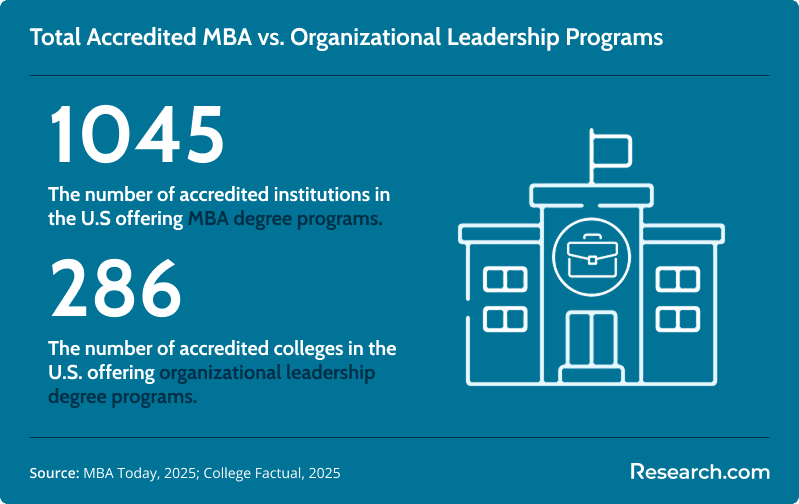
- Approximately 1,045 institutions offer accredited MBA programs, while 286 schools offer organizational leadership degrees.
- MBA-related roles show over 103,025 active listings, while management roles connected to organizational leadership are projected to add 1.2 million openings from 2023–2033.
- Data analytics is increasingly important in MBA education, with 11.2% of students identifying it as a skill area needing improvement.
- The best decision is not based on prestige alone. Compare curriculum, accreditation, total cost, career services, alumni outcomes, employer recognition, and whether the degree directly supports the job you want next.
References:
- CLRN. (n.d.). What is an organizational leadership degree? Retrieved from CLRN.
- Data USA. (n.d.). General business administration & management. Retrieved from Data USA.
- Data USA. (n.d.). Organizational leadership. Retrieved from Data USA.
- edX. (n.d.). How to meet MBA admission requirements: A step-by-step guide. Retrieved from edX.
- MBA.com. (n.d.). MBA specializations: Everything you need to know. Retrieved from MBA.com.
- MBA.org. (n.d.). Certificates and designations. Retrieved from MBA.org.
- Salary.com. (n.d.). Leadership development specialist salary. Retrieved from Salary.com.
- ZipRecruiter. (n.d.). Business consultant salary. Retrieved from ZipRecruiter.
- ZipRecruiter. (n.d.). Executive director salary. Retrieved from ZipRecruiter.
- ZipRecruiter. (n.d.). Finance manager salary. Retrieved from ZipRecruiter.
- ZipRecruiter. (n.d.). HR manager salary. Retrieved from ZipRecruiter.
- ZipRecruiter. (n.d.). Marketing manager salary. Retrieved from ZipRecruiter.
- ZipRecruiter. (n.d.). Operations manager salary. Retrieved from ZipRecruiter.
- ZipRecruiter. (n.d.). Organizational development consultant salary. Retrieved from ZipRecruiter.
- ZipRecruiter. (n.d.). Product manager salary. Retrieved from ZipRecruiter.
- ZipRecruiter. (n.d.). Team leader salary. Retrieved from ZipRecruiter.
Other Things You Should Know about Getting an MBA vs. an Organizational Leadership Degree
In 2027, an MBA focuses on broad business management skills, including finance, marketing, and operations. In contrast, an Organizational Leadership degree emphasizes leadership theories, change management, and enhancing organizational culture. Both paths offer distinct but complementary skill sets useful for different career goals.
An MBA in 2027 often leads to roles such as financial manager, marketing manager, or consultant. In contrast, an organizational leadership degree prepares graduates for positions like human resources director, operations manager, or nonprofit executive, focusing more on leadership and people management.


