2027 How to Become a Human Resources Recruiter

Co-Founder and Chief Data Scientist
Becoming a human resources recruiter is a practical career path for people who like solving hiring problems, communicating with candidates, and helping organizations build stronger teams. The role matters even more now because employers are competing for skilled workers, hiring tools are becoming more data-driven, and candidates expect faster, more transparent recruiting experiences.
This guide explains how to become an HR recruiter, what the job involves, what education and skills employers usually look for, how salary and advancement work, and how to choose the right degree, course, or certification. It is written for students, career changers, entry-level HR workers, and professionals deciding whether recruiting is the right long-term career move.
Quick Answer: How Do You Become a Human Resources Recruiter?
Most HR recruiters start by earning an associate or bachelor’s degree in human resources, business, psychology, communications, or a related field, then build experience through HR assistant, recruiting coordinator, internship, or staffing agency roles. Employers usually value communication skills, sourcing ability, interview coordination, HR technology experience, and knowledge of basic employment laws. Certifications can help, but they are usually most useful after you have some HR or recruiting experience.
The Bureau of Labor Statistics (BLS, 2023) projects employment for HR specialists to grow 8% from 2023 to 2033, with about 74,200 new jobs added. For students comparing career options, recruiting can offer a clear entry point into human resources, with room to move into talent acquisition leadership, HR generalist work, HR management, or consulting.
Why Become an HR Recruiter?
Recruiting can be a strong fit if you want a people-centered business career with measurable results. Recruiters help employers find talent, guide candidates through hiring decisions, and influence the quality of a company’s workforce. The work can be fast-paced, but it also offers variety because every role, hiring manager, and candidate search is different.
- Earning potential can improve with experience. The median annual salary for human resources specialists was $67,650 (BLS, 2023). Senior recruiters and talent acquisition managers earn between $70,000–$130,000+ per year (Glassdoor, 2024).
- Recruiting remains central to business operations. Companies still need to hire for critical roles, replace employees, and build talent pipelines even when economic conditions shift.
- The work can feel meaningful. 64% of recruiters say they find their jobs fulfilling (Onepoll for Ciphr, 2024), often because the role connects people with better employment opportunities while helping organizations grow.
- What does a human resources recruiter do?
- What responsibilities are part of the recruiting process?
- What skills do HR recruiters need?
- What education is required to become an HR recruiter?
- How should you choose HR recruiting courses or degree programs?
- How much do human resources recruiters make?
- Where do HR recruiters work?
- What does the HR recruiting career path look like?
- What trends are changing recruitment?
- What is the job outlook for HR recruiters?
- How can networking and mentorship help?
- Can an online HR associate degree help you start?
- How do recruiters handle legal and ethical issues?
- What challenges do recruiters face?
- Can a business degree strengthen recruiting strategy?
- How can you move up in HR recruiting?
- What KPIs should HR recruiters track? Career advancement options
What Does a Human Resources Recruiter Do?
A human resources recruiter finds, attracts, screens, and helps hire candidates for open positions. Recruiters work with hiring managers to understand role requirements, decide where to search for candidates, evaluate applicants, coordinate interviews, and support job offers.
Recruiting sits within the broader field of human resources roles and responsibilities. Unlike some HR jobs that focus heavily on employee relations, payroll, compliance, or benefits, recruiting is centered on talent acquisition: getting the right people into the organization at the right time.
Good recruiters do more than fill vacancies. They improve hiring processes, reduce mismatches between candidates and roles, strengthen employer reputation, and help managers make better hiring decisions.
What Are the Main Duties of a Human Resources Recruiter?
The exact duties vary by employer, industry, and seniority level. In a small company, one recruiter may handle the entire hiring process. In a large organization, recruiters may specialize by department, job level, geography, or candidate type.
| Recruiting Duty | What It Involves | Why It Matters |
| Talent sourcing | Searching job boards, LinkedIn, social media, referrals, resume databases, professional groups, and internal talent pools. | A strong sourcing strategy gives hiring managers more qualified candidates instead of relying only on incoming applications. |
| Screening candidates | Reviewing resumes, checking basic qualifications, conducting phone screens, and identifying role fit. | Screening saves hiring managers time and helps candidates avoid roles that do not match their goals or background. |
| Interview coordination | Scheduling interviews, preparing candidates, communicating with interview teams, and keeping the process moving. | Timely coordination improves the candidate experience and reduces the risk of losing strong applicants. |
| Employer branding | Writing job posts, presenting the company’s culture, and communicating why candidates should consider the role. | Clear messaging can help employers compete for talent, especially in hard-to-fill roles. |
| Hiring manager partnership | Clarifying job requirements, salary expectations, must-have skills, and realistic candidate availability. | Recruiters help managers separate essential qualifications from preferences that may unnecessarily narrow the talent pool. |
| Offer support | Discussing compensation, benefits, start dates, and candidate concerns before a formal offer is accepted. | Effective offer management can improve acceptance rates and reduce late-stage drop-offs. |
| Onboarding handoff | Helping new hires move from accepted offer to first day, often in coordination with HR operations or hiring teams. | A smoother transition can improve early employee engagement and reduce confusion after hiring. |
Some recruiters later broaden their careers by meeting HR specialist career requirements. That path may involve deeper work in compliance, employee relations, benefits, training, or talent management.
What Skills Should Human Resources Recruiters Have?
Recruiting combines relationship-building with process management. The best recruiters are organized, persuasive, ethical, and comfortable using technology without losing the human side of hiring.
- Communication and relationship-building. Recruiters must write clear messages, explain roles accurately, ask useful screening questions, and build trust with candidates and managers.
- AI and HR technology skills. 74% of professionals agree AI is transforming hiring (LinkedIn, 2025). Recruiters increasingly need to understand resume-screening tools, recruiting platforms, chatbots, scheduling software, and predictive analytics while recognizing the limits of automated decisions.
- Marketing and employer branding. Recruiting often requires marketing judgment: writing stronger job descriptions, communicating culture clearly, and using social channels effectively. A background such as an accelerated marketing degree online can support this part of the work.
- Data-driven decision-making. Recruiters use metrics such as time-to-fill, offer acceptance rate, source quality, interview-to-hire ratio, and candidate satisfaction to improve hiring outcomes.
- Negotiation and persuasion. Recruiters often help align candidate expectations with employer budgets, benefits, location requirements, remote work options, and growth opportunities.
- Adaptability and problem-solving. Hiring needs change quickly. Recruiters must adjust when budgets shift, job requirements change, candidates decline offers, or talent markets become more competitive.
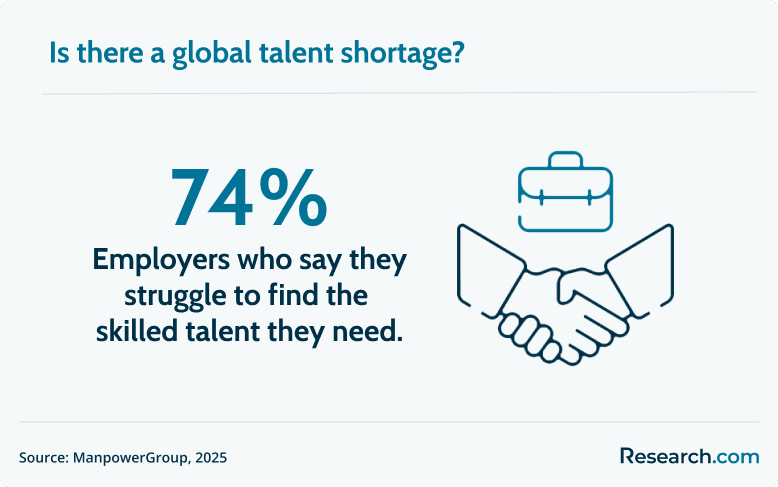
With 74% of employers struggling to find skilled talent (ManpowerGroup, 2025), recruiters who combine sourcing ability, ethical judgment, technology fluency, and strong communication can be valuable to employers across many industries.
What Are the Educational Requirements for Becoming a Human Resources Recruiter?
There is no single required major for every HR recruiter job, but most employers prefer candidates with college-level training in human resources, business, psychology, communications, marketing, or a related area. Some entry-level recruiting coordinator jobs may accept an associate degree plus relevant experience, while many recruiter roles list a bachelor’s degree as the preferred qualification.
| Education Path | Best For | Typical Recruiting Outcome |
| Associate degree in human resources or business | Students who want a faster, lower-cost entry point into HR support roles. | HR assistant, recruiting coordinator, staffing assistant, or administrative recruiting support. |
| Bachelor’s degree in HR, business, psychology, communications, or marketing | Students aiming for standard HR recruiter or talent acquisition specialist roles. | Recruiter, talent acquisition associate, HR coordinator, or HR generalist track. |
| Master’s degree in HR, business, or industrial-organizational psychology | Experienced HR professionals seeking leadership, analytics, workforce planning, or strategic HR roles. | Talent acquisition manager, HR manager, HR director, or specialized HR leadership positions. |
| Certificate or short course | Career changers or degree holders who need focused recruiting knowledge. | Useful supplement for sourcing, interviewing, HR law basics, or HR technology skills. |
If you need a quicker starting point, 1 year associate degree programs online can help you build foundational knowledge in business, communication, and HR processes. If you want broader preparation for recruiter roles, a bachelor’s degree is often the more flexible credential.
Students often ask, is business administration a good major for recruiting? It can be. Business is a common route into HR because recruiters need to understand organizational goals, budgets, managers’ needs, and workforce planning. Zippia (2025) reports that 34% major in business, while other common majors include human resources management and psychology.
How to Choose the Best Courses or Programs to Become an HR Recruiter
The best program depends on your starting point. A high school graduate, a working adult with college credits, a psychology major, and an experienced administrative assistant may all need different paths into recruiting. Before enrolling, compare programs based on credibility, cost, flexibility, career support, and practical recruiting experience.
Questions to Ask Before Choosing a Program
- Do I need a full degree, or would a certificate be enough? If you already completed a business management degree or a Psychology degree online, you may only need targeted HR coursework, a recruiting certificate, or direct recruiting experience.
- Is the school properly accredited? Accreditation affects transfer credits, graduate school options, employer perception, and financial aid eligibility.
- Does the curriculum include employment law, interviewing, HR analytics, and recruiting technology? A general business program can be useful, but recruiter preparation should include hiring-specific skills.
- Will I complete projects, simulations, internships, or case studies? Recruiting is practical work. Programs that include real hiring scenarios can help you speak more confidently in interviews.
- Can I afford the total cost? Look beyond tuition. Include fees, books, technology requirements, commuting, lost work hours, and whether credits transfer.
- Does the format fit my life? Some students need online flexibility, while others benefit from campus networking and structured schedules.
Online programs, including 4-year and accelerated bachelor's degrees online, may work well for career changers and working adults. In-person programs may offer more face-to-face networking, campus recruiting, and direct access to professors. The right choice is the one that fits your budget, schedule, learning style, and career timeline.
Degree vs. Certificate: Which Makes More Sense?
| Option | Choose This If... | Be Careful If... |
| Associate degree | You want an affordable entry point and are open to starting as an HR assistant or recruiting coordinator. | Your target employers usually require a bachelor’s degree for recruiter roles. |
| Bachelor’s degree | You want the broadest access to entry-level recruiter and HR roles. | You are taking on major debt without checking job placement support or transfer options. |
| HR certificate | You already have a degree or related work experience and need focused HR knowledge. | The certificate is not recognized by employers or lacks practical recruiting content. |
| Recruiting bootcamp or short course | You need skills in sourcing, interviewing, LinkedIn recruiting, or applicant tracking systems. | The course promises unrealistic job outcomes or does not provide portfolio-worthy projects. |
How Much Is the Salary of a Human Resources Recruiter?
According to the most recent data from ZipRecruiter, the average salary for a human resources recruiter in the United States is approximately $54,254 per year, or around $26 per hour. Actual pay depends on location, industry, experience, employer size, commission structure, and whether the recruiter works in-house, for an agency, or as an executive search specialist.
Some markets pay more because competition for talent is stronger. California leads in high-paying HR recruiter jobs, with 7 out of the top 10 highest-paying towns in the state. Tech-heavy areas such as San Francisco, Palo Alto, and Menlo Park can influence compensation because employers may need recruiters who understand specialized, competitive hiring markets.
| Factor | How It Can Affect Recruiter Pay |
| Experience level | Entry-level coordinators usually earn less than recruiters, senior recruiters, and talent acquisition managers. |
| Industry | Technical, healthcare, finance, and executive recruiting may pay more when roles are difficult to fill. |
| Location | Higher-cost labor markets may offer higher salaries, especially where specialized hiring demand is strong. |
| Employer type | Agency recruiters may have commission potential, while in-house recruiters may have steadier salaries and benefits. |
| Specialization | Recruiters with expertise in technical hiring, executive search, compliance-heavy fields, or workforce analytics may have stronger earning potential. |
Where Can I Work as a Human Resources Recruiter?
HR recruiters work anywhere organizations need employees. That includes corporations, staffing agencies, healthcare systems, universities, government agencies, nonprofits, consulting firms, and specialized search firms.
Recruiters are 57% higher likelihood to work at private companies than at public companies (Zippia, n.d.). Many also build careers in industries where hiring requires specialized knowledge, such as healthcare, technology, finance, manufacturing, and professional services.
Some recruiters work as internal employees who hire for one organization. Others work for third-party staffing firms that serve multiple clients. Experienced professionals may later move toward consulting; the HR consultant career guide explains how broader HR expertise, workforce management skills, and client-facing experience can support that transition.
Remote and hybrid work have also changed recruiting. Many sourcing, screening, interview coordination, and candidate communication tasks can be done online, although some employers still prefer recruiters who can attend onsite hiring events or meet managers in person.
BLS data shows that the largest employers of HR specialists include employment services, professional and technical services, healthcare, government, and manufacturing.
What Is the Career Pathway of a Human Resource Recruiter?
Recruiting can lead to several paths: deeper specialization in talent acquisition, broader HR generalist work, HR leadership, agency recruiting, executive search, or consulting. According to Indeed (2025), HR professionals often move through roles such as the following:
| Career Stage | Role and Salary | Typical Focus |
| Entry level | HR Assistant / Recruiting Coordinator ($41,875 per year) | Posting jobs, scheduling interviews, tracking candidates, supporting recruiters, and handling administrative hiring tasks. |
| Early career | HR Recruiter / Talent Acquisition Specialist ($56,326 per year) | Sourcing candidates, conducting screens, coordinating hiring steps, and managing requisitions. |
| Broad HR track | HR Generalist ($58,240 per year) | Recruiting plus onboarding, employee relations, documentation, compliance support, and HR operations. |
| Management | HR Manager / Talent Acquisition Manager ($79,007 per year) | Leading recruiters or HR staff, setting hiring strategy, improving processes, and ensuring compliance. |
| Senior leadership | HR Director ($97,584 per year) | Overseeing HR programs, policy development, workforce planning, and executive collaboration. |
| Executive level | Vice President (VP) of HR ($128,457 per year) | Managing company-wide HR strategy, leadership development, culture, and talent planning. |
| C-suite | Chief Human Resources Officer ($212,918 per year) | Aligning HR strategy with business goals and advising senior leadership on workforce decisions. |
If you are new to the field, reviewing human resources assistant career requirements can help you identify realistic first roles. Many recruiters begin with scheduling, job posting, applicant tracking, and HR administration before taking ownership of full-cycle searches.
What Emerging Trends Are Shaping HR Recruitment?
Recruiting is changing quickly because employers are using more technology, candidates expect better communication, and organizations are under pressure to hire fairly and efficiently. Recruiters who understand these changes can improve both hiring outcomes and candidate trust.
- AI-assisted recruiting is expanding. Tools can help screen resumes, match candidates, automate scheduling, and summarize candidate interactions. Recruiters still need to review outputs carefully and watch for bias, privacy, and accuracy concerns.
- Candidate experience is now a competitive factor. Slow communication, unclear job descriptions, and disorganized interviews can cause strong candidates to leave the process.
- Skills-based hiring is gaining attention. Employers increasingly examine skills, portfolios, certifications, and work samples instead of relying only on degree titles or years of experience.
- Diversity, equity, and inclusion remain important in sourcing and selection. Recruiters need structured interviews, consistent evaluation criteria, and inclusive outreach practices.
- Data analytics is becoming part of everyday recruiting. Hiring teams use metrics to identify bottlenecks, compare sourcing channels, and improve offer acceptance.
Students who want a structured foundation in these areas may consider an HR degree, especially if they want long-term flexibility across recruiting, compliance, employee relations, and HR leadership.
What Is the Job Outlook for Human Resources Recruiters?
The outlook for HR recruiters is tied to the broader demand for human resources specialists and the health of the employment services industry. The BLS projects 8% growth for HR specialists from 2023 to 2033, with approximately 74,200 new jobs added. That growth supports continued demand for professionals who can source, screen, and guide candidates through the hiring process.
As of 2024, there are 19,425 employment and recruiting agencies in the U.S. (IBISWorld, 2024). This reflects a large and competitive recruiting industry, especially for employers that outsource hiring or rely on staffing firms for specialized roles.
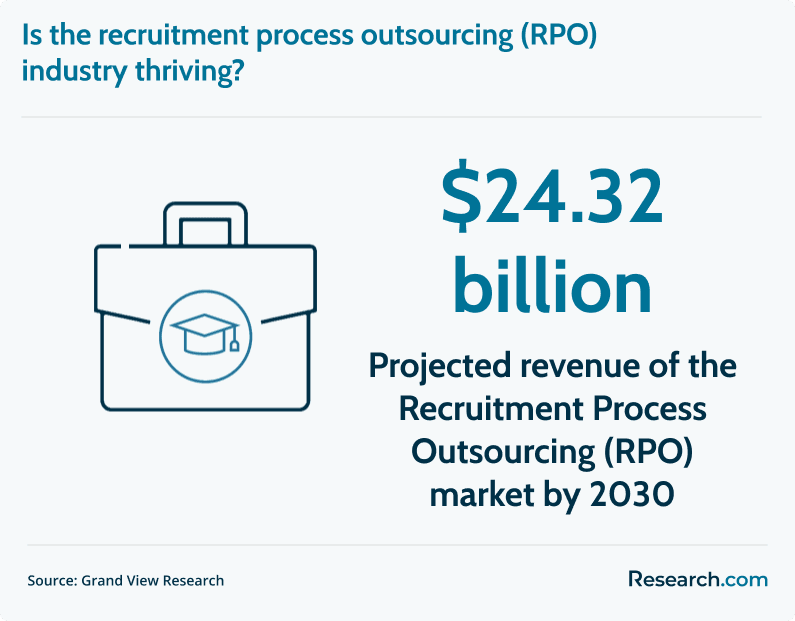
The global recruitment process outsourcing (RPO) market was valued at $8.53 billion in 2023. Grand View Research projects the market will grow at a compound annual growth rate (CAGR) of 16.1%, with a revenue forecast of $24.32 billion in 2030.
Job prospects are likely to be strongest for recruiters who can work with technology, understand labor market data, communicate clearly with hiring managers, and recruit for specialized roles.
How Can Networking and Mentorship Accelerate Your HR Career?
Networking can help recruiters learn which industries are hiring, which tools employers use, and which skills are becoming more valuable. Mentorship can be even more useful because experienced HR professionals can review your resume, help you prepare for recruiter interviews, explain compensation conversations, and show you how to handle difficult hiring situations.
- Join HR associations, local business groups, alumni networks, and recruiting communities.
- Ask experienced recruiters how they source candidates, manage hiring managers, and track performance.
- Attend webinars or events on employment law, HR technology, talent acquisition, and workforce planning.
- Build a professional LinkedIn presence that shows your HR interests, coursework, projects, and recruiting-related experience.
If you are still exploring HR options, what kind of jobs can you get with an HR degree? can help you compare recruiting with HR generalist, training, compensation, and employee relations paths.
Could an Online HR Associates Degree Jumpstart Your HR Recruiting Career?
An online HR associates degree can help you qualify for entry-level HR support roles, especially if you are new to college or changing careers. These programs can introduce employment law basics, HR administration, business communication, compensation concepts, and hiring processes.
This path is most useful if you are willing to start with coordinator or assistant roles and build experience. If your goal is to move directly into full recruiter positions at larger employers, compare whether a bachelor’s degree will provide stronger access.
How Can HR Recruiters Navigate Legal and Ethical Challenges?
Recruiters influence who gets considered for jobs, so legal and ethical judgment matters. Common risks include discriminatory screening, inconsistent interview questions, mishandling candidate data, misleading job descriptions, and overreliance on automated hiring tools.
- Use consistent screening criteria tied to job requirements.
- Avoid interview questions that could create discrimination risk.
- Protect candidate data and follow company privacy procedures.
- Be transparent about job duties, compensation ranges when available, work location expectations, and hiring timelines.
- Review AI-assisted recommendations rather than treating them as final decisions.
Professionals who want to move into higher-level compliance or HR leadership work may benefit from studying what you can do with a master's in human resources management.
What Are Common Challenges Faced by HR Recruiters and How Can They Overcome Them?
Recruiting can be rewarding, but it is not always easy. Recruiters often work with urgent deadlines, changing job requirements, hard-to-reach candidates, and hiring managers who may not agree on what they want.
| Common Challenge | Why It Happens | Better Approach |
| Unclear job requirements | Hiring managers may ask for too many skills or change priorities mid-search. | Hold intake meetings, define must-have versus preferred skills, and confirm salary and work location early. |
| Weak candidate pipeline | Job posts alone may not reach qualified candidates. | Use referrals, direct sourcing, professional groups, and targeted outreach. |
| Slow hiring decisions | Interview teams may delay feedback or add unnecessary steps. | Set a timeline before sourcing begins and track bottlenecks with hiring metrics. |
| Bias in screening | Unstructured interviews and vague criteria can create inconsistent decisions. | Use standardized questions, job-related scorecards, and diverse sourcing strategies. |
| Low offer acceptance | Compensation, flexibility, role clarity, or timing may not match candidate expectations. | Discuss expectations early and keep communication honest throughout the process. |
If your long-term goal is HR leadership, advanced business and HR education may help. For example, is an MBA in human resources worth it? can help you decide whether graduate business training fits your career goals.
Could an Accelerated Business Degree Improve Your HR Recruitment Strategy?
An accelerated business degree can be useful for recruiters who want to understand finance, operations, management, marketing, and organizational strategy. Recruiting is not only an HR function; it is also a business function because hiring decisions affect productivity, budgets, growth, and team performance.
This path may make sense if you want to move beyond day-to-day recruiting into workforce planning, talent acquisition leadership, HR analytics, or HR business partner roles. It may be less necessary if you already have a business degree and mainly need recruiting-specific experience or certification.
How Do You Advance in Your HR Recruiting Career?
Advancement usually comes from a combination of stronger hiring results, broader HR knowledge, leadership ability, and recognized credentials. Recruiters who want to move up should build measurable experience: filling difficult roles, improving time-to-fill, strengthening candidate pipelines, training hiring managers, and using data to improve recruiting strategy.
Earn a Master’s Degree
A bachelor’s degree may be enough for many recruiting roles, but an online master degree in human resources can support advancement into HR management, workforce planning, organizational development, or executive-track positions.
- Master’s in Human Resources Management (MHRM). This degree focuses on HR leadership, talent strategy, workforce planning, and aligning people practices with business objectives.
- Master’s in Business Administration (MBA) with an HR concentration. This option combines broad business training with HR coursework, which can help professionals move into strategic management roles.
- Master’s in Industrial-Organizational Psychology. This path emphasizes workplace behavior, employee assessment, selection methods, motivation, and organizational performance.
Obtain HR Certifications
Certifications can signal professional commitment and specialized knowledge. They are most valuable when paired with practical recruiting experience.
| Certification | Best For | Main Focus |
| Professional in Human Resources (PHR) by HR Certification Institute (HRCI) | Recruiters who want stronger grounding in U.S. employment laws, workforce planning, and compliance. | Operational HR knowledge, regulations, and workforce practices. |
| Certified Professional (SHRM-CP) by the Society for Human Resource Management (SHRM) | HR professionals involved in hiring, employee relations, and day-to-day HR operations. | Practical HR competencies, talent acquisition, and compliance. |
| Talent Acquisition Specialty Credential by SHRM | Recruiters who want to specialize more deeply in sourcing, assessment, and workforce planning. | Talent acquisition strategy and recruiting process improvement. |
| LinkedIn Certified Recruiter | Recruiters who rely heavily on digital sourcing and employer branding through LinkedIn tools. | Online sourcing, candidate search, and platform-based recruiting workflows. |
Choose credentials based on where you want to go next. A recruiter aiming for HR manager may prioritize broader HR certifications, while a technical recruiter may gain more from advanced sourcing, analytics, or platform-specific training.
What Are the Key Performance Indicators for HR Recruiters?
Recruiters are often evaluated by both speed and quality. The goal is not simply to fill jobs quickly; it is to help the organization hire qualified people who accept offers, perform well, and stay.
| KPI | What It Measures | How Recruiters Use It |
| Time-to-fill | How long it takes to fill an open role. | Identifies delays in sourcing, interviewing, feedback, or offer approval. |
| Cost-per-hire | The total cost of recruiting for a position. | Helps compare job boards, agencies, tools, and sourcing strategies. |
| Candidate quality | How well hired candidates match role expectations. | Shows whether screening criteria and sourcing channels are effective. |
| Offer acceptance rate | The percentage of offers candidates accept. | Reveals whether compensation, role clarity, timing, or candidate communication needs improvement. |
| Retention rate | Whether hires remain with the organization after joining. | Connects recruiting decisions with long-term hiring success. |
| Candidate satisfaction | How candidates experience the hiring process. | Helps improve communication, interview structure, and employer reputation. |
Recruiters who want to move into leadership may benefit from advanced analytics and HR strategy training. An MBA in HR management online can be one option for professionals who want to combine business strategy with people analytics and talent leadership.
Common Mistakes to Avoid When Becoming an HR Recruiter
- Choosing a program without checking accreditation. Accreditation can affect credit transfer, financial aid, and employer confidence.
- Looking only at tuition. Compare fees, books, commuting, technology, time away from work, and whether credits will transfer.
- Assuming a certificate replaces experience. Certifications can help, but employers still want proof that you can communicate with candidates, manage requisitions, and support hiring managers.
- Ignoring HR law and ethics. Recruiters need to understand fair hiring, candidate privacy, bias risks, and compliant interview practices.
- Relying only on rankings or brand names. A program with internships, employer connections, and practical HR coursework may be more useful than a recognizable name with limited career support.
- Underestimating technology. Applicant tracking systems, sourcing platforms, analytics dashboards, and AI tools are becoming part of routine recruiting work.
- Assuming salary outcomes are guaranteed. Pay varies by industry, location, experience, employer type, and specialization.
References
- Business LinkedIn. (2025). The future of recruiting: Staffing industry insights. Retrieved from https://business.linkedin.com/talent-solutions/resources/future-of-recruiting/staffing
- Bureau of Labor Statistics. (2023). Human resources specialists: Occupational outlook handbook. U.S. Department of Labor. Retrieved from https://www.bls.gov/ooh/business-and-financial/human-resources-specialists.htm
- CIPHR. (2024). How HR professionals view their jobs. Retrieved from https://www.ciphr.com/infographics/how-hr-professionals-view-their-jobs
- Glassdoor. (2024). Recruiter salary insights. Retrieved from https://www.glassdoor.com/Salaries/recruiter-salary-SRCH_KO0,9.htm
- IBISWorld. (2025). Employment & recruiting agencies industry report (United States). Retrieved from https://www.ibisworld.com/united-states/industry/employment-recruiting-agencies/1463/
- IBISWorld. (2025). Number of employment & recruiting agencies in the United States. Retrieved from https://www.ibisworld.com/united-states/number-of-businesses/employment-recruiting-agencies/1463/
- Indeed. (2025). Hierarchy of HR job titles. Retrieved from https://www.indeed.com/career-advice/finding-a-job/hierarchy-of-hr-job-titles
- ManpowerGroup. (2025). Talent shortage report. Retrieved from https://go.manpowergroup.com/talent-shortage
- ZipRecruiter. (2025). Executive recruiter salary insights. Retrieved from https://www.ziprecruiter.com/Salaries/Executive-Recruiter-Salary
- Zippia. (2025). Human resource specialist education statistics. Retrieved from https://www.zippia.com/human-resource-specialist-jobs/education/
Key Insights
- HR recruiting is a practical entry point into human resources because it combines communication, business judgment, technology, and measurable hiring results.
- Most recruiter roles favor candidates with a bachelor’s degree, but associate degrees, certificates, internships, and coordinator roles can help beginners enter the field.
- The strongest recruiters are not just “people persons.” They know how to source candidates, use HR technology, interpret hiring metrics, manage stakeholders, and reduce bias in the hiring process.
- Salary varies widely by experience, industry, location, and employer type. The average U.S. salary cited by ZipRecruiter is approximately $54,254 per year, while broader HR specialist data from BLS reports a median annual salary of $67,650.
- Career growth can lead from recruiting coordinator to recruiter, talent acquisition specialist, HR generalist, HR manager, HR director, VP of HR, or CHRO.
- Before choosing a program, check accreditation, total cost, transfer policies, practical experience, HR technology coverage, and career support—not just the program name or tuition rate.
- AI, analytics, skills-based hiring, and candidate experience are reshaping recruitment, so future recruiters should build both technical fluency and ethical judgment.
Other Things You Should Know About How to Become a Human Resources Recruiter
In 2027, human resources recruiters need strong communication skills, proficiency in digital recruiting tools, and an understanding of diversity and inclusion practices. Analytical and interpersonal skills are also crucial for assessing potential candidates and collaborating with hiring managers effectively.
Yes. Recruiters must understand basic federal employment rules, especially Title VII, the ADA, the ADEA, and the FLSA, to avoid illegal screening questions and discriminatory hiring practices. Many employers also expect knowledge of state hiring laws, background check rules, and recordkeeping requirements.
Entry-level HR recruiter roles often do not require prior experience, though internships or HR assistant positions can be helpful. Some companies prefer customer service, sales, or administrative experience, as these roles develop transferable skills like communication and relationship-building. However, mid-to-senior-level recruiting roles typically require several years of experience in talent acquisition.