
2027 How to Become a Supply Chain Manager: Salary & Career Paths

Co-Founder and Chief Data Scientist
Becoming a supply chain manager is a practical career goal for people who like solving operational problems, working with data, coordinating teams, and making business processes run better. The role matters because companies now compete not only on product quality or price, but also on how reliably they can source materials, manage inventory, ship orders, reduce waste, and recover from disruptions.
This guide explains what supply chain managers do, how to enter the field, what skills and credentials can improve your prospects, where the jobs are, how much the role can pay, and what trade-offs to consider before choosing this career path. It is written for students, early-career logistics professionals, business majors, operations employees, and career changers who want a clear path into supply chain leadership.
Quick Answer: How Do You Become a Supply Chain Manager?
Most supply chain managers start with a bachelor’s degree in supply chain management, logistics, business administration, operations management, or a related field. They usually build experience in entry-level roles such as logistics coordinator, procurement assistant, inventory analyst, or supply chain analyst before moving into management. Certifications such as CSCP, CPIM, CPSM, SCPro, or Six Sigma can strengthen a resume, especially for professionals aiming for higher salaries or leadership roles.
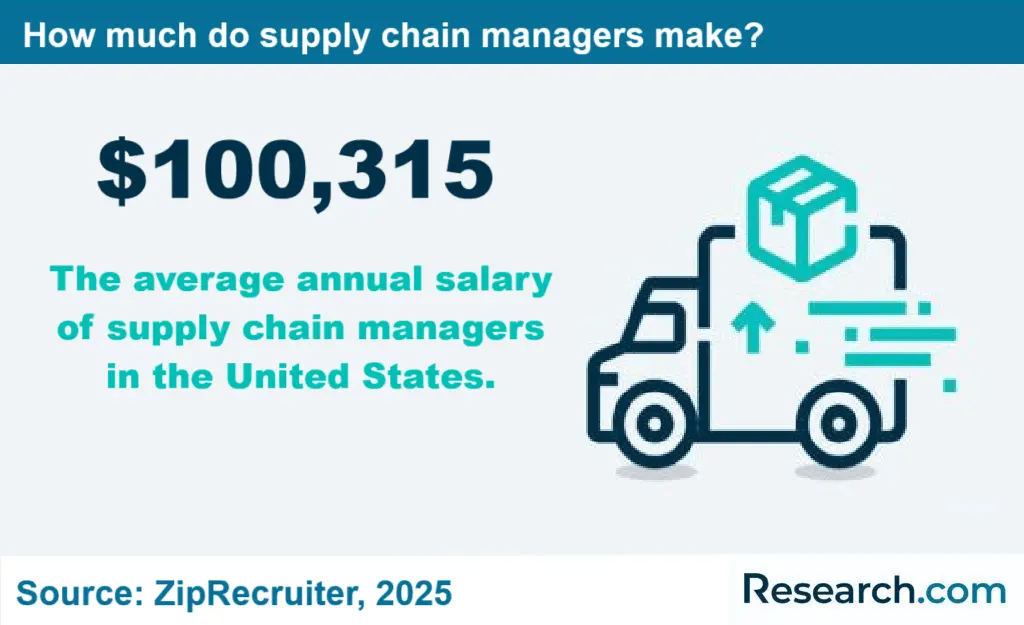
In the United States, supply chain managers commonly earn between $80,000 and $110,000 per year, while experienced professionals can earn $120,000 or more annually. ZipRecruiter reports an average of $100,300 per year, or $48 per hour. Career growth is also supported by strong demand: the U.S. Bureau of Labor Statistics projects 19% employment growth for logisticians from 2023 to 2033.
Key Things You Should Know About Becoming a Supply Chain Manager
- Pay can be strong, but it varies widely. The average salary range for U.S. supply chain managers is $80,000 to $110,000 per year, with experienced professionals sometimes earning $130,000 or more.
- Most people do not start as managers. Common first roles include logistics coordinator, procurement analyst, inventory planner, and supply chain analyst. With experience, professionals can move into operations manager, supply chain manager, director, VP of Supply Chain, or Chief Supply Chain Officer roles.
- The field is broad. Supply chain professionals work in manufacturing, retail, healthcare, e-commerce, aerospace, technology, government, defense, and transportation.
- Education and credentials can affect advancement. A bachelor’s degree is often the baseline requirement, while certifications and graduate education can help professionals qualify for more specialized or senior positions.
- Global operations create additional opportunities. International logistics, supplier management, language skills, and cross-cultural communication can be valuable for professionals working with multinational teams.
- What does a supply chain manager do?
- What responsibilities should you expect in this role?
- How can you become a supply chain manager in 2026?
- What skills matter most for supply chain managers?
- Which certifications are useful for supply chain managers?
- What industries hire supply chain managers?
- How much money can supply chain managers make?
- How can you build stronger leadership skills in supply chain management?
- Which interdisciplinary skills help supply chain managers stand out?
- Can advanced academic credentials support supply chain career growth?
- How can additional education speed up advancement in supply chain management?
- How do quantitative skills improve supply chain decisions?
- How can continuous learning improve supply chain performance?
- What is the job outlook for supply chain managers?
- What are the advantages of becoming a supply chain manager?
- What challenges should supply chain managers expect?
What does a supply chain manager do?
A supply chain manager oversees the systems that move products, materials, information, and resources from suppliers to customers. The role connects procurement, production, inventory, transportation, warehousing, distribution, and customer delivery into one coordinated operation.
In practice, supply chain managers make sure the right materials arrive at the right time, inventory levels are appropriate, products move efficiently, and disruptions are handled before they cause serious business problems. They work with suppliers, manufacturers, carriers, warehouses, retailers, finance teams, sales teams, and customer service departments.
Because this job requires coordination across many teams, strong leadership skills in management roles can be important. Supply chain managers often need to align people who have different priorities: finance may focus on cost, sales may focus on availability, operations may focus on capacity, and customers may focus on speed.
The role also overlaps with finance and accounting. For example, managers may work with finance teams on cost controls, compliance, budgets, and vendor payments. In those situations, it can help to understand the difference between accounting roles, including questions such as whether a CPA is the same as an accountant.
At its core, supply chain management is a decision-making career. Managers use demand forecasts, supplier data, transportation costs, inventory reports, and risk assessments to make practical choices that affect profit, customer satisfaction, and operational resilience.
The image below shows how much supply chain managers earn on average each year.
What responsibilities should you expect as a supply chain manager?
Supply chain managers are responsible for keeping operations reliable, cost-effective, and responsive to demand. The exact duties depend on the employer, industry, company size, and level of seniority, but most roles include the following responsibilities.
| Responsibility | What it involves | Why it matters |
| Planning and forecasting | Reviewing sales trends, demand patterns, seasonal changes, and market signals to estimate future inventory and production needs. | Good forecasting helps companies avoid both stockouts and costly excess inventory. A business background, including a traditional or online marketing degree path, can support this work. |
| Procurement and supplier management | Selecting vendors, negotiating contracts, monitoring supplier performance, and addressing quality or delivery concerns. | Supplier decisions affect cost, reliability, compliance, and customer delivery timelines. |
| Inventory control | Setting inventory targets, monitoring stock levels, reducing waste, and coordinating replenishment. | Inventory that is too low can hurt sales; inventory that is too high can tie up cash and warehouse space. |
| Logistics and distribution | Coordinating transportation, warehousing, shipping schedules, delivery routes, and carrier performance. | Efficient logistics improve delivery speed, reduce costs, and protect customer satisfaction. |
| Process improvement | Finding bottlenecks, reducing unnecessary steps, improving workflows, and applying methods such as Lean or Six Sigma. | Small process improvements can produce large savings across high-volume operations. |
| Risk management | Planning for supplier disruptions, transportation delays, shortages, geopolitical issues, weather events, and other operational threats. | Resilient supply chains reduce downtime and protect revenue when problems occur. |
| Cross-functional coordination | Working with sales, finance, production, customer service, IT, legal, and executive teams. | Supply chain decisions affect the entire organization, so communication is essential. |
| Technology adoption | Using ERP systems, inventory platforms, supply chain software, automation tools, analytics dashboards, and related technologies. | Modern supply chains depend on accurate data and fast decision-making. |
How can you become a supply chain manager in 2026?
There is no single required route into supply chain management, but most professionals move through a combination of formal education, hands-on operations experience, technical skill development, and leadership growth. The path below is the most common route for students and early-career professionals.
- Earn a relevant bachelor’s degree. A supply chain management degree is directly aligned with the field, but employers may also consider degrees in logistics, business administration, operations management, industrial engineering, analytics, or related areas.
- Build practical experience in an entry-level role. Look for jobs such as logistics coordinator, procurement assistant, inventory analyst, operations associate, warehouse analyst, production planner, or supply chain analyst. These jobs teach you how real supply chains work beyond the classroom.
- Learn the tools used by employers. Experience with ERP systems, inventory systems, spreadsheets, data visualization tools, procurement platforms, and transportation management systems can make you more competitive.
- Develop a track record of measurable results. Employers often promote people who can show they reduced costs, improved delivery accuracy, shortened lead times, increased forecast accuracy, or solved recurring operational problems.
- Consider graduate education if your goals require it. A master’s degree in supply chain management, operations, analytics, or business may be useful for professionals targeting senior management or strategic roles, although it is not always mandatory.
- Add certifications when they match your career direction. Credentials such as CSCP, CPIM, CPSM, SCPro, and Six Sigma can demonstrate specialized knowledge. Some professionals view these as career-focused certifications with strong earning potential because they can support advancement.
- Network inside and outside your organization. Cross-functional projects, industry associations, conferences, mentors, and professional communities can expose you to new opportunities and help you understand employer expectations.
| Career stage | Typical roles | What to focus on |
| Student or career changer | Intern, operations assistant, warehouse associate, procurement intern | Learn supply chain basics, spreadsheets, communication, and business operations. |
| Entry level | Logistics coordinator, procurement assistant, inventory analyst | Gain hands-on experience with vendors, data, inventory, transportation, and systems. |
| Early to mid-career | Supply chain analyst, production planner, procurement analyst, operations supervisor | Build analytical skills, lead projects, and show measurable process improvements. |
| Manager level | Supply chain manager, logistics manager, procurement manager, operations manager | Manage teams, budgets, suppliers, risk, and cross-functional priorities. |
| Senior leadership | Director of Supply Chain, VP of Supply Chain, Chief Supply Chain Officer | Set strategy, manage enterprise-level risk, lead transformation, and align supply chain goals with business growth. |
The chart below shows what supply chain managers commonly major in for their bachelor's degree. At the top of the list is a traditional or online business degree, followed by supply chain management.
What skills matter most for supply chain managers?
Supply chain managers need a mix of analytical, technical, operational, and interpersonal abilities. The best candidates are not only good with data; they can also persuade stakeholders, manage pressure, and turn complex information into practical decisions.
- Analytical judgment: You need to interpret demand forecasts, supplier performance, cost trends, inventory reports, and delivery data without losing sight of business priorities.
- Project management: Supply chain work often involves overlapping timelines, vendors, budgets, risks, and teams. Planning and follow-through are essential.
- Communication: You must explain trade-offs clearly to executives, vendors, warehouse teams, finance staff, sales teams, and customers.
- Leadership: As you advance, you may manage teams, resolve conflicts, delegate work, and lead improvement initiatives across departments.
- Adaptability: Delayed shipments, inaccurate forecasts, supplier failures, and sudden demand spikes are common. Managers need to respond quickly without creating new problems.
- Technical confidence: ERP systems, analytics tools, inventory software, automation platforms, AI-supported planning tools, and supply chain dashboards are increasingly part of the job.
- Negotiation: Supplier contracts, shipping terms, pricing, service levels, and delivery commitments often depend on strong negotiation and relationship management.
- Risk awareness: Managers must think ahead about alternative suppliers, safety stock, transportation constraints, compliance requirements, and geographic vulnerabilities.
Current Trends Affecting Supply Chain Skills
- AI and analytics are changing decision-making. Employers increasingly value professionals who can use data tools to support forecasting, route planning, inventory optimization, and supplier evaluation.
- Resilience is now a strategic priority. Companies are paying closer attention to supplier concentration, backup sourcing, transportation risk, and disruption planning.
- Sustainability and ethical sourcing matter more. Many organizations expect supply chain teams to consider environmental impact, supplier practices, waste reduction, and traceability.
- Automation is reshaping operations. Warehousing, procurement, planning, and transportation functions are increasingly supported by automated systems, which means managers need both technical literacy and change management skills.
Which certifications are useful for supply chain managers?
Certifications are not always required, but they can help you prove specialized knowledge, prepare for advancement, or move into a more focused area such as procurement, inventory planning, logistics, or process improvement. The right certification depends on your current role and target career path.
| Certification | Best fit | Main focus |
| Certified Supply Chain Professional (CSCP) | Professionals who want broad, end-to-end supply chain knowledge | Planning, sourcing, manufacturing, delivery, returns, and integrated supply chain strategy |
| Certified in Production and Inventory Management (CPIM) | Professionals in manufacturing, production planning, and inventory roles | Internal operations, production systems, inventory control, and planning |
| SCPro Certification | Professionals who want to demonstrate applied supply chain problem-solving | Practical supply chain knowledge across multiple tiers |
| Certified Professional in Supply Management (CPSM) | Procurement, sourcing, and supplier management professionals | Supplier relationships, contracts, purchasing, and supply management |
| Six Sigma Green Belt or Black Belt | Professionals focused on quality, efficiency, waste reduction, and process improvement | Operational improvement, defect reduction, measurement, and Lean-related practices |
| Logistics-focused certifications | Professionals specializing in transportation, distribution, or logistics operations | Freight, routing, distribution networks, transportation planning, and logistics execution |
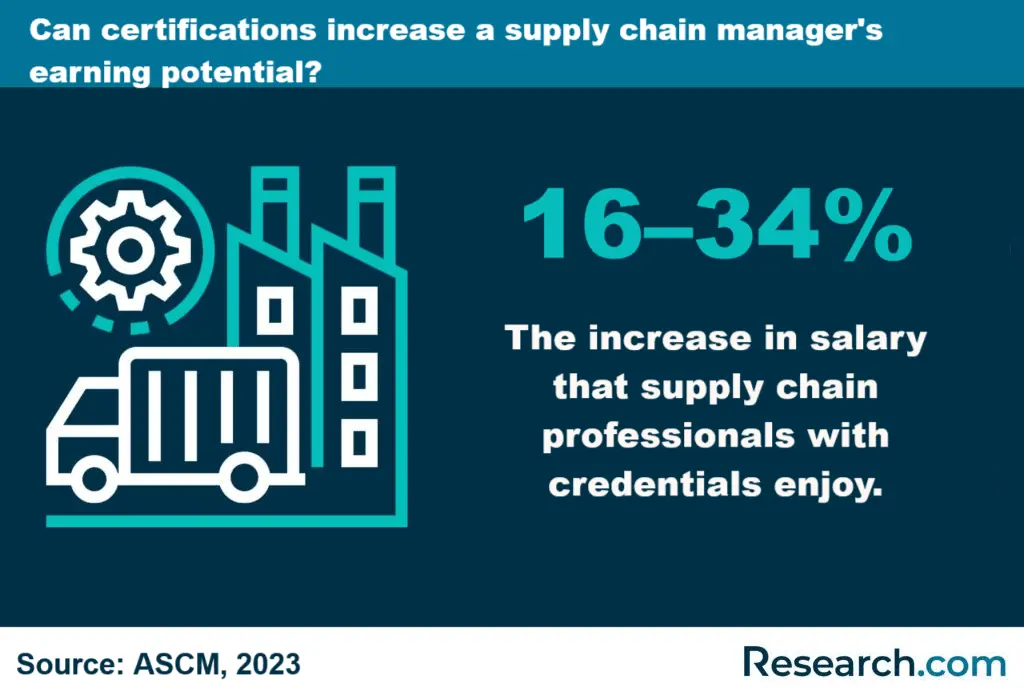
The image below shows how much additional certifications or credentials can contribute to a supply chain manager's salary.
What industries hire supply chain managers?
Supply chain managers are employed wherever organizations need to source materials, manage inventory, coordinate vendors, move products, or control operational costs. This makes the career portable across many industries, but each sector has different demands.
| Industry | What supply chain managers handle | Who may be a good fit |
| Manufacturing | Raw materials, production schedules, supplier performance, inventory, and distribution | People who enjoy complex operations, production planning, and high-volume processes |
| Retail and e-commerce | Sourcing, warehouse operations, order fulfillment, last-mile delivery, and demand swings | Professionals who can work quickly and manage customer-driven timelines |
| Healthcare and pharmaceuticals | Medical supplies, medications, equipment, compliance, and time-sensitive delivery | Detail-oriented professionals comfortable with regulated environments |
| Logistics and transportation | Freight coordination, routing, carrier management, fleet operations, and distribution networks | People with a logistics degree background or strong interest in transportation systems |
| Technology and electronics | Global sourcing, component availability, supplier risk, product launches, and distribution | Professionals interested in fast-moving, innovation-focused environments |
| Food and beverage | Perishable inventory, cold chain requirements, safety standards, sourcing, and delivery timing | People who can manage tight timelines and quality requirements |
| Energy and utilities | Equipment, parts, raw materials, project logistics, and large-scale operational support | Professionals comfortable with complex, high-value supply networks |
| Government and defense | Procurement, inventory, emergency readiness, program logistics, and compliance | People who value structure, accountability, and mission-critical operations |
When choosing an industry, look beyond salary. Consider regulation, work pace, travel expectations, technology use, sustainability priorities, and how much pressure comes with delays or shortages.
How much money can supply chain managers make?
Supply chain management can offer strong compensation because the work directly affects cost control, delivery performance, customer satisfaction, and business continuity. Pay depends on experience, industry, location, employer size, education, credentials, and the complexity of the supply chain being managed.
In the United States, the average salary for a supply chain manager ranges between $80,000 and $110,000 per year. Professionals with several years of experience can earn $120,000 or more annually, particularly when they have advanced degrees, specialized credentials, or experience in complex industries.
ZipRecruiter reports that U.S. supply chain managers can earn an average of $100,300 per year, or $48 per hour.
| Experience level | Reported salary range | Typical career focus |
| Entry-Level (1–3 years) | $60,000–$80,000 | Learning systems, coordinating shipments, supporting procurement, tracking inventory, and analyzing data |
| Mid-Level (4–7 years) | $85,000–$110,000 | Managing projects, improving processes, supervising teams, and handling supplier or logistics responsibilities |
| Senior-Level (8+ years) | $115,000–$140,000+ | Leading larger teams, managing budgets, setting strategy, and overseeing complex supply chain functions |
| Executive Roles (Director/VP/CSCO) | $150,000–$200,000+ | Setting enterprise strategy, managing global risk, leading transformation, and aligning supply chain operations with business goals |
Some sectors tend to offer higher pay because their supply chains are global, regulated, technically complex, or highly time-sensitive. These include pharmaceuticals and healthcare, aerospace and defense, technology and electronics, oil, gas, and energy, and high-end manufacturing.
Location also affects compensation. Supply chain managers in major metropolitan areas or high-cost regions such as New York, San Francisco, Chicago, or Houston may earn more than those in smaller markets. However, remote roles and global employers can reduce some geographic limitations.
Credentials may also influence earnings. According to a 2023 survey report from the Association for Supply Chain Management salary report, supply chain professionals with at least one credential earn a median salary that is 16% higher than those without credentials. Professionals with two or more credentials earn 34% more. The same report states that professionals with one credential receive 45% higher cash bonuses, while those with two or more credentials receive 81% higher cash bonuses.
The chart below shows the median salaries of supply chain professionals. Supply chain managers are the second highest paid among these professionals, next only to supply chain directors.
How can you build stronger leadership skills in supply chain management?
Moving from analyst or coordinator roles into management requires more than technical competence. Supply chain leaders must make decisions with incomplete information, lead teams through disruptions, negotiate across departments, and explain operational trade-offs to executives.
Leadership development can come from stretch assignments, mentorship, supervisor training, cross-functional projects, professional associations, and graduate study. Some professionals who want advanced leadership preparation explore options such as a doctorate in organizational leadership online, especially when their long-term goals involve executive leadership, consulting, research, or organizational transformation.
Which interdisciplinary skills help supply chain managers stand out?
Supply chain management sits at the intersection of operations, finance, data, communication, technology, and global business. Interdisciplinary skills can therefore make a major difference. Strong writing, negotiation, cultural awareness, and language ability help managers communicate with international suppliers, internal executives, warehouse teams, and customers.
Not every degree outside supply chain will be directly relevant, so students should evaluate programs based on career goals. For example, communication-heavy roles may benefit from stronger writing and language training, and some learners may compare options such as the most affordable online English degree programs when building communication skills for business settings.
Can advanced academic credentials support supply chain career growth?
Advanced degrees can help some supply chain professionals move into senior strategy, teaching, consulting, analytics, organizational leadership, or executive roles. However, they are not automatically necessary for every manager. Before enrolling, compare tuition, time commitment, employer tuition assistance, career outcomes, and whether the credential matches your target role.
Professionals focused on leadership, change management, and applied research may consider doctoral-level programs. Flexible options such as the most affordable online EdD programs may appeal to working adults who want advanced study without leaving the workforce.
How can additional education speed up advancement in supply chain management?
Additional education can accelerate career growth when it fills a real gap: analytics, procurement, operations strategy, leadership, finance, technology implementation, or change management. The best choice depends on whether you need a short certification, a master’s degree, an MBA, or a doctoral program.
Some professionals compare accelerated doctoral options, including 2 year Ed D programs, when they want advanced leadership training on a faster timeline. Before choosing that route, confirm accreditation, workload, dissertation or capstone requirements, and whether the degree will be valued in your intended career path.
How do quantitative skills improve supply chain decisions?
Quantitative skills help supply chain managers turn data into better decisions. Forecasting, safety stock calculations, route analysis, supplier scorecards, cost modeling, risk analysis, and inventory optimization all require comfort with numbers.
Professionals who want deeper math and analytics preparation may consider programs such as an accelerated online bachelor’s degree in mathematics. This kind of background can be especially useful for supply chain analytics, demand planning, operations research, and data-heavy logistics roles.
How can continuous learning improve supply chain performance?
Supply chain tools, risks, and employer expectations change quickly. Continuous learning helps managers stay current with AI-supported planning, automation, analytics, cybersecurity concerns, supplier risk, sustainability expectations, and global logistics practices.
The most relevant learning options are usually supply chain certifications, analytics training, ERP training, procurement courses, leadership development, and industry-specific compliance education. Broader information-management programs, such as the most affordable online master’s degrees in library science, may be useful only for professionals whose goals involve complex information systems, knowledge management, or data organization; they should not be treated as a standard supply chain credential.
What is the job outlook for supply chain managers?
The job outlook for supply chain managers is supported by the increasing complexity of global commerce, the need for resilient operations, and the growing use of technology in logistics and planning. Companies need people who can reduce costs, manage risk, improve delivery performance, and respond to disruptions.
According to the U.S. Bureau of Labor Statistics, employment in logistics careers, including logisticians and related supply chain roles, is projected to grow by 19% from 2023 to 2033. That growth rate is much faster than the average for all occupations.
Technology is also changing what employers expect. AI, automation, data analytics, RFID-related technologies, barcodes, and digital logistics systems are shaping how supply chain teams forecast demand, monitor inventory, plan routes, and evaluate performance.
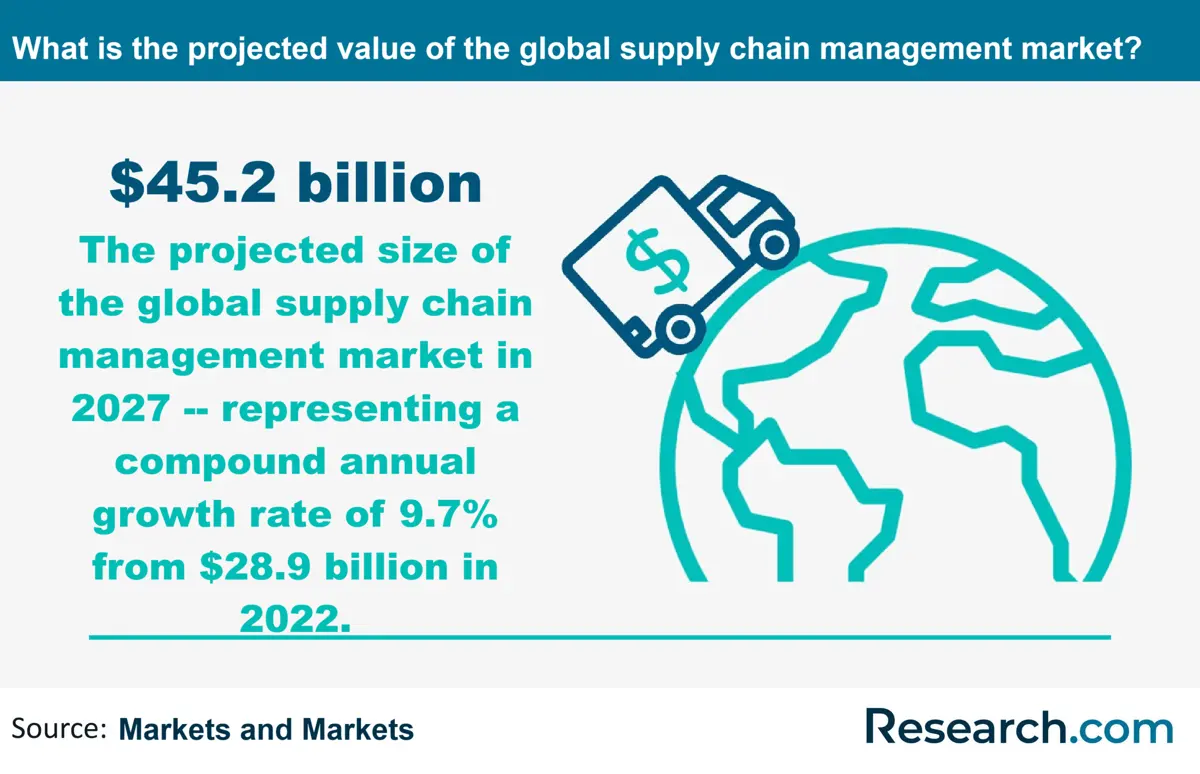
Markets and Markets reports that the global supply chain management market size is projected to grow from $28.9 billion in 2022 to $45.2 billion in 2027, representing a compound annual growth rate of 9.7%. The report identifies increased adoption of RFID-related technologies and barcodes, along with advances in AI logistical distribution systems, as major growth drivers.
What are the advantages of becoming a supply chain manager?
Supply chain management can be a rewarding career for people who enjoy operational problem-solving, business strategy, technology, and measurable results. The role is especially appealing because it exists across many industries and offers room for advancement.
- Strong earning potential: Supply chain managers can earn competitive salaries, especially after gaining experience or moving into leadership roles. Professionals who aim for executive business leadership may also compare advanced options and outcomes, including Doctor of Business Administration salary information.
- Demand across industries: Manufacturing, healthcare, retail, technology, logistics, energy, defense, and government employers all need supply chain talent.
- Clear advancement paths: Professionals can move from coordinator or analyst roles into management, director, VP, and CSCO positions.
- Variety of specializations: You can focus on procurement, logistics, inventory planning, demand planning, operations strategy, analytics, sustainability, or supplier risk.
- Global work opportunities: Many supply chains cross national borders, which can create opportunities to work with international teams or multinational employers.
- Meaningful business impact: Supply chain decisions affect cost, delivery speed, customer satisfaction, resilience, and profitability.
- Pathways for career changers: People from adjacent fields can enter the profession with additional training. Some professionals with social science backgrounds, for example, may connect policy, operations, and planning skills to roles related to logistics or strategy, similar to how some higher-paying sociology degree jobs involve research, planning, and organizational analysis.
What challenges should supply chain managers expect?
Supply chain management can be demanding. The work often involves high stakes, competing priorities, tight timelines, and problems that require quick decisions. Before choosing this career, consider the challenges as carefully as the benefits.
| Challenge | What it looks like | How to prepare |
| Disruptions | Supplier failures, shipping delays, natural disasters, political instability, shortages, or sudden demand changes | Build contingency plans, diversify suppliers when possible, and monitor risk indicators. |
| Cost versus service trade-offs | Pressure to reduce costs while maintaining quality, availability, and delivery performance | Use data to explain trade-offs instead of making cuts based only on short-term savings. |
| Complex networks | Multiple suppliers, carriers, warehouses, vendors, and internal departments across regions | Improve communication systems, documentation, supplier scorecards, and escalation processes. |
| Technology change | New tools for AI, automation, analytics, blockchain, IoT, and ERP modernization | Stay current, learn core systems, and build change management skills. |
| Data overload | Large volumes of inventory, supplier, cost, shipment, and demand data | Focus on the metrics that support decisions rather than tracking everything equally. |
| Sustainability and ethics | Pressure to reduce waste, improve sourcing transparency, and meet environmental or labor expectations | Understand supplier practices, compliance standards, and sustainability reporting needs. |
| Stress and urgency | Last-minute shortages, late shipments, peak-season pressure, or customer escalations | Develop prioritization habits, escalation plans, and calm communication under pressure. |
Common Mistakes to Avoid When Planning This Career
- Choosing a degree without checking relevance. Make sure the curriculum includes operations, logistics, procurement, analytics, inventory, or supply chain systems.
- Focusing only on salary. High-paying industries may also involve higher pressure, stricter compliance, longer hours, or more complex global risk.
- Assuming certifications replace experience. Credentials can help, but employers usually still want evidence that you can solve real operational problems.
- Ignoring software skills. Supply chain managers increasingly work with ERP systems, analytics tools, inventory platforms, and automation-supported workflows.
- Overlooking accreditation and transfer policies. If you pursue a degree, confirm the school’s accreditation, credit transfer rules, cost, and program outcomes.
- Relying only on rankings. Rankings can be useful, but they should not replace research into curriculum, faculty, employer connections, flexibility, and total cost.
- Assuming salary outcomes are guaranteed. Pay varies by location, employer, industry, experience, credentials, and economic conditions.
Questions to Ask Before Choosing a Supply Chain Program or Career Path
- Does the program teach procurement, logistics, inventory management, analytics, forecasting, and operations strategy?
- Are internships, capstone projects, employer partnerships, or applied supply chain projects available?
- Will the program help you learn relevant software, ERP concepts, spreadsheets, and data tools?
- Does the school have proper accreditation?
- Can you transfer credits or use employer tuition assistance?
- Which industries recruit from the program?
- Are you more interested in logistics, procurement, analytics, operations, sustainability, or executive leadership?
- Would a certification be more useful than a graduate degree at your current career stage?
What Supply Chain Managers Say About the Career
- I chose supply chain management because the work affects real business outcomes. The problems can be difficult, but it is rewarding to know that better planning and coordination can keep operations moving. Carlos
- Switching into supply chain gave me a career with strong demand and constant learning. I have worked with global teams, learned new systems, and built skills that apply across industries. Mei
- I started in logistics and gradually moved into management. The salary growth has been steady, but the best part is solving practical problems every day and seeing the results of better processes. Liam
Key Insights
- Supply chain managers oversee the movement of materials, products, information, and resources across procurement, inventory, logistics, production, and distribution.
- A bachelor’s degree is the common starting point, but experience in logistics, procurement, inventory, operations, or analytics is usually what moves candidates into management.
- U.S. supply chain managers commonly earn between $80,000 and $110,000 per year, and ZipRecruiter reports an average of $100,300 per year, or $48 per hour.
- Career growth can be strong: the U.S. Bureau of Labor Statistics projects 19% employment growth for logisticians from 2023 to 2033.
- Certifications can matter. ASCM reports that supply chain professionals with at least one credential earn a median salary 16% higher than those without credentials, while those with two or more credentials earn 34% more.
- The global supply chain management market is projected to grow from $28.9 billion in 2022 to $45.2 billion in 2027, with Markets and Markets reporting a compound annual growth rate of 9.7%.
- The best career path depends on your target specialty. Logistics, procurement, analytics, operations, sustainability, and executive leadership each require different skills and credentials.
- The role is not stress-free. Supply chain managers must handle disruptions, cost pressure, technology change, complex vendor networks, and urgent operational problems.
- Before choosing a program or credential, compare accreditation, curriculum, hands-on experience, software training, cost, employer recognition, and how directly it supports your career goal.
References:
- Markets and Markets. (n.d.). Logistics Market by Model (1PL, 2PL, 3PL, 4PL), Transportation (Road, Rail, Sea, Air), End-Use Industry (Healthcare, Automotive, FMCG, Energy & Utilities, Industrial Machinery & Equipment), End-use (B2B, B2C) and Region - Global Forecast to 2027. marketsandmarkets.com.
- Markets and Markets. (n.d.). Supply Chain Management (SCM) Market Worth $45.2 Billion by 2027. marketsandmarkets.com.
- Rennie, E. (2023, June 7). The 10 Highest-Paying Supply Chain Jobs. Association for Supply Chain Management.
- United States Bureau of Labor Statistics. (2024, April 3). Occupational Employment and Wages: 13-1081 Logisticians. BLS.
- United States Bureau of Labor Statistics. (2024, August 29). Occupational Outlook Handbook: Logisticians. BLS.
- Zippia. (2025, January 8). Supply Chain Manager Education Requirements. zippia.com.
- ZipRecruiter. (2025, April 10). Supply Chain Manager Salary. ziprecruiter.com.
Other Things You Should Know About Becoming a Supply Chain Manager
APICS/ASCM’s CPIM and CSCP are the most recognized certifications for supply chain managers in 2027. CPIM focuses on planning and inventory control, while CSCP covers end-to-end supply chain strategy. Some employers also value ISM’s CPSM for sourcing and procurement roles.
To pursue a supply chain management career in 2027, candidates typically need a bachelor's degree in supply chain management, logistics, or business administration. Some positions may require a master's degree or specialized certifications, which can enhance prospects and potential salary.


