
2027 Is Finance a Good Career Path? Guide to Required Skills & Jobs Outlook

Co-Founder and Chief Data Scientist
Finance can be a strong career path if you like working with numbers, interpreting business decisions, solving risk problems, or helping organizations and individuals use money more effectively. The field is broad: a finance background can lead to roles in accounting, budgeting, financial analysis, lending, insurance, logistics, investing, tax, and financial planning.
The reason this decision matters now is that finance is changing quickly. Employers still need professionals who understand financial statements, budgets, risk, compliance, and markets, but they also increasingly expect comfort with data tools, automation, fintech platforms, and AI-supported analysis. This guide explains what finance careers actually involve, which roles are available, what education and certifications may help, what salaries and job outlook data show, and how to decide whether a finance degree or online finance program is worth the investment.
Quick answer: Is finance a good career path?
Yes, finance can be a good career path for people who want a business-focused career with multiple job options, solid earning potential, and room to specialize. According to the US Bureau of Labor Statistics, business and financial operations occupations in the United States are expected to grow faster than the average for all occupations from 2022 to 2032, and the median annual wage for these occupations was $79,050 (US BLS, 2024).
Finance is not the right fit for everyone. Many roles require accuracy, quantitative reasoning, careful judgment, deadline management, and the ability to explain complex information clearly. Some careers, such as financial analysis or actuarial work, can be highly technical, while others, such as personal financial advising or loan officer roles, require strong client communication.
| Best fit for | May not fit if you | What to verify before choosing finance |
| Students who enjoy business, numbers, markets, planning, or risk analysis | Dislike detailed data work, compliance rules, spreadsheets, or performance pressure | Whether your target role requires a bachelor's degree, graduate degree, certification, license, or specialized software skills |
| Professionals who want advancement options across corporate, government, banking, insurance, and investment settings | Want a career with little continuing education or minimal technology change | Whether the program is accredited, affordable, career-aligned, and realistic for your schedule |
Key Things You Should Know About Finance Careers
- A finance degree can support several career routes, including accountant, auditor, budget analyst, claims investigator, logistician, financial analyst, loan officer, and personal financial advisor.
- The median annual wage for business and financial operations occupations was $79,050 (US BLS, 2024).
- Projected employment growth varies by role: accountants and auditors are projected to grow by 4%, budget analysts by 3%, financial analysts by 8%, logisticians by 18%, and claims adjusters, appraisers, examiners, and investigators by -3% (US BLS, 2024).
- Why choose a career in finance?
- What finance career paths are available?
- What skills and qualifications do finance jobs require?
- How much do finance professionals earn?
- What degrees can lead to finance careers?
- Do finance certifications such as CFA or CPA matter?
- How are fintech, automation, and AI changing finance work?
- Can finance professionals work remotely or on flexible schedules?
- What continuing education options are available in finance?
- What is the long-term outlook for finance careers?
- When does an accelerated online bachelor's degree make sense?
- Can a DBA help finance professionals move into leadership?
- 2027 Easiest Finance Degrees to Kickstart Your Career
- How should you choose an online finance degree?
- What should you evaluate in a low-cost online finance degree?
- What questions should you ask before choosing the cheapest online finance degree?
- How can you judge a finance program's credibility?
- What is the ROI of a finance degree?
- Are online finance degrees respected?
- How does the cost of an online MBA compare with finance degree options?
- Should you add a management degree to a finance background?
- How can accelerated finance programs help aspiring professionals?
- Additional finance program comparison questions
What are the advantages of choosing a career in finance?
A career in finance is attractive because financial expertise is useful in nearly every sector. Companies, government agencies, nonprofits, banks, insurers, investment firms, and regulatory bodies all need people who can evaluate money decisions, prepare reports, manage budgets, assess risk, and support compliance. If you are ready to start a career in finance, the main advantages are breadth, transferability, and advancement potential.
- Many possible employers. Finance professionals work in corporate finance departments, banks, insurance companies, government agencies, public accounting firms, investment companies, stock brokerages, trading firms, academic institutions, and regulatory organizations. This variety can help workers pivot when industries change.
- Strong earning potential in many roles. Finance jobs often require specialized knowledge in accounting, analysis, markets, budgeting, risk, or compliance. That technical value can translate into wages above the national median for many occupations, though actual pay depends on role, location, experience, credentials, and employer.
- Work that rewards analytical thinking. Finance is not just arithmetic. Professionals interpret patterns, compare alternatives, forecast outcomes, evaluate risk, and communicate recommendations. People who enjoy structured problem-solving may find the work engaging.
- Room to specialize. A finance foundation can lead toward corporate finance, personal financial planning, investment analysis, quantitative finance, insurance, real estate appraisal, tax, logistics, or compliance.
- Career mobility. Skills such as financial reporting, spreadsheet modeling, budgeting, data analysis, and business communication can apply across industries, making finance a flexible business discipline.
| Finance benefit | Why it matters | Trade-off to consider |
| Broad career options | You can pursue roles in banking, accounting, corporate finance, government, insurance, investments, and logistics. | Different roles require different credentials, so one finance degree does not prepare you equally for every job. |
| Higher-than-average wages in several occupations | Business and financial occupations had a median annual wage of $79,050 (US BLS, 2024). | Entry-level pay may be lower than the median, and salary outcomes are not guaranteed. |
| Technology-driven growth | Fintech, data analytics, and automation are creating demand for finance professionals who can use modern tools. | Workers need ongoing training to stay current. |
What are the different career options available in the field of finance?
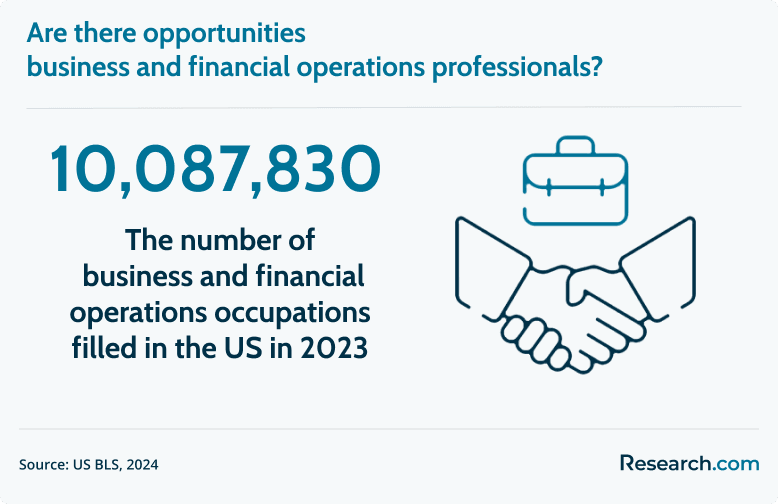
Finance is not a single occupation. It is a cluster of careers that use financial information to make decisions, monitor compliance, reduce risk, allocate resources, or advise clients. The US BLS reported 10,087,830 business and financial operations occupations already filled (US BLS, 2024), and demand differs widely by job title.
| Career option | Typical work | Good fit for |
| Actuary | Estimates the financial cost of risk and uncertainty, often using probability, statistics, and financial mathematics. | People who enjoy advanced quantitative analysis and risk modeling. |
| Accountant or auditor | Prepares, reviews, or verifies financial records for accuracy, reporting, and compliance. | Detail-oriented students who like rules, documentation, and financial statements. |
| Budget analyst | Reviews spending plans, evaluates budget proposals, and helps organizations allocate money efficiently. | Professionals interested in public, nonprofit, or corporate budgeting. |
| Claims adjuster, appraiser, examiner, or investigator | Reviews insurance claims, estimates losses, verifies policy coverage, or investigates possible fraud. | People who combine financial judgment with investigation and documentation. |
| Financial analyst | Studies data, builds forecasts, reviews investments, prepares models, and advises on financial decisions. | Analytical workers interested in markets, companies, securities, or performance trends. |
| Financial examiner | Reviews institutions and transactions for compliance with financial laws and regulations. | People interested in finance, regulation, risk, and legal standards. |
| Loan officer | Evaluates loan applications, reviews borrower information, and helps determine lending terms. | Professionals who can combine financial review with customer communication. |
| Logistician | Coordinates supply chains, purchasing, transportation, inventory, and distribution systems. | People interested in operations, data systems, and resource movement. |
| Personal financial advisor | Helps individuals plan investments, taxes, insurance, retirement, estate goals, and long-term finances. | Client-focused professionals who can explain complex financial choices clearly. |
| Property appraiser or assessor | Estimates real estate value for tax, lending, sale, lease, or assessment purposes. | People interested in real estate, market comparison, valuation, and field research. |
| Purchasing manager, buyer, or purchasing agent | Evaluates suppliers, negotiates contracts, reviews costs, and manages purchasing decisions. | Professionals who like negotiation, vendor management, and cost analysis. |
| Tax examiner, tax collector, or revenue agent | Determines tax obligations and supports collection or enforcement activities for government agencies. | People interested in tax rules, records, compliance, and public-sector work. |
Actuaries
Actuaries estimate the financial impact of uncertain events. They assess how likely certain outcomes are, calculate possible costs, and help organizations design ways to reduce or manage risk. Many work in insurance, where probability, statistics, and financial mathematics are central to the job.
Accountants and Auditors
Accountants prepare and maintain financial records, while auditors review those records for accuracy and compliance. Their work helps organizations report financial performance honestly, meet regulatory requirements, and detect errors or inconsistencies.
Budget Analysts
Budget analysts help organizations plan and monitor spending. They review budget proposals, analyze past financial data, prepare reports, and recommend how money should be allocated across programs, departments, or projects.
Claims Adjusters, Appraisers, Examiners, and Investigators
These professionals evaluate insurance claims and determine whether policy terms have been met. Examiners may review health-related or other claims for payment decisions, investigators look into suspected fraud, and appraisers estimate the value of damaged or lost property.
Financial Analysts
Financial analysts gather data, organize information, analyze historical performance, prepare forecasts, build financial models, and present recommendations. They may evaluate stocks, bonds, companies, or investment opportunities for banks, insurance firms, mutual funds, hedge funds, pension funds, securities firms, private equity groups, venture capital firms, government institutions, or corporate employers.
Financial Examiners
Financial examiners combine finance knowledge with regulatory expertise. They review balance sheets, income and expense accounts, loan files, lending practices, borrower information, and institutional stability to determine whether companies and financial institutions comply with applicable laws.
Loan Officers
Loan officers review applications for consumer, mortgage, business, auto, education, or startup loans. They collect and verify financial documents, evaluate creditworthiness, explain terms, and help determine loan amounts and conditions. Many work for banks, credit unions, and other financial institutions.
Logisticians
Logisticians plan and coordinate the movement of goods, people, supplies, or materials. Their work often includes purchasing, inventory management, transportation, warehousing, and software-based tracking of supply chain activity.
Personal Financial Advisors
Personal financial advisors help clients make decisions about investments, taxes, insurance, retirement, estate planning, and long-term financial goals. They may also build, review, and adjust client investment portfolios.
Property Appraisers and Assessors
Appraisers and assessors estimate property values for purposes such as tax assessments, mortgage lending, lease negotiations, and real estate transactions. Appraisers usually value one property at a time, while assessors may estimate values across neighborhoods or groups of properties using mass appraisal methods and computer-assisted mass appraisal (CAMA) systems.
Purchasing Managers, Buyers, and Purchasing Agents
Purchasing professionals compare suppliers, review proposals, negotiate contracts, evaluate quality, monitor costs, and manage vendor relationships. They also track deliveries, inventory, and product performance.
Tax Examiners, Tax Collectors, and Revenue Agents
These professionals determine tax liabilities, review records, and collect taxes for government agencies. Their work requires knowledge of tax rules, documentation standards, and compliance procedures.
What qualifications and skills are needed for various finance career paths?
Finance careers usually require more than completing a degree. Employers look for a combination of quantitative ability, business judgment, software proficiency, communication, and ethical decision-making. The exact mix depends on the role: a financial analyst may need modeling and data skills, an auditor needs documentation and compliance strength, and a personal financial advisor needs client communication and planning ability.
| Skill area | Why it matters in finance | Examples of where it appears |
| Quantitative and mathematical ability | Finance workers often calculate percentages, ratios, projections, variances, valuations, and budget changes. | Financial analysis, accounting, lending, budgeting, actuarial work |
| Mathematical reasoning | Professionals must know which method, formula, or model fits the problem. | Forecasting, risk analysis, investment evaluation, pricing |
| Deductive and inductive reasoning | Finance decisions require applying rules to specific cases and drawing conclusions from patterns in data. | Auditing, compliance, underwriting, investigation |
| Information ordering | Financial work depends on organizing data, transactions, schedules, and procedures in the correct sequence. | Accounting close processes, loan review, budgeting, reporting |
| Problem-solving | Finance professionals identify errors, explain performance gaps, compare options, and recommend solutions. | Corporate finance, consulting, financial planning, operations finance |
| Attention to detail | Small errors in formulas, records, or assumptions can affect decisions and reports. | Financial statements, spreadsheets, audits, claims review |
| Computer and software skills | Modern finance work relies on spreadsheets, accounting platforms, payroll systems, forecasting tools, databases, and analytics software. | Nearly all finance roles |
| Comprehension and communication | Professionals must understand financial information and explain it to managers, clients, regulators, or colleagues. | Advising, reporting, presentations, audits, lending |
| Financial statement literacy | Finance workers must understand income statements, cash flow statements, balance sheets, notes to financial statements, and statements of changes in equity. | Accounting, analysis, corporate finance, investing |
Quantitative/Mathematical Skills
Finance professionals need comfort with arithmetic, percentages, fractions, ratios, and formulas. Speed helps, but accuracy matters more.
Mathematical Reasoning
Knowing how to calculate is only the first step. Strong finance workers also know which calculation is appropriate and how to interpret the result.
Reasoning Skills
Finance roles often require applying policies, laws, or business rules to specific situations and drawing conclusions from incomplete or varied information.
Information Ordering
Many finance tasks depend on correct sequencing, such as arranging transactions, following audit procedures, organizing data fields, or applying formulas in the right order.
Problem-solving Skills
Good finance problem-solvers identify the true issue, select the right method, test assumptions, and explain recommendations clearly.
Selective Attention
Financial reports, spreadsheets, and statements require sustained focus. Missing one number, formula, or policy detail can change the outcome.
Computer Skills
Basic computer literacy is expected, and many roles require accounting, payroll, financial analysis, forecasting, database, or reporting software. Employers may train workers on internal systems, but candidates with strong spreadsheet and data skills often have an advantage.
Comprehension Skills
Finance professionals must understand written policies, financial reports, client information, regulations, and spoken instructions.
Communication Skills
Clear speaking and writing are essential because finance workers often translate complex numbers into decisions for managers, clients, or regulators.
Handling Financial Statements
Financial statement skills are central to many finance careers. Professionals should understand how to read, prepare, and interpret income statements, cash flow statements, balance sheets, notes to financial statements, and statements of changes in equity.
What is the average salary for finance professionals?
Finance-related fields are often listed among the highest paying college majors, but earnings depend heavily on job title, experience, employer, industry, geography, credentials, and performance. The median annual wage for business and financial occupations was $79,050. By comparison, the estimated median annual wage for 119.2 million full-time wage and salary workers in the US was $54,672, based on median weekly earnings of $1,139 in the first quarter of 2024 (US BLS, 2024).
The following finance-related occupations reported median annual wages above that estimated national median for full-time wage and salary workers (US BLS, 2024):
| Occupation | Median annual wage |
| Claims Adjusters, Appraisers, Examiners, and Investigators | $75,020 |
| Logisticians | $79,400 |
| Accountants and Auditors | $79,880 |
| Budget Analysts | $84,940 |
| Financial Analysts | $99,890 |
The visualization below summarizes median annual wages for selected business and financial occupations using 2024 data from the US BLS.
What degrees are typically required for entry into the finance industry?
Most finance careers begin with a college credential in finance, accounting, economics, business, mathematics, or a related field. The right degree depends on the role you want. A bachelor's degree may be enough for many entry-level roles, while advanced or specialized positions may favor a master's degree, MBA, or professional certification.
| Credential | Typical purpose | When it may make sense |
| Bachelor's degree in finance | Builds broad knowledge in business, accounting, markets, economics, and financial analysis. | You want entry-level access to corporate finance, banking, analysis, budgeting, or related business roles. |
| MBA | Combines management, leadership, strategy, and business decision-making, often with a finance concentration. | You want broader management mobility or already have experience and want advancement. |
| Master's in finance | Offers deeper study in financial theory, analysis, quantitative finance, investments, or risk. | You want a more finance-specific graduate pathway than an MBA. |
| Related master's degree | Develops expertise in accounting, economics, business law, or another adjacent field. | Your target role overlaps with another discipline, such as accounting, policy, regulation, or analytics. |
| Certificate or shorter credential | Provides focused training without the full length of a degree. | You need a lower-cost starting point, a skill refresh, or a way to test your interest before committing to a degree. |
BA/BS Finance Degrees
Understanding the meaning of a bachelor's degree is important before committing to a finance program. A BS in Finance commonly takes four years and includes general education courses along with accounting, business law, statistics, and economics. Depending on the school, students may also study management and organization theory, money and banking, fintech, financial institutions and markets, international finance, investments, risk management, securities analysis and valuation, contemporary finance issues, and applied finance practice.
Students who want a shorter or lower-cost introduction to business education can also compare certificate options, including the best online certificate programs, before deciding whether to pursue a full degree.
MBA Degrees
A Master of Business Administration can be useful for finance professionals who want leadership, strategy, and management training in addition to finance coursework. Many MBA programs take two years, while some formats, including executive options for experienced employees, may take one year. Graduate-level online business management degree pathways may also appeal to working professionals seeking flexible business education.
Some universities offer dual master's degrees that combine an MBA with another graduate program over two to four years. These pathways can be intensive, so students should weigh time, cost, workload, and career value carefully.
The best MBA choice depends on your experience, schedule, target role, and preferred specialization. Finance-focused MBA tracks may be helpful for students aiming for management roles in banking, corporate finance, investments, or consulting.
MA/MS Finance Degrees
A master's degree in finance is usually more specialized than an MBA. It may focus on investment analysis, financial modeling, markets, risk, corporate finance, quantitative finance, or STEM-oriented finance. Some programs are designed for early-career students, while others are built for working professionals.
Students who need flexibility can compare online master's degrees in finance to see whether a remote format fits their goals and schedule.
Related MA/MS Degrees
Finance is closely connected to accounting, economics, business law, analytics, and management. If your interests extend beyond finance, a related graduate degree may better match your long-term plans.
Finance-related Specializations
Specialization matters because finance jobs differ widely. Before choosing a track, compare the coursework with the skills used in your intended role.
- Quantitative Finance. This specialization uses advanced mathematics, statistics, programming, and large datasets to study markets and securities. It can support work in modeling, trading strategy, risk systems, and investment analysis.
- Investments. An investment track focuses on asset classes, investment strategies, portfolio decisions, timing, and methods for evaluating opportunities that may increase assets, revenue, or long-term value.
- International Finance. This track examines money movement across countries, including foreign direct investment (FDI), exchange rates, global markets, and the financial effects of international trade.
- Personal Finances/Personal Financial Planning. This option is useful for students interested in advising individuals on budgeting, investing, insurance, mortgages, loans, estate planning, tax planning, and retirement preparation.
- Risk Management. Risk management focuses on identifying, measuring, reducing, accepting, or transferring financial risk. Coursework may include fixed-income securities, corporate finance, financial modeling, programming, portfolio diversification, hedging, big data, derivatives, foreign currency trading, and risk models.
- Corporate Finance. Corporate finance centers on increasing firm value through decisions about investment, financing, dividends, valuation, and the company’s overall financial objective. It is a practical choice for students who want to work inside large organizations.
How important is obtaining certifications such as CFA or CPA in finance careers?
Certifications are not required for every finance job, but they can be important for specialized or advancement-oriented roles. A certification can signal technical competence, ethical commitment, and readiness for responsibilities that go beyond entry-level work.
- They can validate expertise. Credentials show that a professional has met defined education, examination, or experience standards in a specific area of finance.
- They may support advancement. Some employers prefer or require certifications for senior, client-facing, investment, planning, accounting, or management roles.
- They can improve credibility. Recognized credentials may reassure employers, clients, and peers that a professional follows industry standards and ongoing development expectations.
The Financial Management Association International (FMA) lists finance certifications that professionals may consider. Common examples include Certified Financial Planner ® (CFP®), Chartered Financial Analyst (CFA®), and Certified Investment Management Analyst (CIMA).
Certification requirements vary. Many credentials require specific coursework, professional experience, exams, continuing education, and adherence to professional standards. Before pursuing one, check whether it is valued in your target role and whether the time and cost are justified.
How is technology impacting finance careers, such as the rise of fintech?
Technology is reshaping finance work rather than eliminating the need for human judgment. Routine tasks such as data entry, basic reconciliation, transaction processing, and standardized reporting are increasingly supported by automation. At the same time, employers need people who can interpret outputs, test assumptions, manage risk, protect data, and explain financial implications.
- Fintech is expanding the field. Financial technology companies have changed how consumers and businesses handle payments, lending, wealth management, budgeting, and financial access. Traditional institutions now compete with and adopt fintech models.
- Automation is changing daily tasks. Repetitive finance processes can be automated, allowing professionals to spend more time on analysis, risk review, advising, and decision support.
- Data and technical skills are more valuable. Finance professionals increasingly benefit from data analysis, spreadsheet modeling, programming awareness, cybersecurity basics, and comfort with digital platforms.
- AI is increasing the need for judgment. AI-supported tools can summarize information or detect patterns, but professionals still need to evaluate accuracy, context, ethics, compliance, and business consequences.
| Technology trend | Impact on finance careers | Skill to build |
| Fintech platforms | Creates new roles in digital banking, payments, lending, and wealth technology. | Understanding of digital financial products and customer experience. |
| Automation | Reduces manual processing and increases demand for review, control, and interpretation. | Process improvement, analytics, and quality control. |
| AI-supported analysis | Speeds up research and pattern recognition but requires human validation. | Critical thinking, data literacy, and ethical judgment. |
| Cybersecurity and compliance technology | Raises the importance of protecting financial information and meeting regulations. | Risk awareness, compliance knowledge, and secure data handling. |
Are there flexible work arrangements or remote opportunities in the finance industry?
Remote and hybrid work options are available in parts of the finance industry, especially for roles centered on data analysis, reporting, budgeting, accounting, risk review, and internal operations. Banks, investment firms, accounting organizations, and corporate finance teams may offer flexible scheduling, telecommuting, or hybrid arrangements depending on the job.
Flexibility is not equal across all finance roles. Client-facing positions, branch-based banking jobs, certain compliance functions, and roles requiring secure systems or in-person meetings may have less remote flexibility. Students who want remote work should research job descriptions in their target field before choosing a degree or specialization.
Are there formal training or continuing education programs for finance professionals?
Yes. Finance professionals often use continuing education to keep up with changing regulations, technologies, analytical methods, products, and market conditions. Training can be formal, such as a graduate degree or certification, or practical, such as employer-sponsored software training and professional workshops.
- Financial Modeling Certification (FMC). This type of training focuses on building and analyzing financial models, a useful skill in investment banking, corporate finance, and equity research.
- Certified Financial Planner (CFP). This credential is designed for professionals who advise clients on retirement planning, estate planning, tax planning, risk management, and broader personal financial decisions.
- Master of Business Administration (MBA). An MBA can strengthen strategic, analytical, leadership, and management capabilities for professionals pursuing senior finance or business roles.
What is the future outlook for finance careers, considering automation and AI?
The future of finance is uneven by occupation. Some jobs are expected to grow, while others face pressure from automation, changing claims processes, outsourcing, or industry restructuring. Based on US BLS 2024 data, employment for budget analysts is projected to increase by 3% by 2032. Accountants and auditors are projected to grow by 4%, financial analysts by 8%, and logisticians by 18%. Claims adjusters, appraisers, examiners, and investigators have a projected outlook of -3%.
The strongest candidates will likely be those who combine finance fundamentals with technology fluency, communication skills, and the ability to apply judgment to automated outputs. AI may handle more routine work, but organizations still need professionals who can verify results, manage risk, comply with rules, and communicate decisions.
The chart below shows employment outlook data for selected business and financial occupations in the US, based on 2024 data from the US BLS.
What are the unique advantages of an accelerated bachelor's degree online?
An accelerated online bachelor's degree can help students finish faster than a traditional schedule when they can handle an intensive pace. This format may reduce time away from full-time work, shorten the path to entry-level roles, and allow motivated learners to apply finance concepts sooner. It is especially useful for adults with transfer credits, disciplined study habits, and a clear career goal.
The trade-off is workload. Accelerated courses move quickly, and students who are balancing work, family, and school should confirm weekly time expectations before enrolling. To compare formats, review Research.com’s guide to an accelerated bachelor's degree online.
Can an Advanced DBA Degree Accelerate My Finance Career?
A Doctor of Business Administration may help experienced finance professionals who want executive, consulting, teaching, or applied research-oriented roles. Unlike a basic finance degree, a DBA typically emphasizes leadership, organizational decision-making, strategy, and advanced business problem-solving.
A DBA is usually not necessary for entry-level finance work. It makes more sense for professionals who already have substantial business experience and want to move toward senior leadership or specialized consulting. If speed and affordability are priorities, compare options such as a 1 year DBA program online while verifying accreditation, admissions standards, workload, and career fit.
2027 Easiest Finance Degrees to Kickstart Your Career
The “easiest” finance degree is not always the best choice. A more useful question is: Which program matches your current academic background, math comfort level, schedule, budget, and target role? Students who want an accessible starting point may prefer broader business programs, associate degrees, or flexible online options before pursuing more quantitative specializations.
Bachelor’s in Business Administration (BBA) with a Finance Concentration
A BBA with a finance concentration gives students a broad business base along with finance coursework. It can be a practical option for students who want flexibility because it may support entry-level work in banking, account management, financial services, or business operations.
Associate’s Degree in Finance or Accounting
An associate degree usually introduces core finance and accounting concepts and may be completed in two years. It can support junior roles in bookkeeping, payroll, clerical finance, or administrative support, and it may also serve as a transfer pathway into a bachelor's program.
Online Finance Degrees
Online finance programs can be easier to fit around work or family responsibilities, but flexibility does not mean the coursework is simple. Students still need to complete assignments, meet deadlines, and build quantitative and software skills.
If you want a manageable starting point, compare easy finance degrees by accreditation, curriculum, cost, transfer policies, academic support, and career outcomes.
How do I choose the best online finance degree program?
The best online finance degree is not automatically the cheapest or the fastest. It is the program that is accredited, affordable for your situation, aligned with your target career, and realistic for your schedule. Students comparing a low-cost online finance degree should evaluate value, not just tuition.
- Verify accreditation first. Accreditation helps confirm that a school or program meets recognized academic standards and may affect transfer credit, financial aid eligibility, employer recognition, and graduate school options.
- Compare total cost, not just tuition. Include fees, books, software, technology costs, residency requirements, exam fees, and the income you may give up if you reduce work hours.
- Check financial aid and scholarships. Grants, scholarships, employer tuition assistance, and work-study options can change the real cost of attendance.
- Review curriculum carefully. Look for courses in accounting, financial analysis, investments, corporate finance, statistics, data tools, ethics, and financial statement analysis.
- Ask about transfer credits. Generous transfer policies can reduce both completion time and cost, especially for students with prior college work.
- Evaluate flexibility honestly. Self-paced, part-time, asynchronous, and accelerated formats serve different types of learners. Choose the format you can complete consistently.
- Look at career support. Strong programs may offer advising, internship help, resume support, employer connections, networking events, or career coaching.
| Question to ask | Why it matters |
| Is the institution accredited? | Accreditation affects credibility, transfer options, and access to certain forms of aid. |
| What is the full program cost? | Tuition alone may not reflect required fees, materials, or technology expenses. |
| Does the curriculum match my target job? | A personal finance career, accounting role, and investment analysis path may require different coursework. |
| How many credits can I transfer? | Transfer credits can shorten time to graduation and reduce total cost. |
| What career services are available to online students? | Online learners should receive meaningful advising, networking, and employment support. |
What factors should be considered when choosing the cheapest online finance degree?
A low price can be valuable, but only if the program is credible and aligned with your goals. When comparing the cheapest online finance degree options, check accreditation, curriculum quality, faculty background, student support, graduation information, and employer relevance.
Students should also examine whether the program offers practical coursework in financial modeling, financial statements, analytics, business law, ethics, economics, and accounting. A cheap program that lacks career support, has limited transfer flexibility, or does not fit your target role may cost more in the long run.
What are the key considerations when searching for the cheapest online finance degree?
Before choosing the most affordable online finance degree, ask whether the program’s low cost comes with acceptable quality, support, and recognition. A careful comparison should include academic standards, course delivery format, faculty access, advising availability, technology requirements, and career services.
| Common mistake | Better approach |
| Choosing the lowest tuition without checking accreditation | Confirm institutional and, when relevant, programmatic accreditation before applying. |
| Ignoring fees and required materials | Compare the total estimated cost of attendance. |
| Assuming all online programs are equally flexible | Check whether courses are synchronous, asynchronous, self-paced, part-time, or accelerated. |
| Relying only on rankings | Use rankings as one input, then verify curriculum, outcomes, support, and fit. |
| Assuming salary outcomes are guaranteed | Use wage data as a benchmark, not a promise, and consider experience, location, and role. |
How can I assess a finance program's quality and credibility?
A credible finance program should combine academic legitimacy, relevant coursework, qualified faculty, and student support. Start with accreditation, then review whether the curriculum reflects current finance work, including financial analysis, modeling, accounting, investments, risk, ethics, and data tools.
Faculty experience also matters. Instructors with academic credentials and industry knowledge can help connect theory to real business decisions. Partnerships with employers, internship access, alumni networks, and career advising can further improve practical value.
Students comparing business-related programs may also benefit from understanding how program focus differs. For example, the distinction between business management vs administration can help clarify whether a program emphasizes operations, leadership, broad administration, or specialized finance preparation.
What is the return on investment for a finance degree?
The ROI of a finance degree depends on total education cost, time to completion, debt, lost income while studying, career placement, salary growth, and whether the credential is required for your target role. A finance degree may offer strong value when it leads to a role with advancement potential and when the student controls borrowing and chooses a credible program.
To evaluate ROI, estimate the full cost of the degree, compare it with likely wages in your intended occupation, and consider how long it may take to recover the investment. Accelerated graduate routes, such as a one year MBA program, may reduce time in school, but they can also be demanding and may not be necessary for every finance career.
Do online finance degrees deliver comparable outcomes to traditional programs?
Online finance degrees can deliver outcomes comparable to campus programs when they are accredited, rigorous, well-supported, and connected to career opportunities. Employers generally care about the institution, program quality, skills, experience, and evidence that a candidate can perform the work.
Online students should be intentional about building experience. Internships, projects, case competitions, portfolio work, networking, and software skills can help strengthen a resume. Students who want an additional business credential may also compare options such as the fastest MBA program online, especially if they are pursuing leadership or management roles.
How does an online MBA’s cost compare to other finance degree options?
An online MBA often has a broader management focus than a specialized finance degree, and the cost can vary widely by institution, format, reputation, and services. A specialized finance master's may offer more direct technical finance training, while an MBA may be stronger for leadership, strategy, and cross-functional business roles.
Before choosing, compare the curriculum, total cost, financial aid, time to completion, employer recognition, and likely career benefit. For a focused discussion of MBA expenses, review Research.com’s guide to MBA online cost.
Should I Complement My Finance Degree with an Affordable Online Management Degree?
A management credential can be useful if your finance goals include supervising teams, leading departments, managing operations, or moving into executive decision-making. Finance expertise helps you understand money; management training can help you lead people, coordinate projects, and make broader organizational decisions.
This combination is most useful for professionals aiming for leadership roles rather than narrowly technical finance positions. If cost is a major concern, compare an affordable online management degree with shorter certificates, employer training, or an MBA concentration before enrolling.
How can accelerated finance degree programs benefit aspiring professionals?
Accelerated finance programs can shorten the path to a credential, which may help students enter or advance in the workforce sooner. They can be especially valuable for motivated learners with transfer credits, prior business experience, or a clear target role.
The main risk is pace. Condensed courses can be difficult for students who need more time to absorb quantitative material or who have heavy work and family responsibilities. Before enrolling, ask about weekly workload, tutoring, faculty access, withdrawal policies, transfer credits, and whether the program covers the same outcomes as the standard track.
Students who want speed and affordability can compare cheapest accelerated online finance degrees while paying close attention to accreditation, curriculum depth, and student support.
References
- US Bureau of Labor Statistics. (2024, April 17). Business and Financial Occupations. Occupational Outlook Handbook. https://www.bls.gov/ooh/business-and-financial/home.htm
- US Bureau of Labor Statistics. (2024, April 17). Accountants and Auditors. Occupational Outlook Handbook. https://www.bls.gov/ooh/business-and-financial/accountants-and-auditors.htm
- US Bureau of Labor Statistics. (2024, April 17). Budget Analysts. Occupational Outlook Handbook. https://www.bls.gov/ooh/business-and-financial/budget-analysts.htm
- US Bureau of Labor Statistics. (2024, April 17). Logisticians. Occupational Outlook Handbook. https://www.bls.gov/ooh/business-and-financial/logisticians.htm
- US Bureau of Labor Statistics. (2024, April 3). May 2023 National Occupational Employment and Wage Estimates, United States. Occupational Employment and Wage Statistics. https://www.bls.gov/oes/current/oes_nat.htm
- US Bureau of Labor Statistics. (2024, April 16). USUAL WEEKLY EARNINGS OF WAGE AND SALARY WORKERS, FIRST QUARTER 2024. https://www.bls.gov/news.release/pdf/wkyeng.pdf
Key Insights
- Finance is a strong career path for people who like analysis, business decisions, financial data, risk, markets, or client advising.
- The field is broad. A finance background can lead to accounting, auditing, budgeting, financial analysis, lending, insurance claims, logistics, tax, appraising, purchasing, or financial planning.
- Business and financial occupations had a median annual wage of $79,050, but pay varies by job title, experience, location, credentials, and employer.
- Job outlook is role-specific. Logisticians, financial analysts, accountants and auditors, and budget analysts show positive projected growth, while claims adjusters, appraisers, examiners, and investigators show a projected -3% outlook.
- Technology is changing finance work. Automation and AI make data skills, software fluency, judgment, ethics, and communication more important—not less.
- A bachelor's degree can open many entry-level finance doors, while an MBA, master's in finance, DBA, or certification may make sense for specialized or leadership goals.
- When choosing an online finance program, check accreditation, total cost, curriculum, transfer credit policy, flexibility, career support, and whether the program matches your intended role.
- The cheapest or fastest program is not always the best value. The right program is the one you can complete, afford, and use toward a realistic finance career goal.
Other Things You Should Know about Career Paths in Finance
In 2027, the finance sector is expected to see steady growth, driven by technological advancements and globalization. Jobs in finance are projected to grow slightly faster than the average across all industries, offering numerous opportunities in diverse areas like fintech, investment banking, and financial analysis.
In 2027, essential skills for a successful finance career include a strong understanding of data analytics, proficiency in financial technologies like AI and blockchain, and expertise in risk management. Effective communication and problem-solving skills are also crucial in navigating the evolving financial landscape.


