
2027 How to Become a Hiring Manager

Co-Founder and Chief Data Scientist
Becoming a hiring manager is not usually a first job in human resources. It is a role people move into after they understand recruiting, interviewing, workforce needs, employment rules, and how teams actually function. For 2027, the path is especially important because organizations are hiring in a more complex labor market: candidates expect faster communication, many roles are remote or hybrid, employers are using AI tools, and companies need managers who can make fair, evidence-based hiring decisions.
This guide explains how to become a hiring manager, what education and experience employers commonly expect, how the role differs from recruiting and HR management, what skills matter most, and how technology, data, budgets, employer branding, and diversity practices shape modern hiring. It is designed for students, early-career HR professionals, recruiters, team leads, and managers who want a practical route into hiring leadership.
Quick Answer: How Do You Become a Hiring Manager?
To become a hiring manager, you typically need relevant education, several years of experience in recruiting, HR, team leadership, or people management, and strong skills in interviewing, communication, employment compliance, candidate evaluation, and decision-making. Many employers prefer candidates with a bachelor’s degree in human resources, business administration, psychology, communication, or a related field. Senior hiring roles may favor candidates with graduate education, HR certifications, or experience managing recruitment strategy across departments.
Key Things You Should Know About Becoming a Hiring Manager
- The management sector, including hiring managers, is projected to grow faster than average from 2023 to 2033, with roughly 1.2 million job openings annually.
- A bachelor’s degree in fields such as business administration, human resources, psychology, communication, or labor relations is commonly preferred, while advanced degrees may help with senior-level roles.
- Hiring managers are responsible for defining role needs, shaping job descriptions, interviewing candidates, selecting finalists, making or recommending hiring decisions, and supporting onboarding.
- The average annual salary for hiring managers is $59,525, though earnings vary by location, employer, industry, education, and experience.
- AI and automation are becoming important in recruiting workflows. The AI recruitment market was valued at USD 661.56 million in 2023 and is projected to reach USD 1119.80 million by 2030.
- What are the steps to becoming a hiring manager for 2027?
- What are the career advancement opportunities for hiring managers?
- What is the job outlook for a hiring manager?
- What are the core responsibilities of a hiring manager?
- Is a hiring manager the same as a recruitment manager?
- What is the difference between a hiring manager and a human resource manager?
- How can hiring managers leverage technology and data analytics to optimize recruitment?
- How do hiring managers measure recruitment success?
- How can hiring managers overcome remote recruitment challenges?
- How can hiring managers optimize recruitment budgets?
- How can hiring managers build a strong employer brand?
- How does an online MBA enhance a hiring manager's strategic capabilities?
- How can hiring managers ensure diversity and inclusion in recruitment?
- What other essential skills should a hiring manager develop?
- How can hiring managers create a positive interview experience that attracts top talent?
- How can hiring managers stay updated with the latest trends in talent acquisition?
What are the steps to becoming a hiring manager for 2027?
The most reliable path to a hiring manager role combines education, HR or recruiting experience, people-management exposure, and evidence that you can make sound hiring decisions. The title can mean different things depending on the employer. In some organizations, a hiring manager is the department leader filling a role on their team. In others, it may be a recruitment-focused manager who oversees hiring workflows. Either way, employers look for judgment, communication skill, compliance awareness, and the ability to evaluate candidates consistently.
1. Choose education that supports HR, business, and people decisions
Most hiring manager roles require at least an associate’s degree, but many employers prefer a bachelor’s degree. Common degree areas include human resources management, business administration, communication, psychology, organizational psychology, economics, and labor or industrial relations. If you need a faster route to degree completion, an accelerated online bachelor's degree may help you finish required coursework while continuing to work.
Students who want a broad business foundation can also compare cheap online business administration degree programs, especially at community colleges, public universities, and online institutions that provide lower tuition options or financial aid. For leadership-track roles, some employers may prefer a graduate degree, particularly an MBA. If test requirements are a barrier, review cheapest online MBA no GMAT options and confirm whether the curriculum includes leadership, organizational behavior, analytics, or HR-related coursework.
| Education option | Best fit | How it helps a future hiring manager |
| Associate’s degree | Entry-level HR assistants, administrative roles, or students planning to transfer | Builds basic workplace, communication, and business knowledge |
| Bachelor’s degree | Recruiters, HR specialists, team leads, and future managers | Provides a stronger foundation in business, employee relations, organizational behavior, and communication |
| Master’s degree or MBA | Professionals targeting senior hiring, HR leadership, or strategic workforce planning | Strengthens leadership, financial, analytics, and strategic decision-making skills |
| HR degree pathway | Learners who want a focused talent acquisition or HR career | Connects recruiting, compliance, employee lifecycle, and workforce planning concepts |
2. Build experience in recruiting, HR, or team leadership
Hiring managers rarely learn the role from coursework alone. Practical experience is essential. Strong starting points include HR assistant, HR coordinator, recruiter, talent acquisition specialist, HR specialist, benefits specialist, HR generalist, or department team lead. These roles expose you to job postings, applicant screening, interview scheduling, candidate communication, employee records, workplace policies, and offer processes.
Working in human resources also helps you understand how hiring decisions connect to compensation, workforce planning, compliance, onboarding, and employee retention. If you are comparing early HR pathways, Research.com’s guide on how to become a human resource coordinator can help you understand one common entry point into broader HR work.
3. Learn the full hiring workflow, not just interviewing
Interviewing is only one part of the job. A strong hiring manager understands how to identify a staffing need, justify the role, create a realistic job description, partner with recruiters, evaluate candidates fairly, manage stakeholders, negotiate offers, and help new hires succeed after they accept.
| Career stage | Typical focus | Skills to prove before moving up |
| Entry-level HR or recruiting role | Scheduling, screening, records, candidate communication | Accuracy, professionalism, follow-through, basic HR systems use |
| Recruiter or HR specialist | Sourcing, interviews, hiring coordination, hiring manager support | Candidate evaluation, sourcing judgment, structured communication |
| HR generalist or talent acquisition specialist | Broader employee lifecycle and recruiting process ownership | Policy knowledge, stakeholder management, reporting, compliance awareness |
| Team lead or hiring manager | Defining role needs, interviewing finalists, making hiring decisions | Leadership, decision-making, bias control, workforce planning |
| Senior hiring or HR leadership | Recruitment strategy, employer brand, budgets, analytics, DEI outcomes | Strategic planning, data interpretation, business alignment |
4. Develop the skills employers expect
Hiring managers need a balance of technical HR knowledge and people-centered judgment. The strongest candidates can read a resume critically, ask structured interview questions, assess job-relevant evidence, communicate with candidates respectfully, and explain hiring decisions to stakeholders.
- Communication: Explain role expectations clearly, keep candidates informed, and align recruiters and department leaders.
- Analytical judgment: Compare resumes, interview notes, work samples, and hiring metrics without overrelying on instinct.
- Interpersonal skill: Build trust with candidates, recruiters, executives, and team members.
- Organization: Keep the process moving while tracking interviews, feedback, approvals, and deadlines.
- Adaptability: Adjust sourcing and evaluation methods as labor market conditions and business needs change.
- Technology fluency: Use applicant tracking systems, screening tools, scheduling platforms, and recruiting analytics responsibly.
- Problem-solving: Respond when offers are declined, candidate pools are weak, timelines slip, or stakeholders disagree.
- Leadership: Guide interview panels, model fair evaluation, and support new hires after selection.
5. Consider HR certifications when they match your goals
Certifications can strengthen your profile, especially if you already have work experience and want to show formal HR knowledge. The Society for Human Resource Management (SHRM) offers credentials that are widely recognized in HR settings.
- SHRM-CP: Designed for professionals working in operational HR roles.
- SHRM-SCP: Designed for senior-level professionals whose work involves strategy, leadership, and organizational impact.
Before paying for a certification, compare eligibility rules, exam content, renewal requirements, employer preferences in your target market, and whether the credential will help you qualify for the specific hiring manager roles you want.
6. Understand employment law, ethical hiring, and company culture
A hiring manager must know enough about employment rules and organizational policy to avoid risky or unfair practices. This includes using job-related selection criteria, asking appropriate interview questions, documenting decisions, protecting candidate information, and applying the same evaluation process consistently. Cultural understanding matters too, but it should not become a vague “gut feel” test. A better approach is to define the behaviors and work conditions that support success in the role.
7. Apply for roles that match your experience level
When you are ready to move into hiring management, target jobs where your background matches the level of responsibility. Update your resume to show the number and types of roles you helped fill, hiring tools you used, interview panels you led, process improvements you made, and any measurable outcomes you can support. If your long-term goal is senior talent acquisition, Research.com’s executive recruiter career guide explains another advanced path focused on high-level search and strategic hiring.
The chart below shows the eight most common skills for managers in 2025.
What are the career advancement opportunities for hiring managers?
Hiring managers can advance by managing larger teams, handling more complex roles, improving hiring outcomes, and connecting recruiting decisions to business strategy. Advancement is not only about years of experience. Employers look for proof that you can reduce hiring friction, improve candidate quality, protect fairness, and help new employees succeed after they join.
| Next role | What changes | How to prepare |
| Senior hiring manager | You handle higher-impact openings and more complex stakeholder expectations. | Build stronger interviewing, compensation, workforce planning, and negotiation skills. |
| Recruitment manager | You oversee recruiting operations, sourcing strategy, and recruiter performance. | Learn analytics, ATS workflows, sourcing channels, and recruitment budgeting. |
| Talent acquisition manager | You lead hiring strategy across teams or business units. | Develop employer branding, diversity recruiting, process design, and reporting skills. |
| Human resources manager | You manage broader HR functions beyond hiring. | Gain experience in employee relations, compliance, performance management, and policy. |
| Director of talent acquisition or HR leadership | You align workforce strategy with business growth and executive priorities. | Strengthen strategic planning, finance, leadership, and organizational design skills. |
To move up, set specific skill goals, ask for hiring projects with more responsibility, document results, build relationships with recruiters and department leaders, and request promotion conversations when your track record supports it. Networking also matters because many hiring leadership roles depend on trust, cross-functional credibility, and knowledge of the business.
What is the job outlook for a hiring manager?
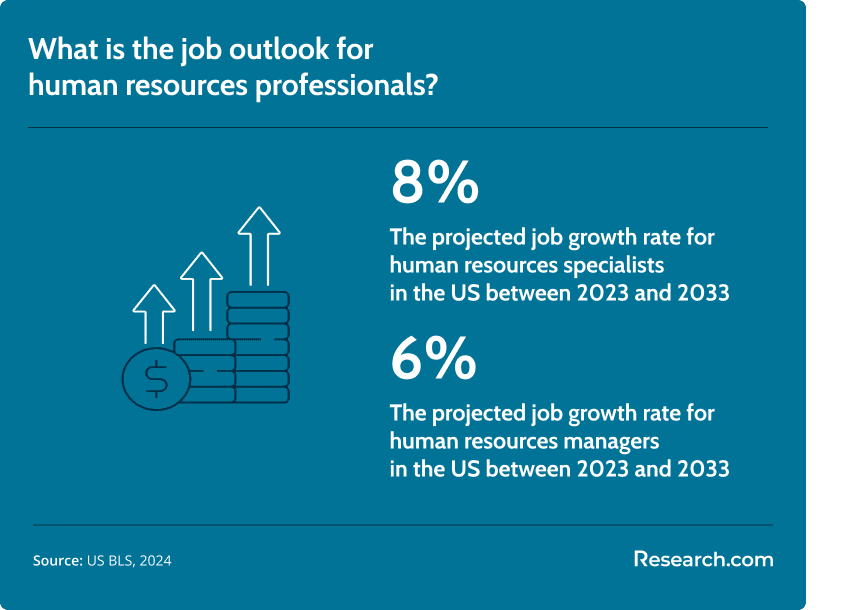
The broader management sector, which includes hiring managers, is expected to experience faster-than-average growth from 2023 to 2033. The field is projected to produce roughly 1.2 million job openings each year. These openings are tied to business growth as well as replacement needs when workers retire, change employers, or move into different roles.
The average annual salary for hiring managers is $59,525. Actual pay can differ substantially depending on location, employer size, industry, education, years of experience, and whether the position is a department-level hiring role, a recruiting leadership role, or part of a broader HR management function.
The chart below shows the top five best-paying related hiring manager jobs in the United States.
What are the core responsibilities of a hiring manager?
A hiring manager is accountable for choosing the right person for a specific business need. The role starts before a job is posted and continues after the offer is accepted. In many organizations, HR or recruiters coordinate the process, but the hiring manager defines what the team needs and usually has the strongest voice in the final selection.
| Responsibility | What it means in practice | Why it matters |
| Identify the staffing need | Determine whether a vacancy, new role, or workload issue requires hiring. | Prevents unnecessary hiring and clarifies the business reason for the role. |
| Define the role | Work with HR to outline duties, required skills, qualifications, reporting lines, and success measures. | Creates a job description that attracts better-matched applicants. |
| Coordinate with recruiters and HR | Set timelines, screening criteria, interview steps, and communication expectations. | Keeps the process organized and consistent. |
| Review candidates | Assess resumes, applications, screening results, and interview evidence. | Helps identify candidates who meet the role’s actual requirements. |
| Interview finalists | Ask job-related questions, compare responses, and involve interview panels when needed. | Improves decision quality and reduces overreliance on first impressions. |
| Make or recommend a hiring decision | Select the candidate or present a recommendation to decision-makers. | Connects the hiring choice to team goals and role expectations. |
| Support the offer process | Help shape offer terms and respond to candidate questions with HR or leadership. | Improves acceptance chances and sets realistic expectations. |
| Participate in onboarding | Prepare the team, clarify early goals, and help the new hire transition. | Supports retention and early performance. |
| Maintain compliance | Follow organizational policy and legal requirements throughout hiring. | Reduces legal, ethical, and reputational risk. |
- Start the hiring process: Evaluate whether a new employee is needed, confirm budget or approval requirements, and clarify the problem the hire should solve.
- Create practical job descriptions: Partner with HR to describe the work accurately rather than listing unrealistic requirements.
- Align the hiring team: Make sure recruiters, interviewers, and leaders understand the timeline, evaluation criteria, and decision process.
- Review resumes and interview candidates: Examine candidate evidence and conduct structured interviews individually or with a panel.
- Make hiring decisions: Compare candidates against role requirements and team needs. For specialized roles, such as applicants from top architecture degree programs online, the hiring manager must understand how academic preparation connects to practical job performance.
- Prepare or support job offers: Work with HR or leadership to communicate employment terms and negotiate where appropriate.
- Onboard new hires: Help new employees understand expectations, workflows, team culture, and early priorities.
- Plan workforce needs with HR: Discuss upcoming staffing gaps, skill needs, and hiring strategies.
- Protect fairness and compliance: Apply consistent criteria and follow employment policies throughout the process.
Navigating Specialized Hiring Needs
Hiring managers often recruit for roles outside their own technical background. That makes preparation essential. A manager does not need to become an architect, software engineer, or game designer, but they should understand the work well enough to ask relevant questions, involve subject-matter experts, and avoid being persuaded by buzzwords alone.
For example, a hiring manager in the gaming industry benefits from understanding what a video game designer does before interviewing candidates for a design position. That knowledge helps the manager evaluate whether a candidate can connect creative ideas to playable features, collaboration demands, and user experience goals. The same principle applies to technical, creative, healthcare, finance, architecture, and operations roles: better role knowledge leads to better interviews and stronger hiring decisions.
Is a hiring manager the same as a recruitment manager?
No. A hiring manager and a recruitment manager both participate in hiring, but they are not the same role. A hiring manager is usually the person who needs to fill a position on a specific team. They define the role, interview candidates, evaluate fit for the job, and make or influence the final decision. Hiring may be one part of their broader job as a department manager, team lead, or functional supervisor.
A recruitment manager focuses on the recruiting function itself. This role may oversee recruiters, sourcing channels, screening processes, interview coordination, candidate pipelines, and recruitment metrics. In short, the hiring manager owns the business need for a specific hire, while the recruitment manager owns the recruiting process that helps produce qualified candidates.
| Role | Main focus | Typical responsibilities | Decision authority |
| Hiring manager | Filling a role for a specific team or department | Define role needs, interview finalists, compare candidates, support onboarding | Often makes or strongly influences the final hiring choice |
| Recruitment manager | Managing recruiting operations and candidate pipelines | Oversee recruiters, sourcing, screening workflows, recruiting tools, and hiring metrics | Usually supports or manages the process rather than owning every final selection |
What is the difference between a hiring manager and a human resource manager?
A hiring manager focuses on selecting a person for a particular job opening. A human resource manager has a broader organizational role that may include recruitment strategy, employee relations, compliance, benefits coordination, performance management, policy development, and workplace planning. The two roles often work closely together, but their responsibilities are different.
For example, a hiring manager may decide which software engineer to hire for a product team. The HR manager may ensure that the process follows company policy, compensation guidelines, equal employment practices, and onboarding procedures. In smaller organizations, one person may perform parts of both roles. In larger organizations, these responsibilities are usually separated more clearly.
How can hiring managers leverage technology and data analytics to optimize recruitment?
Hiring managers can use recruiting technology to make hiring faster, more organized, and more evidence-based, but tools should support judgment rather than replace it. Applicant tracking systems, scheduling tools, screening platforms, assessment software, and analytics dashboards can help managers see where candidates drop out, how long each stage takes, which sourcing channels produce qualified applicants, and whether interview teams are applying criteria consistently.
Data is most useful when the hiring manager knows what question they are trying to answer. For example: Are strong candidates declining interviews? Are job descriptions attracting mismatched applicants? Are interview panels taking too long to submit feedback? Are new hires staying after onboarding? A focused analytics approach can improve decisions without turning hiring into a purely mechanical process. Professionals who want formal preparation in HR systems and workforce practices may benefit from exploring an HR degree.
| Technology or data tool | Useful purpose | Risk to watch |
| Applicant tracking system | Organizes applications, interview stages, communication, and hiring records | Poor setup can create inconsistent workflows or missed candidates |
| AI screening or sourcing tools | Can help sort large applicant pools and identify potential matches | May reinforce bias if not monitored and validated |
| Recruiting dashboards | Shows time-to-fill, pipeline status, source performance, and bottlenecks | Metrics can be misleading if not connected to hiring quality |
| Structured interview scorecards | Creates consistent evaluation criteria across interviewers | Weak scorecards may measure vague impressions instead of job-related skills |
| Candidate experience surveys | Reveals communication gaps and process pain points | Low response rates can limit conclusions |
How do hiring managers measure recruitment success?
Hiring success should be measured with both speed and quality in mind. A fast process is not successful if the hire leaves quickly or performs poorly. A careful process is not successful if it creates unnecessary delays and causes qualified candidates to accept other offers. Hiring managers should track a balanced set of indicators.
- Time-to-fill: How long it takes to fill an approved opening.
- Cost-per-hire: The estimated cost of sourcing, tools, advertising, staff time, and related recruiting expenses.
- Candidate-to-interview ratio: Whether sourcing and screening are producing candidates worth interviewing.
- Offer acceptance patterns: Whether selected candidates are accepting or declining offers.
- Retention after onboarding: Whether new hires stay after joining the organization.
- Hiring manager and candidate feedback: Whether the process feels clear, respectful, and job-relevant.
Advanced study can also help professionals interpret workforce metrics, budgets, and strategy more effectively. For those considering doctoral-level business education, online DBA programs may be relevant for leadership, analytics, and organizational decision-making goals.
How can hiring managers overcome remote recruitment challenges?
Remote recruitment changes how hiring managers evaluate communication, collaboration, accountability, and culture fit. It also adds logistical challenges, including time zones, video interview quality, assessment design, and remote onboarding. The best approach is to make the process structured, transparent, and accessible.
- Use clear interview agendas so candidates know who they will meet and what will be assessed.
- Offer scheduling flexibility when candidates are in different time zones.
- Use structured questions and work samples that reflect the actual remote or hybrid role.
- Give candidates realistic information about communication norms, meeting expectations, tools, and performance measurement.
- Create a remote onboarding plan before the offer is accepted, not after the start date.
Managers who want broader strategic and leadership preparation may consider flexible graduate business options such as one year MBA programs online, especially if their responsibilities include distributed teams, organizational change, or workforce planning.
How can hiring managers optimize recruitment budgets?
Recruitment budgeting is not just about spending less. The real goal is to spend where it improves candidate quality, process efficiency, and long-term retention. Hiring managers should work with HR and finance teams to understand where money is going and whether each channel or tool is producing useful results.
| Budget area | Questions to ask | Better practice |
| Job boards and advertising | Which postings produce qualified applicants, not just large applicant volume? | Shift spending toward channels that produce interview-ready candidates. |
| Recruiting software | Is the tool reducing manual work or creating extra steps? | Keep tools that improve workflow, reporting, or candidate communication. |
| Agency or external recruiter fees | Are fees justified by role difficulty, urgency, or specialization? | Use external help selectively for hard-to-fill or senior roles. |
| Interview time | Are too many people interviewing each candidate? | Limit interview panels to people who provide distinct, job-relevant input. |
| Candidate experience investments | Are delays or poor communication causing candidate drop-off? | Improve communication templates, scheduling, and feedback timelines. |
Hiring managers who oversee budgets may benefit from stronger finance and strategy knowledge. An AACSB online MBA degree affordable pathway can be useful for professionals who want business training that supports resource allocation and talent strategy.
How can hiring managers build a strong employer brand?
An employer brand is the reputation a company has among current employees, candidates, and the broader labor market. Hiring managers influence that reputation every time they communicate with candidates, write job descriptions, conduct interviews, respond to questions, or delay feedback. A polished careers page cannot compensate for a confusing or disrespectful hiring process.
- Write job descriptions that reflect the real work, not exaggerated wish lists.
- Explain the team’s mission, challenges, work style, and expectations honestly.
- Coordinate with marketing or communications teams when sharing employee stories.
- Train interviewers to represent the organization professionally and consistently.
- Follow up promptly, even when a candidate is not selected.
- Monitor candidate feedback and adjust the process when recurring problems appear.
Employer branding also requires project coordination across HR, leadership, marketing, and department teams. Professionals who want to improve these coordination skills can explore related education such as the fastest online bachelors in project management degree.
How does an online MBA enhance a hiring manager's strategic capabilities?
An online MBA can help hiring managers move beyond transactional recruiting and think more strategically about workforce planning. MBA coursework often emphasizes leadership, finance, organizational behavior, operations, analytics, and competitive strategy. Those skills can help hiring managers connect staffing decisions to business goals, budget constraints, market changes, and long-term team performance.
An MBA is not required for every hiring manager role, and it should be evaluated against cost, time commitment, employer expectations, and career goals. It may be most useful for professionals who want to move into HR leadership, talent acquisition strategy, operations management, or executive-level people leadership. If flexibility is important, compare online MBA degree programs and look closely at accreditation, curriculum, faculty experience, student support, and total cost.
How can hiring managers ensure diversity and inclusion in recruitment?
Diversity and inclusion in hiring require more than broad statements of support. Hiring managers need consistent processes that reduce bias and expand access to qualified candidates. This means defining job-related criteria in advance, using structured interviews, asking comparable questions, involving diverse perspectives where appropriate, and reviewing data for patterns that may signal barriers.
- Separate required qualifications from preferences so strong candidates are not screened out unnecessarily.
- Use structured scorecards tied to actual job duties.
- Review job descriptions for language that may discourage qualified applicants.
- Source candidates through multiple channels rather than relying only on familiar networks.
- Train interviewers to avoid illegal, irrelevant, or bias-prone questions.
- Track outcomes across stages to see where candidates may be dropping out.
Hiring managers who want more formal preparation in equitable HR systems, workforce policy, and organizational culture may consider advanced options such as a 1 year online master's in human resources.
What other essential skills should a hiring manager develop?
The best hiring managers combine structured evaluation with human judgment. They know how to listen, challenge assumptions, manage competing stakeholder opinions, and keep the process fair under time pressure.
- Decision-making: Choose candidates based on evidence, not personal similarity or interview charisma. An online master's in communication can support professionals who want deeper training in messaging, persuasion, and interpersonal communication.
- Negotiation: Work toward offer terms that meet organizational limits while remaining competitive and respectful.
- Relationship building: Maintain trust with candidates, recruiters, interviewers, and executives.
- Adaptability: Respond to changes in candidate expectations, remote work norms, and labor market conditions.
- Empathy: Treat candidates as people making important career decisions, not just applicants in a pipeline.
- Time management: Prevent unnecessary delays that cause candidates to disengage or accept other offers.
- Strategic planning: Link hiring activity to current workload, future growth, and skill gaps.
- Critical thinking: Test assumptions, compare evidence, and identify weak signals in the process.
- Active listening: Understand candidate motivations, team concerns, and stakeholder priorities.
- Cultural awareness: Evaluate candidates fairly across backgrounds and avoid confusing difference with lack of fit.
How can hiring managers create a positive interview experience that attracts top talent?
A positive interview experience helps candidates understand the role, assess the organization, and feel respected regardless of the outcome. It also protects the employer brand. Strong candidates often compare multiple opportunities, so unclear communication, excessive interview rounds, or delayed feedback can cause them to withdraw.
- Explain the interview process early, including steps, expected timeline, and decision points.
- Keep the process as focused as possible, commonly around two to three interviews when appropriate for the role.
- Discuss actual responsibilities, success measures, team structure, and challenges rather than giving only a polished overview.
- Offer workplace or virtual team introductions when they help candidates understand the culture.
- Give candidates access to relevant leaders or future collaborators when appropriate.
- Provide timely feedback or status updates, even if the final decision is not ready.
- Prepare interviewers so candidates are not asked repetitive or inconsistent questions.
The chart below shows how candidates learn about company culture.
How can hiring managers stay updated with the latest trends in talent acquisition?
Talent acquisition changes quickly because candidate expectations, technology, business needs, and work models keep evolving. Hiring managers do not need to chase every trend, but they should understand which changes affect the quality, fairness, cost, and speed of hiring.
- Use AI and automation carefully: AI tools can help with sourcing, screening, scheduling, and communication, but human oversight is essential. The AI recruitment market was valued at USD 661.56 million in 2023 and is projected to reach USD 1119.80 million by 2030.
- Adopt skills-based hiring where appropriate: Focus on whether candidates can perform the work, not only on traditional credentials or linear career paths.
- Improve candidate experience: Personalize communication, reduce unnecessary steps, and make expectations clear.
- Prioritize DEI: Use consistent criteria, broader sourcing, and structured interviews to support fairer hiring.
- Adapt to remote and hybrid work: Evaluate candidates for communication, autonomy, collaboration, and role-specific remote work expectations.
- Strengthen employer branding: Highlight employee experience, culture, leadership, well-being, and work-life expectations honestly.
- Support upskilling and reskilling: Consider whether internal development can solve some talent gaps before opening external searches.
- Use data-driven recruiting: Track process metrics, hiring outcomes, and candidate feedback to improve decisions.
- Stay flexible: Adjust recruiting models when business needs, budget, or labor market conditions shift.
- Build talent communities: Maintain relationships with promising candidates before a role opens.
Common Mistakes to Avoid When Becoming or Working as a Hiring Manager
| Mistake | Why it creates problems | Better approach |
| Choosing education without checking fit | A degree may not support your target HR, recruiting, or management role. | Compare curriculum, cost, flexibility, accreditation, and employer expectations. |
| Assuming interviewing skill is enough | Hiring managers also need compliance, workforce planning, data, and onboarding knowledge. | Learn the full hiring lifecycle from role approval to new-hire success. |
| Relying on instinct or “culture fit” | Unstructured judgment can introduce bias and inconsistent decisions. | Use job-related criteria, structured questions, and documented evaluation methods. |
| Focusing only on speed | Fast hiring can lead to poor fit, turnover, or missed red flags. | Balance time-to-fill with candidate quality and retention indicators. |
| Ignoring candidate experience | Poor communication can damage the employer brand and lose strong applicants. | Set expectations, follow up, and keep the process respectful. |
| Using AI tools without oversight | Automated tools can create fairness, accuracy, or compliance concerns. | Audit outputs, keep humans involved, and evaluate candidates based on role-relevant evidence. |
| Underestimating onboarding | The hiring decision is not successful if the new employee is poorly integrated. | Plan first-week expectations, training, introductions, and early goals before the start date. |
Questions to Ask Before Pursuing a Hiring Manager Career
- Do I enjoy evaluating people, asking questions, and making decisions that affect teams?
- Am I willing to learn employment rules, documentation practices, and fair hiring methods?
- Do I have enough HR, recruiting, or leadership experience to make credible hiring decisions?
- Which industry or function do I understand well enough to hire for effectively?
- Do I want to be a department manager who hires for my own team or a recruitment leader who manages hiring systems?
- Would a bachelor’s degree, HR certification, MBA, or master’s degree improve my access to the roles I want?
- Can I use recruiting technology and analytics without losing the human side of hiring?
- Am I prepared to give candidates clear, respectful communication, including when they are not selected?
Here’s What Graduates Have to Say about Becoming a Hiring Manager
As a hiring manager, I directly impact the growth of our company by finding the right talent. It's rewarding to see how a well-selected candidate can transform a team's dynamic. I feel a real sense of purpose in connecting people with opportunities. - Sam
The variety of people and roles I encounter keeps the job interesting. I've developed a strong understanding of different industries and skill sets. Knowing I helped someone find a fulfilling career makes the work feel worthwhile. - Paolo
I enjoy the challenge of matching a candidate's skills and personality to the right team. It's satisfying to build strong teams and see them succeed. This role allows me to contribute to a positive work environment. - Eunice
Key Insights
- Becoming a hiring manager usually requires a progression through HR, recruiting, team leadership, or people-management roles rather than a single entry-level jump.
- A bachelor’s degree is commonly preferred, while graduate education or HR certifications may be useful for senior, strategic, or leadership-focused hiring roles.
- The role is broader than interviewing. Hiring managers define needs, align stakeholders, evaluate candidates, support offers, and help new employees transition successfully.
- Hiring managers are different from recruitment managers and HR managers: they usually own the business need for a specific hire, while recruiters and HR leaders manage broader recruiting systems and employee policies.
- Technology and AI can improve recruiting speed and visibility, but hiring managers must monitor fairness, accuracy, and job relevance.
- Strong hiring decisions depend on structured evaluation, clear communication, candidate respect, compliance awareness, and a realistic understanding of the role being filled.
- The best next step is to assess your current experience gap: education, HR exposure, recruiting tools, interviewing skill, analytics, compliance, or leadership—and build the missing area deliberately.
References:
- Bureau of Labor Statistics, U.S. Department of Labor. (2024). Management occupations. Occupational Outlook Handbook. https://www.bls.gov/ooh/management
- LinkedIn Talent Solutions. (n.d.). Inside the mind of today’s candidate: 13 insights that will make you a better hiring manager. Retrieved from https://business.linkedin.com/content/dam/me/business/en-us/talent-solutions/resources/pdfs/inside-the-mind-of-todays-candidate.pdf
- Maximize Market Research. (2023). AI recruitment market: Global industry analysis and forecast (2024-2030). Retrieved from https://www.maximizemarketresearch.com/market-report/global-ai-recruitment-market/63261
- Zippia. (2025). Manager skills for your resume and career. Retrieved from https://www.zippia.com/manager-jobs/skills/#bank-deposits
- ZipRecruiter. (2025). Hiring manager salary. Retrieved from https://www.ziprecruiter.com/Salaries/Hiring-Manager-Salary
Other Things You Should Know About Becoming a Hiring Manager
To gain experience relevant to a hiring manager role in 2027, start by working in entry-level HR or recruitment positions to understand the basics of talent acquisition. Additionally, seek mentorship from experienced hiring managers, volunteer for recruitment projects, and take leadership roles in hiring initiatives to build practical skills.
To become a hiring manager in 2027, you'll typically need a bachelor's degree in human resources, business administration, or a related field. Additionally, experience in HR or recruitment and strong leadership skills are important. Certifications like SHRM-CP or PHR can enhance your qualifications.


