2027 Online PharmD Programs That Prepare Students for Community and Ambulatory Care Roles

Co-Founder and Chief Data Scientist
Choosing an online PharmD is a licensure, cost, and career-fit decision—not just a format preference. The U.S. Bureau of Labor Statistics reported a median pharmacist salary of $137,480 in May 2024, but outcomes vary by setting, state, residency training, and employer.
This guide is for students comparing online pharmacy programs with community and ambulatory care goals. You will learn how online PharmD programs work, what accreditation matters, how rotations are handled, what roles may fit, and how to evaluate whether the investment supports your career plan.
Key Things You Should Know
- An online PharmD must still meet ACPE professional education standards and state licensure requirements; online coursework alone is not enough without required experiential training and eligibility for the NAPLEX and state law exams.
- The BLS reported a May 2024 median pharmacist wage of $137,480, but community pharmacy, ambulatory care, specialty pharmacy, and managed care roles can differ meaningfully in schedule, clinical scope, and advancement potential.
- Most PharmD pathways take about three to four professional years after prerequisite coursework, and the total cost depends heavily on tuition, residency status, fees, travel for labs or rotations, and lost work time.
What is an online PharmD and how does it prepare graduates for community and ambulatory care?
An online Doctor of Pharmacy, or PharmD, is a professional doctoral degree designed to prepare students for pharmacist licensure. In an online or hybrid PharmD, didactic courses such as pharmacotherapy, pharmacokinetics, drug information, health assessment, and pharmacy law may be delivered through a learning platform, while hands-on labs, simulations, introductory pharmacy practice experiences, and advanced clinical rotations are completed in person.
The key point for prospective students is that an online PharmD is not a shortcut around clinical training. Students still need supervised practice experiences in real patient-care settings.
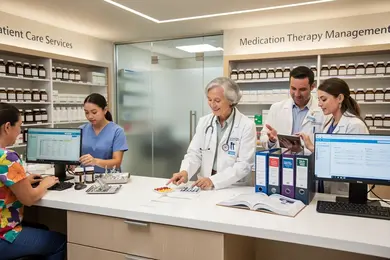
For learners focused on community and ambulatory care, those experiences may include retail pharmacies, outpatient clinics, federally qualified health centers, physician group practices, medication therapy management services, transitions-of-care programs, and chronic disease management clinics.
Community pharmacy usually emphasizes access, medication safety, immunizations, adherence counseling, point-of-care testing where allowed, and coordination with prescribers. Ambulatory care is often more clinic-based and may involve managing chronic conditions such as diabetes, hypertension, asthma, anticoagulation, or heart failure under collaborative practice agreements where state law and employer policy permit it.
Students comparing PharmD online programs should look beyond the word "online" and ask how the program builds patient-care judgment. Strong programs make clinical reasoning visible through case-based courses, skills labs, interprofessional learning, simulated patient encounters, and rotations aligned with the student's preferred practice setting.
The table below summarizes how major parts of an online PharmD typically support community and ambulatory care preparation. Use it to identify whether a program's curriculum matches the kind of pharmacist role you want after graduation.
| Program component | What students usually learn | Why it matters for community and ambulatory care |
| Pharmacotherapy courses | Medication selection, dosing, monitoring, contraindications, and evidence-based treatment plans | Builds the clinical foundation needed to counsel patients and recommend therapy changes |
| Patient assessment and skills labs | Blood pressure technique, medication histories, communication, documentation, and patient interviewing | Supports outpatient services such as screenings, immunizations, adherence work, and chronic disease follow-up |
| Introductory practice experiences | Early exposure to pharmacy workflows, dispensing safety, patient counseling, and health systems | Helps students confirm whether community-based practice fits their strengths and interests |
| Advanced pharmacy practice experiences | Full-time supervised rotations in community, ambulatory, institutional, and elective settings | Provides the strongest evidence of readiness for direct patient-care responsibilities |
| Telehealth and digital health activities | Virtual counseling, remote monitoring concepts, documentation, privacy, and patient engagement tools | Prepares students for outpatient care models that increasingly blend in-person and virtual services |
How do online PharmD programs compare to campus-based options for community and ambulatory care training?
Online and campus-based PharmD programs can lead to the same professional degree, but the student experience can differ significantly. The best choice depends on how you learn, where you live, how much schedule flexibility you need, and whether the program can place you in high-quality experiential sites near your preferred market.
Online formats may be attractive to working adults, students far from a pharmacy school, or applicants with family responsibilities. Campus-based formats may be better for students who want frequent in-person faculty access, a traditional cohort experience, or easier participation in campus organizations and research projects. Neither format is automatically better for community and ambulatory care; the decisive factor is whether the program can deliver strong practice experiences.
The comparison below highlights the trade-offs that matter most for future community and ambulatory care pharmacists. It is especially useful if you are deciding whether flexibility is worth possible travel requirements or less daily campus interaction.
| Factor | Online or hybrid PharmD | Campus-based PharmD | Decision point |
| Course delivery | Mostly online lectures, discussions, assessments, and case work, often with synchronous requirements | Primarily in-person classes and labs | Online works best if you are self-directed and comfortable with structured independent study |
| Skills training | May require scheduled campus immersions or regional skills sessions | Usually integrated into weekly campus labs | Ask how often you must travel and what costs are not included in tuition |
| Rotations | Completed in approved in-person sites, sometimes near the student's location | Completed through the school's established regional network | Verify placement support before enrolling, especially if you live outside the school's home state |
| Peer and faculty access | Virtual advising, online office hours, remote teamwork, and periodic in-person events | More spontaneous access to faculty, classmates, organizations, and campus services | Choose based on your need for daily structure and relationship-building opportunities |
| Community pharmacy exposure | Can be strong if the school has reliable local site agreements and preceptor oversight | Can be strong if the campus has deep ties with local pharmacies and clinics | Compare actual rotation sites, not just marketing language |
Online students should be especially careful not to assume that "remote learning" means "remote clinical training." Licensure-track pharmacy education requires real-world patient-care experience. If a program cannot clearly explain where and how you will complete rotations, that is a major red flag.
What accreditation and quality standards should online PharmD programs meet for pharmacist licensure?
For U.S. pharmacist licensure, the most important program-level checkpoint is accreditation by the Accreditation Council for Pharmacy Education. ACPE accreditation signals that a PharmD program is evaluated against professional standards covering curriculum, faculty, experiential education, assessment, student services, and continuous quality improvement.
Accreditation matters because state boards of pharmacy typically require graduation from an ACPE-accredited PharmD program, along with passing the North American Pharmacist Licensure Examination, meeting internship or experiential hour requirements, passing a pharmacy law examination where required, and satisfying state-specific background or application rules. Requirements can change, so students should verify details with the state board where they plan to practice.
ACPE's current professional standards emphasize competencies that are especially relevant to outpatient care, including patient-centered care, medication use systems management, interprofessional collaboration, communication, professionalism, and population health.
For online programs, quality also depends on whether the school can maintain consistent oversight of remote learners and geographically distributed rotation sites.
Before applying, students should complete a basic quality check. These steps help separate legitimate licensure-track programs from options that may be convenient but risky:
- Confirm the program's ACPE status directly through ACPE's public directory, including whether the program is accredited, candidate, precandidate, or otherwise listed.
- Check whether the program's online or distance pathway is included in the school's accreditation disclosures and state authorization information.
- Ask which states the program is designed to serve for licensure preparation and whether there are limitations for your state.
- Review NAPLEX preparation support, progression policies, remediation processes, and experiential placement policies.
- Contact your intended state board of pharmacy before enrolling if you plan to study online from one state and become licensed in another.
A common mistake is treating institutional accreditation and professional accreditation as interchangeable. Institutional accreditation is important for federal financial aid and institutional quality, but a pharmacist licensure pathway also requires the appropriate professional pharmacy accreditation.
What admission requirements and prior education are needed for online PharmD programs?
Admission to an online PharmD program usually requires college-level prerequisite coursework rather than a completed bachelor's degree in every case. Many applicants complete two to three years of undergraduate science and general education courses before entering the professional phase, while others apply after earning a bachelor's degree in biology, chemistry, health sciences, or another field.
Typical prerequisites include general chemistry, organic chemistry, biology, microbiology, anatomy and physiology, calculus or statistics, English composition, communication, humanities or social science courses, and sometimes economics or public speaking. Schools may also evaluate prerequisite GPA, science GPA, pharmacy or healthcare experience, recommendation letters, interviews, professionalism, and readiness for online learning.
Applicants who are interested in patient-facing healthcare but not fully committed to pharmacy should compare nearby alternatives before investing in prerequisite courses. For example, students who want a faster path into prescribing-focused advanced nursing practice may research the shortest online nurse practitioner program, while those who want direct patient care through nursing may compare online accelerated nursing programs if they already hold a non-nursing bachelor's degree.
The admissions checklist below shows what most applicants should prepare early. Requirements vary by school, so use this as a planning tool rather than a universal rule:
- Completed prerequisite courses with minimum grades that meet the school's policy, often with separate expectations for science coursework.
- Official transcripts from all colleges attended, including community college, dual-enrollment, and transfer coursework.
- Evidence of communication skills, professionalism, ethical judgment, and readiness for patient-facing responsibilities.
- Pharmacy exposure through work, volunteering, shadowing, technician experience, or healthcare service, if recommended or required.
- Interview preparation for behavioral, ethical, teamwork, and patient-care scenarios.
- Technology readiness for online learning, including reliable internet access, webcam capability, proctored testing requirements, and time-management capacity.
One admissions red flag is applying before you understand how transfer credits and prerequisite expiration policies work. Some programs limit the age of science courses, require labs, or reject pass/fail grades for prerequisites. Asking these questions before applying can prevent wasted time and application fees.
How long do online PharmD programs take and what do they cost for future community pharmacists?
Most PharmD programs take three to four professional years after prerequisites, though the full timeline can be longer if a student completes prerequisites part time or earns a bachelor's degree first. Some accelerated pathways compress the professional curriculum into year-round study, while traditional programs follow an academic-year calendar with summers used for work, electives, introductory experiences, or rest.
Cost varies widely because PharmD tuition is affected by public or private control, residency status, program length, fees, required travel, books and equipment, background checks, immunizations, housing near rotation sites, and lost wages during full-time clinical rotations.
The College Board's 2024 Trends in College Pricing reported average published tuition and fees of $43,350 at private nonprofit four-year institutions, which is a useful reminder that professional programs can carry substantial annual price tags even before living costs are included.
The table below breaks down the major cost categories students should compare. It can help you estimate the real cost of attendance rather than relying only on the advertised per-credit tuition rate.
| Cost factor | Why it matters | Questions to ask |
| Tuition structure | Programs may charge by credit, term, academic year, or professional year | Is tuition locked by cohort, and are summer terms included? |
| Fees and equipment | Online programs may still require lab kits, assessment tools, simulation fees, exam fees, or technology fees | Which fees are mandatory and which are estimates? |
| Travel and immersions | Hybrid programs may require campus visits for labs, orientations, skills assessments, or exams | How many trips are required, and how much notice is provided? |
| Experiential rotations | Students may need transportation, parking, housing, immunizations, background checks, and drug screening | Can rotations be arranged near my home, or must I relocate? |
| Opportunity cost | Advanced rotations are often full-time and may limit paid work | When will I need to reduce work hours or stop working? |
Students can manage cost more strategically when they compare total program cost and likely career fit together. Consider these practical steps before committing:
- Request a full cost-of-attendance estimate that includes tuition, fees, travel, supplies, rotation expenses, and living costs.
- Ask whether scholarships renew automatically or require a minimum GPA, service commitment, or separate annual application.
- Compare federal loan options, institutional aid, employer tuition benefits, and state pharmacy association scholarships.
- Estimate how much paid work is realistic during each professional year, especially during full-time rotations.
- Evaluate whether a residency, fellowship, or postgraduate training year may be needed for your preferred ambulatory care role.
The lowest tuition is not always the lowest-risk choice. A slightly more expensive program with strong rotation placement, licensure support, and local employer relationships may be a better fit than a cheaper option that leaves students scrambling for experiential sites.
What core courses, clinical rotations, and telehealth training do online PharmD programs include?
Online PharmD curricula are built around the same core goal as campus programs: preparing students to make safe, evidence-based medication decisions. Courses typically progress from biomedical and pharmaceutical sciences into applied pharmacotherapy, patient care, law, ethics, public health, and pharmacy practice management.
For community and ambulatory care, the most valuable learning experiences are those that connect drug knowledge with real patient behavior. Students need to practice explaining complex therapies clearly, identifying medication-related problems, recommending monitoring plans, documenting care, and working with prescribers and other healthcare professionals.
The curriculum elements below are especially important for outpatient practice readiness. Strong programs will be able to explain where each element appears in the curriculum and how student competency is assessed:
- Integrated pharmacotherapy sequences covering common chronic and acute conditions seen in outpatient care.
- Immunization training, medication safety, public health, and preventive care concepts relevant to community pharmacy services.
- Medication therapy management, adherence counseling, motivational interviewing, and health literacy strategies.
- Pharmacy law, reimbursement, documentation, controlled substance rules, and scope-of-practice issues that vary by state.
- Introductory and advanced pharmacy practice experiences in community, ambulatory care, institutional, and elective settings.
- Interprofessional education with medicine, nursing, public health, social work, or other healthcare students where available.
- Telehealth, digital documentation, remote patient communication, and privacy practices aligned with modern outpatient care.
Telehealth training is increasingly relevant because many outpatient services now use secure messaging, video visits, remote monitoring, appointment-based medication synchronization, and centralized clinical support. For pharmacists, technology does not replace clinical judgment; it changes how medication review, counseling, follow-up, and care coordination are delivered.
A common mistake is choosing a program based only on course titles. Ask for examples of clinical cases, simulated patient encounters, rotation settings, and assessment methods. A course named "ambulatory care" is more meaningful when students actively manage patient cases, present therapy plans, and receive feedback from experienced clinicians.
Demographic Breakdown of Ambulatory Care Pharmacists in 2019 (in Percentage)

What community and ambulatory care pharmacist roles can graduates pursue after an online PharmD?
Graduates of accredited PharmD programs who become licensed pharmacists can pursue a range of outpatient roles. Community pharmacy remains the most visible pathway, but ambulatory care, specialty pharmacy, managed care, population health, and transitions-of-care roles may offer different levels of clinical involvement, schedule predictability, and collaboration with medical teams.
Some roles are accessible immediately after licensure, while others strongly prefer or require a postgraduate year one residency, postgraduate year two ambulatory care residency, board certification, managed care experience, or employer-specific training.
Students who want clinic-based chronic disease management should ask programs how graduates compete for residencies and ambulatory care positions.
The table below compares common outpatient pharmacy paths. Use it to identify which roles match your preferred work environment and how much postgraduate training may be helpful.
| Role | Typical setting | Common responsibilities | Training considerations |
| Community pharmacist | Chain, independent, grocery, mass merchant, or outpatient pharmacy | Dispensing verification, patient counseling, immunizations, medication safety, adherence support, and workflow leadership | Licensure is required; immunization certification and leadership experience can help |
| Ambulatory care pharmacist | Primary care clinic, specialty clinic, health system outpatient service, or physician group | Chronic disease medication management, therapy monitoring, collaborative care, documentation, and patient follow-up | Residency training is often preferred, especially for competitive clinic-based roles |
| Medication therapy management pharmacist | Community pharmacy, health plan, telepharmacy service, or vendor organization | Comprehensive medication reviews, adherence interventions, patient education, and provider recommendations | Strong communication, documentation, and clinical review skills are important |
| Specialty pharmacist | Specialty pharmacy, health system, insurer, or manufacturer-supported service | High-cost medication counseling, prior authorization support, adherence monitoring, and therapy coordination | Experience with complex disease states and payer processes can be valuable |
| Managed care pharmacist | Health plan, pharmacy benefit manager, government program, or integrated delivery network | Formulary support, utilization management, medication policy, quality measures, and population health initiatives | Managed care residency, fellowship, or relevant experience may strengthen candidacy |
Pharmacy is not the only path for students interested in healthcare leadership. If your long-term goal is managing clinics, operations, policy, or payer strategy rather than providing medication therapy as a licensed pharmacist, a hospital administration course online or healthcare administration degree pathway may fit better than a PharmD.
Students should also think carefully about work style. Community pharmacy can be fast-paced and public-facing, with evening or weekend hours in many settings. Ambulatory care may offer deeper clinical relationships but can be more competitive and may require residency training. Managed care may involve less direct patient contact but more policy, analytics, and population-level decision-making.
What are typical salaries and earning potential for community and ambulatory care pharmacists?
The U.S. Bureau of Labor Statistics reported a median annual wage of $137,480 for pharmacists in May 2024. This figure is useful as a national benchmark, but it should not be treated as a guaranteed salary for a new graduate or for every practice setting.
Pay depends on employer type, region, shift requirements, union status, leadership duties, residency training, years of experience, and whether the job is community-based, hospital-affiliated, ambulatory, specialty, managed care, or industry-adjacent. Community pharmacy roles may include premium pay for hard-to-staff locations or inconvenient schedules, while ambulatory care positions may emphasize clinical credentials and health-system experience.
The table below explains how salary context differs by outpatient pharmacy path. It does not predict individual earnings, but it can help you understand what factors tend to influence compensation.
| Career path | Pay drivers | What students should consider |
| Community pharmacist | Geography, staffing needs, chain or independent ownership, volume, hours, and management duties | Higher pay may come with evenings, weekends, high prescription volume, or supervisory pressure |
| Pharmacy manager | Leadership responsibility, store performance, compliance oversight, staffing, and inventory control | Management can increase earning potential but also adds operational accountability |
| Ambulatory care pharmacist | Residency training, board certification, clinic specialty, collaborative practice role, and health-system pay scales | Clinical fit may be strong, but entry can be more competitive than traditional community roles |
| Specialty pharmacist | Therapeutic area expertise, payer knowledge, accreditation requirements, and complex patient coordination | Specialty work may reward niche knowledge and strong documentation skills |
| Managed care pharmacist | Population health experience, formulary knowledge, quality metrics, analytics, and policy work | Direct patient contact may be lower, but advancement can involve strategy and leadership |
To evaluate return on investment, compare total borrowing against realistic early-career options in your target region. A student pursuing a competitive ambulatory care role may need to factor in residency compensation for one or two years after graduation, while a student entering community practice immediately may begin full pharmacist wages sooner but face different schedule demands.
What is the job outlook and demand for pharmacists in community and ambulatory care settings?
The BLS projects pharmacist employment to grow 5% from 2024 to 2034, which suggests moderate national demand rather than explosive growth. For students, the more important question is not simply whether pharmacists are needed, but which practice settings are expanding and what skills employers expect.
Community pharmacy demand is shaped by prescription volume, immunization services, retail healthcare models, pharmacy closures in some markets, and staffing changes across large chains and independent pharmacies. Ambulatory care demand is influenced by chronic disease prevalence, value-based care, primary care shortages, medication safety initiatives, and health systems' interest in keeping patients out of hospitals when appropriate.
Technology is also changing the market. Central fill, automation, e-prescribing, artificial intelligence tools, clinical decision support, and telepharmacy can reduce repetitive tasks but increase the value of pharmacists who can manage exceptions, counsel patients, resolve medication problems, document outcomes, and collaborate with care teams. Students should treat technology fluency as a career advantage, not as an optional extra.
Employers in outpatient pharmacy increasingly value a mix of clinical, operational, and communication skills. The most marketable graduates often build evidence in these areas:
- Patient counseling that is clear, empathetic, culturally responsive, and adapted to health literacy needs.
- Chronic disease medication management skills in diabetes, hypertension, anticoagulation, respiratory disease, and cardiovascular risk reduction.
- Immunization delivery, preventive care knowledge, and public health awareness.
- Documentation, billing awareness, quality measures, and payer-related workflows.
- Comfort with telehealth platforms, pharmacy management systems, clinical decision support, and remote patient communication.
- Team leadership, conflict resolution, workflow improvement, and preceptor or staff development potential.
A practical way to read the job outlook is to focus locally. Before enrolling, review pharmacist job postings in your region, note whether employers request residency training or board certification, and ask schools where recent graduates actually work. National projections are helpful, but local employer demand will shape your first job search more directly.
How can students evaluate and choose a reputable online PharmD program in the United States?
Choosing an online PharmD program should start with licensure fit, then move to clinical training quality, cost, student support, and career outcomes. A reputable program should be transparent about accreditation, state authorization, experiential education, student progression, NAPLEX preparation, and placement support.
Start by clarifying your intended practice state and career setting. A student who wants to manage a community pharmacy may prioritize workflow, leadership, immunization, and local employer partnerships. A student aiming for ambulatory care should prioritize residency placement support, clinic rotations, interprofessional training, and faculty with outpatient practice expertise.
Use the following evaluation steps before applying or paying a deposit. They are designed to uncover the issues that matter most for licensure and career readiness:
- Verify ACPE accreditation status and confirm that the online or hybrid pathway is included in the program's official disclosures.
- Ask whether the program meets educational requirements for pharmacist licensure in your state and any state where you may relocate.
- Request details on required campus visits, skills labs, proctored exams, and travel expectations.
- Ask how introductory and advanced rotations are assigned, who secures sites, and what happens if a local placement falls through.
- Review student support services, including advising, tutoring, technical support, remediation, mental health resources, and disability accommodations.
- Compare the total cost of attendance, not just tuition, and ask about scholarship renewal rules and loan counseling.
- Ask for recent outcomes such as graduation rates, residency placement support, NAPLEX preparation resources, and common graduate employment settings.
- Speak with current students or alumni about workload, faculty access, rotation quality, and whether the online format is well organized.
Several red flags deserve extra caution: vague accreditation language, no clear rotation plan, pressure to enroll quickly, unclear state authorization, weak student support, unusually limited faculty access, or unwillingness to provide cost and licensure information in writing. A trustworthy school should welcome detailed questions because pharmacist education is a regulated professional pathway.
The best program is not necessarily the fastest, cheapest, or highest ranked. It is the one that can credibly take you from your current academic background to licensure eligibility, supervised patient-care competence, and a realistic path toward the community or ambulatory care role you want.
Other Things You Should Know About PharmD
Some students work part time during didactic coursework, but workload and scheduling can be demanding. Full-time rotations often make regular employment difficult, so applicants should plan financially for periods when work hours may need to drop.
Yes. Most online PharmD curricula include a state pharmacy-law component that covers controlled-substance rules, dispensing limits, and documentation standards. Students also complete supervised experiential rotations, often 300 to 600 hours, in community pharmacies or ambulatory care settings to meet licensure expectations.
Many PharmD programs have reduced or eliminated PCAT requirements, but policies vary by school. Applicants should check each program's current admissions page and ask whether submitting scores is optional, recommended, or not accepted.
Not automatically. Licensure is controlled by state boards of pharmacy, and requirements can vary. Students should confirm that their program meets educational requirements in the state where they plan to practice before enrolling.
References
- Is a Career in Pharmacy Worth It? https://pharmdonline.findlay.edu/blog/pharmacy-career-worth-it
- Best Online PharmD Programs https://pharmddegree.com/choosing/best-online-pharmd-programs
- Career Paths in Pharmacy | University of Health Sciences and Pharmacy in St. Louis https://www.uhsp.edu/academics/pharmd-program/career-paths-in-pharmacy/
- Ambulatory Care https://www.pharmacist.com/Career/Career-Pathways/Career-Option-Profiles/Ambulatory-Care
- Pharmacy Career Outlook: Is a Career in Pharmacy Worth It? - Roseman University https://www.roseman.edu/student-experience/news/pharmacy-career-outlook-is-a-career-in-pharmacy-worth-it/
- Earn Your PharmD with Flexibility: Explore the Hybrid Program at West Coast University | West Coast University https://westcoastuniversity.edu/blog/earn-your-pharmd-with-flexibility-explore-the-hybrid-program-at-west-coast-university
- 2025 Best Online Pharmacy Schools https://www.onlineu.com/degrees/pharmacy
- Many Paths of Pharmacy - The Happy PharmD https://thehappypharmd.com/ultimate-guide-to-pharmacy-career-opportunities/
- Careers in Pharmacy https://pharmacyforme.org/careers-in-pharmacy
- Doctor of Pharmacy, PharmD https://www.pacific.edu/pharmacy/academics/doctor-pharmacy