
2027 Ideal Jobs for Economics Majors

Co-Founder and Chief Data Scientist
If you are wondering what you can actually do with an economics degree, the short answer is this: much more than become an economist. Economics is one of the most flexible majors for students who want to work with data, markets, policy, business strategy, finance, or law. It teaches how people make choices, how incentives shape behavior, and how to evaluate trade-offs using evidence instead of guesswork.
This guide breaks down the most useful career paths for economics majors, the skills employers expect, what extra education may help, and how to decide whether this major fits your goals. It is designed for students choosing a major, recent graduates building a job search plan, and career changers trying to understand where economics can take them.
Quick Answer: What Can You Do With an Economics Degree?
An economics degree can lead to careers in economics, finance, analytics, market research, public policy, consulting, compliance, accounting, law, education, and management. The major is especially useful when the job requires quantitative reasoning, research, forecasting, or strong judgment about how markets and organizations work.
Professional economists earn an average salary of $105,000, but pay varies a lot by role, location, employer, experience, and education level. Some jobs are open to bachelor’s degree holders, while others require graduate study, exams, licensure, or specialized training.
12 Career Paths That Fit an Economics Degree
- Professional economist
- Market research analyst
- Data scientist
- Actuary
- Financial analyst
- Lawyer
- Statistician
- Accountant
- Compensation manager
- Economics professor
- Compliance analyst
- Stockbroker
What an Economics Degree Actually Teaches
Economics is the study of how individuals, firms, governments, and entire economies allocate limited resources. That makes it far broader than money, GDP, or stock prices. Economics students learn how prices are formed, how labor and product markets function, how policy changes affect behavior, and how to interpret data in uncertain environments.
The major typically starts with two foundation areas. Microeconomics focuses on individual and firm-level decisions, including demand, supply, competition, pricing, and consumer behavior. Macroeconomics looks at the bigger picture, including inflation, unemployment, growth, fiscal policy, monetary policy, exchange rates, and trade. Students also spend a great deal of time on statistics, econometrics, mathematics, and research methods.
Many programs also introduce different schools of economic thought, such as monetarist and Keynesian perspectives, so students can compare how economists explain similar problems in different ways. That matters because real-world decisions rarely come with perfect information. Economics trains students to work with incomplete data, defend assumptions, and explain uncertainty clearly.
Economics is sometimes listed among the easy majors that pay well, but that label can be misleading. The degree can be mathematically demanding, especially if the program emphasizes econometrics, modeling, or graduate preparation. As Target Careers (n.d.) notes, economics overlaps with business, finance, law, and marketing, which helps explain why graduates can move into many industries. Economist Bill Conerly made a similar point in his Forbes article Career Advice for Economics Majors, saying that people with an economics major work in all industries.
Skills Employers Look for in Economics Graduates
Employers value economics majors because they tend to bring together analysis, business judgment, and a practical understanding of how systems work. Heidrick & Struggles (2024) reported that economics is the most common undergraduate major among Fortune 100 CEOs, which shows that the major can support leadership as well as technical work.
The 2033 job outlook growth for economists in the United States is at 7%, higher than the national average of 5%. Even so, employers usually want more than classroom knowledge. The strongest candidates can point to internships, research, software tools, writing samples, project work, or relevant industry exposure.
| Skill | How economics students use it | Where it matters most |
| Problem-solving | Breaks complex business, policy, or financial issues into smaller questions and builds evidence-based recommendations. | Consulting, finance, policy, operations, management |
| Data analysis | Uses statistics, software, and models to identify patterns and support decisions. | Analytics, forecasting, market research, risk |
| Case analysis | Looks at why outcomes changed, such as whether revenue rose because of more customers or higher sales per customer. | Pricing, strategy, marketing, operations |
| Evidence-based reasoning | Tests assumptions, checks data quality, and avoids unsupported conclusions. | Compliance, research, policy, finance |
| Research methods | Selects the right approach for the question and audience. | Academia, think tanks, government, corporate research |
| Understanding relationships | Connects variables such as wages and education, prices and demand, or trade and exchange rates. | Economics, labor analysis, public policy, pricing |
| Communication | Converts technical findings into reports, charts, presentations, and recommendations. | Nearly every economics-related job |
| Trend monitoring | Tracks changes in markets, technology, regulation, and the broader economy. | Technology, marketing, finance, consulting |
| Concept integration | Links economics with business, psychology, sociology, finance, and political science. | Policy, product strategy, management, social research |
Arndt and Rehm (2024) describe economic competencies as part of being an informed citizen who can evaluate economic issues thoughtfully. Luminate (2025) also identifies time management as a skill economics students develop. In the workplace, that matters because economists and analysts often work under deadlines, handle large datasets, and need to organize their work carefully before drawing conclusions.
Best Jobs for Economics Majors
Economics majors can work across government, finance, consulting, technology, insurance, healthcare, higher education, nonprofits, and private companies. Some of these jobs are open right after a bachelor’s degree, while others typically require a graduate degree or a professional license.
Professional economist is the most direct match, but it is not the only strong option. Many economics graduates build successful careers in roles where the title does not include “economist” at all.
| Career | Why economics fits | Common extra preparation | Salary information stated in source text |
| Professional economist | Uses economic theory, forecasting, policy analysis, and data directly. | Master’s degree or Ph.D. often improves competitiveness. | $115,260 a year and $55.41 per hour; also reported as $116,210 a year and $55.87 per hour. |
| Market research analyst | Applies consumer behavior, demand forecasting, and research methods. | Survey tools, data visualization, statistics, and marketing knowledge. | $76,950 a year or $37.00 per hour. |
| Data scientist | Uses quantitative modeling, interpretation, and decision support. | Programming, machine learning, and database skills. | $117,000 a year on average. |
| Actuary | Combines math, probability, statistics, and risk modeling. | Actuarial exams and industry training. | $108,350 annually and $52.09 per hour. |
| Financial analyst | Studies markets, investments, budgets, and business performance. | Excel modeling, valuation, forecasting, and possible credentials. | $88,111 per year or $42.36 per hour. |
| Lawyer | Economic reasoning supports tax, antitrust, corporate, and regulatory work. | Law school and bar exam passage. | $145,760 a year or $70.08 per hour. |
| Statistician | Builds on quantitative analysis, research design, and modeling. | Advanced statistics and software; graduate study may help. | $73,184 yearly and $29.66 per hour. |
| Accountant | Uses financial analysis, cost review, and business problem-solving. | Accounting coursework, software, and possible CPA pathway. | $51,162 per year and $20.29 per hour. |
| Compensation manager | Analyzes labor markets, pay structures, incentives, and benefits costs. | HR, compensation, benefits, and management experience. | $122,270 annually and $58.80 hourly. |
| Economics professor | Centers on theory, teaching, publication, and research. | Usually a Ph.D. and a research record. | $133,080 on average; around $234,450 at high levels in prestigious universities. |
| Compliance analyst | Uses research, regulation analysis, and risk assessment. | Industry compliance knowledge and documentation skills. | $59,312 annually and $20.57 hourly. |
| Stockbroker | Applies market analysis, trend interpretation, and client communication. | Licensing, sales skills, and financial markets training. | $56,078 yearly and $23.41 per hour, plus $20,000 in commissions each year. |
Professional Economist
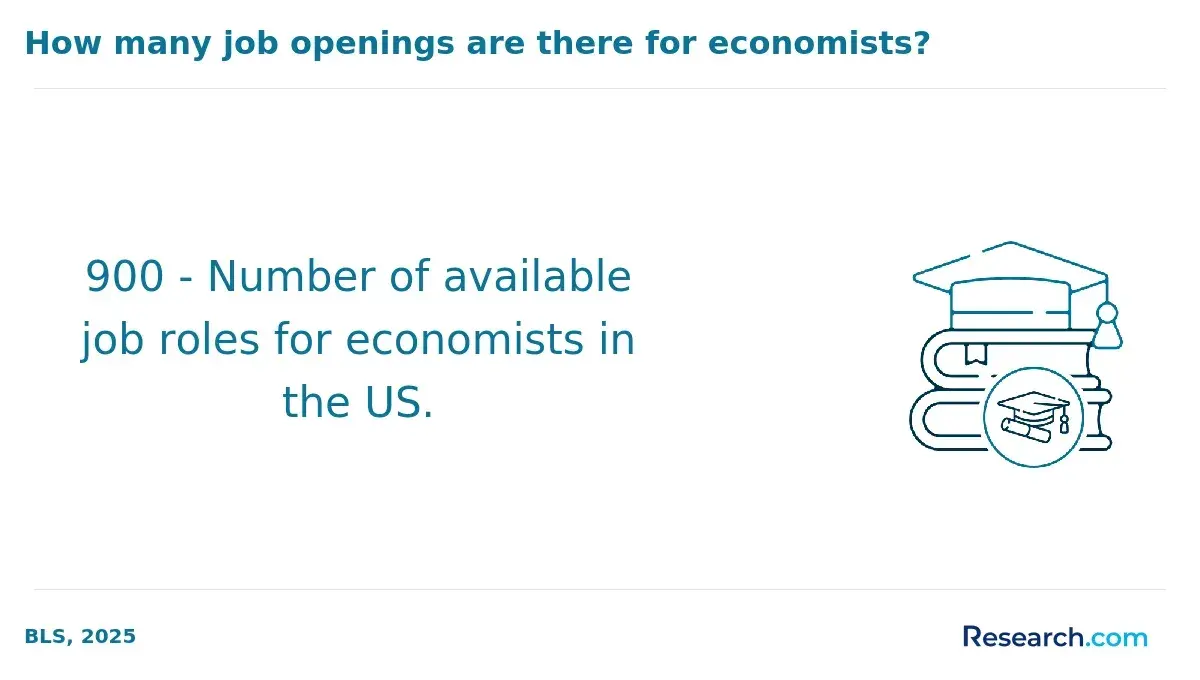
Economist is the closest direct career match for the major. Economists study data, build forecasts, examine policy or market conditions, and explain how economic changes may affect businesses, governments, or communities. Their work can support pricing, labor planning, regulation, investment, or public policy.
A bachelor’s degree can open the door to analyst-level roles, but many competitive economist positions prefer applicants with an economics master's degree or a Ph.D. Graduate study matters most for research-intensive, academic, and advanced policy jobs that depend on econometrics and deeper specialization.
Economists work in government, finance, consulting, research organizations, large companies, accounting firms, and think tanks. Some also work independently as consultants.
Median salary: Professional economists receive $115,260 a year and $55.41 per hour on average (BLS, 2024).
Market Research Analyst
Market research analysts study customers, competitors, products, pricing, and demand. Their job is to help organizations understand whether a product can succeed, which audience is most valuable, and how market conditions are shifting.
Economics majors are a strong fit because they already work with supply and demand, consumer behavior, incentives, market structure, and research design. They may still need hands-on experience with survey tools, segmentation, data visualization, and marketing analytics, but the academic foundation is highly relevant.
Median salary: Market research analysts receive $76,950 a year or $37.00 per hour on average (BLS, 2024). Their job outlook by 2033 is at 7% (BLS, 2024).
Data Scientist
Data science is a strong path for economics graduates who enjoy numbers and are willing to build technical skills. Data scientists gather, clean, analyze, and model data so organizations can make better choices about products, operations, risk, and strategy.
Economics students often already understand statistics, hypothesis testing, and causal reasoning. To compete for data science jobs, they usually need programming, database knowledge, machine learning basics, and real project experience.
Median salary: Data scientists earn $117,000 a year on average (Wharton, n.d.). The growth rate of jobs in data science is at 28% (Wharton, n.d.).
Actuary
Actuaries assess financial risk. They use math, statistics, probability, and modeling to estimate how likely future events are and how much those events may cost. Most work in insurance, pensions, healthcare, finance, or risk management.
Economics majors can fit this path well because actuary work rewards quantitative discipline, careful reasoning, and the ability to explain uncertainty. The catch is that the field is exam-based. Students interested in actuarial work should plan early for exams, internships, and software training.
Median salary: Actuaries receive an annual salary of $108,350 and an hourly rate of $52.09 on average. The field has a growth rate of 20% over the next 10 years, compared with 8% for economist jobs.
Financial Analyst
Financial analysts evaluate markets, investments, budgets, company performance, and financial trends. They help organizations decide how to allocate capital, manage risk, and judge whether a financial strategy is working. Students comparing economics and finance may also want to review what can you do with a finance degree.
Economics supports this career because it teaches opportunity cost, market behavior, interest rates, trade, consumer demand, and firm decision-making. To improve job prospects, graduates should build financial statement analysis, valuation, Excel modeling, forecasting, and presentation skills.
Median salary: Financial analysts receive $88,111 per year or $42.36 per hour on average (ZipRecruiter, 2026). The number of jobs in this field has reached hundreds of thousands in recent years, and that figure would stand to increase by 6% in the next few years.
Lawyer
Economics can be a valuable foundation for law, especially in areas involving markets, regulation, taxation, competition, contracts, damages, and corporate behavior. Economics graduates are used to comparing alternatives, evaluating evidence, and working through complex cause-and-effect questions.
The downside is the amount of training required. Anyone who wants to become a lawyer must complete law school and pass the bar exam. That investment can pay off for students drawn to corporate law, tax law, antitrust, regulatory work, or litigation that relies on economic evidence.
Median salary: Lawyers receive around $145,760 a year or $70.08 per hour (BLS, 2024).
Statistician
Statisticians design studies, analyze datasets, interpret results, and explain what the findings mean. Their work supports decisions in government, science, medicine, finance, healthcare, marketing, law enforcement, and many other settings.
Economics majors who like econometrics, modeling, and research design may find statistics to be a natural next step. They should strengthen their training in statistical software, probability, experimental design, and advanced methods.
Median salary: Statisticians earn $73,184 yearly and $29.66 per hour on average (PayScale, n.d.). Statistical analysis, data analysis, and data modeling are among their most used skills (PayScale, n.d.).
Accountant
Accounting is different from economics, but the two fields overlap in financial interpretation, cost analysis, reporting, and decision-making. Economics graduates can do well in accounting-related roles if they understand financial statements, bookkeeping, internal controls, and accounting software.
This path usually appeals to students who prefer structured records and compliance-heavy work. Students aiming for licensure should check requirements early, because an economics degree alone may not meet all CPA education expectations.
Median salary: Accountants earn $51,162 per year and $20.29 per hour on average (PayScale, n.d.). General ledger accounting, financial reporting, and bookkeeping are among the skills employers commonly seek (PayScale, n.d.).
Compensation Manager
Compensation managers design and oversee pay and benefits systems. They compare salaries across the labor market, review internal fairness, monitor benefits costs, and help employers create compensation packages that attract and retain workers.
Economics majors are well matched to this work because they understand labor markets, incentives, cost-benefit analysis, and competitive strategy. Most people enter this field after gaining experience in human resources, compensation analysis, benefits administration, or workforce analytics.
Median salary: Compensation managers receive $122,270 annually and $58.80 hourly on average (BLS, 2020f).
Economics Professor
Economics professors teach classes, conduct research, publish scholarship, advise students, and contribute to academic departments. This path is best for people who enjoy theory, writing, long-term research, and deep specialization.
Most tenure-track positions require a Ph.D. in economics or a closely related field. Industry experience can help in applied programs, but academic advancement usually depends on publication quality, teaching, research output, and institutional fit.
Median salary: Economics professors earn an average annual pay of $133,080, and that figure can rise to around $234,450 at a high position in a prestigious university (U.S. Bureau of Labor Statistics, 2024).
Compliance Analyst
Compliance analysts help organizations follow laws, regulations, internal policies, and industry standards. They review processes, investigate concerns, document risks, and recommend changes that reduce legal or financial exposure.
Economics graduates can do well here because they are trained to evaluate evidence, follow relationships among variables, and explain findings clearly. Students with coursework in regulation, finance, healthcare economics, or political economy may find this path especially relevant.
Median salary: Compliance analysts receive $59,312 annually and $20.57 hourly (PayScale, n.d.). Policy analysis, research analysis, and data analysis are among the skills employers expect (PayScale, n.d.).
Stockbroker
Stockbrokers help clients buy and sell securities. The role requires market knowledge, communication skill, trust-building, and the ability to interpret changing financial conditions. Economics majors are often interested in the job because markets reflect incentives, expectations, risk, and information flow.
This is not just a numbers job. It is also client-facing and often sales-oriented. Students who want this path should learn financial markets, licensing rules, ethics, client suitability requirements, and portfolio basics.
Median salary: Stockbrokers earn $56,078 yearly and $23.41 per hour on average (PayScale, n.d.). They also receive $20,000 worth of commissions each year (PayScale, n.d.), along with bonuses when applicable.
How to Decide Which Economics Career Fits You
The best economics career is not always the one with the biggest salary number. The right choice depends on what kind of work you want to do, how much schooling you are willing to complete, and whether you prefer research, finance, coding, law, policy, teaching, or people-focused work.
| If you enjoy... | Consider... | Be prepared for... |
| Academic research and policy questions | Economist, professor, policy analyst | Graduate study and strong econometrics |
| Markets, investments, and corporate finance | Financial analyst, stockbroker, corporate finance roles | Financial modeling, regulations, and market knowledge |
| Coding, statistics, and large datasets | Data scientist, statistician, analytics roles | Programming, machine learning, and portfolio projects |
| Risk, probability, and long-term exams | Actuary | Actuarial exams and insurance or finance specialization |
| Rules, evidence, and argumentation | Lawyer, compliance analyst | Law school for attorneys or regulatory knowledge for compliance |
| People strategy and workplace incentives | Compensation manager, HR analytics | HR systems, benefits knowledge, and management experience |
How Economics Graduates Fit Into Technology Jobs
Economics majors are increasingly useful in technology because digital transformation is not only about software. Companies also have to decide which tools are worth adopting, how users will respond, what risks exist, and whether the expected payoff justifies the cost.
- Technology market analysis: Economics graduates can study demand, pricing, competition, and adoption patterns for AI, cloud services, and analytics tools.
- Cost-effective technology decisions: Their background in cost-benefit thinking helps companies compare software and platforms before spending money.
- Data-driven strategy: They can interpret datasets that affect product design, user experience, operations, and productivity.
- FinTech and GreenTech: Economics training is useful for roles involving markets, pricing, incentives, risk, and innovation.
- Digital change in established industries: Healthcare, retail, and manufacturing all need people who can estimate how technology affects costs and outcomes.
Students who want tech roles should not depend on economics coursework alone. They should add coding, data tools, product analytics, business intelligence, or fintech experience through projects, internships, certificates, or graduate study.
Should You Consider an Accelerated Online Degree?
An accelerated online program can be a smart choice for students or working adults who want to finish faster, but speed should not be the only reason to enroll. Before choosing a program, check accreditation, transfer policies, total cost, course load, faculty support, career services, and how well the curriculum matches your goals.
An accelerated bachelor's degree online may work well for students who already have credits, can handle compressed terms, and want to start working sooner. It may be a poor fit for students who need more academic support, prefer campus networking, or want to balance heavy quantitative classes with full-time work.
How a Finance Degree Can Complement Economics
Economics gives you a broad framework for understanding incentives, resource allocation, and market behavior. Finance goes deeper into valuation, risk, investments, capital markets, and corporate financial decisions. For students who want analyst, banking, investment, or corporate finance roles, the combination can be especially useful.
An accelerated finance degree online may be a good next step for economics graduates who want more specialized training in less time. Before enrolling, compare prerequisites, intensity, tuition, accreditation, internship support, and whether the program teaches practical tools such as financial modeling.
How Economics Helps in Environmental and Sustainability Work
Environmental policy is also about economics. Governments, nonprofits, and companies need people who can measure trade-offs, estimate incentives, and compare the costs and benefits of sustainability choices.
- Environmental policy analysis: Economics graduates can evaluate carbon pricing, emissions trading, and pollution control policies.
- Sustainable resource management: They can study how to allocate water, energy, and forestry resources efficiently.
- Corporate sustainability strategy: Businesses may use economic analysis to assess green business models and cost savings.
- Green finance and investment: Economics training can support renewable energy and clean technology analysis.
- Climate change mitigation: Graduates may help examine carbon taxes, cap-and-trade systems, and incentives for renewable energy adoption.
Can an Accelerated Online MBA Help Your Economics Career?
An economics degree develops analytical depth. An MBA adds broader business training in strategy, operations, management, marketing, finance, and organizational leadership. For economics graduates who want to move from analysis into leadership, an accelerated online MBA program may be worth comparing.
The key question is fit, not prestige. An MBA can be especially helpful for students aiming at management, consulting, entrepreneurship, corporate finance, or executive roles. It may be less necessary for students who want technical economics research, actuarial work, or data science unless the program offers real quantitative depth.
Is an Economics Degree Worth It?
The return on investment depends on tuition, scholarships, debt, time to finish, the opportunity cost of studying, your career direction, and whether you plan to attend graduate school. Economics can lead to strong outcomes, but the degree alone does not guarantee a salary or a particular job.
Before committing to the major, compare the total cost of attendance with realistic entry-level roles and the likelihood that your target career may require more education. Students considering graduate business school should also review how much does an MBA cost before assuming the extra credential will automatically pay for itself.
Additional Credentials That Can Strengthen an Economics Degree
The most useful credentials are the ones that close a specific skill gap. Economics graduates do not need to collect certificates randomly. They should choose training that supports a target career path.
| Career goal | Skill area to build | Training or credential to consider |
| Data science or analytics | Programming, databases, visualization, machine learning | Applied analytics certificates, coding bootcamps, portfolio projects |
| Finance | Financial modeling, valuation, markets, risk | Finance coursework, investment analysis training, graduate finance options |
| Business leadership | Management, strategy, operations, accounting | MBA, business administration coursework, leadership certificates |
| Compliance | Regulation, documentation, auditing, risk controls | Industry compliance training |
| Accounting | Bookkeeping, reporting, tax, auditing | Accounting coursework and CPA-aligned preparation where applicable |
Students who want an affordable way to add business training can compare options such as the cheapest business administration degree online, but cost should always be weighed against accreditation, curriculum quality, transfer rules, and employer recognition.
Business Management vs. Business Administration: Which Makes More Sense?
Economics graduates who want leadership roles often compare business management with business administration. Business management usually focuses on leading teams, setting direction, and coordinating work. Business administration tends to focus more on systems, policies, operations, and organizational structure.
The difference matters when you are choosing a next degree. If you want to manage people or operations, a management-focused program may fit better. If you want broader knowledge of business systems and support functions, administration-focused coursework may be the better match. For a fuller comparison, see the difference between business management and business administration.
Online Education Options for Economics and Finance Students
Online study can be a practical way for economics graduates to add finance, analytics, management, or business skills while keeping a job. The biggest advantage is flexibility. The biggest risk is choosing a program based only on price or speed.
When comparing finance programs, look past the tuition headline. You should review accreditation, faculty background, quantitative rigor, internship or project opportunities, student support, graduation outcomes, and total fees. If you are searching for the cheapest online finance degree, make sure it still supports the career you want.
How to Find Affordable Online Finance Programs Without Lowering Quality
An affordable online finance program can help economics graduates move toward banking, corporate finance, investment analysis, or financial planning. But low price does not always equal good value. A program that lacks accreditation, applied coursework, or employer recognition may not deliver the outcome you need.
- Review total cost, not just tuition: Include books, technology fees, residency requirements, exam fees, and any differences between in-state and out-of-state pricing.
- Verify accreditation: Confirm recognized institutional accreditation and, when relevant, business accreditation such as the Accreditation Council for Business Schools and Programs (ACBSP) or the Association to Advance Collegiate Schools of Business (AACSB).
- Look at financial aid options: Scholarships, grants, employer tuition help, and military or veteran benefits can change the real price.
- Think carefully about accelerated formats: Faster programs can reduce time away from the workforce, but they also create heavier course loads.
Graduate finance programs deserve the same level of scrutiny. A cheapest online finance degree can be a smart choice if it is accredited, rigorous, and aligned with your goals.
Future Trends Shaping Economics Careers
Economics jobs are being reshaped by AI, automation, data analytics, sustainability concerns, and more demanding regulatory environments. Employers increasingly want people who can combine economic reasoning with technical fluency and clear communication.
For some graduates, specialized business training can help bridge analysis and leadership. Programs such as one year MBA programs USA may appeal to economics majors who want a faster route to management, but applicants should still compare workload, cost, accreditation, and career outcomes carefully.
Why Online Learning Matters for Economics and Business Students
Online learning has made it easier to pursue economics-related credentials while working or managing family responsibilities. It can also help students who do not live near a campus or who need more scheduling flexibility.
If you want to pair economics with broader business training, you can explore affordable online business options, including the cheapest online business bachelor's degree. The real question is not whether the program is online. It is whether the school is accredited, the curriculum is strong, the price is reasonable, and the program leads toward the job you want.
Online credentials can be competitive when students choose respected programs and build practical experience alongside them. Internships, projects, writing samples, data portfolios, and networking still matter.
Common Mistakes Economics Majors Should Avoid
- Thinking the degree is enough by itself: Employers usually want evidence of applied skills, not just a transcript.
- Ignoring weak spots in quantitative skills: Students headed toward analytics, finance, data science, or actuarial work need stronger math, coding, and statistics early.
- Going to graduate school without a clear reason: A master’s, Ph.D., MBA, law degree, or certificate should match a specific career goal and financial plan.
- Choosing based only on salary: Higher-paying jobs can come with more years of study, more exams, more debt, or heavier workloads.
- Skipping accreditation checks for online programs: Accreditation affects financial aid, transfer credits, employer trust, and graduate school options.
- Overvaluing rankings: Fit, cost, curriculum, support, and alumni outcomes often matter more than a single ranking position.
- Neglecting communication skills: Technical ability is important, but so is the ability to explain what the numbers mean.
Questions to Ask Before Choosing a Career or Program
- Do I want a technical, policy, business, legal, academic, or client-facing career?
- Which roles are realistic with a bachelor’s degree, and which require graduate study or licensure?
- What software, statistics, finance, or writing skills do employers expect in my target field?
- Can I complete an internship, capstone, research project, or portfolio before graduation?
- How much debt am I willing to take on, and what salaries are realistic for my target roles?
- If I choose an online or accelerated option, is the program accredited and manageable for my schedule?
- Does the school provide career services, employer connections, and evidence of graduate outcomes?
- Would a finance, business, data analytics, law, or MBA credential strengthen my plan?
Key Insights
- An economics degree leads to more than one career path: Graduates can work in economics, finance, analytics, market research, compliance, law, accounting, technology, sustainability, education, and management.
- The major’s real value is analytical thinking: Economics teaches students to test assumptions, evaluate trade-offs, work with data, and explain decisions clearly.
- Some careers need extra preparation: Law requires law school and bar passage, actuarial work requires exams, professor roles usually require a Ph.D., and data science often requires coding and technical experience.
- Pay varies by role and preparation: Economists, lawyers, actuaries, compensation managers, and data scientists can all offer strong earning potential, but each path comes with different requirements.
- Graduate school should be strategic: A master’s in economics, MBA, finance degree, law degree, or certificate makes sense only when it clearly supports your target job.
- Technology and sustainability are expanding opportunities: AI, automation, digital transformation, green finance, and environmental policy are creating new uses for economics training.
- Program quality matters as much as price: Whether you study online, on campus, or in an accelerated format, verify accreditation, cost, support services, and career relevance before enrolling.
References:
- American University (n.d.). Is a masters in economics worth it? AmericanUniversity
- Career Planner (n.d.). Job outlook for economists. CareerPlanner.
- PayScale (n.d.). Average accountant salary. PayScale.
- PayScale (n.d.). Average policy analyst salary. PayScale.
- PayScale (n.d.). Average statistician salary. PayScale.
- PayScale (n.d.). Average stock broker salary. PayScale.
- Salary.com (2025). Professor – economics salary in the United States. Salary.com.
- Target Careers (n.d.). Should I study economics at university? Target Careers.
- TopUniversities (n.d.). Economics degrees. TopUniversities.
- University of Houston (n.d.). What skills will I learn as an economics major? Houston, TX: University of Houston.
- University of Nebraska-Omaha (n.d.) Economics. Omaha, NE: College of Arts and Sciences, University of Nebraska-Omaha.
- BLS (2025). Actuaries. Occupational Outlook Handbook. Washington, DC: US Bureau of Labor Statistics.
- BLS (2025). Economists. Occupational Outlook Handbook. Washington, DC: US Bureau of Labor Statistics.
- BLS (2025). Financial Analysts. Occupational Outlook Handbook. Washington, DC: US Bureau of Labor Statistics.
- BLS (2025). Lawyers. Occupational Outlook Handbook. Washington, DC: US Bureau of Labor Statistics.
- BLS (2025). Market Research Analysts. Occupational Outlook Handbook. Washington, DC: US Bureau of Labor Statistics.
- BLS (2025). Compensation and Benefit Managers. Occupational Outlook Handbook. Washington, DC: US Bureau of Labor Statistics.
- Wharton (n.d.). 3 Things You Can Do with an Economics Degree. Philadelphia, PA: University of Pennsylvania.
Other Things You Should Know About Jobs for Economics Majors
Employers expect economics majors to use regression analysis, statistical software, and data visualization tools. Proficiency in Stata, R, Python, or Excel is common, and many entry-level roles require coursework in econometrics, probability, and applied statistics.
Economics majors can prepare for fintech roles in 2027 by gaining proficiency in data analytics, blockchain technology, and programming languages like Python. Internships and certifications in financial technologies will enhance their qualifications and industry readiness.
In 2027, the employment prospects for economics majors remain strong. As the demand for data-driven decision-making grows, economics majors will find opportunities in various sectors, including finance, consulting, and tech. The increasing emphasis on global economic challenges will also enhance their value in governmental and international organizations.
Yes, an economics major can pursue a career in law. The analytical skills gained from studying economics are valuable in legal careers. Economics majors often excel in areas such as antitrust, corporate law, and regulatory issues, making the transition to law school and legal practice feasible and advantageous.
Economics majors aiming for tech sectors should consider certifications like SAS Certified Data Scientist or AWS Certified Solutions Architect in 2027. These qualifications can enhance their marketability by equipping them with skills in data analysis and cloud computing, crucial for tech roles.
Economics majors develop strategic skills such as analytical thinking, data analysis, and problem-solving. They often gain expertise in utilizing statistical software and understanding economic models, which equips them to assess market conditions and economic trends. These skills are vital in roles across finance, consulting, and public policy in 2027.





