2027 Most Affordable Finance Degree Online Programs

Co-Founder and Chief Data Scientist
Choosing an online finance degree is a cost, time, and career decision—not just a search for the lowest tuition. A good program should teach you how money moves through businesses, markets, banks, investment firms, public agencies, and households while also giving you the flexibility to study around work or family responsibilities. This guide is designed for students comparing affordable online bachelor’s programs in finance, working adults who want a career change, and transfer students trying to lower the total price of a degree.
Below, you will find affordable online finance degree options, what these programs usually include, how online study compares with campus-based learning, what finance graduates can do after graduation, and how to evaluate accreditation, cost, financial aid, certifications, and return on investment before enrolling.
Quick Answer: Is an Online Finance Degree Worth Considering?
An online bachelor’s degree in finance can be a practical option if you want a business-focused degree with broad career uses and need a flexible format. Most full-time students finish in four years, while accelerated or transfer-friendly options may shorten that timeline. Public institutions often cost less than private institutions, with average tuition ranges of $38,000 to $61,000 at public institutions and $45,000 to $248,000 at private institutions.
The labor market is also favorable for many finance-related roles. The BLS projects more than 911,000 openings for business and financial occupations each year from 2022 to 2032, with 7% employment growth projected for business and financial operations occupations over the same period. However, salaries and job outcomes vary by role, location, industry, experience, certifications, and school quality, so students should compare programs carefully rather than choosing by price alone.
What are the main benefits of earning a finance degree online?
- Career flexibility: Finance skills apply in banking, corporate finance, investment services, insurance, public finance, financial planning, consulting, fintech, and entrepreneurship.
- Schedule flexibility: Online finance programs often allow students to complete lectures, assignments, and discussions around work, caregiving, military service, or other commitments.
- Strong earning potential in some roles: BLS wage data show that securities, commodities, and financial services sales agents can earn over $189,000 at the 90th percentile, though this is not a guaranteed outcome for all graduates.
- Useful technical training: Many programs include financial accounting, investment analysis, corporate finance, financial modeling, data analysis, and risk management.
- Pathway to advanced credentials: A bachelor’s in finance can support later preparation for graduate study or industry credentials such as CFA- or CFP-related pathways, depending on the program and career goal.
What can I expect from an online finance degree?
An online finance degree usually combines business fundamentals with specialized study in financial decision-making. Students learn how organizations raise capital, evaluate investments, manage risk, interpret financial statements, analyze markets, and make data-informed financial recommendations.
Most programs include courses in financial accounting, investments, corporate finance, risk management, economics, statistics, financial modeling, and business law. Many schools also offer electives or concentrations in areas such as corporate finance, financial planning, banking, investment management, fintech, international finance, or real estate finance.
The biggest difference is delivery. Instead of attending classes on campus at set times, online students usually access readings, recorded lectures, discussion boards, assignments, and exams through a learning management system. Some courses are asynchronous, meaning there are no required live class meetings. Others may include scheduled virtual sessions, group projects, presentations, or proctored exams.
Online learning is convenient, but it is not effortless. Students need strong time management, comfort with technology, consistent internet access, and the discipline to keep up with quantitative coursework without daily in-person reminders.
Where can finance graduates work?
Finance graduates can work in many settings because financial analysis, budgeting, planning, valuation, and risk assessment are needed across industries. Common employment settings include:
- Banks
- Investment firms
- Corporate finance departments
- Government agencies
- Financial consulting firms
- Entrepreneurial ventures
- Financial technology companies
BLS data show how varied the field can be. Among personal financial advisors, 63% worked in securities, commodity contracts, and other financial investments and related activities, while 17% worked in credit intermediation and related services, and 12% were self-employed. Students who continue to doctoral-level finance study may move toward research, higher education, or senior corporate roles, depending on their goals and experience.
How much can I earn with a finance degree?
Finance earnings depend heavily on the specific role, employer, location, commission structure, credentials, and years of experience. Two common finance-related occupations reported by the BLS include personal financial advisors and securities, commodities, and financial services sales agents.
| Occupation | Mean Annual Wage | 10th Percentile | 90th Percentile |
| Personal Financial Advisors | $137,740 | $46,700 | $165,590 |
| Securities, Commodities, and Financial Services Sales Agents | $100,740 | $40,200 | $189,620 |
These figures should be viewed as labor market benchmarks, not promises. Entry-level graduates may start below mean wage levels, while experienced professionals in high-paying markets or specialized roles may earn more.
- 10 Most Affordable Online Finance Degrees for 2027
- Online vs. On-Campus Finance Degrees
- How Long an Online Bachelor’s in Finance Takes
- Average Cost of an Online Finance Degree
- Admissions Requirements and Prerequisites
- Common Online Finance Degree Courses
- Career Paths for Online Finance Graduates
- Salary Expectations by Finance Career
- How to Choose the Best Online Finance Program
- Why Accreditation Matters
- Financial Aid for Online Finance Students
- When an Advanced Degree Makes Sense
- Finance Job Market Outlook
- Return on Investment for an Online Finance Degree
- ESG and Sustainable Finance in Online Programs
- Online Finance Degree vs. One-Year Online MBA
- Finance Degree Specializations
- Technology Used in Online Finance Programs
- Student Engagement in Online Finance Courses
- Preparation for Finance Certifications
- Career Support and Networking
- Accelerated Online MBA Options After Finance
- How Programs Respond to Industry Change
10 Most Affordable Online Finance Degrees for 2027
How this ranking should be used
Affordability matters, but it should not be the only factor in your decision. A lower-cost online finance degree is most valuable when it also has recognized accreditation, relevant coursework, strong student support, transparent tuition policies, and career services that match your goals.
Research.com’s experts created this ranking using a structured methodology designed to help students compare programs using credible information rather than marketing claims. Sources used in the evaluation include the IPEDS database, Peterson’s Distance Learning Licensed Data Set, the College Scorecard database, and the National Center for Education Statistics.
| Rank | School | Online Finance Program | Cost Information | Credits | Accreditation Listed |
| 1 | Florida International University | Online Bachelor of Business Administration in Finance | $236 in-state; $649 out-of-state per credit | 120 | SACSCOC; AACSB |
| 2 | Oregon State University | Online Bachelor of Science in Finance | $392 per credit | 180 | NWCCU; AACSB |
| 3 | University of Wisconsin Whitewater | Online Bachelor of Business Administration in Finance | $412 per credit | 120 | HLC; AACSB |
| 4 | University of North Carolina at Greensboro | Bachelor of Science in Finance | $5,469 in-state; $21,820 out-of-state per semester | 120 | AACSB; SACSCOC |
| 5 | Western Carolina University | Online Bachelor of Science in Business Administration in Finance | $66 in-state; $232 out-of-state per credit | 120 | SACSCOC; AACSB |
| 6 | Oklahoma State University | Online Bachelor of Science in Business Administration - Finance | $341 in-state; $858 out-of-state per credit | 120 | AACSB; HLC |
| 7 | Thomas Edison State University | Bachelor of Science in Business Administration in Finance | $419 in-state; $545 out-of-state per credit | 120 | ACBSP |
| 8 | University of Houston-Downtown | Bachelor of Business Administration in Finance | $246 in-state; $666 out-of-state per credit | Not stated | AACSB; SACSCOC |
| 9 | Dickinson State University | Bachelor of Business Administration in Finance | $249 per credit | 120 | HLC; IACBE |
| 10 | University of Alabama at Birmingham | Online Bachelor of Science in Finance | $458 per credit | 120 | AACSB |
1. Florida International University
Florida International University offers an online Bachelor of Business Administration in Finance for students who want a business degree with focused finance training. The asynchronous format is built for flexibility, and the curriculum develops analytical skills across investments, corporate finance, and financial modeling.
- Program Length: 4 years
- Tracks/Concentrations: Corporate Finance, Investment Management, Banking
- Cost per Credit: $236 (in-state); $649 (out-of-state)
- Required Credits to Graduate: 120
- Accreditation: Southern Association of Colleges and Schools Commission on Colleges (SACSCOC); The Association to Advance Collegiate Schools of Business (AACSB)
2. Oregon State University
Oregon State University’s online Bachelor of Science in Finance, established in 2017, is designed for students seeking a grounding in financial theory and applied finance. Courses are delivered asynchronously, and the program includes a capstone project that asks students to apply finance concepts to realistic business problems.
- Program Length: 4 years
- Tracks/Concentrations: Finance
- Cost per Credit: $392
- Required Credits to Graduate: 180
- Accreditation: Northwest Commission on Colleges and Universities (NWCCU); AACSB
3. University of Wisconsin Whitewater
The University of Wisconsin Whitewater offers an online Bachelor of Business Administration in Finance that has been available since 2011. Its flexible start options and asynchronous coursework can work well for adults balancing school with other responsibilities, while case studies and simulations connect finance concepts to workplace decisions.
- Program Length: 4 years
- Tracks/Concentrations: Financial Planning, Corporate Finance
- Cost per Credit: $412
- Required Credits to Graduate: 120
- Accreditation: Higher Learning Commission (HLC); AACSB
4. University of North Carolina at Greensboro
The University of North Carolina at Greensboro’s online Bachelor of Science in Finance, launched in 2011, emphasizes finance knowledge, ethical practice, and career adaptability. Students complete online modules and may choose from options such as financial management or financial institutions and markets.
- Program Length: 4 years
- Tracks/Concentrations: Financial Management or Financial Institutions and Markets
- Cost per Semester: $5,469 (in-state); $21,820 (out-of-state)
- Required Credits to Graduate: 120
- Accreditation: AACSB; SACSCOC
5. Western Carolina University
Western Carolina University’s online Bachelor of Science in Business Administration in Finance, established in 2019, provides a flexible route into finance study. The program uses asynchronous online delivery and covers core topics in financial decision-making, with tracks connected to corporate finance and financial planning.
- Program Length: 4 years
- Tracks/Concentrations: Corporate Finance, Financial Planning
- Cost per Credit: $66 (in-state), $232 (out-of-state)
- Required Credits to Graduate: 120
- Accreditation: SACSCOC; AACSB
6. Oklahoma State University
Oklahoma State University’s online Bachelor of Science in Business Administration - Finance has been offered since 2010. It serves students preparing for entry into finance careers as well as adults changing careers, with applied coursework and options connected to corporate finance and financial analysis.
- Program Length: 4 years
- Tracks/Concentrations: Corporate Finance, Financial Analysis
- Cost per Credit: $341 (in-state); $858 (out-of-state)
- Required Credits to Graduate: 120
- Accreditation: AACSB; HLC
7. Thomas Edison State University
Thomas Edison State University offers a Bachelor of Science in Business Administration degree in Finance for students interested in banking, brokerage firms, financial institutions, and corporate finance roles. The program focuses on financial markets, investments, institutions, and organizational financial management.
- Program Length: 4 years
- Tracks/Concentrations: Finance
- Cost per Credit: $419 (in-state); $545 (out-of-state)
- Required Credits to Graduate: 120
- Accreditation: Accreditation Council for Business Schools and Programs (ACBSP)
8. University of Houston-Downtown
The University of Houston-Downtown’s Marilyn Davies College of Business offers a Bachelor of Business Administration in Finance that prepares students for work in investment management, banking, financial institutions, and corporate financial management. The curriculum is designed to help graduates apply financial and technological tools to business challenges.
- Program Length: 4 years
- Tracks/Concentrations: Finance
- Tuition per Credit: $246 (in-state); $666 (out-of-state)
- Accreditation: AACSB, SACSCOC
9. Dickinson State University
Dickinson State University offers a Bachelor of Business Administration with a major in Finance that covers financial management, business decision-making, accounting and reporting concepts, management, and international business applications. Students learn to solve foundational financial management problems and apply finance concepts in organizational settings.
- Program Length: 4 years
- Tracks/Concentrations: Finance
- Cost per Credit: $249
- Required Credits to Graduate: 120
- Accreditation: HLC; International Assembly for Collegiate Business Education (IACBE)
10. University of Alabama at Birmingham
The University of Alabama at Birmingham offers an online Bachelor of Science in Finance that has been available since 2019. The program is built for students preparing to enter finance or advance in business roles, with asynchronous coursework and an applied curriculum. An optional financial planning concentration is available.
- Program Length: 4 years
- Tracks/Concentrations: Finance
- Cost per Credit: $458
- Required Credits to Graduate: 120
- Accreditation: AACSB
If you are still deciding whether finance is the right major, compare it with other affordable online degree paths before committing. For example, students drawn to research, writing, archives, education, or public history may want to review the cheapest online history degree programs as an alternative academic direction.
What Online Finance Graduates Say About the Experience
- “My finance classes brought together classmates and instructors from different locations, so discussions about markets and economic events were broader than I expected. At the same time, local mentorship and career guidance helped me connect what I was learning online to opportunities in my own city.” — Lucas
- “I did not think I could return to school while working full-time and raising a family. The online format made it possible because I could study when my schedule allowed. Discussion boards and virtual study groups helped me stay connected, and the degree helped me move into a finance role.” — Dea
- “Affordability mattered to me. Scholarships and financial aid reduced the pressure, and the online format allowed me to keep working while finishing my finance degree. The program gave me a stronger financial foundation and helped me serve clients and my community more effectively.” — Margaret
Key Findings
- A bachelor’s degree in finance commonly takes four years for full-time students.
- Average tuition ranges from $38,000 to $61,000 at public institutions and from $45,000 to $248,000 at private institutions.
- In 2022, there were 15,838 finance and financial management degree graduates, and 72.45% were employed full-time.
- Business and financial operations occupations are projected to grow 7% from 2022 to 2032.
- Among personal financial advisors, 63% worked in securities, commodity contracts, and other financial investments and related activities; 17% worked in credit intermediation and related services; and 12% were self-employed.
- The BLS projects more than 911,000 yearly openings for business and financial occupations from 2022 to 2032.
How does an online bachelor’s degree in finance compare to an on-campus program?
Online and campus-based finance programs can lead to the same degree level, but the student experience is different. The best choice depends on your schedule, learning style, budget, need for campus services, and networking preferences.
| Factor | Online Finance Degree | On-Campus Finance Degree |
| Schedule | Often more flexible, especially when courses are asynchronous | Usually follows fixed class times and campus schedules |
| Best for | Working adults, caregivers, transfer students, military learners, and students outside commuting range | Students who want in-person instruction, campus life, and face-to-face networking |
| Learning style | Requires self-direction, independent study habits, and comfort with online platforms | Provides more direct classroom interaction and structured routines |
| Costs | May reduce commuting, housing, and relocation expenses, though tuition and fees vary by school | May involve tuition, housing, transportation, meal plans, and campus-based fees |
| Networking | Depends on virtual events, alumni groups, career services, internships, and discussion-based engagement | Often includes more informal networking through clubs, events, faculty access, and peer interaction |
| Employer perception | Generally strongest when the institution is accredited and the student can show relevant skills and experience | May offer stronger local employer pipelines in some regions or industries |
An accredited online finance degree can be a credible credential. Employers typically care about whether the institution is legitimate, whether the program is relevant, and whether the graduate can demonstrate analytical ability, communication skills, software proficiency, and professional judgment.
How long does it take to complete an online bachelor’s degree in finance program?
Most online finance bachelor’s programs take four years for full-time students who follow a traditional credit load. A full-time schedule often means 12-18 credit hours per semester. This timeline is similar whether students are comparing finance vs accounting or choosing among business-related majors.
Some schools offer an accelerated finance degree format that can shorten completion time by using heavier course loads, summer enrollment, shorter terms, or generous transfer credit policies. In some cases, highly motivated students may finish in as little as two years, especially if they already have prior college credit.
Part-time students usually take longer. If you reduce your course load to balance employment, caregiving, or other responsibilities, completion may take five or more years. Before enrolling, ask each school how transfer credits, prior learning credit, military credit, summer courses, and accelerated terms could affect your graduation date.
What is the average cost of an online finance degree program?
The total cost of an online bachelor’s in finance varies widely. Public universities usually charge less than private universities, and in-state students at public institutions often pay lower tuition than out-of-state students. Program pricing may be listed by credit, semester, term, or full program.
Average tuition ranges from $38,000 to $61,000 at public institutions and from $45,000 to $248,000 at private institutions.
Tuition is only one part of the cost. Students should also review technology fees, online learning fees, textbooks, software subscriptions, proctoring fees, graduation fees, and the cost of a reliable computer and internet service. Accelerated programs can reduce time in school, but may require higher credit loads that affect workload and short-term costs.
Cost questions to ask before enrolling
- Is tuition charged per credit, per semester, or as a flat program rate?
- Do online students pay the same rate regardless of state residency?
- Are there extra technology, platform, proctoring, or course material fees?
- How many of my transfer credits will apply to the finance major, not just general electives?
- Can I use federal financial aid, employer tuition assistance, scholarships, or military benefits?
- Will accelerated study reduce total cost, or only shorten the calendar timeline?
What are the prerequisites for enrolling in an online bachelor’s degree in finance program?
Admission standards vary by institution, so students should review each school’s posted finance degree requirements. In 2022, there were 15,838 finance and financial management degree graduates, and 72.45% were employed full-time. Students who want to enter this workforce should understand the common admissions expectations early.
- High school diploma or GED: This is the usual baseline requirement for bachelor’s-level admission.
- Official transcripts: Schools commonly request records from high schools and any colleges previously attended.
- ACT or SAT scores: Some institutions still consider standardized test scores, while others use test-optional policies. Confirm the current policy with each program.
- Math placement: Because finance is quantitative, schools may evaluate math readiness and require prerequisite math courses if needed.
- General education coursework: Students generally complete requirements in writing, math, science, humanities, and social sciences.
- Business foundation courses: Some finance majors require introductory accounting, economics, statistics, or business courses before upper-division finance classes.
This chart shows demand by functional area in public finance.
What courses are typically in an online finance degree program?
Course names differ by school, but most online finance degrees cover a similar mix of business core, finance major, and elective coursework. Students should compare not only course titles, but also whether the program includes practical assignments such as modeling, case analysis, data interpretation, simulations, or capstone projects.
Core finance courses
- Principles of Finance: Introduces financial markets, financial institutions, financial instruments, and basic financial decision-making.
- Financial Accounting: Covers how companies record, summarize, and report financial performance.
- Corporate Finance: Examines capital budgeting, financing decisions, valuation, and how firms manage capital.
- Financial Modeling: Teaches students to build models used for forecasting, valuation, budgeting, and scenario analysis.
- Investments: Explores securities, portfolio construction, risk-return tradeoffs, and investment strategy.
- Financial Management: Focuses on cash flow, working capital, debt, capital structure, and long-term financial planning.
Business core courses
- Principles of Economics: Introduces microeconomic and macroeconomic concepts used to understand markets and business conditions.
- Marketing Principles: Covers market research, customers, pricing, positioning, and product strategy.
- Business Law: Reviews contracts, liability, agency relationships, and other legal issues affecting organizations.
- Management Information Systems: Explains how information systems support business operations and decision-making.
- Business Communication: Builds professional writing, presentation, and reporting skills.
Common finance electives
- Financial Planning: Covers wealth management, retirement planning, estate planning, and personal financial decision-making.
- International Finance: Examines exchange rates, global capital markets, trade finance, and international risk.
- Fintech: Studies the role of technology in financial services and digital financial products.
- Data Analytics in Finance: Uses data tools to identify trends, evaluate performance, and support financial decisions.
- Real Estate Finance: Focuses on financing, evaluating, and managing real estate-related investments.
What career paths are available for graduates of online finance degree programs?
Finance graduates can pursue traditional finance roles, emerging technology-driven finance jobs, and broader business careers. Some positions may require additional experience, licensing, graduate education, or professional certifications.
| Career Area | Examples of Roles | When This Path Makes Sense |
| Banking | Loan officer, financial analyst, credit analyst, wealth management advisor, investment banker, risk management analyst | Good fit for students interested in lending, credit, client relationships, financial institutions, and capital markets |
| Accounting-adjacent roles | Staff accountant, auditor, tax analyst, forensic accountant | Better suited for students who enjoy financial records, compliance, reporting, and detail-oriented analysis |
| Insurance | Underwriter, claims adjuster, risk analyst, actuary | Useful for students interested in risk, probability, policy analysis, and financial protection products |
| Investment management | Investment analyst, portfolio manager, research analyst, financial advisor | Strong option for students drawn to markets, securities, portfolios, valuation, and client asset management |
| Real estate finance | Financial analyst, appraiser, loan officer, property manager | Best for students interested in property markets, lending, valuation, and real estate investment |
| Fintech | Product manager, data analyst, risk analyst, blockchain specialist | Appropriate for students who want to combine finance with technology, analytics, digital products, or automation |
| Financial planning | Certified financial planner, personal finance advisor, retirement planning specialist | Good fit for students who want client-facing roles focused on individual financial goals |
| Data analytics | Financial data analyst, business intelligence analyst, quantitative analyst | Useful for students who enjoy statistics, visualization, coding, and data-supported financial decisions |
| Risk management | Enterprise risk analyst, operational risk analyst, IT risk analyst | Strong path for students interested in identifying, measuring, and reducing financial and operational risk |
| Beyond finance | Management consultant, business consultant, financial consultant, budget analyst, policy analyst, grant writer, program manager, development director, entrepreneur | Works for students who want to apply finance skills in consulting, government, nonprofits, or business ownership |
What are the typical salary of finance graduates in different career paths?
Finance salaries vary by position, employer, region, performance incentives, and experience. Students comparing finance major salary outcomes should use salary data as a planning tool, not as a guarantee of earnings.
- Financial Analyst: Financial analysts review financial data and support investment or business decisions. The median annual salary is around $81,000, with top earners making over $100,000 annually.
- Personal Financial Advisor: Personal financial advisors help individuals plan for goals such as investing, retirement, insurance, and wealth management. The median salary is about $94,000, and top performers working with high-net-worth clients can earn upwards of $160,000 annually.
- Investment Banker: Investment bankers often work long hours on capital raising, mergers, acquisitions, and complex transactions. The median salary is around $101,000, and performance bonuses can substantially increase total compensation.
- Financial Planner: Financial planners create financial strategies for individuals or businesses. The average salary is $87,000, and experienced planners with credentials such as CFP may earn above the median.
- Risk Manager: Risk managers evaluate and reduce financial exposure. The median salary is approximately $95,000, with potential advancement into six-figure pay as experience grows.
How do you choose the best online finance degree program?
The best online degrees in finance are the ones that match your career plan, budget, learning style, and credential needs. Start with your end goal, then work backward to the curriculum, accreditation, cost, and support services that will help you get there.
1. Match the program to your intended finance role
If you want investment banking, look for rigorous coursework in valuation, modeling, corporate finance, and capital markets. If you want financial planning, check whether the curriculum supports planning-related coursework and client-facing skills. If fintech interests you, prioritize programs with data analytics, financial technology, Python, Tableau, Power BI, or similar tools. Students who are still comparing business fields should review different types of business degrees and salaries before choosing finance.
2. Verify accreditation before applying
Institutional accreditation is essential. Business-specific accreditation, such as AACSB, ACBSP, or IACBE, can also signal that the business school has undergone additional review. Accreditation affects employer trust, transfer credit, eligibility for federal financial aid, and graduate school options.
3. Compare the full cost, not just tuition
A low per-credit price can be misleading if the program has high fees, weak transfer policies, or limited course availability. Calculate the total cost based on credits you still need to complete, required fees, books, technology, and time to graduation.
4. Check online student support
Strong online programs should provide academic advising, tutoring, library access, technical support, career coaching, internship guidance, and clear communication with faculty. Ask whether online students receive the same career support as campus students.
5. Review outcomes and limitations
No degree can guarantee a specific job or salary. Look for evidence of internship access, employer partnerships, alumni networks, certification preparation, and transparent employment data when available.
If your goal changes and finance no longer fits, compare other practical career-focused programs. For example, healthcare-focused students may want to review low cost medical assistant programs as a different route into the workforce.
Why Accreditation Matters in Online Finance Degree Programs
Accreditation is one of the most important safeguards when choosing an online finance degree. It shows that an institution or program has been reviewed against recognized educational standards. For students, accreditation can affect credibility, financial aid, transfer credit, graduate admission, and sometimes certification eligibility.
Academic quality
Accredited institutions are reviewed by external agencies that evaluate areas such as curriculum, faculty qualifications, student support, academic policies, and institutional stability. This does not mean every accredited program is equal, but it does provide a baseline level of quality assurance.
Employer recognition
Employers are more likely to recognize degrees from accredited schools. In finance, where analytical accuracy, ethics, and trust matter, the legitimacy of your degree can affect how employers view your preparation.
Certification and licensing pathways
Some finance credentials, licenses, or professional designations may require coursework, degrees, or experience from recognized institutions. If you are targeting a credential such as CFA or CFP, confirm requirements directly with the relevant certifying organization and ask whether your program’s curriculum aligns with exam topics.
Financial aid eligibility
Federal financial aid is generally tied to accredited institutions. Students who enroll in non-accredited schools may lose access to federal grants, loans, and other aid options.
Transfer credit and future education
Credits from accredited schools are more likely to be accepted by other institutions, although transfer is never automatic. If you might change schools or pursue graduate study later, accreditation becomes even more important.
Recognition beyond the United States
Students interested in multinational companies, global finance, or international graduate programs should pay close attention to accreditation and institutional reputation because recognition can vary across countries and employers.
Students prioritizing both price and legitimacy can also compare cheap accredited online colleges before narrowing their finance program options.
What are the financial aid options for students enrolling in an online finance degree program?
An online finance degree may be one of the most useful online degrees for students seeking business and analytical training, but affordability still depends on aid, transfer credit, and total program cost. The national average state and local funding per student increased in 2021-22 for the tenth consecutive year, and state and local funding per student reached $10,240 in 2021-22, the highest level since 1999-2000.
Federal aid
- Federal Pell Grant: A need-based grant for eligible undergraduate students with significant financial need. It does not need to be repaid.
- Federal Stafford Loans: Subsidized and unsubsidized loans that can help cover educational costs. Loans must be repaid with interest, so borrow carefully.
- Federal Work-Study Program: A program that allows eligible students to earn money through approved part-time work.
State and institutional aid
- State grants: Many states offer aid based on need, merit, residency, or field of study. Requirements vary by state.
- Institutional scholarships: Colleges may award scholarships based on grades, financial need, major, transfer status, leadership, or other criteria.
Other scholarship and payment options
- Private scholarships: Foundations, companies, professional groups, and community organizations may fund students in business or finance-related fields.
- Professional organizations: Groups such as the Financial Planning Association (FPA) or the National Association of Certified Public Accountants (AICPA) may offer student support or scholarship opportunities.
- Employer tuition assistance: Working students should ask their employer about tuition reimbursement or education benefits.
Ways to reduce the total cost
- Transfer previously earned credits whenever possible.
- Ask whether community college courses can satisfy general education requirements before transferring.
- Complete the FAFSA early if you plan to use federal aid.
- Compare in-state, out-of-state, and online tuition rules.
- Choose a realistic course load so you do not pay for classes you later withdraw from.
- Apply for scholarships every year, not only before your first term.
Should I Pursue an Advanced Degree to Amplify My Finance Career?
An advanced degree can help some finance professionals move into leadership, strategy, analytics, consulting, or specialized finance roles, but it is not automatically necessary for every career path. Before enrolling, compare the cost, time commitment, employer expectations, opportunity cost, and whether the graduate credential directly supports your target role.
A graduate business degree may make sense if you want broader management training, while a specialized finance master’s may be better for deeper technical finance preparation. Students who want a broad graduate business credential with recognized business-school accreditation may want to compare options such as an AACSB online MBA.
What is the job market for graduates with an online degree in finance?
The job outlook for finance majors is generally positive, but competition can vary by role and location.
The Bureau of Labor Statistics projects 7% employment growth for business and financial operations occupations from 2022 to 2032. This category includes roles such as financial analysts, financial advisors, and loan officers. Fintech developments are also influencing demand for skills in data analytics, cybersecurity, artificial intelligence-driven financial tools, and digital financial services.
Online degrees are increasingly accepted when they come from accredited institutions. Still, employers may look closely at internships, projects, work experience, technical skills, communication ability, and certifications. Graduates who can show Excel modeling, data analysis, financial statement interpretation, and professional writing skills may be better positioned than those who rely on the degree alone.
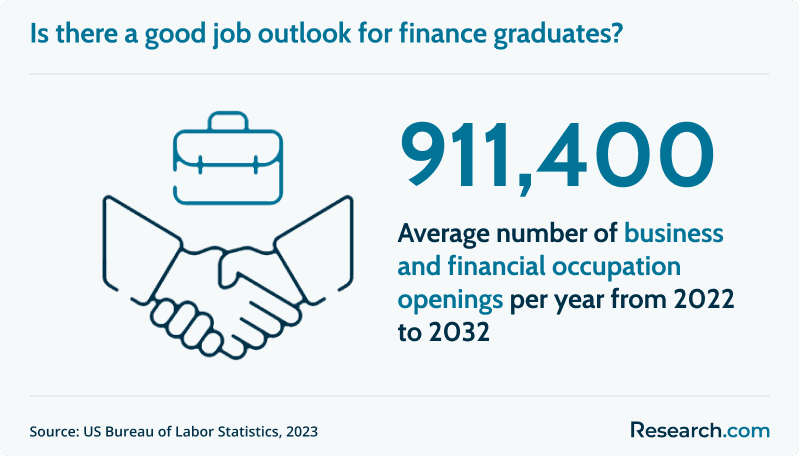
The image below shows that the BLS projects more than 911,000 openings for business and financial occupations each year in the country from 2022 to 2032.
What is the return on investment for an online finance degree?
The return on investment for an online finance degree depends on what you pay, how long you take to graduate, how much income you give up while studying, and what career outcome you achieve. A lower-cost accredited program can improve ROI, especially if you transfer credits, keep working while enrolled, qualify for aid, or finish on time.
ROI is strongest when the program aligns with a realistic career path. For example, students seeking investment analysis, financial planning, banking, or corporate finance should look for courses, projects, internships, and career services tied to those fields. If your long-term goal requires more specialized graduate training, compare the cost and potential value of options such as the cheapest masters in finance programs before committing to additional debt.
| ROI Factor | Why It Matters | What to Check |
| Tuition and fees | Lower cost can reduce debt and shorten the time needed to recover your investment | Total program cost, not just per-credit tuition |
| Transfer credits | Accepted credits can reduce both cost and time to completion | How credits apply to major, general education, and elective requirements |
| Accreditation | Accreditation supports financial aid eligibility, transferability, and employer recognition | Institutional accreditation and business-specific accreditation when available |
| Career alignment | A program should prepare you for the roles you actually want | Specializations, projects, software tools, internships, and career support |
| Work flexibility | Online study may allow you to keep earning income while enrolled | Asynchronous options, part-time pacing, and workload expectations |
How do online finance degree programs integrate ESG and sustainable finance principles?
Many online finance programs are adding material related to Environmental, Social, and Governance (ESG) analysis, responsible investing, corporate social responsibility, ethical finance, and sustainability risk. These topics matter because investors, regulators, companies, and consumers increasingly examine how financial decisions connect to environmental impact, governance practices, and social outcomes.
Students may encounter ESG topics through case studies, investment analysis assignments, corporate finance discussions, risk management courses, ethics modules, or electives in sustainable finance. Professionals who want to combine finance, leadership, and sustainability strategy may also compare graduate options such as a low cost executive MBA.
Is an Online Finance Degree a Viable Alternative to an MBA in One Year Online?
An online finance bachelor’s degree and a one-year online MBA serve different purposes. A bachelor’s in finance is an undergraduate credential that builds foundational and specialized finance knowledge. A one-year MBA is a graduate business degree designed for students who already meet graduate admission requirements and want broader management preparation.
If you need your first bachelor’s degree or want technical finance coursework, an online finance degree is the more appropriate option. If you already have an undergraduate degree and want fast graduate-level training in leadership, strategy, operations, marketing, and management, an MBA in one year online may be a better match.
What types of specializations are available in online finance degree programs?
Specializations help students tailor a finance degree toward a career interest. Availability varies by school, so always confirm whether the concentration is fully online and whether courses are offered frequently enough to support your graduation timeline.
- Financial Planning: Focuses on budgeting, investment planning, wealth management, retirement strategies, and personal financial decision-making.
- International Finance: Covers currency markets, international investing, cross-border risk, and global financial management.
- Real Estate Finance: Emphasizes real estate investment, valuation, lending, and the financial structure of real estate transactions.
- Entrepreneurial Finance: Examines funding strategies, capital raising, cash flow, and financial management for startups and growing ventures.
- Banking: Studies banking operations, regulation, services, commercial banking, and investment banking topics.
Students seeking advancement may later pursue a master’s degree in finance for deeper specialization. Those interested in academic research or postsecondary teaching may consider a PhD in finance, which emphasizes qualitative and quantitative research methods. A DBA in finance is more practice-oriented and focuses on applying advanced theory to real organizational finance problems.
The finance industry is competitive, so students should build a portfolio of skills beyond the degree itself. Relevant internships, financial modeling experience, data tools, certifications, communication skills, and professional networking can all help a graduate stand out.
The chart below shows some of the top-paying industries for financial managers.
What technological tools and platforms enhance learning in an online finance degree program?
Modern finance work is technology-heavy, so online finance programs should expose students to tools used for modeling, analysis, collaboration, research, and market simulation. The specific platforms vary by school, but students should look for practical software experience, not only textbook-based assignments.
- Financial modeling software: Excel, MATLAB, and R may be used to build forecasts, valuation models, projections, and scenario analyses.
- Virtual trading simulators: Tools such as StockTrak or TD Ameritrade’s thinkorswim platform allow students to test portfolio strategies using virtual capital in market-like conditions.
- Data analytics tools: Tableau, Power BI, and Python can help students analyze financial data, build dashboards, and communicate insights.
- Learning management systems: Canvas, Blackboard, or Moodle often serve as the central hub for lectures, assignments, grades, discussions, and course materials.
- Financial databases: Access to Bloomberg, Reuters, or Morningstar can help students practice market research and use data sources common in finance workplaces.
- Communication and collaboration platforms: Zoom, Microsoft Teams, and Slack support group projects, virtual office hours, presentations, and peer collaboration.
How Do Online Finance Degree Programs Foster Interactive Learning and Student Engagement?
Good online finance programs do more than post readings and exams. They use discussion boards, live sessions, case studies, simulations, team projects, financial modeling assignments, and virtual presentations to help students practice analysis and communication.
Interactive design matters because finance is applied work. Students need to interpret data, defend recommendations, collaborate with others, and explain financial conclusions clearly. Similar hands-on learning models appear in other applied online fields, including an accelerated construction management degree, where simulations and project-based assignments can help students connect theory to practice.
How do online finance degree programs prepare graduates for industry certifications?
Finance certifications can improve credibility in certain roles, but requirements differ by credential. Online finance programs may help by aligning coursework with certification topics, offering exam resources, and building the analytical skills needed for later professional study.
Certification-aligned coursework
Many programs include topics that overlap with exams such as Chartered Financial Analyst (CFA) or Certified Financial Planner (CFP), including investments, portfolio management, financial planning, ethics, risk, and financial analysis.
Exam preparation support
Some programs provide review materials, practice exams, faculty guidance, or workshops connected to professional certification exams. Students should ask whether these resources are included in tuition or require extra cost.
Applied skill development
Case studies, simulations, modeling exercises, and portfolio projects can help students move beyond memorization and practice the type of applied analysis valued in finance credentials and workplaces.
Access to certified professionals
Guest speakers, alumni events, mentoring programs, and webinars can introduce students to professionals who have completed certification pathways and can explain the process realistically.
Flexible preparation time
Asynchronous online study can make it easier for students to balance coursework, work, and independent exam preparation. However, certification exams often require significant study beyond degree requirements.
Students asking, “Is finance a good career path?” should consider not only degree completion, but also whether certifications, internships, licenses, or work experience are expected in their target area.
How Do Online Finance Degree Programs Enhance Career Support and Networking?
Career support can make a major difference in the value of an online finance degree. Strong programs provide resume feedback, interview preparation, internship guidance, virtual career fairs, employer events, alumni mentoring, and help translating coursework into marketable skills.
Online students should ask whether they have equal access to the university’s career center, business school employer events, finance clubs, alumni networks, and job boards. Students comparing broader business pathways may also want to review online business degree programs accredited to understand related options beyond finance.
Is an Accelerated Online MBA a Beneficial Next Step for Finance Graduates?
An accelerated online MBA can be useful for finance graduates who want to move into management, leadership, consulting, entrepreneurship, or cross-functional business roles. It may be less necessary for students who still need entry-level experience or who are targeting roles where a specialized certification or master’s in finance would be more relevant.
Before enrolling, compare cost, accreditation, admissions requirements, employer expectations, and whether the accelerated pace fits your schedule. If speed is a priority, review the best accelerated online MBA programs and weigh them against specialized finance graduate options.
How Do Online Finance Degree Programs Adapt to Emerging Industry Trends?
Finance is being reshaped by fintech, artificial intelligence, blockchain, cybersecurity, digital currencies, algorithmic trading, data analytics, regulatory change, and sustainability concerns. Online finance programs respond by updating electives, adding workshops, involving industry speakers, and incorporating current software tools into coursework.
Students should look for evidence that a program refreshes its curriculum rather than relying only on traditional theory. Courses in financial analytics, fintech, AI-supported decision-making, cybersecurity risk, digital financial services, and ESG can help students prepare for a changing market. Professionals aiming for broader leadership roles may also compare MBA fast track programs as part of a long-term career plan.
Common Mistakes to Avoid When Choosing an Online Finance Degree
| Mistake | Why It Can Hurt You | Better Approach |
| Choosing only by lowest tuition | The cheapest program may not offer the right accreditation, support, courses, or transfer policies | Compare total cost, accreditation, graduation requirements, and career fit together |
| Ignoring accreditation | Non-accredited programs may limit financial aid, transfer credit, employer recognition, and graduate school options | Verify institutional accreditation and business-specific accreditation when available |
| Assuming online means easier | Finance courses can be quantitative and demanding, especially in accounting, modeling, and investments | Assess your math readiness, weekly study time, and access to tutoring |
| Overlooking transfer credit rules | Credits may transfer as electives but not reduce major requirements | Request a formal transfer evaluation before enrolling |
| Not checking certification alignment | Your degree may not fully prepare you for the credential needed in your target role | Ask how coursework aligns with CFA, CFP, or other relevant credentials |
| Relying only on rankings | Rankings cannot capture every student’s goals, budget, location, or career needs | Use rankings as a starting point, then compare program details directly |
| Assuming salary outcomes are guaranteed | Pay varies by role, region, experience, performance, and industry | Use salary data to plan, but build skills, experience, and networks to improve outcomes |
Questions to Ask Before You Apply
- Is the institution accredited, and is the business school accredited by AACSB, ACBSP, or IACBE?
- What is the total estimated cost after tuition, fees, materials, and technology expenses?
- How many credits are required, and how many of my prior credits will count toward graduation?
- Are courses asynchronous, synchronous, or a mix of both?
- How often are required finance courses offered online?
- Does the program include financial modeling, data analytics, investment analysis, or a capstone?
- Are internships, career coaching, employer events, or alumni mentors available to online students?
- Does the curriculum support the certifications or licenses relevant to my career goal?
- What is the average time to completion for online students?
- What academic support is available if I struggle with math, accounting, statistics, or software tools?
Key Insights
- An affordable online finance degree can be a strong option when it combines low total cost, recognized accreditation, relevant coursework, and meaningful career support.
- Most full-time students complete a bachelor’s in finance in four years, but transfer credit, accelerated formats, and part-time enrollment can significantly change the timeline.
- Tuition ranges vary widely: public institutions average $38,000 to $61,000, while private institutions range from $45,000 to $248,000.
- Finance graduates can work in banking, corporate finance, investments, financial planning, insurance, consulting, government, fintech, and data-focused roles.
- The BLS projects 7% employment growth for business and financial operations occupations from 2022 to 2032 and more than 911,000 openings each year during that period.
- Accreditation is non-negotiable. It affects financial aid eligibility, employer recognition, transfer credit, graduate study, and sometimes certification pathways.
- Do not choose a program based only on ranking or tuition. Compare career alignment, transfer policies, software training, course availability, student support, and certification preparation.
- Online study works best for disciplined students who can manage deadlines, quantitative coursework, technology platforms, and independent learning.
References:
- U.S. Bureau of Labor Statistics. (2023b, September 6). Occupational Outlook Handbook: Business and financial occupations. BLS.
- U.S. Bureau of Labor Statistics. (2023a, September 6). Occupational Outlook Handbook: Personal financial advisors. Occupational Outlook Handbook. BLS.
- Chernev, B. (2021). 29 Astonishing E-learning Statistics for 2021. Techjury.
- Corporate Finance Institute. (2020). Finance Definition. Corporate Finance Institute.
- Ewing, J. (2020). United States is the richest country in the world, and it has the biggest wealth gap. NY Times.
- Government Finance Officers Association (2023). Employment Landscape of the State and Local Public Finance Workforce. gfoaorg.
- McGrath, M. (2020). A Global Financial Literacy Test Finds That Just 57% Of Adults In U.S. Are Financially Literate. Forbes.
- Sarkar, S. (2020). A Brief History of Online Education. Adamas University.
Other Things You Should Know About Affordable Finance Degree Online Programs
The cost of online finance degree programs in 2027 is influenced by factors such as tuition rates, availability of financial aid, geographic location, and institutional reputation. Discounts for in-state students and military personnel, as well as additional fees for digital resources, also play a significant role.
In 2027, the most affordable online finance degree programs typically offer self-paced learning and credit transfers from previous coursework to enhance accessibility and cost savings. Additionally, many programs have partnerships with industry professionals, offering webinars and networking opportunities to aid students in career placement.
Finance degree programs offer a wealth of practical experiences and internship opportunities to prepare students for the professional world. Internships are typically available at banks, investment firms, corporate finance departments, and governmental financial agencies, providing hands-on experience in real-world financial operations. Students may engage in tasks such as financial analysis, risk assessment, investment research, and portfolio management. Many programs also offer experiential learning opportunities through finance labs, where students can practice trading simulations and financial modeling. Additionally, participation in finance clubs and competitions, such as stock trading contests or case studies, further enhances practical skills and industry knowledge.