2027 Best ASHA Accredited Online & On-Campus SLP Programs

Co-Founder and Chief Data Scientist

Reviewed by Rhea Paul, PhD
SLP Education & Research Expert
An online speech-language pathology master's degree may fit your schedule, but its coursework alone cannot prepare you for licensure: you also need supervised clinical training and a program that fits your state's rules. This guide compares CAA-accredited online, hybrid, and campus-based options for prospective speech-language pathologists. You'll learn which schools belong on a shortlist, what "ASHA-accredited" means, and how to verify accreditation, placements, eligibility, and total cost before you apply.
Key Things You Should Know
- "ASHA-accredited" usually means accredited by ASHA's Council on Academic Accreditation (CAA). Verify the specific master's program and its current status in the CAA directory, not just the university's accreditation.
- Online classes do not eliminate in-person training. ASHA's certification standards call for at least 400 supervised clinical hours, including 25 guided-observation hours and 375 direct-contact hours.
- Emerson, Baylor, and New York University offer online SLP master's options; the right choice still depends on state eligibility, clinical-placement arrangements, required travel, and a comparable total-cost estimate.
- Which online and on-campus SLP programs hold current ASHA accreditation? Accredited SLP Programs
- What does ASHA accreditation mean for speech-language pathology students and graduates? ASHA Accreditation Meaning
- How can applicants verify an SLP program's ASHA accreditation and status? Verify Accreditation
- Which accredited SLP programs offer fully online, hybrid, or campus-based study? Program Delivery Formats
- What should applicants check before enrolling in an ASHA-accredited SLP program? Enrollment Checklist
Which online and on-campus SLP programs hold current ASHA accreditation?
The accreditor to look for is the Council on Academic Accreditation in Audiology and Speech-Language Pathology (CAA), which operates under ASHA. The schools below provide a practical comparison shortlist of established CAA-accredited SLP master's options, not a numerical ranking. Formats and accreditation statuses can change, so confirm each specific program and delivery option in the CAA program directory before treating it as a current enrollment choice.
This table compares advertised study formats and the main logistical question each option raises. It does not imply that an online school can place every student locally or that a campus program meets every state's licensure rules.
| University and SLP master's option | Study format to investigate | Key comparison question |
| Emerson College | Online coursework with in-person clinical training | What live-class, placement, and travel commitments apply? |
| Baylor University | Online coursework with in-person clinical training | How are local placements arranged and approved? |
| New York University | Online coursework with in-person clinical training | What are the placement and state-eligibility rules for your address? |
| University of Northern Colorado | Distance study with required in-person components | How many campus visits are required, and when? |
| University of Florida | Campus-based study | How do its clinical assignments fit your goals and budget? |
| University of Washington | Campus-based study | What are the full-time attendance and residency costs? |
| Vanderbilt University | Campus-based study | How does the net cost compare after any aid? |
These are useful starting points because they offer different delivery arrangements while keeping programmatic accreditation central to the search. None is universally "best": a lower-travel online option may beat a campus option for a working applicant, while an applicant seeking a particular clinical environment may prefer campus study. If price is your first filter, compare the accreditation of affordable online slp master's programs alongside each school's current tuition and fee schedule.
What does ASHA accreditation mean for speech-language pathology students and graduates?
In this context, "ASHA accreditation" is shorthand for CAA programmatic accreditation. The CAA evaluates eligible graduate programs in speech-language pathology against standards covering areas such as curriculum, faculty, clinical education, and student outcomes. It accredits the graduate program, not every degree offered by the university, and accreditation does not guarantee admission, licensure, employment, or ASHA certification.
CAA status matters because completing an appropriately accredited graduate program is part of the usual path toward ASHA's Certificate of Clinical Competence in Speech-Language Pathology (CCC-SLP). Graduates must still satisfy applicable clinical, examination, and supervised professional-experience requirements. State licenses are issued separately by state authorities; school-based positions can also have state education-agency requirements.
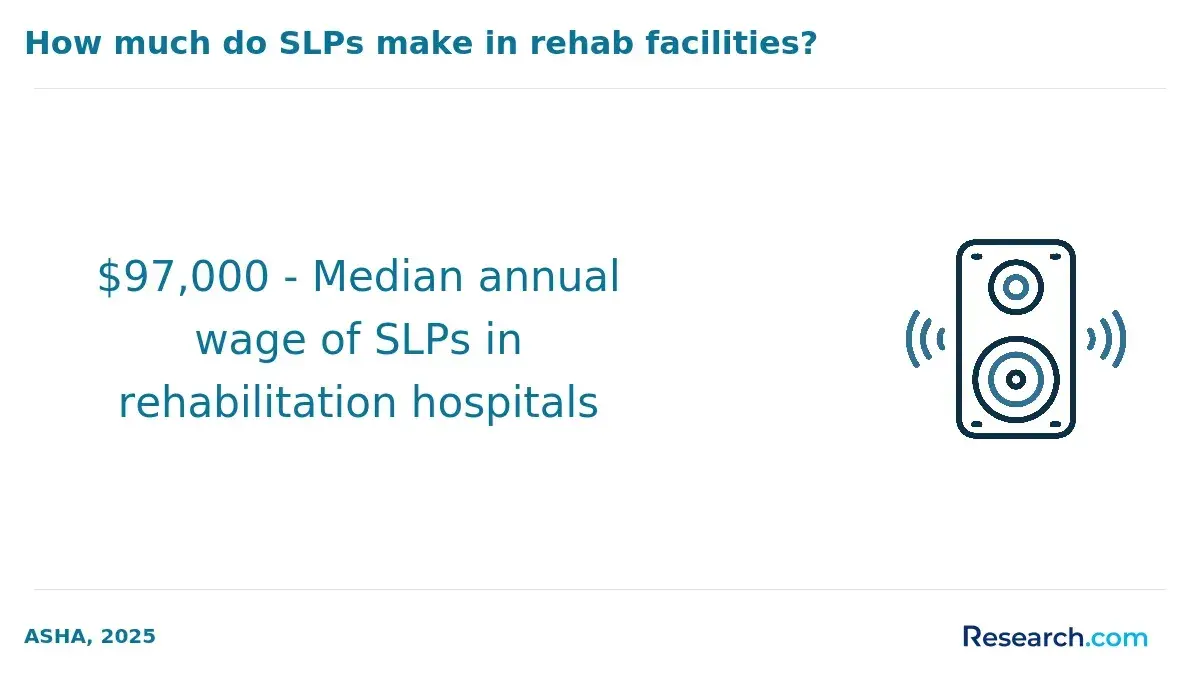
The U.S. Bureau of Labor Statistics reports a $97,870 median annual wage for speech-language pathologists in May 2025. That is an occupation-wide figure, not an expected starting salary or a return promised by any program. Use it as context when weighing borrowing against the speech pathology career options and salaries relevant to your preferred setting and location.
How can applicants verify an SLP program's ASHA accreditation and status?
Check accreditation at the program level immediately before applying and again before paying an enrollment deposit. A university's statement that it is accredited is not enough to establish that its SLP master's program holds the CAA status you need.
Use this sequence to resolve both the formal status and any practical ambiguity about the option you plan to attend:
- Search the CAA's accredited-program directory or ASHA EdFind for the university and speech-language pathology master's program; note the exact status and any effective dates or public notices.
- Match the listing to the school's official graduate catalog and ask the program to confirm that your intended online, hybrid, or campus pathway is covered.
- If the listing says "candidate" rather than "accredited," ask the CAA and program how candidacy applies to your anticipated graduation date and certification plans; do not silently treat the statuses as identical.
- Save the relevant listing and request written clarification from the program if its website, directory entry, or admissions advice appears inconsistent.
EdFind can also help you locate program-reported student-outcome information. Compare the reporting period and definitions before using those figures to judge schools; a published outcome is not a prediction of your own result.
Which accredited SLP programs offer fully online, hybrid, or campus-based study?
"Fully online" usually describes academic coursework, not the entire route to becoming an SLP. Supervised contact with clients or patients takes place in approved clinical settings. Some distance programs also require scheduled live classes or campus visits, so a format label cannot substitute for a term-by-term schedule.
These examples show the format distinctions worth investigating; confirm the current pathway directly with each school.
| Format | Examples from the shortlist | Potential advantage | Important constraint |
| Online coursework | Emerson College; Baylor University; New York University | Coursework without a routine campus commute | In-person placements and possible live-session or travel requirements |
| Distance/hybrid | University of Northern Colorado | Remote study combined with scheduled in-person components | Campus-trip timing and associated costs |
| Campus-based | University of Florida; University of Washington; Vanderbilt University | Regular access to an in-person academic setting | Relocation or commuting and a less flexible attendance schedule |
An online pathway may suit someone who cannot relocate but can attend approved local placements during required hours. A campus pathway may suit someone who wants to study and train near the university. If finishing sooner is important, examine the actual course sequence and placement calendar rather than assuming online delivery is accelerated; the benefits of accelerated online speech pathology programs matter only if the schedule and clinical obligations are workable for you.
Which ASHA-accredited SLP programs meet state licensure and clinical practicum requirements?
No single school can be declared licensure-compatible for every applicant without knowing the state in which that person intends to practice. CAA accreditation is an important starting point, but state licensing boards set their own application rules. Online students must also establish that the university accepts residents of their state and can support the required clinical education there.
ASHA's CCC-SLP standards specify a minimum of 400 supervised clinical hours: 25 hours of guided observation and 375 hours of direct client or patient contact. A CAA-accredited program should have a route for students to complete required supervised training, but that does not mean every proposed site, supervisor, or placement location will be approved. Ask whether the school identifies sites, expects students to propose them, or uses a shared process - and what happens if a placement falls through.
Check the relevant state licensing board's current education, supervised-experience, examination, and application rules for where you plan to work. If you want a public-school position, check the state education agency as well. Get the university's state-specific professional-licensure disclosure in writing; wording such as "has not determined" is not confirmation that the program meets that state's requirements.
The BLS projects 17% employment growth from 2025 to 2035 for speech-language pathologists. That outlook helps explain interest in the field, but it does not reduce the need to meet the rules for your intended state and work setting.
How do online and on-campus ASHA-accredited SLP programs compare?
Once CAA status and state eligibility are established, compare formats by their effect on your weekly life and clinical training - not by the assumption that one delivery method is inherently better. The same applicant might favor online classes for access yet favor a campus program for its location and schedule.
This comparison identifies the trade-offs that commonly change an enrollment decision.
| Decision factor | Online or hybrid pathway | Campus pathway |
| Course attendance | Remote access; live sessions may still be scheduled | Regular in-person attendance |
| Clinical training | Approved in-person sites; local availability and school support matter | Approved in-person sites; assignments may still involve travel |
| Location | May avoid relocation, subject to state eligibility and required visits | May require relocation or a reliable commute |
| Costs to compare | Tuition, fees, placement travel, technology, and possible visits | Tuition, fees, commuting or housing, and placement travel |
| Best initial fit | Applicants who need remote coursework and can meet clinical schedules | Applicants who can attend regularly and prefer an in-person setting |
Neither format automatically takes less time. Clinical-site availability and required course sequencing can affect a student's finish date even when classes are offered remotely. Compare the published plan of study against your work commitments; guidance on course sequencing in the shortest online slp programs can help frame that question.
What degree levels and entry pathways do ASHA-accredited SLP programs offer?
For entry into professional speech-language pathology practice, the central programmatic-accreditation decision is usually the CAA-accredited master's degree in speech-language pathology. Universities may name the degree differently, so check the program and its accreditation listing rather than relying on whether the diploma says MS or MA. An undergraduate communication sciences and disorders degree is useful preparation but is not a substitute for the graduate qualification.
Applicants without an SLP-related bachelor's degree may need prerequisite or "leveling" courses before starting graduate coursework; policies vary by school. Ask whether those courses are part of the degree, whether they add terms and tuition, and whether completing them creates any admission preference - it may not. Graduate admissions advising in slp bridge programs is especially relevant when comparing the full time and cost of changing fields.
A research doctorate serves a different purpose from an entry-level clinical master's. Do not choose a doctorate, bachelor's program, or short certificate on the assumption that its university affiliation alone provides a CAA-accredited route to SLP licensure.
Which program costs, admissions standards, and completion requirements should applicants compare?
Compare estimated cost to graduation, not an advertised per-credit price against another school's annual tuition. Published charges differ by residency, enrollment pace, leveling needs, and academic year; a responsible comparison needs a current, applicant-specific estimate from each university. No comparable total-cost figure can be assumed for the shortlisted programs without those details.
These are the cost and completion inputs to request from every school before comparing offers:
- Required graduate credits, tuition rate applicable to you, mandatory fees, and any separate prerequisite or leveling charges.
- Clinical-placement, travel, campus-visit, technology, and living costs that tuition does not cover.
- Available grants, assistantships, and other aid, distinguishing offered funding from aid you merely might receive.
- The published course sequence, expected completion time at your intended pace, and policies for placement delays or leaves.
Admissions requirements can also change the real cost of applying. Verify prerequisites, GPA policies, references, interviews, tests if required, application deadlines, and whether the school uses CSDCAS or its own application. A program with an accessible admissions route is not automatically inexpensive or easy to complete; use finding a realistic slp graduate school match to focus applications on schools whose prerequisites and format fit your background.
For return-on-investment planning, compare your likely borrowing with employment conditions in the setting and region you want. The national median wage describes an occupation, not your first offer or the amount available to repay loans after taxes and living expenses.
How does ASHA accreditation differ from institutional accreditation and state authorization?
These terms answer different questions. Treating one as proof of the others is a common enrollment mistake, especially for distance students crossing state lines.
The comparison below shows which authority to consult for each decision.
| Term | What it addresses | What it does not establish by itself |
| CAA programmatic accreditation | The status of an eligible graduate SLP program under professional accreditation standards | That you may enroll from any state or qualify automatically for a state license |
| Institutional accreditation | Accreditation of the university as an institution | That its particular SLP master's program is CAA-accredited |
| State authorization | Whether a university may offer its educational program to students in a state | That the program meets that state's professional-licensure rules |
| Professional-licensure disclosure | The university's determination about meeting a state's educational requirements | That a licensing board will approve every individual applicant |
For an online application, verify all four issues separately. State authorization concerns access to the program; professional licensure concerns permission to practice after satisfying the board's requirements. Neither should be inferred from the word "online."
What should applicants check before enrolling in an ASHA-accredited SLP program?
Before committing, narrow your shortlist to programs that pass three tests: verifiable CAA status, a workable clinical-training plan, and a credible path toward the requirements of your intended state. Then compare cost and schedule using the same assumptions for each school.
Use this final check before accepting an offer or paying a deposit:
- Confirm the exact master's program and current CAA status in the accreditor's directory.
- Obtain the school's written enrollment eligibility and professional-licensure disclosure for your state; independently review the relevant board's rules.
- Ask who secures placements, where training may occur, what supervisor approval requires, and what happens if a site becomes unavailable.
- Request the term-by-term schedule, including live classes, in-person visits, clinical hours, and any restrictions on working while enrolled.
- Build a comparable cost-to-graduation estimate that includes prerequisites, mandatory fees, travel, and likely borrowing.
Red flags include a school citing only university-level accreditation, calling remote coursework a completely remote clinical degree, or promising licensure in every state without a state-specific review. If a material answer remains unclear, seek written clarification before enrolling rather than relying on a ranking or an informal assurance.
References
- U.S. Bureau of Labor Statistics - Speech-Language Pathologists https://www.bls.gov/ooh/healthcare/speech-language-pathologists.htm
- ASHA EdFind - Accredited Speech-Language Pathology Programs https://find.asha.org/ed/
- ETS Praxis - Speech-Language Pathology (5331) https://praxis.ets.org/test/speech-language-pathology-5331.html
- Pennsylvania Western University - Master of Science in Speech-Language Pathology https://online.pennwest.edu/programs/speech-language-pathology-grad/index.php
- University of North Carolina at Greensboro - Speech-Language Pathology, M.A. (Online) https://csd.uncg.edu/graduate/masters-of-arts-online/
- University of Nebraska at Kearney - Speech-Language Pathology, Master of Science in Education (Online Track) https://www.unk.edu/online/degrees-programs/speech-language-pathology-online.php
- University of Wisconsin-Eau Claire - Master of Science in Speech-Language Pathology (Online) https://www.uwec.edu/speech-language-and-hearing-sciences-department/graduate-program/speech-language-pathology-online
- University of Scranton - Master of Science (M.S.) in Speech-Language Pathology https://www.scranton.edu/academics/pcps/health-and-human-performance/programs/speech-language-pathology/index.shtml
Other Things You Should Know About Speech Pathology
Do not assume so. Clinical training involves in-person supervised work, and some programs require campus visits. Ask for the complete travel and placement schedule for your pathway before applying.
No. Accreditation concerns the program. Licensure is granted by a state board after you meet its applicable education, clinical, examination, and other requirements.
Often, but you may need prerequisite or leveling courses. Check each program's accepted courses and whether you must finish them before admission or before graduate classes begin.
Yes. ASHA-accredited speech-language pathology programs require supervised clinical practicum, usually at least 400 total clock hours before graduation. That includes 25 hours of guided observation and 375 hours of direct client contact, with supervision by qualified faculty or approved clinical supervisors.