Research.com is an editorially independent organization with a carefully engineered commission system that’s both transparent and fair. Our primary source of income stems from collaborating with affiliates who compensate us for advertising their services on our site, and we earn a referral fee when prospective clients decided to use those services. We ensure that no affiliates can influence our content or school rankings with their compensations. We also work together with Google AdSense which provides us with a base of revenue that runs independently from our affiliate partnerships. It’s important to us that you understand which content is sponsored and which isn’t, so we’ve implemented clear advertising disclosures throughout our site. Our intention is to make sure you never feel misled, and always know exactly what you’re viewing on our platform. We also maintain a steadfast editorial independence despite operating as a for-profit website. Our core objective is to provide accurate, unbiased, and comprehensive guides and resources to assist our readers in making informed decisions.

2026 Highest Paying States for Speech-Language Pathologists: Jobs & Salaries

Imed Bouchrika, PhD

by Imed Bouchrika, PhD

Co-Founder and Chief Data Scientist

Table of Contents
  1. Highest-paying states for speech-language pathologists
  2. Highest-paying metro areas for speech-language pathologists
  3. Average speech-language pathologist salary
  4. Highest-paying industries for SLPs
  5. How SLPs can raise their earning potential
  6. States with the most speech-language pathologist jobs
  7. Industries that employ the most SLPs
  8. Career paths for future speech-language pathologists
  9. Whether advanced degrees are necessary for advancement
  10. Common challenges in speech-language pathology
  11. Educational programs that support SLP career growth
  12. Job outlook for speech-language pathologists
  13. Important certifications for speech-language pathologists
  14. Common workplaces for SLPs
  15. Salary trends shaping the SLP profession
  16. How experience and specialization affect SLP pay

What are the highest-paying states for speech-language pathologists?

According to the United States Bureau of Labor Statistics (BLS), the five states or jurisdictions with the highest average annual salaries for speech-language pathologists are California ($112,030), the District of Columbia ($111,110), Colorado ($107,780), Hawaii ($106,790), and New Jersey ($102,820). These markets may be attractive to SLPs who want stronger compensation, but the headline salary should be weighed against cost of living, housing, taxes, commute time, caseload expectations, and state licensure rules.

RankState or jurisdictionAverage annual salaryWhat to consider before relocating
1California$112,030High salaries are common in several metro areas, but living costs can be substantial.
2District of Columbia$111,110Urban demand can be strong, but competition and housing costs should be reviewed.
3Colorado$107,780Pay is competitive in some markets, especially where healthcare and school demand overlap.
4Hawaii$106,790Salary should be compared carefully with island living costs and relocation expenses.
5New Jersey$102,820Proximity to major healthcare and education markets can create opportunities.

At the other end of the salary range, the lowest average annual salaries are reported in South Dakota ($69,350), North Dakota ($72,900), Idaho ($73,890), Louisiana ($74,390), and West Virginia ($75,260). When US territories are included, Puerto Rico reports the lowest average salary at $49,470. Lower average pay does not automatically mean poor career prospects; in some markets, lower living costs, easier entry into roles, smaller caseloads, or loan repayment opportunities may make the overall package more reasonable.

What are the highest-paying metropolitan areas for speech-language pathologists?

BLS data shows that many of the highest-paying metro areas for speech-language pathologists are in California. The leading metropolitan areas by average annual salary are San Jose-Sunnyvale-Santa Clara, CA ($127,190); San Francisco-Oakland-Hayward, CA ($123,830); Napa, CA ($119,750); Santa Maria-Santa Barbara, CA ($114,960); Santa Rosa, CA ($113,920); Modesto, CA ($113,300); Boulder, CO ($113,130); Los Angeles-Long Beach-Anaheim, CA ($111,140); Danbury, CT ($111,140); and Denver-Aurora-Lakewood, CO ($110,980).

Metro areaAverage annual salaryDecision point for SLPs
San Jose-Sunnyvale-Santa Clara, CA$127,190Best evaluated alongside housing costs and commute realities.
San Francisco-Oakland-Hayward, CA$123,830Strong pay, but total compensation should include benefits and schedule.
Napa, CA$119,750May appeal to clinicians seeking high pay outside the largest urban centers.
Santa Maria-Santa Barbara, CA$114,960Compare school, medical, and private practice options before deciding.
Santa Rosa, CA$113,920Useful market to evaluate for both salary and work-life fit.

The highest-paying non-metropolitan areas are Southside Virginia ($108,350), Southwest Colorado ($107,720), Northern New Mexico ($107,390), Eastern New Mexico ($105,100), and Connecticut ($104,850). These areas can be worth considering for SLPs who want high pay without necessarily working in a large metro area.

Before moving, check state licensure requirements, supervision rules, school credential requirements, and whether your current credentials transfer smoothly. ASHA certification can support professional mobility, but it does not replace state-specific licensure. Students planning ahead should also confirm that their program meets educational and clinical requirements, including when considering accredited online programs for speech language pathology.

What is the average salary of speech-language pathologists?

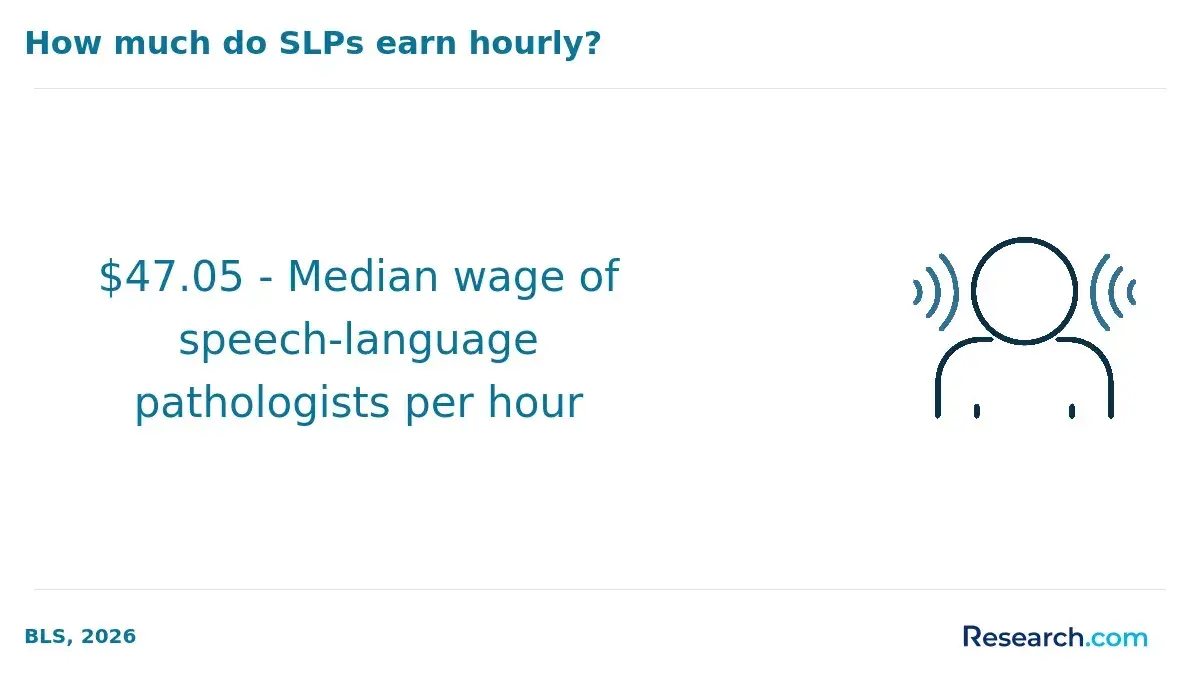
The BLS reports that the average annual speech language pathologist salary is $95,840, while the median annual salary is $95,410. That median is nearly double the median annual salary for all occupations in the United States, which is $49,500.

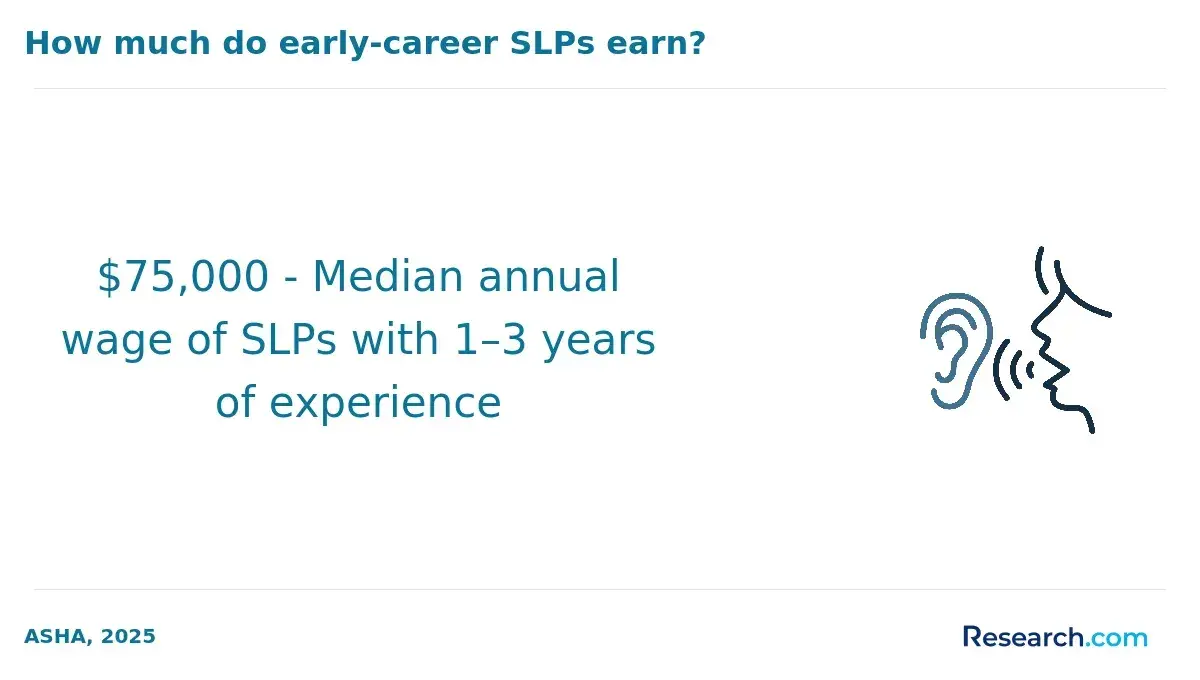
Speech-language pathologist salaries range from $60,480 to $132,850, with entry-level roles often paying about $60,000 to $75,000. Compared with related occupations, SLPs have a higher median salary than psychologists ($94,310), audiologists ($92,120), and respiratory therapists ($80,450).

Salary measure or comparisonAmountHow to interpret it
Average annual SLP salary$95,840Useful for understanding overall market pay, but it can be pulled upward by high-paying regions and settings.
Median annual SLP salary$95,410A better midpoint measure because half of workers earn above it and half earn below it.
Typical SLP salary range$60,480 to $132,850Reflects wide variation by location, employer, experience, and specialty.
Entry-level range$60,000 to $75,000A realistic starting point for many new clinicians, though offers vary by market.
Median salary for all occupations$49,500Shows that SLP pay is comparatively strong at the national level.

What are the highest-paying industries for speech-language pathologists?

The highest average annual salaries for speech-language pathologists are reported in civic and social organizations ($130,620), home health care services ($121,410), company management ($112,110), child care services ($109,110), and nursing care facilities ($108,640).

Industry choice can matter as much as location. Medical, home health, and nursing-related roles may pay more because they often involve complex cases, productivity expectations, documentation demands, and specialized clinical skills such as dysphagia assessment and intervention. School-based roles may pay less in many markets but can offer predictable schedules, public-sector benefits, and strong alignment for clinicians who prefer pediatric language and educational support.

IndustryAverage or median salary figureBest fit for SLPs who want
Civic and social organizations$130,620 average annual salarySpecialized community-based or organizational roles.
Home health care services$121,410 average annual salaryAutonomy, travel between clients, and functional therapy in home settings.
Company management$112,110 average annual salaryAdministrative, leadership, consulting, or corporate-related opportunities.
Child care services$109,110 average annual salaryEarly childhood communication and developmental support.
Nursing care facilities$108,640 average annual salary; $106,500 median annual salary for nursing and residential care facilitiesMedical SLP work with older adults, dysphagia, cognition, and rehabilitation.
Hospitals$101,560 median annual salaryAcute care, inpatient rehabilitation, and interdisciplinary medical practice.
Offices of Physical, Occupational and Speech Therapists, and Audiologists$98,470 median annual salaryOutpatient therapy, multidisciplinary collaboration, and private clinic work.
Educational Services$80,280 median annual salarySchool calendars, pediatric caseloads, IEP work, and collaboration with educators.

If you are comparing terminology while researching roles, you may also want to review whether a speech therapist is the same as a speech pathologist.

SLP Salary.png

How can speech-language pathologists increase their earning potential?

SLPs usually improve earnings by making deliberate choices about specialty, setting, geography, credentials, and employment model. The best strategy depends on whether you want clinical depth, higher hourly pay, leadership, private practice income, or a more flexible schedule.

StrategyWhy it may increase payBest for
Earn advanced or specialty credentialsCredentials such as Board Certified Specialist in Swallowing (BCS-S), VitalStim® Therapy Provider, or PROMPT Certification can signal focused expertise.Clinicians who want to work in high-need specialty areas.
Pursue a clinical doctorate such as an SLPD or CScDDoctoral preparation can support leadership, supervision, research, higher education, and advanced clinical roles.Experienced SLPs seeking long-term advancement beyond direct service.
Move into medical settingsHospitals, skilled nursing facilities, and outpatient clinics often value dysphagia, neurogenic communication, and medically complex care skills.SLPs comfortable with clinical complexity and healthcare documentation.
Consider travel or contract SLP workShort-term assignments may include higher hourly rates, tax-free stipends, or bonuses in shortage areas.Clinicians who can relocate temporarily and tolerate less schedule stability.
Develop bilingual skillsFluency in Spanish, Mandarin, or another high-demand language can expand the client base and strengthen bargaining power.SLPs serving multilingual communities.
Move into leadershipRoles such as clinic director, rehabilitation manager, or clinical services supervisor often carry broader responsibility and higher pay potential.SLPs interested in operations, mentoring, and program management.
Start private practice or consultingIndependent services such as corporate speech coaching, AAC consulting, accent modification, or specialty therapy can create additional income streams.Clinicians with business skills and a clear niche.
Use telepractice strategicallyRemote service delivery can expand access to clients and create schedule flexibility, especially in underserved areas.SLPs licensed appropriately for remote clients and comfortable with technology.
Relocate to higher-paying marketsSome states and metro areas pay more, although cost of living can offset part of the gain.SLPs with geographic flexibility.
Invest in continuing educationTraining in newer tools, therapies, and evidence-based interventions can support raises, promotions, and specialty roles.Clinicians who want to remain competitive over time.

These strategies are one reason many clinicians view the profession favorably. If you are still weighing the trade-offs, Research.com also examines whether SLP is a good career.

Which states employ the most speech-language pathologists?

The states with the highest employment levels for speech-language pathologists are Texas (18,790), California (17,270), New York (16,610), Illinois (8,260), and Florida (7,850). These states may offer more openings simply because they have large populations, extensive school systems, major healthcare networks, and broad demand for therapy services.

However, total employment is not the same as job availability for a specific applicant. A state may employ many SLPs but also have more competition, stricter credentialing requirements, or higher living costs. Job concentration gives another useful lens. The states with the highest SLP employment rate per thousand jobs are New York (1.77), Arkansas (1.75), Vermont (1.59), Louisiana (1.51), and North Dakota (1.47).

StateEmployment level or job concentrationWhat it tells job seekers
Texas18,790 employed SLPsLarge statewide market with many school and healthcare employers.
California17,270 employed SLPsLarge employment base plus several high-paying metro areas.
New York16,610 employed SLPs; 1.77 per thousand jobsStrong employment presence and the highest listed job concentration.
Illinois8,260 employed SLPsLarge market with opportunities across education and healthcare.
Florida7,850 employed SLPsDemand is supported by schools, healthcare, rehabilitation, and older adult care.
SLP Number.png

Which industries employ the most speech-language pathologists?

The largest employers of speech-language pathologists are elementary and secondary schools (67,640), offices of other health practitioners (42,750), general medical and surgical hospitals (19,290), nursing care facilities (5,770), and home health care facilities (5,660). For many new clinicians, schools and outpatient therapy offices are the most visible entry points because they employ large numbers of SLPs.

Job concentration also matters. The industries with the highest percentage of SLP employment are offices of other health practitioners (3.75%), specialty hospitals (1.95%), elementary and secondary schools (0.79%), nursing care facilities (0.42%), and home health care facilities (0.35%). Some sectors appear on both lists, which suggests they combine large employment numbers with meaningful reliance on SLP services.

IndustryEmployment levelIndustry employment concentrationTypical appeal
Elementary and secondary schools67,6400.79%Stable pediatric caseloads, school schedules, and IEP-based services.
Offices of other health practitioners42,7503.75%Outpatient and therapy-focused environments.
General medical and surgical hospitals19,290Not listed among the highest concentration sectorsMedical assessment and treatment in interdisciplinary care.
Nursing care facilities5,7700.42%Dysphagia, cognition, rehabilitation, and older adult care.
Home health care facilities5,6600.35%Functional therapy in clients’ homes and post-discharge support.

What are the possible career paths for aspiring speech-language pathologists?

Speech-language pathology is not a single-track profession. Graduates of campus-based and online SLP programs can work with children, adults, older adults, medical patients, students, families, caregivers, researchers, or organizations. The right path depends on your preferred population, tolerance for documentation, desired schedule, interest in medical complexity, and appetite for specialization.

Career pathPrimary population or settingGood fit if you want
School-based SLPPreschool, K–12, and sometimes higher education studentsPediatric language, articulation, fluency, social communication, IEP collaboration, and family-school coordination.
Healthcare SLPHospitals, nursing homes, rehabilitation centers, and long-term care facilitiesWork with communication and swallowing disorders related to illness, injury, aging, or neurological conditions.
Private practice SLPChildren, adults, or specialty client groupsAutonomy, niche development, scheduling flexibility, and business ownership potential.
Research or academiaUniversities, labs, and clinical education programsTeaching, research, supervision, and contribution to evidence-based practice.
Management and leadershipSchools, clinics, healthcare systems, or rehabilitation organizationsProgram oversight, staff supervision, quality improvement, and administrative responsibility.
Specialized clinical rolesPediatric, fluency, voice, swallowing, AAC, neurological, bilingual, or multicultural practiceDeep expertise in a focused area and potential access to specialized roles.

Many teachers explore school-based speech-language pathology because they already understand education systems and student support. If that describes you, Research.com explains whether you can become a speech pathologist with an education degree. SLPs also often collaborate with special education professionals; if that role interests you more, see what a special education teacher does.

The visual below displays the highest-paying industries for SLPs.

Are advanced degrees essential for career progression?

A master’s degree is the standard educational foundation for entry into speech-language pathology practice, but additional graduate study is not always required to earn more. For many clinicians, targeted certifications, specialty experience, strong supervision, and work in higher-paying settings can have a more direct salary impact than pursuing another degree immediately.

Advanced degrees can still be valuable when they match a clear goal. A clinical doctorate may make sense for SLPs aiming for leadership, advanced clinical practice, program development, supervision, research translation, or university-level teaching. Students and clinicians comparing options should evaluate curriculum quality, clinical placement support, cost, accreditation alignment, and whether the degree improves access to the roles they actually want. Programs such as masters in communication disorders online can also help learners build the academic foundation needed for the profession.

What challenges do speech-language pathologists commonly face?

SLP work can be rewarding, but it is not low-pressure. Common challenges include high caseloads, heavy documentation, productivity standards, changing licensure or payer rules, emotional demands, and the need to adapt services for clients with complex needs. School-based SLPs may spend significant time on IEP meetings and compliance tasks, while medical SLPs may face fast clinical decision-making and complex swallowing or cognitive-communication cases.

Teletherapy has also changed expectations. Remote care can improve access and flexibility, but it requires appropriate technology, privacy safeguards, client suitability, and licensure compliance. SLPs who want to broaden their understanding of adjacent communication and hearing professions may find it useful to explore how to become an audiologist.

Common mistakeWhy it can hurt your career or salaryBetter approach
Choosing a job based only on salaryA high salary may come with high caseloads, difficult productivity targets, long commutes, or limited support.Compare salary, benefits, supervision, caseload, documentation expectations, and cost of living together.
Ignoring licensure requirements before movingYou may face delays or find that additional state requirements apply.Review state licensure and school credential rules before accepting an offer.
Assuming every online program leads to the same outcomePrograms can differ in accreditation alignment, clinical placements, and licensure preparation.Ask programs directly how they support clinical hours, practicum placement, and licensure eligibility.
Overlooking specializationGeneral experience may not be enough for higher-paying medical or niche roles.Build a focused portfolio in areas such as dysphagia, AAC, voice, fluency, or bilingual services.
Not negotiating total compensationSalary is only part of the package.Review benefits, continuing education funds, paid time off, retirement contributions, relocation support, and supervision.

Which educational programs best prepare speech-language pathologists for career advancement?

The strongest educational path is one that prepares you for licensure, clinical competence, and the setting where you want to work. Prospective students should look beyond convenience and compare accreditation, clinical practicum quality, faculty expertise, Praxis preparation, student support, cost, and outcomes. Programs with strong clinical placement systems are especially important because supervised experience is central to becoming practice-ready.

Students considering online or hybrid study should verify whether the program supports placements in their state and whether graduates meet local requirements. Research.com’s guide to ASHA accredited online SLP programs can help prospective students compare options with accreditation in mind.

Question to ask a programWhy it matters
Is the program appropriately accredited for speech-language pathology preparation?Accreditation affects licensure eligibility, employer recognition, and professional credibility.
How are clinical placements arranged?Students need supervised clinical experiences, and placement support varies by program.
Does the program prepare students for state licensure where they plan to work?Licensure requirements can differ by state and by school or healthcare setting.
What is the expected timeline and format?Full-time, part-time, online, hybrid, and campus formats affect work-life balance and completion speed.
What is the total cost after fees, travel, clinical requirements, and materials?Tuition alone does not show the full cost of attendance.
What support is available for Praxis preparation and clinical fellowship planning?Strong advising can make the transition from student to clinician smoother.

What is the job outlook for speech-language pathologists?

The employment outlook for speech-language pathologists is strong. The BLS projects employment to grow by 18% from 2023 to 2033, which is more than four times the national average of 4%. This does not guarantee employment for every graduate in every location, but it does show that demand for SLP services is expected to remain above average.

The BLS also projects about 13,700 openings each year during that period. Job postings can fluctuate by season and platform; Indeed currently lists over 30,000 openings for speech-language pathologists.

Demand is also supported by the prevalence of communication and swallowing concerns. The National Institute on Deafness and Other Communication Disorders reports that 7.7% of children aged 3-17 had a speech, voice, language, or swallowing disorder in the past year, and 7.6% of adults 18 or older experienced a voice disorder in the past year.

What are the top certifications for speech-language pathologists?

Certifications can strengthen an SLP’s professional profile by documenting clinical competence or advanced specialty expertise. They do not automatically guarantee higher pay, but they can support promotion, specialization, medical roles, private practice positioning, and competitive job applications.

CertificationWho it is forKey requirements or focus
Certificate of Clinical Competence in Speech-Language Pathology (CCC-SLP)SLPs seeking the field’s core professional credentialThe CCC-SLP certification is offered by ASHA and requires a graduate degree in speech-language pathology, at least 400 supervised clinical hours, a passing score on a national exam, and completion of a clinical fellowship.
Board Certified Specialist in Child Language (BCS-CL)SLPs specializing in children and adolescents up to age 21Requires at least five years of full-time experience after CCC-SLP and 100 hours of advanced training related to child language disorders.
Board Certified Specialist in Fluency (BCS-F)SLPs focused on stuttering, cluttering, and other fluency disordersRequires five years of professional experience, 450 clinical hours involving fluency disorders, 100 hours of specialized fluency training, and letters of recommendation.
Board Certified Specialist in Swallowing and Swallowing Disorders (BCS-S)SLPs who work extensively with dysphagiaRequires at least three years of post-CCC-SLP clinical experience focused on swallowing, continuing education in dysphagia, and evidence of advanced clinical or leadership work.
Clinical Specialty Certification (CSC) in Other AreasSLPs seeking recognition in focused practice areasMay apply to areas such as AAC, neurogenic communication disorders, or voice therapy, typically involving additional training, defined clinical experience, and sometimes specialty examinations.

Where do speech-language pathologists work?

SLPs work across education, healthcare, community, home-based, remote, academic, and business settings. Their training allows them to support people across the lifespan, from infants and toddlers to older adults. The best work setting depends on the population you want to serve, the disorders you want to treat, and the type of schedule and documentation you can manage. Research.com also explains the communication disorders treated by speech language pathologists.

Work settingTypical responsibilitiesPotential trade-offs
Schools: K–12 public and privateSupport students with speech, language, communication, and learning-related needs; collaborate with teachers and special education teams.Predictable calendar, but high caseloads and IEP documentation can be demanding.
Early intervention programs: birth to age 3Work with infants and toddlers with developmental delays, often coaching parents and caregivers in home or community settings.Family-centered work can be rewarding, but travel and scheduling may vary.
Hospitals: acute care and inpatient rehabilitationEvaluate and treat communication and swallowing issues related to stroke, brain injury, surgery, illness, or complex medical conditions.Clinically challenging and fast-paced, with high documentation and medical coordination demands.
Skilled nursing facilities and long-term careAddress dysphagia, cognitive-communication disorders, and speech-language needs in older adults and medically fragile patients.Strong medical focus, often with productivity expectations.
Outpatient clinics and private practicesProvide individualized therapy for children and adults with speech, language, fluency, voice, or communication needs.Can allow specialization, but caseload stability and benefits vary by employer.
Home health careVisit clients at home, commonly supporting rehabilitation after hospital discharge.Autonomy is high, but travel and scheduling are major factors.
Telepractice or teletherapyDeliver services remotely through video platforms, often for clients in underserved or rural areas.Requires technology skills, privacy awareness, and appropriate licensure. Those interested in remote care can review how to start a career in online therapy.
Universities and research institutionsTeach, supervise student clinicians, conduct research, or contribute to clinical training.May require advanced preparation and interest in scholarship or education.
Corporate or business settingsProvide accent modification, voice coaching, presentation training, or consultation on AAC and speech technology.Often niche-based and may require entrepreneurial skills.
Travel SLP positionsTake short-term contracts, often 8–13 weeks, in schools, hospitals, or clinics.Can offer higher pay and stipends, but stability and benefits may vary.

The visual below shows the US states with the most SLPs.

What are the salary trends that speech-language pathologists should take note of?

SLP salaries are shaped by demand for services, healthcare needs, school staffing patterns, specialization, and regional labor markets. Clinicians who understand these trends can make more informed choices about where to work, what skills to build, and when to negotiate.

  • Demand supports salary growth: Continued need for SLP services, including services connected to aging populations, autism diagnoses, and early intervention, supports ongoing demand across many settings.
  • Medical and skilled nursing settings often pay more: Hospitals, rehabilitation centers, and skilled nursing facilities frequently compensate SLPs well because cases can involve complex medical needs, swallowing disorders, neurological conditions, and interdisciplinary care.
  • Location creates major pay differences: California, New Jersey, Connecticut, and selected metro areas may offer higher wages, but those figures should always be compared with cost of living. Some rural and underserved areas may also use incentives or signing bonuses to attract clinicians.
  • Specialized skills can improve bargaining power: Expertise in dysphagia, voice therapy, AAC, fluency, or bilingual services may help SLPs qualify for roles that value advanced skills. Training in VitalStim, LSVT LOUD, and PROMPT can also support specialty positioning.
  • Telepractice expands options: Remote therapy can increase flexibility and help clinicians serve clients in underserved regions, although licensure, payer rules, and client suitability still matter.

Students who want a more accessible admissions pathway can compare the easiest online SLP programs to get into, while still verifying accreditation, clinical placement support, and licensure alignment.

How do experience and specialization influence SLP salaries?

Experience can raise earnings because seasoned SLPs often manage more complex caseloads, supervise others, document efficiently, collaborate across teams, and demonstrate stronger clinical judgment. However, years of experience alone may not produce the largest salary gains. The most valuable experience is usually paired with a marketable specialty.

Specialization can help SLPs stand out in areas such as pediatric language, neurological communication disorders, dysphagia, fluency, voice, AAC, bilingual service delivery, or medical rehabilitation. These niches may open doors to higher-paying roles, leadership tracks, consulting, private practice, or markets where demand is especially strong. SLPs comparing relocation or job-change options can also review SLP highest salaries by state to understand how geography interacts with expertise.

If your goal is...Consider focusing on...Why it may help
Higher clinical payDysphagia, medical SLP work, neurogenic disorders, or specialized therapy methodsThese areas are often valued in hospitals, rehabilitation, nursing, and home health settings.
More autonomyPrivate practice, telepractice, consulting, or niche pediatric servicesIndependent or specialty work can offer more control over caseload and pricing.
LeadershipSupervision, program development, quality improvement, and advanced educationManagement roles reward clinical expertise plus operational skill.
Better job mobilityCCC-SLP, state licensure readiness, and in-demand specialtiesPortable credentials and shortage-area skills can make relocation easier.
Long-term career resilienceContinuing education, technology fluency, and evidence-based practiceEmployer expectations change, and adaptable clinicians remain more competitive.

What speech-language pathologists say about their work

"I stay engaged because each client requires careful assessment, clinical reasoning, and a treatment plan that fits their actual communication needs. Helping someone communicate more effectively makes the complexity of the work worthwhile." – Ed

"One reason I value this profession is the variety. I can work in schools, hospitals, or private practice, and in each setting my skills can improve daily life for people at different ages and stages." – Debbie

"Travel SLP work has given me professional flexibility, competitive compensation, and the chance to learn from teams in different healthcare environments while seeing new parts of the country." – Grace

Key insights

  • Speech-language pathologists earn a national average annual salary of $95,840 and a median annual salary of $95,410, but pay varies widely by location, industry, experience, and specialty.
  • The highest-paying states are California ($112,030), the District of Columbia ($111,110), Colorado ($107,780), Hawaii ($106,790), and New Jersey ($102,820).
  • High salary does not always mean best financial outcome. Compare pay with housing, taxes, commute, benefits, workload, and licensure requirements before relocating.
  • Medical, home health, nursing, and specialized clinical roles may offer stronger pay potential, while school-based positions may appeal to SLPs who value education settings and predictable calendars.
  • Certifications and specialties can improve marketability, especially in dysphagia, child language, fluency, AAC, voice, bilingual services, and neurological communication disorders.
  • The BLS projects SLP employment to grow 18% from 2023 to 2033, with about 13,700 openings each year, making the profession one of the stronger healthcare and education career paths.
  • Before choosing an SLP program, confirm accreditation, clinical placement support, state licensure alignment, total cost, and preparation for supervised practice.

References:

  • American Speech-Language-Hearing Association (2024, August). Annual Workforce Data: 2023 ASHA-Certified Audiologist- and Speech-Language Pathologist-to-Population Ratios. American Speech-Language-Hearing Association
  • BLS (2024, April 3). 29-1127 Speech-Language Pathologists. BLS
  • BLS (2025, May 8). Industry: Cross-industry, Private, Federal, State, and Local Government Period: May 2024. BLS
  • BLS (2025, April 18). Speech-Language Pathologists. BLS
  • National Institute on Deafness and Other Communication Disorders (2025, March 11). Quick Statistics About Voice, Speech, Language. National Institute on Deafness and Other Communication Disorders

Other Things You Should Know About Speech Language Pathologists Salaries

Which U.S. states offer the highest salaries for speech-language pathologists in 2026?

In 2026, the highest-paying states for speech-language pathologists include California, New York, and Texas. These states not only offer competitive salaries but also present numerous job opportunities in diverse settings, such as schools, hospitals, and private practices.

Why is it important to know the highest paying states for speech-language pathologists in 2026?

Knowing the highest paying states for speech-language pathologists in 2026 can help professionals make informed career decisions, identify potential relocation opportunities, and maximize their earning potential. It also allows students and new graduates to strategically plan their job searches.

Related Articles
2026 How to Become a Speech Language Pathologist in Vermont: Requirements & Certification thumbnail
2026 How to Become a Speech-Language Pathologist in South Carolina: Requirements & Certification thumbnail
2026 How to Become a Speech Language Pathologist in Tennessee: Requirements & Certification thumbnail
2026 CCC-SLP Salary and Career Outlook thumbnail
Careers JUN 18, 2026

2026 CCC-SLP Salary and Career Outlook

by Imed Bouchrika, PhD
2026 How to Become a Speech Language Pathologist in Iowa thumbnail
Careers JUN 17, 2026

2026 How to Become a Speech Language Pathologist in Iowa

by Imed Bouchrika, PhD
2026 How To Become an Audiologist thumbnail
Careers JUN 18, 2026

2026 How To Become an Audiologist

by Imed Bouchrika, PhD

Recently Published Articles

Newsletter & Conference Alerts

Research.com uses the information to contact you about our relevant content.
For more information, check out our privacy policy.

Newsletter confirmation

Thank you for subscribing!

Confirmation email sent. Please click the link in the email to confirm your subscription.