2027 Pros and Cons of Being a Speech Pathologist: Is It a Good Career?

Co-Founder and Chief Data Scientist

Reviewed by Rhea Paul, PhD
SLP Education & Research Expert
Speech-language pathology can offer meaningful clinical work and strong job prospects, but reaching the profession takes graduate study, supervised training, and a license. If you are weighing that investment against the day-to-day realities of therapy, this guide is for you. It compares the career's benefits and drawbacks, explains how pay and workload vary by setting, and shows what to check before choosing a program or changing careers.
Key Things You Should Know
- The career offers strong prospects, not guaranteed employment: The U.S. Bureau of Labor Statistics projects 17% employment growth for speech-language pathologists from 2025 to 2035, with about 12,500 openings annually on average.
- Pay must be weighed against training costs: The May 2025 median annual wage was $97,870, but becoming a licensed speech-language pathologist generally requires a master's degree and supervised clinical experience.
- Setting determines much of the experience: Schools, hospitals, rehabilitation facilities, and private practices differ substantially in schedules, paperwork, patient needs, and compensation arrangements.
- What are the biggest pros of becoming a speech-language pathologist? Career Advantages
- What are the main disadvantages of working as a speech-language pathologist? Career Drawbacks
- Is speech-language pathology a good career for your goals and personality? Career Fit
- How much do speech-language pathologists earn, and what affects their income? Salary Factors
- What should you consider before choosing speech-language pathology as a career? Decision Checklist
What are the biggest pros of becoming a speech-language pathologist?
A speech-language pathologist (SLP) evaluates and treats communication and swallowing disorders. The work can involve helping a child communicate in class, supporting an adult recovering from a stroke, or teaching a family strategies they can use between visits. Its strongest advantage is the chance to see clinical skills make a practical difference in someone's daily life.
SLPs also have a broader choice of populations and workplaces than many prospective students realize. A clinician might focus on early language development, voice, fluency, adult neurological conditions, or swallowing disorders. Changing specialties requires appropriate training and sometimes a different schedule, but the range can make the career more adaptable as interests change.
National demand is another advantage. The Bureau of Labor Statistics (BLS) projects faster-than-average employment growth, although openings will not be distributed evenly across locations or specialties. A strong national outlook gives applicants options to investigate; it does not replace checking the employers and positions available where they want to live.
What are the main disadvantages of working as a speech-language pathologist?
The largest upfront drawback is the path to independent practice. Graduate tuition, prerequisite courses, required clinical experiences, and time away from full-time earnings can add up. Prospective career changers should check their transcripts early rather than assume an unrelated bachelor's degree either qualifies them automatically or rules them out. A guide to undergraduate preparation for SLP graduate admission can help frame that review, but each graduate program sets its own prerequisites.
The job itself extends well beyond therapy sessions. Assessment reports, treatment plans, progress notes, meetings, and coordination with families or other professionals all compete for time. School clinicians may manage large caseloads; medical clinicians may face medically complex cases and rapidly changing discharge plans. Neither setting is uniformly easier.
There is also an emotional trade-off. Progress may be gradual, and a client's goals, available services, and likely outcomes may not align neatly. If you need predictable results or dislike extensive documentation, the meaningful parts of the work may not outweigh these demands.
Is speech-language pathology a good career for your goals and personality?
Speech-language pathology is a good fit if you enjoy combining science with patient-facing teaching, can adjust your approach when progress is slow, and are willing to document and defend clinical decisions. It may be a poor fit if you want to enter practice quickly, avoid one-to-one service work, or cannot accommodate supervised placements during graduate school.
The right comparison is not simply "helping profession versus office job." Consider what kind of helping work you want and how much training you can finance. Someone drawn to communication treatment may find SLP worth the investment; someone primarily seeking a shorter route into health care should compare other licensed roles before enrolling. If time to qualification is decisive, an accelerated online SLP program comparison can clarify pacing options. A faster classroom schedule does not eliminate clinical requirements or guarantee an earlier license.
Before applying, try to observe both a school-based and a medical SLP if possible. Ask how much of a typical day is spent in direct care, documentation, and meetings. The contrast is often more useful than deciding based on the most appealing therapy session you observe.
How much do speech-language pathologists earn, and what affects their income?
The BLS reports a median annual wage of $97,870 for speech-language pathologists in May 2025. The median describes the midpoint for employed SLPs, not a starting salary or a prediction for a particular graduate. Use it as a national benchmark while comparing actual offers in your area.
Income varies with location, experience, employer, specialty, and the way a position is paid. A school offer based on an academic calendar should not be compared with a year-round hospital offer by annual salary alone. Likewise, a high hourly contract rate may come without the paid leave, benefits, or guaranteed hours attached to an employee position. For a closer look at roles and compensation, see the 2027 speech pathology salary and career guide articles on reputable educational websites.
When judging the return on a graduate degree, compare likely local pay with total education costs: prerequisites, tuition, mandatory fees, travel or relocation for placements, and any income you would give up. A higher-paying specialty is not automatically the best financial choice if reaching it requires additional training or a job market you cannot access.
What education, accreditation, licensure, and clinical training does speech-language pathology require?
In the United States, the usual route to becoming an SLP is a bachelor's degree, required communication sciences and disorders coursework, a graduate degree in speech-language pathology, supervised clinical training, and state licensure. Requirements differ by state and by the population or workplace you intend to serve. School positions may also involve state education agency requirements.
Program accreditation is a central check. The Council on Academic Accreditation in Audiology and Speech-Language Pathology (CAA) accredits eligible graduate SLP programs; applicants should verify a program's current status rather than rely on an old directory listing or a school's general institutional accreditation. State boards determine licensure eligibility, so ask the program whether its curriculum meets the requirements in the state where you plan to practice.
Clinical training is not interchangeable with online coursework. Programs must provide supervised opportunities to develop and demonstrate clinical skills, followed by the postgraduate supervised experience required for the relevant credential or license. The American Speech-Language-Hearing Association's Certificate of Clinical Competence (CCC-SLP) is a professional certification distinct from a state license; whether an employer requires it can vary. Applicants coming from another major can start with an SLP prerequisite transcript evaluation, then confirm any remaining courses directly with each graduate program.
How demanding is a speech-language pathologist's workload and daily schedule?
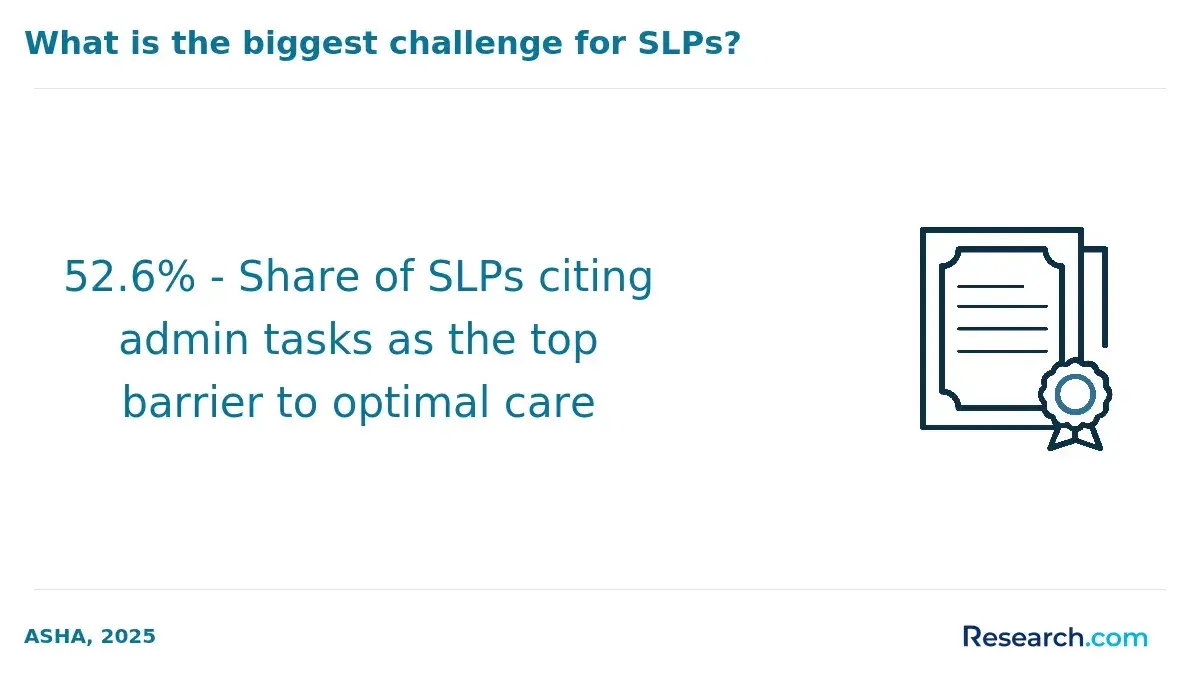
An SLP's day commonly mixes evaluations, treatment, documentation, care coordination, and meetings. The demanding part is often the transition between them: a clinician may need to tailor therapy to each client while keeping reports accurate and deadlines on track. Caseload size alone does not capture workload; case complexity, travel between sites, support staff, and protected documentation time matter too.
School calendars can offer predictable breaks, but the school day may be tightly scheduled and include meetings outside treatment blocks. Hospital and rehabilitation work may involve earlier starts, weekend coverage, or urgent assessments. Private practice can offer more control over appointments while shifting responsibility for cancellations, billing, or business operations to the clinician.
Technology can help with scheduling, telepractice, and documentation, but it does not remove the need for clinical judgment, privacy safeguards, and appropriate supervision. Prospective students comparing flexible degrees should examine clinical competencies in fast online SLP degrees as closely as class schedules. An online lecture does not mean a flexible clinical placement.
Which settings employ speech-language pathologists, and how does the work differ?
The same SLP credential can lead to notably different workweeks. This comparison highlights typical differences; individual employers' caseloads, schedules, and support can vary widely:
| Setting | Common focus | Potential attraction | Trade-off to investigate |
| Schools | Communication needs affecting students' education | Academic-year schedule and collaboration with educators | Caseloads, meetings, and education-related documentation |
| Hospitals | Acute communication and swallowing needs | Medical teamwork and varied clinical cases | Fast decisions, medically complex patients, and possible weekend coverage |
| Rehabilitation or skilled nursing facilities | Recovery and functional communication or swallowing | Ongoing work toward practical daily goals | Productivity expectations and changing patient needs |
| Private practice | Varies by practice and clientele | Potential to develop a focused service area | Cancellations, referrals, billing, and business responsibilities |
If a setting appeals to you, ask a local employer how clinicians' time is divided between direct service and other duties. That answer may tell you more about fit than the job title does.
How strong is job demand for speech-language pathologists across the United States?
The BLS projects 17% employment growth from 2025 to 2035 for SLPs, much faster than the average for all occupations. It also projects about 12,500 openings per year on average over that period; openings include positions created by growth and the need to replace workers who leave occupations or the labor force.
Those national figures support a favorable long-term outlook, not a promise of a position in a preferred ZIP code. Demand, competition, and pay can differ between urban and rural markets and among schools, health systems, and private employers. Before committing to a program, review local postings for required credentials, experience, and schedules. Pay particular attention to whether the entry-level positions you want offer the supervision needed after graduation.
What emotional, physical, and ethical challenges do speech-language pathologists face?
SLPs may work with people experiencing serious illness, disability, frustration, or slow progress. Building rapport while setting realistic goals takes patience, and explaining difficult findings to a family can be emotionally draining. Supervisors, colleagues, and manageable caseloads can make a substantial difference to how sustainable the work feels.
Physical demands depend on the setting. A clinician may spend long periods speaking, sit through consecutive sessions, move between rooms or schools, or help position clients safely. Telepractice changes some of those demands but introduces screen time and technology barriers.
Ethical practice means staying within your competence, protecting confidential information, documenting honestly, and making recommendations based on client needs rather than convenience or pressure to meet productivity targets. A job offer with unclear supervision, unrealistic visit expectations, or no time for required records deserves careful scrutiny.
What should you consider before choosing speech-language pathology as a career?
Start with your preferred work, then test whether the education route is financially and logistically realistic. These steps help prevent common mistakes such as choosing a program on tuition or advertised speed alone:
- Test career fit: Speak with SLPs in at least two settings about documentation, caseloads, and what makes their work rewarding or difficult.
- Check eligibility: Compare your transcript with each program's prerequisites, confirm current CAA accreditation status, and review licensure requirements in your intended state.
- Price the full pathway: Request tuition and mandatory fees, then account for prerequisite courses, clinical travel, living costs, and potential lost earnings.
- Examine placements and scheduling: Ask who finds clinical sites, where placements can occur, whether campus visits are required, and when students must be available.
- Compare realistic first jobs: Look at local postings and ask about supervision, benefits, annual versus academic-year pay, and advancement opportunities.
If you will study while employed, use affordable online SLP programs for working adults as a starting point, not a substitute for confirming each school's current costs and placement expectations. The smartest choice is a program you can complete, finance, and use to pursue licensure where you intend to work.
References:
- U.S. Bureau of Labor Statistics - Speech-Language Pathologists https://www.bls.gov/ooh/healthcare/speech-language-pathologists.htm
- ASHA EdFind - Accredited Speech-Language Pathology Programs https://find.asha.org/ed/
- ETS Praxis - Speech-Language Pathology (5331) https://praxis.ets.org/test/speech-language-pathology-5331.html
- New England Institute of Technology - Master of Science in Speech Language Pathology https://www.neit.edu/academics/graduate-degrees/speech-language-pathology-ms
- Maryville University - Master of Science in Speech-Language Pathology https://www.maryville.edu/masters/speech-language-pathology/
- Emerson College - Master of Science (M.S.) in Communication Disorders (Speech@Emerson, online) https://speech.emerson.edu/
- Baylor University - Master of Science in Speech-Language Pathology (Online) https://csd.robbins.baylor.edu/graduate/online-csd-graduate-program
- California State University-San Marcos - Online MS in Speech-Language Pathology https://www.csusm.edu/slp/programs/mastersonline/index.html
Other Things You Should Know About Speech Pathology
Yes, potentially. Many graduate programs consider applicants from other majors, but they may require prerequisite coursework first. Have each program evaluate your transcript before assuming you qualify or enrolling in extra classes.
It depends on the program and your job's flexibility. Online classes may reduce commuting, but supervised clinical placements generally require scheduled in-person availability. Ask for a semester-by-semester schedule before committing.
No. A speech-language pathology assistant works in a different, supervised role and cannot independently practice as an SLP. Assistant qualifications and permitted duties vary by state, so it is worth investigating as a distinct career rather than assuming it leads automatically to licensure.
Not every job requires ASHA's CCC-SLP, but some employers prefer or require it. State licensure is a separate issue. Check both the licensing board's rules and the credential requirements in job postings for the settings you want.