
2027 Best Environmental Sustainability Degree Programs

Co-Founder and Chief Data Scientist
Choosing an environmental sustainability degree is not just a question of finding a “green” major. It is a decision about the kind of environmental problems you want to solve, the technical skills you need, the cost you can justify, and the career path you want after graduation. Climate-related disasters, pollution, resource pressure, and environmental health risks are creating demand for professionals who can connect science, policy, business, engineering, and community action. From 1980 to 2022, 5,582 people died from flood-related causes and 702 people died from wildfire-related causes in 32 European countries (European Environment Agency, 2024), underscoring how environmental risks can become public safety, infrastructure, and health challenges.
This guide explains what to expect from an environmental sustainability degree, how to compare online and campus programs, what these programs cost, which schools offer relevant options, and what careers graduates commonly pursue. It is designed for students comparing undergraduate programs, working adults considering a career change, and professionals deciding whether a graduate credential or accelerated pathway is worth the investment.
Quick Answer: Is an Environmental Sustainability Degree Worth It?
An environmental sustainability degree can be worth it if you want a career focused on environmental science, climate adaptation, sustainable resource use, public policy, conservation, planning, environmental justice, or corporate sustainability. The strongest programs combine science coursework, data skills, policy analysis, fieldwork, internships, and a clear specialization. Career outcomes vary by role, degree level, location, and experience, but several related occupations reported median annual wages above the 2023 US median annual wage for all occupations of $48,060 (US BLS, 2024).
- Best fit: Students who want interdisciplinary environmental work involving science, policy, communities, data, land use, food systems, energy, or conservation.
- Less ideal fit: Students who want a highly technical engineering license path without completing an engineering-focused program or students who are not interested in science, quantitative analysis, or policy trade-offs.
- Typical undergraduate timeline: 4 years for full-time students, often requiring around 120 to 130 credit hours.
- Common career areas: environmental science, conservation, urban planning, sustainable agriculture, forestry, public programs, environmental consulting, and sustainability management.
- Important decision point: Accreditation, hands-on learning, internship access, total cost, and specialization fit matter more than the program title alone.
What are the benefits of getting a degree in environmental sustainability?
- An environmental sustainability degree can prepare students for roles such as environmental scientist, conservation scientist, urban and regional planner, forester, sustainability analyst, environmental policy assistant, or community program manager.
- Several related occupations offer solid earning potential. In 2023, environmental scientists and specialists had a median annual wage of $78,980, conservation scientists had $68,750, and social and community service managers had $77,030 [US Bureau of Labor Statistics (BLS), 2024].
- The degree builds practical problem-solving skills for work that affects communities, ecosystems, infrastructure, and public health. Students learn to evaluate environmental risks, communicate evidence, and design more sustainable approaches to energy, food, land, water, and resource use.
What can I expect from an environmental sustainability degree program?
An environmental sustainability degree is usually interdisciplinary. Instead of studying only one field, students learn how environmental science, economics, policy, social equity, public health, energy systems, and natural resource management intersect. A strong program should help you understand environmental problems scientifically while also teaching you how decisions are made by governments, companies, communities, and nonprofit organizations.
Coursework often includes environmental science, sustainability principles, climate change, renewable energy, sustainable development, environmental law and policy, data collection, geographic or field methods, and community-based problem solving. Many programs also include internships, research projects, field stations, study-abroad opportunities, or a capstone project. These experiences matter because sustainability work is rarely theoretical; employers often want graduates who can analyze data, write clearly, collaborate across disciplines, and apply research to real constraints.
| Program feature | Why it matters | What to look for |
| Interdisciplinary curriculum | Sustainability problems involve science, policy, economics, and communities. | Courses that connect environmental science with policy, data, social justice, and resource management. |
| Hands-on learning | Fieldwork and applied projects help students turn classroom knowledge into job-ready experience. | Internships, research, labs, field stations, consulting projects, or senior practicums. |
| Specialization options | Employers may value focused knowledge in areas such as energy, conservation, planning, food systems, or environmental health. | Concentrations that match the kind of role or industry you want after graduation. |
| Career support | Environmental jobs can be competitive, especially for students without experience. | Employer partnerships, internship placement support, alumni networks, and career advising. |
Where can I work with an environmental sustainability degree program?
Environmental sustainability graduates can work in government agencies, consulting firms, engineering services, conservation organizations, nonprofits, planning departments, agricultural organizations, public health programs, corporate sustainability teams, and research settings. The best fit depends on whether your program emphasizes science, policy, planning, business, public service, or technical analysis.
In 2023, 84,600 environmental scientists and specialists were employed in the US. Employment for these professionals is projected to increase by 7% between 2023 and 2033, with about 8,500 openings expected each year on average (US BLS, 2024).
The largest employers of environmental scientists and specialists in 2023 were (US BLS, 2024):
- State Government, excluding education and hospitals: 28%
- Management, Scientific, and Technical Consulting Services: 19%
- Local Government, excluding education and hospitals: 14%
- Engineering Services: 11%
- Federal Government, excluding postal service: 7%
How much can I make with an environmental sustainability degree program?
Salary depends on the role, employer, location, education level, technical skills, and experience. Environmental sustainability is not one occupation; it is a broad field that can lead to science, planning, conservation, engineering-adjacent, policy, agriculture, and management roles.
In 2023, foresters had a median annual wage of $67,330, conservation scientists had $68,750, environmental scientists and specialists had $78,980, urban and regional planners had $81,800, and environmental engineers had $100,090 (US BLS, 2024). For comparison, the median annual wage for all occupations in the US was $48,060 in 2023.
Students should not treat these figures as guaranteed outcomes. Entry-level pay may be lower, and some higher-paying roles require graduate education, technical expertise, licensing, engineering preparation, or several years of experience. However, the wage data shows that many sustainability-related career paths can offer earnings above the national median when graduates build the right qualifications.
- Environmental Sustainability Degree Programs for 2027
- How long does it take to complete an environmental sustainability degree program?
- Online vs. on-campus environmental sustainability degree programs
- What is the average cost of an environmental sustainability degree program?
- What are the prerequisites for enrolling in an environmental sustainability degree program?
- What courses are typically in an environmental sustainability degree program?
- What types of specializations are available in environmental sustainability degree programs?
- How can I verify the credibility of my environmental sustainability degree program?
- How to choose the best environmental sustainability degree program
- Is an accelerated environmental sustainability degree program right for me?
- Can accelerated degree pathways boost career readiness in environmental sustainability?
- What career paths are available for graduates of environmental sustainability degree programs?
- What challenges do environmental sustainability professionals face?
- What is the job market for graduates with an environmental sustainability degree?
- How do environmental sustainability degree programs build industry partnerships and provide career support?
- How do environmental sustainability degree programs promote diversity and inclusion?
- What are the international opportunities for environmental sustainability graduates?
- What complementary credentials can enhance career prospects in environmental sustainability?
- What emerging trends are driving innovation in environmental sustainability careers?
- What is the return on investment of an environmental sustainability degree?
Environmental Sustainability Degree Programs for 2027
The right environmental sustainability program depends on your target career, preferred learning format, budget, academic profile, and desired specialization. The programs below were selected using the Research.com methodology. The research team reviewed recent information from the IPEDS database, Peterson's database, the College Scorecard database, and the National Center for Education Statistics.
| School | Degree or program | Format or structure | Required credits | Accreditation |
| Indiana University-Bloomington | BA in Environmental and Sustainability Studies | Concentration-based undergraduate program | 120 credits | Higher Learning Commission (HLC) |
| Yale University | BA or BS in Environmental Studies | BA for policy, law, and social science interests; BS for science-focused pathways | 36 course credits | New England Commission of Higher Education (NECHE) |
| University of Michigan-Ann Arbor | Program in the Environment (PitE) | Custom specialization with field, study-abroad, or internship requirement | 120 credits | HLC |
| University of California, Los Angeles | BS in Environmental Science | Science-centered curriculum with Environmental Science Colloquium and senior practicum | 120 credits | WASC Senior College and University Commission (WSCUC) |
| Arizona State University | BA and BS in Sustainability; BS in Sustainable Food Systems | Online and on-campus options with accelerated graduate pathways | 120 credits | HLC |
1. Indiana University-Bloomington
Indiana University-Bloomington offers a Bachelor of Arts in Environmental and Sustainability Studies through the School of Public and Environmental Affairs. The program is delivered through a partnership between the O’Neill School and the College of Arts and Sciences and is administered by the Integrated Program in the Environment. Students complete a broad foundation in sustainability studies, human-environment systems, communication, data collection and analysis, and environmental science before selecting a concentration.
- Program Length: 4 years
- Concentrations: Sustainable Food Systems; Sustainable Energy and Resources; Environmental Ethics and Justice; Biodiversity and Sustainability; Individualized Concentration
- Total Annual Cost of Attendance: $30,600 (Resident); $60,348 (Non-resident)
- Required Credits to Graduate: 120 credits
- Accreditation: Higher Learning Commission (HLC)
2. Yale University
Yale University offers both BA and BS options in environmental studies. The BA is generally better aligned with students interested in law, policy, social sciences, advocacy, or humanities-based environmental work. The BS is better suited to students who want a stronger science pathway in areas such as ecology, environmental medicine, climate science, and related technical fields.
- Program Length: 4 years
- Concentrations: Biodiversity & Conservation; Customized Concentration; Energy & Climate; Environmental Humanities; Environmental Justice; Environmental Policy; Food & Agriculture; Human Health & Environment; Sustainability & Natural Resources; Urban Environments
- Total Annual Cost of Attendance: $90,975
- Required Credits to Graduate: 36 course credits
- Accreditation: New England Commission of Higher Education (NECHE)
3. University of Michigan-Ann Arbor
The University of Michigan-Ann Arbor offers the Program in the Environment through the College of Literature, Science, and the Arts and the School of Environment and Sustainability. The program is useful for students who want flexibility because learners design a specialization by selecting three courses tied to their interests. Students must also complete applied or research experience through residential field stations, overseas study, or internships.
- Program Length: 4 years
- Specializations: Environmental Natural Science; Environmental Social Science; Culture & Environment; Conservation of Biological Diversity; Urban Planning; Environmental Politics and Policy; Natural Resource Management; Public Health; Environmental Education
- Total Annual Cost of Attendance: $8,702 (Resident); $30,307 (Non-resident)
- Required Credits to Graduate: 120 credits
- Accreditation: HLC
4. University of California, Los Angeles
The University of California, Los Angeles offers a BS in Environmental Science through the Institute of the Environment and Sustainability. The curriculum combines physical sciences, life sciences, social sciences, and humanities. Students also participate in the Environmental Science Colloquium and complete a yearlong senior practicum, which can be valuable for building applied project experience before graduation.
- Program Length: 4 years
- Concentrations: Atmospheric and Oceanic Sciences; Civil and Environmental Engineering; Earth Planetary and Space Sciences; Ecology and Evolutionary Biology; Environment; Environmental Health Sciences; Geography
- Total Annual Cost of Attendance: $42,059 (Resident); $76,259 (Non-resident)
- Required Credits to Graduate: 120 credits
- Accreditation: WASC Senior College and University Commission (WSCUC)
5. Arizona State University
Through the School of Sustainability, Arizona State University offers BA and BS programs in sustainability, along with a BS in Sustainable Food Systems. Students can study online or on campus, which makes the program more flexible for learners who need location or scheduling options. ASU also offers accelerated pathways that allow students to work toward a master’s degree in global management or sustainability solutions.
- Program Length: 4 years
- Concentrations: Sustainability; Sustainable Food Systems
- Total Annual Cost of Attendance: Contact the university for tuition information based on campus choice.
- Required Credits to Graduate: 120 credits
- Accreditation: HLC
How long does it take to complete an environmental sustainability degree program?
A bachelor’s degree in environmental sustainability usually takes 4 years for full-time students. Most programs require around 120 to 130 credit hours, including general education courses, environmental science foundations, sustainability coursework, electives, and a concentration or capstone component.
Part-time students usually need more time because they complete fewer courses each term. Some schools offer accelerated tracks that may allow students to finish in 3 years, often through summer enrollment, heavier course loads, or compressed academic schedules. Students considering leadership-heavy sustainability roles may also benefit from management training, and one related option is exploring the easiest organizational leadership degrees as a possible complement to environmental study.
Internships, research projects, study-abroad programs, and field experiences can strengthen a student’s resume, but they may affect the timeline depending on how the program is structured. Online programs may offer additional flexibility for working students, caregivers, or learners who cannot relocate.
Master’s programs in environmental sustainability commonly take 1 to 3 years, depending on whether the student enrolls full time or part time and whether the program is thesis-based, project-based, or professionally oriented. Full-time students often complete a master’s program in 12 to 24 months, while part-time learners may need up to 3 years. Students who want a shorter graduate pathway can compare relevant fastest master's degree options in sustainability-related fields.
Students interested in environmental science, ecology, conservation, or environmental health may also compare sustainability programs with pathways that lead to biology major jobs, especially when they want stronger laboratory, field research, or life science preparation.
| Degree path | Typical time commitment | Best for | Trade-off |
| Bachelor’s degree | 4 years for full-time students | Students entering the field or preparing for entry-level environmental roles | May not be enough for advanced research, leadership, or technical specialist positions |
| Accelerated bachelor’s pathway | May allow completion in 3 years | Highly organized students who can manage heavier workloads | Less room for work, internships, or slower-paced exploration |
| Master’s degree | 1 to 3 years | Professionals pursuing specialization, career advancement, or career change | Higher cost and opportunity cost unless clearly tied to career goals |
Online vs. on-campus environmental sustainability degree programs
Online and campus-based environmental sustainability programs can both be credible if they are offered by accredited institutions and include strong academic support. The better choice depends on your schedule, learning style, need for fieldwork, access to campus resources, and career goals.
| Factor | Online program | On-campus program | Best choice if... |
| Flexibility | Usually easier to fit around work, family, or relocation limits. | Typically follows set class times and campus schedules. | Choose online if you need schedule control; choose campus if you prefer structure. |
| Networking | Often uses virtual discussions, video meetings, and online career events. | Offers more face-to-face contact with peers, faculty, and visiting employers. | Choose campus if local networking and in-person collaboration are priorities. |
| Labs and fieldwork | May require local field experiences, hybrid sessions, or project-based alternatives. | Usually provides easier access to laboratories, field sites, and research centers. | Choose campus if your target role depends heavily on field science or lab work. |
| Cost and access | Can reduce relocation or commuting expenses, though tuition varies by school. | May provide more campus services but can add housing and transportation costs. | Compare total cost, not tuition alone. |
Students who want to connect sustainability with environmental health, public health policy, or climate-related health risks may also consider an accelerated MPH online pathway, particularly if their long-term goal involves public health agencies, environmental health departments, or community resilience programs.
What is the average cost of an environmental sustainability degree program?
The cost of an environmental sustainability degree varies by institution, residency status, degree level, delivery format, housing needs, and financial aid. A useful comparison should include tuition, mandatory fees, housing, transportation, books, technology, fieldwork costs, and the income you may give up if you reduce work hours to study.
For the academic year 2024–2025, the featured undergraduate programs listed the following total annual cost of attendance figures:
| Institution | Resident cost | Non-resident cost | Notes |
| Indiana University-Bloomington | $30,600 | $60,348 | Resident and non-resident costs differ substantially. |
| Yale University | $90,975 | $90,975 | Listed as a single total annual cost of attendance. |
| University of Michigan-Ann Arbor | $8,702 | $30,307 | Resident cost is much lower than non-resident cost. |
| University of California, Los Angeles | $42,059 | $76,259 | Resident and non-resident costs differ substantially. |
In-state or resident students often pay less at public universities than out-of-state students. Scholarships, grants, work-study, employer tuition benefits, transfer credits, and accelerated formats may reduce the net cost. Before enrolling, ask each school for a financial aid estimate and compare net price, not just the advertised cost.
Some students pair sustainability with another discipline to broaden career options. For example, an example of dual degree program online could combine environmental sustainability with business training, which may be useful for students targeting corporate sustainability, ESG-related functions, supply chain roles, or environmental management.
The chart below visualizes the total annual cost of attendance for the featured academic institutions in the academic year 2024–2025, based on current tuition data from these universities.
What are the prerequisites for enrolling in an environmental sustainability degree program?
Admission requirements differ by school and degree level, but environmental sustainability programs usually expect applicants to show readiness for science-based and interdisciplinary coursework. Competitive programs may review academic performance, writing ability, science preparation, and evidence of interest in environmental issues.
- Science and math preparation: High school or prior college coursework in biology, chemistry, physics, algebra, or related subjects can help students handle environmental science, data analysis, and systems-based courses.
- Minimum GPA requirement: Many programs use a minimum GPA, often around 2.5 to 3.0. More selective schools may expect stronger academic records or consider standardized test scores such as the SAT or ACT when applicable.
- Statement of purpose or personal essay: Some programs ask applicants to explain their interest in sustainability, relevant experiences, and career goals. A strong essay should be specific about the environmental issues you want to work on and why the program fits those goals.
What courses are typically in an environmental sustainability degree program?
Environmental sustainability programs vary, but most include a mix of environmental science, policy, resource management, systems thinking, and applied problem solving. The strongest curricula help students understand both environmental processes and the human decisions that shape environmental outcomes.
- Environmental Science: Introduces ecosystems, biodiversity, environmental systems, and the effects of human activity on air, water, soil, habitats, and climate.
- Renewable Energy Systems: Examines technologies such as solar, wind, and hydropower and explores how energy choices affect emissions, infrastructure, costs, and communities.
- Sustainable Development: Focuses on balancing economic activity, environmental protection, and social equity in communities, organizations, and public policy.
- Environmental Policy and Law: Covers regulations, legal frameworks, treaties, and policy tools used to manage pollution, land use, resource protection, and environmental risk.
- Climate Change and Mitigation: Explains climate science, impacts, adaptation strategies, and methods for reducing greenhouse gas emissions.
What types of specializations are available in environmental sustainability degree programs?
Specializations help students move from broad interest to a clearer career direction. When comparing programs, look for concentrations that match the work you want to do after graduation rather than choosing a school based only on prestige or title.
| Specialization | What it emphasizes | Possible career direction |
| Biodiversity and Conservation | Ecosystem protection, species conservation, habitat management, and natural systems. | Conservation science, land management, wildlife programs, parks, and environmental nonprofits. |
| Environmental Policy | Regulation, governance, advocacy, compliance, and policy analysis. | Government agencies, advocacy organizations, consulting, and policy research. |
| Environmental Health Sciences | Links between environmental exposures and human health, including pollution and water quality. | Public health agencies, environmental health programs, community resilience, and research support. |
| Sustainable Food Systems | Sustainable agriculture, food production, distribution, soil health, and food security. | Agriculture, food systems planning, nonprofit food programs, sustainability consulting, and research. |
| Sustainable Energy and Resources | Renewable energy, resource use, materials, and systems for reducing environmental impact. | Energy programs, corporate sustainability, resource management, and climate-related roles. |
How can I verify the credibility of my environmental sustainability degree program?
Start with accreditation. Confirm that the college or university is accredited by a recognized institutional accreditor, then review whether the program’s curriculum, faculty expertise, research activity, and applied learning opportunities match your goals. Accreditation does not guarantee a specific job outcome, but it is important for credit transfer, graduate school eligibility, employer trust, and access to many forms of financial aid.
Students should also review faculty backgrounds, internship partners, research centers, student outcomes, fieldwork requirements, and career services. If you are considering an online option, confirm that online students receive the same advising, library access, career support, and internship guidance as campus students. You can also compare institutional quality signals by reviewing examples of non profit universities that emphasize accreditation and student support.
How to choose the best environmental sustainability degree program
The best environmental sustainability degree is the one that aligns with your target role, offers credible training, fits your budget, and gives you applied experience before graduation. Use the following criteria to narrow your list.
| Selection factor | Questions to ask | Why it matters |
| Program focus | Does the curriculum emphasize science, policy, business, planning, conservation, food systems, energy, or public health? | The word “sustainability” can mean very different things across schools. |
| Accreditation | Is the institution properly accredited? | Accreditation affects credit transfer, financial aid, graduate school options, and employer confidence. |
| Applied learning | Are internships, fieldwork, research projects, or practicums required or strongly supported? | Experience can help graduates compete for entry-level roles. |
| Total cost | What is the net price after aid, and what costs are not included in tuition? | A lower advertised tuition may not mean a lower total cost. |
| Career support | Which employers recruit students, and what support exists for internships and job placement? | Environmental careers often depend on networks, projects, and early experience. |
| Format | Can you succeed in the delivery format: online, on campus, hybrid, full time, part time, or accelerated? | The wrong format can delay graduation or reduce access to important experiences. |
Common mistakes to avoid when choosing a program
- Choosing by title alone: “Environmental studies,” “sustainability,” and “environmental science” may have different course requirements and career outcomes.
- Ignoring accreditation: Always verify institutional accreditation before enrolling.
- Looking only at tuition: Compare total annual cost of attendance, financial aid, housing, transportation, technology, and fieldwork costs.
- Assuming online programs include field experience: Ask how internships, labs, field methods, and capstones work for remote students.
- Skipping career outcome questions: Ask where recent graduates work and what types of internships students complete.
- Assuming salary outcomes are guaranteed: Median wage data is useful, but your results depend on experience, location, role, and qualifications.
Is an accelerated environmental sustainability degree program right for me?
An accelerated environmental sustainability degree can be a good fit if you are academically prepared, highly organized, and motivated to enter the workforce or graduate school sooner. These programs usually compress the timeline by increasing course intensity, requiring summer terms, or allowing students to combine undergraduate and graduate coursework.
Before choosing this route, confirm that the program is accredited, that accelerated students still receive access to advising and career services, and that the heavier pace will not prevent you from completing internships or field experiences. Students comparing faster degree options can review broader accelerated college degree pathways to understand common structures and trade-offs.
| Accelerated path may work if... | It may not work if... |
| You can manage a heavier course load without sacrificing academic quality. | You need a slower pace because of work, caregiving, health, or financial responsibilities. |
| You already know your concentration or career direction. | You need time to explore multiple environmental subfields before specializing. |
| You want to reduce time-to-degree and enter the workforce sooner. | You would lose valuable internship, research, or networking opportunities by rushing. |
Can accelerated degree pathways boost career readiness in environmental sustainability?
Accelerated programs can improve career readiness when they combine speed with applied learning. A shorter timeline is useful only if students still graduate with relevant projects, fieldwork, data skills, writing samples, and professional connections. Programs that simply compress lectures without practical experience may be less helpful for job seekers.
Working adults may find accelerated formats especially useful when they are reskilling or moving from a related field into sustainability. Flexible options such as accelerated bachelor's degree programs for adults can help learners complete a credential while balancing employment, but the program should still provide career advising and discipline-specific experience.
What career paths are available for graduates of environmental sustainability degree programs?
Graduates can pursue many careers in sustainability, but the best options depend on specialization, degree level, technical training, and experience. Some jobs focus on field science, while others emphasize policy, planning, agriculture, public programs, or engineering-related problem solving.
| Career path | What the role does | 2023 median annual wage | Important note |
| Foresters | Manage forest ecosystems, support conservation, plan timber use, and help reduce wildfire risk. | $67,330 | Field experience and natural resource coursework can be important. |
| Conservation Scientists | Develop land-use practices and manage forests, parks, rangelands, or conservation areas. | $68,750 | Strong fit for students focused on biodiversity, land management, or conservation. |
| Agricultural and Food Scientists | Research farming methods, food systems, crop resilience, and agricultural sustainability. | $76,400 | Sustainable food systems coursework can support this direction. |
| Social and Community Service Managers | Lead programs related to environmental justice, community sustainability, and disaster resilience. | $77,030 | Management, grant writing, and community engagement skills are valuable. |
| Environmental Scientists and Specialists | Study environmental problems and develop solutions that protect ecosystems and public health. | $78,980 | Often requires strong science, data, and communication skills. |
| Urban and Regional Planners | Design sustainable communities, manage land-use plans, and support green infrastructure. | $81,800 | Students interested in planning can explore an urban planning degree online. |
| Farmers, Ranchers, and Agricultural Managers | Apply sustainable practices to soil health, production, resource use, and agricultural operations. | $83,770 | Business, agriculture, and sustainability training can be useful. |
| Environmental Engineers | Design solutions for pollution control, water treatment, waste management, and environmental systems. | $100,090 | This path may require additional engineering education or engineering-specific preparation. |
The chart below visualizes the 2023 median annual wages of professions related to environmental sustainability, based on 2024 data from the US BLS.
What challenges do environmental sustainability professionals face?
Sustainability professionals often work in settings where scientific evidence, public budgets, business priorities, community needs, and regulation do not move at the same speed. Common challenges include limited funding, changing environmental rules, pressure to prove measurable impact, competing stakeholder interests, and the need to keep up with new tools and methods.
Another challenge is communication. Professionals may need to translate technical findings for executives, elected officials, community members, engineers, farmers, or nonprofit leaders. The work can be rewarding, but progress may be slow when projects require policy approval, public buy-in, or long-term investment. Students concerned about education costs can also compare financial-aid-friendly options, including online colleges in oklahoma that accept FAFSA, when affordability is a major factor in choosing a pathway.
What is the job market for graduates with an environmental sustainability degree?
The job market is generally favorable for several sustainability-related occupations, though growth varies by role. Students should compare occupational outlooks carefully because a sustainability degree can lead to many different job categories. For students seeking early-career options, Research.com also provides guidance on entry level jobs with environmental science degree pathways.
| Occupation | Projected employment growth, 2023 to 2033 | What is driving demand |
| Foresters | 3% | Forest conservation, land stewardship, and wildfire management needs. |
| Conservation Scientists | 6% | Sustainable land-use practices and natural resource protection. |
| Agricultural and Food Scientists | 8% | Advances in sustainable farming, crop resilience, and food systems. |
| Social and Community Service Managers | 8% | Community programs tied to environmental justice, resilience, and public services. |
| Environmental Scientists and Specialists | 7% | Need for professionals who can evaluate and solve environmental problems. |
| Urban and Regional Planners | 4% | Demand for sustainable development, land-use planning, and infrastructure coordination. |
| Farmers, Ranchers, and Agricultural Managers | 2% | Industry automation and consolidation, along with evolving agricultural practices. |
| Environmental Engineers | 7% | Technical solutions for pollution, water systems, waste, and environmental protection. Some professionals may also move into related fields such as biotech careers. |
The chart below visualizes the job outlook for occupations related to environmental sustainability between 2023 and 2033, based on 2024 data from the US BLS.
How do environmental sustainability degree programs build industry partnerships and provide career support?
Strong programs connect students with employers before graduation. Look for partnerships with environmental consulting firms, renewable energy companies, government agencies, planning departments, agricultural organizations, conservation groups, and community nonprofits. These relationships can lead to internships, guest lectures, applied class projects, research opportunities, career fairs, and mentorship.
Career support is especially important for working adults and online students, who may need flexible advising and employer connections that fit their schedules. Students comparing affordability and flexibility can also review options from the cheapest online schools for working adults while checking whether each program offers sustainability-specific career support.
How do environmental sustainability degree programs promote diversity and inclusion?
Environmental problems do not affect all communities equally. Programs that take diversity and inclusion seriously help students understand environmental justice, community engagement, Indigenous and local knowledge, public health disparities, and the social dimensions of climate and resource decisions.
Useful signs include courses on environmental justice, community-based research, partnerships with local organizations, inclusive fieldwork practices, mentorship initiatives, and case studies from different regions and populations. Students may also strengthen their professional profile with targeted training or high paying certifications when those credentials align with their career goals and do not replace essential degree-level preparation.
What are the international opportunities for environmental sustainability graduates?
Environmental sustainability graduates may find international opportunities with nongovernmental organizations, multinational companies, government agencies, research collaborations, conservation initiatives, and development-focused programs. Work may involve climate adaptation, biodiversity protection, sustainable agriculture, water management, environmental policy, or corporate sustainability across different regulatory and cultural contexts.
Students interested in global roles should look for programs with study-abroad options, international research partnerships, language preparation, global policy coursework, or cross-cultural internships. Additional high paying certifications may also support international competitiveness when they validate practical skills that employers recognize.
What complementary credentials can enhance career prospects in environmental sustainability?
Complementary credentials can help graduates stand out when they build skills not fully covered in the degree. Useful areas may include data analysis, geographic information systems, project management, environmental compliance, energy systems, grant writing, public health, business, or community engagement. The best credential depends on the role you want, not simply on whether the credential sounds marketable.
Students who need a faster foundation in a related field can compare options such as a 6 month associate degree online, but they should confirm how credits transfer and whether the credential is recognized by employers or graduate programs. A short credential works best when it fills a specific skill gap.
What emerging trends are driving innovation in environmental sustainability careers?
Environmental sustainability careers are being shaped by stronger use of data, remote monitoring, climate-risk planning, renewable energy transitions, sustainable supply chains, environmental justice work, and cross-sector collaboration. Employers increasingly need professionals who can interpret evidence, communicate risk, and work across technical and nontechnical teams.
Flexible education formats are also changing how students enter the field. Some learners use online, accelerated, or stackable pathways to build skills while working. For students comparing faster education routes, a fastest online degree pathway may be worth evaluating, but speed should not come at the cost of accreditation, applied experience, or career relevance.
What is the return on investment of an environmental sustainability degree?
The return on investment depends on total cost, time to graduation, financial aid, debt, career goal, and the kind of role you pursue after completing the degree. A lower-cost program with strong internships may produce a better outcome than a more expensive program that lacks applied learning. Likewise, a graduate degree may be worthwhile for specialization or advancement, but it should be tied to a clear career plan.
Students should compare upfront cost with likely career opportunities, not with the highest possible salary in the field. Accelerated options, including 1 year graduate programs, may reduce opportunity cost for some students, but only if the program is rigorous, accredited, and aligned with the roles they want.
ROI questions to ask before enrolling
- What is the total annual cost of attendance after grants and scholarships?
- How much debt would I need, and what monthly payment could I realistically manage?
- Does the program require internships, fieldwork, research, or a practicum?
- Which employers hire graduates from this program?
- Does my target job require a graduate degree, certification, license, or engineering background?
- Can I transfer credits or use prior learning to reduce cost and time?
- Will an online, part-time, or accelerated format help me finish, or will it limit access to key experiences?
Key Insights
- An environmental sustainability degree is strongest when it blends environmental science, policy, data, applied learning, and a focused specialization.
- A bachelor’s degree typically takes 4 years for full-time students and often requires around 120 to 130 credit hours; master’s programs commonly take 1 to 3 years.
- Career outcomes vary widely. In 2023, related median annual wages included $67,330 for foresters, $68,750 for conservation scientists, $78,980 for environmental scientists and specialists, $81,800 for urban and regional planners, and $100,090 for environmental engineers (US BLS, 2024).
- Several sustainability-related occupations are projected to grow from 2023 to 2033, including 8% for agricultural and food scientists, 8% for social and community service managers, 7% for environmental scientists and specialists, and 7% for environmental engineers (US BLS, 2024).
- Do not choose a program based only on ranking, tuition, or the word “sustainability.” Check accreditation, curriculum depth, internship access, career support, total cost, and whether the specialization matches your target job.
- Online and accelerated programs can be valuable for working adults, but students should confirm how fieldwork, labs, internships, and advising are handled before enrolling.
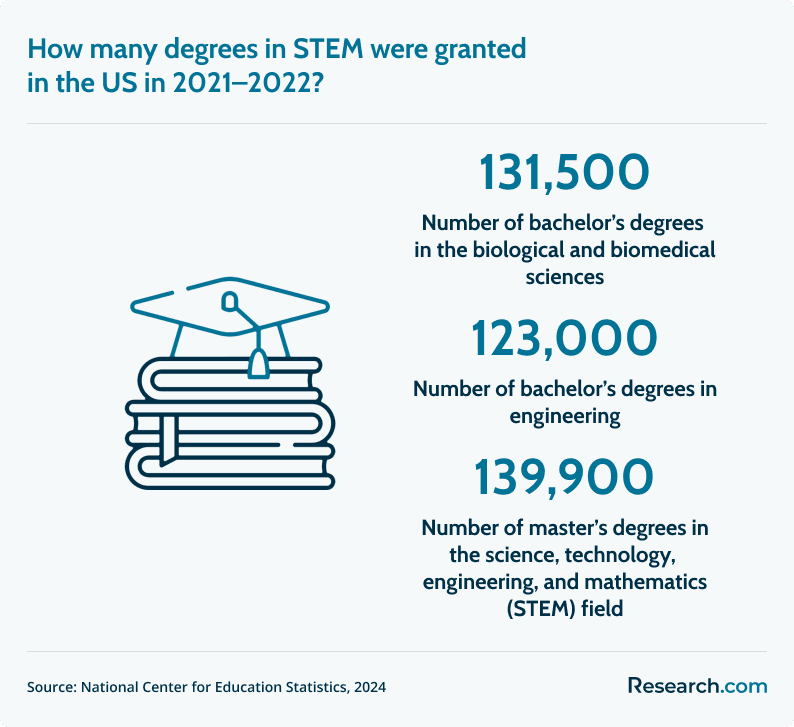
- In the academic year 2021–2022, 139,900 master’s degrees in a science, technology, engineering, and mathematics (STEM) field were conferred in the US (National Center for Education Statistics, 2024), showing the broader scale of advanced STEM education relevant to many sustainability pathways.
References:
- European Environment Agency. (2024, December 10). Environmental health impacts. https://www.eea.europa.eu/en/topics/in-depth/environmental-health-impacts?activeTab=fa515f0c-9ab0-493c-b4cd-58a32dfaae0a
- Hanson, Melanie. (2024, November 03). Scholarship Statistics. Education Data Initiative. https://educationdata.org/scholarship-statistics
- National Center for Education Statistics. (2024). Graduate Degree Fields. Condition of Education. US Department of Education, Institute of Education Sciences. https://nces.ed.gov/programs/coe/indicator/ctb/graduate-degree-fields
- National Center for Education Statistics. (2024). Undergraduate Degree Fields. Condition of Education. US Department of Education, Institute of Education Sciences. https://nces.ed.gov/programs/coe/indicator/cta
- US Bureau of Labor Statistics. (2024, August 29). Agricultural and Food Scientists. Occupational Outlook Handbook. https://www.bls.gov/ooh/life-physical-and-social-science/agricultural-and-food-scientists.htm
- US Bureau of Labor Statistics. (2024, August 29). Business and Financial Occupations. Occupational Outlook Handbook. https://www.bls.gov/ooh/business-and-financial
- US Bureau of Labor Statistics. (2024, August 29). Conservation Scientists and Foresters. Occupational Outlook Handbook. https://www.bls.gov/ooh/life-physical-and-social-science/conservation-scientists.htm
- US Bureau of Labor Statistics. (2024, August 29). Environmental Engineers. Occupational Outlook Handbook. https://www.bls.gov/ooh/architecture-and-engineering/environmental-engineers.htm
- US Bureau of Labor Statistics. (2024, September 30). Environmental Scientists and Specialists. Occupational Outlook Handbook. https://www.bls.gov/ooh/life-physical-and-social-science/environmental-scientists-and-specialists.htm
- US Bureau of Labor Statistics. (2024, August 29). Farmers, Ranchers, and Other Agricultural Managers. Occupational Outlook Handbook. https://www.bls.gov/ooh/management/farmers-ranchers-and-other-agricultural-managers.htm
- US Bureau of Labor Statistics. (2024, April 03). May 2023 National Occupational Employment and Wage Estimates, United States. Occupational Employment and Wage Statistics. https://www.bls.gov/oes/current/oes_nat.htm
- US Bureau of Labor Statistics. (2024, August 29). Social and Community Service Managers. Occupational Outlook Handbook. https://www.bls.gov/ooh/management/social-and-community-service-managers.htm
- US Bureau of Labor Statistics. (2024, August 29). Urban and Regional Planners. Occupational Outlook Handbook. https://www.bls.gov/ooh/life-physical-and-social-science/urban-and-regional-planners.htm
Other Things You Need to Know about Environmental Sustainability Degree Programs
In 2027, a standout environmental sustainability degree program combines cutting-edge curriculum with hands-on research opportunities, interdisciplinary collaboration, and strong industry connections. Programs that offer immersive fieldwork, access to sustainable campus initiatives, and engagement with global environmental challenges attract top students seeking impactful careers.
Many environmental sustainability degree programs are not STEM-designated, but some environmental science, climate data, and sustainability analytics majors are. In the United States, a STEM designation is listed by the U.S. Department of Homeland Security and matters for certain international student work benefits, including the 24-month OPT extension.


