2027 Fastest Online Natural Sciences Degree Programs

Co-Founder and Chief Data Scientist
According to recent education data, approximately 29% of all undergraduate students in the U.S. pursued STEM majors, underscoring the popularity and demand for science-focused degrees. For students looking to jumpstart their careers or transition quickly into science-related fields, accelerated online natural science degree programs offer a flexible and time-efficient option.
This guide will help you explore some of the fastest options available, comparing program duration, costs, specializations, and accreditation so you can make an informed decision based on your career goals and timeline.
What are the benefits of getting a fast online natural sciences degree?
- Completing your degree in 12–24 months allows you to start your career or apply to graduate programs much sooner than traditional timelines.
- Accelerated programs help you gain the skills and credentials needed for advancement or career changes without spending years in school.
- The flexible online format makes it easier to balance coursework with work, family, or other responsibilities while progressing at a faster pace.
What can I expect from a fast online natural sciences degree program?
A fast online natural science degree program is designed to deliver the same core scientific knowledge and academic rigor as a traditional program, but in a shorter timeframe. You can expect accelerated course formats, often lasting 5 to 8 weeks per class, with multiple start dates throughout the year to maintain momentum. These programs typically cover subjects like biology, chemistry, environmental science, and mathematics, while offering flexibility to study on your own schedule.
Many programs also allow credit transfers, prior learning assessments, or competency-based learning to shorten the duration even further. While the pace is intense, students benefit from focused instruction, streamlined curricula, and support services tailored for online learners.
Where can I work with an online natural sciences degree?
Graduates with an online natural science degree can work in a wide range of settings across both the public and private sectors. Common workplaces include government agencies, environmental consulting firms, laboratories, research institutions, healthcare organizations, and schools. Depending on your specialization, you might find roles in environmental monitoring, public health, science education, conservation, or laboratory analysis.
Some graduates also work for nonprofit organizations or policy think tanks, applying scientific knowledge to social and environmental issues. With the versatility of a natural science degree, you can pursue careers in fieldwork, office-based analysis, teaching, or leadership positions across various industries.
How much can I earn with an online natural sciences degree?
Earnings with an online natural science degree can vary widely based on your job title, experience level, and area of specialization. Entry-level roles such as lab technicians or environmental field assistants typically earn between $45,000 and $60,000 per year, while more advanced positions like environmental scientists and wildlife biologists average around $65,000 to $75,000 annually.
With experience or a graduate degree, professionals can move into higher-paying roles such as natural sciences managers, who earn over $140,000 per year on average. Overall, a degree in natural science offers strong earning potential and room for salary growth as you gain expertise or pursue further education.
- Fastest Online Natural Sciences Degree Programs for 2027 Best Programs
- How long does it take to complete a fast online natural sciences degree program? Completion Time
- How does an online natural sciences degree compare to an on-campus program? How does an online natural sciences degree compare to an on-campus program?
- What is the average cost of an online natural sciences degree program? Average Cost
- What are the financial aid options for students enrolling in an online natural sciences degree program? Financial Aid
- What are the prerequisites for enrolling in an online natural sciences degree program? Requirements
- What courses are typically in an online natural sciences degree program? What courses are typically in an online natural sciences degree program?
- What types of specializations are available in an online natural sciences degree program? Specializations
- How do I choose the best online natural sciences degree program? How do I choose the best online natural sciences degree program?
- What challenges might I encounter in a fast online natural science degree program? What challenges might I encounter in a fast online natural science degree program?
- What career paths are available for graduates of an online natural sciences degree program? What career paths are available for graduates of an online natural sciences degree program?
- What is the job market for graduates with an online natural sciences degree? Job Market
- What practical experience opportunities are available through online natural science degree programs? What practical experience opportunities are available through online natural science degree programs?
- Are online natural science degrees cost-competitive with other STEM fields? Are online natural science degrees cost-competitive with other STEM fields?
Fastest Online Natural Science Degree Programs for 2027
Choosing a fast online natural science degree is not just about finding the shortest program. You also need to confirm that the degree level fits your goal, the labs are realistic for an online format, the school is properly accredited, and the cost makes sense for the career path you want. Natural science programs can support careers in environmental science, science education, laboratory work, natural resources, health-related preparation, GIS, and graduate study, but outcomes depend heavily on specialization, experience, and credentials beyond the degree.
This guide is written for students comparing accelerated, online, and flexible natural science programs at the associate, bachelor’s, and master’s levels. It explains how long these programs take, what they cost, how online science coursework compares with campus-based study, which programs appear in this ranking, and how to decide whether a natural science degree is the right investment for your plans.
Quick answer: What is the fastest online natural science degree?
The fastest option depends on the credential you need. An associate degree in natural sciences and mathematics can often be completed in about two years full-time, while bachelor’s programs usually require 120 credit hours and commonly take three to four years. Master’s programs in natural science, natural resources, GIS, or science education may take about one to two years depending on the curriculum, enrollment pace, and whether the program accepts accelerated or part-time study.
If your goal is quick workforce entry, an associate degree or short healthcare credential may be faster. If your goal is environmental science, graduate school, teaching, or leadership, a bachelor’s or master’s degree may be more appropriate even if it takes longer.
How do we rank schools?
Research.com evaluates online natural science degree programs using a transparent ranking process built around academic quality, program fit, institutional credibility, and available public data. You can review our ranking methodology for more detail on how school and program information is assessed. Data sources considered in our review include:
- IPEDS institutional data
- Peterson's database and distance learning data
- College Scorecard outcomes and school data
- National Center for Education Statistics, NCES data tools, and NCES institutional resources
Fast online natural science programs at a glance
| School and program | Degree level | Program length listed | Best fit |
| American Public University – B.S. in Natural Sciences | Bachelor’s | Three to four years; 120 credit hours | Students seeking a broad online science foundation |
| Oregon State University Ecampus – Master of Natural Resources | Master’s | Typically 2–3 years part-time; 45 quarter credits | Professionals focused on natural resources and applied environmental problem-solving |
| Colorado State University Online – M.N.S.E. | Master’s | One year full-time; 30 to 31 credit hours | Current or future science educators |
| University of Denver – Online MS Geographic Information Science | Master’s | Two Years | Students targeting GIS, mapping, remote sensing, and geospatial careers |
| University of Memphis – B.A. in Earth Sciences | Bachelor’s | Four years full-time; 120 credit hours | Students interested in earth science concentrations and field-based study |
| Spalding University – B.S. in Natural Science | Bachelor’s | Four years full-time; 120 credit hours | Pre-health and graduate school preparation |
| Hamline University – MAEd in Natural Sciences and Environmental Education | Master’s | About 18 months; 34 credits | Educators and environmental education professionals |
| Arizona State University – MNS in Natural Science, Earth and Space Sciences | Master’s | One to two years | Professionals seeking advanced Earth and space science training |
| Florida National University – B.S. in Natural Sciences | Bachelor’s | Four years full-time; 120 credit hours | Students preparing for health, environmental, or education pathways |
| Thomas Edison State University – A.S. in Natural Sciences and Mathematics | Associate | Two years full-time; 60 credit hours | Students who want a faster STEM credential or transfer pathway |
1. American Public University – B.S. in Natural Sciences
American Public University offers a fully online Bachelor of Science in Natural Sciences for students who want broad exposure to major scientific fields rather than a single narrow major. The 120-credit curriculum includes biology, chemistry, physics, earth science, mathematics, scientific reasoning, data interpretation, communication, and lab-based learning delivered through virtual and hands-on components.
- Program Length: Three to four years (120 credit hours)
- Tracks/concentrations: N/A
- Cost per Credit/Tuition: $350 per credit (standard); $250 with Preferred Military Rate; $315 with Veteran or Opportunity Grant
- Accreditation: Higher Learning Commission (HLC)
2. Oregon State University (Ecampus) – Master of Natural Resources (MNR)
The Master of Natural Resources at Oregon State University Ecampus is built for students who want graduate-level preparation in natural resource management while continuing to work. The program develops analytical, ecological, economic, health, and cultural problem-solving skills and ends with a capstone project and oral defense that may be completed online.
- Program Length: Typically 2–3 years part-time (45 quarter credits)
- Tracks/concentrations: Optional certificates in GIS, Water Conflict Management, Wildlife Management, Urban Forestry, and more
- Cost per Credit/Tuition: $582 per credit
- Accreditation: Northwest Commission on Colleges and Universities (NWCCU)
3. Colorado State University Online – M.N.S.E. (Master of Natural Sciences Education)
Colorado State University’s online Master of Natural Sciences Education is designed for science educators who want stronger content knowledge and better instructional strategies. The program revisits biology, chemistry, physics, and environmental science while emphasizing curriculum planning, classroom engagement, and clear science communication for learners.
- Program Length: One year full-time (30 to 31 credit hours)
- Tracks/concentrations: N/A
- Cost per Credit/Tuition: $660 per credit
- Accreditation: HLC
4. University of Denver - Online MS Geographic Information Science
The University of Denver's online Master of Science in Geographic Information Science focuses on geospatial technology, including cartography, remote sensing, GIS, and GPS. Students learn to use digital mapping and spatial data tools to analyze relationships between people, places, infrastructure, and the environment, which can support policy, planning, and technical decision-making roles.
- Program Length: Two Years
- Tracks/concentrations: GIS
- Cost per Credit/Tuition: For more information about billing and tuition payments, visit the Office of Student Billing website.
- Accreditation: Higher Learning Commission (HLC)
5. University of Memphis – B.A. in Earth Sciences
The University of Memphis offers a Bachelor of Arts in Earth Sciences with concentrations in Geoarchaeology, Geography, Geology, and Environmental Science. The 120-credit curriculum includes courses such as Geomorphology, Geographic Information Science, Quantitative Methods, and Field Methods, helping students build analytical, fieldwork, and GIS-related skills.
- Program Length: Four years full-time (120 credit hours)
- Tracks/concentrations: Geoarchaeology; Geography; Geology; Environmental Science.
- Cost per Credit/Tuition: Refer to the University of Memphis tuition page for updated figures.
- Accreditation: Southern Association of Colleges and Schools Commission on Colleges (SACSCOC)
6. Spalding University – B.S. in Natural Science
The Bachelor of Science in Natural Science at Spalding University is structured for students planning to enter health-professional or graduate programs. Coursework spans biology, chemistry, physics, and mathematics, and students can choose pre-professional pathways, including accelerated 3+1 and 3+2 options connected to pharmacy or athletic training preparation.
- Program Length: Four years full-time (120 credit hours)
- Tracks/concentrations: Pre-Medical, Pre-Dental, Pre-Veterinary, Pre-Pharmacy, Pre-Physician Assistant, Pre-Physical Therapy; with options for 3+1 Pre-Pharmacy and 3+2 B.S./M.S. in Athletic Training.
- Cost per Credit/Tuition: Refer to Spalding’s current undergraduate tuition rates (financial aid available); students receive an average of 99% aid, with merit awards up to $50,000.
- Accreditation: Southern Association of Colleges and Schools Commission on Colleges (SACSCOC)
7. Hamline University – Master of Arts in Natural Sciences & Environmental Education (MAEd)
Hamline University’s MAEd in Natural Sciences and Environmental Education serves classroom teachers, informal educators, and professionals working in environmental learning settings. The program can support online-capable study and emphasizes environmental literacy, place-based education, field-based methods, program design, and elective options such as climate literacy and nature-based learning.
- Program Length: About 18 months (34 credits)
- Tracks/concentrations: Electives/certificates in Climate Literacy, Nature-Based Early Learning, Environmental Education, and Place-Based Education.
- Cost per Credit/Tuition: $592 per credit
- Accreditation: North American Association for Environmental Education (NAAEE)
8. Arizona State University – MNS in Natural Science (Earth & Space Sciences)
Arizona State University’s Master of Natural Science in Earth & Space Sciences is a STEM-classified, professionally oriented 30-credit program for students seeking advanced training without pursuing a research-heavy degree. The program can support professionals in environmental consulting, geoscience, education, hazard assessment, and planetary science.
- Program Length: One to two years
- Tracks/concentrations: Flexible specialization across Earth and space disciplines (e.g., geology, planetary science, atmospheric science, geophysics); program is self-designed with advisor oversight
- Cost per Credit/Tuition: $13,960 per semester for full-time students (U.S. residents), $19,260/semester for international students
- Accreditation: Higher Learning Commission (HLC)
9. Florida National University – B.S. in Natural Sciences
Florida National University’s B.S. in Natural Sciences is a 120-credit program available online and on campus in Hialeah and Miami. The program includes a 66-credit science core covering biology, chemistry, anatomy, physics, microbiology, organic chemistry, biochemistry, and epidemiology, making it a broad preparation option for students considering pre-med, allied health, environmental science, or secondary education pathways.
- Program Length: Four years full-time (120 credit hours)
- Tracks/concentrations: N/A
- Cost per Credit/Tuition: See current rates for undergraduate tuition, with financial aid commonly available
- Accreditation: Commission for Independent Education of the Florida Department of Education
10. Thomas Edison State University – A.S. in Natural Sciences and Mathematics
Thomas Edison State University’s A.S. in Natural Sciences and Mathematics is a 60-credit online associate degree for students who want foundational STEM training before transferring to a bachelor’s program or entering a science-adjacent role. The curriculum develops quantitative reasoning, scientific inquiry, and critical thinking through areas such as biology, earth science, programming, and calculus.
- Program Length: Two years full-time (60 credit hours)
- Tracks/concentrations: Biology, Computer Science, or Mathematics.
- Cost per Credit/Tuition: TESU charges standardized tuition for all undergraduate online courses.
- Accreditation: Middle States Commission on Higher Education (MSCHE)
How long does it take to complete a fast online natural science degree program?
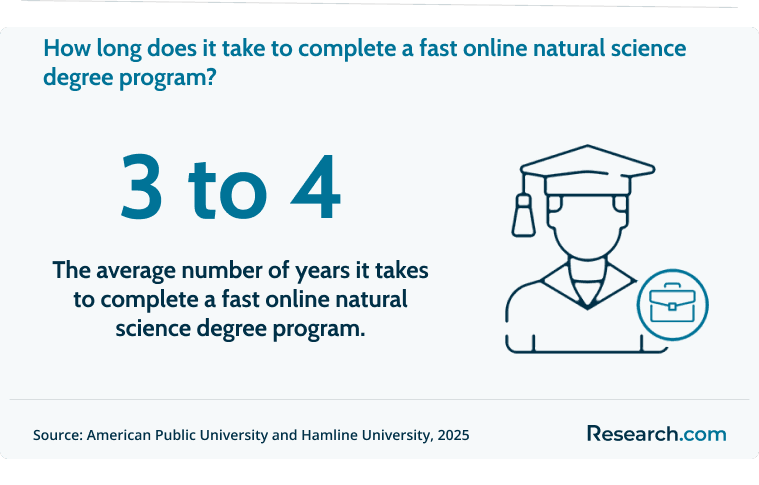
Completion time depends mainly on degree level, transfer credits, course load, lab requirements, and whether the school offers year-round or accelerated terms. A bachelor’s degree in natural science typically requires 120 credit hours and is commonly completed in three to four years by full-time students. Students with prior college credits may finish sooner if the program has generous transfer policies and the required science sequence is available often enough.
| Degree type | Typical credits or length listed | When it makes sense |
| Associate degree | About two years; around 60 credit hours | You want a faster STEM credential, lower upfront cost, or a transfer path into a bachelor’s program. |
| Bachelor’s degree | Three to four years; often 120 credit hours | You need broad science preparation for entry-level roles, graduate study, education pathways, or pre-health preparation. |
| Master’s degree | About 18 months to two years in many formats; some programs are part-time and take longer | You already hold a bachelor’s degree and want advancement in teaching, environmental work, GIS, natural resources, or a specialized science area. |
Accelerated formats can help motivated students move faster, but speed should not be the only priority. Science programs often include sequenced prerequisites, labs, capstones, or field components that cannot always be compressed without affecting learning quality. Students interested in a quick healthcare credential while building toward a science degree may also compare options such as the shortest online pharmacy technician certificate programs.
Graduate-level natural science and science education programs may be completed in about two years of full-time study, while some flexible programs are designed for working adults and may take longer. With experience and advanced credentials, graduates may pursue leadership or specialized roles, including some of the higher-paying careers related to exercise science and applied science backgrounds.
How does an online natural science degree compare to an on-campus program?
An online natural science degree can cover the same academic subjects as a campus program, but the learning experience is different. The biggest questions are how labs are handled, how much structure you need, and whether the program supports your career or graduate school goals.
| Factor | Online natural science program | On-campus natural science program |
| Schedule | Often more flexible for working adults, parents, military students, and learners outside commuting distance. | Usually follows fixed class and lab schedules. |
| Curriculum | May include the same core subjects, including biology, chemistry, environmental science, physics, and mathematics. | Typically offers direct access to campus labs, equipment, and in-person faculty interaction. |
| Labs | May use virtual labs, mailed lab kits, local lab arrangements, or short in-person intensives. | Hands-on lab work is usually embedded into weekly coursework. |
| Peer and faculty interaction | Relies on discussion boards, video meetings, messaging, advising, and online office hours. | Provides face-to-face classroom, lab, and campus networking opportunities. |
| Best for | Self-directed students who can manage deadlines and technology independently. | Students who prefer frequent in-person instruction, lab access, and campus structure. |
Some students use online science coursework alongside short workforce credentials. For example, a learner pursuing healthcare experience may compare accelerated online phlebotomy technician certificate programs while continuing toward a broader science degree.
What is the average cost of an online natural science degree program?
There is no single average cost that applies to every online natural science degree because tuition varies by degree level, residency, institution type, military status, transfer credits, and aid eligibility. The more useful approach is to compare realistic tuition scenarios from the programs listed and then calculate your own net price after grants, scholarships, employer support, or transfer credits.
| Cost scenario | Listed tuition basis | Estimated program tuition described | Important note |
| Standard bachelor’s rate | $350 per credit for a 120-credit program | Approximately $42,000 | This reflects a full bachelor’s program before individual aid or discounts. |
| Military bachelor’s rate | $250 per credit for qualifying military students | About $30,000 | Available to eligible active-duty service members, National Guard members, and reservists at institutions offering this rate. |
| Veteran or grant-supported bachelor’s rate | $315 per credit | About $37,800 | May apply to students who qualify for a Veteran Grant, APUS Opportunity Grant, or similar institutional support. |
| Colorado State University master’s program | $660 per credit for a 31-credit program | About $20,460 | A graduate option for professionals pursuing science education. |
Tuition is only one part of cost. Ask schools about technology fees, textbooks, lab kits, proctored exams, in-person lab travel, graduation fees, and whether transfer credits reduce the total number of credits you must complete. Students who want shorter workforce preparation in parallel with academic study may also review fast-track online sterile processing technician certificate programs.
What are the financial aid options for students enrolling in an online natural science degree program?
Online students in accredited programs may qualify for many of the same aid options as campus-based students. The key is to confirm that the school and program are eligible for the type of aid you plan to use before you enroll.
- Federal financial aid: Students in eligible accredited programs can submit the FAFSA to be considered for federal grants, loans, and work-study options.
- Scholarships and grants: Schools, nonprofits, professional associations, and private organizations may offer merit-based or need-based awards that do not need to be repaid.
- Military and veteran education benefits: Active-duty students, veterans, and eligible family members may be able to use tuition assistance, GI Bill® benefits, military rates, or school-based military grants.
- Employer tuition support: Some employers reimburse tuition or provide education benefits when the degree aligns with the employee’s role or future advancement.
- Institutional aid: Online learners may qualify for transfer scholarships, opportunity grants, veteran grants, or program-specific discounts depending on school policy.
Before borrowing, ask the financial aid office for a full cost-of-attendance estimate and a net price after grants and scholarships. Also ask whether aid covers summer terms, lab fees, and required technology.
What are the prerequisites for enrolling in an online natural science degree program?
Admission requirements vary by school and degree level, but natural science programs usually expect students to be ready for college-level math, science reading, lab assignments, and independent online learning. Graduate programs often expect prior undergraduate coursework in science or a related field.
- Educational background: Bachelor’s programs generally require a high school diploma or GED, while master’s programs usually require a bachelor’s degree, often in a science-related area.
- Math and science preparation: Prior study in algebra, biology, chemistry, physics, or related STEM subjects can help students succeed in core coursework.
- Transcripts and possible test scores: Schools typically request official transcripts, and some programs may ask for SAT, ACT, or GRE scores depending on level and admissions policy.
- Technology access: Online students need a reliable computer, high-speed internet, and any required software for simulations, data analysis, labs, or exams.
- Additional application materials: Graduate programs may request recommendations, a personal statement, a résumé, or evidence of relevant professional experience.
Strong STEM preparation can also support fields such as biotechnology, where students need a foundation in biology, chemistry, data interpretation, and scientific reasoning. Students comparing long-term options can review biotechnology major and career considerations.
What courses are typically in an online natural science degree program?
Natural science degrees are interdisciplinary by design. Most programs combine general education, core science courses, mathematics, research methods, and electives that support a concentration or career direction.
| Course area | What students learn | Why it matters |
| General Biology | Cells, genetics, evolution, ecosystems, and living systems. | Useful for healthcare preparation, ecology, laboratory work, and biological analysis in areas such as forensic science fields. |
| General Chemistry | Atomic structure, bonding, reactions, thermodynamics, and chemical problem-solving. | Important for lab science, health-related prerequisites, environmental testing, and pharmaceuticals. |
| Physics | Motion, energy, forces, waves, heat, and real-world physical systems. | Strengthens quantitative reasoning and supports advanced science and engineering-related study. |
| Earth and Environmental Science | Earth systems, climate, environmental change, and human impacts. | Relevant to conservation, sustainability, environmental monitoring, and natural resource work. |
| Mathematics for Science | Algebra, statistics, calculus, or quantitative methods depending on program level. | Needed for scientific data analysis, modeling, and research interpretation. |
| Scientific Research Methods | Experiment design, data collection, analysis, documentation, and scientific reasoning. | Builds habits that also overlap with precision-focused healthcare roles and medical assistant skills. |
What types of specializations are available in an online natural science degree program?
Specializations help turn a broad natural science degree into a more focused academic and career pathway. Available concentrations vary by school, but common areas include biology, chemistry, physics, environmental science, earth science, marine science, natural resource management, GIS, and science education.
- Biology: Often useful for students interested in anatomy, ecology, genetics, healthcare preparation, laboratory work, or teaching.
- Chemistry: Supports interests in chemical analysis, pharmaceuticals, forensics, materials, and laboratory techniques.
- Earth or environmental science: Focuses on geological systems, ecosystems, environmental assessment, conservation, and climate-related topics.
- GIS and geospatial science: Prepares students to work with mapping, remote sensing, location data, and spatial analysis.
- Natural resource management: Blends environmental science with policy, planning, sustainability, and resource decision-making.
- Science education: Designed for students who want to teach science or strengthen instruction in classroom and informal learning environments.
Some students combine natural science study with applied healthcare training, such as the fastest online surgical tech associate’s degree options, when they want both science knowledge and direct clinical workforce preparation. Students planning to teach may also compare how science education programs align with master’s in education requirements.
How do I choose the best online natural science degree program?
The best program is the one that fits your career target, learning style, budget, and timeline without creating accreditation or transfer problems later. Use the following checklist before applying.
- Confirm accreditation: Choose an institution accredited by a recognized accreditor. Accreditation can affect financial aid, graduate admission, transfer credit, and employer acceptance. The Higher Learning Commission is one example of a regional accrediting body.
- Match the degree level to your goal: An associate degree may support transfer or entry-level STEM exposure, while a bachelor’s degree is usually more appropriate for broader career preparation. A master’s degree is better for specialization or advancement.
- Review lab expectations: Ask whether labs are virtual, mailed, local, or in person. If travel is required, include that in your budget and schedule.
- Check transfer policies: Prior credits can shorten a program, but science courses may expire or may not transfer if they lack labs.
- Compare total cost, not just tuition: Include fees, materials, lab kits, software, travel, lost work time, and the number of credits you must actually complete.
- Evaluate student support: Look for online advising, tutoring, library access, technical help, career services, and faculty availability.
- Ask about outcomes: Request information on internships, graduate school pathways, employer connections, licensure alignment for teaching, and alumni roles.
Questions to ask before enrolling
- Is the program fully online, or are there required campus visits, fieldwork, or lab intensives?
- Will this degree meet prerequisites for the graduate or professional program I may apply to later?
- How many of my prior credits will apply directly to the major?
- Are lab courses accepted by graduate schools, employers, or licensing bodies in my intended field?
- What is the total estimated cost after grants, scholarships, military benefits, or employer support?
- Does the program offer the specialization I need, or is it only a general science degree?
What challenges might I encounter in a fast online natural science degree program?
Accelerated online science programs can be demanding because they compress reading, labs, data analysis, exams, and projects into shorter terms. Students who underestimate the workload may struggle, especially in courses such as chemistry, physics, calculus, or research methods.
| Common challenge | Why it matters | Better approach |
| Choosing speed over fit | A fast program may not offer the specialization, labs, or prerequisites you need. | Start with your target career or graduate program, then work backward. |
| Ignoring accreditation | Accreditation can affect aid, transfer, graduate admission, and employer confidence. | Verify institutional accreditation before applying. |
| Assuming online labs are always enough | Some graduate or professional programs may prefer or require hands-on lab experience. | Ask how labs are delivered and whether they appear clearly on transcripts. |
| Looking only at tuition | Fees, lab kits, software, travel, and repeated courses can change the real cost. | Request a full cost breakdown. |
| Taking too many accelerated science courses at once | Science courses often require problem sets, labs, and exam preparation each week. | Balance difficult courses with your work and family schedule. |
If environmental science is your main interest and affordability is a major factor, compare this list with affordable online environmental science degree programs before deciding.
What career paths are available for graduates of an online natural sciences degree program?
A natural science degree can lead to different outcomes depending on degree level, specialization, certifications, teaching credentials, work experience, and graduate education. Some roles are entry-level, while others require advanced degrees or several years of experience.
| Career path | Salary listed | Typical work | Important consideration |
| Environmental Scientist | $80,060 | Collects environmental data, supports compliance, monitors ecosystems, and helps organizations reduce ecological risks. | A concentration in environmental science, GIS, or natural resources can be helpful. |
| Science Teacher | $68,285 for high school teachers | Teaches biology, chemistry, earth science, physics, or general science to students. | Public school teaching usually requires state certification or licensure. |
| Natural Sciences Manager | $161,180 | Oversees scientific teams, laboratories, research operations, or technical departments. | This is typically an advanced role requiring experience and often graduate-level preparation. |
| Lab Technician | $46,864 | Prepares samples, runs tests, maintains equipment, records data, and supports scientific or healthcare research. | Hands-on lab skills and internships can improve readiness. |
| Policy Analyst | $100,949 | Uses scientific evidence to analyze public health, climate, environmental, or natural resource policy. | Writing, statistics, policy knowledge, and graduate education may strengthen candidacy. |
| Wildlife Biologist | $72,860 | Studies animals, habitats, ecosystems, and conservation issues. | Biology, ecology, fieldwork, and graduate study may be important for advancement. Students may also compare related aquatic careers and marine biologist salary and career paths. |
What is the job market for graduates with an online natural sciences degree?
The labor market is strongest for graduates who connect their science degree to a specific skill set, such as environmental monitoring, GIS, data analysis, laboratory techniques, teaching, natural resource management, or policy analysis. A general natural science degree can be useful, but employers often look for evidence of applied experience through labs, internships, fieldwork, certifications, or technical projects.
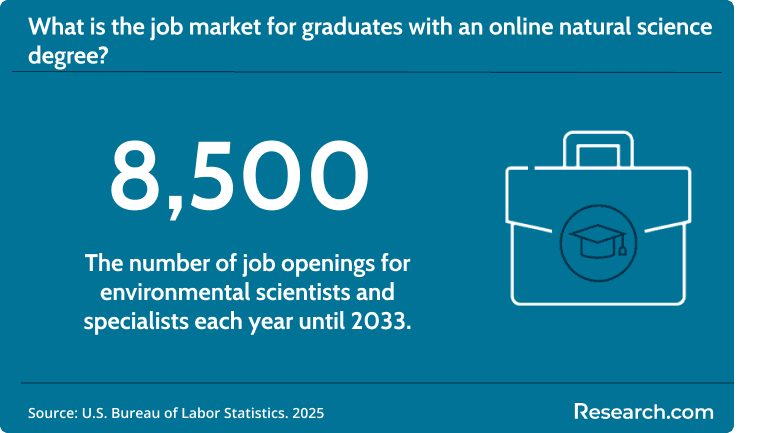
According to the U.S. Bureau of Labor Statistics, employment of environmental scientists and specialists is projected to grow 7 percent from 2023 to 2033, which is faster than the average for all occupations. The same outlook reports an estimated 8,500 openings for environmental scientists and specialists each year over the decade, reflecting both new positions and replacement needs.
Demand is also shaped by environmental regulation, sustainability planning, climate resilience, public health needs, and data-driven decision-making. Graduates with interdisciplinary training and practical experience may be better positioned than those who complete only lecture-based coursework.
What practical experience opportunities are available through online natural science degree programs?
Online natural science programs may include practical learning through virtual labs, mailed lab kits, local field assignments, capstone projects, research modules, internships, or partnerships with employers and community organizations. The quality and format vary widely, so students should ask detailed questions before enrolling.
- Virtual labs: Useful for learning concepts, procedures, and data interpretation, but may not fully replace hands-on laboratory practice in every field.
- Local or short-term in-person labs: Some programs allow students to complete lab or field requirements near home or through brief campus sessions.
- Capstone projects: These can help students apply science knowledge to a real problem and create a portfolio piece for employers or graduate schools.
- Internships and employer projects: Applied experience can strengthen résumés, especially in environmental science, GIS, laboratory science, and natural resources.
- Research or industry collaborations: Some programs connect students to emerging fields, including the biotechnology career path.
What do students often value in fast online natural science programs?
- Elena: "The biggest advantage was being able to keep working while moving through science courses at an accelerated pace. The format required discipline, but it gave me a realistic way to study biology and environmental science without putting my career on hold."
- Leonard: "The online labs were more interactive than I expected, and the course platform made it easier to connect with instructors and classmates outside my region. That exposure helped me think more broadly about how science is used in different communities."
- Renee: "Returning to school online felt challenging at first, especially with family responsibilities. A flexible schedule, strong advising, and steady progress in chemistry and physics made the degree feel manageable instead of overwhelming."
Are online natural science degrees cost-competitive with other STEM fields?
Online natural science programs can be cost-competitive, but the comparison depends on school type, lab requirements, degree level, and career target. A lower-cost natural science degree may be a strong option for students pursuing environmental science, science education, natural resources, or graduate preparation. However, students comparing STEM paths should also weigh salary potential, licensure needs, equipment requirements, transfer rules, and whether the program leads directly to the jobs they want.
For a broader STEM cost comparison, students may review the cheapest online electrical engineering degree programs and compare tuition, program length, accreditation, and career alignment against natural science options.
References
- American Public University System. (2025). Bachelor of Science in Natural Sciences. American Public University program page
- Colorado State University. (2025). Tuition and Fees. CSU Online tuition information
- Glassdoor. (2025). Salary: Science Teacher in the United States 2025. Glassdoor science teacher salary data
- Hamline University. (2025). Master's in Natural Science and Environmental Education. Hamline University program page
- U.S. Bureau of Labor Statistics. (2025). Occupational Outlook Handbook: Environmental Scientists and Specialists. BLS environmental scientists outlook
- ZipRecruiter. (2025). Laboratory Technician Salary. ZipRecruiter laboratory technician salary data and ZipRecruiter salary reference page
Key Insights
- The fastest natural science credential is usually an associate degree, but a bachelor’s or master’s degree may be necessary for environmental science, teaching, graduate school, GIS, or management-oriented goals.
- Online natural science programs can be academically strong, but lab format matters. Confirm whether labs are virtual, mailed, local, or in person before enrolling.
- Do not judge programs only by speed. Accreditation, transfer credit, specialization, total cost, student support, and practical experience are more important for long-term value.
- Program costs vary significantly. Listed examples range from bachelor’s tuition scenarios around $30,000 to approximately $42,000 and a CSU master’s example of about $20,460.
- Career outcomes depend on how focused your degree is. Pairing natural science coursework with GIS, environmental fieldwork, lab skills, teaching certification, or graduate study can make the degree more marketable.
- Before applying, ask whether the program meets your next-step requirements, including graduate prerequisites, teaching certification rules, lab expectations, and employer preferences.
Other Things You Should Know About Fast Online Natural Science Degrees
Fast online natural sciences degree programs typically take about 12 to 24 months to complete. These programs are designed to accelerate learning paths, allowing students to earn their degrees faster than traditional timelines, without sacrificing the depth and quality of education typically provided in the field of natural sciences.
Fast online natural sciences degree programs in 2027 offer various support resources, including virtual tutoring, online library access, discussion forums, and academic advising. These resources help students grasp course material effectively and successfully manage their accelerated studies.
It is possible, but it depends on the program’s structure and the student’s time management skills. Many fast-track programs are asynchronous and flexible, making them suitable for working professionals. However, because of the intensive pace, students should be prepared to commit significant time each week to keep up with coursework, especially during lab-heavy terms.