2027 Fastest Online Environmental Engineering Degree Programs

Co-Founder and Chief Data Scientist
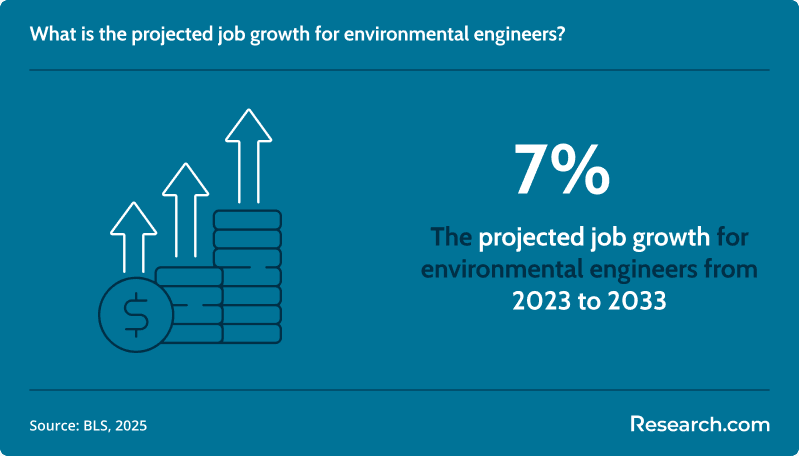
Many individuals want to become environmental engineers, but their busy schedules create a challenge. They often wonder if online environmental engineering degrees offer the same quality as traditional campus programs. They also ask if fast-track options exist. This is an important consideration, especially since environmental engineer jobs are projected to grow 7% from 2023 to 2033—a rate faster than average.
For over a decade, the Research.com team has guided career planning. We thoroughly researched and built this article using only reliable sources. As you read on, you'll learn whether online environmental engineering degrees are legitimate and beneficial. You'll also discover accelerated programs to help you quickly achieve your career goals.
What are the benefits of getting an online environmental engineering degree program?
- Unlocks diverse job opportunities—work as an environmental engineer, consultant, water resources manager, or director in sustainability roles across public and private sectors, including positions that allow remote and flexible work arrangements.
- Offers strong earning potential, with median salaries for environmental engineers reaching about $104,170 per year in the United States.
- Experience greater flexibility and accessibility—online programs let you balance your studies with work or family commitments, access top programs without commuting, and complete coursework on your schedule.
What can I expect from an online environmental engineering degree program?
An online environmental engineering degree program covers core topics like water treatment, pollution control, sustainable design, and environmental law. You’ll complete a structured curriculum that often includes a capstone project—allowing you to apply classroom knowledge to real-world problems. Some programs also require internship hours, giving you practical, hands-on experience in the field.
Tuition varies widely, but you can expect a range from about $15,000 to $40,000 for the entire program, depending on the institution and degree level. Courses are delivered through interactive online platforms. You’ll access lectures, assignments, and discussions virtually, giving you the flexibility to study from anywhere while collaborating with classmates and professors through forums, live sessions, and online labs.
Where can I work with an online environmental engineering degree?
An online environmental engineering degree opens doors to a diverse range of careers across various sectors. Graduates can work for corporations, government agencies, nonprofits, or start their consulting businesses. Common roles include project manager, consultant, health and safety director, and green building engineer. Many also find positions in research, management, education, or even creative and tech-focused industries.
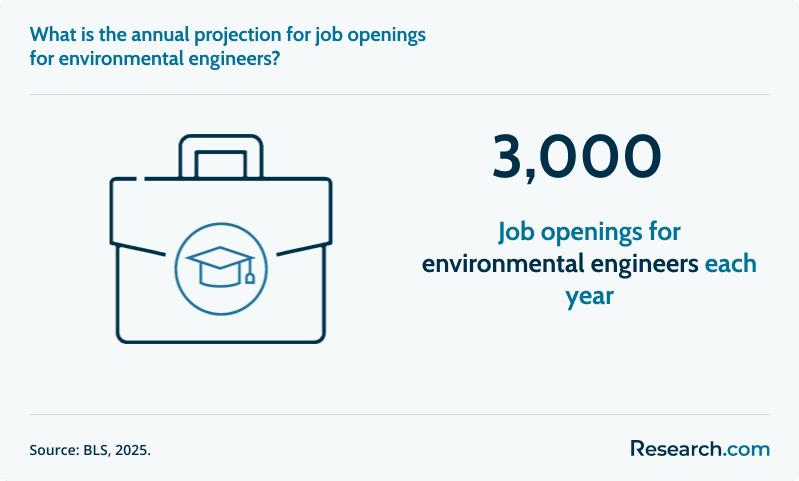
Environmental engineers are in demand. About 3,000 openings are projected each year, on average, over the decade. Key skills, such as problem-solving, communication, and critical thinking, help graduates adapt and succeed in various environments, from fieldwork to leadership and innovation roles.
How much can I make with an online environmental engineering degree?
Entry-level professionals with an online environmental engineering degree can expect to earn a median salary of $75,000. However, several factors influence earning potential. For example, experienced engineers, those in government or large corporations, or those working in states like California or major metropolitan areas often earn more. Additionally, pursuing an advanced degree or relevant certifications, such as a Professional Engineer (PE) licensure, can significantly boost your salary and unlock management positions.
- List of the Best Online Environmental Engineering Degree Programs for 2027 List of Programs
- How long does it take to complete an online environmental engineering degree program? Completion Time
- How does an online environmental engineering degree program compare to an on-campus program? How does an online environmental engineering degree program compare to an on-campus program?
- What is the average cost of an online environmental engineering degree program? Average Cost
- What are the financial aid options for students enrolling in an online environmental engineering degree program? Financial Aid
- What are the prerequisites for enrolling in an online environmental engineering degree program? Requirements
- What courses are typically in an online environmental engineering degree program? What courses are typically in an online environmental engineering degree program?
- What types of specializations are available in an online environmental engineering degree program? What types of specializations are available in an online environmental engineering degree program?
- How to Choose the Best Online Environmental Engineering Degree Program How to Choose the Best Online Environmental Engineering Degree Program
- Are comprehensive student support services and career resources integrated into online environmental engineering programs? Are comprehensive student support services and career resources integrated into online environmental engineering programs?
- What career paths are available for graduates of an online environmental engineering degree program? Career Paths
- How do online environmental engineering programs integrate interdisciplinary innovation and emerging technologies? How do online environmental engineering programs integrate interdisciplinary innovation and emerging technologies?
- Is an online environmental engineering degree cost-effective compared to other engineering programs? Is an online environmental engineering degree cost-effective compared to other engineering programs?
- What is the job market for graduates with an online environmental engineering degree program? Job Market
Best Online Environmental Engineering Degree Programs for 2027
Choosing an online environmental engineering degree is not just a question of convenience. It affects your licensure options, technical training, career direction, tuition cost, and ability to keep working while you study. The best program for you depends on whether you want a practice-focused engineering credential, a research-oriented master’s degree, a water resources specialization, a compliance-focused career, or a pathway into consulting, public agencies, or infrastructure work.
This guide reviews leading online environmental engineering degree programs, explains how they differ, and shows what to check before applying. You will find program comparisons, cost and time expectations, admissions requirements, specialization options, career paths, financial aid choices, and practical questions to ask schools before enrolling.
Quick answer: What is the best online environmental engineering degree program?
The strongest online environmental engineering program is the one that matches your career goal, schedule, budget, and licensure needs. For many working engineers, the best fit is a regionally accredited graduate program with 30 to 36 credits, flexible online delivery, strong faculty expertise in water, air, waste, or remediation, and clear support for capstone projects, research, or professional advancement. If you plan to pursue professional engineering licensure, confirm whether the degree and your prior engineering education meet your state’s requirements before enrolling.
How our online environmental engineering degree rankings are developed
Because graduate engineering education can require a major financial commitment, the ranking process uses transparent education data to help students compare programs more carefully. Research.com reviews information from the Integrated Postsecondary Education Data System, Peterson's data resources, the College Scorecard, and the National Center for Education Statistics. These sources help evaluate institutional quality, student outcomes, affordability, and program-level information where available. You can review the broader ranking approach on our methodology page.
Online environmental engineering programs at a glance
| Rank | University and program | Program length | Reported cost | Total credits | Accreditation |
| 1 | University of Wisconsin-Madison - Civil & Environmental Engineering: Environmental Engineering MEng | 2-3 years | $1,300 | 30 | Higher Learning Commission (HLC) |
| 2 | North Carolina State University - Master of Environmental Engineering (MENE) | 2-3 years | $679.43 (residents) | 30 | SACSCOC |
| 3 | University of Florida - Environmental Engineering Sciences (Systems Ecology & Ecological Engineering) M.Sc. | As little as 24 months | $12,680 | 10 courses (equivalent credit hours not specified). | SACSCOC |
| 4 | California State University, Fullerton - Master of Science in Environmental Engineering | 2 years | $14,128.94 total semester cost (residents) | N/A | Western Association of Schools and Colleges Senior College and University Commission (WSCUC) |
| 5 | University of North Dakota - Environmental Engineering M.S.../M.Eng. | 18 months | $798.08 | 30 | HLC |
| 6 | Worcester Polytechnic Institute (WPI) - Master of Science in Environmental Engineering | 18-24 months | $1,464 | 33 | New England Commission of Higher Education (NECHE) |
| 7 | University of Illinois Urbana-Champaign - Master of Science in Environmental Engineering (MSEE) | 1 to 5 years | $1183 | 36 | HLC |
| 8 | Old Dominion University - Master of Science in Environmental Engineering | 2 years | $486 (residents) | 30 | Accreditation Board for Engineering and Technology (ABET) |
| 9 | Johns Hopkins University - Master's in Environmental Engineering | 2-3 years | $1,585 | 30 | ABET |
| 10 | University of Kansas - Online Master's in Environmental & Water Resources Engineering | 1-2 years | $795 per credit hour | 30 | HLC |
1. University of Wisconsin-Madison - Civil & Environmental Engineering: Environmental Engineering MEng
The fully online Master of Engineering in Environmental Engineering at the University of Wisconsin-Madison is built for engineers who want applied graduate training rather than a campus-based research experience. The program emphasizes professional skills in water treatment, waste management, environmental cleanup, and sustainable engineering practice, making it a strong option for students who want to move into higher-level technical or leadership responsibilities.
- Program length: 2-3 years
- Cost per credit: $1,300
- Total credits: 30
- Accreditation: Higher Learning Commission (HLC)
2. North Carolina State University - Master of Environmental Engineering (MENE)
The online Master of Environmental Engineering from North Carolina State University is intended for engineers who want advanced preparation in areas such as air quality, water resources, and environmental process design. The program does not require a thesis or campus residency, which can make it practical for working professionals seeking roles in consulting, project management, environmental compliance, or public-sector engineering.
- Program length: 2-3 years
- Cost per credit: $679.43 (residents)
- Total credits: 30
- Accreditation: SACSCOC
3. University of Florida - Environmental Engineering Sciences (Systems Ecology & Ecological Engineering) M.Sc.
The University of Florida offers an online Master of Science in Environmental Engineering Sciences with a concentration in Systems Ecology & Ecological Engineering. Students complete 10 courses and study ecological systems, environmental problem-solving, and engineering-based approaches to sustainability. The online degree follows the same academic expectations as the campus version and does not require campus visits.
- Program length: As little as 24 months
- Cost per credit: $12,680
- Total credits: 10 courses (equivalent credit hours not specified).
- Accreditation: SACSCOC
4. California State University, Fullerton - Master of Science in Environmental Engineering
The online Master of Science in Environmental Engineering at California State University, Fullerton is structured for professionals who want a cohort-based graduate experience. Coursework covers applied environmental topics such as water treatment and waste management, and the program includes a team capstone project. This format can be especially useful for students who want technical development with peer collaboration.
- Program length: 2 years
- Cost per credit: $14,128.94 total semester cost (residents)
- Total credits: N/A
- Accreditation: Western Association of Schools and Colleges Senior College and University Commission (WSCUC)
5. University of North Dakota - Environmental Engineering M.S.../M.Eng.
The University of North Dakota offers both online Master of Science and Master of Engineering options in Environmental Engineering. The program examines ways to protect air, water, and soil from industrial and human impacts. Students complete online coursework along with research and applied learning requirements, including a required campus visit.
- Program length: 18 months
- Cost per credit: $798.08
- Total credits: 30
- Accreditation: HLC
6. Worcester Polytechnic Institute (WPI) - Master of Science in Environmental Engineering
The online Master of Science in Environmental Engineering at WPI is designed for students interested in stormwater management, industrial waste, water quality, physicochemical treatment, and sustainability. The program blends applied and theoretical study and allows students to shape their coursework around professional interests.
- Program length: 18-24 months
- Cost per credit: $1,464
- Total credits: 33
- Accreditation: New England Commission of Higher Education (NECHE)
7. University of Illinois Urbana-Champaign - Master of Science in Environmental Engineering (MSEE)
The online Master of Science in Environmental Engineering from the University of Illinois Urbana-Champaign gives students a flexible route to graduate-level environmental engineering study. The program is suitable for professionals who need time to balance coursework with employment, as students may complete the degree over a broad timeline while earning the same degree as campus students.
- Program length: 1 to 5 years
- Cost per credit: $1183
- Total credits: 36
- Accreditation: HLC
8. Old Dominion University - Master of Science in Environmental Engineering
Old Dominion University offers a Master of Science in Environmental Engineering that can be completed online or on campus. The curriculum addresses water quality, air quality, pollution prevention, waste management, and related technical topics. It may appeal to students preparing for advanced roles in government, industry, and environmental engineering practice.
- Program length: 2 years
- Cost per credit: $486 (residents)
- Total credits: 30
- Accreditation: Accreditation Board for Engineering and Technology (ABET)
9. Johns Hopkins University - Master's in Environmental Engineering
The part-time online Master's in Environmental Engineering at Johns Hopkins University is designed for professionals working on problems related to waste, pollution, climate change, green building, and renewable energy research. Students learn from faculty and industry practitioners while building skills for technical leadership and advanced environmental problem-solving.
- Program length: 2-3 years
- Cost per credit: $1,585
- Total credits: 30
- Accreditation: ABET
10. University of Kansas - Online Master's in Environmental & Water Resources Engineering
The University of Kansas offers a 100% online Master's in Environmental & Water Resources Engineering. The program uses synchronous online courses and focuses on water and air quality, waste, wetlands management, research skills, and engineering problem-solving. It is a practical option for professionals interested in consulting, infrastructure, and public-sector work.
- Program length: 1-2 years
- Cost per credit: $795 per credit hour
- Total credits: 30
- Accreditation: HLC
How long does it take to complete an online environmental engineering degree program?
Most online master’s programs in environmental engineering take one to five years to complete. The timeline depends on the number of credits required, whether you enroll full time or part time, and whether the program includes a thesis, capstone, campus visit, or synchronous course schedule.
Many programs require 30 to 36 credits. Students who can study intensively may finish in about one year, while working professionals often spread courses over two or three years. Programs with the most flexible pacing may allow up to five years.
| Study pace | Typical fit | What to consider |
| Accelerated full-time study | Students who can reduce work commitments and manage a heavy course load | Faster completion can reduce time away from advancement opportunities, but the workload may be demanding. |
| Standard part-time study | Working engineers, consultants, public-sector employees, and military-affiliated students | This is often the most realistic path for students balancing job, family, and tuition planning. |
| Extended flexible study | Students who need slower pacing because of work travel, family obligations, or employer tuition limits | Confirm the maximum completion window and whether required courses are offered often enough. |
If your goals are more business-oriented than technical, you may also compare environmental engineering programs with fast online MBA programs in environmental management. An MBA path usually emphasizes leadership, operations, finance, and environmental management rather than engineering design.
How does an online environmental engineering degree program compare to an on-campus program?
An online environmental engineering degree can cover the same academic material as a campus program, but the experience is different. The biggest differences involve flexibility, laboratory access, networking, and how easily you can combine school with full-time work.
| Factor | Online environmental engineering degree | On-campus environmental engineering degree |
| Schedule | Often designed for working students, with asynchronous or scheduled virtual classes depending on the program | Usually follows fixed class times and campus-based academic calendars |
| Location | Allows students to study without relocating, though some programs may require campus visits | Requires regular campus attendance and may require relocation or commuting |
| Hands-on learning | May use virtual labs, simulations, team projects, field assignments, or limited in-person intensives | Typically offers easier access to physical labs, campus research facilities, and in-person workshops |
| Networking | Depends heavily on online cohorts, faculty access, employer connections, and virtual events | Often provides more spontaneous interaction with faculty, classmates, labs, and campus recruiters |
| Career continuity | Useful for professionals who want to apply new knowledge immediately at work | May be better for students who want a traditional graduate school environment or full-time research experience |
Online study is often best for students who already work in engineering, environmental compliance, infrastructure, utilities, consulting, or government roles. Campus study may be better if you want daily lab access, a thesis-heavy research experience, or deeper in-person faculty mentorship. If you are also interested in policy and infrastructure planning, you can compare this path with accelerated online energy policy degree programs.
What is the average cost of an online environmental engineering degree program?
The price of an online environmental engineering degree depends on the credential level, institution type, residency status, credit requirements, fees, and whether the university charges online students a separate tuition rate. Public universities may offer lower tuition for residents, while private institutions and out-of-state rates can raise the total cost.
An online master's degree in environmental engineering typically ranges from around $9,000 to $35,000 in total. Some lower-cost programs report annual tuition as low as $6,500 to $10,000, while more expensive, private, or out-of-state programs may exceed $30,000. Across the nation, an online environmental engineering master's degree for in-state students averages approximately $34,900.
Cost factors students often overlook
- Fees: Technology, distance learning, graduation, and course fees can change the real price.
- Residency rules: Some universities charge different rates for residents and nonresidents.
- Credit load: A 36-credit program may cost more than a 30-credit program even if the per-credit price looks competitive.
- Travel requirements: Short campus visits, labs, or intensives can add transportation and lodging costs.
- Time to completion: Studying part time may make tuition easier to manage, but it can extend the period before you see career benefits.
Students who want shorter, technical, non-degree training should understand that trade school and certification programs serve different goals. For example, affordable online HVAC trade school and certification options can cost as little as a few hundred to a couple of thousand dollars, depending on curriculum depth and included certifications, but they do not replace an engineering degree.
What are the financial aid options for students enrolling in an online environmental engineering degree program?
Online graduate students may qualify for several forms of financial support, but aid availability varies by school, enrollment status, employer, and program structure. Before applying, ask each university whether online students receive the same access to aid, assistantships, military benefits, and payment plans as campus students.
| Financial aid option | How it can help | What to verify |
| Employer tuition assistance | Some employers reimburse part of the cost for job-related graduate study. Johns Hopkins reports that about 78% of its enrolled students’ tuition is covered by employer tuition reimbursement or assistance. | Check annual reimbursement caps, grade requirements, service commitments, and whether the program must be preapproved. |
| Scholarships and fellowships | Engineering departments and universities may offer awards for civil, environmental, or sustainability-focused students. | Ask whether online and part-time students are eligible. |
| Federal student aid | Eligible graduate students may use federal loans, including Direct Unsubsidized and Grad PLUS loans, and possibly work-study. | Complete the FAFSA application process to determine eligibility. |
| Teaching and research assistantships | Some universities, including Old Dominion University, offer assistantship opportunities that may include tuition remission and stipends. | Confirm whether assistantships are available to online students and whether they require campus work. |
| Military and veterans benefits | Programs may be eligible for education benefits through the U.S. Department of Veterans Affairs or Department of Defense programs. | Verify benefit eligibility with both the school and the relevant benefits office. |
| Institutional aid and payment plans | Universities may offer grants, fee waivers, installment plans, or online-student funding. | Ask the financial aid office for a total cost estimate, not just tuition. |
What are the prerequisites for enrolling in an online environmental engineering degree program?
Most online environmental engineering master’s programs expect applicants to have a technical academic background. Requirements differ by university, but admissions committees usually look for evidence that you can handle graduate-level engineering math, science, and design work.
- Bachelor’s degree: Many programs require an undergraduate degree in engineering, preferably environmental, civil, or a closely related field, from an accredited institution. Some schools prefer or require an ABET-accredited background.
- Minimum GPA: A common benchmark is around 3.0 on a 4.0 scale, although each program sets its own standard.
- Prerequisite coursework: Applicants may need previous study in calculus, physics, chemistry, biology, geology, statistics, and differential equations. Students missing key courses may be admitted conditionally or asked to complete prerequisites first.
- Testing requirements: Some programs require the GRE, while others waive it for applicants with a U.S. engineering degree. International applicants may need TOEFL or IELTS scores if their prior education was not completed in English or outside the U.S.
- Application materials: Expect to submit transcripts, a statement of purpose, recommendation letters, and a current resume.
- Plan of study: Some universities require admitted students to work with an advisor to build an individualized course plan.
If you are comparing environmental engineering with a healthcare-focused advanced degree, the admissions pathway will be very different. For example, a fast online MSN in nurse midwifery is built around nursing licensure and clinical preparation, not engineering prerequisites.
The environmental engineering workforce also reflects demographic patterns, including gender representation. The visual below summarizes that breakdown.
What courses are typically in an online environmental engineering degree program?
Online environmental engineering programs usually combine engineering fundamentals with specialized study in water systems, air quality, waste treatment, environmental systems, sustainability, and regulatory problem-solving. Course names vary by university, but many programs include both technical and management-oriented coursework.
- Engineering in the Global Environment: Students examine how engineers manage projects across borders, including regulatory expectations, communication challenges, cultural context, collaboration tools, and outsourcing decisions.
- Introduction to Systems Engineering: This course introduces methods for designing, evaluating, and managing complex engineered systems over their life cycles.
- Principles of Engineering Management: Coursework focuses on project planning, leadership, risk, organizational decision-making, and communication within technical teams.
- Technology Innovation and Strategy for Engineers: Students study how organizations manage innovation, align technical development with strategy, and bring new engineering solutions into practice.
How to evaluate a curriculum before applying
- Check whether the program offers courses in your target area, such as water resources, air quality, hazardous waste, stormwater, or remediation.
- Ask whether online students complete a thesis, capstone, design project, or exam.
- Review how often required courses are offered so you do not face delays.
- Look for applied assignments that use real environmental data, case studies, modeling tools, or compliance scenarios.
- Confirm whether the program includes professional practice topics such as permitting, risk analysis, and environmental law.
Students comparing environmental engineering with life science careers may also ask, whether biotechnology is a good major and career choice. Biotechnology and environmental engineering can overlap in areas such as bioremediation and sustainable manufacturing, but the degree requirements, lab expectations, and job markets are not the same.
What types of specializations are available in an online environmental engineering degree program?
Specializations help you align graduate study with the kind of environmental problems you want to solve. Some programs offer formal concentrations, while others let you build a focus through electives, capstone work, or faculty-supervised projects. Students who want a broader science-based route can also compare engineering programs with accelerated online environmental science degree programs.
Air Quality Management
This focus prepares students to analyze, monitor, and reduce air pollution. Coursework may address emission control, atmospheric modeling, environmental regulations, and technologies used to limit health and environmental impacts.
Water Quality Management
Students study drinking water treatment, wastewater systems, water reuse, contaminant removal, and sustainable water supply. This specialization is especially relevant for careers in utilities, infrastructure, consulting, and public agencies.
Solid and Hazardous Waste Management
This area covers the handling, treatment, disposal, and reduction of solid and hazardous waste. Students may study landfill design, hazardous waste rules, waste minimization, and remediation technologies.
Geoenvironment Quality Management
This specialization focuses on soil, groundwater, contamination assessment, remediation planning, and risk analysis. It is useful for students interested in site cleanup, land development, and environmental restoration.
Environmental Systems Engineering
Students learn to approach environmental challenges as interconnected systems. This focus can support work in infrastructure planning, sustainability analysis, climate adaptation, and integrated environmental process design.
MS vs. MEng: which degree type fits your goal?
| Degree type | Best fit | Common emphasis |
| Master of Science in Environmental Engineering | Students interested in research, technical specialization, doctoral study, or analytical roles | May include a thesis, deeper theory, research methods, or specialized technical analysis |
| Master of Engineering in Environmental Engineering | Working engineers who want practical advancement and applied project skills | Often coursework-heavy, industry-focused, and oriented toward professional engineering practice |
For a more detailed comparison, review the differences between a Master of Engineering and a Master of Science in Engineering. Your choice should reflect whether you want a research-heavy path, a practice-focused path, or a blend of both.
The chart below highlights core skills environmental engineers commonly need to build throughout their education and careers.
How to Choose the Best Online Environmental Engineering Degree Program
A strong program should do more than fit your schedule. It should support your technical goals, meet accreditation expectations, offer relevant coursework, and provide enough academic and career support for online learners. Use the criteria below before applying.
1. Confirm institutional and program accreditation
Start with regional accreditation at the university level. Then check whether program-level ABET accreditation matters for your goals, especially if you plan to pursue professional engineering licensure. Requirements can vary by state, so contact your licensing board if licensure is part of your plan.
2. Match the curriculum to your career direction
Do not choose a program based only on the degree title. Review the course catalog, electives, faculty research, and capstone options. A student interested in water systems should not choose a program with limited water resources coursework, and a student targeting environmental compliance should look for regulatory and risk-focused content.
3. Compare faculty expertise and industry connections
Look for faculty members with research or professional experience in your area of interest. Also ask about employer partnerships, professional associations, project sponsors, and opportunities to work on applied problems with real clients or agencies.
4. Review outcomes and student support
Graduation rates, career services, alumni networks, advising access, and online student retention can reveal how well a program supports distance learners. Ask whether online students receive the same career coaching, library resources, tutoring, technical support, and faculty access as campus students.
5. Evaluate the total cost, not just tuition
Compare per-credit tuition, fees, books, software, travel, residency rules, and expected time to completion. If your employer pays tuition annually, a slower part-time path may be financially smarter than an accelerated path. Students interested in leadership outside engineering may also compare focused administrative credentials, such as a fast online graduate certificate for nurse administrators, to understand how different career fields structure graduate training.
Questions to ask before enrolling
- Is the university regionally accredited?
- Is the engineering program ABET-accredited, and does that matter for my state licensure plan?
- Are online students eligible for the same scholarships, assistantships, and career services as campus students?
- Does the program require campus visits, labs, synchronous sessions, or proctored exams?
- Which courses are offered every term, and which are offered less often?
- Can I study part time without delaying required course sequencing?
- What software, lab kits, fieldwork, or technical tools are required?
- How does the program support capstone projects, research, or employer-based applied work?
Are student support services and career resources available in online environmental engineering programs?
Many online environmental engineering programs provide academic advising, technical help, virtual library access, career coaching, resume reviews, interview preparation, and networking opportunities. The quality of support varies widely, so prospective students should ask specific questions rather than assume online learners receive the same services as campus students.
Strong programs make support easy to access outside standard business hours, connect students with faculty mentors, and provide career resources that reflect environmental engineering employers. If cost is your top concern and you are comparing related fields, you can also review affordable online environmental science bachelor’s programs to see how lower-cost environmental pathways differ from graduate engineering degrees.
Common mistakes when choosing an online environmental engineering degree
| Mistake | Why it can hurt you | Better approach |
| Choosing based only on ranking | A highly ranked school may not offer your preferred specialization or schedule. | Use rankings as a starting point, then compare curriculum, cost, accreditation, and support. |
| Ignoring licensure requirements | Not every degree path automatically supports professional engineering licensure. | Check your state board’s rules before applying. |
| Looking only at tuition | Fees, travel, software, and delayed completion can increase total cost. | Request a full cost estimate from each school. |
| Assuming online means self-paced | Some programs use live sessions, cohorts, or strict deadlines. | Ask about synchronous requirements and course sequencing. |
| Overlooking faculty fit | You may struggle to find mentorship or capstone support in your focus area. | Review faculty profiles and ask who advises students in your specialization. |
What career paths are available for graduates of an online environmental engineering degree program?
Graduates of online environmental engineering programs can pursue roles in consulting firms, utilities, environmental agencies, construction and infrastructure companies, manufacturing, energy, research organizations, and local, state, or federal government. The degree format matters less than the program’s quality, accreditation, technical relevance, and your prior engineering background.
Environmental Engineers
- Design and improve systems that address pollution control, waste treatment, contaminated sites, water quality, and ecosystem restoration.
- Work may involve permitting, compliance, site assessment, remediation planning, modeling, and engineering design.
Water Resources and Treatment Specialists
- Common roles include water project manager, wastewater engineer, stormwater specialist, and flood risk manager.
- These professionals evaluate treatment systems, inspect infrastructure, monitor performance, and help ensure compliance with health, safety, and environmental standards.
Environmental Consultants
- Consultants advise companies, developers, public agencies, and communities on environmental impact, compliance, sustainability, and risk reduction.
- Work often includes site assessments, sampling plans, pollution data analysis, remediation reports, and client recommendations.
Academic or Research Careers
- University teaching and research roles often require a master’s degree or Ph.D., depending on the institution and position.
- Responsibilities may include teaching environmental engineering courses, conducting funded research, publishing findings, and supervising student projects.
Environmental work is becoming more data-intensive, especially in monitoring, modeling, risk assessment, and infrastructure planning. Students who want to strengthen analytical skills may consider an accelerated online graduate certificate in data analytics alongside or after an engineering degree.
How do online environmental engineering programs use interdisciplinary innovation and emerging technologies?
Environmental engineering increasingly intersects with data science, public health, infrastructure planning, climate resilience, biotechnology, energy systems, and policy. Online programs may reflect this shift through simulation-based assignments, collaborative design projects, virtual labs, modeling tools, case studies, and interdisciplinary electives.
Students should look for programs that teach more than traditional treatment systems. Useful preparation may include environmental data analysis, sensor-based monitoring, systems thinking, life-cycle assessment, risk communication, and regulatory decision-making. Graduates who understand both engineering and adjacent fields may find broader opportunities in sustainability, remediation, water infrastructure, and biotechnology-related careers connected to environmental applications.
Is an online environmental engineering degree cost-effective compared to other engineering programs?
An online environmental engineering degree can be cost-effective when it helps you advance professionally without leaving the workforce, qualifies for employer tuition assistance, and aligns with a clear career plan. However, the return on investment depends on tuition, fees, time to completion, your current role, and whether the degree supports advancement in your specific industry.
To judge value, compare programs by total cost, credit requirements, accreditation, career services, specialization fit, and expected use of the degree. It can also help to compare environmental engineering with other online engineering fields. For example, reviewing low-cost online electrical engineering degree programs can give you a broader view of affordability and trade-offs across engineering disciplines.
What is the job market for graduates with an online environmental engineering degree program?
Graduates of accredited online environmental engineering programs can compete for roles in public agencies, private consulting, utilities, infrastructure, remediation, industry, and research. Employers generally care most about technical competence, accreditation, relevant experience, licensure status, and the applicant’s ability to solve real environmental problems.
The U.S. Bureau of Labor Statistics projects employment of environmental engineers to grow by 7% from 2023 to 2033, about as fast as the average for all occupations. An estimated 3,000 openings per year are expected, driven by replacement needs and new roles in pollution control, water resources, and remediation. In 2023, approximately 41,300 environmental engineers were employed. The main employer categories are shown below.
What Graduates Say About Online Environmental Engineering Degree Programs
- Shiela: "Earning my environmental engineering degree online let me keep my full-time job while building stronger knowledge in remediation and sustainable engineering. The schedule flexibility mattered, but the biggest benefit was being able to use new concepts immediately in my workplace."
- Zack: "I worried that an online engineering program would feel too theoretical, but the simulations, virtual activities, and project work gave me a practical learning experience. The program helped me understand environmental systems more deeply and supported my move into pollution control work."
- Bonney: "The online format made graduate school possible while I managed family responsibilities. I could review lectures when needed, work through difficult topics at my own pace, and build a stronger understanding of climate adaptation and resource management."
Key Insights
- Best fit depends on career goal: Choose a program based on specialization, accreditation, cost, format, and licensure relevance, not name recognition alone.
- Most online master’s programs require 30 to 36 credits: Completion can range from one to five years depending on pace and program design.
- Accreditation matters: Regional accreditation is essential, and ABET accreditation may be important if professional engineering licensure is part of your plan.
- Total cost is more than tuition: Compare fees, software, travel, residency rates, and employer reimbursement rules before deciding.
- Online does not always mean self-paced: Some programs require live classes, cohort participation, campus visits, capstones, or specific course sequencing.
- Specialization should drive your choice: Water resources, air quality, hazardous waste, remediation, and systems engineering lead to different coursework and career options.
- The job market is steady but competitive: BLS projects 7% employment growth from 2023 to 2033, so practical experience, technical tools, and licensure planning can improve your prospects.
- Ask direct questions before applying: Confirm online student support, career services, course availability, faculty access, and whether the degree supports your state’s licensure requirements.
References
- ZipRecruiter. 9 of the Highest Paying Environmental Engineer Jobs in 2025. Retrieved July 25, 2025, from https://www.ziprecruiter.com/g/Highest-Paying-Environmental-Engineer-Jobs
- Zippia. Environmental Engineer Demographics and Statistics [2025]: Number of environmental engineers in the US. Retrieved from https://www.zippia.com/environmental-engineer-jobs/demographics
- PayScale. Environmental Engineer salary in 2025. Retrieved from https://www.payscale.com/research/US/Job=Environmental_Engineer/Salary
- ZipRecruiter. Environmental Engineering Manager salary. Retrieved July 25, 2025, from https://www.ziprecruiter.com/Salaries/Environmental-Engineering-Manager-Salary
- Salary.com. Environmental Engineering Manager salary. Retrieved July 25, 2025, from https://www.salary.com/research/salary/benchmark/environmental-engineering-manager-salary
- Bureau of Labor Statistics. Environmental engineers. Retrieved from https://www.bls.gov/ooh/architecture-and-engineering/environmental-engineers.htm#tab-6
- Zippia. How to become an environmental engineer: what it is and career path. Retrieved from https://www.zippia.com/environmental-engineer-jobs
Other Things You Should Know About Online Environmental Engineering Degree Programs
Completing an online environmental engineering degree quickly in 2027 involves enrolling in accelerated programs that offer shorter terms or allow for taking more credits per semester. Prioritize programs that offer flexible scheduling, have generous credit transfer policies, and provide year-round course availability.
The speed of completion depends on factors such as accelerated course formats, availability of transfer credits, 24/7 access to online materials, and flexible scheduling. Programs in 2027 may offer condensed modules or competency-based learning to facilitate faster graduation within personal timelines.
The fastest online environmental engineering degree programs in 2027 typically offer accelerated courses, flexible scheduling, and credit for prior learning. These programs use cutting-edge technology to deliver coursework efficiently while meeting rigorous academic standards, allowing students to graduate in less time without compromising education quality.