
2027 Fastest Online Energy Policy Degree Programs

Co-Founder and Chief Data Scientist
As a career and education expert, I understand that identifying the best accelerated online energy policy degree is a significant challenge. The web is rife with programs making bold claims, but discerning actual completion times, curriculum quality, and true costs requires a sharp eye. Many prospective students encounter conflicting information and opaque details, making a confident choice feel impossible.
My purpose is to provide clarity. This guide filters out the promotional noise, presenting a vetted list of the fastest U.S. programs. Here, you will find the straightforward, accurate information necessary to advance your career in this vital field.
What are the benefits of getting an online energy policy degree?
- Career Advancement: Opens pathways to influential roles like Energy Policy Analyst, Sustainability Manager, Regulatory Affairs Specialist, and Energy Consultant.
- Earning Potential: Professionals with this specialized degree can pursue roles with median salaries often ranging from $70,000 to over $100,000 annually.
- Flexible Learning: The online format offers the convenience of studying from any location, making it possible to balance advanced education with a current career.
What can I expect from an online energy policy degree program?
- Focused Advanced Topics: Expect an intensive curriculum centered on key areas like renewable energy finance, grid modernization, environmental law, and global energy markets.
- Structured Curriculum: Delivery typically combines recorded video lectures, live online seminars, policy memo assignments, and data analysis projects.
- Applied Strategic Knowledge: Emphasis is placed on solving real-world energy challenges through economic modeling and policy analysis.
- Condensed Timeline: Accelerated programs are designed to be completed quickly, often in 12-24 months, to fast-track your career advancement.
- Networking Opportunities: Connect with experienced faculty and a diverse cohort of professionals from government, non-profit, and private sector energy industries.
Where can I work with an online energy policy degree?
- Government Agencies: Shape regulations and initiatives at the federal or state levels with employers like the Department of Energy (DOE) or the Environmental Protection Agency (EPA).
- Utility and Energy Companies: Work for renewable energy developers or traditional utilities to navigate regulatory landscapes and develop sustainability strategies.
- Private Consulting: Advise corporate clients on energy efficiency, procurement, and compliance with environmental policies.
- Non-Profit and Advocacy Groups: Drive policy change and public awareness by working for environmental NGOs and clean energy advocacy organizations.
- Pathway to Leadership: The degree provides a strong foundation for moving into senior roles like Director of Sustainability or VP of Regulatory Affairs.
How much can I make with an online energy policy degree?
- Analyst-Level Roles: Professionals in positions like Policy Analyst or Regulatory Analyst typically earn between $70,000 and $95,000.
- Management-Level Roles: Experienced individuals in positions like Sustainability Manager or Project Manager can expect salaries ranging from $90,000 to $125,000.
- Senior & Specialized Roles: Senior leadership and specialized consulting positions can command salaries well over $140,000 annually.
- What is the average cost of an online energy policy degree? Cost
- What are the financial aid options for an online energy policy degree? Financial Aid
- What are the prerequisites for enrolling in an online energy policy degree program? What are the prerequisites for enrolling in an online energy policy degree program?
- What courses are typically in an online energy policy degree program? What courses are typically in an online energy policy degree program?
- What types of specializations are available for energy policy graduates? Specializations
- How do you choose the best among the fastest online energy policy degree programs? How do you choose the best among the fastest online energy policy degree programs?
- What career paths are available for graduates of online energy policy degree programs? Career paths
- How much can I earn with an online energy policy degree? Salaries
- What is the job market like for graduates of an online energy policy degree? Job Market
- Are online energy policy degree programs accredited and recognized? Are online energy policy degree programs accredited and recognized?
- What are some current and future trends in energy policy? What are some current and future trends in energy policy?
- Can an online energy policy degree boost opportunities in emerging industries? Can an online energy policy degree boost opportunities in emerging industries?
- How Can Technical Engineering Skills Enhance an Online Energy Policy Degree? How Can Technical Engineering Skills Enhance an Online Energy Policy Degree?
Fastest Online Energy Policy Degree Programs for 2027
Choosing an online energy policy degree is not just a question of speed. The real decision is whether a program can help you understand energy markets, regulation, climate policy, sustainability strategy, and technology well enough to move into a stronger role without putting your career or finances on hold.
This guide is for working professionals, career changers, undergraduate students, and policy-minded technical specialists comparing accelerated online energy policy degrees, certificates, and related sustainability programs. You will find the fastest options, what each program is best suited for, how costs compare, what admissions teams typically expect, and how to judge whether an online energy policy credential is worth the investment.
Quick answer: What is the fastest online energy policy program?
The fastest options in this list are graduate certificates that can be completed in less than 1 year or as little as 1 year, including Penn State World Campus’s Graduate Certificate in Sustainable Energy Development, Oregon State University’s Graduate Certificate in Energy Policy, Stony Brook University’s online master’s option that may be completed in as little as 1 year, and the University of North Dakota’s Graduate Certificate in Energy Dynamics, Policy, and Strategy. Students who need a full master’s degree should compare 12- to 24-month programs from Johns Hopkins University, the University of Denver, the University of Connecticut, and similar institutions.
How to use this ranking
Fast completion time matters, but it should not be the only filter. A 9-credit or 18-credit certificate may be ideal if you already hold a degree and need targeted energy policy knowledge. A 30-credit master’s degree usually provides broader preparation for analyst, consultant, regulatory, sustainability, or management roles. A 120-credit bachelor’s degree is better for students who still need an undergraduate credential.
| Program type | Best for | Main advantage | Watch for |
| Graduate certificate | Professionals adding energy policy, sustainability, or regulatory expertise | Shorter timeline and fewer credits | May not carry the same weight as a full graduate degree for senior roles |
| Master’s degree | Students targeting policy analyst, sustainability manager, consultant, or leadership roles | Deeper interdisciplinary training | Higher total tuition and longer time commitment |
| Bachelor’s degree | Students who need a first degree for entry-level energy or sustainability careers | Broad foundation in policy, science, and analysis | Longer completion time unless transfer credits apply |
| LLM or law-focused program | Law graduates who want advanced energy law specialization | Strong fit for legal, regulatory, and policy work | Usually requires a prior law degree |
How do we rank schools?
Because college decisions involve time, tuition, and career risk, our ranking process uses transparent criteria and established education data sources. You can review our full methodology. Sources used in Research.com ranking work include the IPEDS database, Peterson's database and its Distance Learning Licensed Data Set, the College Scorecard database, and the National Center for Education Statistics.
The schools below were selected for online accessibility, accelerated or flexible completion options, institutional accreditation, and relevance to energy policy, sustainability, climate, energy systems, or energy law.
Fast comparison of featured online energy policy programs
| Rank | School | Credential | Program length | Credits | Tuition |
| 1 | University of Michigan–Dearborn | Master of Science in Energy Systems and Sustainability Engineering | Typically 1.5–2 years, depending on part-time or full-time pace | 30 credit hours | Michigan resident: $1,160/credit; Non-Michigan resident, fully online program: $1,450/credit |
| 2 | Johns Hopkins University | Master of Science in Energy Policy and Climate | 12-24 months | 30 credits (10 courses) | $47,700 – $49,700 total cost |
| 3 | Oregon State University | Graduate Certificate in Energy Policy | As little as 1 year (full-time) | 18 credits | $657.00 per credit |
| 4 | Penn State World Campus | Bachelor of Science in Energy and Sustainability Policy | Varies (as little as 2–3 years with transfer credits; standard 4-year degree) | 120 credits | $638 per credit |
| 5 | Penn State World Campus | Graduate Certificate in Sustainable Energy Development | Less than 1 year (accelerated, part-time option available) | 9 credits | $1,037 per credit |
| 6 | Stony Brook University | Master of Science in Technological Systems Management | As little as 1 year (full-time) | 30 credits | $471.00 per credit (in-state graduate online tuition); $1,125.00 per credit (out-of-state) |
| 7 | University of Connecticut | Master of Energy and Environmental Management | 18–24 months (full or part-time) | 30 credits | $925 per credit |
| 8 | University of Denver | Energy and Sustainability master’s concentration | 12–18 months (full-time; part-time option available) | 48 credits (12 courses) | $859/credit |
| 9 | University of North Dakota | Graduate Certificate in Energy Dynamics, Policy, and Strategy | As little as 1 year (part-time) | 9 credits | North Dakota Residents: $545.16/credit; US Non-resident: $817.73/credit |
| 10 | Vermont Law & Graduate School | LLM in Energy Law | 1 year (full-time); part-time available | 30 credits | $1,508 per credit |
1. University of Michigan–Dearborn
The University of Michigan-Dearborn offers a Master of Science in Energy Systems and Sustainability Engineering for students who want a technical graduate program with strong relevance to clean energy systems, sustainable engineering, environmental policy, and transportation-related energy innovation. Its online and evening course options make it practical for working engineers and technical professionals.
The program is a strong fit for students who want to work near the intersection of energy technology, automotive systems, sustainability, and applied engineering. Coursework allows students to pursue either a broader path or a concentration, with attention to areas such as electric batteries, fuel cells, alternative energy, and sustainable system design.
Students may benefit from projects, research opportunities, internships, and access to engineering labs with advanced computing and software resources. This option is best for applicants who want policy-adjacent energy expertise supported by technical engineering depth rather than a purely public policy curriculum.
- Program Length: Typically 1.5–2 years, depending on part-time or full-time pace
- Tracks/Concentrations: Energy Systems Concentration; Sustainability Concentration
- Tuition Cost: Michigan resident: $1,160/credit; Non-Michigan resident, fully online program: $1,450/credit
- Required Credits to Graduate: 30 credit hours
- Accreditation: Higher Learning Commission (HLC)
2. Johns Hopkins University
Johns Hopkins University offers a Master of Science in Energy Policy and Climate for students who want a policy-centered graduate degree with scientific, legal, economic, technological, and climate dimensions. The program is designed for working professionals and is especially relevant for students who want to evaluate energy systems through both policy and climate lenses.
Students study renewable energy, fossil fuels, climate change, energy modeling, global energy issues, and regulatory questions. The curriculum includes five focus areas: Energy, Climate Change, Policy, Modeling, and Social Perspectives in Climate and Energy. Electives such as “The Electric Grid” and “Global Energy Policy” allow students to shape the degree toward technical, analytical, or governance-focused goals.
The program also includes a capstone project focused on a real-world environmental problem. Field study and international trip options may appeal to students who want applied experience and exposure to policy practice beyond the classroom.
- Program Length: 12-24 months
- Tracks/Concentrations: Five focus areas: Energy, Climate Change, Policy, Modeling, Social Perspectives in Climate and Energy
- Tuition Cost: $47,700 – $49,700 total cost
- Required Credits to Graduate: 30 credits (10 courses)
- Accreditation: Middle States Commission on Higher Education (MSCHE)
3. Oregon State University
Oregon State University offers a Graduate Certificate in Energy Policy for students who want a shorter credential focused on U.S. energy policy, energy institutions, clean energy development, and the policy conditions that shape energy markets. Because it can be completed in as little as 1 year (full-time), it is one of the faster options for professionals who do not need a full master’s degree.
The certificate covers energy technologies, resources, market development, and the relationship between science and policy. It can be useful for professionals working at the community, state, or national level who need to understand how policy decisions affect clean energy implementation.
Oregon State’s experience in energy initiatives, including work connected with the OSU Sun Grant Program and the Pacific Marine Energy Center, gives the program a practical energy research context. This certificate is best for students who want a compact policy credential rather than a broad graduate degree.
- Program Length: As little as 1 year (full-time)
- Tracks/Concentrations: None (certificate program with elective options)
- Tuition Cost: $657.00 per credit
- Required Credits to Graduate: 18 credits
- Accreditation: Northwest Commission on Colleges and Universities (NWCCU)
4. Penn State World Campus
Penn State World Campus offers a Bachelor of Science in Energy and Sustainability Policy for students who need an undergraduate degree that connects energy, sustainability, policy analysis, science, business, and global energy issues. Unlike the graduate programs on this list, this is a 120-credit bachelor’s degree.
The online format is useful for transfer students, adult learners, and students who want to set a flexible pace. Students with eligible transfer credits may shorten the completion timeline, while first-time bachelor’s students should expect a standard 4-year degree path.
The curriculum emphasizes energy use, environmental implications, sustainability policy, stakeholder collaboration, legislation, and critical analysis of energy management. Graduates may be prepared for entry-level energy policy, advocacy, sustainability, and energy management support roles.
- Program Length: Varies (as little as 2–3 years with transfer credits; standard 4-year degree)
- Tracks/Concentrations: Energy Policy and Sustainability concentrations are included in curriculum
- Tuition Cost: $638 per credit
- Required Credits to Graduate: 120 credits
- Accreditation: Middle States Commission on Higher Education (MSCHE)
5. Penn State World Campus Graduate Certificate
The online Graduate Certificate in Sustainable Energy Development at Penn State World Campus is one of the shortest credentials in this guide. With only 9 credits and completion possible in less than 1 year, it is well suited to professionals who want targeted sustainable energy knowledge without committing immediately to a full graduate degree.
The certificate can stand alone or serve as a pathway toward a Master of Professional Studies in Renewable Energy and Sustainability Systems. Developed through Penn State’s Department of Energy and Mineral Engineering, the curriculum focuses on sustainable energy development, energy project ethics, stakeholder interests, market conditions, and environmental impacts.
This credential is a practical choice for students who want to evaluate energy development pathways, understand sustainability trade-offs, and respond to current and future market opportunities at national and international levels.
- Program Length: Less than 1 year (accelerated, part-time option available)
- Tracks/Concentrations: None (certificate program)
- Tuition Cost: $1,037 per credit
- Required Credits to Graduate: 9 credits
- Accreditation: Middle States Commission on Higher Education (MSCHE)
6. Stony Brook University
Stony Brook University offers a Master of Science in Technological Systems Management that can be completed fully online. While not exclusively an energy policy degree, it becomes highly relevant to energy and sustainability through the Resilience and Sustainability concentration.
The program is designed for students who want to manage complex technical operations, organizational systems, and socio-technological processes. Core coursework includes leadership, ethics, decision-making, and technological systems, while concentration electives may include Electric Power Systems, National Energy Decision Making, Risk Assessment and Hazard Management, Energy and Buildings, and Waste Management.
This degree is strongest for students who want to manage technical sustainability projects, alternative energy initiatives, or organizational resilience programs. It may be less ideal for students looking for a public policy-only curriculum.
- Program Length: As little as 1 year (full-time)
- Tracks/Concentrations: Technology Management. Resilience and Sustainability, Educational Technology
- Tuition Cost: $471.00 per credit (in-state graduate online tuition); $1,125.00 per credit (out-of-state)
- Required Credits to Graduate: 30 credits
- Accreditation: Middle States Commission on Higher Education (MSCHE)
7. University of Connecticut
The University of Connecticut offers a fully online Master of Energy and Environmental Management that combines energy policy, sustainability, environmental law, planning, management, and geographic information systems. It is a strong option for students who want a broad interdisciplinary toolkit rather than a narrow energy markets or engineering degree.
The program focuses on the interaction between energy systems, environmental concerns, and social outcomes. Courses in environmental law, management, planning, and GIS can help students understand how energy and environmental decisions affect communities, ecosystems, infrastructure, and regulation.
This program is especially useful for professionals pursuing roles in energy management, environmental planning, public agencies, consulting, sustainability, or compliance-oriented work.
- Program Length: 18–24 months (full or part-time)
- Tracks/Concentrations: Various tailored options
- Tuition Cost: $925 per credit
- Required Credits to Graduate: 30 credits
- Accreditation: New England Commission of Higher Education (NECHE)
8. University of Denver
The University of Denver offers an Energy and Sustainability master’s concentration for students who want to lead sustainability strategies, renewable energy initiatives, and energy-focused business solutions. The program blends policy, renewable energy, environmental impact, business operations, financial planning, and marketing strategy.
Students complete twelve courses and may finish in as little as 18 months, with evening or online formats available. The program is career-oriented and may fit students pursuing roles such as energy consultant, renewable energy manager, sustainability planner, or organizational sustainability lead.
The curriculum includes industry input through an advisory board, and students can access University of Denver Career Services for coaching and job search support. A notable option is the ability to take a course before formally applying, which can help students test fit before committing to the full program.
- Program Length: 12–18 months (full-time; part-time option available)
- Tracks/Concentrations: Energy and Sustainability
- Tuition Cost: $859/credit
- Required Credits to Graduate: 48 credits (12 courses)
- Accreditation: Higher Learning Commission (HLC)
9. University of North Dakota
The University of North Dakota offers a Graduate Certificate in Energy Dynamics, Policy, and Strategy online or on campus. The certificate is designed for professionals who need to understand fast-changing energy sectors, regulatory environments, project strategy, and the political context surrounding energy development.
This 9-credit credential can be completed in as little as 1 year (part-time), making it a fast option for professionals who want focused energy policy and strategy training. UND positions the program around the connection between policy, strategy, project development, and energy technologies that are economically competitive and sustainable.
Online students receive support similar to on-campus students, including access to academic advisors and free online tutoring. Potential career directions include energy project manager, policy analyst, and renewable energy consultant.
- Program Length: As little as 1 year (part-time)
- Tracks/Concentrations: Energy Policy and Strategy
- Tuition Cost: North Dakota Residents: $545.16/credit; US Non-resident: $817.73/credit
- Required Credits to Graduate: 9 credits
- Accreditation: Higher Learning Commission (HLC)
10. Vermont Law & Graduate School
The LLM in Energy Law at Vermont Law and Graduate School is built for students who already have a law degree and want advanced energy law preparation. With over 50 courses in energy and environmental law, students can shape the curriculum around regulatory, environmental, transactional, or policy interests.
Faculty ties to the Institute for Energy and the Environment create opportunities for applied learning and exposure to energy experts. Students also complete a specialized LLM seminar and finish the program with a capstone project or research paper.
This program is best for lawyers or law graduates who want to work in energy regulation, energy litigation, policy design, compliance, public interest law, or energy project development. It is not designed as a first graduate credential for students without legal training.
- Program Length: 1 year (full-time); part-time available
- Tracks/Concentrations: Energy Law and Policy (core focus)
- Tuition Cost: $1,508 per credit
- Required Credits to Graduate: 30 credits
- Accreditation: New England Association of Schools and Colleges, Inc.
What is the average cost of an online energy policy degree?
The cost of an online energy policy degree depends on whether you choose a certificate, bachelor’s degree, master’s degree, or law-focused graduate program. Per-credit tuition is useful, but total program cost is the number that matters most because required credits vary widely.
- Public Universities: Typically range from $15,000 to $35,000 for the entire program for in-state students.
- Private Universities: Generally have higher tuition, often falling between $40,000 and $70,000 or more for the full degree.
- Per-Credit Hour: Costs can run from as low as $500 to over $2,000, depending entirely on the school.
- Additional Fees: Technology fees, graduation fees, online learning fees, course materials, software, and travel for optional field experiences can change the real cost.
Students comparing energy policy with broader public affairs programs should review curriculum differences carefully. An online Masters in Public Policy may provide stronger general policy analysis training, while an energy policy program usually focuses more directly on energy markets, regulation, sustainability, climate, and infrastructure.
| Cost question | Why it matters |
| What is the total tuition, not just the per-credit rate? | A low per-credit price can still lead to a higher bill if the program requires many credits. |
| Are online students charged different tuition? | Some public universities use separate online rates for residents and nonresidents. |
| Are certificates stackable into master’s degrees? | A certificate may reduce wasted credits if it can later apply toward a graduate degree. |
| Are internships, field studies, or residencies optional? | Travel-based learning can add value but may increase out-of-pocket costs. |
| Will employer tuition assistance apply? | Working professionals may reduce costs significantly if their employer supports policy, sustainability, or energy training. |
Salary outcomes also vary by role, location, industry, and experience. State-level salaries for energy policy analysts show considerable variation, with a range of over $21,000 between the lowest and highest-paying states. Average compensation is lowest in states like Arkansas ($95,840) and Alabama ($97,463).
Salaries cross the $100,000 threshold in states such as Arizona ($103,372), Delaware ($107,435), and Colorado ($108,241). The highest average salaries are found in regions like Connecticut ($113,376), Alaska ($114,840), California ($117,015), and the District of Columbia, which tops the list at $117,460, as shown in the graph below.
This pattern suggests that energy policy analyst pay is often stronger in higher-cost labor markets and in places with larger policy, regulatory, consulting, government, or energy-sector ecosystems.
What are the financial aid options for an online energy policy degree?
Online energy policy students often combine several funding sources. The best strategy is to apply early, confirm whether the program is eligible for aid, and compare the net cost after scholarships, employer support, and loans rather than looking only at advertised tuition.
- Federal Student Aid: Students should complete the Free Application for Federal Student Aid (FAFSA) to access federal loans and grants.
- University Scholarships: Many universities offer specific scholarships for students in energy, environmental, or public policy programs.
- External Fellowships: Organizations focused on energy and the environment often provide competitive fellowships that may include tuition and a stipend.
- Employer Tuition Assistance: Professionals already working in the field may be eligible for tuition reimbursement programs offered by their employers.
- Private Loans: These can supplement other aid but often come with higher interest rates and should be considered carefully.
Students who want a stronger engineering foundation may also compare energy policy programs with an accelerated environmental engineering online degree. Similar financial aid paths may apply, but eligibility depends on the school, credential level, enrollment status, and program classification.
Before enrolling, ask the financial aid office whether certificate students qualify for federal aid, whether part-time students remain eligible, and whether any scholarships are reserved for online learners.
What are the prerequisites for enrolling in an online energy policy degree program?
Admissions requirements depend on the credential. Graduate certificates and master’s degrees usually require a completed bachelor’s degree, while an LLM normally requires prior legal education. Bachelor’s programs evaluate high school preparation, transfer credits, and prior college work.
- Bachelor's Degree: A four-year undergraduate degree from an accredited institution is the most fundamental requirement for most graduate-level programs.
- Minimum GPA: Most programs look for a cumulative undergraduate GPA of 3.0 or higher.
- Professional Experience: Some programs prefer or require applicants to have relevant work experience in energy, policy, or a related field. Applicants already established in public policy careers may be more competitive.
- Standardized Tests: While many schools have become test-optional, some may still require GRE scores.
- Application Materials: Expect to submit a statement of purpose, letters of recommendation, a resume, and official transcripts.
A strong application should do more than meet minimum requirements. Use your statement of purpose to explain why energy policy fits your goals, what sector you want to work in, and how the program’s curriculum connects to your next career step.
What courses are typically in an online energy policy degree program?
Energy policy programs are interdisciplinary. They often combine public policy, economics, environmental science, law, engineering, data analysis, climate policy, and sustainability management. Students comparing energy-specific degrees with top environmental policy degree programs should check whether the curriculum emphasizes energy markets and infrastructure or broader environmental governance.
- Energy Law and Regulation: Covers legal structures that shape energy production, transmission, distribution, consumption, permitting, and compliance.
- Energy Economics: Examines prices, markets, investment decisions, utility models, and the economic effects of different energy resources.
- Environmental Policy and Management: Connects energy decisions with environmental protection, sustainability planning, and regulatory requirements.
- Policy Analysis and Methods: Builds quantitative and qualitative skills for evaluating policy options and outcomes.
- Energy Technology and Systems: Introduces conventional energy, renewable technologies, grid systems, infrastructure, and storage.
- Climate Change Policy: Focuses on domestic and international strategies to reduce greenhouse gas emissions and adapt to climate risks.
- Geopolitics of Energy: Studies how energy resources affect national security, international relations, trade, and global power dynamics.
- Project Finance and Development: Explains how large-scale energy infrastructure projects are planned, financed, modeled, and evaluated.
- Data Analysis for Energy Policy: Teaches students to interpret energy data, use statistical tools, and support evidence-based policy decisions.
- Energy Justice: Focuses on whether energy systems distribute costs, risks, and benefits fairly across communities.
Students who want stronger quantitative preparation for energy modeling, research, or technology work may also consider the shortest physics programs online to build analytical and problem-solving depth.
What types of specializations are available for energy policy graduates?
Specialization matters because energy policy is broad. A student preparing for utility regulation may need different coursework than someone targeting climate advocacy, clean transportation, grid modernization, or renewable project development.
- Renewable Energy Policy: Focuses on incentives, mandates, permitting, procurement, and deployment policies for solar, wind, and other renewable sources.
- Energy and Environmental Justice: Studies how energy benefits and burdens are distributed across different communities.
- Energy Security: Examines supply chains, resource access, infrastructure resilience, geopolitics, and national energy strategy.
- Energy Finance and Economics: Builds expertise in markets, investment models, project evaluation, pricing, and risk.
- Grid Modernization and Smart Cities: Looks at smart grids, digital infrastructure, distributed energy, urban energy systems, and reliability concerns.
- Sustainable Transportation: Covers electric vehicles, public transit, low-carbon fuels, and transportation emissions policy.
- Carbon Management: Focuses on carbon capture, utilization, and storage (CCUS), direct air capture, and emissions-reduction strategies.
- Water-Energy Nexus: Studies the relationship between water use, energy production, resource planning, and environmental impact.
- International Development: Centers on sustainable energy access, infrastructure, and policy in developing countries.
- Building Energy Efficiency: Explores codes, standards, incentives, retrofits, and policies that reduce building energy use.
Students who want to shape legislation, work with public agencies, or understand governance systems may find that a fast track bachelor's in political science online pairs well with later graduate study in energy policy.
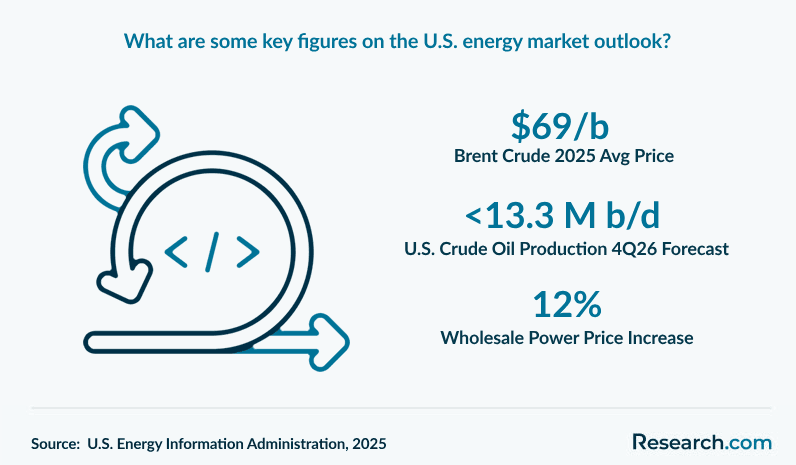
According to the U.S. Energy Information Administration (2025), the energy market outlook indicates dynamic shifts, with the average Brent crude oil price projected at $69 per barrel in 2025 before decreasing to $58 per barrel in 2026. U.S. crude oil production is expected to plateau, peaking at over 13.4 million barrels per day (b/d) in mid-2025 and then declining to less than 13.3 million b/d by the end of 2026.
The forecast also shows a strong upward trend in U.S. ethane exports, rising from over 500,000 b/d in 2025 to nearly 650,000 b/d in 2026. Meanwhile, natural gas prices are expected to climb from an average of about $3.70 per million British thermal units (MMBtu) in 2025 to $4.40/MMBtu in 2026, contributing to a 12% increase in wholesale power prices this summer compared to last.
These figures, shown in the graphic below, point to a policy environment shaped by price movement, production shifts, power market pressure, and global energy demand.
How do you choose the best among the fastest online energy policy degree programs?
The best program is the one that matches your target role, current education level, schedule, and budget. A fast program is useful only if it gives you the credential and skills employers or graduate schools will recognize.
- Accreditation: Confirm that the institution is regionally accredited before you apply.
- Faculty Expertise: Review faculty backgrounds to see whether they work in energy regulation, climate policy, engineering, markets, environmental law, sustainability, or your intended specialty.
- Program Format and Flexibility: Check whether courses are synchronous, asynchronous, accelerated, part-time friendly, or tied to specific term starts. Students interested in spatial analysis, energy siting, mapping, and resource planning may also compare options with a fast track geographic information systems degree online.
- Alumni Network and Career Services: Ask whether online students receive resume support, employer connections, internship help, and access to alumni working in energy policy.
- Cost and Return on Investment: Compare total tuition, fees, financial aid, employer reimbursement, and likely career benefits before deciding.
Questions to ask before enrolling
| Question | What a useful answer should clarify |
| Is the program built for policy, engineering, law, sustainability management, or a mix? | The curriculum should match the kind of job you want after graduation. |
| Can certificate credits transfer into a master’s degree? | This matters if you may continue your education later. |
| Are courses asynchronous or scheduled live? | Working students need to know whether class times fit their schedule. |
| Does the program include applied projects, capstones, internships, or field options? | Practical experience can strengthen your portfolio and job applications. |
| What career services are available to online students? | Online learners should not assume they receive the same career access unless the school confirms it. |
What career paths are available for graduates of online energy policy degree programs?
Energy policy graduates work in government, utilities, renewable energy companies, consulting firms, nonprofits, research organizations, law and regulatory settings, and corporate sustainability departments. The right role depends on whether your program emphasizes policy analysis, technical systems, law, sustainability, economics, or project development.
- Policy Analyst: Researches energy issues, evaluates policy proposals, and prepares recommendations for agencies, think tanks, companies, or advocacy groups.
- Regulatory Affairs Manager: Helps utilities, developers, or energy companies comply with local, state, and federal rules.
- Sustainability Director: Leads energy efficiency, renewable procurement, emissions reduction, and sustainability reporting initiatives.
- Energy Consultant: Advises clients on markets, regulations, risks, project strategy, and compliance.
- Legislative Aide: Supports elected officials or committees working on energy and environmental legislation.
- Utility Program Manager: Designs or manages programs related to demand response, efficiency, electric vehicles, or grid services.
- Climate Policy Advisor: Develops policy strategies for climate mitigation, adaptation, and energy transition work.
- Renewable Energy Project Developer: Coordinates siting, permitting, financing, stakeholder engagement, and construction planning for energy projects.
- Energy Markets Analyst: Interprets commodity data, market signals, and energy trends for investors, companies, or major energy users.
- Non-Profit Advocate: Leads campaigns, policy research, public education, or stakeholder outreach for energy and environmental organizations.
- Corporate Social Responsibility (CSR) Manager: Oversees environmental and social initiatives aligned with energy and climate goals.
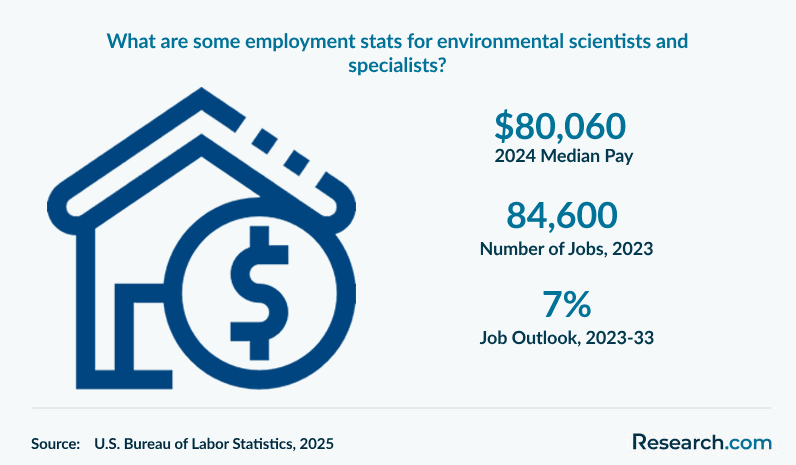
According to 2024 data from the U.S. Bureau of Labor Statistics, the median pay for environmental scientists and specialists was $80,060 per year, or $38.49 per hour. In 2023, there were 84,600 jobs in this field, and a bachelor's degree is the typical entry-level education required.
The job outlook for 2023 to 2033 is strong, with a projected growth rate of 7%, which is faster than the average for all occupations. This growth is expected to result in an employment change of approximately 6,100 new jobs over the decade. These statistics, shown in the graphic below, indicate a healthy and growing demand for environmental scientists and specialists in the coming years.
How much can I earn with an online energy policy degree?
Earnings depend on job title, employer type, location, experience, and whether your work is policy-focused, technical, legal, or managerial. An online degree does not guarantee a salary, but a recognized credential can help qualify graduates for roles that require energy, climate, environmental, regulatory, or sustainability expertise.
- Entry-Level Roles: Graduates starting as Policy Analysts or Program Coordinators can typically expect salaries from $65,000 to $85,000.
- Mid-Career Roles: Professionals with several years of experience in positions like Energy Manager or Senior Analyst often earn between $85,000 and $125,000.
- Senior-Level Roles: Leadership positions such as Director of Policy, Sustainability Director, or senior consultants can command salaries well over $140,000.
- Public vs. Private Sector: Private sector roles, especially consulting and corporate management, often pay more than government or nonprofit positions. Legal roles vary as well, and environmental lawyer salary outcomes differ by employer, credentials, and experience.
2025 salaries in the energy sector from various sources show a wide range, starting with roles like environmental scientist at $53,796 and regulatory analyst at $55,100. Other analyst and coordinator positions, such as project coordinator (IT), environmental planner, staff scientist, energy engineer, and energy analyst, fall within a range of approximately $64,000 to $73,000. Technical and project management roles, including project engineer, project management officer, and technical project manager, see salaries from about $75,000 to $82,000.
A clear progression is visible for energy policy analysts, with salaries increasing from $102,301 for an entry-level position to $110,348 for an expert-level role. The highest salaries are found in management and strategic positions, where a sustainability manager earns around $106,677, a program manager for engineering earns $115,868, and manufacturing directors and senior strategy managers command top-tier salaries of $133,436 and $139,147, respectively.
Overall, the data, shown in the graph below, indicates a strong correlation between salary, experience level, and managerial responsibility. As roles shift from technical analysis to strategic management, compensation increases significantly.
What is the job market like for graduates with an online energy policy degree?
The job market for energy policy graduates is shaped by energy transition, climate policy, infrastructure modernization, corporate sustainability commitments, and changing regulation. Demand is strongest for professionals who can translate between technology, economics, law, environmental impact, and public decision-making.
- High Demand: Employers need people who understand how energy systems, policy rules, markets, and technologies interact.
- Sector Growth: The Bureau of Labor Statistics projects strong growth for related occupations such as environmental scientist roles.
- Policy-Driven Hiring: Government initiatives and regulations, including the Inflation Reduction Act, continue to influence renewable energy, sustainability, and compliance hiring.
- Private Sector Investment: Companies are hiring energy and sustainability professionals to reduce risk, manage costs, and address environmental, social, and governance (ESG) goals.
- Geographic Hotspots: Opportunities exist nationwide, but stronger markets often include Washington D.C., California, Texas, Colorado, and the Northeast.
Are online energy policy degree programs accredited and recognized?
Online energy policy degrees can be respected by employers when they come from accredited institutions and offer relevant, rigorous coursework. Accreditation is important because it supports academic quality, federal financial aid eligibility, credit transfer, and employer confidence.
Before applying, verify the institution’s accreditation through the school and the accreditor. Then evaluate program reputation, faculty credentials, industry partnerships, capstones, internships, alumni outcomes, and whether online students receive the same support as campus learners. Students comparing related sustainability pathways may also review affordable online environmental science degrees if they want a broader science-based environmental foundation.
What are some current and future trends in energy policy?
Energy policy is changing quickly because of technology, climate commitments, market volatility, infrastructure needs, and geopolitical risk. Students entering this field should look for programs that teach both core policy analysis and current energy-sector issues.
- Data Analytics: Big data and AI are increasingly used to forecast demand, optimize energy systems, evaluate grid performance, and support renewable integration. Students drawn to this work may explore an environmental data analyst career path.
- Green Energy: The market for renewable sources is expanding rapidly, driven by government incentives and corporate sustainability goals, with projections showing the market tripling to $4.5 trillion by 2034.
- Grid Decarbonization: Policy work increasingly focuses on moving electricity generation toward carbon-free sources such as wind, solar, and nuclear power.
- Electrification of Everything: Transportation, buildings, and industry are being pushed toward electricity to reduce fossil fuel dependence.
- Energy Storage Solutions: Battery storage and long-duration storage policies are becoming central to renewable energy reliability.
- Hydrogen Economy: Policymakers and investors are paying greater attention to green hydrogen as a potential clean energy carrier.
- Critical Mineral Supply Chains: Energy policy now includes the materials needed for batteries, wind turbines, solar panels, and other clean energy technologies.
- Cybersecurity and Grid Resilience: A more digital grid creates new policy questions around cyber protection, physical security, and reliability.
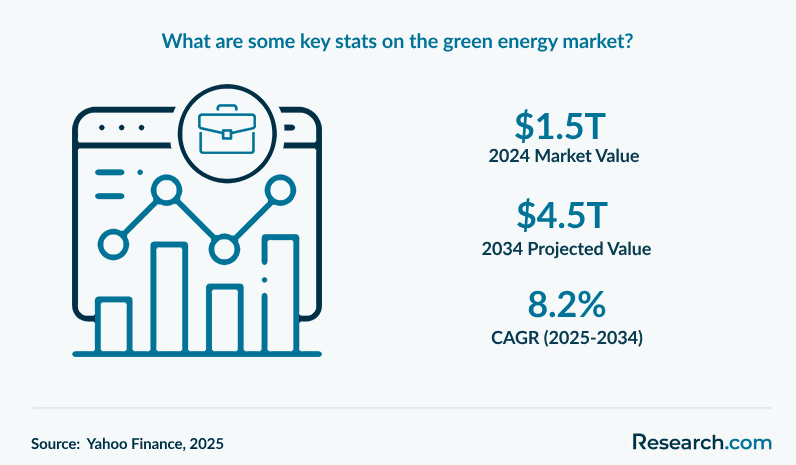
The global green energy market, which includes sources like solar, wind, and hydropower, is experiencing substantial growth driven by a global push to reduce greenhouse gas emissions and embrace sustainability. Valued at approximately $1.5 trillion in 2024, the market is projected to expand significantly, with forecasts estimating it will reach $4.5 trillion by 2034, reflecting a compound annual growth rate (CAGR) of 8.2%.
This expansion is fueled by several key factors, including supportive government policies like tax credits and mandates, continuous technological innovation that lowers costs, increasing corporate commitments to net-zero emissions, and rising public demand for clean energy solutions.
Market analysis reveals that solar energy is the dominant segment, accounting for 31% of the market, followed by wind (25%) and hydropower (18%). In terms of consumption, the industrial sector is the largest end-user, making up 62% of the market as it shifts towards renewable sources to meet high energy demands.
Regionally, North America shows strong growth potential, with the U.S. market expected to grow at a CAGR exceeding 9.3% through 2032, largely stimulated by investments from policies like the Inflation Reduction Act. These are shown in the graphic below.
Can an online energy policy degree boost opportunities in emerging industries?
Yes, an online energy policy degree can support careers beyond utilities, government, and renewable energy companies. Many emerging industries now need professionals who understand energy efficiency, sustainability rules, climate risk, supply chains, and environmental impact.
Graduates may apply their skills in advanced manufacturing, sustainable construction, clean transportation, data-driven environmental analysis, corporate sustainability, and even research-driven fields such as biotechnology careers, where energy use, environmental compliance, and sustainable operations increasingly matter.
How Can Technical Engineering Skills Enhance an Online Energy Policy Degree?
Technical engineering knowledge can make an energy policy graduate more effective because many policy decisions depend on how energy systems actually work. Professionals who understand grids, storage, electrical systems, efficiency, and infrastructure can communicate more effectively with engineers, regulators, project developers, and executives.
Students who want a stronger technical complement to energy policy may compare related options such as the cheapest electrical engineering online degree. This type of preparation can be useful for roles involving system design, energy efficiency, grid modernization, renewable integration, or technology strategy.
Common mistakes to avoid when choosing an online energy policy program
| Mistake | Better approach |
| Choosing the shortest program without checking credential value | Make sure a certificate, bachelor’s, master’s, or LLM matches your target role. |
| Comparing only per-credit tuition | Calculate full tuition, fees, materials, and any travel or residency costs. |
| Ignoring accreditation | Verify institutional accreditation before applying or paying a deposit. |
| Assuming online means self-paced | Ask whether courses are asynchronous, live, cohort-based, accelerated, or term-based. |
| Overlooking technical requirements | Check whether the program expects quantitative skills, GIS, economics, law, engineering, or statistics preparation. |
| Relying only on rankings | Use rankings as a starting point, then compare curriculum, faculty, outcomes, cost, and flexibility. |
| Assuming salary outcomes are guaranteed | Evaluate likely career paths by role, region, experience, and employer type. |
Key Insights
- The fastest online energy policy options are usually graduate certificates, with some requiring only 9 credits and completion in less than 1 year or as little as 1 year.
- A certificate is best for professionals adding focused energy expertise, while a master’s degree is stronger for broader policy, sustainability, consulting, or leadership preparation.
- Total tuition matters more than per-credit tuition because program lengths range from 9 credits to 120 credits.
- Accreditation should be verified before enrollment because it affects quality assurance, financial aid access, transferability, and employer recognition.
- Energy policy careers span government, utilities, consulting, nonprofits, renewable energy, corporate sustainability, regulatory affairs, and legal settings.
- Students should choose programs based on target roles: policy-heavy, technical, legal, sustainability management, or interdisciplinary energy systems.
- Current energy trends include AI and data analytics, renewable growth, grid decarbonization, electrification, energy storage, hydrogen, critical minerals, and grid resilience.
- The best program is not simply the fastest one; it is the fastest credible option that matches your career goals, budget, schedule, and desired level of specialization.
References
- Payscale. (2025). Master of Science (MS), Environmental Policy Analysis & Planning degree salary. Payscale.
- Payscale. (2025). Master of Science (MS), renewable energy degree salary. Payscale.
- Salary.com (July 01, 2025) Energy Policy Analyst Salary, Hourly Rate in the United States | Salary.com. Salary.com.
- U.S. Bureau of Labor Statistics. (2025). Environmental scientists and specialists. In Occupational Outlook Handbook. U.S. Bureau of Labor Statistics.
- U.S. Energy Information Administration. (2025, July). Short-Term Energy Outlook. U.S. Energy Information Administration.
- Yahoo Finance. (2025, May 26). Green energy market trends, growth drivers and regional analysis. Yahoo Finance.
- ZipRecruiter. (2025). Energy policy salary. ZipRecruiter.
Other Things You Should Know About the Fastest Energy Policy Degree Programs
In 2027, the fastest online energy policy degree programs can be completed in as little as one year. These accelerated programs require a full-time course load but offer flexibility to accommodate various learning paces.
In 2027, platforms like Coursera, edX, and Moodle are highly beneficial for online energy policy courses. They offer a wide range of resources, forums for student interaction, and tools for effective learning, making them popular among programs for delivering comprehensive curricula.


