
2027 Most Affordable MPA Programs

Co-Founder and Chief Data Scientist
Choosing an affordable master's in public administration is not just a tuition decision. It is a career decision about whether graduate training in budgeting, policy, leadership, ethics, and public-sector management will help you move into roles with more responsibility in government, nonprofit, healthcare, emergency management, consulting, or community service. The challenge is that MPA programs vary widely in cost, accreditation, format, specialization options, and career support, so the cheapest option is not always the strongest value.
This guide is for working professionals, recent graduates, public employees, nonprofit staff, military learners, and career changers comparing lower-cost MPA programs. You will learn what affordable MPA programs typically include, how online and campus formats differ, what the listed programs cost, which specializations may fit your goals, how to evaluate accreditation and ROI, and what career paths may be available after graduation.
Quick Answer: Are the Most Affordable MPA Programs Worth Considering?
Affordable MPA programs can be worthwhile when they are accredited, match your career goals, offer relevant concentrations, and provide enough flexibility to let you finish without taking on unnecessary debt. The strongest low-cost programs still cover core public administration skills such as policy analysis, public finance, organizational leadership, program evaluation, ethics, and public-sector management.
For many students, the best affordable MPA is an online or hybrid program with transparent tuition, strong advising, faculty with public-service experience, and career support connected to government agencies, nonprofits, healthcare organizations, or public-sector consulting firms.
What are the benefits of enrolling in the most affordable MPA programs?
- An MPA can support advancement into public, nonprofit, and mission-driven management roles, including positions such as medical and health services manager.
- Average annual pay for MPA-related roles can range from $83,400 to $134,440 depending on occupation, with medical and health services managers listed at the highest average among the roles discussed here.
- Online MPA programs can make graduate study more manageable for working adults because students can often complete coursework without relocating or leaving full-time employment.
What can I expect from the most affordable MPA programs?
An affordable MPA program should prepare students to lead programs, manage public resources, analyze policy choices, and make decisions in complex civic environments. Lower tuition should not mean a narrow or low-quality curriculum. A strong program usually includes public budgeting, administrative law or ethics, policy analysis, organizational management, leadership, research methods, and program evaluation.
Many programs also let students focus their studies through concentrations in nonprofit leadership, healthcare administration, emergency management, public policy, urban planning, public leadership, or state and local government. These options matter because an MPA is a broad degree; choosing electives strategically can make the degree more relevant to a specific career target.
Students should expect differences in course delivery, faculty access, internships, capstone requirements, and student support. Some affordable programs are highly structured, while others give working adults more control over pace. The key is to confirm that the program’s low price is paired with credible accreditation, clear graduation requirements, and outcomes that align with your goals.
What a strong affordable MPA should include
| Program feature | Why it matters | What to check before applying |
| Accreditation | Helps verify institutional or field-specific quality and may affect financial aid eligibility and employer recognition. | Confirm regional accreditation or NASPAA accreditation where relevant. |
| Transparent tuition | Low advertised tuition may not include fees, residency rules, or technology costs. | Ask for the full estimated program cost, not only cost per credit. |
| Relevant curriculum | An MPA should build skills in budgeting, policy, leadership, management, ethics, and evaluation. | Review required courses and electives against the jobs you want. |
| Flexible format | Working adults often need asynchronous courses, part-time pacing, or multiple start dates. | Ask whether classes require live attendance, campus visits, or fixed meeting times. |
| Career support | Public administration careers are often network-driven. | Look for internship help, alumni access, resume support, and employer connections. |
Where can I work after graduating from the most affordable MPA programs?
MPA graduates work across public-sector, nonprofit, healthcare, public safety, and private consulting settings. The degree is especially useful for people who want to manage programs, evaluate services, administer budgets, lead teams, or translate policy into operations.
Common employers include local governments, state agencies, federal offices, nonprofit organizations, public health departments, hospitals and healthcare systems, emergency management offices, community development organizations, advocacy groups, universities, and consulting firms serving public agencies.
Common MPA career settings
| Sector | Typical roles | Best fit for students interested in |
| Government agencies | Policy analyst, program manager, administrator, budget analyst, public affairs manager | Public policy, budgeting, service delivery, regulation, and civic operations |
| Nonprofit organizations | Program director, development manager, operations manager, community service manager | Advocacy, social services, fundraising, community development, and mission-driven leadership |
| Healthcare and public health | Healthcare administrator, public health program manager, medical and health services manager | Health policy, healthcare operations, compliance, and population health programs |
| Emergency management and public safety | Emergency management director, disaster response coordinator, public safety administrator | Preparedness, crisis response, resilience planning, and interagency coordination |
| Private-sector consulting | Public-sector consultant, policy consultant, management analyst | Data-informed decision-making, organizational improvement, and public program evaluation |
How much can I make with a degree from the most affordable MPA programs?
Earnings depend on the role, employer, location, prior experience, and specialization. The article’s referenced data shows average annual salaries for MPA-related roles ranging from $83,400 to $134,440. Medical and health services managers are listed at an average annual salary of $134,440, making healthcare administration one of the higher-paying pathways connected to this degree.
Students should not treat salary figures as guarantees. An affordable MPA may improve long-term earning potential, but the strongest outcomes usually come from combining the degree with relevant work experience, a focused specialization, strong references, and practical projects or internships.
- Most Affordable MPA Programs for 2027
- How long does it take to complete an affordable MPA program?
- Online MPA vs. on-campus MPA: which format is better?
- What does an affordable MPA cost?
- Financial aid options for affordable MPA students
- Admission requirements for affordable MPA programs
- Common courses in affordable MPA programs
- MPA specializations to consider
- MPA vs. MHA: which degree fits your goal?
- Why accreditation matters for affordable MPA programs
- Practical learning experiences in MPA programs
- Advanced degrees that may complement an MPA
- Emerging public-service challenges in MPA curricula
- Employer and industry partnerships in MPA programs
- Public administration and healthcare certifications
- How to evaluate the ROI of an affordable MPA
- Student support and career development services
- Certifications that can strengthen an MPA
- Interdisciplinary learning and MPA career value
- How to choose the best affordable MPA program
- Career paths for affordable MPA graduates
- Job market outlook for affordable MPA graduates
List of the Most Affordable MPA Programs for 2027
How do we rank schools?
This ranking was built using Research.com’s independent ranking methodology and institutional data from several established sources. The analysis included the IPEDS database from the National Center for Education Statistics, Peterson's database and its Distance Learning Licensed Data Set, and the College Scorecard database for information related to cost, institutional outcomes, and student data. The National Center for Education Statistics was also used to support current institutional information. The most affordable MPA options identified in this list are typically online programs.
Affordable MPA programs at a glance
| Rank | School and program | Program length | Credits | Cost per credit | Accreditation |
| 1 | Purdue Global — Online Master's in Public Administration | 1.5 years (average) | 55 | $420 | Higher Learning Commission (HLC) |
| 2 | Bridgewater State University — Online Master's in Public Administration | ~2 years | 39 | $516.50 | Network of Schools of Public Policy, Affairs, and Administration (NASPAA) |
| 3 | Southern Illinois University — Online Master's in Public Administration - General | 14 months | 36 | $540 | Higher Learning Commission (HLC) |
| 4 | Walden University — Online Master of Public Administration | ~2 years | 39 | $516.50 | Higher Learning Commission (HLC) |
| 5 | Liberty University — Online Master's in Public Administration - General | ~2 years | 36 | $565 (full-time); $615 (part-time); $275 (military) | Southern Association of Colleges and Schools Commission on Colleges (SACSCOC) |
| 6 | Arizona State University — Online Master's in Public Administration | ~2 to 3 years | 42 | $576 | Network of Schools of Public Policy, Affairs, and Administration (NASPAA) |
| 7 | Southern New Hampshire University — Online MBA in Public Administration | ~2 years | 39 | $637 | Accreditation Council for Business Schools and Programs (ACBSP) |
| 8 | Ohio University — Online Master of Public Administration | 2 years | 36 | $823 | Higher Learning Commission (HLC) |
| 9 | Clark Atlanta University — Online Master's in Public Administration | ~2 years | 36 (pre-service); 30 (in-service) | $951 | Network of Schools of Public Policy, Affairs, and Administration (NASPAA) |
| 10 | American University — Online Master’s in Public Administration and Policy | 24 months | 36 | $2,000 | Network of Schools of Public Policy, Affairs, and Administration (NASPAA) |
1. Purdue Global - Online Master's in Public Administration
Purdue Global’s online MPA is designed for students preparing for leadership in government, public safety, security, protection, and emergency management. The curriculum emphasizes ethics, leadership, budgeting, strategic planning, human resources, and methods for assessing how public policies are implemented and whether they work as intended.
- Program Length: 1.5 years (average)
- Required Credits to Graduate: 55
- Cost per Credit: $420
- Accreditation: Higher Learning Commission (HLC)
2. Bridgewater State University - Online Master's in Public Administration
Bridgewater State University’s online MPA focuses on leadership, service, civic engagement, and management in public and nonprofit organizations. Students can pursue a general path or a concentration in civic and nonprofit leadership and administration. Smaller classes may support more direct interaction with instructors and peers.
- Program Length: ~2 years
- Concentrations: General; Civic and Nonprofit Leadership and Administration
- Required Credits to Graduate: 39
- Cost per Credit: $516.50
- Accreditation: Network of Schools of Public Policy, Affairs, and Administration (NASPAA)
3. Southern Illinois University - Online Master's in Public Administration - General
Southern Illinois University’s online MPA prepares students for public-sector work involving communities, education, infrastructure, environmental protection, and emergency management. Coursework includes public policy analysis, negotiation strategy, budgeting, financial management, organizational leadership, and human resources. The program is shaped in part by an advisory board with local, state, federal, and nonprofit professionals.
- Program Length: 14 months
- Required Credits to Graduate: 36
- Cost per Credit: $540
- Accreditation: Higher Learning Commission (HLC)
4. Walden University - Online Master of Public Administration
Walden University’s online MPA centers on turning policy into public programs and emphasizes social change, equity, and practical application. The program uses simulations and story-based learning experiences to help students practice workplace decision-making and prepare to serve diverse communities.
- Program Length: ~2 years
- Concentrations: General Program; Diversity and Social Justice; Emergency Management; Law and Public Policy; and Nonprofit Management and Leadership
- Required Credits to Graduate: 39
- Cost per Credit: $516.50
- Accreditation: Higher Learning Commission (HLC)
5. Liberty University - Online Master's in Public Administration - General
Liberty University’s online MPA is intended for professionals seeking leadership, executive, management, and policy analysis roles in local, state, and federal government. The curriculum addresses public administration principles, executive leadership, and analysis of social challenges. The program also incorporates a biblical worldview and offers eight-week courses, no set login times, and multiple annual start dates.
- Program Length: ~2 years
- Concentrations: General; Business & Governance; Disaster Management; Fire Administration; Healthcare; Law & Public Policy; Public & Non-Profit Management; Urban Planning
- Required Credits to Graduate: 36
- Cost per Credit: $565 (full-time); $615 (part-time); $275 (military)
- Accreditation: Southern Association of Colleges and Schools Commission on Colleges (SACSCOC)
6. Arizona State University - Online Master's in Public Administration
Arizona State University’s online MPA prepares students to address public problems through ethical, inclusive, and effective management. Students study leadership, decision-making, organizational behavior, change management, policy analysis, program evaluation, and financial management for work across government, nonprofit, and private organizations.
- Program Length: ~2 to 3 years
- Required Credits to Graduate: 42
- Cost per Credit: $576
- Accreditation: Network of Schools of Public Policy, Affairs, and Administration (NASPAA)
7. Southern New Hampshire University - Online MBA in Public Administration
Southern New Hampshire University offers an online MBA with a public administration specialization. This option blends graduate business training with public administration topics, making it a possible fit for students who want broader business leadership coursework alongside public-sector management preparation.
- Program Length: ~2 years
- Required Credits to Graduate: 39
- Cost per Credit: $637
- Accreditation: Accreditation Council for Business Schools and Programs (ACBSP)
8. Ohio University - Online Master of Public Administration
Ohio University’s online MPA is built for students who want flexible graduate training in public leadership, management, public policy analysis, financial management, strategic planning, and ethical leadership. Students may choose concentrations in public leadership and management, nonprofit management, or state and local government management, or complete a project management certificate.
- Program Length: 2 years
- Concentrations: Public Leadership and Management; Non-Profit Management; and State and Local Government Management
- Required Credits to Graduate: 36
- Cost per Credit: $823
- Accreditation: Higher Learning Commission (HLC)
9. Clark Atlanta University - Online Master's in Public Administration
Clark Atlanta University’s online MPA prepares students for public-sector and nonprofit roles while also supporting professionals already working in public service. The program includes options in human resources management, international administration and development management, nonprofit leadership and management, and public policy. Its curriculum emphasizes diversity, ethics, professionalism, social equity, research, service, and global engagement.
- Program Length: ~2 years
- Required Credits to Graduate: 36 (pre-service); 30 (in-service)
- Cost per Credit: $951
- Accreditation: Network of Schools of Public Policy, Affairs, and Administration (NASPAA)
10. American University - Online Master’s in Public Administration and Policy
American University’s online master’s in public administration and policy combines public administration and public policy training. The program is designed for students who want to lead public programs, shape policy, and evaluate implementation. Students may also pursue a certificate in analytics and management.
- Program Length: 24 months
- Required Credits to Graduate: 36
- Cost per Credit: $2,000
- Accreditation: Network of Schools of Public Policy, Affairs, and Administration (NASPAA)
How long does it take to complete the most affordable MPA programs?
Most affordable MPA programs can be completed in about one and a half to two years by full-time students, although timelines vary by credit load, course length, enrollment pace, transfer policies, and capstone or internship requirements. Part-time students often need two to three years, especially if they are balancing graduate school with full-time work or family responsibilities.
Program length is not only about speed. A 14-month program may be attractive if you can handle an intensive workload, while a slower part-time schedule may produce better results if you need time for internships, networking, or employer-sponsored tuition assistance. Before choosing the shortest program, confirm weekly workload expectations and whether accelerated courses affect your ability to absorb technical material such as public finance, research methods, and policy evaluation.
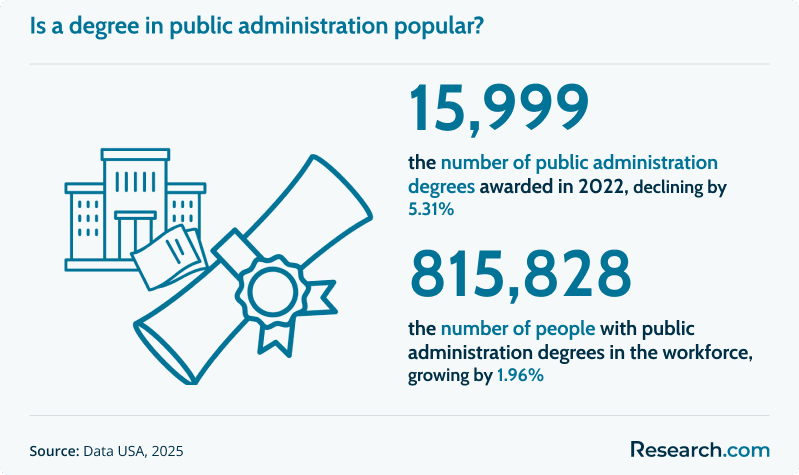
In 2022, there were 15,999 public administration degrees awarded in all degree levels. Students comparing flexible public-service and healthcare-related options may also want to review the most affordable online bachelor’s in health sciences programs, especially if their long-term goal involves healthcare policy or administration.
| Enrollment pace | Typical completion time | Best for | Trade-off |
| Accelerated full-time | As short as 14 months in one listed program | Students who can manage a demanding schedule | Less time for work, internships, or gradual skill building |
| Standard full-time | About one and a half to two years | Students who want a predictable graduate timeline | May still be difficult with full-time employment |
| Part-time | Often two to three years | Working professionals and caregivers | Longer time before graduation and possible tuition changes over time |
How does an online MPA program compare to an on-campus program?
The main difference between online and on-campus MPA programs is delivery format, not necessarily academic value. A strong online program can cover the same core public administration content as a campus program, while a weak campus program may still lack flexibility, career support, or applied learning. Students should compare structure, access to faculty, networking opportunities, field requirements, and technology expectations before deciding.
Students exploring the broader field of public service can also read this explanation of a career in public administration to understand how the discipline connects government, nonprofit management, and policy implementation.
Online vs. on-campus MPA programs
| Factor | Online MPA | On-campus MPA | Choose this if... |
| Schedule | Often more flexible, with asynchronous or evening options | Usually follows set class meeting times | Online fits working adults; campus fits students who prefer routine |
| Location | Can reduce relocation and commuting barriers | Requires regular campus access | Online works if the best program is outside your region |
| Networking | Depends on virtual events, alumni access, group projects, and local placements | Often easier for in-person relationship building | Campus may help if local government networks are important |
| Learning style | Requires self-direction and comfort with digital tools | Provides in-person discussion and immediate classroom interaction | Online suits independent learners; campus suits highly interactive learners |
| Career access | Can be strong if the program offers remote advising and employer connections | May provide local internships and public-sector events | Compare actual support services, not just format |
When an online MPA makes sense
- You need to keep working while earning the degree.
- You cannot relocate for graduate school.
- You are comfortable managing deadlines without frequent in-person reminders.
- Your target program offers strong online advising, library access, career services, and faculty communication.
- You are comparing graduate formats similar to the most affordable online business degree programs, where asynchronous learning and virtual collaboration are common.
When an on-campus MPA may be better
- You want face-to-face discussion, campus-based networking, and direct access to faculty.
- You are targeting local government or nonprofit roles where the university has a strong regional employer network.
- You learn better through structured class meetings.
- You plan to use campus facilities, in-person career events, or graduate assistantships.
Students comparing public administration with business-oriented graduate paths may also review high-paying MBA concentrations to understand how MBA specializations differ from public-service training. Those considering entry-level business pathways can explore associate business degree jobs, while career changers evaluating other helping professions may find master’s in sports psychology career options useful for comparison.
What is the average cost of the most affordable MPA programs?
Among the affordable MPA programs discussed here, the average cost per credit is around $925, and average total tuition is approximately $34,206. The listed cost per credit ranges from $565 to $2,000, while total tuition can range from $20,340 to $72,000. These figures show why students should compare full program cost instead of relying only on the word “affordable.”
Cost comparisons should include tuition, fees, books, technology charges, residency requirements, travel for any campus intensives, and the number of credits required. A program with a lower cost per credit may not be the cheapest overall if it requires more credits or charges substantial fees.
Students comparing MPA costs with management-oriented alternatives can also review low-cost online business administration degree programs. The best choice depends on whether your goals are centered on public service and policy implementation or broader business management.
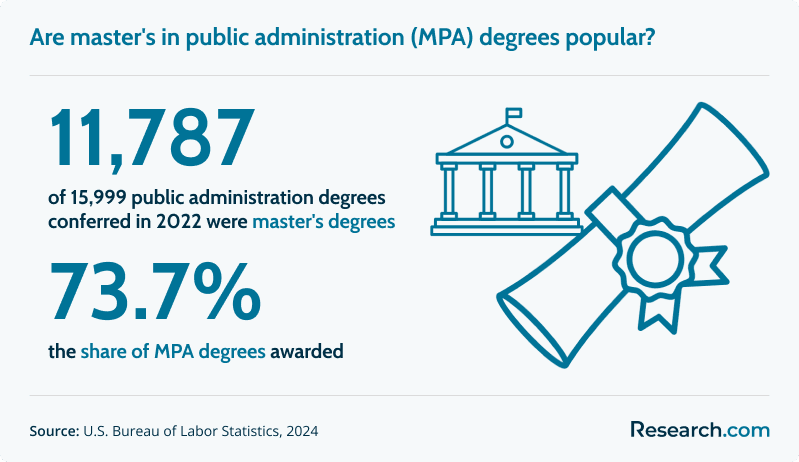
In 2022, around 73.7% of all public administration degrees awarded across levels were MPAs.
How to estimate the real cost of an MPA
| Cost item | Why it can change your final price | Question to ask |
| Tuition per credit | This is the base cost, but it does not always reflect the full bill. | Is the tuition rate the same for online, out-of-state, part-time, and military students? |
| Total credits | More credits can make a lower per-credit price more expensive overall. | How many credits are required for graduation? |
| Mandatory fees | Technology, graduation, student service, and online learning fees can add up. | What fees are required each term? |
| Books and materials | Public finance, statistics, and policy courses may require paid materials. | Are course materials included in tuition? |
| Travel or residency | Some online programs may still require in-person sessions. | Are there any campus visits, internships, or field placements with travel costs? |
What are the financial aid options for students enrolling in the most affordable programs?
Financial aid can make an affordable MPA even more manageable, but students need to apply early and compare aid packages carefully. Aid may come from federal programs, universities, employers, professional associations, military benefits, or public-service-related scholarship sources.
- Federal Aid. The Free Application for Federal Student Aid (FAFSA) is the starting point for federal loans and other aid eligibility. Many online colleges that accept FAFSA participate in federal aid programs.
- Institutional Aid. Universities may offer scholarships, grants, tuition discounts, or need-based aid for graduate students.
- External Scholarships. Professional associations, foundations, nonprofits, and civic organizations may fund students preparing for public-service careers.
- Graduate Assistantships. Some programs provide stipends or tuition benefits in exchange for research, teaching, or administrative work.
- Employer Tuition Assistance. Government agencies, healthcare systems, universities, and nonprofit employers may help pay for job-relevant graduate coursework.
Practical ways to reduce MPA costs
- Complete the FAFSA as early as possible and confirm the school’s federal aid participation.
- Ask whether tuition differs for full-time, part-time, online, out-of-state, or military students.
- Request a total cost estimate for the full degree, including fees.
- Check whether your employer offers tuition reimbursement or professional development funding.
- Prioritize accredited programs so financial aid and employer recognition are less likely to become problems.
- Avoid borrowing the maximum amount automatically; borrow only what you need after scholarships and employer aid.
What are the prerequisites for enrolling in the most affordable MPA programs?
Admission requirements vary, but most affordable MPA programs are designed for applicants who have completed an undergraduate degree and can demonstrate readiness for graduate-level writing, analysis, and leadership coursework. Many programs welcome applicants from different majors because public administration draws from political science, business, economics, sociology, public health, criminal justice, communication, and related fields.
- Bachelor's Degree. Applicants typically need a bachelor’s degree from an accredited institution.
- Grade Point Average (GPA). Many programs use a minimum GPA requirement, often around 3.0 on a 4.0 scale, although policies differ.
- Standardized Tests. Some schools may request GRE or GMAT scores, but many affordable MPA programs now waive these tests or make them optional.
- Personal Statement or Essay. Programs commonly ask applicants to explain their public-service interests, leadership experience, and career goals.
- Letters of Recommendation. Schools may request recommendations from faculty members, supervisors, or professional mentors.
- Resume or Work History. Some programs consider professional experience in public service, nonprofit work, military service, healthcare, education, or administration.
Application checklist for affordable MPA programs
| Requirement | What it shows | How to strengthen it |
| Transcript | Academic preparation and GPA history | Explain upward trends or relevant quantitative coursework if needed |
| Statement of purpose | Fit between your goals and the program | Connect your career plan to specific MPA courses or concentrations |
| Resume | Leadership, service, management, and analytical experience | Highlight projects, budgets, teams, grants, compliance, or community impact |
| Recommendations | Professional maturity and graduate readiness | Choose recommenders who can discuss your work ethic and public-service potential |
| Test scores, if required | Quantitative or verbal readiness | Check whether waivers are available before spending money on exams |
What courses are typically in the most affordable MPA programs?
Affordable MPA programs usually combine management, policy, finance, ethics, and research courses. The goal is to prepare students to make evidence-based decisions in organizations that serve communities, manage public resources, or deliver public programs.
- Public Policy Analysis: Students learn how policies are developed, implemented, evaluated, and revised.
- Public Budgeting and Finance: Coursework covers revenue, budgeting, resource allocation, financial accountability, and public-sector fiscal decision-making.
- Organizational Theory and Management: Students examine how public and nonprofit organizations operate, change, and respond to leadership decisions.
- Public Administration Ethics: This area focuses on accountability, transparency, conflicts of interest, equity, and responsible public leadership.
- Research Methods for Public Administration: Students build skills in data collection, analysis, evaluation, and evidence-based decision-making.
- Human Resources Management in the Public Sector: Coursework addresses hiring, employee relations, labor rules, training, supervision, and workforce planning.
Some leadership and organizational management topics overlap with graduate business programs, including an affordable executive MBA. The distinction is that an MPA generally frames these skills around public value, accountability, policy implementation, and service delivery rather than profit-centered business strategy.
What types of specializations are available in the most affordable MPA programs?
Specializations help convert a broad MPA into a targeted career credential. Students should choose a concentration based on the type of employer, population, policy area, or management function they want to serve after graduation.
- Nonprofit Management: Focuses on fundraising, board governance, program evaluation, volunteer management, and mission-driven operations.
- Healthcare Administration: Prepares students for management work involving healthcare policy, finance, compliance, and service delivery.
- Emergency Management: Covers disaster preparedness, crisis response, recovery planning, interagency coordination, and community resilience.
- Public Policy: Emphasizes policy design, analysis, advocacy, implementation, and evaluation.
- Urban and Regional Planning: Addresses land use, transportation, housing, community development, and regional policy issues.
- Public Leadership and Management: Builds advanced leadership, supervision, strategic planning, and organizational decision-making skills.
Students who want a more policy-heavy degree may also compare MPA programs with the most affordable online master’s in public policy programs. An MPP typically emphasizes policy research and analysis more heavily, while an MPA usually focuses more on management and implementation.
Specializations can also influence career positioning. Healthcare administration and emergency management may connect to roles such as medical and health services managers or emergency management directors, while nonprofit management may support advancement toward social and community service manager roles.
Should I Choose an MPA or an MHA Program?
Choose an MPA if you want broad public-service leadership training that can apply across government, nonprofit, public policy, emergency management, public safety, and community programs. Choose an MHA if your goal is specifically healthcare management, hospital administration, health system operations, or healthcare compliance. Students focused almost entirely on healthcare leadership should compare MPA healthcare concentrations with the most affordable online MHA programs.
| Degree | Best fit | Common focus areas | Potential limitation |
| MPA | Students who want flexible public-sector and nonprofit leadership options | Policy, budgeting, public management, ethics, nonprofit leadership, emergency management | May be less specialized for hospital or health system operations |
| MHA | Students committed to healthcare administration | Healthcare finance, quality improvement, compliance, health systems, operations | May be less flexible for non-healthcare public administration roles |
Is Accreditation Important for Affordable MPA Programs?
Yes. Accreditation is one of the most important quality checks when comparing affordable MPA programs. Institutional accreditation can affect federal financial aid eligibility, transfer policies, and employer confidence. NASPAA accreditation is a field-specific indicator for public policy, affairs, and administration programs, while regional accreditation confirms broader institutional quality.
Students should verify accreditation directly through the school and accreditor rather than relying only on marketing language. Working adults comparing flexible schools may also find Research.com’s guide to the most affordable online colleges for working adults useful when evaluating credibility, support services, and online learning quality.
What practical experiences enhance learning in affordable MPA programs?
The most useful MPA programs connect coursework to real administrative problems. Practical learning can include internships, capstones, consulting projects, simulations, case studies, grant-writing assignments, budget analyses, policy memos, community research, and partnerships with agencies or nonprofits.
Applied work is especially important for students changing careers because it creates evidence of skills beyond classroom grades. Students interested in healthcare-related public administration may also compare applied training models in accelerated healthcare administration programs.
What complementary advanced degree options can bolster your public administration career?
Some professionals combine public administration with another advanced credential when their work sits at the intersection of policy, healthcare, regulation, technology, or public health. This path makes the most sense for students with a defined career reason, not simply because more degrees look impressive.
For example, professionals working in health policy or pharmaceutical regulation may explore an online PharmD to understand clinical and pharmaceutical systems more deeply. Before pursuing multiple graduate credentials, compare accreditation, total cost, time commitment, employer expectations, and whether the added degree is required for your target role.
How are affordable MPA programs addressing emerging public service challenges?
Public administration is changing as agencies and nonprofits respond to digital services, cybersecurity risks, data analytics, climate resilience, emergency preparedness, equity concerns, and public trust issues. Strong MPA programs increasingly address these topics through case studies, simulations, analytics assignments, crisis management exercises, and courses that connect policy decisions with operational realities.
Students should look for programs that teach practical use of data and technology without losing focus on ethics, transparency, and public accountability. Similar cross-sector innovation appears in fields such as healthcare education, including programs discussed in Research.com’s guide to the best online pharmacy school options.
What industry partnerships support career advancement in affordable MPA programs?
Partnerships with public agencies, nonprofits, healthcare organizations, civic groups, and consulting firms can strengthen an MPA program by giving students access to internships, guest speakers, mentors, capstone projects, and job leads. These connections are especially valuable in public administration because hiring often rewards relevant experience and demonstrated service commitment.
Students interested in administrative roles connected to healthcare operations can also compare related workforce-oriented programs, such as accredited medical billing and coding schools online, to understand how healthcare administration teams rely on specialized operational functions.
Can combining public administration with healthcare certifications enhance your career?
Healthcare-related credentials can strengthen an MPA when your target roles involve health departments, hospitals, community health organizations, Medicaid programs, public health initiatives, or healthcare compliance. Complementary training can help public administrators understand clinical workflows, patient services, documentation, and operational constraints in health environments.
For students exploring entry-level healthcare support knowledge, medical assistant schooling can illustrate the operational side of patient-facing care. However, certifications should be chosen strategically. A credential is most valuable when employers in your target role recognize it and when it fills a clear skill gap.
How can you evaluate the ROI of an affordable MPA program?
Return on investment is not limited to salary. For an MPA, ROI should include tuition, fees, time away from work, borrowing costs, promotion potential, employer tuition assistance, job mobility, public-service goals, and whether the program helps you qualify for roles you could not otherwise access.
Students considering healthcare management alternatives may compare MPA programs with an affordable online healthcare administration degree to see which credential better matches their desired roles.
MPA ROI questions to ask before enrolling
- What is the total program cost after fees, books, and expected travel?
- How much debt would I need, and what monthly payment could I reasonably manage?
- Does the program publish employment, promotion, or alumni outcome information?
- Will my employer recognize or help fund this degree?
- Does the curriculum match the roles I want within government, nonprofit, healthcare, or consulting?
- Does the program include internships, capstones, or projects I can show employers?
- Is the school properly accredited?
What student support and career development services are available in affordable MPA programs?
Strong student support can make the difference between enrolling and graduating. Affordable MPA programs should provide academic advising, library access, writing support, technology help, faculty office hours, career coaching, resume reviews, interview preparation, internship guidance, and alumni networking. Online students should confirm that these services are available remotely and outside traditional business hours when possible.
Students comparing fast, career-focused credentials in adjacent healthcare fields may also review medical assistant degree online 6 weeks options as an example of highly streamlined career training, although those programs serve a different purpose than an MPA.
How can complementary certifications enhance your MPA degree?
Certifications can add value when they validate a specific skill that employers request. For MPA students, useful areas may include project management, data analytics, grant writing, public procurement, emergency management, nonprofit leadership, healthcare administration, or digital governance. The right certification can help translate a broad graduate degree into a clearer employment signal.
Students interested in health data, compliance, and administrative technology may also compare options such as the fastest online health information management degree to understand how technical healthcare information skills can complement public administration work.
Could interdisciplinary learning strengthen your MPA’s competitive edge?
Interdisciplinary study can strengthen an MPA when it supports a defined career path. Public administrators increasingly work with data systems, healthcare organizations, cybersecurity teams, public health researchers, community planners, and emergency response networks. Learning across fields can make graduates better prepared for complex public problems.
For example, a student interested in data-heavy health policy might explore how programs such as an online bioinformatics master’s degree approach large-scale biological and health data. The goal is not to collect unrelated credentials, but to build a coherent skill set that fits a specific public-service role.
How do you choose the best affordable MPA program?
The best affordable MPA program is the one that balances price, credibility, flexibility, curriculum relevance, and career support. A low tuition rate is helpful only if the program helps you finish, builds marketable skills, and supports your next career step.
- Verify accreditation. Look for institutional accreditation and, when relevant, NASPAA accreditation.
- Compare total cost. Include tuition, fees, books, technology costs, travel, and time to completion.
- Match the curriculum to your goal. Choose electives or concentrations tied to your target sector.
- Review faculty experience. Look for instructors with expertise in public administration, policy, nonprofit leadership, government, healthcare, or emergency management.
- Assess flexibility. Confirm whether courses are asynchronous, synchronous, accelerated, hybrid, or campus-based.
- Check career support. Ask about internships, capstones, alumni networks, employer partnerships, and career coaching.
- Understand admissions expectations. Make sure you can meet GPA, recommendation, essay, and testing requirements.
If you plan to study remotely, compare programs carefully against broader guidance on respected online degree options. Online quality depends on accreditation, instructional design, faculty access, student services, and employer recognition.
Common mistakes to avoid when choosing an affordable MPA
| Mistake | Why it can hurt you | Better approach |
| Choosing only the lowest tuition | The cheapest program may lack the specialization, support, or credibility you need. | Compare total value, not only price. |
| Ignoring accreditation | Accreditation can affect aid eligibility, transfer options, and employer confidence. | Verify accreditation with the school and accrediting organization. |
| Assuming online means easier | Online graduate courses can require strong time management and independent study. | Ask about weekly workload, deadlines, and live-session requirements. |
| Overlooking career services | An MPA is most useful when paired with networking and practical experience. | Request details about internships, capstones, alumni, and employer partnerships. |
| Choosing a concentration too early | A narrow focus may limit flexibility if your goals change. | Choose a specialization based on target roles and employer requirements. |
| Assuming salary outcomes are guaranteed | Pay depends on experience, location, employer, and role. | Use salary data as a planning tool, not a promise. |
What career paths are available for graduates of the most affordable MPA programs?
Affordable MPA graduates can pursue leadership and administrative work in government, nonprofit organizations, healthcare, public safety, social services, and consulting. The degree’s value comes from its transferability: budgeting, program evaluation, policy analysis, leadership, ethics, and organizational management are useful across many mission-driven settings.
- Government Agencies: Graduates may work in local, state, or federal offices as policy analysts, program managers, administrators, or public-sector managers.
- Nonprofit Organizations: MPA training can support roles in social services, advocacy, fundraising, community development, and nonprofit operations.
- Private Sector Consulting: Some graduates work with consulting firms that advise agencies, nonprofits, or public programs on strategy, operations, policy, and evaluation.
- Healthcare Administration: Students who focus on healthcare policy or management may pursue roles connected to health systems, public health agencies, or community health organizations.
- Emergency Management: Graduates with emergency management preparation may work in preparedness, response planning, disaster recovery, or public safety administration.
The referenced data shows that 32% of medical and health services managers hold an advanced degree, 31% of social and community service managers hold an advanced degree, and 21% of workers in the “managers, all other” category hold an advanced degree. These figures suggest that graduate education can be important for advancement in several management occupations connected to public administration.
The Share of Workers in Select Public Administration Occupations with an Advance Degree in 2022

What is the job market for graduates with a degree from the most affordable MPA programs?
The job market for MPA graduates varies by region, specialization, employer type, and prior experience. The strongest opportunities often go to candidates who combine graduate education with practical experience, technical skills, leadership ability, and knowledge of a specific sector such as healthcare, nonprofit management, emergency management, or local government.
Among the occupations discussed in this guide, medical and health services managers are projected to grow 29% from 2023 to 2033, while social and community service managers are projected to grow 8%. Emergency management directors are projected to grow 4%, and administrative services and facilities managers are projected to grow 6%. These roles are only part of the broader management landscape; MPA skills may apply to many management occupations across sectors.
| Occupation | Relevant MPA preparation | Projected growth cited | Important note |
| Medical and health services managers | Healthcare administration, public finance, policy, leadership, compliance | 29% from 2023 to 2033 | Healthcare specialization and experience may be especially important. |
| Social and community service managers | Nonprofit management, program evaluation, budgeting, community development | 8% | Experience with grants, programs, and community partnerships can help. |
| Administrative services and facilities managers | Organizational management, operations, budgeting, human resources | 6% | Operational experience may matter as much as the degree. |
| Emergency management directors | Emergency management, crisis planning, interagency coordination | 4% | Public safety, disaster response, or government experience can be valuable. |
Here's What Graduates Have to Say About Their Affordable MPA Programs
- What helped me most was the program’s emphasis on workplace-ready skills. I practiced policy analysis, budget management, and team leadership, then used those skills to earn a promotion after graduation. Because the program was online, I could keep my full-time job while completing the degree. James
- Cost was a major part of my decision. I wanted graduate training without taking on more debt than I could manage, and the affordable format made that possible. After finishing the program, I moved into a public-sector role focused on community improvement, and the online structure let me study at a pace that worked for me. Aisha
- I wanted a program that would stretch me professionally, and the MPA did that. The coursework was demanding, but the faculty support helped me build stronger leadership, critical thinking, and policy skills. I now work in a role where I can contribute to public service in a meaningful way. Jennifer
Key Insights
- The most affordable MPA is not automatically the best choice; the strongest value comes from the right mix of accreditation, total cost, curriculum fit, flexibility, and career support.
- Online MPA programs can be a practical option for working adults, but students should confirm workload, faculty access, live-session requirements, and student services before enrolling.
- The listed affordable MPA programs show wide cost differences, with cost per credit ranging from $565 to $2,000 and total tuition ranging from $20,340 to $72,000.
- In 2022, 15,999 public administration degrees were awarded across all degree levels, and MPAs represented 73.7% of all public administration degrees awarded across levels.
- There are 815,828 people with MPA degrees in the workforce, with growth of 1.96%, showing that the degree remains a common credential in public administration-related employment.
- Career outcomes depend heavily on specialization and experience. Medical and health services managers are projected to grow 29% from 2023 to 2033 and have an average annual salary of $134,440 among the occupations discussed here.
- Advanced education is common in several related management roles: 32% of medical and health services managers, 31% of social and community service managers, and 21% of “managers, all other” hold an advanced degree.
- Before applying, ask each school for total program cost, accreditation status, graduation requirements, concentration options, internship or capstone details, financial aid availability, and career support services.
References:
- Bureau of Labor Statistics. (2024). Administrative services and facilities managers. Retrieved January 14, 2025, from BLS.
- Bureau of Labor Statistics. (2024). Emergency management directors. Retrieved January 14, 2025, from BLS.
- Bureau of Labor Statistics. (2024). Field of degree: Public policy and social services. Retrieved January 14, 2025, from BLS.
- Bureau of Labor Statistics. (2024). Occupational employment and wages, May 2023 - 11-0000 management occupations (major group). Retrieved January 14, 2025, from BLS.
- Bureau of Labor Statistics. (2024). Occupational employment and wages, May 2023 - 11-3010 administrative services and facilities managers. Retrieved January 14, 2025, from BLS.
- Bureau of Labor Statistics. (2024). Occupational employment and wages, May 2023 - 11-9111 medical and health services managers. Retrieved January 14, 2025, from BLS.
- Bureau of Labor Statistics. (2024). Occupational employment and wages, May 2023 - 11-9151 social and community service managers. Retrieved January 14, 2025, from BLS.
- Bureau of Labor Statistics. (2024). Occupational employment and wages, May 2023 - 11-9161 emergency management directors. Retrieved January 14, 2025, from BLS.
- Bureau of Labor Statistics. (2024). Social and community service managers. Retrieved January 14, 2025, from BLS.
- Data USA. (2025). Public administration. Retrieved January 14, 2025, from Data USA.
Other Things You Should Know About The Most Affordable MPA Programs
Yes, many affordable MPA programs in 2027 offer scholarships based on academic merit or financial need. Eligibility criteria vary, but typical awards can reduce tuition costs significantly. Check individual program details for application deadlines and requirements.
In 2027, some of the most affordable online MPA programs include the University of North Dakota, Arkansas State University, and Valdosta State University. These programs offer competitive tuition rates, making them excellent choices for budget-conscious students seeking quality public administration education.
Yes. Many low-cost MPA programs require a capstone, portfolio, or thesis, and the final project is often worth 3 to 6 credits. Some programs allow students to choose between a thesis track and an applied capstone track, especially in 30- to 42-credit curricula.


