
2027 Fastest Online Public Policy Degree Programs

Co-Founder and Chief Data Scientist
Choosing the fastest online Master’s in Public Policy is not just a question of finding the shortest completion time. The real decision is whether an accelerated program can help you build credible policy, budgeting, leadership, and analytical skills without weakening academic quality or limiting your career options.
This guide is for working professionals, public servants, nonprofit leaders, analysts, military-affiliated students, and career changers who want a graduate public policy credential on a compressed timeline. You will learn how accelerated online MPP, MPA, and public administration-policy programs work, what they cost, how to check accreditation, which careers they can support, and how to compare programs before applying.
The goal is practical: help you avoid programs that sell speed without substance and identify options that match your schedule, budget, professional goals, and preferred policy area.
Quick answer: What is the fastest online Master’s in Public Policy?
The fastest online Master’s in Public Policy programs are usually designed for completion in about 12-18 months, though many students finish in 18–24 months depending on course load, transfer policies, work schedule, and capstone or thesis requirements. The best accelerated programs do not simply reduce content; they use shorter terms, year-round enrollment, focused course sequencing, and applied projects to help students progress faster.
Before choosing the shortest option, verify institutional accreditation, program-specific recognition such as NASPAA where applicable, total cost, faculty expertise, student support, and whether the curriculum includes the skills employers expect: policy analysis, economics, statistics, public finance, program evaluation, ethics, management, and written policy communication.
What are the benefits of earning a credential from one of the fastest online Master's in Public Policy programs?
- Faster movement into policy and leadership roles: A graduate public policy credential can strengthen your qualifications for positions such as policy analyst, program manager, senior research analyst, policy director, or government affairs professional.
- Potential for higher compensation over time: Public policy earnings vary widely, but analyst roles often fall between $65,000 and $90,000 annually. Experienced managers can earn over $125,000, while senior and specialized leadership positions in areas such as government affairs or technology policy can exceed $175,000.
- Graduate study without leaving your job: Online accelerated formats allow many students to continue working while completing a condensed course sequence, which can reduce career disruption and opportunity cost.
- Immediate application at work: Many courses require policy memos, budget analysis, stakeholder mapping, data interpretation, and program evaluation projects that can be useful in public, nonprofit, and private-sector settings.
What can I expect from the fastest online Master's in Public Policy programs?
Accelerated online public policy programs are intensive graduate degrees built around applied analysis, public decision-making, and organizational leadership. They are often structured for working adults, but the pace can be demanding because courses may run year-round in shorter terms.
| Program feature | What it usually means for students | Why it matters |
| Condensed schedule | Many programs use intensive 8- to 10-week course terms and may be completed in 12-18 months. | Speed helps, but shorter terms require steady weekly time and strong organization. |
| Applied curriculum | Assignments often include policy briefs, data analysis, program evaluations, budget work, and capstone projects. | You graduate with work samples that may support advancement or career change. |
| Analytical training | Core topics commonly include quantitative methods, economics, public finance, policy evaluation, and ethics. | Employers need policy professionals who can interpret evidence, not just discuss issues broadly. |
| Online learning format | Programs may combine recorded lectures, live seminars, discussion boards, group projects, and faculty feedback. | The right format depends on whether you need maximum flexibility or prefer scheduled interaction. |
| Professional network | Cohorts may include public employees, nonprofit professionals, consultants, military-affiliated students, and private-sector analysts. | A strong peer and faculty network can be valuable for policy careers, referrals, and field knowledge. |
- Expect a heavy writing load: Public policy students usually produce policy memos, recommendations, literature reviews, and executive-style reports.
- Expect data work: Even if the program is not math-heavy, most reputable degrees include statistics, evaluation methods, or evidence-based decision-making.
- Expect team-based projects: Policy work is collaborative, so group projects and client-based capstones are common.
- Expect less schedule slack: Accelerated courses move quickly, so falling behind in one week can affect the rest of the term.
Where can I work with a qualification from the fastest online Master's in Public Policy programs?
A public policy master’s degree can be used across sectors because policy decisions affect budgets, regulations, social programs, health systems, infrastructure, technology, and organizational strategy.
| Sector | Common roles | Best fit for students interested in |
| Government agencies | Policy analyst, budget analyst, program evaluator, public administrator, agency manager | Regulation, public finance, program delivery, civic service, and government operations |
| Nonprofit organizations | Program manager, advocacy director, research manager, executive director | Social impact, community development, public health, education, housing, and equity work |
| Private sector | Government affairs manager, regulatory affairs specialist, corporate social responsibility leader | Compliance, public affairs, ESG, technology policy, and stakeholder engagement |
| Consulting firms | Policy consultant, management consultant, evaluation specialist, strategic planning analyst | Solving policy and management problems for multiple clients |
| International organizations | Development analyst, diplomacy support specialist, program officer | Global development, foreign policy, humanitarian work, and international governance |
| Leadership pathway | Chief of staff, executive director, director of government affairs, chief policy officer | Strategic decision-making, cross-sector leadership, and high-level policy execution |
How Can I Evaluate the Quality and Accreditation of an Online Master's in Public Policy Program?
Start with accreditation, then evaluate whether the program’s curriculum, faculty, outcomes, and student services justify the speed and cost. A fast degree should still come from a properly accredited institution and should demonstrate graduate-level rigor through measurable learning outcomes, qualified instructors, and meaningful applied work.
- Confirm institutional accreditation: The university should be accredited by a recognized accrediting body. This affects credit transfer, employer acceptance, and access to federal financial aid.
- Look for public affairs recognition when relevant: For MPA and public affairs programs, accreditation or standards from the Network of Schools of Public Policy, Affairs, and Administration can be a useful quality signal.
- Review the curriculum in detail: A credible program should include economics, quantitative analysis, public budgeting, policy evaluation, ethics, management, and a substantial applied project.
- Check faculty background: Strong programs often include scholars, former public officials, policy researchers, budget experts, or practitioners with direct field experience.
- Ask about online student support: Career advising, writing support, library access, technical help, and faculty availability matter more in accelerated formats.
- Compare with adjacent leadership degrees: If your goal is broader executive management rather than policy analysis, an inexpensive online MBA may be worth comparing against a public policy master’s.
How do accelerated online programs balance speed with quality?
High-quality accelerated programs move faster by changing delivery, not by removing essential learning. They may use shorter academic terms, continuous enrollment, carefully sequenced courses, and applied assignments that combine theory with practice. The stronger programs also maintain faculty oversight, clear assessment standards, advising support, and accreditation alignment.
Speed becomes a problem when a program lacks transparent outcomes, minimizes analytical coursework, uses weak capstone requirements, or offers little faculty interaction. The same evaluation logic applies across accelerated graduate education; reviewing how accelerated online construction management programs structure compressed learning can help you think critically about pace, workload, and quality controls.
| Fast-program feature | Quality version | Warning sign |
| Shorter terms | Courses are focused, sequenced, and supported by advising. | Students are expected to teach themselves with little faculty guidance. |
| Applied projects | Projects require analysis, evidence, recommendations, and professional writing. | Assignments are mostly discussion posts or generic reflections. |
| Flexible online delivery | Students can access faculty, library resources, tutoring, and career support. | Online students receive fewer services than campus students. |
| Reduced completion time | The degree remains rigorous and transparent about weekly workload. | The program emphasizes speed more than learning outcomes or graduate standards. |
What is the Return on Investment for an Online Master's in Public Policy?
The ROI of an online Master’s in Public Policy depends on total cost, time to completion, your current salary, the roles you are targeting, and whether the degree fills a clear credential or skill gap. A lower-cost program may offer strong ROI if it helps you advance in your current field, while a higher-cost program may be worthwhile only if it provides a network, specialization, or employer recognition that supports your goals.
Use ROI carefully. A master’s degree can improve access to leadership and specialized policy roles, but it does not guarantee a raise, promotion, or executive position. Students considering management-focused careers should also compare public policy programs with a fully online MBA because the stronger choice depends on whether they need policy expertise, business leadership training, or both.
- Calculate total cost: Include tuition, fees, books, technology charges, travel for any residencies, and interest if borrowing.
- Account for time: A 12-18 month program may reduce opportunity cost, but it can also be harder to balance with full-time work.
- Match the degree to your target role: Policy analysis, program evaluation, and government affairs roles may value an MPP or MPA more than a general management degree.
- Review employer tuition support: Public agencies, nonprofits, military benefits, and private employers may reduce your out-of-pocket cost.
- Ask for outcomes data: Request information about graduate roles, career services, alumni network access, and internship or capstone placement support.
How much can I earn with an online Master's degree in Public Policy?
Earnings with an online Master’s in Public Policy depend on job title, sector, geography, experience, and leadership responsibility. Public policy jobs can range from over $60,000 in analyst roles to more than $180,000 for executive-level positions.
- Analyst-level positions: Policy Analyst, Research Associate, and similar roles commonly fall between $65,000 and $90,000 annually.
- Management-level positions: Program Manager, Senior Policy Analyst, and related roles can range from $80,000 to over $125,000.
- Senior and specialized positions: Director of Government Affairs, Chief Policy Officer, and comparable leadership jobs can exceed $175,000.
Salary should be treated as a planning estimate, not a promise. Public-sector compensation can be more structured, nonprofit salaries vary by funding and mission area, and private-sector policy roles may pay more when they involve regulation, technology, risk, or government relations.
- Fastest Online Public Policy Degree Programs for 2027
- What is the average cost of an online Master's degree in Public Policy?
- What are the financial aid options for an online Master's degree in Public Policy?
- What are the prerequisites for enrolling in an online Master's degree in Public Policy?
- What courses are typically in an online Master's degree in Public Policy?
- What types of specializations are available for Master's degree in Public Policy graduates?
- How do you choose the best online Master's degree in Public Policy?
- What career paths are available for graduates of online Master's degree in Public Policy programs?
- How to evaluate accreditation and program quality
- How accelerated public policy programs maintain quality
- How to think about ROI for an online public policy master’s
- Salary expectations for online Master’s in Public Policy graduates
- Job market outlook for public policy graduates
- Current and future public policy trends
Fastest Online Public Policy Degree Programs for 2027
The programs below are designed for students who want graduate-level policy, administration, or public management training with online flexibility and, in many cases, accelerated completion options. Use this list as a starting point, then confirm current tuition, start dates, course formats, accreditation, and completion timelines directly with each school.
Students comparing accelerated graduate pathways may also want to understand how compressed online degrees work in other disciplines, including the fastest online bachelor's in history degree programs.
How do we rank schools?
Because graduate education is a major investment, Research.com uses a transparent process designed to help readers compare programs with more confidence. Our methodology draws on respected education data sources, including:
- IPEDS database
- Peterson's database, including its Distance Learning Licensed Data Set
- College Scorecard database
- National Center for Education Statistics
Here are the selected programs:
1. American Public University (APU)
American Public University offers an online Master of Public Administration for professionals who want a broad grounding in public service leadership. The program examines administrative theory, policy processes, planning, management, and the practical challenges facing public organizations.
Students use case-based work and guided discussion to evaluate strategic issues with classmates. The degree requires a concentration, giving students options such as Disaster Management, Environmental Policy, National Security, Public Policy, Health Policy, and other areas. Monthly course starts and varied course lengths add scheduling flexibility, while open educational resources are used to help reduce textbook expenses.
- Program Length: Varies (accelerated options available; typical completion in 1.5–2 years)
- Tracks/Concentrations: Disaster Management, Environmental Policy, Human Resources, Security Management, Organizational Management, Health Policy, National Security, Public Policy, Coaching, and Conflict Resolution
- Tuition Cost: Per MS Level Credit Standard Rate: $455, Per credit hour with Preferred Military Rate: $250, Per credit hour with Veteran Grant: $386.75, Per credit hour with APUS Opportunity Grant: $409.50
- Required Credits to Graduate: 36
- Accreditation: Higher Learning Commission (HLC)
2. American University
American University offers an online Master of Public Administration and Policy (MPAP) that combines public administration and public policy in one integrated degree. The program is built for students who want to lead in government, nonprofit, or for-profit organizations and who need both management and policy analysis skills.
Students learn from public affairs scholars with strong professional networks and may pursue a Certificate in Analytics and Management. The curriculum emphasizes applied learning, allows students to select cases aligned with their interests, and ends with a capstone project for a real-world client. American University also provides military education benefits and support through its Office of Veterans Services.
- Program Length: 24 months (full-time, two courses per semester)
- Tracks/Concentrations: None (integrated curriculum)
- Tuition Cost: $2,080 per credit hour (no in-state/out-of-state distinction)
- Required Credits to Graduate: 36
- Accreditation: Network of Schools of Public Policy, Affairs, and Administration (NASPAA)
3. Arizona State University
Arizona State University offers an online Master of Public Administration for students preparing for public service careers in government, nonprofits, and related settings. The program develops leadership, ethical decision-making, policy analysis, and program evaluation skills.
Coursework in public management and human resource management supports team leadership, while financial management courses prepare students to work with budgets and accountability expectations. Students also study organizational behavior in public agencies and learn from faculty involved in public service, administration, and applied problem-solving.
- Program Length: 18–24 months (accelerated option available)
- Tracks/Concentrations: Various
- Tuition Cost: $13,590/academic year
- Required Credits to Graduate: 42
- Accreditation: Higher Learning Commission (HLC)
4. George Mason University
George Mason University offers a Master of Public Administration that can be completed online or in a hybrid format. The program is designed for students pursuing senior-level public policy and administration roles and emphasizes leadership, management, policy, communication, budgeting, and analysis.
The Schar School connects students with scholars and practitioners who bring professional experience from major public and global institutions. The program also receives internship opportunities from government and nonprofit organizations, including many paid options.
- Program Length: 18–24 months (accelerated option available)
- Tracks/Concentrations: Various electives; other departments also offer electives
- Tuition Cost: In-state tuition: $789/credit; Out-of-state tuition: $1,650/credit
- Required Credits to Graduate: 36-39
- Accreditation: Network of Schools of Public Policy, Affairs, and Administration (NASPAA)
5. Johns Hopkins University
Johns Hopkins University offers an MA in Public Management in online and on-campus formats. The program combines rigorous public affairs coursework with management training and covers policy analysis, financial management, economics, and other core governance topics.
Students can shape the degree through focus areas such as Public Administration and Leadership, Public Policy Evaluation, and Public Financial Management and Budgeting. Faculty include current and former senior government officials and policy analysts, and the Washington, D.C. location can provide access to policy-related internships and professional opportunities.
- Program Length: 12-24 months
- Tracks/Concentrations: Electives: Defense Policy, Negotiating as a Leadership Skill, The Budgetary Process, Legislative Language and Policymaking, Health Care Analytics and Policy, Energy and Security, Global Political Economy
- Tuition Cost: $58,680 – $61,080 total program cost
- Required Credits to Graduate: 12 courses
- Accreditation: Middle States Commission on Higher Education (MSCHE)
6. Liberty University
Online Master of Public Policy (MPP)
Liberty University offers an online Master of Public Policy for students who want to study policy development through a Christian worldview. The program focuses on public policy at the local, state, and national levels and is delivered fully online.
Coursework addresses economics, political policy, geopolitics, American governance, and related policy subjects. Students may customize part of the degree with electives and can choose an optional thesis, which may be useful for those considering doctoral study. The program also offers 8-week courses, multiple annual start dates, and military-focused tuition options.
- Program Length: 18 months (accelerated option)
- Tracks/Concentrations: Various
- Tuition Cost: Graduate full time: $580/credit, Graduate part time: $645/credit, Military graduate: $290/credit
- Required Credits to Graduate: 36
- Accreditation: Southern Association of Colleges and Schools Commission on Colleges (SACSCOC)
7. Northeastern University
Northeastern University offers a Master of Public Policy with a strong emphasis on data use, urban resilience, equity, and practical policy analysis. Students may study online, on campus in Boston, Arlington, or Oakland, or combine formats.
The curriculum develops skills in analysis, statistics, Big Data analytics, data visualization, and programming. Students complete experiential learning through the co-op model and a required team-based capstone that provides recommendations to real clients. Optional concentrations and certificates allow students to focus on areas such as Urban Analytics or Nonprofit Sector studies.
- Program Length: 18–24 months
- Tracks/Concentrations: Healthcare Management and Policy (only at Boston campus); Sustainability and Climate Change Policy
- Tuition Cost: $1,013/credit hour; $40,520 total plus fees
- Required Credits to Graduate: 40
- Accreditation: New England Commission of Higher Education (NECHE)
8. Northwestern University
Northwestern University offers an online Master of Arts in Public Policy and Administration that blends public policy and administration. The program is intended for students who want to lead change across local, national, and international contexts.
Students may complete the degree online or combine online and campus courses. The program offers a flexible part-time format as well as a full-time accelerated option. Specializations include Public Administration, Public Policy, Global Policy, Data Analytics, and Global Health. Students also apply learning through the MPPA Global Policy Lab, working with client organizations such as the American Red Cross.
- Program Length: 18–24 months (accelerated option)
- Tracks/Concentrations: Public Administration, Public Policy, Global Policy, Data Analytics, Global Health
- Tuition Cost: Entire program (four quarters): $56,380
- Required Credits to Graduate: 13 courses (equivalent to 39–52 credits, depending on course selection)
- Accreditation: Higher Learning Commission (HLC)
9. Oregon State University
Oregon State University offers online Master of Public Policy and Executive MPP options. The programs are interdisciplinary and housed within a research university, which may appeal to students who want to connect science, evidence, and policy practice. Students from other advanced academic backgrounds, including the fastest online master's degree in nutrition, may find opportunities to apply subject-matter knowledge to public health, food systems, and related policy areas.
The MPP is designed for recent graduates and professionals seeking advancement, while the Executive MPP is a shorter option for mid-career practitioners with five or more years of experience. Students can choose from seven established concentrations in the School of Public Policy or design a concentration with program director approval.
- Program Length: 18–24 months (accelerated option)
- Tracks/Concentrations: Various
- Tuition Cost: $919/credit
- Required Credits to Graduate: 45-54
- Accreditation: Northwest Commission on Colleges and Universities (NWCCU)
10. University of Illinois Urbana-Champaign
The University of Illinois Urbana-Champaign offers an online Master of Public Administration through the College of Urban Planning and Public Affairs. The program focuses on public management, policy analysis, financial management, and emerging issues in public administration.
Courses are offered in accelerated 8-week terms throughout the year, allowing students to move at a pace that fits their schedule. Concentration options include Public Management, Nonprofit Management, and Financial Management.
- Program Length: As few as 16 months
- Tracks/Concentrations: Public Management, Nonprofit Management. Financial Management
- Tuition Cost: $407/credit
- Required Credits to Graduate: 53 (13 courses)
- Accreditation: Network of Schools of Public Policy, Affairs, and Administration (NASPAA); Higher Learning Commission (HLC)
What is the average cost of an online Master's degree in Public Policy?
Online Master’s in Public Policy costs vary by school type, residency rules, total credits, technology fees, and whether the program is public, private, or military-affiliated. Students seeking lower-cost options should compare tuition carefully and review affordable online Master's in Public Policy programs before committing.
| Cost factor | Typical range or consideration | How to evaluate it |
| Required credits | Generally, these programs require between 30 to 48 credit hours to complete. | Multiply tuition per credit by required credits, then add fees. |
| Public university tuition | In-state tuition for an online master's at a public university can range from approximately $25,000 to $50,000 for the entire program. | Confirm whether online students receive in-state, out-of-state, or separate online tuition rates. |
| Out-of-state tuition | Students outside the state may pay considerably more at some public institutions. | Ask whether the online program has one tuition rate for all students. |
| Private university tuition | Private university total program costs often range from $50,000 to over $90,000. | Compare the network, faculty access, specialization, and career services against the higher price. |
| Additional expenses | Technology fees, application fees, digital textbooks, and other course materials can add to the total. | Request a full program cost sheet, not only tuition per credit. |
Cost is also a public policy issue. According to a 2025 policy brief from the Conference Board Inc., the U.S. national debt has exceeded $36 trillion and the current debt-to-GDP ratio is 100%.
The brief projects a worsening fiscal path, with the debt-to-GDP ratio expected to reach 180% by 2050 and the Social Security Trust Fund expected to be depleted within a decade. At the same time, the country has made major domestic investments, including the $1.2 trillion Infrastructure Investment and Jobs Act.
The graphic below highlights why public finance, budgeting, oversight, and institutional capacity remain central issues for future policy leaders.
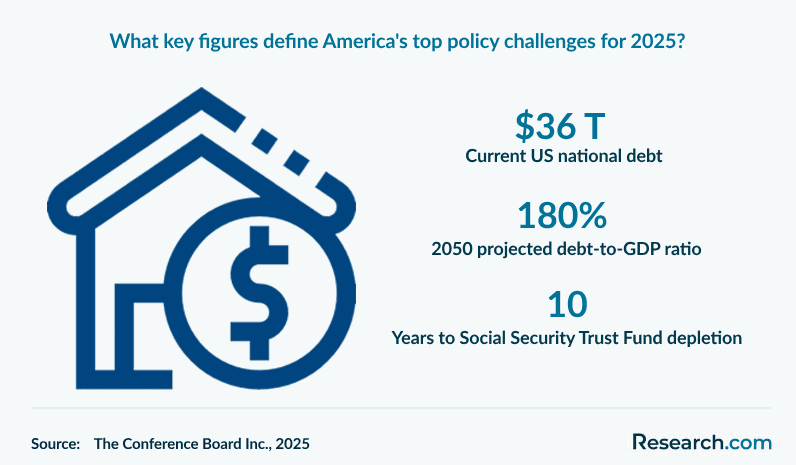
For students, these fiscal pressures reinforce the importance of choosing a program that teaches budget analysis, public finance, and evidence-based evaluation, not only broad public affairs theory.
What are the financial aid options for an online Master's degree in Public Policy?
Financial aid can materially change the value of an online public policy degree. Students comparing Masters in Public Policy online programs should evaluate both advertised tuition and actual net cost after aid, grants, employer support, military benefits, or scholarships.
- Federal student aid: Graduate students can submit the Free Application for Federal Student Aid (FAFSA) to access federal aid options, including Direct Unsubsidized Loans.
- Military and veteran benefits: Active-duty service members, veterans, and eligible family members may qualify for institutional military tuition discounts, the Post-9/11 GI Bill, or the Yellow Ribbon Program.
- Employer tuition assistance: Professionals already working in government, nonprofits, consulting, or regulated industries should ask whether their employer offers tuition reimbursement or professional development funding.
- Scholarships and grants: Universities and public service organizations may offer awards for students pursuing public policy, public administration, or public affairs degrees.
- State-specific aid: Some states offer grants or loan forgiveness tied to public service, residency, or workforce needs.
| Before borrowing, ask | Why it matters |
| What is the full cost after fees? | Tuition alone can understate the actual price. |
| Can I take fewer courses per term without losing aid? | Accelerated pacing may not fit every work schedule. |
| Does my employer require a grade minimum for reimbursement? | Employer aid often comes with conditions. |
| Are scholarships renewable? | One-term awards may not reduce total debt enough. |
| What happens if I pause enrollment? | Leave policies can affect aid, timeline, and loan repayment status. |
What are the prerequisites for enrolling in an online Master's degree in Public Policy?
Admission requirements vary, but most online public policy master’s programs look for evidence that applicants can handle graduate writing, analytical coursework, and professional problem-solving. Applicants from related fields, including graduates of the fastest online master of health administration programs, may be able to connect prior experience to policy areas such as healthcare access, regulation, public health, or organizational management.
- Bachelor's degree: Applicants generally need a bachelor’s degree from a regionally accredited institution.
- Minimum GPA: Many programs expect an undergraduate GPA around 3.0 on a 4.0 scale, though some may review lower GPAs conditionally or holistically.
- Professional experience: Executive MPA or Executive MPP programs may prefer or require several years of relevant work in the public, nonprofit, military, or private sectors.
- Application documents: Most programs request official transcripts, a resume, recommendation letters, and a statement of purpose explaining public service interests and career goals.
- Standardized tests: Many schools are test-optional, but some may still request GRE or GMAT scores as part of their review process.
If your goal is senior management rather than policy analysis, it may also be useful to compare this pathway with executive masters degrees.
What courses are typically in an online Master's degree in Public Policy?
Online public policy master’s programs combine analytical training with leadership and governance coursework. While they are not technology bootcamps, strong programs increasingly expect students to use data tools and evidence-based methods; students comparing fast skill-building models may notice similar intensity in options such as the fastest online Microsoft Azure dual certification bootcamps.
| Course area | What you learn | Career relevance |
| Foundations of Public Policy and Administration | Governance structures, policy processes, and the role of public and nonprofit institutions | Builds context for work in agencies, nonprofits, and public affairs organizations |
| Quantitative Methods for Policy Analysis | Statistical methods, data interpretation, program effectiveness, and evidence-based recommendations | Useful for analyst, evaluation, research, and consulting roles |
| Microeconomics for Public Policy | Market failures, incentives, government intervention, and policy trade-offs | Supports regulatory, fiscal, and social policy analysis |
| Public Budgeting and Financial Management | Revenue, spending, budget analysis, financial reporting, and accountability | Important for government, nonprofit, and program management careers |
| Policy and Program Evaluation | Methods for assessing implementation, outcomes, and impact | Core preparation for evaluation, oversight, and performance roles |
| Public and Nonprofit Management | Leadership, organizational behavior, performance management, and service delivery | Relevant for managers and future executives |
| Legal and Ethical Issues in Public Administration | Legal frameworks, ethical dilemmas, transparency, and public accountability | Essential for responsible decision-making in public service |
A 2025 Pew Research survey found that dissatisfaction with democracy is widespread, with a 23-country median of 58% of citizens dissatisfied with how democracy is working. Dissatisfaction reached 81% in Greece, 76% in Japan, and 71% in South Korea.
In North America, 62% of adults in the USA reported dissatisfaction, while Canada was lower at 39%. Like the demand patterns behind the fastest online cybersecurity bootcamps, these figures point to a need for professionals who can rebuild institutional trust, improve service delivery, and design evidence-based interventions.
What types of specializations are available for Master's degree in Public Policy graduates?
Specializations help students connect policy training to a specific issue area, employer type, or career goal. As with focused credentials such as the fastest online special education graduate certificate programs, a concentration can make your degree more targeted and easier to explain to employers.
- Environmental Policy and Sustainability: Focuses on environmental regulation, resource management, climate policy, and sustainability planning.
- Health Policy and Management: Covers healthcare systems, health insurance, access, public health, regulation, and the economic and social forces shaping care delivery.
- Social Policy and Inequality: Examines poverty, housing, education, social welfare, equity, and policy responses to systemic inequality.
- Urban and Regional Planning: Addresses land use, transportation, community development, infrastructure, and metropolitan governance.
- Technology and Innovation Policy: Explores data privacy, cybersecurity, artificial intelligence, platform governance, and regulation of emerging technologies.
- International Development and Global Policy: Focuses on diplomacy, human rights, global poverty, aid, development, and international institutions.
Foreign policy is one important area within the broader public policy landscape. A Pew Research 2024 survey of U.S. adults found that the top long-range foreign policy priority was protecting the country from terrorist attacks, identified as a top goal by 73% of respondents. Other high-ranking priorities included reducing the flow of illegal drugs into the country at 64% and preventing the spread of weapons of mass destruction at 63%.
Just over half of Americans named maintaining U.S. military advantage as a top goal at 53%, and 52% prioritized reducing the spread of infectious diseases. Limiting the power and influence of Russia and China were top priorities for 50% and 49% of adults, respectively.
The graph below shows that Americans tend to give highest priority to foreign policy goals that feel directly connected to domestic safety and public health.
How do you choose the best online Master's degree in Public Policy?
The best online public policy master’s is the one that fits your career target, learning style, timeline, and budget while meeting credible academic standards. Choosing well requires more than scanning rankings or selecting the lowest tuition. As with the fastest online master's in adult education programs, you need to evaluate structure, accreditation, specialization, and support before enrolling.
| Decision factor | Choose this if... | Be cautious if... |
| MPP | You want policy analysis, economics, evaluation, and evidence-based decision-making. | You mainly want broad public management or executive administration training. |
| MPA | You want public administration, management, budgeting, and organizational leadership. | You want a highly analytical policy research curriculum. |
| Executive MPA or Executive MPP | You have several years of experience and want a leadership-oriented format. | You are early career and need foundational policy or administration training. |
| Online accelerated format | You can manage intensive weekly work and want to finish faster. | Your job or family schedule is unpredictable and you may need a slower pace. |
| Part-time online format | You need flexibility and want to reduce overload. | You need the credential quickly for promotion or career change. |
- Accreditation: Confirm recognized institutional accreditation and review whether the program is aligned with or accredited by the Network of Schools of Public Policy, Affairs, and Administration (NASPAA) where relevant.
- Curriculum fit: Map required courses to your goals. A future budget analyst needs public finance; a future evaluation specialist needs statistics and program evaluation.
- Faculty expertise: Look for faculty whose research or professional background matches your policy interests.
- Format and flexibility: Check whether the program is fully online, hybrid, asynchronous, synchronous, or requires residencies.
- Student support: Ask about academic advising, writing help, technology support, career coaching, and alumni access for online students.
- Capstone or thesis: Choose a capstone if you want applied professional experience; consider a thesis if doctoral study may be in your future.
Common mistakes to avoid when choosing a fast online public policy master’s
- Choosing based on speed alone: The shortest program is not always the strongest option for career growth.
- Ignoring accreditation: Accreditation affects financial aid, credit transfer, employer perception, and graduate school pathways.
- Looking only at tuition per credit: Total cost depends on required credits, fees, materials, and time to completion.
- Assuming online means self-paced: Many accelerated programs have fixed weekly deadlines and live sessions.
- Overlooking specialization fit: A strong general program may not be ideal if you need technology, health, environmental, or international policy expertise.
- Assuming salary outcomes are guaranteed: Compensation depends on experience, sector, location, and role level.
- Relying only on rankings: Rankings can help narrow options, but they cannot replace program-specific research.
What career paths are available for graduates of online Master's degree in Public Policy programs?
A Master’s in Public Policy can support careers in government, nonprofits, consulting, private industry, and international organizations. Graduates from other fields, including the fastest online nutrition degree programs, may use their subject-matter expertise to move into public health policy, food systems policy, health equity, or program evaluation.
| Career path | Typical responsibilities | Useful graduate preparation |
| Policy Analyst | Researches public issues, evaluates legislation, models policy effects, and writes recommendations | Statistics, economics, policy analysis, research methods, policy writing |
| Program Manager | Oversees public or nonprofit programs, budgets, staff, reporting, and outcomes | Public management, budgeting, evaluation, leadership |
| Government Affairs Manager | Tracks legislation, builds relationships with officials, advises organizations, and supports advocacy strategy | Regulation, stakeholder analysis, communications, political institutions |
| City Manager or Urban Planner | Supports local government operations, planning, infrastructure, land use, and community development | Urban policy, public finance, planning, public administration |
| Budget Analyst | Develops budgets, monitors spending, analyzes funding requests, and supports fiscal accountability | Public finance, budgeting, economics, data analysis |
| Nonprofit Executive Director | Leads mission strategy, fundraising, programs, staff, advocacy, and external partnerships | Nonprofit management, leadership, grant strategy, program evaluation |
How much can I earn with an online Master's degree in Public Policy?
Public policy salaries vary by role, employer, location, and years of experience. A graduate degree may support advancement, but it should be paired with relevant experience, analytical skills, and professional networks. For a broader view of roles in the field, review Research.com’s guide to public policy jobs.
- Analyst-Level Roles: Policy Analyst, Research Associate, and related positions typically earn between $65,000 and $90,000 annually.
- Management-Level Roles: Program Manager, Senior Policy Analyst, and similar positions can range from $80,000 to over $125,000.
- Senior & Specialized Roles: Director of Government Affairs, Chief Policy Officer, and other high-level roles can exceed $175,000.
Based on 2025 PayScale data shown in the graph below, compensation rises with seniority and management responsibility. Foundational analyst and associate roles include research analyst at an average of $62,111, policy analyst at $63,139, and data analyst at $66,913. Mid-level roles include policy advisor at $72,510 and program director for non-profits at $80,875.
Senior and management roles show a clear salary step up. A senior policy analyst averages $83,832, while an operations manager averages $83,676. Director-level roles often reach six figures, including director of operations at $95,282, management consultant at $103,840, and director of public policy at $110,595.
The highest averages are associated with executive leadership: executive director at $137,760, chief of staff at $145,207, and chief executive officer (CEO) at $161,239.
The salary pattern reinforces a practical point: public policy professionals usually increase earnings by combining analytical credibility with management responsibility, specialized expertise, and strategic leadership experience.
What is the job market like for graduates with an online Master's degree in Public Policy?
The job market for public policy graduates is shaped by government needs, nonprofit funding, regulation, public health, infrastructure, technology governance, and demand for measurable outcomes. Students comparing an online Masters in Public Policy should look at both broad labor-market data and the specific sectors where they want to work.
- Government sector: The U.S. Bureau of Labor Statistics projects stable demand in public-sector-related roles, with urban and regional planners projected to grow 4% between 2023 and 2033.
- High-demand specializations: Healthcare policy, environmental regulation, social services, and data analytics remain important areas. Employment for social and community service managers is projected to grow 8% from 2023 to 2033, much faster than the average for all occupations.
- Private sector growth: Companies increasingly need public policy expertise for government relations, regulatory compliance, corporate social responsibility, and risk management.
- Nonprofit employment: Nonprofits continue to hire policy graduates for advocacy, research, community development, public health, social services, and international aid work.
What are some current and future trends in public policy?
Public policy is being reshaped by data, AI, institutional trust concerns, fiscal pressure, climate risk, geopolitical competition, and cross-sector service delivery. Many online MPP programs now reflect these shifts through coursework in analytics, ethics, equity, governance, and program evaluation.
- Evidence-based and data-driven policy: Governments and nonprofits increasingly rely on data, evaluation, and measurable outcomes to design and defend programs.
- Artificial intelligence and GovTech: AI is affecting public services, administrative automation, fraud detection, policy modeling, and decision support, while also raising ethics and accountability concerns.
- Equity and inclusion: Policy professionals are expected to understand how programs affect different communities and how to assess fairness in implementation.
- Public-private partnerships: Governments often work with private and nonprofit partners to deliver infrastructure, technology, health, and social programs.
- ESG and regulatory governance: Environmental, Social, and Governance issues influence both corporate strategy and public regulation, creating demand for professionals who understand policy and accountability.
AI policy is a major example. The Partnership for Global Inclusivity on AI (PGIAI) includes eight U.S. companies with a combined commitment of more than $100 million. The U.S. Department of State also intends to provide $10 million in foreign assistance to help close the AI access gap and plans to provide an additional $23 million to support responsible AI use globally.
Funding is targeted across several policy goals, including over $12 million for democracy and human rights programs, $5 million for AI capacity-building through exchanges, and over $3 million for efforts to identify misinformation and disinformation.
Additional funding includes a $1.2 million project for an AI policy framework in the Americas and $1.3 million to launch a USAID responsible AI initiative. The graphic below summarizes these commitments.
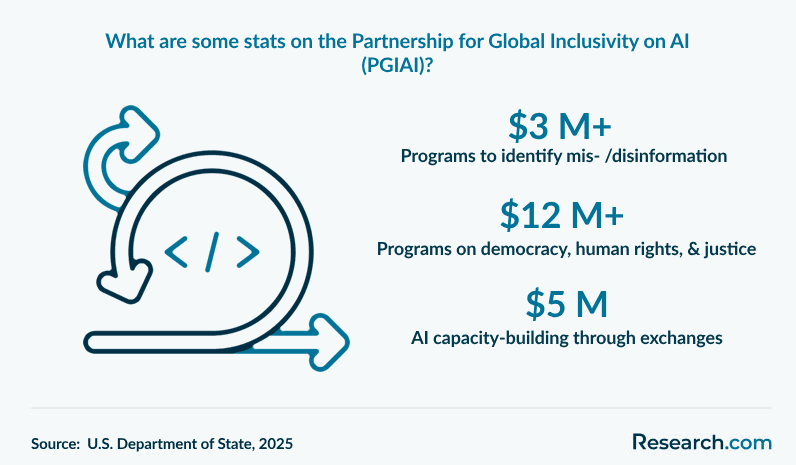
For public policy students, these investments show why AI governance is no longer a niche topic. Future policy professionals will need to understand technology access, responsible implementation, democratic safeguards, misinformation, and cross-border coordination.
Questions to ask before applying to an accelerated online public policy master’s
- Is the university institutionally accredited, and is the public affairs program recognized by NASPAA or aligned with comparable standards?
- How many hours per week should students expect in each accelerated course?
- Are courses asynchronous, synchronous, or a mix of both?
- Can working students slow down if needed without losing financial aid or cohort access?
- Does the program include a capstone, thesis, internship, practicum, or client-based project?
- What policy specializations are available, and are they offered fully online?
- What career services are available specifically to online graduate students?
- What is the total program cost after tuition, fees, books, and technology charges?
- Can employer tuition reimbursement, military benefits, scholarships, or grants reduce the net cost?
- Where do graduates work, and does the school provide role-specific outcomes data?
Key Insights
- Fast does not automatically mean better: The strongest accelerated public policy programs compress delivery while preserving analytical coursework, faculty interaction, and applied projects.
- Most accelerated timelines require discipline: Many fast programs use 8- to 10-week terms and may be completed in 12-18 months, but the workload can be intense for full-time employees.
- Accreditation should be nonnegotiable: Confirm institutional accreditation and review NASPAA recognition where relevant before applying.
- Cost varies widely: Public university online programs may range from approximately $25,000 to $50,000 for in-state students, while private university programs often range from $50,000 to over $90,000.
- Career outcomes depend on alignment: Choose an MPP for policy analysis and evidence-based decision-making, an MPA for administration and management, and an executive format if you already have substantial professional experience.
- Salary growth is tied to responsibility: 2025 PayScale data shows progression from analyst averages such as $62,111 for research analyst to executive averages such as $161,239 for CEO.
- Public policy demand is issue-driven: Fiscal pressure, AI governance, democratic dissatisfaction, health policy, environmental regulation, and social services are shaping employer needs.
- ROI must be personal: Compare total cost, time to completion, employer support, target role, and realistic salary movement before borrowing for a fast online public policy master’s.
References:
- Bureau of Labor Statistics. (2025). Social and Community Service Managers. U.S. Department of Labor, Occupational Outlook Handbook. Bureau of Labor Statistics.
- Bureau of Labor Statistics. (2025). Urban and Regional Planners. U.S. Department of Labor, Occupational Outlook Handbook. Bureau of Labor Statistics.
- PayScale. (2025). Master of Public Policy (MPP) Salary in the United States. PayScale.
- Pew Research Center. (2024, April 23). What are Americans’ top foreign policy priorities? Pew Research Center.
- Pew Research Center. (2025, June 30). Dissatisfaction with democracy remains widespread in many nations. Pew Research Center.
- U.S. Bureau of Economic Analysis. (2025). U.S. International Investment Position, 1st Quarter 2025 and Annual Update. Bureau of Economic Analysis.
- U.S. Department of State. (2025). United States and eight companies launch the partnership for global inclusivity on AI. U.S. Department of State.
Other Things You Should Know About the Fastest Online Master's Degree in Public Policy Programs
In 2027, online public policy programs provide flexibility for working professionals to balance education with career commitments. They often offer asynchronous classes, which enable students to learn at their own pace. The ability to apply theoretical knowledge directly into current job roles enhances both learning and career advancement opportunities.
The fastest online public policy degree programs in 2027 often feature accelerated courses, allowing students to complete the program in as little as one year. These programs commonly offer flexible schedules, enabling students to balance work and study. The curriculum typically covers key areas such as policy analysis, ethics, and economic principles.
The fastest online public policy degree programs in 2027 typically take between one to two years to complete. Accelerated formats enable students to balance work and study, with some programs offering completion in as little as 12 months.


