2027 Best Environmental Policy Degree Programs

Co-Founder and Chief Data Scientist
Choosing an environmental policy degree is not just about finding a program with “environment” in the title. The right program should prepare you to interpret science, evaluate laws, communicate with stakeholders, and turn sustainability goals into workable policies. This matters more now because governments, nonprofits, consulting firms, and private employers need professionals who can respond to climate risks, resource pressures, environmental justice concerns, and changing regulations.
This guide is for students comparing undergraduate environmental policy programs, working adults considering a career change, and future graduate students who want a practical foundation before specializing. You will learn what environmental policy programs teach, how long they take, what they cost, which schools are included in our 2027 list, what careers may follow, and how to evaluate whether a program fits your goals.
Quick Answer: Is an Environmental Policy Degree Worth It?
An environmental policy degree can be a strong choice if you want to work at the intersection of environmental science, public policy, law, planning, sustainability, and community decision-making. The U.S. Bureau of Labor Statistics projects 7% employment growth for environmental scientists and specialists, including environmental policy-related roles, from 2023 to 2033. Graduates may pursue jobs in state government, consulting, local government, engineering services, federal agencies, nonprofits, and sustainability-focused organizations.
The degree is most useful when the program includes applied policy analysis, environmental law, economics, data interpretation, writing-intensive coursework, internships, and a capstone or field-based project. Students should compare accreditation, total cost, curriculum depth, internship access, online flexibility, transfer credit policies, and career outcomes before enrolling.
What Are the Main Benefits of an Environmental Policy Degree?
- Broader career options: Environmental policy graduates can qualify for roles that require knowledge of regulations, sustainability planning, public-sector decision-making, compliance, research, and advocacy.
- Competitive earning potential: Reported salaries commonly range from $59,000 to $103,000 per year, although actual pay depends heavily on job title, employer, location, education level, and experience.
- Transferable professional skills: Students build research, policy writing, public communication, leadership, negotiation, and analytical skills that can be used in government, consulting, corporate sustainability, law-adjacent work, and nonprofit advocacy.
- Pathway to graduate or professional study: The degree can support future study in public policy, environmental law, urban planning, sustainability, environmental science, or public administration.
What Can I Expect From an Environmental Policy Degree?
An environmental policy degree teaches students how environmental problems become public decisions. Programs usually combine environmental science, economics, political science, law, ethics, planning, and research methods. Instead of focusing only on ecological systems, these programs examine how governments, businesses, communities, and courts shape environmental outcomes.
Students commonly study environmental law, policy analysis, environmental economics, sustainability, climate policy, environmental justice, and natural resource management. Many programs also include internships, applied projects, fieldwork, or a capstone assignment where students evaluate a real environmental issue and propose a policy response.
| Program Feature | What It Usually Means for Students | Why It Matters |
| Interdisciplinary coursework | Classes may cover science, policy, economics, law, ethics, and planning. | Environmental policy work requires both technical understanding and public decision-making skills. |
| Policy analysis training | Students learn how to compare policy options, weigh trade-offs, and evaluate outcomes. | This is central for analyst, planning, advocacy, and consulting roles. |
| Internship or field experience | Some programs connect students with agencies, nonprofits, or consulting organizations. | Practical experience can strengthen resumes and clarify career direction. |
| Capstone project | Students apply classroom learning to a current environmental problem. | Capstones can become writing samples for jobs or graduate school applications. |
| Tuition range | Published costs in this guide range from around $250 to over $1,500 per credit hour. | Total price can vary widely, so students should calculate full program cost rather than comparing tuition alone. |
Where Can I Work With an Environmental Policy Degree?
Environmental policy graduates work in settings where environmental rules, sustainability goals, public planning, and organizational decisions intersect. The strongest fit depends on whether you prefer research, regulation, communication, advocacy, planning, or business-facing work.
- State Government (28%): Professionals may help design policies, administer programs, enforce regulations, manage natural resources, or support environmental planning at the state level.
- Management, Scientific, and Technical Consulting Services (19%): Graduates may advise agencies, companies, or communities on compliance, sustainability strategies, environmental reviews, and policy implementation.
- Local Government (14%): Roles may involve land use, zoning, climate action plans, waste programs, transportation planning, conservation, and local environmental regulations.
- Engineering Services (11%): Environmental policy knowledge can support infrastructure projects by helping teams meet environmental standards, permitting requirements, and community-impact goals.
- Federal Government (7%): Federal roles may involve national environmental programs, research support, regulatory work, and policy implementation through agencies such as the EPA.
How Much Can I Make With an Environmental Policy Degree?
Pay in environmental policy varies by employer, specialization, location, credentials, and experience. A graduate working in a local nonprofit will usually have a different salary range than a professional in federal policy, consulting, environmental economics, or law-adjacent compliance.
- Average salary: As of 2025, professionals earn an average of $61,806 per year, with reported salaries typically ranging from $59,000 to $103,000.
- Location differences: In Seattle, salaries range from $94,000 to $119,000, while environmental scientist II roles in Renton, WA, are listed at $96,512 to $122,572 annually.
- Experience levels: Entry-level positions may start at $45,000–$54,000, while professionals with 15+ years can earn up to $150,000.
- Industry differences: Environmental policy professionals in federal government roles pay around $109,120, while state government positions average $73,030.
- Advanced education and specialization: Graduate degrees, legal training, technical expertise, or specialized credentials can support access to higher-paying roles. For example, environmental economists earn about $111,940, and environmental lawyers average $93,223 annually.
- Best Environmental Policy Degree Programs for 2027
- How Long Does an Environmental Policy Degree Take?
- How Much Does an Environmental Policy Degree Cost?
- Financial Aid Options for Environmental Policy Students
- Environmental Policy Degree Admission Requirements
- Common Environmental Policy Courses
- Environmental Policy Specializations
- Trends Increasing the Value of Environmental Policy Degrees
- How to Check Accreditation and Program Quality
- Are Online Environmental Policy Degrees Cost-Effective?
- How Urban Planning Can Strengthen an Environmental Policy Career
- Online Courses That Can Complement an Environmental Policy Degree
- How Engineering Knowledge Can Support Environmental Policy Work
- Whether an Online Sustainability Master’s Program Is a Good Investment
- How to Choose the Best Environmental Policy Degree Program
- Environmental Policy Career Paths
- Job Market for Environmental Policy Graduates
Best Environmental Policy Degree Programs for 2027
How Research.com Evaluates These Programs
A degree can affect your finances, career options, and graduate school preparation, so rankings should be read as a starting point rather than the only decision tool. Research.com uses data-informed evaluation methods and trusted education sources, including the IPEDS database, Peterson's database, the College Scorecard database, and The National Center for Education Statistics. These sources help assess institutional and program information for environmental policy degrees. For more detail on how Research.com evaluates schools and programs, review the methodology page.
| Rank | School | Degree | Credits | Cost | Accreditation |
| 1 | Purdue University Global | Bachelor of Science in Environmental Policy | 180 | $371 per credit hour | Higher Learning Commission (HLC) |
| 2 | Everglades University | Bachelor of Science in Environmental Policy and Management | 123 | $870 per credit hour | Southern Association of Colleges and Schools Commission on Colleges (SACSCOC) |
| 3 | Loyola University Chicago | Bachelor of Arts in Environmental Policy | 120 | $960 per credit hour | Higher Learning Commission (HLC) |
| 4 | Lynn University | Bachelor of Science in Environmental Policy | 120 | $1,220 per credit hour | Southern Association of Colleges and Schools Commission on Colleges (SACSCOC) |
| 5 | University of Iowa | Bachelor of Science in Environmental Policy | 120 | $1,548 per credit hour | Higher Learning Commission (HLC) |
| 6 | University of Tulsa | Bachelor of Arts in Environmental Policy | 120 | $1,564 per credit hour | Higher Learning Commission (HLC) |
| 7 | Eastern Washington University | Bachelor of Arts in Environmental Policy | 75-76 | $250.68 per credit hour | Northwest Commission on Colleges and Universities |
| 8 | Bowling Green State University | Bachelor of Arts in Environmental Policy and Analysis | 120 | $445.40 per credit hour | Higher Learning Commission |
| 9 | Western Washington University | Environmental Policy Bachelor’s Degree Program | 120 | $275 per credit hour | Northwest Commission on Colleges and Universities |
| 10 | University of Wisconsin-Green Bay | Bachelor of Science in Environmental Policy and Planning | 120 | $296.87 per credit hour | Higher Learning Commission |
1. Purdue University Global
Purdue University Global offers a Bachelor of Science in Environmental Policy that brings together environmental studies, science, economics, and policy. The curriculum examines how government, private organizations, communities, and environmental systems interact. Students study topics such as environmental politics, law, ethics, economics, and sustainability, then synthesize their learning through a capstone course.
- Required credits to graduate: 180
- Cost: $371 per credit hour
- Accreditation: Higher Learning Commission (HLC)
2. Everglades University
Everglades University provides a Bachelor of Science in Environmental Policy and Management designed for students who want both environmental knowledge and management preparation. Coursework addresses industrialization, environmental technologies, regulatory systems, and business-oriented decision-making for environmental organizations.
- Required credits to graduate: 123
- Cost: $870 per credit hour
- Accreditation: Southern Association of Colleges and Schools Commission on Colleges (SACSCOC)
3. Loyola University Chicago
Loyola University Chicago offers a Bachelor of Arts in Environmental Policy focused on policy design, enforcement, ecological protection, and environmental justice. The program emphasizes ethics, social justice, research, and internships, preparing students for public-sector, nonprofit, consulting, and graduate-study pathways.
- Required credits to graduate: 120
- Cost: $960 per credit hour
- Accreditation: Higher Learning Commission (HLC)
4. Lynn University
Lynn University offers a Bachelor of Science in Environmental Policy with an interdisciplinary structure. Students study environmental issues through scientific and policy-based lenses, with coursework that may include ecology, climate change, sustainability, and policy responses to complex environmental problems.
- Required credits to graduate: 120
- Cost: $1,220 per credit hour
- Accreditation: Southern Association of Colleges and Schools Commission on Colleges (SACSCOC)
5. University of Iowa
The University of Iowa provides a Bachelor of Science in Environmental Policy that prepares students to approach environmental problems through policy and planning. The program highlights the human side of environmental issues and supports preparation for fields such as environmental law, city planning, and public policy. Students may choose between planning and policy tracks.
- Required credits to graduate: 120
- Cost: $1,548 per credit hour
- Accreditation: Higher Learning Commission (HLC)
6. University of Tulsa
At the University of Tulsa, the Bachelor of Arts in Environmental Policy connects natural science, social science, and public policy. Students build critical thinking and problem-solving skills while studying environmental science, public policy, advocacy, and decision-making.
- Required credits to graduate: 120
- Cost: $1,564 per credit hour
- Accreditation: Higher Learning Commission (HLC)
7. Eastern Washington University
Eastern Washington University offers a Bachelor of Arts in Environmental Policy for students interested in policy, planning, and sustainable communities. Courses include environmental planning, international political economy, and sustainable communities, with a senior capstone that allows students to apply their policy knowledge.
- Required credits to graduate: 75-76
- Cost: $250.68 per credit hour
- Accreditation: Northwest Commission on Colleges and Universities
8. Bowling Green State University
Bowling Green State University offers a Bachelor of Arts in Environmental Policy and Analysis for students interested in environmental improvement through policy, education, behavioral change, and community engagement. The program has a social science orientation and prepares students to examine how people, institutions, and policies shape environmental outcomes.
- Required credits to graduate: 120
- Cost: $445.40 per credit hour
- Accreditation: Higher Learning Commission
9. Western Washington University
Western Washington University offers an environmental policy bachelor’s degree program that prepares students to influence laws, regulations, and organizational decisions related to environmental and climate challenges. The program emphasizes interdisciplinary problem-solving for careers in policy agencies, consulting firms, nonprofit organizations, and related settings.
- Required credits to graduate: 120
- Cost: $275 per credit hour
- Accreditation: Northwest Commission on Colleges and Universities
10. University of Wisconsin-Green Bay
The University of Wisconsin-Green Bay offers a Bachelor of Science in Environmental Policy and Planning for students interested in policy development, sustainable communities, and evidence-based decision-making. The curriculum combines environmental science, policy, and planning to help students address ecological and community challenges.
- Required credits to graduate: 120
- Cost: $296.87 per credit hour
- Accreditation: Higher Learning Commission
How Long Does It Take to Complete an Environmental Policy Degree Program?
Completion time depends on degree level, enrollment status, transfer credits, course availability, and whether the student studies online, on campus, full time, or part time.
| Path | Typical Full-Time Timeline | Best For | Important Consideration |
| Bachelor’s degree | About four years | Students starting from high school or transferring into an undergraduate program | Transfer credits and general education requirements can change the timeline. |
| Master’s degree | Generally two years | Students who already hold a bachelor’s degree and want advanced policy expertise | Applicants without environmental coursework may need additional foundational classes. |
| Accelerated bachelor’s degree | Typically three years | Motivated students who can handle a compressed schedule | Faster programs may require heavier course loads and fewer breaks. |
| Accelerated master’s degree | Typically one year | Students with strong preparation or related prior study | These programs can be intensive and may offer less schedule flexibility. |
Bachelor's Degree in Environmental Policy
A full-time bachelor’s program in environmental policy usually takes about four years. Students complete general education courses along with major coursework in environmental law, economics, public policy, science, planning, and research methods.
Master's Degree in Environmental Policy
A full-time master’s degree in environmental policy generally takes two years. Graduate study is more specialized and may include advanced work in environmental law, climate policy, economic analysis, global environmental issues, public administration, and policy evaluation.
- Students with a non-environmental undergraduate degree: Applicants from unrelated majors may need an additional year if the program requires foundational coursework in environmental science, economics, or policy.
- Students with a pre-professional environmental degree: Students who already studied environmental studies or a closely related field may move more quickly through some master’s programs, potentially finishing in one to one-and-a-half years.
Accelerated Programs
Accelerated environmental policy programs shorten the time to graduation by compressing coursework or allowing students to take heavier course loads. Bachelor’s programs may take three years, while master’s programs may take one year. Students who need flexibility can also compare accelerated online degrees, but they should confirm course intensity, internship expectations, and transfer policies before enrolling.
What Is the Average Cost of an Environmental Policy Degree Program?
The price of an environmental policy degree depends on the school, residency status, delivery format, credit requirements, fees, books, technology costs, internship expenses, and how many credits a student transfers.
- Public vs. private institutions: Costs vary widely. Western Washington University, a public institution, lists $275 per credit hour for its environmental policy program. Loyola University Chicago, a private institution, lists $960 per credit hour.
- In-state vs. out-of-state tuition: Public universities often charge less for in-state students, while out-of-state students may pay more. Students seeking lower-cost routes should compare residency policies, transfer credits, and affordable online bachelor degree programs.
- Additional fees: Registration, technology, lab, fieldwork, books, software, travel, and internship-related expenses can increase the total price beyond tuition.
The chart below compares tuition rates among the listed environmental policy programs and shows how much the per-credit price can differ by institution.
What Financial Aid Options Are Available for Environmental Policy Students?
Environmental policy students may be able to reduce out-of-pocket costs through federal, state, institutional, employer, and work-based aid. Many campus-based and online institutions participate in aid programs, and students can use resources on online colleges that accept financial aid to understand how aid eligibility works in distance education.
- Federal grants and loans: The U.S. Department of Education offers aid such as the Pell Grant for eligible low-income undergraduate students and federal student loans with borrower protections.
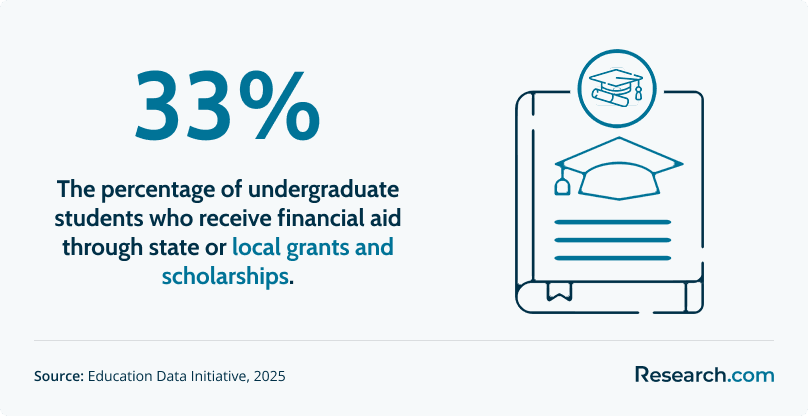
- State aid programs: States may offer grants or scholarships to residents. Approximately 33% of undergraduate students receive financial aid from state or local grants and scholarships.
- Institutional scholarships and assistantships: Schools may provide merit-based or need-based scholarships, tuition discounts, fellowships, research opportunities, or assistantships, especially at the graduate level.
- Work-study: Eligible students may qualify for part-time jobs through federal work-study, which can provide income and, in some cases, relevant experience.
- Employer tuition assistance: Working adults should ask whether their employer offers tuition reimbursement for degrees related to sustainability, compliance, policy, planning, or public administration.
| Aid Type | Who Should Look Into It | What to Ask Before Relying on It |
| Federal aid | Most eligible undergraduate and graduate students | Does the school participate in federal aid programs, and what is the net cost after aid? |
| State grants or scholarships | Students attending school in their state of residence | Are awards limited to in-state institutions or certain enrollment levels? |
| Institutional scholarships | Students with strong academics, financial need, or specific career goals | Is the award renewable, and what GPA or credit load is required? |
| Assistantships | Graduate students interested in research, teaching, or administrative support | Does the assistantship include tuition support, a stipend, or both? |
| Employer assistance | Working adults | Is there a service commitment or repayment requirement if you leave the company? |
What Are the Prerequisites for Enrolling in an Environmental Policy Degree Program?
Admission requirements vary by school and degree level. In general, undergraduate programs focus on college readiness, while graduate programs look for prior academic preparation, writing ability, analytical capacity, and sometimes relevant work experience.
Undergraduate Programs
Applicants to bachelor’s programs in environmental policy commonly need the following:
- High school diploma or equivalent: Students must usually show completion of secondary education.
- Minimum GPA: Some programs require a cumulative GPA, often around 2.0 or higher.
- Prerequisite courses: Certain schools may expect introductory environmental studies, science, or related coursework with minimum grades.
- General education readiness: Students should be prepared for writing, oral communication, quantitative reasoning, social science, and science-based coursework.
Graduate Programs
Master’s-level environmental policy programs commonly evaluate the following:
- Bachelor's degree: Applicants usually need an undergraduate degree from an accredited institution. Related majors may include political science, sustainability, planning, business, environmental studies, or social sciences, though some programs accept broader backgrounds.
- Minimum GPA: A competitive GPA is often 3.0 or higher.
- Standardized test scores: Some graduate programs may request GRE scores, while others make them optional.
- Professional or research experience: Experience in policy, sustainability, environmental science, advocacy, planning, or compliance can strengthen an application.
- Prerequisite coursework: Some programs may require prior work in environmental science, economics, policy analysis, physical science, or life science.
Admission planning matters in any field with defined eligibility standards. Just as students researching how to become an FBI agent must understand academic and professional expectations, environmental policy applicants should review each program’s science, policy, writing, and GPA requirements before applying.
What Courses Are Typically Included in an Environmental Policy Degree Program?
Environmental policy curricula are built to help students understand environmental problems, evaluate possible solutions, and communicate policy recommendations clearly. The strongest programs usually balance theory with applied analysis.
- Environmental Law: Students examine statutes, regulations, enforcement systems, and legal cases that shape environmental protection, pollution control, permitting, and resource management.
- Environmental Economics: This course explores how economic tools are used to evaluate environmental problems, including cost-benefit analysis, incentives, externalities, and sustainable resource use.
- Environmental Policy Analysis: Students learn how to assess policy options based on effectiveness, efficiency, feasibility, equity, and likely environmental impact.
- Environmental Ethics: Coursework examines moral questions in environmental decision-making, including responsibility to future generations, community impacts, conservation, and environmental justice.
- Environmental Planning: Students study how land use, transportation, housing, infrastructure, and natural resource decisions can support sustainable communities.
Students interested in regulatory investigations, compliance documentation, or evidence-based enforcement may also benefit from understanding evidence technician education requirements, especially when environmental work intersects with legal processes, public safety, or inspections.
What Types of Specializations Are Available in an Environmental Policy Degree Program?
Specializations help students connect environmental policy training to a clearer career direction. Not every school offers every track, so students should compare electives, faculty expertise, internship partners, and capstone options.
| Specialization | Focus | Good Fit For |
| Climate Policy | Policies for emissions reduction, adaptation, resilience, and climate governance | Students interested in climate action plans, public agencies, advocacy, or sustainability roles |
| Sustainable Development | Balancing economic activity, environmental protection, and social equity | Students drawn to international development, community planning, or sustainability strategy |
| Environmental Justice | Fair distribution of environmental benefits and burdens across communities | Students interested in advocacy, community engagement, public health, or civil rights-related policy work |
| Natural Resource Management | Policies governing forests, water, wildlife, land, and conservation | Students who want to work with agencies, conservation groups, or resource planning teams |
| Public Policy | Broad policy design, implementation, evaluation, and governance | Students considering government, think tanks, graduate study, or flexible policy roles |
Students who want a broader policy credential after earning a bachelor’s degree may compare MPP online programs, especially if they need a flexible route into advanced policy analysis.
What Emerging Trends Enhance the Value of an Environmental Policy Degree?
Environmental policy work is changing as climate adaptation, data-driven decision-making, renewable energy planning, environmental justice, and cross-border regulation become more important. Employers increasingly need professionals who can interpret technical information, translate evidence into policy, work with diverse stakeholders, and understand the practical consequences of environmental rules.
Technology is also shaping the field. Policy teams may use geographic information systems, emissions data, climate-risk models, sustainability metrics, and public dashboards to guide decisions. Graduates who combine policy training with data literacy, communication skills, and sector-specific knowledge may be better prepared for sustainability jobs and related environmental roles.
How Can I Verify Program Accreditation and Quality Standards?
Accreditation should be one of the first items students check. Institutional accreditation helps confirm that a college or university meets recognized academic and administrative standards. It can also affect transfer credits, graduate school eligibility, employer recognition, and access to federal financial aid.
- Confirm the school’s accreditor on the institution’s official website.
- Check whether the accreditor is recognized by a legitimate accrediting authority.
- Ask whether credits transfer to other accredited institutions.
- Review faculty qualifications, internship options, capstone requirements, and student support services.
- Compare program outcomes, not just marketing claims.
Students can also learn from career-focused resources, such as guidance on becoming an environmental scientist, to understand how employers view scientific preparation, field experience, and recognized credentials.
Are Online Environmental Policy Degree Programs a Cost-Effective Alternative?
Online environmental policy programs can be cost-effective for students who need flexibility, want to avoid relocation, or plan to keep working while studying. However, the least expensive option is not automatically the best value. Students should compare accreditation, faculty access, internship support, technology fees, course format, career services, and total program cost.
| Online Programs May Be a Good Fit If... | Campus Programs May Be a Better Fit If... |
| You need to work while earning the degree. | You want regular in-person faculty access and campus activities. |
| You live far from schools with environmental policy majors. | You want local fieldwork, labs, or community-based projects tied to the campus region. |
| You are disciplined with independent learning and deadlines. | You learn better through face-to-face discussion and structured schedules. |
| You want to compare lower-cost online options. | You want campus networking, student organizations, and in-person public-policy events. |
Students comparing online affordability can use lists of the cheapest online environmental science degree options as a benchmark, while still checking whether the curriculum is truly focused on policy, science, or both.
Can Integrating Urban Planning Enhance My Environmental Policy Career?
Urban planning can strengthen an environmental policy career because many environmental decisions happen through land use, transportation, housing, zoning, infrastructure, and local development. Students interested in climate-resilient cities, sustainable communities, water management, transportation policy, or environmental impact review may benefit from planning coursework.
Graduate-level planning study can also be useful for professionals who want to move into local government, regional planning agencies, consulting, or sustainable development. Students exploring this route can compare options such as the cheapest online masters in urban planning to understand how planning credentials may complement policy training.
What Additional Online Courses Can Complement an Environmental Policy Degree?
Short online courses can help students add targeted skills without committing immediately to another degree. Useful areas may include data analysis, GIS, grant writing, environmental law updates, sustainability reporting, climate adaptation, public budgeting, and project management. The best courses are those that close a specific skills gap for your intended career.
Students can review online environmental science programs to identify options that strengthen technical knowledge, especially if their environmental policy degree is more focused on law, governance, or social science than natural science.
Can Integrating Engineering Perspectives Enhance Environmental Policy Careers?
Engineering knowledge can help environmental policy professionals understand whether proposed solutions are technically feasible. This is especially valuable in areas such as water systems, renewable energy, waste management, infrastructure, environmental remediation, and pollution control. Policy recommendations are stronger when they account for cost, regulation, community impact, and technical constraints.
Students who want a more technical background can review most affordable online environmental engineering degree programs and compare whether an engineering-focused path, a policy path, or a combined approach best fits their career goals.
Is an Online Sustainability Master’s Program a Strategic Investment for My Career?
An online sustainability master’s program may be a useful next step for environmental policy graduates who want advanced training in sustainable development, resource management, corporate sustainability, climate strategy, or systems-based environmental problem-solving. The investment makes the most sense when the program aligns with a specific career goal and offers measurable benefits such as relevant coursework, applied projects, employer recognition, and networking opportunities.
Before enrolling, compare total cost, accreditation, time commitment, employer tuition support, career services, and whether the credential is needed for your target role. Cost-conscious students can review cheapest sustainability masters programs online while still evaluating quality and career fit.
How to Choose the Best Environmental Policy Degree Program
The best environmental policy program is the one that matches your career direction, budget, learning style, and need for practical experience. Rankings can help you build a shortlist, but they should not replace a detailed program comparison.
- Clarify your career target: Decide whether you are more interested in government policy, advocacy, sustainability consulting, corporate responsibility, planning, compliance, environmental justice, or graduate school.
- Review the curriculum carefully: Look for a balanced mix of environmental science, law, economics, policy analysis, statistics, writing, ethics, and applied projects.
- Check flexibility and format: Compare full-time, part-time, online, hybrid, and accelerated options. Make sure the schedule fits your work, family, and internship needs.
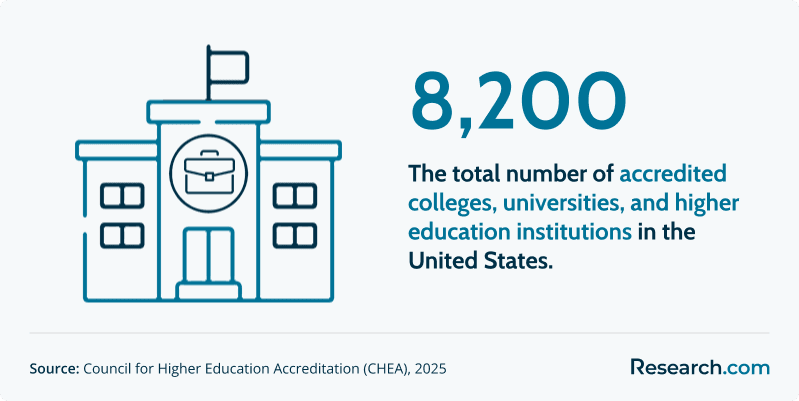
- Confirm accreditation: Accreditation helps protect degree value. According to the Council for Higher Education Accreditation (CHEA), there are 8,200 accredited education institutions in the U.S.; students should verify that the institution they choose is properly recognized.
- Compare outcomes and support: Ask about internship placements, career services, alumni roles, faculty connections, capstone projects, and graduate school placement.
- Calculate the real cost: Include tuition, fees, books, technology, travel, lost work time, and interest on loans if you borrow.
- Ask about transfer credits: Transfer-friendly policies can reduce both time and cost, especially for students with prior college coursework.
| Question to Ask | Why It Matters |
| Is the institution accredited by a recognized accreditor? | Accreditation affects financial aid, transferability, employer trust, and graduate school options. |
| Does the curriculum include environmental law and policy analysis? | These are core skills for many environmental policy roles. |
| Are internships, fieldwork, or capstone projects required? | Applied experience can make the degree more useful in the job market. |
| What career paths do recent graduates pursue? | Graduate outcomes help you judge whether the program supports your goals. |
| What is the total cost after aid? | Tuition alone does not show the full financial commitment. |
| Can online students access advising, library resources, and career services? | Support services are especially important for remote learners. |
Common Mistakes to Avoid When Choosing a Program
- Choosing based only on tuition: A cheaper program may cost more in the long run if it lacks transfer flexibility, career support, or required courses.
- Ignoring accreditation: Unaccredited or poorly recognized institutions can create problems with financial aid, transfer credits, graduate admission, and employer acceptance.
- Assuming every environmental degree is policy-focused: Environmental science, sustainability, environmental studies, and environmental policy programs can have very different course requirements.
- Overlooking internships: Policy work often rewards practical experience, writing samples, and professional contacts.
- Relying only on rankings: A highly ranked school may not be the best fit if it lacks your desired specialization, schedule, or affordability.
- Assuming salary outcomes are guaranteed: Pay depends on role, location, employer, experience, graduate education, and market conditions.
What Career Paths Are Available for Environmental Policy Graduates?
Environmental policy graduates can pursue roles that involve research, regulation, planning, sustainability, advocacy, compliance, and public communication. Some positions may require graduate education, technical experience, legal training, or specialized knowledge.
| Career Path | What the Role Involves | Median Salary |
| Environmental Policy Analyst | Researches environmental issues, evaluates regulations, analyzes data, and recommends policy improvements for agencies, nonprofits, or private organizations. | $72,221 per year |
| Urban and Regional Planner | Develops land-use plans, reviews development proposals, considers environmental impacts, and supports sustainable community growth. | $70,808 per year |
| Sustainability Consultant | Helps organizations reduce environmental impact, improve sustainability practices, assess operations, and comply with environmental expectations. | $57,583 per year |
| Environmental Lobbyist | Advocates for environmental legislation, communicates with lawmakers, supports campaigns, and represents organizations or interest groups. | $45,760 per year |
| Environmental Compliance Inspector | Inspects facilities, reviews permits, investigates potential violations, and helps enforce environmental rules for air, water, waste, or land management. | $65,481 per year |
1. Environmental Policy Analyst
Environmental policy analysts study environmental problems, evaluate existing policies, and recommend new or improved approaches. They often combine research, data interpretation, writing, and stakeholder communication. Employers may include government agencies, consulting firms, advocacy groups, and research organizations.
Median salary: $72,221 per year
2. Urban and Regional Planner
Urban and regional planners help communities make land-use decisions that balance development, conservation, transportation, housing, and public needs. Environmental policy training can be useful for reviewing environmental impact reports, designing sustainability plans, and supporting climate-resilient community growth.
Median salary: $70,808 per year
3. Sustainability Consultant
Sustainability consultants advise businesses and organizations on ways to reduce environmental impact, improve resource efficiency, comply with regulations, and build stronger sustainability strategies. They may conduct assessments, prepare reports, recommend operational changes, and support corporate responsibility initiatives.
Median salary: $57,583 per year
4. Environmental Lobbyist
Environmental lobbyists work to influence legislation, regulation, and public opinion. They may represent nonprofits, industry groups, advocacy organizations, or coalitions. This role requires strong communication, policy knowledge, research skills, and the ability to explain complex environmental issues to decision-makers.
Median salary: $45,760 per year
5. Environmental Compliance Inspector
Environmental compliance inspectors review whether organizations are following environmental laws and permit requirements. They may conduct inspections, document findings, investigate complaints, review records, and recommend corrective action when violations occur.
Median salary: $65,481 per year
Some graduates use environmental policy training in less traditional careers, including education, international development, and public communication. Students interested in global teaching or sustainability education can review the ESL teacher career path to see how cross-cultural communication skills may complement environmental advocacy or education work abroad.
What Is the Job Market for Graduates With an Environmental Policy Degree?
The job market for environmental policy graduates is supported by rising attention to environmental hazards, climate resilience, sustainability, and natural resource protection. The U.S. Bureau of Labor Statistics projects 7% growth in employment for environmental scientists and specialists, including environmental policy-related work, from 2023 to 2033.
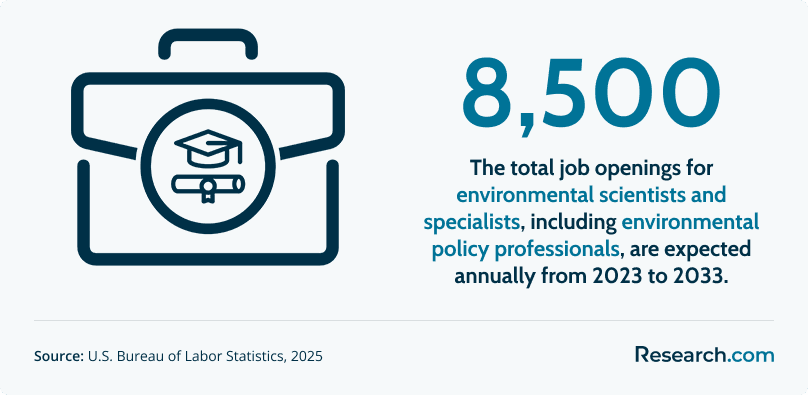
About 8,500 job openings for environmental scientists and specialists, including environmental policy professionals, are expected each year over the next decade. Some openings come from growth, while others result from workers retiring or moving into different occupations. Graduates may find opportunities in government agencies, consulting firms, nonprofits, planning offices, engineering-related organizations, and sustainability departments.
Students who need schedule flexibility sometimes compare the easiest degree to get online, but environmental policy students should be careful not to choose based on ease alone. A useful program should still provide rigorous writing, research, policy analysis, and applied learning.
Graduates interested in legal advocacy, regulation, litigation, or compliance may also consider environmental law. This path usually requires additional education, so it is important to understand environmental lawyer education requirements before planning a law-focused career.
What Graduates Say About Environmental Policy Degree Programs
-
: "
I cared about environmental issues before college, but the degree helped me understand how policy actually changes outcomes. The coursework was demanding, and my professors pushed me to think clearly about environmental law, regulation, and public responsibility. – Jezreel
"
-
: "
The program surprised me because it connected economics, law, science, and politics in ways I had not expected. That mix gave me several career options and helped me feel ready to work on real environmental problems after graduation. – Kathleen
"
-
: "
Internships and project-based assignments were the most valuable parts of my experience. Working with local government showed me how policy decisions affect communities, and that experience helped shape my path into environmental consulting. – Jonas
"
Key Insights
- Environmental policy is an interdisciplinary degree. The strongest programs combine environmental science, law, economics, policy analysis, ethics, planning, and applied research.
- Career outcomes vary by specialization and experience. Graduates may work in government, consulting, planning, sustainability, advocacy, compliance, nonprofits, or law-adjacent roles.
- Salary potential is real but not guaranteed. Reported earnings range from $59,000 to over $103,000 annually, with higher salaries often tied to location, experience, advanced education, technical expertise, or specialized roles.
- The labor market outlook is favorable. The BLS projects 7% growth from 2023 to 2033 for environmental scientists and specialists, including environmental policy-related positions.
- Cost differences are significant. Listed programs range from $250.68 per credit hour to $1,564 per credit hour, so students should calculate total cost, not just compare school names.
- Accreditation and applied experience matter. Before enrolling, confirm institutional accreditation and look for internships, capstones, fieldwork, research opportunities, and career support.
- Online programs can be worthwhile when they are rigorous and well-supported. Flexibility is valuable, but students should verify accreditation, advising, internship access, faculty interaction, and total net cost.
References
- Bureau of Labor Statistics. (n.d.). Environmental scientists and specialists: Occupational outlook handbook. U.S. Department of Labor. Retrieved from BLS.
- College Tuition Compare. (n.d.). Environmental science major. Retrieved from College Tuition Compare.
- Glassdoor. (n.d.). Environmental policy salary. Retrieved from Glassdoor.
- Indeed. (n.d.). Environmental policy jobs: What they are and how to get one. Retrieved from Indeed.
- United States Government. (n.d.). Federal student aid. USA.gov. Retrieved from USA.gov.
- ZipRecruiter. (n.d.). Environmental compliance inspector salary. Retrieved from ZipRecruiter.
- ZipRecruiter. (n.d.). Environmental lobbyist salary. Retrieved from ZipRecruiter.
- ZipRecruiter. (n.d.). Environmental policy analyst salary. Retrieved from ZipRecruiter.
- ZipRecruiter. (n.d.). Environmental policy salary. Retrieved from ZipRecruiter.
- ZipRecruiter. (n.d.). Sustainability consultant salary. Retrieved from ZipRecruiter.
- ZipRecruiter. (n.d.). Urban and regional planner salary. Retrieved from ZipRecruiter.
Other Things You Should Know About Environmental Policy Degree Programs
The 2027 Best Environmental Policy Degree Programs list highlights top universities like Harvard, Stanford, and Yale for their exemplary programs designed to address critical environmental challenges through comprehensive coursework and research opportunities.
Graduates of 2027 Environmental Policy degree programs can pursue careers in governmental agencies, non-profits, or private companies as policy analysts, environmental consultants, or sustainability advisors. Roles focus on developing, implementing, and evaluating policies to address environmental challenges.
Most bachelor’s programs require about 120 semester credit hours, including core courses in economics, political science, environmental science, and policy analysis. Many master’s programs require 30 to 48 graduate credits and a capstone, thesis, or practicum approved by the university.