
2027 Most Affordable Online AutoCAD Certificate Programs

Co-Founder and Chief Data Scientist
Choosing an online AutoCAD certificate is usually a practical decision: you want marketable drafting and design skills without committing to a full degree or paying more than necessary. AutoCAD remains widely used in architecture, engineering, construction, manufacturing, interior design, and technical documentation, but the value of a certificate depends heavily on the program’s curriculum, project work, software access, instructor support, and employer recognition.
This guide is written for beginners, students, career changers, and working professionals who want a lower-cost way to learn AutoCAD online in 2027. It explains what these certificates teach, how long they take, what they cost, which programs offer strong value, and how to decide whether a certificate is enough for your career goals or whether you should pair it with a degree, portfolio, or industry certification.
You will also find practical comparison points, common mistakes to avoid, career paths, salary considerations, and questions to ask before enrolling. The goal is not just to list programs, but to help you choose the option that fits your budget, schedule, and long-term plans.
Quick answer: Is an online AutoCAD certificate worth it?
An online AutoCAD certificate can be worth it if you need job-ready CAD skills, want to strengthen a design portfolio, or already work in architecture, engineering, construction, manufacturing, or a related technical field. It is usually less expensive and faster than a degree, but it may not replace an associate or bachelor’s degree for roles that require broader engineering, architecture, or design education.
- Best for: Beginners learning CAD, working professionals adding AutoCAD to an existing skill set, and students building a portfolio for drafting or design roles.
- Less ideal for: People pursuing licensed architecture or engineering careers where formal degrees, exams, and professional experience are required.
- Typical outcome: A certificate can support entry-level drafting, CAD technician, design assistant, or construction documentation roles when combined with strong samples of work.
- Main decision factor: Choose a program with hands-on projects, a clear curriculum, credible institutional backing, and transparent total costs, including software fees.
What are the benefits of getting an online AutoCAD Certificate?
- Employment for drafters is expected to remain relatively stable between 2024 and 2034, with minimal to no overall growth (BLS, 2025).
- AutoCAD designers earn up to $68,647 annually, while AutoCAD engineers can earn as much as $101,752 (ZipRecruiter, n.d.).
- Online study lets you build AutoCAD skills from home and often on a flexible schedule, which can make training more realistic if you are working, enrolled in school, or managing family responsibilities.
- A certificate can give employers quick evidence that you have completed structured AutoCAD training, especially when you can also show drawings, models, construction documents, or other project files.
- Short certificate programs can help you test whether drafting, CAD design, architecture support, or technical documentation is a good career direction before investing in a longer degree.
What can I expect from an Online AutoCAD Certificate Program?
Most online AutoCAD certificate programs focus on practical software skills rather than broad theory. You can expect lessons that move from basic navigation and drawing commands to more technical drafting workflows, depending on the level of the program. Strong programs do more than show you menus; they require you to create drawings, revise files, manage layers, apply dimensions, and produce documents that resemble workplace deliverables.
| Program feature | What it usually includes | Why it matters |
| AutoCAD fundamentals | Interface navigation, drawing tools, editing commands, layers, annotations, and plotting | These are the baseline skills needed before moving into architectural, civil, mechanical, or construction drawings. |
| 2D drafting practice | Technical drawings, measurements, dimension styles, layouts, and drawing organization | Many entry-level CAD jobs still rely heavily on accurate 2D documentation. |
| 3D concepts | Basic modeling, visualization, and object manipulation when included in the curriculum | 3D exposure can help if you want to work with product design, building models, or multidisciplinary design teams. |
| Project assignments | Floor plans, construction documents, mechanical parts, or other applied drafting tasks | Employers are more likely to value your certificate when you can show finished work samples. |
| Instructor or technical support | Email support, discussion boards, live sessions, grading, or feedback depending on the provider | AutoCAD has a learning curve, and feedback can prevent bad habits from becoming permanent. |
| Certificate or exam preparation | Certificate of completion, Autodesk AutoCAD User certification preparation, or exam voucher in some programs | A certificate documents training; exam preparation may add another layer of employer-recognized validation. |
Where can I work with an Online AutoCAD Certificate?
AutoCAD skills are used in several industries, but the role you can qualify for depends on your background. A certificate may be enough for some entry-level drafting support jobs, especially if you have a strong portfolio. For more technical positions, employers may prefer or require an associate degree, bachelor’s degree, apprenticeship experience, or specialized knowledge in architecture, engineering, construction, or manufacturing.
- Architecture firms: Support architects and project teams by preparing floor plans, elevations, site drawings, and revisions.
- Engineering companies: Assist civil, mechanical, electrical, or structural teams by creating and updating technical drawings.
- Construction companies: Prepare site layouts, construction documentation, permit drawings, and change-related drawing updates.
- Manufacturing employers: Draft parts, assemblies, shop drawings, and production documentation.
- Interior design studios: Create measured drawings, space plans, furniture layouts, and visual documentation for client projects.
- Public agencies and utilities: Help maintain infrastructure maps, facilities drawings, utility plans, and project records.
How much can I make with an Online AutoCAD Certificate?
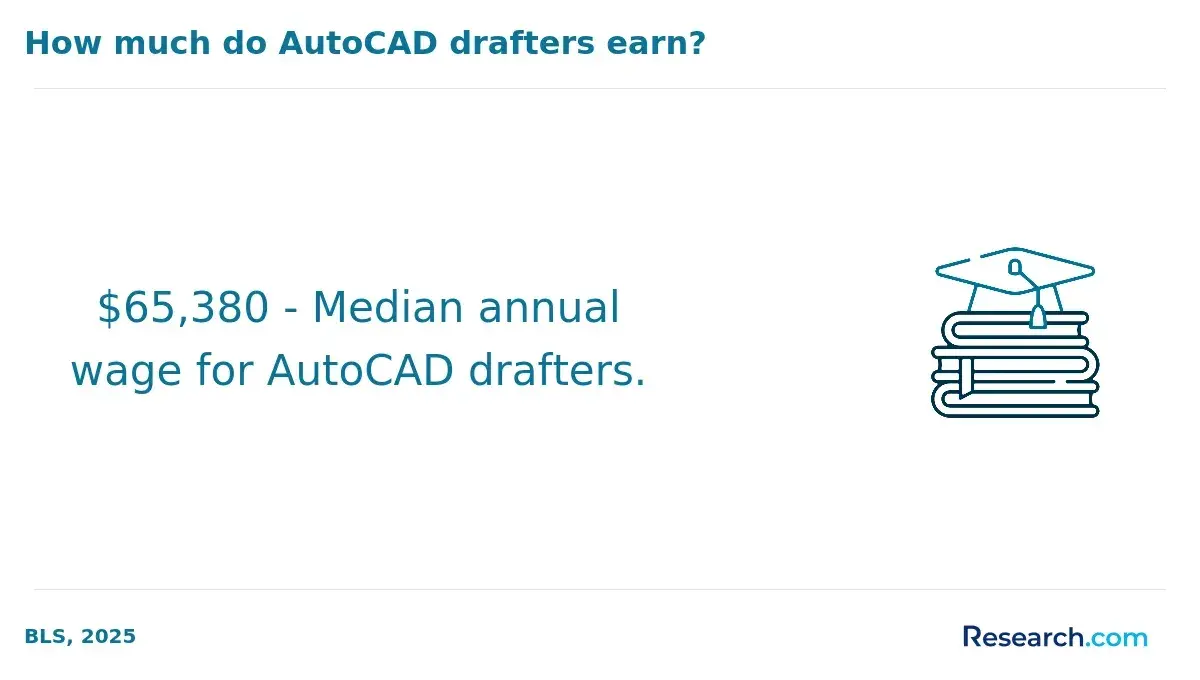
An AutoCAD certificate does not guarantee a specific salary. Pay depends on your job title, industry, location, experience, portfolio, degree level, and whether you can work across related tools or standards. The certificate is best viewed as a skill credential: it may help you qualify for CAD-related work, but employers still evaluate your drawing accuracy, technical judgment, communication skills, and ability to follow project requirements.
According to ZipRecruiter (n.d.), an AutoCAD Engineer can earn as high as $101,752 annually, while a Designer and a Programmer take home up to $82,234 and $68,647, respectively. Some roles that value AutoCAD skills report higher figures, including remote Industrial Designers at up to $123,907 annually, Integrated Designers at $123,762, and Design System Designers at around $116,016. These higher-paying roles typically require more than basic AutoCAD knowledge; they often involve advanced design thinking, industry experience, multiple software tools, and broader technical responsibilities.
- Best universities for online AutoCAD certificate programs in 2027
- How long online AutoCAD certificate programs take
- Online AutoCAD certificates vs. on-campus programs
- Average cost of an online AutoCAD certificate
- Financing options for online AutoCAD training
- Employer recognition of online AutoCAD certificates
- Return on investment for AutoCAD certificates
- Using an AutoCAD certificate as a pathway to further study
- Prerequisites for online AutoCAD certificate programs
- Common courses in online AutoCAD certificate programs
- How to choose the right online AutoCAD certificate
- Career paths for AutoCAD certificate holders
- Job market for AutoCAD certificate holders
List of the Best Universities for Online AutoCAD Certificate Program for 2027
How do we rank schools?
A good AutoCAD program should match your career goal, not just your budget. Some learners need an inexpensive introduction to 2D drafting, while others need a structured certificate with instructor support, project work, and exam preparation. To make the comparison more useful, Research.com reviewed programs through the lens of affordability, flexibility, curriculum scope, institutional credibility, and practical value.
Our review uses information from established education data sources, including the IPEDS database, Peterson’s database—including its Distance Learning Licensed Data Set—the College Scorecard database, and the National Center for Education Statistics. These sources help evaluate institutional details, costs, online learning options, and student-related information where available.
You can review the broader Research.com ranking process and weighting approach in our methodology guide.
1. University of Houston-Downtown
The University of Houston-Downtown provides an online AutoCAD option built around core AutoCAD functions and progressive skill development. Students begin with practical 2D drafting topics such as sketching, layers, and dimension styles, then move toward more advanced work including attributed blocks and technical drawing. The mix of text, video, quizzes, and interactive work makes it a suitable option for learners who want a structured but affordable introduction.
- Program Length: 12 months.
- Tracks/concentrations: AutoCAD 2D, AutoCAD 2D Advanced, and AutoCAD 3D.
- Tuition: $345.
- Accreditation: Southern Association of Colleges and Schools Commission on Colleges (SACSCOC).
2. Penn Foster College
Penn Foster College offers an AutoCAD Online Certificate for learners who want drafting and computer-aided design training in a flexible format. The program is designed for home study and can work well for students who already have basic drafting familiarity and experience using a Windows PC. Graduates are expected to develop the ability to create mechanical and architectural drawings with AutoCAD software.
- Program Length: 7-11 months.
- Tracks/concentrations: AutoCAD Basic Commands and Advanced Functions.
- Tuition: $1089.
- Accreditation: Distance Education Accrediting Commission (DEAC).
3. Virtual Design and Construction Institute
Virtual Design and Construction Institute teaches AutoCAD through a project-based structure that starts with the interface and key commands before moving into drawing setup and plotting. A major advantage is the applied construction-document work, including drafting for a Habitat for Humanity project with floor and roof plans. The program also introduces intermediate tools such as blocks, external references, coordinate systems, and dynamic viewing.
- Program Length: 60 hours.
- Tracks/concentrations: Intro to AutoCAD and Intermediate AutoCAD.
- Tuition: $799.
- Accreditation: Accreditation Council for Continuing Education and Training (ACCET).
4. University of Wisconsin - River Falls
The University of Wisconsin - River Falls offers an AutoCAD Certification Training Course focused on professional workflows and construction-document production. Students progress from basic AutoCAD operations to more polished documentation tasks through applied projects. The course is also designed to prepare learners for the Autodesk AutoCAD User certification exam, and the enrollment includes an exam voucher.
- Program Length: 6 months.
- Tracks/concentrations: AutoCAD Basics.
- Tuition: $1595.
- Accreditation: Higher Learning Commission (HLC).
5. Franklin University
Franklin University delivers an AutoCAD certification course that emphasizes complete construction-document workflows. The training begins with foundational tools and advances into more complex drafting practices used in professional environments. The curriculum also supports preparation for the Autodesk AutoCAD User certification exam, making it a fit for students who want both structured learning and exam readiness.
- Program Length: 6 months.
- Tracks/concentrations: Intro to AutoCAD and Intermediate AutoCAD.
- Tuition: $2995.
- Accreditation: Higher Learning Commission (HLC).
6. University of California–San Diego Extended Studies
The University of California–San Diego Extended Studies sequence is useful for learners who want a broader path that includes both AutoCAD and Revit. The course progression includes AutoCAD I: Introduction, AutoCAD II: Intermediate, AutoCAD III: Working Drawings, and Revit I: Introduction. This can be especially helpful for students interested in architecture, building design, or documentation workflows that go beyond a single software tool.
- Program Length: 10 weeks.
- Tracks/concentrations: Intro to AutoCAD, Intermediate AutoCAD, Working Drawings, and Revit.
- Tuition: $1725.
- Accreditation: WASC Senior College and University Commission (WSCUC).
7. Florida International University
Florida International University offers AutoCAD certification training that starts with basic commands and develops into professional construction-document production. The program uses real-world workflows and optional hands-on projects to help students practice documents relevant to architecture, engineering, and construction settings. It also prepares students for the Autodesk AutoCAD User certification exam.
- Program Length: 6 months.
- Tracks/concentrations: Intro to AutoCAD and Intermediate AutoCAD.
- Tuition: $2995.
- Accreditation: Southern Association of Colleges and Schools Commission on Colleges (SACSCOC).
8. New York Institute of Art and Design
New York Institute of Art and Design offers an online AutoCAD course for both new learners and designers who want to improve their drafting efficiency. The course covers software navigation, key AutoCAD features, and methods for improving accuracy and productivity. Students use software access during the program so they can practice the tools rather than only watch demonstrations.
- Program Length: Unspecified; available 24/7.
- Tracks/concentrations: AutoCAD Basic Commands and Advanced Functions.
- Tuition: $1199.
- Accreditation: Distance Education Accrediting Commission (DEAC)
9. Louisiana State University–Shreveport
Louisiana State University–Shreveport provides AutoCAD certification training that introduces drafting symbols, kitchen and bath fixtures, and floor-plan development. Students learn how to combine elements into a professional sheet file while also covering intermediate skills such as layer management, user coordinate systems, plotting, and title-block creation aligned with National CAD Standards. The course is beginner-friendly and includes optional projects.
- Program Length: 6 months.
- Tracks/concentrations: Intro to AutoCAD and Intermediate AutoCAD.
- Tuition: $2995.
- Accreditation: Southern Association of Colleges and Schools Commission on Colleges (SACSCOC).
10. Texas State Technical College
Texas State Technical College offers a fully online AutoCAD certification course that begins with core drafting concepts and builds toward professional construction documents. Optional real-world projects give students a way to practice workflows and develop deliverables. The program also includes preparation for the Autodesk AutoCAD User certification exam, with an exam voucher provided as part of enrollment.
- Program Length: 6 months.
- Tracks/concentrations: AutoCAD Drafting and Design.
- Tuition: $1595-$2995.
- Accreditation: Southern Association of Colleges and Schools Commission on Colleges (SACSCOC).
How long does it take to complete an online AutoCAD certificate program?
Completion time depends on the program format, your weekly study time, and whether the course is self-paced or instructor-led. Short skills courses may take weeks or a set number of hours, while more structured certificate programs may run several months. The most important question is not only how fast you can finish, but whether you will have enough time to practice drawing accurately and build portfolio-ready work.
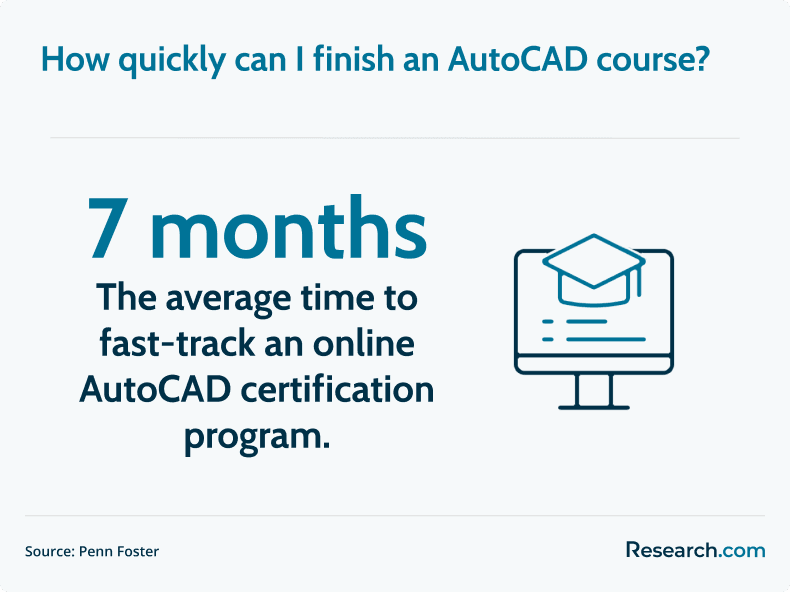
According to Penn Foster College (n.d.), students can use the following timeline as a planning reference:
- Fast Track: You can finish in as little as 7 months if you can commit more study time and move through assignments confidently.
- Average Time: Many students complete the program in about 11 months while studying at a steadier pace for a few hours each week.
If you are considering AutoCAD as part of a larger architecture pathway, compare certificate timelines with online architecture degree programs so you understand how CAD training fits into broader design education.
How does an online AutoCAD Certificate compare to an on-campus program?
Online and campus-based AutoCAD programs can teach similar software skills, but the learning experience differs. Online programs prioritize convenience and self-direction, while on-campus programs provide scheduled lab time and face-to-face support. The better choice depends on how you learn, how much feedback you need, and whether you can attend scheduled sessions.
| Factor | Online AutoCAD certificate | On-campus AutoCAD program |
| Schedule | Often self-paced or flexible, making it easier to study around work or school | Usually follows set class times and campus attendance requirements |
| Learning environment | Delivered through videos, readings, simulations, quizzes, assignments, and online support | Delivered in classrooms or computer labs with in-person instruction |
| Feedback | May come through email, forums, video meetings, grading, or instructor comments | Often includes immediate in-person feedback during lab exercises |
| Best for | Independent learners, remote students, working adults, and budget-conscious students | Students who want structured class meetings, peer interaction, and direct supervision |
| Potential drawback | Requires self-discipline and reliable computer access | May be less convenient and may involve commuting or fixed schedules |
Many AutoCAD professionals also combine certificates with formal education. The chart below shows that 42% have a bachelor’s degree and 37% hold an associate degree, which suggests that certificates often work best as part of a broader education-and-skills profile rather than as a standalone credential for every role.
What is the average cost of an online AutoCAD certificate program?
Online AutoCAD training costs vary widely because programs range from low-cost self-paced tutorials to college-backed certificates with instructor support and exam preparation. You also need to consider software costs. AutoCAD software subscriptions typically run around $200 to $250 per month. Training may cost $25-$500 for self-paced options, $325-$1,200+ for live online or in-person courses, and $40,000+ when AutoCAD is part of a full college degree program. Free self-study is possible, but it usually requires more discipline and may not provide feedback or a credential.
Students comparing technical learning options often look at adjacent affordable STEM pathways, such as the cheapest online math degree, because both AutoCAD and math-heavy programs can support analytical, technical, and design-related careers.
Cost breakdown for AutoCAD training
| Expense | Estimated Cost | What to check before paying |
| AutoCAD Subscription | $200-$250 a month | Confirm whether the program includes software access or requires you to pay separately. |
| Self-Paced Training Courses | $25-$500 | Look for assignments, practice files, and a clear progression from beginner to applied drafting. |
| Live Online/In-Person Courses | $325-$1,200+ | Check instructor access, meeting times, feedback, and whether projects are reviewed. |
| College Degree with AutoCAD | $40,000+ | Make sure the broader degree is necessary for your target role before taking on higher costs. |
| Self-Learning | $0 | Useful for exploration, but you may need a portfolio or certification to document your skills. |
Source: Noble Desktop, n.d.
What financing options are available for online AutoCAD certificate programs?
Financing depends on the provider. Some college-based programs may offer payment plans, workforce training funds, employer reimbursement eligibility, or continuing education financing. Short noncredit courses may not qualify for the same aid options as degree programs, so you should ask the provider directly before assuming financial aid is available.
- Employer reimbursement: Ask whether your employer will cover AutoCAD training if it supports your current job or promotion path.
- Payment plans: Some providers let students spread tuition over multiple payments instead of paying upfront.
- Workforce or career training funds: Local workforce boards, career centers, or state programs may support eligible technical training.
- Scholarships or institutional discounts: These are less common for short certificates than for degrees, but they are worth asking about.
- Loans: Use caution with borrowing for short certificates. Compare the total cost against realistic entry-level wages in your area.
If you are comparing AutoCAD with other affordable technical fields, reviewing options such as the best data science online masters can help you understand how certificate costs differ from graduate-level technology pathways.
Is an online AutoCAD certificate recognized by employers?
Employers may recognize an online AutoCAD certificate when it comes from a credible institution or training provider and is supported by evidence of real skills. However, employer recognition is not automatic. A certificate from an accredited college, a recognized continuing education provider, or a course aligned with Autodesk certification preparation can carry more weight than an unknown course with no projects or assessment.
To evaluate credibility, look for institutional accreditation, transparent curriculum details, instructor qualifications, project requirements, and whether the program prepares students for an Autodesk AutoCAD certification exam. If you are comparing technical credentials broadly, Research.com’s guide to the fastest accredited online tech programs can help you see how accreditation and speed affect program value.
What is the return on investment of an online AutoCAD certificate?
The ROI of an AutoCAD certificate depends on what you pay, how quickly you finish, and whether the training helps you qualify for better work. A low-cost program with strong projects may deliver strong value if it helps you enter drafting support or improve your current job performance. A more expensive program may still be worthwhile if it includes instructor feedback, exam preparation, portfolio work, and employer-recognized training.
To estimate ROI, compare tuition and software costs with the salary range for your target jobs, local employer requirements, and your existing credentials. AutoCAD can also pair well with adjacent skills in construction technology, engineering support, BIM, product design, data analysis, and automation. If you are exploring a broader technical pivot, it may also be useful to compare unrelated but data-intensive fields, such as careers in bioinformatics, to understand how different credentials lead to different labor markets.
Can an online AutoCAD certificate pave the way for advanced degrees?
An AutoCAD certificate can support further study by helping you build technical confidence and a portfolio, but it usually does not replace the admission requirements for an associate, bachelor’s, or graduate degree. If you later pursue architecture, engineering technology, construction management, interior design, or digital design, your AutoCAD experience may help you complete technical coursework more effectively.
Think of the certificate as a skills bridge rather than an automatic academic shortcut. Ask schools whether certificate coursework is credit-bearing, transferable, or strictly noncredit continuing education. If you are comparing very different online pathways, such as an online master in health informatics, pay close attention to admissions standards, prerequisites, and whether your previous technical training is relevant.
What are the prerequisites for enrolling in an online AutoCAD certificate program?
Many online AutoCAD certificates are beginner-friendly, but “no formal prerequisite” does not mean “no preparation needed.” AutoCAD requires attention to detail, comfort with computer-based work, and the patience to practice technical drawing until your files are accurate and organized. Learners with prior drafting, architecture, engineering, construction, manufacturing, or design exposure may move faster, but beginners can succeed if the course starts with fundamentals.
- Basic math readiness: Geometry, measurement, scale, and spatial reasoning are helpful for understanding technical drawings.
- Computer comfort: You should be able to install software, manage files, use a mouse efficiently, and troubleshoot basic settings.
- Compatible hardware: Confirm that your computer can run AutoCAD and any required learning software before enrolling.
- Reliable internet: Online videos, course files, software downloads, and instructor communication require dependable access.
- Drafting familiarity: Prior knowledge of plans, elevations, dimensions, or technical symbols can help, but many beginner courses introduce these concepts.
- Self-management: Online programs require consistent practice, especially if there are few live deadlines.
Because AutoCAD relies on measurement and spatial reasoning, some learners also explore math-focused careers or teaching. If that is part of your longer-term plan, review the requirements to become a math teacher so you understand how education credentials differ from technical certificates.
By contrast, healthcare and education programs often have separate licensure rules. For example, a resource about how to become a teacher with an associate's degree follows a very different pathway than AutoCAD training, which commonly requires only a high school diploma for entry into many certificate programs.
What courses are typically in an online AutoCAD certificate program?
AutoCAD certificate curricula usually begin with the software interface and basic drawing commands, then move into applied drafting and documentation. According to the source cited in the original article, there are over 111,000 employed architects and civil drafters who are AutoCAD certified. For students, that means the strongest programs should help you develop workplace-style drawing habits, not only software familiarity.
- Introduction to AutoCAD: Covers navigation, workspace setup, file handling, drawing commands, and the basic logic of CAD drafting.
- 2D Drafting and Drawing: Teaches lines, shapes, object snaps, annotations, layer control, dimensions, and drawing organization.
- 3D Modeling and Visualization: Introduces 3D tools, solid modeling, views, and presentation concepts when included in the program.
- Advanced AutoCAD Techniques: May include dynamic blocks, external references, templates, customization, and workflow shortcuts.
- Construction and Architectural Drafting: Focuses on floor plans, elevations, sections, sheet layouts, and construction-document standards.
- Mechanical Drafting: Covers parts, assemblies, technical specifications, dimensioning, and tolerancing concepts.
- Project-Based Learning: Uses practical assignments to help students create work samples for a portfolio.
- Certification Preparation: Reviews skills that may appear on the Autodesk AutoCAD User certification exam.
AutoCAD also intersects with automation and emerging design workflows. Designers who understand CAD and are curious about automation may benefit from exploring adjacent technical roles, including this machine learning engineer career guide, though machine learning requires a very different set of programming and mathematical skills.
How to choose the best online AutoCAD certificate program?
The best AutoCAD certificate is the one that fits your target role, skill level, schedule, and budget. Do not choose only by price or brand name. A very cheap course may be fine for exploration, but it may not include feedback, projects, or certification preparation. A more expensive course may be worthwhile if it gives you structured practice and a stronger portfolio. The original source notes that AutoCAD professionals working in Support Activities for Mining earn the highest salaries, averaging $109,990 annually, which also shows why industry context matters when evaluating career value.
| Selection factor | What to look for | Red flag |
| Accreditation and provider credibility | Accredited college, recognized training provider, transparent program details, and clear student support | No provider information, vague outcomes, or unclear credential language |
| Curriculum depth | Coverage of 2D drafting, layers, dimensions, plotting, project files, and relevant advanced topics | Only short software demonstrations with little guided practice |
| Hands-on work | Assignments that produce drawings, construction documents, models, or portfolio samples | No projects, no feedback, or no evidence of applied learning |
| Certification preparation | Autodesk AutoCAD User exam preparation, practice tasks, and possibly an exam voucher | Promises of “certification” without explaining whether it is a course certificate or industry exam |
| Total cost | Tuition, software subscription, exam fees, textbooks, and payment options | Low advertised tuition but expensive required add-ons |
| Schedule fit | Self-paced or instructor-led format that matches your weekly availability | Deadlines or live sessions that conflict with your work or school schedule |
If you are comparing AutoCAD training with other flexible credentials, you may also want to review cheap one year master's programs online to see how short graduate pathways differ from focused technical certificates.
Similarly, students looking at the best value online ai degree programs should use the same decision logic: compare cost, curriculum, hands-on learning, credibility, and outcomes instead of relying on price alone.
Questions to ask before enrolling
- Is the program offered by an accredited institution or a recognized training provider?
- Will I receive instructor feedback on actual AutoCAD files?
- Does the tuition include software access, exam fees, or an exam voucher?
- Will I create portfolio-ready projects by the end of the program?
- Is the certificate a completion certificate, an exam-prep course, or preparation for an Autodesk credential?
- Can I finish on my schedule, or are there fixed deadlines?
- Do employers in my target industry ask for AutoCAD alone, or do they also expect Revit, SolidWorks, Civil 3D, BIM, or degree training?
Common mistakes when choosing an online AutoCAD certificate
- Choosing only the cheapest course: A low-cost class can be useful, but not if it lacks projects, feedback, or clear learning outcomes.
- Ignoring software costs: AutoCAD access can change the real price of the program.
- Assuming every certificate has the same value: A course completion certificate is not the same as an industry certification exam.
- Skipping accreditation checks: Institutional credibility matters, especially when a program is offered by a college or continuing education division.
- Not building a portfolio: Employers often want to see what you can produce, not just read that you completed a course.
- Overlooking related software: Some industries expect AutoCAD plus Revit, BIM tools, Civil 3D, SolidWorks, or other platforms.
What career paths are available for online AutoCAD certificate holders?
An AutoCAD certificate can support several technical and design-adjacent roles. The strongest opportunities usually go to candidates who can combine AutoCAD with industry knowledge, accurate drafting, communication skills, and a portfolio of completed drawings. In more advanced roles, employers may also expect a degree or specialized software experience.
- AutoCAD Engineer: Uses CAD tools to support design, documentation, and technical system development in fields such as construction, automotive, aerospace, or manufacturing. To compare engineering directions, review Research.com’s guide to engineering branches and salaries.
- Architectural Drafter: Creates plans, elevations, sections, and building documentation under the direction of architects or design teams.
- Civil Drafter: Prepares drawings for roads, bridges, utilities, land development, pipelines, and other infrastructure projects.
- Mechanical Drafter: Produces technical drawings for machines, tools, components, and assemblies used in production.
- Electrical Drafter: Creates wiring diagrams, circuit layouts, and electrical system documentation for residential, commercial, or industrial projects.
- CAD Technician: Updates drawings, manages CAD files, supports engineers or designers, and maintains documentation throughout a project lifecycle.
- Construction Document Specialist: Coordinates drawing sets, specifications, revisions, and documentation needed for permitting, bidding, and compliance.
- 3D Modeler: Creates digital representations of objects, spaces, or products for design, visualization, architecture, manufacturing, or media applications.
- AutoCAD Software Developer: Builds tools, scripts, plugins, or workflow automations for CAD users. If software development interests you, compare this path with Research.com’s guide on how to become an app developer.
Like students in affordable surgical tech associate's programs online, AutoCAD certificate learners are often preparing for specialized technical work. The difference is that CAD roles usually center on design documentation and digital drafting, while surgical technology follows a healthcare training and clinical practice pathway.
What is the job market for online AutoCAD certificate holders?
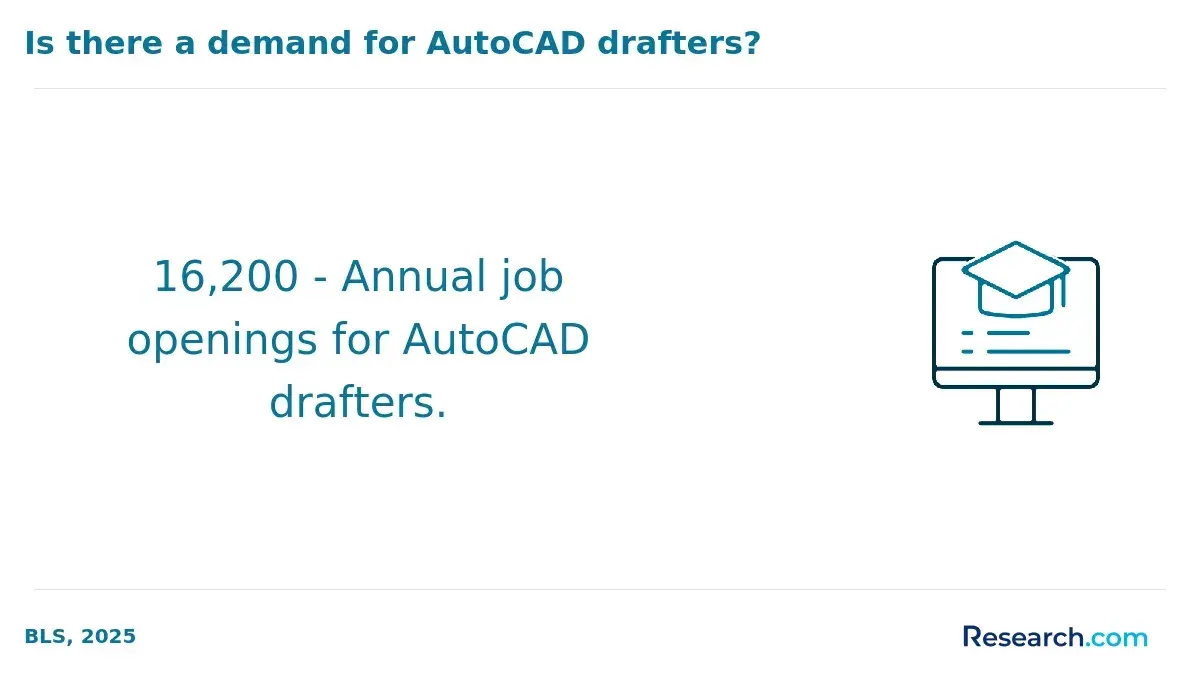
The job market for AutoCAD certificate holders is steady but competitive. BLS data cited in this guide indicates that employment for drafters is expected to remain relatively stable between 2024 and 2034, with minimal to no overall growth. That means a certificate can help, but it is not enough by itself to stand out in every market. Candidates who understand industry standards, produce clean drawings, use related software, and communicate well with engineers, architects, contractors, or clients are typically better positioned.
According to the US Bureau of Labor Statistics (n.d.), the job market details include:
- Job growth rate: 2.3% for roles requiring AutoCAD skills.
- Top hiring industry: Architectural, Engineering, and Related Services.
- Current employment in top industry: There are 80,680 AutoCAD designers and engineers employed in the Architectural, Engineering, and Related Services industry, accounting for 4.9% of total workforce employment.
- Job stability: AutoCAD remains useful in architecture, engineering, manufacturing, and construction because these sectors continue to rely on CAD tools for planning, drawing, revision control, and documentation.
- Opportunities: Entry-level and advanced roles may be available, particularly for candidates who combine AutoCAD training with experience, a portfolio, or additional credentials.
Current trends affecting AutoCAD certificate holders
- Automation is changing drafting work: Routine drafting tasks are increasingly supported by templates, automation, and smarter design tools, so workers need problem-solving skills rather than command memorization alone.
- Employers value multi-tool fluency: AutoCAD is useful, but many workplaces also use Revit, BIM platforms, Civil 3D, SolidWorks, or industry-specific software.
- Portfolios matter more: A certificate is stronger when paired with drawings, models, and documentation samples that show accuracy and applied skill.
- Remote and hybrid work require file discipline: CAD professionals often collaborate digitally, so naming conventions, version control, and documentation habits are increasingly important.
- Industry specialization improves value: AutoCAD for architecture, civil infrastructure, mechanical drafting, or construction documentation can lead to different opportunities and expectations.
Practical steps to get the most value from an online AutoCAD certificate
- Define your target role first. Decide whether you want architectural drafting, civil drafting, mechanical drafting, construction documentation, interior design support, or general CAD technician work.
- Check local job postings. Look for the exact software, education level, and portfolio requirements employers list in your area.
- Choose a program with projects. Prioritize courses that require you to create drawings, not just watch demonstrations.
- Confirm the real cost. Add tuition, AutoCAD subscription fees, exam fees, textbooks, and hardware upgrades before comparing programs.
- Build a portfolio while studying. Save polished examples of floor plans, technical drawings, layouts, title blocks, and models.
- Practice accuracy over speed. Employers need clean files, correct dimensions, organized layers, and reliable documentation.
- Add related skills strategically. Depending on your industry, consider Revit, BIM, Civil 3D, SolidWorks, construction documentation, blueprint reading, or basic project management.
- Use the certificate in context. On your resume, list the certificate with specific AutoCAD skills and project examples rather than relying on the credential name alone.
References
- Bureau of Labor Statistics, U.S. Department of Labor. (2025, August 28). Drafters. Occupational Outlook Handbook. https://www.bls.gov/ooh/architecture-and-engineering/drafters.htm
- FranklinWorks. (n.d.). AutoCAD certification training. Franklinworks.ed2go.franklin.edu. Retrieved 21 May 2025.
- Noble Desktop. (n.d.). Cost to learn AutoCAD. Nobledesktop.com. Retrieved 21 May 2025.
- New York Institute of Art and Design. (n.d.). AutoCAD courses. Nyiad.edu. Retrieved 21 May 2025.
- Penn Foster. (n.d.). AutoCAD certificate program. Pennfoster.edu/. Retrieved 21 May 2025.
- University of Houston-Downtown. (n.d.). Online AutoCAD fundamentals course. Uhd.edu. Retrieved 21 May 2025.
- University of Wisconsin-River Falls. (n.d.). AutoCAD certification training course. Uwrf.edu. Retrieved 21 May 2025.
- VDCI. (n.d.). AutoCAD fundamentals course. Vdci.edu. Retrieved 21 May 2025.
- ZipRecruiter. (n.d.-a). AutoCAD designer salary. Ziprecruiter.com. Retrieved 21 May 2025.
- ZipRecruiter. (n.d.-b). AutoCAD engineer salary. Ziprecruiter.com. Retrieved 21 May 2025.
- ZipRecruiter. (n.d.-c). AutoCAD specialist salary. Ziprecruiter.com. Retrieved 21 May 2025.
- Zippia. (n.d.). AutoCAD draftsman demographics. Zippia.com. Retrieved 21 May 2025.
Key Insights
- An online AutoCAD certificate is most valuable when it teaches applied drafting skills and produces portfolio-ready work, not just when it offers a completion badge.
- Costs vary sharply: self-paced courses may cost $25-$500, live or structured courses may cost $325-$1,200+, software can add $200-$250 a month, and degree programs can exceed $40,000+.
- The best program depends on your goal. Beginners may prioritize affordability and fundamentals, while career-focused learners should look for instructor feedback, project work, and Autodesk AutoCAD User exam preparation.
- A certificate can support entry-level CAD technician, drafter, design assistant, or construction documentation roles, but some architecture and engineering positions still require formal degrees or specialized experience.
- Employer recognition improves when the program is offered by an accredited institution or reputable provider and when you can show accurate drawings, organized files, and industry-relevant projects.
- Do not compare programs by tuition alone. Include software fees, exam costs, time commitment, support, accreditation, and whether the curriculum matches your target industry.
- AutoCAD remains useful, but the strongest candidates often combine it with related tools such as Revit, BIM platforms, Civil 3D, SolidWorks, or industry-specific drafting knowledge.
Other Things You Should Know About Online AutoCAD Certificate Programs
Some of the most affordable online AutoCAD certificate programs in 2027 include those offered by Coursera, LinkedIn Learning, and Udemy. These platforms provide cost-effective courses that cater to different skill levels and often include lifetime access to course materials.
When selecting an AutoCAD certificate program in 2027, consider factors like course content and depth, overall costs including any hidden fees, accreditation status, module flexibility, student support services, and industry connections for post-completion opportunities.


