2027 How To Become a Diesel Technician

Co-Founder and Chief Data Scientist
Becoming a diesel technician is a practical career path for people who want hands-on technical work, steady demand from transportation and heavy equipment employers, and a faster route into the workforce than a four-year degree. Diesel engines still power much of the trucking, construction, agriculture, marine, transit, and military equipment that keeps supply chains moving. The use of diesel remains important because diesel fuel is energy-dense, efficient, and widely used in freight transportation and heavy machinery.
This guide explains how to become a diesel technician, what training options make sense, how certification works, what the career can pay, and how to choose a program without wasting time or money. It is written for high school graduates, career changers, military veterans, working adults, and entry-level mechanics deciding whether diesel technology is the right next step.
Quick Answer: How do you become a diesel technician?
To become a diesel technician, you usually need a high school diploma or GED, hands-on training through a certificate, diploma, associate degree, apprenticeship, or employer training program, and experience working on diesel engines and related systems. A degree is not always required, but many employers prefer applicants who have formal training and industry certifications. ASE certification generally requires at least two years of work experience or one year of experience plus a related degree or certificate.
Key Things You Should Know About Becoming A Diesel Technician
- Most diesel technician programs take 6 months to 2 years, depending on whether you choose a certificate, diploma, or associate degree.
- The typical cost to become a certified diesel technician ranges from $1,000 to $30,000, depending on the credential, school, and program length.
- ASE certification generally requires at least two years of work experience or one year of experience plus a related degree or certificate.
- ASE certification costs include a $34 registration fee plus $56 per standard test or $112 for advanced tests.
- Diesel technicians in 2024 earn an average salary of $58,970 per year, according to BLS data.
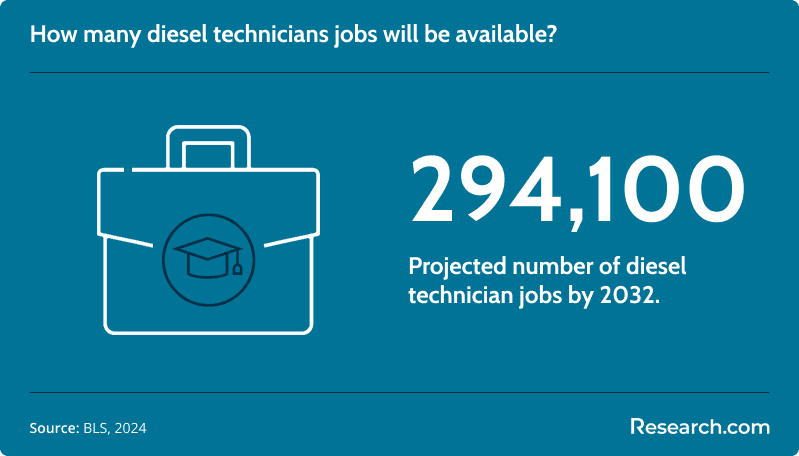
- Although overall job growth is limited, about 24,300 job openings for diesel technicians are projected each year over the next decade.
- What diesel technicians do
- Skills diesel technicians need
- Degree and education requirements
- How long diesel technician training takes
- Courses in diesel technician programs
- Diesel technician certifications
- Cost of training and certification
- Diesel technician specializations
- Diesel technician salary
- How to find your first diesel technician job
- Career advancement options
- Other education paths for diesel technicians
- Graduate certificates and advanced credentials
- Training mistakes to avoid
- Networking and professional organizations
- Continuing education
- Transferable diesel technician skills
- How to choose a training program
- Digital tools in diesel repair
- Digital skills that can strengthen your career
- Data analytics and diagnostics
- Regulations and diesel technician training
- Online associate degrees for diesel technicians
- Balancing work and training
- Financing diesel technician education
- Accelerated associate degrees
- Artificial intelligence in diesel technician training
- Certifications with strong career value
- Diesel technician pay compared with other technical careers
What does a diesel technician do?
A diesel technician, also called a diesel mechanic or diesel service technician, inspects, maintains, diagnoses, and repairs vehicles and equipment powered by diesel engines. These may include commercial trucks, buses, construction equipment, agricultural machines, marine vessels, locomotives, generators, and military vehicles.
The work is more technical than many people expect. Diesel technicians do not only replace parts; they use diagnostic software, electronic test equipment, service manuals, emission-control procedures, and mechanical judgment to identify problems and keep equipment safe and reliable.
- Inspect diesel engines, brakes, transmissions, steering systems, fuel systems, and electrical components.
- Perform preventive maintenance, including oil changes, filter replacements, lubrication, and fluid checks.
- Diagnose engine performance issues using computerized scan tools and manufacturer software.
- Repair or replace damaged components such as injectors, turbochargers, starters, alternators, sensors, pumps, and cooling system parts.
- Document inspections, repairs, parts used, and service recommendations.
- Confirm that equipment meets safety, emissions, and environmental requirements.
- Communicate repair needs to customers, fleet managers, service advisors, and other technicians.
| Work setting | Common equipment | What the job often involves |
| Truck repair shops | Medium-duty and heavy-duty trucks | Engine repair, brake service, electrical diagnostics, preventive maintenance, and fleet inspections |
| Dealerships | Manufacturer-specific diesel vehicles and equipment | Warranty work, factory procedures, brand-specific diagnostic tools, and customer repairs |
| Construction companies | Loaders, excavators, cranes, bulldozers, and generators | Field repairs, hydraulic systems, heavy equipment maintenance, and downtime reduction |
| Agriculture | Tractors, combines, harvesters, and irrigation equipment | Seasonal maintenance, urgent repairs during planting or harvest, and hydraulic troubleshooting |
| Marine and rail | Boats, ships, locomotives, and diesel-electric systems | Specialized engine systems, safety procedures, and equipment-specific maintenance standards |
What skills are required to succeed as a diesel technician?
Successful diesel technicians combine mechanical ability with diagnostic thinking, safe work habits, and comfort using digital tools. Employers look for people who can troubleshoot accurately, work efficiently, and learn new systems as vehicles become more computerized.
- Mechanical understanding: You need to know how engines, transmissions, brakes, cooling systems, hydraulics, and fuel systems operate together.
- Diagnostic reasoning: Diesel problems are not always obvious. A strong technician can move from symptoms to possible causes, test each possibility, and avoid unnecessary parts replacement.
- Attention to detail: Missed torque specifications, loose connections, contaminated fluids, or skipped inspection steps can create safety issues and expensive failures.
- Digital tool confidence: Modern diesel repair often requires scan tools, electronic service information, diagnostic software, sensors, and computer-controlled systems.
- Physical stamina: The job may involve lifting heavy parts, standing for long periods, working in awkward positions, and handling field repairs in demanding conditions.
- Communication skills: You must explain repair findings clearly to customers, supervisors, parts departments, and other technicians.
- Time management: Shops and fleets depend on fast turnaround. Training in scheduling and workflow, including concepts covered in a low-cost online project management degree, can be useful for technicians who later move into lead or management roles.
| Skill area | Why it matters | How to build it |
| Engine fundamentals | Helps you understand how combustion, fuel delivery, air intake, and exhaust systems affect performance | Take diesel engine courses, practice teardown and reassembly, and study service manuals |
| Electrical diagnostics | Many diesel faults involve sensors, wiring, batteries, modules, or control circuits | Practice multimeter use, wiring diagrams, voltage-drop testing, and scan tool interpretation |
| Hydraulics | Heavy equipment often depends on hydraulic systems for lifting, steering, braking, and attachments | Choose programs with hydraulic labs and equipment-based troubleshooting |
| Safety discipline | Diesel shops involve heavy components, high-pressure fuel systems, hazardous materials, and moving equipment | Complete shop safety training and follow lockout, PPE, and lifting procedures |
| Customer documentation | Clear notes help shops justify repairs, track warranty claims, and maintain fleet records | Practice writing concise repair orders and inspection reports |
Do I need a degree to become a diesel technician?
You do not usually need a college degree to become a diesel technician, but you typically need a high school diploma or GED. High school classes in automotive repair, mathematics, electronics, computer applications, and physical science can make diesel training easier.
Formal education is still valuable. A certificate, technical diploma, or associate degree can help you enter the field with structured lab experience and a stronger understanding of diesel systems. Some employers train beginners on the job, but many prefer applicants who have already practiced engine repair, electrical testing, preventive maintenance, and shop safety.
An associate degree in diesel technology can be especially helpful if you want broader training, plan to pursue ASE certification, or hope to advance into diagnostics, fleet maintenance, training, or shop leadership. A business degree is not required for repair work, but technicians who eventually want to own a shop or move into senior business roles may compare broader management paths, including a low-cost online DBA program, after they have gained substantial work experience.
| Path | Best for | Typical advantage | Possible drawback |
| Employer training only | Students who can find an entry-level shop willing to train beginners | Earn while learning and avoid upfront school costs | Training may be slower, narrower, or dependent on the employer’s equipment |
| Certificate program | People who want the shortest formal route into entry-level diesel work | Focused skills training in a shorter time frame | May cover fewer general education or advanced diagnostic topics |
| Technical diploma | Students who want more depth than a short certificate without a full degree | Practical training with stronger coverage of shop procedures | Credits may not always transfer easily to a degree program |
| Associate degree | Students seeking broader preparation, transfer options, and long-term advancement | More complete training in diesel systems, diagnostics, electronics, and safety | Usually takes longer and costs more than a certificate |
The chart below shows the most common degrees held by diesel technicians in the United States, based on Zippia data published in 2024.
How long does it take to complete a diesel technician program?
Diesel technician training usually takes 6 months to 2 years, depending on the credential and whether you attend full time or part time. After school, many technicians continue learning on the job for 1 to 4 years as they handle more complex repairs and work toward certifications.
- Certificate programs: These commonly take 6-12 months and focus on core shop skills, maintenance, engine basics, electrical fundamentals, and entry-level diagnostics.
- Associate degree programs: These commonly take 2 years and provide broader training in diesel engines, powertrains, electronic systems, hydraulics, fuel systems, and advanced diagnostics. Students comparing faster college options can review the fastest associates degree online pathways, but diesel students should confirm that any accelerated option still includes supervised hands-on training.
In practical terms, you may qualify for entry-level work within a year, but becoming a highly skilled diesel technician often takes several years of supervised experience, repeated diagnostics, manufacturer training, and certification exams.
| Stage | Estimated time | What you should focus on |
| High school preparation | Before training | Math, science, automotive technology, computer basics, and safe tool use |
| Certificate or diploma | 6 months to about 1 year | Maintenance, diesel engine basics, brakes, electrical systems, shop safety, and introductory diagnostics |
| Associate degree | About 2 years | Advanced systems, electronics, hydraulics, transmissions, fuel systems, and deeper lab practice |
| Entry-level employment | After initial training | Preventive maintenance, inspections, simple repairs, and shop workflow |
| Advanced skill development | 1 to 4 years | Complex diagnostics, certifications, manufacturer training, and specialization |
What subjects are covered in diesel technician courses?
Diesel technician programs are designed to move students from basic shop safety to increasingly complex vehicle and equipment systems. The strongest programs combine classroom theory with lab work on engines, electrical systems, hydraulics, powertrains, and diagnostic equipment.
- Diesel engine repair: Students learn engine operation, inspection, disassembly, measurement, repair, reassembly, and performance testing.
- Electrical and electronic systems: Coursework covers batteries, starters, alternators, wiring, sensors, control modules, circuit testing, and diagnostic software.
- Fuel systems: Students study diesel fuel delivery, injection systems, filtration, pumps, pressure testing, and performance problems.
- Hydraulics and pneumatics: These courses prepare students to service heavy equipment systems that use fluid or air pressure for power and control.
- Preventive maintenance: Training includes inspections, lubrication, fluid analysis, filter replacement, service intervals, and fleet maintenance practices.
- Transmission and drive systems: Students learn how clutches, gears, differentials, axles, drivelines, and transmissions function and fail.
- Brakes, steering, and suspension: Programs commonly include safety-critical systems found on trucks, buses, and heavy equipment.
- Safety and compliance: Students learn shop safety, hazardous materials handling, lifting procedures, personal protective equipment, and environmental practices. Related safety training is also common in online construction trade schools and campus-based trade programs.
What certifications do I need to become a diesel technician?
Certifications are not always legally required for diesel technician jobs, but they can make you more competitive and help employers verify your skills. The best-known credentials come from the National Institute for Automotive Service Excellence (ASE).
Certification is especially useful after you have some work experience. Many entry-level technicians start with formal training or employer training, then pursue ASE tests once they meet experience requirements.
| Certification | What it demonstrates | Key requirement noted | Best for |
| ASE certification | Competence in specific diesel and vehicle service areas such as diesel engines, electrical/electronic systems, and brakes | At least two years of work experience or one year of experience plus a related degree or certificate | Technicians who want recognized proof of job-ready skills |
| ASE Master Diesel Technician certification | Broad expertise across major diesel repair and maintenance areas | Passing a series of ASE tests | Experienced technicians seeking senior, lead, or advanced diagnostic roles |
| EPA certification | Proper handling of refrigerants when working on air conditioning systems | Some states or job duties may require it | Technicians who service vehicle climate-control systems |
Before paying for a certification course, check whether the credential is recognized by employers in your region and whether it aligns with the equipment you want to service.
How much does it cost to become a certified diesel technician?
The cost to become a certified diesel technician can range from about $1,000 for basic certification or short training to more than $30,000 for an associate degree pathway. Your actual cost depends on tuition, fees, tools, books, commuting, whether you attend public or private schools, and how many certification exams you take.
ASE Certification Costs
- Registration fee: $34 for each order, no matter how many tests are included.
- Standard test fee: $56 for each standard test.
- Advanced level test fee: $112 for tests such as L1, L2, L3, and L4.
- Military Tactical Wheeled Vehicles (TWV) test fee: $88 each.
- Recertification fees: These follow the same structure, including the $34 registration fee and $56 per standard test or $112 for advanced recertification tests.
Education and Training Costs
| Training option | Estimated cost stated | Typical length | When it makes sense |
| Short certificate program | $1,000 to $5,000 | Usually under 1 year | You want entry-level skills quickly and already know you want hands-on diesel work |
| Technical diploma | $5,000 to $15,000 | Often about 1 year | You want more depth than a short certificate without committing to a full associate degree |
| Associate degree | $10,000 to $30,000 | Generally 2 years | You want broader technical training, stronger advancement options, and potential transfer value |
| Certification exams | $34 registration plus test fees | Varies by exam schedule | You already have enough experience or training to validate your skills |
For context, short career-training programs in other trades can fall in a similar range; students comparing skilled-trade pathways may also review requirements for careers such as how to become a locksmith. The important point is not to choose the cheapest option automatically. A low-cost program that lacks lab access, employer connections, or recognized preparation may cost more in missed job opportunities.
The chart below shows the number of ASE-certified students by diesel specialty, as reported by ASE in 2024.
What are the different specializations for diesel technicians?
Diesel technology is broad, so specialization can help you target specific employers and build deeper expertise. The best specialization depends on your local labor market, preferred work environment, and interest in trucks, heavy equipment, marine systems, agriculture, diagnostics, or electronics.
| Specialization | What you work on | Good fit if you want... |
| Heavy-duty diesel engines | Large trucks, buses, construction machines, and industrial equipment | Work on powerful equipment used in freight, transit, and construction |
| Light-duty diesel engines | Diesel pickup trucks, vans, and smaller commercial vehicles | A shop environment closer to automotive repair but with diesel-specific systems |
| Diesel fuel systems | Fuel injection, pumps, filters, pressure systems, and performance problems | Detailed diagnostic work tied to engine efficiency and drivability |
| Marine diesel engines | Boat and ship engines exposed to demanding marine conditions | Specialized work in ports, marinas, shipping, or marine service |
| Agricultural equipment | Tractors, harvesters, combines, and other farm machinery | Field service and seasonal repair work tied to farming operations |
| Diesel-electric systems | Systems combining diesel engines with electric power components | Work with hybridized or electronically complex equipment |
| Diesel engine diagnostics | Computerized testing, scan tools, fault codes, performance data, and troubleshooting | A more technical role focused on solving difficult problems |
| Military diesel equipment | Tactical trucks, armored vehicles, generators, and other military systems | Specialized maintenance in defense, contracting, or military support roles |
Technicians interested in high-level diagnostics, software-connected equipment, or data-heavy systems may eventually benefit from broader computing knowledge. A technical route such as a low-cost online master’s in computer science is not necessary for standard diesel repair, but it may be relevant for professionals moving into advanced systems, software-enabled fleet technology, or technical leadership.
How much does a diesel technician make?
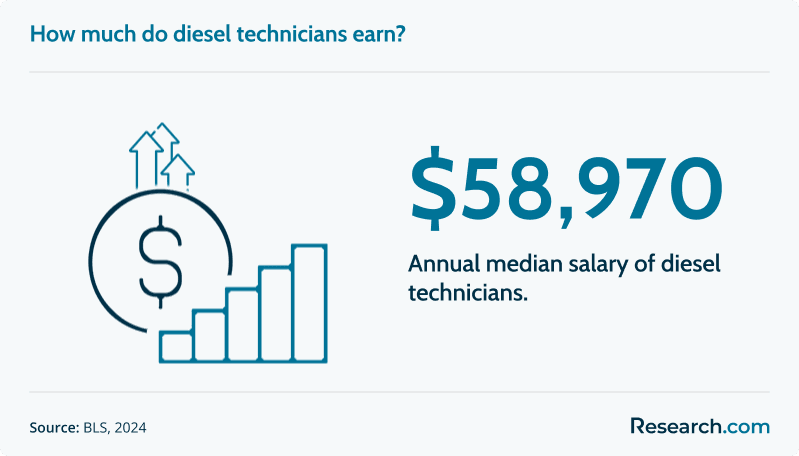
In 2024, the average salary for a diesel technician is $58,970 per year, according to data from the BLS. This is a median wage, so half of workers earn more and half earn less. Actual pay varies by location, experience, employer type, shift schedule, overtime availability, certifications, and specialization.
Entry-level diesel technicians might start closer to $40,000 yearly. Technicians with more experience, advanced certifications, or specialized skills can earn upwards of $70,000 annually. Alaska and Hawaii tend to pay more, partly because of their higher cost of living. ASE Master Diesel Technician certification can also support stronger pay prospects, but salary outcomes are never guaranteed.
Diesel technician training can be a strong alternative to longer degree paths for students who want practical technical work. Students comparing shorter credentials can also review certificate programs that pay well. By contrast, a field such as software may require different academic preparation; for comparison, some students explore the most affordable online software engineering degrees when deciding between hands-on trades and computer-based careers.
How do I find a job as a diesel technician?
The best way to find a diesel technician job is to combine formal applications with local networking, school placement support, and direct outreach to employers. Many diesel jobs are posted online, but smaller shops and fleets may hire through referrals or walk-in conversations.
- Build a skills-based resume: List diesel systems you have worked on, lab projects, tools used, safety training, certifications, and any automotive or equipment experience.
- Search targeted job boards: Use job platforms such as Indeed, Glassdoor, and LinkedIn, but search for multiple titles, including diesel technician, diesel mechanic, fleet mechanic, heavy equipment technician, bus mechanic, and preventive maintenance technician.
- Contact local employers directly: Visit or call truck repair shops, dealerships, construction companies, transit agencies, agricultural equipment dealers, and fleet maintenance departments.
- Use your school’s employer network: If you completed a program, ask about internships, apprenticeships, job fairs, employer visits, and graduate placement support.
- Join industry groups: Organizations such as ASE and the American Trucking Associations can expose you to industry information, job boards, and professional contacts.
- Prepare for hands-on interviews: Employers may ask about diagnostic steps, tool use, safety procedures, or previous repair scenarios. Practice explaining how you identify and solve mechanical problems.
| Entry-level job title | Typical duties | What it can lead to |
| Preventive maintenance technician | Inspections, oil changes, filters, lubrication, fluids, tires, and basic safety checks | Diesel technician, fleet mechanic, or brake and suspension specialist |
| Diesel technician apprentice | Assists senior technicians, performs basic repairs, learns diagnostics, and documents service work | Journeyman-level technician or ASE-certified technician |
| Fleet service technician | Maintains company vehicles and tracks service schedules | Fleet maintenance lead, shop foreman, or fleet manager |
| Heavy equipment service assistant | Supports repairs on construction, agricultural, or industrial machinery | Heavy equipment technician or field service technician |
What are the best ways to advance your career as a diesel technician?
Career growth usually comes from a mix of experience, certifications, specialization, leadership ability, and continued training on new technologies. The technicians who advance fastest often document their skills, volunteer for complex repairs, and stay current with manufacturer procedures.
- Earn advanced certifications: ASE credentials, including Master Diesel Technician status, can help demonstrate expertise in major service areas.
- Specialize strategically: Hydraulics, advanced diagnostics, diesel-electric systems, fuel systems, emissions systems, and heavy equipment repair may strengthen your marketability.
- Learn manufacturer systems: Dealerships and equipment companies often value technicians trained on brand-specific tools and procedures.
- Move toward leadership: Experienced technicians can become lead technicians, shop foremen, service managers, trainers, inspectors, or fleet maintenance supervisors.
- Document results: Keep records of certifications, equipment types, diagnostic tools used, completed training, and complex repairs. This evidence helps during promotions and job changes.
What are the best online programs to become a diesel technician?
Diesel repair is a hands-on field, so a fully online program is rarely enough by itself. Online coursework can be useful for theory, safety, electrical fundamentals, service documentation, and general education, but students still need supervised lab work, shop practice, or employer-based training to build real repair competence.
When comparing online or hybrid options, look for accreditation, clear lab requirements, industry-aligned curriculum, access to instructors with diesel experience, and support for internships or local hands-on training. Students who are comparing broader online education options can review accredited online bachelor degree programs, but diesel students should confirm whether the program is directly connected to diesel technology and whether it includes hands-on training.
- Accreditation: Verify the institution through recognized accreditation sources before enrolling.
- Hands-on requirements: Ask where and how you will complete labs, tool practice, diagnostics, and engine work.
- ASE alignment: Check whether coursework prepares students for relevant ASE tests after they meet experience requirements.
- Employer partnerships: Strong programs often maintain relationships with fleets, dealerships, repair shops, and equipment companies.
What other educational paths can I consider to enhance my career as a diesel technician?
Diesel technicians can improve their long-term options by combining trade training with related education in supervision, business, logistics, safety, electronics, or fleet operations. An associate degree can be a practical next step for technicians who started with a certificate or employer training. Students comparing associate-level options across fields can review best associate degrees to understand how different credentials may support career mobility.
Other useful education paths may include manufacturer training, community college courses in electrical systems, welding, hydraulics, air conditioning service, business communication, and leadership. The right path depends on whether you want to remain a hands-on technician, become a diagnostic specialist, supervise a shop, or move into fleet management.
Why should I consider graduate certificate programs for diesel technicians?
Most diesel technicians do not need graduate certificates to enter or succeed in repair roles. However, experienced technicians who already have an undergraduate degree and want to move into management, technical training, logistics, safety, or operations may consider targeted graduate-level study. The cheapest online graduate certificate programs may be worth comparing if the subject directly supports a specific career goal.
Graduate certificates make the most sense when they solve a clear problem: you need management skills for a supervisory role, analytics skills for fleet performance work, or business knowledge for shop ownership. They are less useful if you are still trying to qualify for your first diesel technician job.
- Choose specialized study only when it matches your target role: Fleet maintenance management, logistics, safety, technical education, and operations may be more relevant than unrelated academic subjects.
- Avoid credential stacking without a plan: More certificates do not automatically create higher pay unless employers value the skills.
- Compare cost against advancement potential: Ask whether the credential has helped graduates move into the specific roles you want.
What pitfalls should you avoid in diesel technician training?
The biggest mistake is enrolling in a program because it is fast, cheap, or convenient without checking whether it provides real diesel repair training. Diesel technology requires practice with tools, vehicles, equipment, diagnostics, and safety procedures. A weak program may leave you with debt but not enough skill to compete for jobs.
| Common mistake | Why it can hurt you | Better approach |
| Choosing a school without checking accreditation | Credits may not transfer, and employers may question the credential | Verify institutional accreditation before enrolling |
| Focusing only on tuition | Low tuition may hide tool costs, fees, weak labs, or poor placement support | Compare total cost, equipment access, employer partnerships, and outcomes |
| Assuming online training is enough | You may miss hands-on practice with engines, scan tools, hydraulics, and safety procedures | Choose online or hybrid study only if it includes local labs, apprenticeships, or shop-based practice |
| Ignoring certification requirements | You may expect immediate ASE certification before meeting experience rules | Understand the work-experience requirement before planning test dates |
| Picking the shortest program without checking curriculum | Some fast programs may skip electrical systems, diagnostics, or safety depth | Review course lists, lab hours, and equipment used in training |
| Relying only on rankings | A highly ranked school may not fit your schedule, location, budget, or career goal | Use rankings as one factor, then ask detailed program and employer-placement questions |
If you need a flexible route, accessible online programs can help with general education or theory. Resources on the easiest degree to get online can be useful for understanding online learning formats, but diesel students should still prioritize hands-on diesel labs and employer-connected training.
The Role of Networking and Professional Organizations in Career Advancement
Networking matters in diesel repair because many opportunities come through local shops, fleets, instructors, former classmates, parts suppliers, and manufacturer representatives. Building a professional network can help you hear about openings, apprenticeships, better shops, tool training, and certification resources.
Trade associations, employer events, technical school job fairs, and online platforms such as LinkedIn can help you meet people in trucking, construction, agriculture, transit, and heavy equipment service. Organizations such as the American Trucking Associations and ASE can also expose you to industry updates, training information, and professional standards.
Networking becomes even more valuable if you want to move beyond repair into supervision, training, operations, or business management. Some experienced professionals compare broader graduate options, including 1 year online masters degrees, but advanced degrees should be considered only when they match a defined advancement plan.
Should Continuing Education Be a Priority for Diesel Technicians?
Yes. Continuing education should be a priority because diesel systems continue to change through electronic controls, emissions systems, telematics, digital diagnostics, safety standards, and hybrid or diesel-electric technology. A technician who stops learning may find it harder to diagnose newer equipment or qualify for advanced roles.
Continuing education does not always mean earning another degree. It may include manufacturer courses, ASE recertification, employer training, evening community college classes, safety credentials, diagnostic workshops, or online theory courses. For technicians considering broader academic acceleration later in their careers, quick masters degrees may be relevant to management or non-repair career goals, but they are not a substitute for diesel-specific technical training.
Can diesel technician skills be applied to other career fields?
Yes. Diesel technician training can transfer to several technical careers because it builds troubleshooting, mechanical reasoning, documentation, safety awareness, tool use, and equipment-maintenance skills. These abilities are useful in fleet management, heavy equipment service, industrial maintenance, generator repair, agricultural equipment support, transit maintenance, and some energy-related maintenance roles.
Technicians who want to broaden their career options should identify which skills transfer and which new credentials are required. Reviewing different college majors can help career changers compare technical, business, engineering technology, and management pathways.
What factors should I consider when selecting a diesel technician training program?
A good diesel technician program should prepare you for real shop work, not just textbook knowledge. Before enrolling, compare programs using the same criteria an employer would care about: practical skill, safety, diagnostic ability, reliability, and familiarity with current equipment.
| Question to ask | Why it matters |
| Is the institution accredited? | Accreditation affects credibility, transfer options, and sometimes financial aid eligibility. |
| How much hands-on lab time is included? | Diesel repair requires practice with engines, tools, diagnostic equipment, and safety procedures. |
| What equipment and software do students use? | Training should reflect current diesel systems, not outdated shop practice. |
| Does the program include electrical and electronic diagnostics? | Modern diesel repair often involves sensors, wiring, modules, and scan tools. |
| Are internships, apprenticeships, or employer partnerships available? | Employer connections can help you gain experience and find your first job. |
| What is the full cost, including tools and fees? | Tuition alone does not show the real price of completion. |
| Will credits transfer if I pursue a higher credential later? | Transfer policies matter if you start with a certificate and later want a degree. |
| Does the schedule work for working adults? | Evening, weekend, hybrid, or part-time options can make completion more realistic. |
Students who need a low-friction application process may also compare online schools no application fee, but diesel-specific hands-on requirements should remain the deciding factor.
Are advanced digital tools reshaping the diesel technician profession?
Yes. Diesel repair increasingly depends on digital diagnostics, electronic control systems, telematics, automated maintenance records, and software-assisted troubleshooting. Technicians still need strong mechanical skills, but they also need to understand data from sensors, fault codes, service platforms, and vehicle networks.
When comparing training programs, ask whether students use modern scan tools, diagnostic software, digital service information, and computer-based testing equipment. Programs that teach both mechanical repair and digital diagnostics can better prepare students for current shop expectations. Students comparing fast career-focused study options may review quick online degrees, but diesel students should prioritize programs that include supervised technical practice.
How Can Interdisciplinary Digital Skills Elevate Diesel Technician Careers?
Digital skills can help diesel technicians move into advanced diagnostics, fleet technology, predictive maintenance, service management, and technical training. The goal is not to become a programmer; it is to understand how digital systems influence equipment performance, maintenance decisions, and repair accuracy.
Useful digital skills include reading diagnostic data, interpreting sensor trends, using service databases, documenting repair patterns, and understanding basic analytics. Professionals interested in broader data-driven fields may examine programs such as the cheapest online bioinformatics masters to see how analytics is used in other disciplines, though diesel technicians should choose digital training that directly supports fleet maintenance or diagnostics.
How Can Diesel Technicians Leverage Data Analytics for Enhanced Diagnostics?
Data analytics can support better diagnostics by helping technicians recognize patterns in fault codes, maintenance histories, sensor readings, repair frequency, and equipment downtime. In fleet environments, this information can support preventive maintenance and help managers decide when to repair, replace, or inspect equipment.
For most technicians, the practical starting point is learning to use service software, scan tools, telematics dashboards, and maintenance records accurately. Technicians who want deeper analytics skills for fleet performance or technical leadership may compare broader programs such as the most affordable online data science masters, but this level of study is not necessary for entry-level diesel repair.
Here’s What Graduates Have to Say About Their Careers as Diesel Technicians
"Diesel technician training gave me the shop practice I needed before applying for jobs. Working directly with engines, tools, and diagnostic equipment helped me understand what employers expect." — Melanie
"The work can be demanding, but it is satisfying to solve a problem and see equipment return to service. Every repair teaches you something new." — Stacia
"Choosing diesel technology gave me a clear career direction. The training was challenging, but mastering complex repairs made the effort worthwhile." — Aaron
How Do Regulatory Changes Impact Diesel Technician Training and Career Opportunities?
Regulations affect diesel technician training because diesel equipment must meet safety, environmental, and emissions-related requirements. Technicians need to understand inspection procedures, emissions systems, refrigerant handling where applicable, hazardous materials practices, and workplace safety standards.
As training programs update their curricula, students should look for instruction in emissions controls, electronic diagnostics, safety documentation, and environmental procedures. Advanced digital tools may also help technicians diagnose and document compliance-related issues. Professionals interested in broader technology education can review the most affordable online master's programs in artificial intelligence, though AI coursework is not required for most diesel technician jobs.
Is an online associates degree a smart investment for diesel technicians?
An online associates degree can be a smart investment only if it includes or connects to hands-on diesel training. Diesel technology cannot be mastered through video lectures alone. Students need shop access, lab practice, tool use, diagnostics, and supervised repair experience.
A hybrid associate degree may work well for students who want to complete general education and theory online while attending labs in person. It can also help working adults reduce commuting time. Before enrolling, confirm the program’s accreditation, lab requirements, transfer policies, tool costs, and employer partnerships.
Can I Balance Work Commitments with Diesel Technician Training?
Many students train for diesel careers while working, but program format matters. Evening classes, weekend labs, hybrid coursework, part-time schedules, and employer-sponsored apprenticeships can make the path more manageable.
Working adults should ask how often they must attend campus, whether labs are offered outside standard business hours, how make-up labs work, and whether internships can be completed with a current employer. Students comparing flexible and affordable options can review cheapest online colleges for working adults, while remembering that diesel programs still require hands-on skill development.
How can I finance my diesel technician education and training?
Diesel technician training can be financed through several sources, depending on the school and your eligibility. Start by asking each program for a full cost estimate that includes tuition, fees, books, tools, uniforms, certification exam costs, transportation, and lab expenses.
- Federal student aid: Eligible accredited programs may participate in federal aid programs.
- Scholarships: Trade schools, community colleges, industry groups, local employers, and foundations may offer scholarships for technical students.
- Employer support: Some fleets, dealerships, and repair companies offer apprenticeships, tool assistance, training reimbursement, or paid entry-level training.
- Workforce grants: Local workforce agencies may support training for in-demand technical occupations.
- Payment plans: Some schools allow students to spread payments across the term.
Students comparing technical education beyond diesel may also explore fields such as an online engineering degree, but diesel technician students should compare costs against realistic entry-level job opportunities and local employer demand.
Can Advanced Degrees Significantly Enhance My Diesel Technician Career?
Advanced degrees are not required for most diesel technician jobs. They may help only if your goal shifts toward management, training, engineering technology, operations, consulting, business ownership, or executive leadership. For a technician who wants to stay hands-on, ASE certification, manufacturer training, and specialized technical courses are usually more directly relevant.
If you are already experienced and considering a move into leadership, compare the cost and value of graduate study carefully. Resources on the most lucrative masters degrees can help you understand how graduate education may affect other career paths, but diesel career advancement should be evaluated against employer requirements in your target role.
Can a Fast Paced Associates Degree Accelerate My Diesel Technician Career?
A fast paced associates degree may help you finish general education or technical coursework sooner, but speed should not come at the expense of lab quality. Diesel repair requires repetition, supervised practice, and exposure to real equipment problems.
An accelerated associate degree can make sense if you already have transfer credits, prior military or mechanical experience, or a work schedule that supports intensive study. It may be a poor fit if the compressed schedule limits shop time, tutoring, internships, or diagnostic practice.
How Can Artificial Intelligence Revolutionize Diesel Technician Training?
Artificial intelligence can support diesel technician training through simulations, guided diagnostics, adaptive learning, predictive maintenance examples, and faster feedback on troubleshooting decisions. AI may help students practice diagnostic reasoning before working on live equipment.
Still, AI is a training support tool, not a replacement for hands-on repair. Students should look for programs that use technology to strengthen real shop practice rather than replace it. Technicians interested in deeper digital education can compare the best online AI degree programs, but most diesel roles require practical diagnostic and repair competence first.
Which Certifications Offer the Best Return on Investment?
The certifications with the best return are the ones employers in your target market recognize and reward. For diesel technicians, ASE credentials are widely known because they validate specific repair competencies after experience and testing requirements are met.
Before paying for any credential, ask local employers which certifications influence hiring, raises, promotions, warranty work, or specialized assignments. Also compare the cost of exams, recertification, prep materials, and time away from work. Students exploring credentials across industries can review what certifications make the most money, but diesel technicians should prioritize certifications that match diesel systems and local employer demand.
How Do Diesel Technician Salaries Compare to Other Technical Careers?
Diesel technician pay is competitive for a skilled trade that can be entered without a four-year degree, but salaries vary by experience, location, specialization, certifications, and employer. In 2024, diesel technicians earn an average salary of $58,970 per year, according to BLS data. Some entry-level technicians may start closer to $40,000 yearly, while experienced or specialized technicians can earn upwards of $70,000 annually.
Other technical careers may have different timelines and education requirements. Some fields require bachelor’s or graduate degrees before reaching higher pay levels. For example, students comparing long-term degree-driven pathways can review the salary after masters in biotechnology. The better comparison is not only salary; it is time in school, tuition cost, debt risk, job availability, physical demands, and whether you prefer hands-on mechanical work.
Key Insights
- Diesel technician careers usually begin with a high school diploma or GED plus hands-on training through an employer, certificate, diploma, associate degree, or apprenticeship.
- A degree is not always required, but formal diesel training can shorten the learning curve and help you compete for entry-level jobs.
- Most programs take 6 months to 2 years, while advanced skill development often continues through 1 to 4 years of on-the-job training.
- ASE certification is one of the most recognized ways to validate diesel repair skills, but it generally requires experience before certification is awarded.
- Costs vary widely: short programs may cost $1,000 to $5,000, technical diplomas $5,000 to $15,000, and associate degrees $10,000 to $30,000.
- Diesel technicians in 2024 earn an average salary of $58,970 per year, with entry-level pay sometimes closer to $40,000 yearly and experienced technicians able to earn upwards of $70,000 annually.
- Specializations such as heavy-duty engines, marine diesel, agricultural equipment, diesel-electric systems, and diagnostics can help you target better-fit employers.
- Digital diagnostics, emissions systems, telematics, and data-supported maintenance are making computer skills more important in diesel repair.
- About 24,300 diesel technician job openings are projected each year over the next decade despite limited overall job growth.
- According to ASE data cited in 2024, about 19,526 diesel technicians are certified in light vehicles under ASE's automobile series.
- Zippia data published in 2024 reports that 38% of diesel technicians in the US hold an associate's degree.
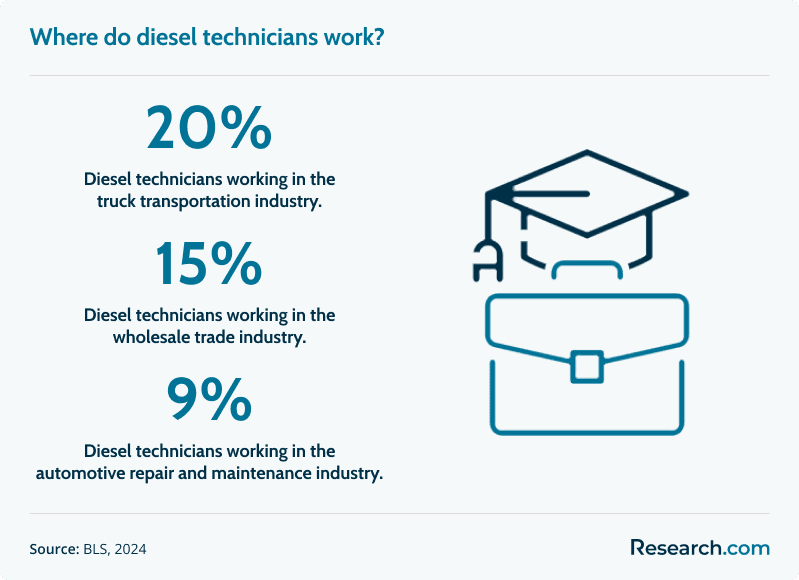
- About 20% of diesel technicians work in the truck transportation industry.
References:
- Bureau of Labor Statistics (BLS). (2024a). 49-3031 Bus and Truck Mechanics and Diesel Engine Specialists. Occupational Employment and Wages, May 2023. BLS.
- Bureau of Labor Statistics (BLS). (2024b). Diesel Service Technicians and Mechanics. Occupational Outlook Handbook. BLS.
- National Institute for Automotive Service Excellence (ASE). (2024a). Statistics. ASE.
- National Institute for Automotive Service Excellence (ASE). (2024b). Dates, Fees & Test Times. ASE.
- Zippia. (2024). Diesel Technician Demographics and Statistics in the US. Zippia.
Other Things You Need to Know About Becoming a Diesel Technician
Yes. Most diesel technician programs teach emissions systems because modern heavy-duty engines must meet EPA standards. Students learn diesel particulate filters, selective catalytic reduction, exhaust gas recirculation, and aftertreatment diagnostics, which are essential for servicing 2027-era trucks and equipment.
In 2027, diesel technicians should be familiar with diagnostic software tools like Cummins INSITE and CAT ET for engine analysis. Knowledge of using advanced electronic multimeters and pneumatic tools is also crucial for effectively diagnosing and repairing contemporary diesel engines.