
2027 Best Online Trade Schools & Construction Programs

Co-Founder and Chief Data Scientist
Choosing an online trade school or construction program is a practical career decision, not just an education choice. You are weighing training time, tuition, hands-on requirements, licensing rules, employer recognition, and whether the credential can lead to steady work. That decision matters because skilled trade roles can offer a faster route into the workforce than many four-year degree paths, but the quality of online programs varies widely.
This guide explains how online trade schools and construction programs work, what they cost, what careers they can lead to, and how to compare programs before enrolling. It is written for students, working adults, career changers, and anyone considering a trade credential while balancing cost, flexibility, and long-term earning potential.
According to the Bureau of Labor Statistics, construction and extraction occupations are projected to produce about 663,500 job openings each year from 2023 to 2033. That demand makes training attractive, but the best choice depends on the trade, the school’s accreditation, the amount of hands-on practice included, and whether the program supports licensing or apprenticeship pathways in your state.
Quick answer: Are online trade schools and construction programs worth considering?
Online trade schools and construction programs can be worth considering if they are accredited, include meaningful hands-on training, align with local employer or licensing expectations, and fit your budget. They are especially useful for students who need flexible coursework in areas such as construction management, safety, blueprint reading, HVAC theory, electrical fundamentals, plumbing basics, or project coordination.
However, not every trade can be learned fully online. Many careers still require labs, apprenticeships, supervised fieldwork, local workshops, or state-specific licensing steps. Before enrolling, confirm what portion is online, what must be completed in person, what tools you need, and whether employers in your region recognize the credential.
Why students choose online trade schools and construction programs
Online trade training can be a strong fit for students who want focused, career-oriented education without committing to a traditional campus schedule. The main advantages are practical rather than theoretical.
- More career directions: Graduates may pursue work in construction, manufacturing, automotive service, HVAC, electrical services, plumbing, welding, renewable energy, or related technical fields.
- Flexible learning: Many programs let students complete lectures, readings, quizzes, and technical modules around work or family responsibilities.
- Lower indirect costs: Online coursework can reduce commuting, relocation, parking, and housing expenses, although tools, materials, and lab fees may still apply.
- Career-focused curriculum: Trade programs usually emphasize job-ready skills such as safety procedures, equipment use, blueprint reading, codes, installation methods, and troubleshooting.
- Demand for skilled labor: Construction, manufacturing, energy, and maintenance employers continue to need workers with practical technical skills.
- Employer variety: Trade-trained workers may find opportunities with construction firms, contractors, manufacturers, utilities, maintenance companies, and large employers such as Bechtel, Tesla, and Caterpillar.
What can I expect from an online trade schools & construction program?
An online trade school or construction program usually combines technical instruction with applied practice. The online portion may cover safety rules, trade terminology, construction math, blueprint interpretation, building systems, code basics, materials, estimating, project planning, and equipment theory. Depending on the specialization, students may also study electrical systems, carpentry, plumbing, HVAC, welding, construction management, or industrial technology.
Course delivery often includes recorded demonstrations, digital readings, interactive lessons, live virtual classes, discussion boards, assignments, and exams. More advanced programs may use simulations or virtual labs to help students practice decision-making before working with physical tools or jobsite conditions.
The hands-on component is the part to examine closely. Some programs require students to complete projects at home, attend campus labs, arrange local workshop access, participate in an apprenticeship, or document supervised field experience. A strong program should explain these requirements before you enroll.
| Program feature | What to look for | Why it matters |
| Online coursework | Clear modules, instructor access, demonstrations, quizzes, and technical assignments | Helps you build foundational knowledge before applying skills in the field |
| Hands-on training | Labs, local workshops, apprenticeships, simulation tools, or supervised projects | Most skilled trades require physical practice, not only online theory |
| Industry alignment | Curriculum tied to codes, safety standards, tools, and employer expectations | Improves the chance that training reflects real jobsite conditions |
| Career support | Resume help, job boards, employer partnerships, apprenticeship referrals, and interview preparation | Can make the transition from training to employment smoother |
| Licensure guidance | State-specific information for regulated trades | Electrical, plumbing, HVAC, and contractor roles may require additional steps |
Where can I work with an online trade schools & construction certificate?
A trade or construction certificate can support entry into several hands-on industries, but the exact job options depend on the specialization, local licensing rules, and the amount of practical experience you complete. Some graduates enter directly into helper or technician roles, while others use the credential to qualify for apprenticeships or advance in a current job.
- Construction: The construction industry employed 8.25 million people as of June 2024, with roles such as carpenters, electricians, plumbers, laborers, and equipment operators.
- Manufacturing: Graduates may work as machinists, welders, industrial maintenance workers, or production equipment operators.
- Automotive repair: Training can lead toward mechanic or technician roles focused on diagnostics, maintenance, and repair.
- HVAC: Workers install, maintain, and repair heating, ventilation, air conditioning, and refrigeration systems in homes and commercial buildings.
- Renewable energy: Trade skills can transfer into solar panel installation, wind turbine maintenance, and related energy infrastructure work.
How much can I make finishing an online trade schools & construction program?
Completing an online trade school or construction program may lead to solid wage potential, especially when the credential is paired with supervised experience, licensing, union training, or employer-recognized certifications. According to the Bureau of Labor Statistics, the median annual wage for construction and extraction occupations was $55,680 as of May 2023. The median wage for all occupations was $48,060.
Pay varies by trade, location, overtime availability, union status, licensing level, and years of experience. The following examples show reported median annual wages for selected roles:
| Occupation | Median annual wage | Career note |
| Electricians | $61,590 | Often requires apprenticeship hours and state or local licensing |
| Carpenters | $56,350 | Common in residential, commercial, and remodeling work |
| Construction Laborers | $44,310 | Can be an entry point into construction while building specialized skills |
These figures do not guarantee individual earnings. A short certificate may help you get started, but higher pay usually depends on experience, certifications, licensing, safety record, and the complexity of the work you can perform.
- Best Online Trade Schools & Construction Programs for 2027
- Online vs. on-campus trade and construction training
- Typical cost of an online trade or construction program
- Financial aid options for online trade students
- Common admission requirements
- Courses usually included in trade and construction programs
- Specializations available in online trade programs
- How to choose the right online trade school
- Career paths after online trade or construction training
- Ways to advance after earning a trade credential
- Job market for trade and construction graduates
- How to evaluate return on investment
- Trends in online trade and construction education
- Challenges to expect in online trade programs
- Enrollment mistakes to avoid
- How to keep trade skills current
- Specialized online training options
- How to verify accreditation and quality
- Career services and job placement support
- Simulation technology in online trade education
- How programs respond to emerging industry technology
- Using trade credentials toward advanced academic goals
- Mentorship and networking in online programs
- How added certifications support career growth
- Certifications with stronger earning potential
- Using trade credentials for further education
- How to finish trade training faster
- Employer views of online trade credentials
- Moving from trade work into business ownership
- Alternative career paths after trade school
Best Online Trade Schools & Construction Programs for 2027
How we approach school rankings
Because trade training affects both your finances and your job options, rankings should be used as a starting point rather than the only deciding factor. Research.com evaluates schools using data from sources such as the IPEDS database, Peterson's database, the College Scorecard, and The National Center for Education Statistics. These sources help compare institutional data, costs, and outcomes. You can read more about Research.com's ranking process on the methodology page.
When reviewing the schools below, compare program format, hands-on expectations, total cost, location requirements, employer partnerships, and whether the credential fits your intended trade.
| School | Examples of programs offered | Length of program | Estimated cost |
| Florida State College at Jacksonville (FSCJ) | Construction Management Technology, Electrical, HVAC, Welding | 12 months to 2 years | $3,000 to $8,000 |
| Texas State Technical College (TSTC) | HVAC Technology, Electrical Power & Controls, Industrial Systems, and more | 12 to 24 months | $5,000 to $10,000 per year |
| Augusta Technical College | Carpentry, Construction Management, Electrical Systems Technology | 6 months to 2 years | $3,000 - $5,000 |
| Arizona Western College (AWC) | Construction Trades, Welding Technology, HVAC Technology | 1 to 2 years | $2,500 to $8,000 |
| Ivy Tech Community College | Construction Technology, HVAC, Electrical Engineering Technology, Building Construction Management, Welding Technology | 12-24 months | $4,200 - $8,500 |
| Apex Technical School | Construction and Building Skills, Plumbing and Pipefitting, Electrical and Advanced Electrical, Welding Technology, Automotive Service and Repair, Air Conditioning and Refrigeration | 7.5 months | Approximately $19,000-$22,000 |
| Thaddeus Stevens College of Technology | Building Construction Technology, HVAC, Electrical Technology, Plumbing, and more | 2 years (associate degrees) | $8,000–$17,000 per year (based on residency) |
| Lansing Community College (LCC) | Building Construction, Electrical Technology, Heating & Air Conditioning | 1 to 2 years | $7,500 to $10,000 (in-district) |
| Los Angeles Trade-Technical College (LATTC) | Construction Technology, Electrical Construction & Maintenance, and Plumbing | 6 months to 2 years | $2,760 - $7,580 (California residents) |
How to use this list
Do not choose a school based only on name recognition or estimated tuition. Ask each program whether courses are fully online, hybrid, or campus-based; whether tools are included; whether credits transfer; and whether the program prepares students for licensing, apprenticeship, or employment in your state.
Important takeaways before you compare programs
- Certificate programs take 6-12 months; associate degrees take up to 2 years.
- Construction industry needs 501,000 new workers in 2024.
- Online programs can reduce scheduling barriers and some indirect costs compared with campus-only options.
- Program costs range from $5,000 to $15,000, depending on the degree.
- Federal financial aid and scholarships are available for online trade programs.
How does an online trade schools & construction program compare to an on-campus program?
Online and on-campus trade programs may teach similar concepts, but the learning experience is different. Online programs are usually better for theory, safety, estimating, codes, blueprint reading, and management coursework. Campus programs often provide easier access to tools, labs, instructors, and supervised hands-on practice.
| Factor | Online program | On-campus program |
| Schedule | Often more flexible and easier to fit around work | Usually follows fixed class and lab times |
| Cost | May reduce commuting and housing expenses | May include more campus fees, travel, or relocation costs |
| Hands-on practice | May require local labs, at-home projects, simulations, or apprenticeships | Typically provides direct access to equipment and supervised labs |
| Instructor access | Available through email, video meetings, learning platforms, and virtual office hours | Often includes immediate in-person feedback during lab work |
| Networking | Depends on virtual cohorts, employer partnerships, and alumni groups | Can make peer and instructor relationships easier to build in person |
| Best fit | Working adults, self-directed learners, students with limited campus access | Students who need structured labs, close supervision, and in-person practice |
If your goal is to move beyond fieldwork into supervision, estimating, or project leadership, you may eventually compare trade credentials with a management-focused path. For example, an online construction management degree may cost more than a shorter trade program, but it can support different job opportunities. Research.com’s guide to construction management degree online cost can help you compare that route.
What is the average cost of an online trade schools & construction program?
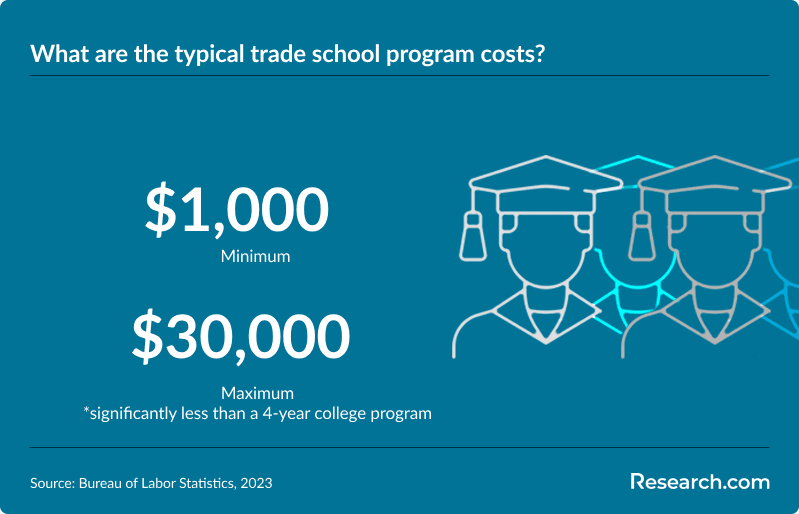
The average cost of an online trade school or construction program ranges from $5,000 to $15,000. That range is somewhat comparable with an accounting certificate online, though trade programs may include additional tool, lab, or equipment costs that academic certificates do not.
| Cost category | Typical consideration | Question to ask before enrolling |
| Program type | Shorter certificate programs typically cost between $5,000 and $10,000, while associate degrees may range from $10,000 to $15,000. | Is this a certificate, diploma, or associate degree, and what credential will appear on my transcript? |
| Tools and materials | Some programs require students to buy tools, safety gear, software, or supplies for hands-on work. | Which materials are included in tuition, and which must I purchase separately? |
| Tuition and fees | Online tuition may be lower than campus tuition, but technology, lab, testing, and graduation fees can still apply. | What is the total price, not just tuition? |
| Local training requirements | Hybrid programs may require travel to labs, workshops, employer sites, or testing locations. | Will I need to pay for travel, lodging, or local facility access? |
| Financial aid | Eligible schools may offer federal aid, scholarships, payment plans, or employer assistance. | Is the program eligible for aid, and what happens if I withdraw? |
For trades that require a starter tool set, budget planning is especially important. Similar to locksmith requirements, some construction and mechanical programs may expect students to obtain specific tools before completing practical assignments.
What are the financial aid options for students enrolling in an online trade schools & construction program?
Financial aid can reduce the upfront cost of online trade and construction education, but eligibility depends on the school, credential type, program length, and accreditation status. Always confirm aid eligibility with the institution’s financial aid office before committing.
- Federal Financial Aid: Students can submit the Free Application for Federal Student Aid (FAFSA) to determine eligibility for federal grants and loans when the program and institution qualify.
- Scholarships: Trade associations, local employers, community foundations, unions, and construction-related organizations may offer awards for students entering skilled trades.
- Payment Plans: Some schools let students divide tuition into scheduled payments rather than paying the full amount upfront.
- Employer Assistance: Current workers should ask employers about tuition reimbursement, apprenticeship sponsorship, certification reimbursement, or paid training benefits.
Construction employment is especially concentrated in states such as California (924,099 workers), Texas (834,694), and Florida (635,433). If you live in a high-employment state, also check local workforce boards, community colleges, and apprenticeship organizations for funding options tied to regional labor demand.
What are the prerequisites for enrolling in online trade schools & construction programs?
Most online trade schools and construction programs have straightforward admissions requirements. They are often less selective than bachelor’s degree programs, but students still need the academic, technical, and practical readiness to complete the coursework. In that sense, the admissions process may feel closer to some of the easiest degree to get online options, though the hands-on expectations can be demanding.
- High School Diploma or GED: Many programs require proof of high school completion or an equivalent credential.
- Basic Skills: Construction math, reading comprehension, measurement, and technical vocabulary are important for safety and accuracy.
- Work Experience: Entry-level programs may not require experience, but advanced tracks may prefer or require related jobsite exposure.
- Technology Access: Students typically need a reliable computer, internet connection, webcam or microphone for some courses, and access to required software.
- Physical or safety requirements: Some programs may require students to use tools, wear protective gear, lift materials, or complete supervised practice.
Students should also consider apprenticeship options. The Associated Builders and Contractors notes that it offers over 800 programs to help new talent enter the construction workforce. Apprenticeship training can complement online coursework by adding supervised experience and employer connections.
What courses are typically in an online trade schools & construction program?
Coursework varies by school and specialization, but most trade and construction programs begin with safety, technical foundations, and jobsite communication before moving into trade-specific skills.
- Introduction to Construction: Covers basic construction concepts, jobsite roles, industry terminology, safety expectations, and common work processes.
- Blueprint Reading: Teaches students how to interpret drawings, symbols, scales, dimensions, and construction plans.
- Materials and Methods: Explains common building materials, installation methods, durability concerns, and appropriate use cases.
- Building Codes and Regulations: Introduces local and national code concepts, inspection requirements, and compliance responsibilities.
- Electrical Systems: Covers circuits, wiring principles, installation practices, and safety concepts for students focused on electrical work.
- Plumbing Fundamentals: Explains pipe systems, fixtures, installation basics, maintenance, and common troubleshooting issues.
- Project Management: Builds skills in scheduling, budgeting, coordination, documentation, and team communication.
Students who later want to run a contracting company, manage crews, or understand business finances may benefit from additional business education. An online finance degree can be one route for tradespeople who want stronger preparation for budgeting, pricing, cash flow, and business ownership.
What types of specializations are available in an online trade schools & construction program?
Specializations help students target a specific trade, jobsite function, or career path. The right choice depends on whether you prefer installation work, repair, diagnostics, structural work, equipment operation, or management.
| Specialization | What you learn | Best fit for students who want to |
| Electrical Work | Electrical systems, circuits, wiring principles, installation practices, and safety | Work toward electrician helper, apprentice, or technician roles |
| Plumbing | Pipe installation, fixtures, maintenance, repair, and system layouts | Enter plumbing support roles or prepare for apprenticeship pathways |
| HVAC (Heating, Ventilation, and Air Conditioning) | Heating and cooling systems, installation, diagnostics, maintenance, and repair | Work in residential or commercial HVAC service |
| Carpentry | Wood framing, layout, measurement, structural components, and repair techniques | Build, renovate, or repair structures |
| Masonry | Brick, stone, concrete, mortar, layout, and repair methods | Work on structural or decorative masonry projects |
| Project Management | Scheduling, budgeting, crew coordination, documentation, and jobsite planning | Move toward supervisory, estimating, or construction management roles |
Depending on experience and industry, electrical work may be one of the certificates that pay well. Entry may also be accessible for newcomers: 62% of job postings in construction require no prior experience, while roles requiring 2–3 years of experience make up 16% of the market.
How to choose the best online trade schools & construction program?
The best program is the one that fits your trade goal, budget, schedule, state requirements, and learning style. A low price is not enough if the credential is not recognized or the program lacks practical training.
- Confirm accreditation: Check whether the institution is accredited by a recognized agency and whether the specific program has industry recognition where relevant.
- Match the program to your target job: A construction management course is not the same as electrician training, and HVAC theory alone may not satisfy hands-on requirements.
- Ask about hands-on work: Find out whether labs, simulations, apprenticeships, local workshops, or supervised projects are included.
- Check licensing relevance: For regulated trades, ask whether the program supports the education hours, apprenticeship steps, or exam preparation required in your state.
- Calculate total cost: Include tuition, fees, tools, books, safety gear, travel, testing, and certification exams.
- Review support services: Look for tutoring, instructor access, career advising, employer partnerships, resume help, and apprenticeship connections.
- Compare outcomes carefully: Ask for job placement information, completion rates, graduate feedback, and employer relationships.
| Question to ask | Why it matters |
| Is this program fully online, hybrid, or mostly online with required labs? | Trade training often requires physical practice, so delivery format affects your schedule and costs. |
| Will this credential help me qualify for local jobs, licensing, or apprenticeships? | Employer and state recognition determine the credential’s practical value. |
| What tools or equipment must I buy? | Required materials can significantly increase the real cost. |
| Can credits transfer to another college or degree? | Transferability matters if you later pursue an associate or bachelor’s degree. |
| What career services are available after completion? | Job placement support can help turn training into employment. |
What career paths are available for graduates of online trade schools & construction programs?
Trade and construction graduates can pursue entry-level, apprentice, technician, inspection, installation, repair, or supervisory pathways. Some roles require additional licensing, apprenticeship hours, field experience, or certification beyond school completion.
| Career path | Typical work | Reported annual pay |
| Elevator and Escalator Installers and Repairers | Install, maintain, and repair elevator and escalator systems | Around $102,420 annually |
| Boilermakers | Build, install, maintain, and repair boilers and large vessels | $71,140 |
| Construction and Building Inspectors | Review structures and projects for code and safety compliance | Approximately $67,700 |
| Electricians | Install, maintain, and troubleshoot electrical systems | $61,590 |
| Plumbers, Pipefitters, and Steamfitters | Install and repair piping systems, fixtures, and related equipment | About $61,550 |
| Ironworkers | Install structural iron and steel on buildings, bridges, and other projects | Around $60,780 |
| Sheet Metal Workers | Fabricate and install sheet metal products and systems | $58,780 |
| Drywall and Ceiling Tile Installers | Install and finish wallboard and ceiling systems | $57,010 |
| Carpenters | Construct, install, and repair building frameworks and structures | Approximately $56,350 |
| Construction Equipment Operators | Operate heavy machinery used in construction projects | About $55,270 |
For context, a boilermaker wage is in a similar range to a diesel mechanic salary. Career outcomes still depend on location, experience, licensing, employer demand, and whether you pursue apprenticeship or advanced certification after graduation.
How can I advance my career with online trade education?
After earning an online trade or construction credential, career growth usually comes from specialization, field experience, licensing, certifications, leadership skills, and employer trust. A graduate might begin as a helper or technician, complete apprenticeship hours, earn a journey-level credential, then move into supervisory, estimating, inspection, or business ownership roles.
- Specialize in a regulated or technical trade: HVAC, plumbing, electrical, welding, and elevator repair can require deeper training but may offer stronger advancement potential.
- Complete required licensing steps: Many states and municipalities regulate electrical, plumbing, HVAC, and contractor work.
- Build documented field experience: Employers value safe, reliable, jobsite-tested workers.
- Add business or management skills: Crew leadership, estimating, budgeting, and customer communication can support supervisory roles.
- Consider advanced education strategically: Some tradespeople pursue business, management, or technical degrees. If you are comparing fast graduate options, Research.com’s guide to 1 year masters programs online may be useful for long-term planning.
What is the job market for graduates with an online trade schools & construction program?
The job market for trade and construction graduates is supported by retirements, infrastructure needs, residential and commercial building activity, maintenance demand, and technical skill shortages. The Associated Builders and Contractors reported that the industry is seeking around 501,000 new workers in 2024 to meet demand and replace retirees.
Opportunities may be found in residential, commercial, industrial, infrastructure, maintenance, manufacturing, and energy settings. Construction also reported a low unemployment rate of 3.3% as of June 2024, which reflects continued need for workers across many construction occupations.
Regional demand matters. States such as California, Texas, and Florida have high levels of construction employment, but licensing rules, wages, union presence, and project demand differ by area. Before choosing a program, review local job postings and talk with employers or apprenticeship offices in your region.
How do I assess the ROI of an online trade schools & construction program?
Return on investment is not just about the advertised tuition. To evaluate ROI, compare the full cost of attendance with the realistic jobs the credential can help you pursue. Include tuition, required fees, books, tools, protective gear, software, travel, certification exams, licensing fees, and any income you lose while studying.
Then compare those costs with local wages, job openings, apprenticeship opportunities, completion rates, job placement support, and transfer options. A lower-cost program with strong employer connections may produce better value than a more expensive program with weak hands-on training.
| ROI factor | How to evaluate it |
| Total cost | Add tuition, fees, tools, testing, travel, and materials rather than relying on advertised tuition only. |
| Time to completion | Compare 6-12 month certificates with associate degrees that take up to 2 years. |
| Employment pathway | Ask whether the program connects to apprenticeships, entry-level jobs, or licensing steps. |
| Wage potential | Use local labor market data and role-specific wage information rather than national averages alone. |
| Stackability | Check whether credits or certificates can build toward a higher credential later. |
If you are comparing trade programs with other short education pathways, Research.com’s guide to the best degrees to get online can provide a broader cost-and-career perspective.
What trends can you expect in online trade and construction education?
Online trade education is becoming more technology-supported, but the strongest programs still connect digital learning to physical skill development. Current trends include simulation, stackable credentials, sustainability topics, and closer alignment with employer needs.
- Virtual Reality (VR) and Augmented Reality (AR) for Hands-On Training: Some programs use simulated jobsite environments to help students practice safety decisions, blueprint interpretation, and equipment-related scenarios before entering a real workspace.
- AI-Powered Personalized Learning: Learning platforms may use student progress data to recommend review materials, identify weak areas, or adjust practice activities.
- Sustainability-Focused Curriculum: Construction programs increasingly include green building materials, energy efficiency, sustainable practices, and environmental considerations.
- Micro-Credentials and Stackable Certifications: Short credentials in areas such as HVAC repair or green building practices can help workers update skills without enrolling in a long program immediately.
- Collaborative Online Platforms: Digital whiteboards, project management tools, and virtual team assignments can help students practice coordination used in construction settings.
Working adults should compare innovation with affordability and support. Research.com’s guide to the most affordable online universities in USA may help students who need flexible programs that fit a tighter budget.
What challenges should I anticipate with online trade schools & construction programs?
The biggest limitation of online trade education is that some skills cannot be mastered through videos alone. Students may need access to tools, labs, mentors, jobsite practice, or apprenticeship placements. Without those components, a program may teach useful theory but leave students underprepared for physical work.
- Hands-on access may be limited: Confirm where and how practical training happens.
- Licensing rules may vary: An online credential may not automatically satisfy state or local requirements.
- Program quality can differ: Accreditation, employer partnerships, instructor qualifications, and outcomes should be verified.
- Self-discipline is essential: Online learners must manage deadlines, practice time, and communication without daily in-person structure.
- Equipment costs can surprise students: Tools, safety gear, testing, and lab access may not be included in tuition.
If you are still comparing skill-based careers, Research.com’s guide to easy trades to learn can help you evaluate training difficulty, timelines, and career fit.
What pitfalls should I avoid when enrolling in an online trade program?
Common mistakes can turn an affordable-looking program into a poor investment. Avoid making a decision based on speed or convenience alone.
| Mistake | Better approach |
| Choosing a school without checking accreditation | Verify institutional accreditation and any program-level recognition relevant to your trade. |
| Looking only at tuition | Calculate the full cost, including tools, fees, materials, testing, and travel. |
| Assuming online means fully remote | Ask whether labs, workshops, apprenticeships, or campus visits are required. |
| Ignoring licensure requirements | Contact your state licensing board or local authority before enrolling in a regulated trade path. |
| Relying only on rankings | Compare curriculum, instructor access, employer connections, completion rates, and career support. |
| Assuming a credential guarantees a salary | Review local job postings and wage data for your target occupation and experience level. |
| Overlooking financial aid rules | Confirm FAFSA eligibility, scholarship availability, payment plans, and refund policies. Research.com’s guide to What online college gives the most financial aid? can help you understand funding options. |
How can I keep my skills current amid industry innovations?
Trade skills need regular updating because tools, codes, materials, energy standards, safety procedures, and digital systems change. Graduates should plan for continuing education rather than viewing the first certificate as the final credential.
- Complete manufacturer training for new tools, systems, or equipment.
- Take continuing education required for license renewal where applicable.
- Attend workshops, webinars, safety courses, and trade association events.
- Follow code updates and industry publications relevant to your specialization.
- Build digital skills in estimating software, project management platforms, or diagnostic tools.
Tradespeople moving toward leadership may also compare technical continuing education with higher academic options. Research.com’s overview of the best masters degree to get can help workers evaluate whether graduate education fits their long-term goals.
How can I supplement my trade education with specialized online training programs?
Specialized online training can fill gaps that a general trade program does not cover. Examples include safety credentials, advanced diagnostics, green construction practices, blueprint software, estimating, welding processes, HVAC systems, or equipment-specific training.
These short programs are most useful when they align with a specific job requirement or employer preference. Before paying for an add-on credential, ask whether employers recognize it, whether it prepares you for a test, and whether it stacks toward a larger credential. Research.com’s guide to online training programs can help you compare certificate options beyond traditional trade school.
How do I verify the accreditation and quality of an online trade program?
Start by confirming the school’s accreditation through recognized sources, then investigate whether the trade program itself meets industry expectations. Accreditation helps establish institutional legitimacy, but it does not automatically guarantee that every program prepares students for licensing or employment in every state.
- Search the school’s accreditation status through official databases and the institution’s website.
- Ask whether the specific program has industry partnerships, advisory boards, or employer input.
- Request completion, placement, and licensure-related information when available.
- Check whether credits can transfer to community colleges or degree programs.
- Read student and alumni feedback, but do not rely only on testimonials.
- Compare the school with reputable online institutions, including those listed in Research.com’s guide to good online colleges.
How do online trade programs support job placement and career services?
Strong online trade programs do more than provide coursework. They help students move from training into work through career advising, employer relationships, apprenticeship connections, resume support, interview preparation, and job boards.
Ask whether the school has partnerships with local contractors, unions, manufacturers, service companies, or apprenticeship providers. Also ask whether career services are available to online students in the same way they are available to campus students. Some accelerated academic options, such as an associate degree in 6 months online, may also combine fast coursework with career support, but students should verify program intensity and transfer value before enrolling.
How do online trade schools incorporate advanced simulation technologies for practical training?
Some online trade programs use simulations, virtual reality, augmented reality, and interactive technical modules to strengthen applied learning. These tools can help students practice identifying hazards, reading plans, sequencing tasks, troubleshooting systems, or navigating jobsite scenarios.
Simulation is useful, but it should not replace physical practice in trades that require tool handling, installation, repair, or equipment operation. When comparing schools, ask how simulations are paired with labs, apprenticeships, or local hands-on assignments. Students comparing lower-cost degree pathways can also review Research.com’s guide to the cheapest associate's degree options.
How do online trade programs adapt to emerging industry technologies?
Quality programs update curricula through employer input, instructor industry experience, advisory boards, new safety standards, revised codes, and emerging equipment. Technology changes may affect diagnostics, building automation, smart home systems, renewable energy, estimating software, and project management platforms.
Students should ask how often courses are reviewed and whether instructors currently work in or consult with the industry. If you want a broader credential after trade training, an affordable bachelor degree online may help combine technical experience with management, business, or leadership education.
How can online trade credentials bridge the gap to advanced academic success?
Online trade credentials can become a foundation for future academic study when credits are transferable or when the credential demonstrates college-level technical learning. This matters for students who begin with a certificate but later want an associate, bachelor’s, or graduate degree.
Before enrolling, ask whether credits are transcripted, whether they transfer to partner institutions, and whether prior learning or work experience can count toward a degree. Workers who later explore graduate school can compare flexible options such as the easiest master degree, but should choose advanced education based on career fit rather than speed alone.
How can I access mentorship and networking opportunities during an online trade program?
Mentorship can be harder to access online, so students should look for programs that intentionally build professional connections. Useful supports include live instructor sessions, cohort groups, alumni networks, employer panels, virtual office hours, industry roundtables, and apprenticeship referrals.
Students should also network locally through contractors, workforce boards, unions, trade associations, and community college career offices. For those considering long-term academic leadership or teaching paths, an online doctorate program may be a later option, though it is not necessary for most trade careers.
How do additional certifications boost career growth?
Additional certifications can help tradespeople document specialized skills, qualify for certain jobs, meet employer requirements, or move toward supervisory responsibility. The value depends on whether the certification is recognized in your trade and region.
Useful certifications may relate to safety, equipment operation, welding processes, HVAC systems, electrical standards, green building, project management, or manufacturer-specific technology. To compare high-value credential options across industries, review Research.com’s guide to what certifications pay the most.
Which certifications offer the highest earning potential?
The certifications with the strongest earning potential are usually those tied to regulated work, scarce technical skills, safety-sensitive responsibilities, or specialized equipment. A credential is more valuable when employers actively request it in job postings or when it helps satisfy licensing, apprenticeship, or contract requirements.
Rather than choosing a certification because it sounds impressive, compare local job ads and ask employers which credentials matter. Research.com’s guide to what certificates make the most money can help you evaluate options with a stronger career payoff.
How can I leverage trade credentials for further academic advancement?
Trade credentials can support further education when they are credit-bearing, transferable, or recognized as prior learning. This can be useful for workers moving into construction management, operations, safety management, estimating, technical sales, or business ownership.
If you want to combine field experience with a broader academic credential, ask schools about transfer credit, articulation agreements, competency-based credit, and credit for prior learning. An accelerated online bachelor's degree may be worth comparing if you already have credits or substantial work experience.
How can I fast track my online trade education?
You can shorten your training timeline by choosing a focused certificate, transferring prior credits, selecting an accelerated schedule, using employer-sponsored training, or completing stackable credentials in sequence. The key is to move faster without sacrificing hands-on competence or licensing eligibility.
Be cautious with programs that promise extremely fast completion but do not explain labs, practice hours, or employer recognition. Students comparing accelerated academic routes can review options to fast track associates degree online, especially if they want a credential that may transfer into further study.
Do employers value online trade credentials?
Employers may value online trade credentials when they come from credible schools, include hands-on training, align with industry standards, and are backed by practical skill. For many trade jobs, what matters most is whether you can work safely, solve problems, follow codes, use tools correctly, and perform reliably on a jobsite.
Online credentials may be less persuasive if the program lacks accreditation, field practice, employer partnerships, or licensing relevance. Graduates who want to strengthen their profile further may combine practical experience with advanced academic learning, such as a 6 month masters degree online, when it supports a realistic leadership or business goal.
How can I transition into entrepreneurship after an online trade program?
Trade training can support entrepreneurship, but running a trade business requires more than technical skill. Business owners must understand licensing, insurance, estimating, bidding, taxes, payroll, customer service, marketing, contracts, safety compliance, and cash flow.
- Gain field experience before launching independently.
- Confirm contractor licensing and insurance requirements in your area.
- Build a realistic business plan and price services accurately.
- Track expenses, tools, vehicles, materials, permits, and labor costs.
- Develop referral relationships with suppliers, contractors, and local customers.
- Consider business-focused education if you need stronger management skills. Research.com’s guide to the best accelerated programs can help you compare faster academic options.
What are the alternative career paths after trade school?
Trade school graduates do not have to stay in one traditional role. Technical training can lead to fieldwork, entrepreneurship, sales, teaching, inspection, renewable energy, or emerging technology positions.
- Entrepreneurship: Graduates with skills in carpentry, welding, electrical work, plumbing, or HVAC may eventually start service businesses or subcontracting companies.
- Renewable Energy Industry: Trade skills can support solar installation, wind turbine maintenance, energy efficiency upgrades, and related infrastructure work.
- Teaching and Training: Experienced tradespeople may teach in vocational schools, community colleges, apprenticeship programs, or employer training departments.
- Technical Sales and Consultancy: Workers with HVAC, plumbing, manufacturing, or construction knowledge can advise customers on equipment, systems, tools, and project solutions.
- Specializing in Emerging Technologies: Skills can transfer into smart home systems, robotics, 3D printing, automation, and advanced building technologies.
If you are comparing paths before enrolling, Research.com’s guide to trade school options can help you see how different credentials connect to conventional and nontraditional careers.
References:
- ABC: 2024 Construction Workforce Shortage Tops Half a Million. (2024, January). Associated Builders and Contractors. Retrieved September 18, 2024, from https://www.abc.org/News-Media/News-Releases/abc-2024-construction-workforce-shortage-tops-half-a-million
- Mid-Year Report: Construction jobs data for 2024 to date - PeopleReady Skilled Trades. (2024, July 26). PeopleReady Skilled Trades. https://skilled.peopleready.com/2024-midyear-report-construction-jobs-data/
- Occupational Outlook Handbook - Construction and Extraction Occupations. (2024, August). U.S. Bureau of Labor Statistics. Retrieved September 18, 2024, from https://www.bls.gov/ooh/construction-and-extraction/
Key Insights
- Online trade schools and construction programs can be valuable when they combine flexible coursework with real hands-on practice, employer recognition, and clear licensing guidance.
- Do not assume a trade program is fully online. Many high-quality programs require labs, apprenticeships, local workshops, supervised projects, or in-person testing.
- Cost should be evaluated beyond tuition. Tools, safety gear, lab fees, travel, exams, and licensing expenses can change the real price of attendance.
- Career outcomes depend on the trade you choose. Electrical, plumbing, HVAC, elevator repair, inspection, welding, and construction management can have very different requirements and advancement paths.
- Accreditation, transferability, employer partnerships, and career services are essential decision factors. A fast or cheap program is not a good investment if employers do not value the credential.
- For the best ROI, match the program to a specific job goal, verify state requirements, compare local wages, and choose training that can stack into certifications, apprenticeships, or higher credentials later.
Other Things You Should Know About Getting Online Trade Construction Programs
In 2027, online trade schools vary significantly in job placement rates. Leading institutions often have partnerships with industry employers that facilitate internships or job placements, ensuring higher success rates. Prospective students should research schools' placement statistics, examining specific programs' outcomes to make informed decisions.
In 2027, some of the top online trade schools offering construction programs include Penn Foster College, Ashworth College, and Southern New Hampshire University. Each offers flexible learning options and a comprehensive curriculum tailored to the demands of modern construction careers.
When selecting an online trade school for construction programs, consider accreditation status, curriculum comprehensiveness, faculty expertise, student support services, placement rates, and tuition costs. In 2027, top programs blend hands-on training with virtual flexibility, ensuring robust education and career-readiness.


