
2027 Best Online AutoCAD Certificate Programs

Co-Founder and Chief Data Scientist
With over 184,000 current users and a commanding 39.62% share of the CAD software market, AutoCAD remains an industry-standard tool across design and engineering fields. For individuals looking to break into drafting or boost their technical credentials, earning an AutoCAD certificate online provides a flexible, career-focused solution.
This article explores what to expect from an online AutoCAD certificate and how it can enhance your job prospects and salary potential for 2027.
What are the benefits of getting an online AutoCAD certificate?
- Earning an AutoCAD certificate can lead to jobs in architecture, mechanical drafting, civil engineering, and manufacturing design. Professionals often work as drafters, CAD technicians, or engineering assistants.
- As of May 2024, drafters earned a median annual wage of $65,380, making this a solid career option for those entering technical design roles.
- Online certificate programs offer the flexibility to study from anywhere, allowing students to upskill or retrain without interrupting their work or personal lives.
What can I expect from an online AutoCAD certificate program?
Online AutoCAD certificate programs are designed to build both foundational and advanced skills in 2D and 3D drafting. Students typically learn to navigate AutoCAD’s interface, create technical drawings, and apply industry-specific standards in fields like architecture, mechanical design, and civil engineering. Many programs also incorporate project-based assessments that simulate real-world drafting tasks, helping students build a portfolio.
While these programs can range from a few weeks to several months in length, most are self-paced or offer flexible scheduling. Upon completion, graduates often receive a digital certificate, which can be added to professional profiles and resumes to boost job market competitiveness.
Where can I work with an AutoCAD certificate?
Graduates with an AutoCAD certificate can find opportunities in a wide variety of industries. The most common employers include architecture firms, engineering consultancies, manufacturing companies, and construction firms. Many organizations use AutoCAD for planning layouts, creating blueprints, and simulating product designs before physical prototypes are built.
Beyond traditional design roles, certified professionals may also work for utility companies, municipal planning departments, and aerospace or automotive manufacturers. The transferable nature of CAD skills means that a certificate in AutoCAD opens doors to numerous technical positions across both public and private sectors.
How much can I make with an AutoCAD certificate?
The earning potential with an AutoCAD certificate largely depends on your role and industry, but salary figures are promising. According to the U.S. Bureau of Labor Statistics (BLS), the median annual wage for drafters in May 2024 was $65,380. Mechanical drafters earned around $63,000, while architectural and civil drafters saw median wages of $61,510 and $63,430, respectively.
With experience and additional certifications, salaries can rise significantly. CAD professionals working in specialized industries like aerospace, electronics, or oil and gas often earn well above the national median. Freelancers and contractors with strong portfolios can also command higher rates, especially if they offer 3D modeling or Building Information Modeling (BIM) expertise.
- List of the Best Online AutoCAD Certificate Programs for 2027 Best Programs
- How long does it take to complete an online AutoCAD certificate program? Completion Time
- How does an online AutoCAD certificate compare to an on-campus program? Online vs. Traditional
- What is the average cost of an online AutoCAD certificate program? Cost
- What are the financial aid options for students enrolling in an online AutoCAD certificate program? Financial Aid
- What are the prerequisites for enrolling in an online AutoCAD certificate program? Prerequisites
- What courses are typically in an online AutoCAD certificate program? What courses are typically in an online AutoCAD certificate program?
- What accreditation and quality standards should I look for? What accreditation and quality standards should I look for?
- What types of specializations are available in an online AutoCAD certificate program? What types of specializations are available in an online AutoCAD certificate program?
- How do you choose the best online AutoCAD certificate program? How do you choose the best online AutoCAD certificate program?
- What career paths are available for graduates of an online AutoCAD certificate program? Career Paths
- What is the job market like for graduates of an online AutoCAD certificate program? Job Outlook
- How can an online AutoCAD certificate pave the way for further education and career advancement? How can an online AutoCAD certificate pave the way for further education and career advancement?
Best Online AutoCAD Certificate Programs for 2027
Choosing an online AutoCAD certificate program is not just about finding the lowest tuition or the shortest timeline. The right program should help you learn drafting workflows, build a usable portfolio, understand 2D and 3D design standards, and prepare for entry-level CAD roles or advancement in architecture, engineering, construction, manufacturing, or design.
This guide is for career changers, working technicians, students considering drafting careers, and professionals who need AutoCAD skills for their current role. You will find ranked program options, cost and timeline comparisons, common course topics, accreditation considerations, career outcomes, and practical questions to ask before enrolling.
Quick Answer: Is an Online AutoCAD Certificate Worth It?
An online AutoCAD certificate can be worthwhile if you need job-ready CAD skills quickly, want a structured learning path, or need a credential to support entry-level drafting, CAD technician, or design support roles. Most programs can be completed in less than a year, and many are flexible enough for working adults. However, students should verify accreditation, software access, instructor credentials, portfolio requirements, and whether the certificate aligns with their target industry before paying tuition.
How We Rank Schools
AutoCAD training varies widely in price, academic credit, software access, and employer recognition. To help students compare options more carefully, Research.com evaluates online AutoCAD certificate programs using transparent education data and program-level factors such as affordability, accessibility, curriculum relevance, institutional credibility, and online learner support.
Our ranking uses information from trusted national education sources, including the IPEDS database, Peterson’s database and its Distance Learning Licensed Data Set, the College Scorecard database, and the National Center for Education Statistics. You can review our full ranking process through our methodology here.
Online AutoCAD Certificate Programs at a Glance
| School | Program Length | Cost per Credit | Credits or CEUs Required | Accreditation |
| Penn Foster College | Self-paced; typically completed in six to 12 months | Approx. $79 per credit | 20 credits | Distance Education Accrediting Commission (DEAC) |
| Colorado State University Pueblo | One semester (approximately four to five months) | $325 | 12 credits | Higher Learning Commission (HLC) |
| Rhode Island School of Design Continuing Education | Six to nine months | Approx. $380 | 12 to 18 CEUs (Continuing Ed Units) | National Association of Schools of Art and Design (NASAD) |
| Austin Community College | One to two semesters | $85 (in-district); $286 (out-of-district) | 16 credits | Southern Association of Colleges and Schools Commission on Colleges (SACSCOC) |
| Purdue University via Purdue Global | Six to eight months | $371 | 18 credits | HLC |
| St. Charles Community College | Two semesters | $113 (in-district); $168 (out-of-district) | 18 credits | HLC |
| Northcentral Technical College | One semester | $138 (Wisconsin residents) | 12 credits | HLC |
| Wake Technical Community College | One semester | $76 (in-state); $268 (out-of-state) | 17 credits | SACSCOC |
| Cerritos College | Two semesters | $46 (California residents); $355 (non-residents) | 18 credits | Accrediting Commission for Community and Junior Colleges (ACCJC) |
| Cuyahoga Community College | One to two semesters | $124 (in-county); $271 (out-of-state) | 16 credits | HLC |
1. Penn Foster College
Penn Foster College offers a fully online AutoCAD certificate built for students who want a flexible route into drafting, design, or technical drawing work. The curriculum emphasizes applied AutoCAD practice through projects that mirror common workplace tasks. Its self-paced structure is especially useful for students who need to study around work, family responsibilities, or an unpredictable schedule. Penn Foster began offering distance education in the early 2000s and has continued adapting its online technology and support services for remote learners.
- Program Length: Self-paced; typically completed in six to 12 months
- Tracks/concentrations: General Drafting with AutoCAD focus
- Cost per Credit: Approx. $79 per credit
- Required Credits to Graduate: 20 credits
- Accreditation: Distance Education Accrediting Commission (DEAC)
2. Colorado State University Pueblo
Colorado State University Pueblo provides an AutoCAD certificate through Extended Studies for learners working in or moving toward engineering, construction, or architecture-related fields. The hybrid-flex format combines asynchronous coursework with optional live sessions, giving students some schedule control while still offering instructor interaction. CSU Pueblo’s online offerings began in the mid-2000s and have expanded to support certificate and degree options for nontraditional students.
- Program Length: One semester (approximately four to five months)
- Tracks/concentrations: Drafting and CAD
- Cost per Credit: $325
- Required Credits to Graduate: 12 credits
- Accreditation: Higher Learning Commission (HLC)
3. Rhode Island School of Design (RISD) Continuing Education
RISD Continuing Education offers an online AutoCAD certificate for students and professionals who need CAD fluency in design-focused environments. The program is a strong fit for learners interested in architectural drawings, interior design documentation, and project-based visual communication. Courses combine live and on-demand instruction, allowing students to learn from structured teaching while still having access to recorded materials. RISD has a long history of serving adult learners and creative professionals through flexible continuing education programs.
- Program Length: Six to nine months
- Tracks/concentrations: Architecture, Interior Design
- Cost per Credit: Approx. $380
- Required Credits to Graduate: 12 to 18 CEUs (Continuing Ed Units)
- Accreditation: National Association of Schools of Art and Design (NASAD)
4. Austin Community College
Austin Community College offers online AutoCAD training through its Continuing Education CAD program. The certificate is designed for beginners, career changers, and working adults who want practical CAD skills tied to workforce needs. ACC’s industry connections and instructor-led approach can be useful for students who want training shaped by current drafting and design expectations.
- Program Length: One to two semesters
- Tracks/concentrations: Mechanical, Architectural Drafting
- Cost per Credit: $85 (in-district); $286 (out-of-district)
- Required Credits to Graduate: 16 credits
- Accreditation: Southern Association of Colleges and Schools Commission on Colleges (SACSCOC)
5. Purdue University (via Purdue Global)
Purdue Global includes AutoCAD coursework within a broader CAD Drafting and Design certificate. The asynchronous format is designed for adults who need to fit coursework into existing professional and personal obligations. Students focus on drafting fundamentals and AutoCAD tools while learning through an online platform that has been expanding since 2001.
- Program Length: Six to eight months
- Tracks/concentrations: Drafting Fundamentals, AutoCAD Tools
- Cost per Credit: $371
- Required Credits to Graduate: 18 credits
- Accreditation: HLC
6. St. Charles Community College
St. Charles Community College offers a CAD certificate with substantial AutoCAD training for beginning and intermediate learners. Online courses use tutorials, drafting assignments, and applied exercises to help students develop technical drawing skills. The program can support students preparing for engineering technician, drafting, or design support positions.
- Program Length: Two semesters
- Tracks/concentrations: CAD Technology
- Cost per Credit: $113 (in-district); $168 (out-of-district)
- Required Credits to Graduate: 18 credits
- Accreditation: HLC
7. Northcentral Technical College
Northcentral Technical College offers an online AutoCAD certificate centered on applied drafting projects. The program is intended for entry-level students and includes support for accessing AutoCAD software from home, which can reduce a common barrier for remote learners. NTC has offered online technical education since the early 2010s.
- Program Length: One semester
- Tracks/concentrations: Drafting, Design Technology
- Cost per Credit: $138 (Wisconsin residents)
- Required Credits to Graduate: 12 credits
- Accreditation: HLC
8. Wake Technical Community College
Wake Tech offers online AutoCAD coursework focused on architectural and engineering drafting. The program is connected to North Carolina’s construction and design workforce needs and is part of a community college system with a strong workforce education mission. Students who want a practical, short-term credential may find the one-semester structure appealing.
- Program Length: One semester
- Tracks/concentrations: Architecture, Engineering Technology
- Cost per Credit: $76 (in-state); $268 (out-of-state)
- Required Credits to Graduate: 17 credits
- Accreditation: SACSCOC
9. Cerritos College
Cerritos College offers an online Computer-Aided Design certificate with AutoCAD training through its Technology Division. The program is suitable for aspiring drafters and working professionals who need stronger software skills for promotion or expanded responsibilities. Online coursework includes lectures, simulations, and design exercises.
- Program Length: Two semesters
- Tracks/concentrations: General CAD with AutoCAD focus
- Cost per Credit: $46 (California residents); $355 (non-residents)
- Required Credits to Graduate: 18 credits
- Accreditation: Accrediting Commission for Community and Junior Colleges (ACCJC)
10. Cuyahoga Community College (Tri-C)
Tri-C offers an AutoCAD-focused certificate through its Engineering and Manufacturing programs. The college has provided online education since the late 2000s and supports students with online services. The certificate includes access to AutoDesk tools and is designed to prepare learners for entry-level drafting work.
- Program Length: One to two semesters
- Tracks/concentrations: Engineering Graphics, CAD
- Cost per Credit: $124 (in-county); $271 (out-of-state)
- Required Credits to Graduate: 16 credits
- Accreditation: HLC
How Long Does It Take to Complete an Online AutoCAD Certificate Program?
Most online AutoCAD certificate programs are built to be finished in less than a year. Many students complete their training in four to eight months, although the exact timeline depends on credit load, course sequencing, assignment deadlines, and whether the program is self-paced or instructor-led.
A self-paced program may work better if your schedule changes from week to week, but it requires stronger time management. A semester-based program usually has clearer deadlines and instructor pacing, which can help students who need structure. If your goal is to enter the workforce or add AutoCAD to your current job skills as quickly as possible, fast-track online AutoCAD certificate programs may be worth comparing.
| Timeline | Best For | Trade-Offs |
| One semester | Students who want a short, structured credential | Workload may be more compressed |
| Four to eight months | Working adults balancing training with other commitments | Requires steady weekly progress |
| Six to 12 months | Learners who need maximum flexibility | Easy to delay completion without a firm study plan |
Online vs. On-Campus AutoCAD Certificate Programs: Which Format Is Better?
Online and campus-based AutoCAD certificate programs usually teach the same core skills: CAD commands, 2D drafting, annotation, plotting, basic modeling, and drawing standards. The better choice depends on how you learn, what equipment you have, how much schedule flexibility you need, and whether you value in-person lab access.
| Factor | Online AutoCAD Certificate | On-Campus AutoCAD Certificate |
| Schedule | Often asynchronous or flexible, making it easier for working adults | Usually follows fixed class and lab times |
| Software access | May include remote software access or require a personal computer that can run AutoCAD | Often includes access to campus computer labs |
| Instructor interaction | May use discussion boards, recorded feedback, virtual office hours, and email support | Offers face-to-face help and immediate classroom feedback |
| Portfolio building | Can be strong if the program includes project-based assignments | Can be strong if lab work and instructor critique are built into the course |
| Best fit | Self-directed learners, rural students, and professionals who cannot commute | Students who need hands-on supervision or prefer a physical classroom |
Online learning is common across many professional fields, but each field has different requirements. For example, students comparing healthcare education formats may evaluate clinical placement requirements in the best online MSN family nurse practitioner programs, while security professionals may compare accelerated formats such as fast-track ISC2 CGRC training online. AutoCAD students should apply the same logic: make sure the delivery format supports the hands-on practice your career goal requires.
How Much Does an Online AutoCAD Certificate Cost?
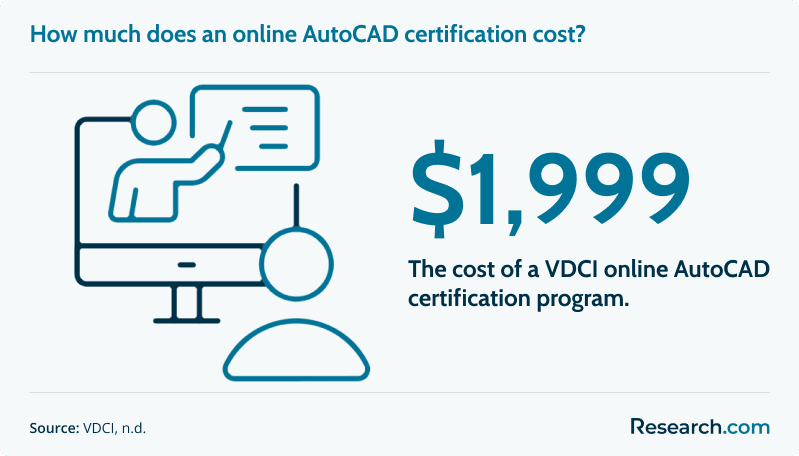
The cost of an online AutoCAD certificate depends on the school, credit requirements, residency status, included software, instructor support, and whether the program includes exam preparation. Students can expect to pay anywhere from $1,000 to $3,500 for a full program.
One example is the Virtual Design and Construction Institute (VDCI), which offers an online AutoCAD certificate program for $1,999. The program includes:
- 150 hours of expert-led, project-based training
- 267 instructional videos
- Six-month access to AutoCAD software
- Certified User Exam with a free retake option
- Instruction from Autodesk Certified professionals
- One-on-one bonus training sessions
- A verified digital certificate and 15.0 CEUs
- Quizzes and assignments to reinforce learning
- Accreditation from a recognized institution
When comparing prices, look beyond tuition. A lower-cost program may become more expensive if you must buy software access, pay separate exam fees, or purchase required hardware. Students comparing CAD training with other technical credentials may also review options such as fast-track CCNA online training to decide which credential best supports their long-term career plan.
Cost Factors to Check Before Enrolling
- Tuition structure: Confirm whether the school charges by credit, course, CEU, or full program.
- Residency rate: Community colleges may charge different rates for in-district, in-state, and out-of-state students.
- Software access: Ask whether AutoCAD access is included and how long it lasts.
- Exam fees: Find out whether Autodesk certification exam preparation or vouchers are included.
- Hardware requirements: Make sure your computer can handle AutoCAD before you enroll.
- Transfer value: If the certificate is for credit, ask whether credits can apply to a related degree later.
What Financial Aid Options Are Available for Online AutoCAD Certificate Students?
Short certificate programs are often less expensive than degrees, but students should still check every funding option before paying out of pocket. Eligibility depends on the school, program type, accreditation, credit status, and student circumstances. Students comparing AutoCAD with longer graduate pathways, such as the best online master's programs in clinical mental health counseling, should remember that aid rules can differ significantly between noncredit certificates, for-credit certificates, and degree programs.
- Federal Student Aid: Some accredited institutions with eligible for-credit certificate programs may allow students to use federal aid.
- Scholarships and Grants: Colleges, foundations, workforce agencies, and nonprofits may offer awards for technology, design, engineering, or career training.
- Workforce Development Programs: State or local workforce programs may help pay for short-term training tied to employment needs.
- Employer Tuition Support: Employers in construction, engineering, manufacturing, facilities, and design may reimburse AutoCAD training if it improves job performance.
- Payment Plans: Some schools offer monthly tuition plans that reduce the need to pay the full cost upfront.
- Military and Veteran Benefits: Active-duty service members and veterans may be able to use GI Bill or tuition assistance benefits, depending on program eligibility.
Before enrolling, ask the financial aid office whether the exact certificate you want is eligible for aid. Do not assume that institutional accreditation automatically means every short certificate qualifies for federal funding.
What Are the Prerequisites for an Online AutoCAD Certificate Program?
Many online AutoCAD certificate programs are beginner-friendly and do not require prior drafting experience. Still, students should be comfortable using a computer, following technical instructions, and working with measurements. Programs that serve students in technical or healthcare technology environments, including pathways such as the best online MSN in health informatics, often show how important basic digital fluency has become across industries.
- Basic computer literacy and comfort with Windows-based applications
- High school diploma or GED, which is a common minimum requirement at many institutions
- Math and geometry skills for scale, dimensions, measurements, and spatial reasoning
- Reliable internet access and a computer capable of supporting AutoCAD-related work
- Enough weekly study time to complete drawings, revisions, quizzes, and project files
According to Zippia, AutoCAD draftsmen come from several educational backgrounds:
- 42% of AutoCAD draftsmen have a bachelor’s degree
- 37% have an associate degree
- Only 8% have a high school diploma
These figures show that a certificate can support entry or advancement, but many workers in the field also have additional education. Students who want broader IT support skills alongside CAD may consider options such as accelerated online CompTIA A+ certification training.
What Courses Are Included in an Online AutoCAD Certificate Program?
Most online AutoCAD certificate programs begin with basic CAD navigation and drawing commands before moving into more advanced drafting, annotation, modeling, and documentation. The strongest programs do not only teach tools; they also require students to produce finished drawings that can become part of a portfolio.
Common Core Courses
- Introduction to AutoCAD: Covers the user interface, file setup, coordinate systems, common commands, and drawing management.
- 2D Drafting and Annotation: Teaches students how to create, edit, dimension, label, and organize technical drawings.
- 3D Modeling in AutoCAD: Introduces three-dimensional objects, visualization, rendering concepts, and model-based workflows.
Common Advanced or Specialized Courses
- Architectural Drafting: Focuses on floor plans, elevations, sections, building details, and construction documents.
- Mechanical Drafting: Covers part drawings, assemblies, tolerances, manufacturing documentation, and technical standards.
- Construction Document Standards: Introduces scales, layers, sheet organization, title blocks, plotting, and blueprint interpretation.
AutoCAD skills can also complement business, analytics, and cloud-based technical work. Students with management goals may compare CAD training with the best online MBA in general business programs, while learners in IT-heavy design environments may explore options such as the fastest online CompTIA Cloud+ training bootcamps.
What Accreditation and Quality Standards Should You Look For?
Accreditation matters because it helps confirm that an institution meets recognized academic or training standards. For an AutoCAD certificate, students should check both the school’s accreditation and the program’s industry relevance. A reputable program should clearly explain its curriculum, instructor qualifications, software requirements, grading expectations, and whether students receive a school certificate, CEUs, academic credit, or preparation for an Autodesk credential.
Students should also distinguish between a school-issued AutoCAD certificate and a vendor certification. A certificate program is usually an educational credential awarded after completing coursework. Autodesk credentials, by contrast, are tied to Autodesk’s own certification ecosystem and may require an exam. Programs that align with current software workflows and industry expectations can be stronger options for learners planning to continue into related technical fields, including areas such as an aerospace engineering online degree.
Quality Checklist
- Is the institution regionally or nationally accredited?
- Does the curriculum include both 2D drafting and 3D modeling?
- Are instructors experienced in AutoCAD or professional drafting workflows?
- Does the program include portfolio-ready projects?
- Is AutoCAD software access included, discounted, or required separately?
- Does the certificate carry academic credit, CEUs, or noncredit continuing education value?
- Does the program prepare students for an Autodesk certification exam?
- Are student support, tutoring, tech help, and career services available online?
What Specializations Are Available in Online AutoCAD Certificate Programs?
Many AutoCAD certificate programs begin with general drafting skills and then allow students to focus on a specific application area. Specialization matters because an architectural drafter, mechanical drafter, civil drafter, and electrical design technician may use AutoCAD differently.
Common AutoCAD Specializations
- Architectural Drafting: Covers building layouts, elevations, sections, construction details, and residential or commercial plan sets.
- Mechanical Drafting: Focuses on parts, assemblies, tolerances, technical specifications, and manufacturing drawings.
- Civil and Structural Drafting: Introduces site plans, infrastructure drawings, survey-related documentation, and structural detailing.
- Electrical or Electronics Drafting: Prepares students to create wiring layouts, circuit diagrams, control schematics, and equipment plans.
- Interior and Industrial Design: Emphasizes space planning, furniture layouts, product-focused drawings, ergonomics, and design documentation.
Zippia reports that 31% of AutoCAD draftsmen major in drafting and design, making it the most common educational background among those entering the field. Other workers come from areas such as architecture and mechanical engineering, which reflects the technical and visual nature of CAD work.
Students interested in design optimization, technical planning, or project evaluation may also combine CAD skills with analytics training, including options such as fastest online data analytics degree programs.
How Do You Choose the Best Online AutoCAD Certificate Program?
The best online AutoCAD certificate is the one that matches your target job, current skill level, schedule, budget, and preferred learning style. A program with a strong brand name is not automatically the best fit if it lacks software access, project feedback, or industry-specific drafting practice.
Step-by-Step Selection Process
- Define your target role. Decide whether you want architectural drafting, mechanical drafting, civil drafting, manufacturing support, interior design documentation, or a general CAD technician role.
- Check accreditation first. Confirm the school’s institutional accreditation and understand whether the certificate is for credit, noncredit, or CEU-based.
- Review the curriculum carefully. Look for 2D drafting, annotation, layers, plotting, 3D modeling, standards, and final projects.
- Verify software and hardware requirements. Ask whether AutoCAD access is included and whether your computer meets program requirements.
- Evaluate instructor support. Strong online programs provide feedback on drawings, not just videos and quizzes.
- Compare total cost. Include tuition, fees, software, textbooks, exam vouchers, technology needs, and potential travel if any sessions are hybrid.
- Ask about career support. Look for resume help, portfolio guidance, job boards, employer connections, or internship information.
- Confirm certification alignment. If your goal is an Autodesk exam, compare the program with resources from Autodesk-authorized training centers or Autodesk training materials.
Questions to Ask Before You Enroll
- Will I complete portfolio-ready drawings by the end of the program?
- Is the program designed for beginners, intermediate learners, or working professionals?
- How often will an instructor review my drawings?
- Can I access AutoCAD during the program, and for how long?
- Are credits transferable to a related associate or bachelor’s degree?
- Does the curriculum match the industry I want to enter?
- What student support is available outside normal business hours?
- What happens if I need extra time to finish?
Common Mistakes to Avoid
| Mistake | Why It Can Hurt You | Better Approach |
| Choosing only by lowest tuition | The cheapest program may not include software, feedback, or portfolio work | Compare total cost and learning support |
| Ignoring accreditation | Unrecognized credentials may have limited value with employers or other schools | Verify institutional accreditation before enrolling |
| Assuming all online programs are self-paced | Some online programs still follow strict weekly deadlines | Ask about pacing, extensions, and assignment schedules |
| Skipping hardware checks | AutoCAD may not run well on an underpowered computer | Review technical requirements before paying tuition |
| Not building a portfolio | Employers often want to see sample drawings, not only a certificate | Choose a project-based program and save polished work samples |
| Assuming salary outcomes are guaranteed | Pay varies by location, industry, experience, and employer demand | Use salary data as context, not a promise |
What Jobs Can You Get With an Online AutoCAD Certificate?
Graduates of online AutoCAD certificate programs can pursue drafting and design support roles in architecture, engineering, construction, interior design, manufacturing, civil infrastructure, and product development. A certificate alone may be enough for some entry-level jobs, while other employers may prefer candidates with an associate degree, bachelor’s degree, prior field experience, or a stronger portfolio.
Common job titles include:
- Architectural Drafter
- Mechanical Drafter
- Civil or Structural Drafter
- Electrical Design Technician
- Engineering Assistant
- 3D Design Specialist
The median annual wage for drafters was $65,380 in May 2024. Actual earnings depend on experience, specialization, region, industry, portfolio quality, and whether the role requires additional software such as BIM or mechanical design tools. With experience or additional credentials, AutoCAD-trained professionals may move into design engineering support, project coordination, BIM-related roles, or technical documentation positions.
| Career Path | Typical Work | Helpful Skills Beyond AutoCAD |
| Architectural Drafter | Creates building plans, elevations, details, and construction documents | Blueprint reading, building codes, Revit or BIM basics |
| Mechanical Drafter | Prepares part drawings, assemblies, and manufacturing documentation | Geometric dimensioning, manufacturing processes, mechanical design concepts |
| Civil or Structural Drafter | Supports infrastructure, site, and structural drawing production | Survey interpretation, civil plan standards, structural detailing |
| Electrical Design Technician | Drafts wiring diagrams, layouts, and control drawings | Electrical symbols, schematic reading, code awareness |
| Engineering Assistant | Supports engineers with drawings, documentation, revisions, and project files | Communication, file management, technical documentation |
What Is the Job Market Like for Online AutoCAD Certificate Graduates?
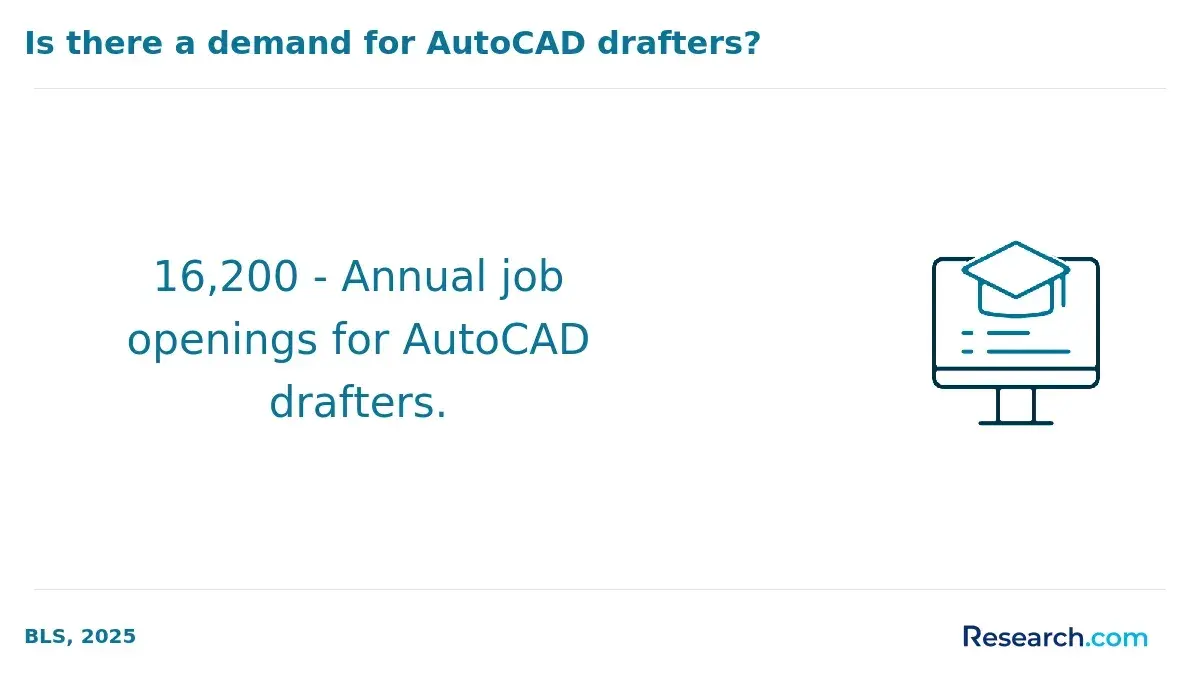
The drafting labor market is not expanding rapidly overall, so students should approach AutoCAD training with realistic expectations. According to BLS projections, overall employment of drafters is projected to show little to no change from 2024 to 2034. Even with limited overall growth, about 16,200 job openings are expected each year, mainly because workers retire, change occupations, or leave positions that need to be refilled.
AutoCAD remains relevant in construction, civil engineering, product design, industrial manufacturing, and design documentation. However, employers increasingly value workers who can combine CAD skills with communication, problem-solving, digital file management, project coordination, and familiarity with related tools. Graduates who build a strong portfolio and learn industry-specific standards may have better opportunities than those who complete only basic software tutorials.
Current Trends Affecting AutoCAD Training
- BIM and model-based workflows: Architecture, engineering, and construction employers may expect familiarity with BIM concepts alongside AutoCAD.
- Remote collaboration: CAD professionals increasingly share files, revisions, markups, and drawing sets through cloud-based platforms.
- AI-assisted design tools: Automation may speed up repetitive drafting tasks, but workers still need technical judgment, standards knowledge, and quality control skills.
- Portfolio-based hiring: Employers often want evidence that candidates can produce clean, accurate, professional drawings.
- Cross-training: AutoCAD skills become more valuable when paired with construction knowledge, mechanical design, civil drafting, electrical systems, analytics, or project management.
What Graduates Say About Online AutoCAD Certificate Programs
- Alex: "I completed my AutoCAD certificate online while continuing to work full time in construction support. The project-based lessons gave me practical drafting experience, and the recorded materials made it easier to review difficult steps. After finishing the program, I was able to move into a CAD technician position with a local company."
- Melissa: "The online format helped me change careers without leaving my job. I started with no drafting background, but the lessons moved from basic commands into 3D modeling at a manageable pace. Having six months of AutoCAD software access included made the training easier to complete, and the self-paced structure let me spend more time on the topics I found challenging."
- David: "Living in a rural area made in-person CAD training difficult, so the online certificate gave me access I would not have had otherwise. The program helped me prepare for the AutoCAD Certified User Exam and gave me enough confidence to pursue freelance drafting work. I am now using my portfolio to take on real client projects remotely."
How Can an Online AutoCAD Certificate Support Further Education and Career Advancement?
An online AutoCAD certificate can be a first step rather than a final credential. Many students use the certificate to build a portfolio, qualify for entry-level work, or test whether drafting and design are a good long-term fit. Others use it to strengthen an existing role in construction, facilities, manufacturing, interior design, engineering support, or project coordination.
For career advancement, consider pairing AutoCAD with complementary skills. Architectural and construction learners may benefit from BIM training. Manufacturing-focused students may need mechanical design and tolerance knowledge. Technical professionals who want broader digital or software skills may explore an accelerated bachelor's degree computer science online or other technology-focused pathways.
References:
- 6sense. (n.d.). AutoCAD - Market share, Competitor insights in CAD software. 6sense.com.
- BLS. (2025, August 28). Drafters. bls.gov.
- VDCI. (n.d.). Intro to AutoCAD course Online - The User Interface Part 1. (n.d.). [Video]. vdci.edu.
- Zippia. (2025, January 8). Best Colleges and Degrees for Autocad Draftsmen. zippia.com.
Key Insights
- An online AutoCAD certificate is best for students who want practical CAD skills in less than a year without committing immediately to a full degree.
- Most programs can be completed in four to eight months, but self-paced options require strong discipline and semester-based options require steady weekly availability.
- Do not compare programs by tuition alone. Software access, exam preparation, instructor feedback, portfolio projects, and residency pricing can significantly affect total value.
- Accreditation and credential type matter. Know whether you are earning academic credit, CEUs, a noncredit certificate, or preparation for an Autodesk certification exam.
- The median annual wage for drafters was $65,380 in May 2024, but salaries are not guaranteed and depend on location, industry, experience, and specialization.
- BLS projections show little to no change in overall drafter employment from 2024 to 2034, yet about 16,200 job openings are expected each year due to workforce turnover.
- The strongest candidates combine AutoCAD ability with industry knowledge, clean drafting standards, communication skills, and a portfolio of finished drawings.
Other Things You Should Know About the Best Online AutoCAD Certificate Programs
When selecting an online AutoCAD certificate program for 2027, consider accreditation, curriculum comprehensiveness, instructor expertise, flexibility, cost, and reviews. Ensure the program aligns with career goals and offers up-to-date tools and resources.
AutoCAD certificates are highly valued in industries like architecture, engineering, construction, and manufacturing. They demonstrate your ability to use industry-standard software to create precise technical drawings. In many entry-level jobs, a certificate is sufficient to get hired, especially when paired with a strong portfolio. The median salary for drafters supports the value of this credential. Overall, if you’re aiming to enter or advance in a technical design field, an AutoCAD certificate can be a smart and cost-effective credential.


