
2027 What Is Marriage and Family Therapy? Salary & Career Paths

Co-Founder and Chief Data Scientist
Choosing marriage and family therapy is not just a question of whether you want to help couples or families. It is a decision about graduate school, supervised clinical training, state licensure, income expectations, and the type of mental health work you want to do every day. The field has a strong labor outlook, with the Bureau of Labor Statistics projecting 16% job growth from 2023 to 2033, but the path still requires careful planning because licensing rules, costs, clinical hours, and career settings vary widely.
This guide explains what marriage and family therapists do, how the career compares with related counseling and social work paths, what education and licensing steps are required, where MFTs work, and how to judge whether an MFT degree is a smart long-term investment for your goals.
Quick Answer: Is Marriage and Family Therapy a Good Career Path?
Marriage and family therapy can be a strong career choice for people who want to provide relationship-centered mental health care and are prepared to complete a master’s degree, supervised clinical experience, and state licensure. The median annual salary for marriage and family therapists is $58,510, and projected job growth is 16% from 2023 to 2033. The best fit is usually someone who enjoys direct client work, systems-based thinking, communication coaching, and long-term professional development.
Key Things You Should Know About Marriage and Family Therapy Salary & Career Paths
- The field is expanding quickly. The Bureau of Labor Statistics projects 16% job growth from 2023 to 2033, which is much faster than the average for all occupations.
- Pay is steady but highly dependent on setting. The median annual salary for marriage and family therapists is $58,510, but earnings differ by state, employer, experience, specialization, and whether the therapist works in private practice.
- Employment is concentrated in a few large states. California employs 28,910 MFTs, followed by New York (5,670), Florida (2,850), Illinois (2,020), and Texas (1,950).
- Licensure is mandatory for independent practice. Most states require a master’s degree, supervised clinical hours, a licensing exam, and continuing education after licensure.
- MFTs are not limited to couples counseling. They work with individuals, couples, children, families, and groups in private practice, clinics, hospitals, schools, government agencies, and specialized treatment programs.
- What is marriage and family therapy?
- How does marriage and family therapy help clients?
- How do you become a marriage and family therapist for 2027?
- What education and licensing requirements do MFTs need?
- What does an MFT do day to day?
- What career paths are open to MFTs?
- What salary and job outlook should MFTs expect?
- How can MFTs move into higher-level roles?
- Do extra certifications help MFTs advance?
- What trends are changing marriage and family therapy?
- How does AAMFT help marriage and family therapists?
- How should you choose an MFT program?
- What is the long-term ROI of an MFT degree?
- Where do MFTs work most often in the US?
- How is marriage and family therapy different from social work?
- What are lower-cost counseling education options?
- How does an MFT degree pair with credentials like LPC?
- How can forensic psychology strengthen MFT practice?
- What is the fastest route into counseling?
What is marriage and family therapy?
Marriage and family therapy is a clinical mental health profession focused on how relationships, family systems, communication patterns, and life stressors affect emotional well-being. Instead of viewing a client’s problem only as an individual issue, MFTs examine the broader relational context: partners, parents, children, extended family, culture, community, and major life transitions.
MFTs may work with one person, a couple, an entire family, or a group. Common concerns include relationship conflict, parenting problems, grief, divorce, anxiety, depression, trauma, substance use, blended family stress, and recurring patterns of conflict. The work is therapeutic, but it is also practical: clients often learn how to communicate, set boundaries, repair trust, regulate emotions, and make decisions during stressful periods.
Prospective students comparing helping professions should understand that MFT is different from education, case management, and general counseling roles. Salary expectations can also vary across human services careers, so it can be useful to compare MFT compensation with adjacent fields such as the early childhood education salary range when weighing long-term financial goals.
How does marriage and family therapy help clients?
Marriage and family therapy helps people make sense of emotional and relational problems that often cannot be solved by one person alone. The therapist’s role is to create a structured, safe process where clients can identify patterns, practice healthier responses, and make changes that hold up outside the therapy room.
- Improves communication. Clients learn to express needs, listen without escalating conflict, and replace blame-based conversations with clearer problem solving.
- Strengthens relationships. Therapy can help partners, parents, children, and other family members rebuild trust, clarify roles, and respond more constructively to tension.
- Supports mental health treatment. MFTs may address anxiety, depression, trauma, and other concerns by looking at both individual symptoms and the relationship environment surrounding them.
- Helps families manage transitions. Divorce, grief, relocation, illness, remarriage, caregiving, and major developmental changes can disrupt family functioning; MFT provides a framework for coping.
- Interrupts harmful patterns. Families often repeat communication styles, emotional responses, or conflict cycles across generations. Therapy can help clients recognize those patterns and practice different choices.
The strongest results usually come when clients are willing to participate actively, practice skills between sessions, and revisit long-standing patterns with honesty. MFT is not a quick fix, but it can give individuals and families a practical structure for lasting change.
How do you become a marriage and family therapist for 2027?
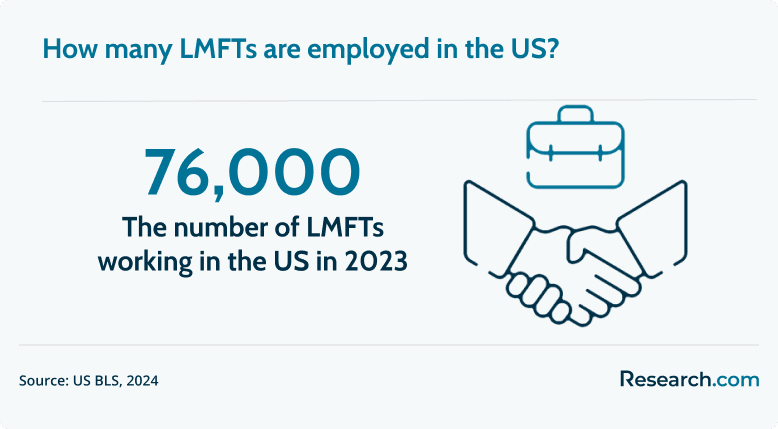
The number of licensed marriage and family therapists (MFTs) in the US is 76,000. Becoming one typically requires graduate education, supervised practice, and state approval to practice independently. Students researching how to become a therapist should pay close attention to their state’s rules before enrolling because licensure requirements are not identical nationwide.
- Complete a bachelor’s degree. Psychology, counseling, social work, human development, sociology, and related majors are common, but some graduate programs admit students from other academic backgrounds if prerequisites are met.
- Earn a qualifying graduate degree. Most future MFTs complete a master’s degree in marriage and family therapy or a closely related counseling field. Programs often take two to three years.
- Finish practicum and internship training. Graduate programs include supervised clinical experiences where students begin working with clients under faculty or site supervision.
- Accumulate post-graduate supervised hours. Most states require 2,000 to 4,000 hours of supervised experience before full licensure.
- Pass the required licensing exam. Many states use the exam administered by the Association of Marital & Family Therapy Regulatory Boards (AMFTRB), though state-specific requirements can differ.
- Renew the license through continuing education. Licensed therapists must keep up with ethics, clinical methods, law, and emerging professional standards.
| Stage | What to verify before moving forward |
| Bachelor’s degree | Check whether your target graduate programs require specific psychology, statistics, or human development prerequisites. |
| Master’s program | Confirm that the curriculum meets your state’s MFT licensure coursework requirements. |
| Clinical training | Ask how practicum placements are arranged and whether online students receive placement support. |
| Post-graduate supervision | Review state rules for eligible supervisors, required hours, documentation, and timelines. |
| Licensure exam | Find out which exam your state requires and whether the program offers exam preparation support. |
What education and licensing requirements do MFTs need?
Marriage and family therapy is a licensed profession, so the degree you choose must do more than look reputable. It should prepare you for your state’s coursework, clinical training, supervision, and exam requirements. A program that is academically strong but poorly aligned with licensure can delay your career and increase costs.
- Graduate education. Most aspiring MFTs need a master’s degree in marriage and family therapy, psychology, counseling, or a closely related field. Programs accredited by the Commission on Accreditation for Marriage and Family Therapy Education (COAMFTE) are often preferred because they are designed around professional MFT preparation. Students who want a shorter format can compare accelerated and online options, including the quickest MFT program pathways.
- Clinical practicum and internship. Graduate students complete supervised client-facing training before graduation. This is where students begin applying theory to real cases while receiving feedback from qualified supervisors.
- Post-graduate supervised experience. Most states require between 1,500 and 4,000 hours of supervised practice, which usually takes at least two years. Documentation matters, so students should learn their state’s tracking rules early.
- Licensure examination. MFT candidates generally must pass a licensing exam before independent practice. Many jurisdictions use the National MFT Exam administered by the AMFTRB, while some add state-specific law or ethics requirements.
- Continuing education. After licensure, MFTs must complete ongoing professional development to renew their credentials. Topics often include ethics, legal updates, cultural competence, trauma-informed care, and new clinical approaches.
The safest approach is to identify the state where you want to practice, read that state board’s licensure rules, and then choose a program that clearly maps its coursework and clinical training to those requirements.
What does an MFT do day to day?
MFTs provide therapy that is structured, goal-oriented, and grounded in relational assessment. Their work may look different depending on the setting, but most roles involve intake assessments, treatment planning, therapy sessions, progress documentation, consultation, and coordination with other professionals when needed. Students comparing mental health roles may also want to review a clinical psychology and counseling psychology degrees comparison to understand how MFT training differs from psychology-focused paths.
- Conduct assessments. MFTs gather information about symptoms, relationship patterns, family history, safety concerns, cultural context, and client goals.
- Create treatment plans. They translate assessment findings into measurable goals and choose interventions that fit the client’s needs.
- Use evidence-based models. Depending on the case, an MFT may use cognitive-behavioral therapy, emotionally focused therapy, structural family therapy, solution-focused therapy, or other recognized approaches.
- Facilitate difficult conversations. Much of the job involves slowing down conflict, helping clients hear one another, and teaching practical skills for repair and accountability.
- Assign between-session work. Clients may practice communication exercises, boundary-setting, emotional regulation, parenting strategies, or reflection tasks outside therapy.
- Monitor risk and progress. MFTs track whether treatment is helping, adjust interventions when needed, and respond appropriately to safety concerns.
- Document services. Clinical notes, treatment plans, consent forms, and insurance-related documentation are routine parts of the work.
| Responsibility | Why it matters |
| Intake and assessment | Helps the therapist understand symptoms, relationships, risks, and goals before selecting interventions. |
| Couples or family sessions | Allows clients to practice communication and conflict resolution in real time. |
| Individual sessions | Supports personal insight, emotional regulation, trauma work, or preparation for joint sessions. |
| Case consultation | Improves care when clients also need medical, psychiatric, school-based, or social service support. |
| Documentation | Protects clients, supports continuity of care, and helps meet legal, ethical, and payer requirements. |

What career paths are open to MFTs?
An MFT license can lead to several types of clinical and community-based work. The right path depends on whether you want autonomy, predictable employment, specialized cases, interdisciplinary teamwork, or broader service access.
- Private practice. MFTs may work independently or in group practices, serving individuals, couples, and families. This path offers flexibility but also requires business, marketing, billing, and compliance skills.
- Community mental health. Nonprofit and government-funded agencies often employ MFTs to serve clients who need affordable or accessible therapy services.
- Hospitals and healthcare organizations. Some MFTs work with medical teams in hospitals, rehabilitation centers, integrated care clinics, and behavioral health programs.
- Schools and universities. MFTs in educational environments may help students address family stress, social difficulties, adjustment issues, and mental health concerns that affect learning.
- Specialized therapy fields. With additional training, MFTs can focus on trauma, substance use, sex therapy, child and adolescent therapy, grief, or expressive approaches such as a masters in art therapy.
| Career setting | Best fit for MFTs who want... | Trade-offs to consider |
| Private practice | Autonomy, specialization, flexible scheduling, and long-term client relationships | Income may fluctuate, and the therapist handles business operations or practice management |
| Community clinic | Mission-driven work with diverse populations and broad clinical exposure | Caseloads can be heavy, and pay may be lower than some private settings |
| Hospital or healthcare system | Team-based care and complex cases involving mental and physical health | Work may include crisis situations, documentation demands, and institutional protocols |
| School or university | Work with students and families in an educational context | Roles may involve academic calendars, institutional policies, and coordination with school staff |
| Specialized practice | A focused client population or treatment method | Often requires additional training, supervision, or certification |
What salary and job outlook should MFTs expect?
The employment outlook for MFTs is strong. The Bureau of Labor Statistics projects a 16% increase in jobs from 2023 to 2033, which is much faster than the average for all occupations. Demand is connected to broader recognition of mental health needs and the value of treating relationship and family dynamics as part of care.
The median MFT salary is $58,510 per year. Actual pay can be higher or lower depending on location, employer type, years of experience, client population, payer mix, and whether the therapist is licensed, supervised, employed, or self-employed.
Many students compare MFT with social work before choosing graduate school. Those researching how much do social workers make will find that licensed clinical social workers (LCSWs) earn a median annual salary of around $61,000, which is similar to the compensation range for MFTs.
| Factor | How it can affect MFT earnings |
| Licensure status | Fully licensed therapists generally have more independence and access to a wider range of roles than pre-licensed clinicians. |
| Work setting | Private practice, healthcare systems, community agencies, and schools can offer different compensation structures. |
| Geographic location | State demand, cost of living, insurance markets, and local workforce supply all influence pay. |
| Specialization | Additional expertise in areas such as trauma, addiction, couples therapy, or child and family work may support stronger positioning. |
| Business model | Self-employed MFTs may have higher income potential, but they also carry expenses, marketing demands, and administrative responsibilities. |
The main takeaway: MFT is a growing profession, but salary outcomes are not guaranteed. Students should compare program cost, local job openings, licensure timelines, and realistic post-graduation earnings before borrowing heavily for graduate school.
How can MFTs move into higher-level roles?
Career growth in marriage and family therapy usually comes from a combination of clinical depth, licensure, specialization, leadership, and professional reputation. Advancement does not always mean leaving therapy; for many MFTs, it means serving more complex cases, supervising others, or building a focused practice.
- Develop a specialty. Training in trauma, addiction, sex therapy, child therapy, high-conflict couples work, or grief counseling can help MFTs serve specific populations more effectively.
- Earn advanced credentials or a doctorate. A master’s degree is typically enough for MFT licensure, but a PhD or PsyD can support academic, research, leadership, or advanced clinical opportunities.
- Become a clinical supervisor. Experienced MFTs can supervise trainees or associate-level clinicians, which expands their professional influence and may diversify income.
- Teach or train. Some MFTs become adjunct instructors, workshop facilitators, or continuing education presenters.
- Build a private practice or consulting niche. Therapists who want more independence may move into private practice, organizational consulting, parent coaching, or relationship education.
- Shift toward systems-level work. Some professionals move into program leadership, advocacy, or macro level social work-related roles that address mental health needs at the community or organizational level.
The best advancement plan starts early. Track the types of clients you enjoy serving, document training hours carefully, seek supervisors with relevant expertise, and choose continuing education that supports a clear practice direction rather than collecting random credentials.
Do extra certifications help MFTs advance?
Additional certifications can be useful when they match your client population, scope of practice, and career goals. They are most valuable when they improve clinical competence, meet employer needs, or support a credible specialization. They are less useful when they are expensive, poorly recognized, or unrelated to the work you actually plan to do.
| Certification or training area | When it may be worth considering |
| Trauma-focused training | You expect to work with clients affected by abuse, violence, grief, accidents, or complex family histories. |
| Addiction counseling | You want to serve clients or families affected by substance use or co-occurring mental health concerns. |
| Sex therapy or couples specialization | You plan to focus heavily on intimacy, relationship repair, and high-conflict partnership work. |
| Behavioral analysis coursework | You want additional tools for behavioral assessment, family routines, or interdisciplinary collaboration; some therapists explore BCBA courses online for this reason. |
| Supervision training | You want to supervise associate-level therapists or build a leadership role in clinical training. |
Before paying for any credential, ask whether it is recognized by employers, accepted for continuing education, aligned with state rules, and likely to improve your work with clients.
What trends are changing marriage and family therapy?
Several shifts are influencing how MFTs train, practice, and compete for roles. The most important changes involve teletherapy, digital tools, cultural responsiveness, integrated care, and employer expectations around evidence-based practice.
- Teletherapy has become a major service model. Many clients now expect virtual options, but therapists must understand privacy, documentation, emergency planning, and state practice rules.
- Digital tools are changing access and workflow. Scheduling platforms, electronic health records, outcome tracking, and secure messaging can improve care, but they also raise ethical and confidentiality considerations.
- Cultural responsiveness is no longer optional. MFTs increasingly need training that addresses identity, family structure, immigration, religion, trauma, socioeconomic stress, and community context.
- Integrated care is expanding. MFTs may collaborate more often with physicians, psychiatrists, social workers, school counselors, and addiction specialists.
- Licensure planning matters for mobility. Therapists who may move or provide remote care across state lines should follow changing rules closely. Students comparing routes into the field can review the path to becoming a licensed therapist to understand timeline differences.
These trends make adaptability essential. Future MFTs should choose programs that teach both core clinical skills and current practice realities, including telehealth ethics, diverse family systems, and interdisciplinary collaboration.
How does AAMFT help marriage and family therapists?
The American Association for Marriage and Family Therapy (AAMFT) supports the profession through advocacy, ethics resources, continuing education, professional networking, and field development. For students and licensed therapists, professional organizations can provide guidance that goes beyond what a graduate program or employer offers.
- Professional advocacy. AAMFT works on issues affecting recognition of MFTs, reimbursement, licensure mobility, and the profession’s role in mental health care.
- Continuing education. Members can access training that supports skill development and licensure renewal. Some therapists also strengthen research literacy through psychology-related coursework; students asking is math required for psychology major should know that statistics and research methods can be useful for evidence-based clinical practice.
- Ethical resources. AAMFT provides professional standards and ethics guidance for difficult clinical decisions.
- Networking. Conferences, divisions, and special interest groups can help therapists find mentors, collaborators, and career opportunities.
- Field knowledge. Publications and professional updates help MFTs follow changes in practice, policy, and research.
Joining a professional association is not a substitute for licensure or supervision, but it can help students and practitioners stay connected to the standards and conversations shaping the field.
How should you choose an MFT program?
The best MFT program is the one that meets licensure requirements in your intended state, fits your budget, offers strong clinical training, and supports the type of practice you want to build. Reputation matters, but it should not outweigh accreditation, field placement quality, cost, and licensure alignment.
| Question to ask | Why it matters |
| Is the program accredited or clearly aligned with state licensure requirements? | Licensure delays can occur if required coursework or clinical training is missing. |
| How are practicum and internship placements handled? | Students need reliable access to supervised client experience, especially in online programs. |
| What is the total cost beyond tuition? | Fees, books, residency requirements, travel, technology, and supervision expenses can raise the real price. |
| Can I study while working? | Part-time, evening, hybrid, or online formats may be necessary for working adults. |
| Does the curriculum match my interests? | Some programs offer tracks in couples therapy, child and adolescent therapy, faith-based counseling, trauma, or community mental health. |
| What support is available for licensure and employment? | Exam preparation, alumni networks, supervision guidance, and career services can affect the transition into practice. |
Students with a specific values-based or faith-integrated counseling interest may also compare specialized options such as a masters degree in Christian counseling, while confirming whether the degree meets clinical licensure requirements in their state.
What is the long-term ROI of an MFT degree?
The return on investment of an MFT degree depends on program cost, debt, licensure timeline, state employment opportunities, and your intended work setting. A low-cost program that meets licensure requirements may provide a stronger financial outcome than a more expensive program with limited placement support.
When estimating ROI, compare total education cost against realistic income during each stage: graduate student, associate or pre-licensed therapist, fully licensed clinician, and advanced practitioner or private practice owner. Also consider non-financial returns, such as career meaning, schedule flexibility, and the ability to specialize in work you find important.
- Calculate total cost. Include tuition, fees, books, technology, travel, unpaid internship time, exam fees, and supervision costs.
- Check licensure outcomes. Ask programs how graduates perform on licensing exams and how quickly they move into supervised roles.
- Compare local job postings. Look at requirements and pay ranges in the state where you plan to work.
- Limit unnecessary borrowing. Consider scholarships, employer tuition support, part-time study, transfer credit policies, and lower-cost accredited options.
- Evaluate fit, not just price. The cheapest program is not always the best value if it lacks placement support or does not meet your state’s requirements.
Students prioritizing affordability can begin by comparing the most affordable MFT degree online options and then verifying licensure alignment before applying.
Where do MFTs work most often in the US?
MFTs work in many environments where mental health, relationships, and family functioning intersect. Employment is not evenly distributed across the country, and larger states with extensive healthcare and mental health systems employ more therapists.
- Highest-employment states. California has the largest number of MFTs, employing approximately 28,910 professionals. New York (5,670), Florida (2,850), Illinois (2,020), and Texas (1,950) also have high employment levels.
- Private and group practices. Many MFTs provide therapy through solo practices, group clinics, or hybrid models. Therapists interested in remote service delivery can learn how to start a career in online therapy while also checking state telehealth rules.
- Community mental health agencies. These roles often serve clients facing financial hardship, trauma, limited access to care, or complex family stressors.
- Hospitals and integrated care settings. MFTs may support patients and families dealing with illness, crisis, behavioral health needs, or major life transitions.
- Educational and government settings. Some MFTs work in schools, universities, correctional programs, family service agencies, or public-sector behavioral health programs.
Location can affect both salary and available roles, so students should research their target state before choosing a school, specialization, or post-graduate supervision plan.
How is marriage and family therapy different from social work?
Marriage and family therapy and social work both support individuals and families, but they are built around different professional lenses. MFTs specialize in relational and systemic therapy. Social workers are trained to address people within broader social, economic, policy, and community systems, and clinical social workers may also provide psychotherapy.
| Comparison point | Marriage and family therapy | Social work |
| Main focus | Relationships, family systems, communication, emotional patterns, and psychotherapy | Individual and community well-being, social services, advocacy, case management, policy, and clinical care |
| Typical graduate degree | Master’s in marriage and family therapy or related counseling field | Master of Social Work for many advanced and clinical roles |
| Clinical orientation | Systems-based therapy for individuals, couples, and families | Person-in-environment framework; clinical social work may include therapy |
| Career flexibility | Strong fit for therapy-focused roles and private practice | Broad options in healthcare, schools, government, nonprofits, policy, and clinical practice |
| Best fit for students who... | Want to specialize in relational therapy and family dynamics | Want a wider human services role that may include therapy, advocacy, resources, and systems work |
If your main goal is to provide therapy to couples and families, MFT may be the more direct fit. If you want a broader role that may combine clinical care, social services, advocacy, and policy work, social work may be better. Students weighing the second path often ask, is a social work degree worth it? The answer depends on whether the degree supports the role and population you want to serve.
What are lower-cost counseling education options?
Cost should be part of every counseling education decision. Tuition is only one piece of the total investment; fees, clinical placement requirements, supervision costs, books, technology, commuting, and lost work time can all affect affordability. A program that looks inexpensive at first may cost more if it does not support placement or delays licensure.
Students who are open to related counseling paths can compare programs beyond MFT, including the cheapest online LPC programs, while confirming that any program under consideration meets state requirements for the intended license.
| Common affordability mistake | Better approach |
| Choosing only by advertised tuition | Calculate total program cost, including fees, travel, books, and clinical requirements. |
| Assuming all online programs qualify for licensure | Confirm state-by-state licensure alignment before enrolling. |
| Ignoring practicum logistics | Ask who finds placements and what happens if local sites are limited. |
| Borrowing without a salary plan | Compare debt with expected income during pre-licensure and after full licensure. |
| Relying only on rankings | Use rankings as a starting point, then verify accreditation, outcomes, cost, and fit. |
How does an MFT degree pair with credentials like LPC?
An MFT degree can complement other counseling credentials by adding specialized preparation in family systems, couples dynamics, and relational assessment. This can be valuable in multidisciplinary settings where clients receive care from therapists, professional counselors, social workers, psychiatrists, and medical providers.
Students comparing credentials should understand the distinction between the degree, the license, and the scope of practice in their state. For example, someone asking What's an LPC? is usually comparing a professional counseling license with MFT licensure. Both can involve therapy, but the training emphasis and state requirements may differ.
How can forensic psychology strengthen MFT practice?
Forensic psychology can be useful for MFTs who work with families involved in legal systems, custody disputes, court-ordered treatment, domestic conflict, risk assessment, or child welfare concerns. It does not replace MFT training, but it can broaden a therapist’s understanding of legal processes, documentation standards, behavioral assessment, and professional boundaries.
MFTs interested in this intersection may explore interdisciplinary graduate study or continuing education, including affordable masters in forensic psychology online options. Before enrolling, therapists should clarify whether the program supports their intended role and whether additional licensure, supervision, or legal qualifications are required for specific forensic work.
What is the fastest route into counseling?
The quickest counseling route depends on the license you want, your prior education, your state’s rules, and whether you can study full time. Some students complete accelerated graduate programs, while others choose part-time formats because they must keep working. Faster is not always better if the program lacks required coursework or clinical placement support.
Anyone comparing accelerated options should review the quickest way to become a counselor and then verify the exact requirements for the intended license. For MFT specifically, the required supervised hours and licensing process mean that even accelerated coursework still leads into a post-graduate supervision period.
What graduates say about MFT degree programs
-
: "
"My MFT program let me keep working while preparing for a career focused on families and relationships. I could connect classroom concepts to real situations right away, and the program community helped me stay motivated." - Lisa
"
-
: "
"Being able to study while managing personal responsibilities helped me grow in more than one area of my life. Live classes and applied assignments gave me practical tools for building trust with future clients." - Zack
"
-
: "
"Completing the degree while balancing other commitments changed how I saw both my career and my own development. The interactive coursework helped me understand what effective therapeutic connection can look like in practice." - Aisha
"
Common mistakes to avoid before choosing an MFT path
- Enrolling before checking licensure rules. Always compare the program curriculum with the requirements of the state where you plan to practice.
- Looking only at speed. A shorter program is only useful if it still includes the coursework and clinical preparation required for licensure.
- Underestimating supervised hours. Post-graduate supervision can take years and may affect income during the early career stage.
- Assuming private practice income is immediate. Building a caseload takes time, and self-employment includes expenses, insurance, billing, and marketing.
- Ignoring fit with daily work. MFTs spend much of their time in emotionally intense conversations, documentation, and long-term client care. Make sure that work style fits you.
- Choosing a school without placement support. Clinical training is central to licensure, so practicum and internship support should be a major selection factor.
Key Insights
- MFT is a therapy-centered career with strong projected growth. The field is expected to grow by 16% from 2023 to 2033, making it a promising option for students committed to mental health work.
- The median annual salary is $58,510, but outcomes vary. Location, licensure status, setting, specialization, and private practice experience all influence earnings.
- Licensure planning should come before program selection. A master’s program must align with your state’s coursework, clinical training, exam, and supervision rules.
- California is the largest MFT employment market. The state employs 28,910 MFTs, followed by New York, Florida, Illinois, and Texas.
- MFTs have multiple career options. Common paths include private practice, community mental health, healthcare, schools, universities, and specialized therapy fields.
- The best ROI comes from balancing cost, fit, and licensure readiness. Do not choose a program based only on tuition, rankings, or speed; verify accreditation, placement support, total cost, and career outcomes.
- MFT and social work overlap but serve different goals. Choose MFT if you want relationship-centered therapy as your main focus; consider social work if you want a broader human services, advocacy, or policy-oriented path.
References:
- American Association for Marriage and Family Therapy. What is marriage and family therapy? Retrieved March 26, 2025, from AAMFT
- California Board of Behavioral Sciences. Marriage and family therapist licensing requirements. Retrieved from BBS
- National Council on Family Relations. Master’s degrees in marriage and family therapy: A guide to programs and career opportunities. Retrieved from NCFR
- The Chicago School of Professional Psychology. The Growing Demand for Marriage and Family Therapists in a Changing World. Retrieved from The Chicago School
Other Things You Should Know About Marriage and Family Therapy
In 2027, career paths for marriage and family therapists include private practice, positions in hospitals, schools, and social service agencies. Advanced roles might involve supervision, research, or developing specialized therapy programs. Opportunities exist for those pursuing leadership and policy development within mental health organizations.
Most state licensing boards require a criminal background check, fingerprinting, and disclosure of any prior disciplinary actions before issuing a marriage and family therapy license. Applicants also usually need supervised clinical hours, a qualifying graduate degree, and passage of the AMFTRB national exam.
In 2027, licensure for marriage and family therapists typically requires a master's degree in marriage and family therapy, completion of supervised clinical hours, and passing the national MFT exam. Requirements vary by state, so it's important to check specific state guidelines.





