2027 ADN vs. AAD vs. AAS Nursing Degree Programs: Explaining The Difference

Co-Founder and Chief Data Scientist
If you want to become a nurse, one of the first choices you may face is whether to enroll in an ADN, AAS, or AAD nursing program. These associate-level options can look similar on a school website, but they do not always lead to the same licensure outcome, transfer pathway, or job opportunity. The most important question is not simply which degree sounds best—it is whether the program prepares you for the nursing license, employer expectations, and future education path you actually want.
This guide explains how Associate Degree in Nursing (ADN), Associate of Applied Science in Nursing (AAS), and Associate of Arts in Nursing (AAD) programs compare. You will learn how each degree typically works, what admissions requirements to expect, how long the programs take, how they may affect NCLEX-RN eligibility, what salaries are associated with common nursing roles, and how to choose a program without creating unnecessary delays later.
Quick answer: ADN vs. AAD vs. AAS nursing degrees
An ADN is usually the clearest associate-level route for students who want to become registered nurses because ADN programs are commonly built around NCLEX-RN preparation. An AAS in Nursing may also lead to RN licensure if the program is approved and structured for that purpose, but some AAS programs are more workforce-focused and may not transfer as smoothly into a BSN. An AAD is less common and may be better suited to students who want a stronger liberal arts foundation or a transfer-oriented path toward a bachelor’s degree.
- Choose an ADN if your main goal is to qualify for the NCLEX-RN and enter registered nursing as directly as possible.
- Consider an AAS if you want practical, career-focused training, but verify that the specific program leads to the nursing license you need.
- Look at an AAD if your priority is transfer preparation and you plan to continue into a BSN program rather than stop at the associate level.
- ADN, AAD, and AAS nursing degrees compared
- Admission requirements for associate-level nursing programs
- Program length and realistic completion timelines
- General education courses you may need
- Salary differences by nursing role
- How degree type can affect NCLEX-RN preparation
- Scholarships and financial aid options
- Using a DNP to move into advanced nursing leadership
- Career paths after an ADN, AAD, or AAS
- Accelerated online FNP pathways
- Ways to reduce the cost of nursing education
- Accreditation checks for nursing programs
- Direct-entry MSN admissions basics
- Accelerated online BSN programs compared with traditional routes
- Affordable LPN-to-RN bridge options
- How to evaluate nursing programs before applying
- Finding nursing schools with more accessible admissions
- MSN options for students without a nursing background
- Best associate degree for advanced nursing goals
- Nursing-related job outlook and source notes
ADN, AAD, and AAS nursing degrees compared
ADN, AAS, and AAD programs are all associate-level options, but their purpose can differ. The degree title alone is not enough to confirm whether you can become an RN. What matters most is whether the nursing program is approved for RN preparation, whether graduates are eligible for the NCLEX-RN exam, and whether the credits will apply toward a future BSN if you plan to continue your education.
| Degree | Typical focus | Best fit | Main caution |
| ADN | Registered nursing preparation with classroom, lab, and clinical training | Students who want a direct associate-level pathway toward RN licensure | You may still need a BSN later for some employers or advancement goals |
| AAS in Nursing | Applied, hands-on nursing or healthcare workforce preparation | Students who want practical training and immediate healthcare employment options | Not every AAS program leads to RN licensure or transfers easily into a BSN |
| AAD in Nursing | Associate-level nursing study with a stronger general education or transfer emphasis | Students planning to move into a bachelor’s program | AAD programs are less common, and NCLEX-RN eligibility must be verified carefully |
ADN: Associate Degree in Nursing
The ADN is the most familiar associate degree for students who want to become registered nurses. Community colleges commonly offer ADN programs, and the curriculum usually combines nursing theory, patient care skills, simulation, and supervised clinical rotations. Graduates of qualifying ADN programs can sit for the NCLEX-RN, which is required for RN licensure.
An ADN can also be a practical starting point for students who expect to complete a BSN later. Many RN-to-BSN bridge programs are designed for licensed RNs who entered the field through an ADN and want to keep working while advancing their education.
AAS in Nursing: Associate of Applied Science
An AAS in Nursing is usually more career-oriented and skills-based. In some schools, the AAS is the degree awarded for an RN-preparation program, meaning graduates may be eligible for the NCLEX-RN. In other cases, an AAS may support vocational, technical, or practical nursing roles instead of direct RN licensure.
Before choosing an AAS, read the program outcomes carefully. Do not assume the words “nursing” and “associate degree” automatically mean RN eligibility. Ask whether the program is approved by the state board of nursing, whether graduates can take the NCLEX-RN, and how many credits transfer into BSN programs.
AAD in Nursing: Associate of Arts Degree
An AAD in Nursing is less common than an ADN or AAS. It may include more liberal arts and general education coursework, which can help students who want to transfer into a four-year degree. Depending on the school, an AAD may or may not be structured around immediate RN licensure.
If your long-term goal is a BSN, MSN, or advanced practice role, an AAD may be useful when it has strong transfer agreements. However, you should still confirm that the program fits your licensing plan. Transfer-friendly coursework is helpful, but it does not replace the need for an approved nursing pathway if you want to become an RN.
Students who already hold a non-nursing bachelor’s degree may also compare associate-level routes with accelerated options. For example, the best 12 month online nursing degree programs may appeal to career changers who want a faster transition into nursing and can meet intensive academic and clinical requirements.
Admission requirements for ADN, AAD, and AAS nursing programs
Admissions standards vary by school and state, but associate-level nursing programs often require a combination of academic prerequisites, entrance testing, health documentation, and background screening. Before applying, students should also estimate total expenses because the answer to how much nursing school costs can vary by institution, residency status, fees, clinical requirements, and supplies.
Common eligibility requirements
- High school completion: Applicants usually need a high school diploma or GED.
- Prerequisite coursework: Many schools require biology, chemistry, anatomy, math, or related foundational courses before admission to the nursing sequence.
- Minimum GPA: Competitive programs may set a minimum GPA, often 2.5 or higher.
- Entrance exam scores: Schools may use the TEAS or HESI A2 to evaluate academic readiness.
- Background check: Clinical sites commonly require criminal background screening before students can work with patients.
- Immunization records: Programs often require proof of vaccinations and health screenings, such as Hepatitis B, MMR, and TB testing.
- CPR or BLS certification: Many programs require Basic Life Support or CPR certification, often through the American Heart Association.
- Application materials: Some schools ask for essays, recommendations, interviews, or documentation of healthcare experience.
Questions to ask before applying
- Does the program prepare graduates for RN licensure, LPN/LVN licensure, transfer, or another outcome?
- Are prerequisite courses included in the published program length, or do they add extra semesters?
- What entrance exam is required, and what score is considered competitive?
- Can prior college credits, AP credits, or healthcare certifications reduce the time to completion?
- Are clinical placements arranged by the school, or must students secure their own sites?
If nursing admissions requirements feel out of reach right now, it may help to compare other healthcare pathways. The difference between respiratory therapy and nursing degree programs shows how another patient-care field may have a different training structure, clinical focus, and credentialing path.
How long does it take to complete an ADN, AAD, or AAS nursing degree?
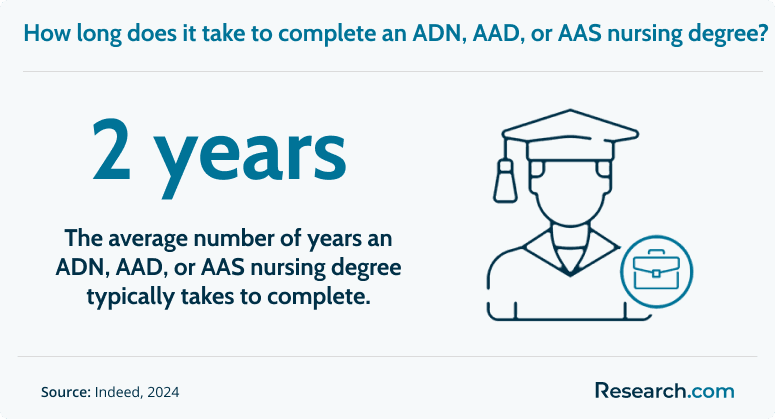
ADN, AAD, and AAS nursing programs typically take about two years for full-time students, but the real timeline depends on prerequisites, admissions cycles, clinical availability, and whether you attend full time or part time. Students who must finish science or math prerequisites before entering the nursing sequence may need more than two years from first enrollment to graduation.
| Enrollment situation | Typical timeline | What can extend the schedule |
| Full-time student with prerequisites completed | About two years | Limited clinical seats, course sequencing, or repeated coursework |
| Student still completing prerequisites | More than two years | Anatomy, physiology, microbiology, math, or other required courses before admission |
| Part-time student | Three to four years | Reduced course load, work schedules, family responsibilities, or delayed clinical placement |
| Student planning to transfer into a BSN | Associate degree plus additional BSN coursework | Nontransferable credits, missing general education courses, or school-specific requirements |
Students can sometimes reduce delays by completing approved prerequisite courses before entering the nursing major. Comparing the cheapest online nursing prerequisites can help lower costs, but confirm with your target nursing school that those credits will transfer before enrolling.
Online and hybrid nursing programs can make scheduling easier, especially for lectures or general education courses. However, clinical hours, skills labs, and simulations still require hands-on training, so online flexibility does not eliminate in-person requirements.
General education requirements for ADN, AAD, and AAS programs
Associate-level nursing programs combine nursing courses with general education classes that support safe patient care, documentation, critical thinking, and communication. The exact mix differs by school. AAS programs may emphasize applied training, AAD programs may include more transferable liberal arts credits, and ADN programs typically focus on the academic and clinical preparation needed for RN licensure.
- Science: Anatomy and Physiology are common requirements, often taken across two semesters. Microbiology is also frequently required because nurses need to understand infection, disease processes, and patient safety.
- Mathematics: Algebra or Statistics may be required. Math preparation matters because nurses calculate dosages, interpret data, and make time-sensitive clinical decisions.
- English and communication: Nursing students need strong writing and speaking skills for charting, care plans, patient education, and collaboration with healthcare teams.
- Social sciences and humanities: Psychology, sociology, ethics, or human development courses can help students understand patient behavior, family systems, cultural context, and decision-making in healthcare.
- Healthcare electives: Some programs include nutrition, medical terminology, computer applications, or related courses that improve readiness for clinical practice and may support transfer to a BSN.
Transfer tip
If you plan to earn a BSN later, ask whether Statistics, chemistry, humanities, and other general education courses will transfer to your target four-year school. Taking the wrong version of a course can create extra cost and delay.
Healthcare programs can differ significantly in how they use general education. For example, the difference between radiographer and radiologist degree programs illustrates how one path may focus on imaging technology while another requires the longer academic and clinical preparation expected of physicians.
Average salary for ADN, AAD, and AAS nursing graduates
Salary is tied more closely to licensure, role, location, experience, and work setting than to the associate degree title by itself. ADN graduates who become RNs generally have access to higher-paying roles because registered nurses earn an average salary of $86,070 per year. AAS graduates may reach similar earning potential if their program qualifies them for the NCLEX-RN and they become licensed RNs.
AAD graduates and AAS graduates whose programs do not lead directly to RN licensure may begin in roles such as LPN/LVN, CNA, psychiatric technician, or other support positions. LPNs have a median salary of $59,730 per year, while CNAs earn $38,130 per year. Students who begin as LPNs and want to move into registered nursing can compare the fastest LPN to RN program options, but they should confirm clinical requirements, state approval, and NCLEX-RN eligibility before enrolling.
| Role | Typical pathway | Salary figure cited | Important note |
| Registered Nurse | ADN or qualifying AAS plus NCLEX-RN | $86,070 per year | Hospitals, outpatient centers, specialty units, and home health may have different pay levels |
| Licensed Practical Nurse / Licensed Vocational Nurse | Practical nursing pathway or qualifying program | $59,730 per year | Often works under RN or physician supervision |
| Certified Nursing Assistant | CNA training and certification | $38,130 per year | Can provide patient care experience before further nursing education |
Salary numbers should be treated as planning estimates, not guarantees. State, city, shift differentials, union contracts, employer type, specialty area, and years of experience can all change actual pay.
Does degree type affect NCLEX-RN pass readiness?
Degree type can influence NCLEX-RN preparation, but the program’s approval status, curriculum design, clinical quality, faculty support, and student preparation matter more than the title alone. ADN programs and some AAS programs are intentionally designed to prepare graduates for the NCLEX-RN. AAD or AAS programs that are not RN-focused may not provide the same exam preparation.
What matters most for NCLEX-RN preparation
- State board approval: Confirm the program is approved for RN preparation in the state where you plan to study.
- Accreditation and quality indicators: Accreditation, faculty qualifications, and clinical depth can signal stronger academic structure.
- Published NCLEX-RN pass rates: Ask for current pass-rate data and compare it with state benchmarks when available.
- Clinical experience: Students need enough supervised practice to connect theory with real patient care.
- Test support: Structured review, practice exams, tutoring, and remediation can improve readiness.
After earning RN licensure, many nurses continue into BSN completion programs. An RN to BSN online in 6 months pathway may be attractive for working nurses who want to strengthen their credentials quickly, but students should compare accreditation, transfer credit policies, workload, and employer tuition support.
Scholarships and financial aid for ADN, AAD, and AAS nursing students
Yes, students in ADN, AAD, and AAS nursing programs may qualify for scholarships, grants, employer aid, state workforce programs, and federal financial aid. Availability depends on the school, student eligibility, enrollment status, state rules, and program accreditation.
- HRSA Nursing Scholarship Program: This federal option can cover tuition, required fees, and a monthly stipend for eligible nursing students who agree to work in underserved or high-need communities after graduation.
- Foundation of the National Student Nurses’ Association scholarships: These awards range from $1,000 to $7,500 and may consider academic achievement, financial need, and leadership.
- Tylenol Future Care Scholarship: Students pursuing healthcare degrees, including nursing, may be eligible for awards of up to $10,000.
- American Red Cross Jane Delano Nursing Scholarship: Nursing students with service or volunteer involvement may qualify for up to $3,000.
- State and regional nursing scholarships: Some states support associate-level nursing students who plan to work locally after graduation. California Board of Registered Nursing scholarships, for example, may provide up to $8,000 for ADN and AAS students who plan to work in-state after graduation.
Cost-saving checklist
- Submit the FAFSA as early as possible if you are eligible.
- Ask whether the nursing program qualifies for federal financial aid.
- Compare tuition, fees, uniforms, background checks, testing fees, books, equipment, and commuting costs.
- Look for employer tuition reimbursement if you already work in healthcare.
- Confirm whether scholarship funds require service commitments after graduation.
How an online DNP can support long-term nursing advancement
An associate degree can start a nursing career, but advanced roles usually require graduate education. Experienced RNs who want to move into clinical leadership, systems improvement, policy, executive practice, or advanced patient care may eventually consider a Doctor of Nursing Practice. A flexible DNP online degree can help working nurses build expertise in evidence-based practice, quality improvement, and healthcare leadership while continuing to meet professional obligations.
Career paths after an ADN, AAD, or AAS nursing degree
Your career options depend on whether your program leads to licensure, what license you earn, and whether you continue your education. An ADN or qualifying AAS can lead to RN roles after passing the NCLEX-RN. AAD or non-RN-focused AAS programs may support transfer, practical nursing, or healthcare support roles instead.
| Career option | Salary figure cited | Who may qualify | Typical work setting |
| Registered Nurse | $86,070 per year | ADN graduates and some AAS graduates who pass the NCLEX-RN | Hospitals, clinics, specialty units, outpatient centers, and community health settings |
| Licensed Practical Nurse / Licensed Vocational Nurse | $59,730 per year | Students who complete a practical nursing pathway or qualifying program | Long-term care, rehabilitation, home health, and outpatient care |
| Certified Nursing Assistant | $38,130 per year | Students who complete CNA requirements | Nursing homes, hospitals, assisted living, and home care |
| Home Health Nurse | $75,459 per year | Often RNs or LPNs, depending on employer and state rules | Patient homes and home healthcare agencies |
| Clinic or physician’s office nurse | $51,820 per year | RNs or LPNs, depending on role requirements | Private practices, outpatient clinics, and specialty offices |
| Psychiatric Technician | $39,610 | Students with relevant healthcare training and interest in mental health | Psychiatric hospitals, residential treatment, and behavioral health facilities |
ADN graduates often have the strongest immediate earning potential when they become licensed RNs. AAS and AAD graduates may still build strong careers, but they should map the next credential carefully if their first program does not lead to RN licensure.
When accelerated online FNP programs make sense
Family Nurse Practitioner programs are not entry-level nursing programs; they are designed for nurses who have already built the academic and clinical foundation required for graduate study. Accelerated formats can be useful for qualified nurses who want a faster route into advanced primary care practice, but the workload can be demanding. Before choosing accelerated FNP programs online, compare clinical placement support, accreditation, faculty access, and whether the pace is realistic with your work schedule.
How to reduce the cost of advancing your nursing education
The least expensive nursing path is not always the one with the lowest tuition. A cheaper program can become costly if credits do not transfer, clinical placements are limited, or the program does not meet licensure requirements. Students planning to move from RN to BSN should compare employer reimbursement, transfer credits, fees, and completion time. Reviewing the cheapest accredited online RN to BSN programs can be useful, especially for licensed RNs who want a flexible and budget-conscious next step.
Accreditation factors to check before choosing a nursing program
Accreditation and state approval are among the most important checks you can make before enrolling. A program may be affordable, nearby, or easy to enter, but if it does not meet licensure or transfer requirements, it can limit your options later.
- State board approval: Verify that the program is approved for the license you want in the state where you plan to practice.
- Recognized nursing accreditation: Accreditation can affect transfer, employer confidence, and eligibility for further education.
- NCLEX-RN pass rates: Ask for recent pass-rate information, not just marketing claims.
- Clinical placements: Confirm where students train and whether placements are reliable.
- Faculty and student support: Advising, tutoring, simulation labs, and remediation support can influence completion and exam readiness.
- Graduate pathways: If you want advanced practice later, ask how graduates move into BSN, MSN, or certificate programs such as an online MSN AGNP.
Admission essentials for online direct-entry MSN programs
Students with a bachelor’s degree in a field outside nursing may not need to start with an associate degree. Direct-entry MSN programs are designed for non-nurses and usually combine prerequisite science preparation with graduate-level nursing coursework. Applicants may need anatomy, physiology, microbiology, strong academic records, essays, recommendations, and sometimes interviews or entrance assessments. If this route fits your background, compare online direct entry MSN programs for non-nursing majors carefully because admissions rules, clinical expectations, and licensure outcomes differ by school.
How accelerated online BSN programs differ from associate nursing routes
An accelerated BSN is usually built for students who already have a non-nursing bachelor’s degree and want to transition into registered nursing through an intensive bachelor’s-level pathway. Compared with an ADN, this option may move students directly toward the BSN credential, but it can require a heavier course load and strict clinical scheduling. If you are comparing associate-level programs with an accelerated BSN program online, focus on total cost, clinical requirements, state authorization, prerequisites, and whether the pace is sustainable.
Can affordable LPN-to-RN bridge programs shorten the path to registered nursing?
For current LPNs, an LPN-to-RN bridge can be a practical way to build on existing nursing experience and qualify for RN licensure. These programs often reduce repetition by recognizing prior practical nursing education, but they still require approved RN-level coursework and clinical preparation. When reviewing the cheapest LPN to RN bridge programs, confirm state approval, NCLEX-RN eligibility, transfer options, and whether online coursework includes local clinical arrangements.
How to evaluate a nursing program before you apply
A strong nursing program should match your licensure goal, learning needs, budget, and future education plans. Rankings can be helpful, but they should not replace direct verification with the school and state board of nursing.
| Factor | Why it matters | Question to ask |
| Licensure pathway | Determines whether you can pursue RN, LPN/LVN, or another credential | Are graduates eligible for the NCLEX-RN or another licensure exam? |
| Accreditation and approval | Affects quality, transfer, and employer recognition | Is the program accredited and approved by the relevant state board? |
| Clinical placement | Nursing requires hands-on patient care training | Does the school arrange clinical placements? |
| Cost and aid | Total program cost includes more than tuition | What are the required fees, supplies, testing costs, and financial aid options? |
| Transferability | Important for BSN, MSN, or advanced practice goals | Which four-year schools accept these credits? |
| Specialized goals | Advanced practice pathways may require specific prerequisites | Does this program support future plans such as the fastest masters women's health NP programs? |
How to identify nursing schools with more accessible admissions
Students searching for less competitive nursing schools should still prioritize quality and licensure outcomes. A program with easier admission is not a good choice if it lacks approval, has weak student support, or does not prepare graduates for the license they need. Use guides to easy nursing schools to get into as a starting point, then verify admission standards, prerequisite rules, NCLEX results, clinical partnerships, and graduation support directly with each school.
Can non-nursing majors pursue an MSN instead of an associate nursing degree?
Yes, some non-nursing bachelor’s degree holders can enter nursing through direct-entry MSN programs. These programs are designed to move students from a non-nursing academic background into nursing through an integrated curriculum. They can be faster than completing a separate associate degree, BSN, and MSN, but they are academically demanding and may require extensive prerequisites. Students considering direct-entry MSN programs for non-nursing majors should confirm licensure outcomes, clinical requirements, accreditation, and whether the program aligns with their intended nursing role.
Best degree option if you want an advanced nursing role
Among ADN, AAD, and AAS options, the ADN is usually the strongest choice for students who want an advanced nursing role later because it is commonly designed to lead to RN licensure. Becoming an RN is a key step for future roles such as Nurse Practitioner, Clinical Nurse Specialist, Nurse Educator, or Nurse Anesthetist.
An ADN can also fit well with RN-to-BSN and RN-to-MSN bridge programs, allowing nurses to work while continuing their education. Employers may also provide tuition assistance or advancement support for RNs pursuing higher credentials. Nurses interested in psychiatric-mental health specialization, for example, may later compare the cheapest online PMHNP certificate programs after meeting the required nursing education and licensure milestones.
If nursing school is not realistic right now because of cost, admissions timing, or personal responsibilities, an entry-level healthcare role can still help you gain experience. If you are asking what does a medical assistant do, the role typically includes administrative and basic clinical tasks such as managing records, taking vital signs, preparing patients, and assisting with exams. Medical assisting does not replace nursing education, but it can introduce you to healthcare work while you plan your next step.
Job outlook for nursing-related occupations
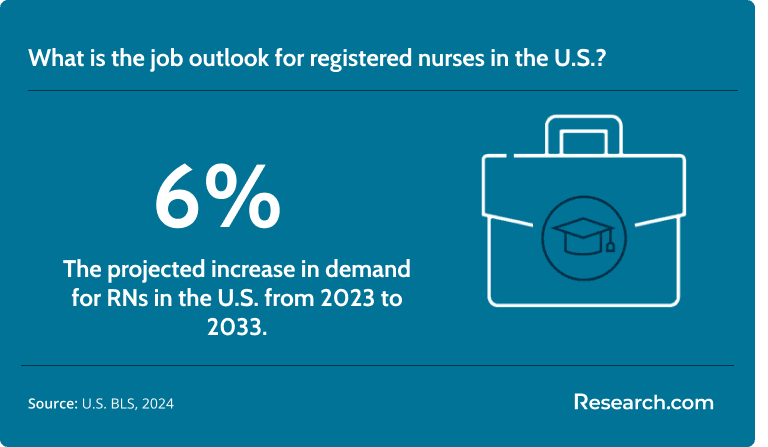
Employment prospects remain favorable for several nursing-related roles, although the strongest opportunities usually go to candidates with the right license, clinical preparation, and willingness to work in high-need settings. According to the figures cited in this guide, employment for RNs is projected to grow by 6% from 2022 to 2032, adding about 177,400 new jobs. ADN graduates who become RNs may find opportunities in hospitals, outpatient care centers, home healthcare, and other patient-care settings.
LPN employment is expected to grow by 3%, while CNA employment is projected to grow by 4% over the same period. Long-term care, rehabilitation, home health, assisted living, and hospital settings continue to rely on practical nurses and nursing assistants. Workers who begin as LPNs or CNAs may improve their options by pursuing RN licensure or additional education. For nurses planning future graduate study, the easiest MSN programs to get into may help identify accessible pathways, but admissions convenience should still be weighed against accreditation, outcomes, and clinical quality.
Common mistakes to avoid when choosing between ADN, AAD, and AAS programs
| Mistake | Why it can hurt you | Better approach |
| Assuming every associate nursing degree leads to RN licensure | Some programs may not qualify graduates for the NCLEX-RN | Ask the school and state board whether graduates are eligible for the exam |
| Choosing based only on tuition | Low tuition may not include fees, supplies, testing, uniforms, or transportation | Compare total cost of attendance and financial aid |
| Ignoring transfer policies | Credits may not apply toward a BSN, adding time and cost later | Request written transfer information from both the associate program and target BSN schools |
| Overlooking clinical placement details | Weak or limited clinical access can delay graduation and reduce readiness | Ask where students complete clinicals and whether the school arranges placements |
| Relying only on rankings or admissions ease | A convenient program may not support your licensing or career goals | Prioritize approval, accreditation, NCLEX outcomes, support services, and employer recognition |
| Assuming salary outcomes are guaranteed | Pay varies by state, employer, shift, specialty, and experience | Use salary data as a planning tool and research local employers |
Key Insights
- An ADN is usually the most direct associate-level option for students who want to become RNs because ADN programs are commonly aligned with NCLEX-RN preparation.
- An AAS can be a strong practical pathway, but only some AAS nursing programs lead to RN licensure. Always verify the program’s stated outcome before enrolling.
- An AAD may work well for transfer-minded students, but it is less common and should be evaluated carefully for licensure eligibility and BSN transfer value.
- All three degree types typically take about two years for full-time students, but prerequisites, part-time enrollment, and transfer requirements can extend the timeline.
- Licensure drives salary more than the degree title. RNs earn an average salary of $86,070 per year, while LPNs earn $59,730 and CNAs earn $38,130.
- NCLEX-RN success depends on program quality, state approval, clinical preparation, faculty support, and student readiness—not just whether the credential says ADN, AAS, or AAD.
- Before applying, confirm accreditation, state board approval, NCLEX eligibility, clinical placement support, total cost, and transfer agreements in writing whenever possible.
- If your long-term goal is advanced practice, choose the pathway that gets you to RN licensure and keeps the BSN, MSN, or DNP route open.
Resources
- Indeed Editorial Team. (2024). ADN vs. ASN vs. AAS Nursing Degrees: What're the Differences? Indeed career guide
- U.S. Bureau of Labor Statistics. (2024). Occupational Outlook Handbook: Registered Nurses. BLS registered nurses outlook
- ZipRecruiter. (2025). Home Health Nurse Salary. ZipRecruiter home health nurse salary data
Other Things You Should Know About ADN vs. AAD vs. AAS Nursing Degree Programs
The ADN is the most widely recognized route for RN licensure because it is a prelicensure nursing degree aligned with NCLEX-RN eligibility. State boards of nursing approve programs individually, and graduates must complete an accredited curriculum and meet board-specific clinical requirements before testing.
In 2027, admission requirements for ADN, AAD, and AAS programs typically include a high school diploma or GED, completion of prerequisite courses in biology and chemistry, and a minimum GPA set by individual institutions. Some programs may require an entrance exam or interview.
In 2027, ADN programs focus on foundational nursing skills and entry-level practice, AAD programs emphasize advanced healthcare management and leadership, while AAS programs offer a mix of technical skills ideal for specialized nursing roles. Each program tailors its curriculum to specific career pathways and professional goals within healthcare settings.