
2027 How to Become a Nurse in Michigan

Co-Founder and Chief Data Scientist
Becoming a nurse in Michigan requires more than choosing a school and passing an exam. You need to select the right nursing pathway, complete an approved education program, meet Michigan Board of Nursing requirements, pass the correct NCLEX exam, and understand how state licensure affects where and how you can practice. The decision matters because Michigan employs over 100,000 registered nurses, RNs earn an average annual salary of $86,210, and healthcare employers continue to need qualified nurses even with a modest projected growth rate.
This guide is for prospective nursing students, career changers, LPNs planning to advance, and current nurses considering graduate education or specialization in Michigan. You will learn the steps to licensure, education options, license types, salary and job outlook details, advanced practice pathways, online program considerations, and mistakes to avoid before enrolling in a program.
Quick Answer: How do you become a nurse in Michigan?
To become a nurse in Michigan, you must complete a state-approved nursing program, apply for licensure through the Michigan Board of Nursing, pass the NCLEX-PN for practical nursing or the NCLEX-RN for registered nursing, complete required background checks, and meet any state-mandated training requirements. RNs usually earn either an Associate Degree in Nursing (ADN) or a Bachelor of Science in Nursing (BSN), while LPNs complete an approved practical nursing program. Advanced practice nurses must complete graduate nursing education and national certification in their specialty.
Key Things You Need to Know About Becoming a Nurse in Michigan
- Michigan has a large nursing workforce and ongoing staffing pressure. The state employs more than 100,000 registered nurses, yet nursing shortages remain a concern, with projections pointing to over 22,000 unfilled nursing positions by 2030.
- RN pay is higher than the statewide average for all jobs. Registered nurses in Michigan earn about $86,210 per year on average, though pay can differ by experience, specialty, employer, shift, and region.
- Job growth is moderate, but openings are steady. Registered nurse employment is projected to grow by 2.7% from 2022 to 2032, with 5,950 average annual RN openings during that period.
- There is more than one route into nursing. Michigan students can pursue practical nursing programs, ADN programs, BSN programs, accelerated nursing tracks for students with prior degrees, and graduate programs for advanced practice roles.
- Technology and specialization are changing nursing work. Telehealth, geriatric care, behavioral health, informatics, and advanced practice roles are becoming more important in Michigan’s healthcare environment.
- Steps to becoming a nurse in Michigan
- Educational requirements for Michigan nurses
- Types of nurses who can practice in Michigan
- Michigan nursing licensing requirements
- Types of nursing licenses in Michigan
- Nurse Licensure Compact rules in Michigan
- Practicing nursing without a license in Michigan
- Current state of nursing in Michigan
- Michigan nursing job outlook
- Ways nurses can diversify healthcare career options
- Career advancement options for Michigan nurses
- Advanced practice nursing pathways
- Why an FNP program can be a strategic option
- Specialized certifications for nurses
- How to become an LVN or LPN in Michigan
- Online nursing programs in Michigan
- Continuing education and renewal requirements
- Michigan nursing programs with strong career value
- How to specialize as a nurse midwife
- Opportunities for LPNs in Michigan
- How to choose the right nursing program in Michigan
What are the steps to becoming a nurse in Michigan?
The path to nursing licensure in Michigan depends on whether you want to become an LPN, RN, or advanced practice nurse. The basic sequence is similar: complete an approved program, pass the required exam, apply for licensure, and keep your credential active through renewal requirements.
- Choose the nursing role you want. Decide whether you want to start as an LPN, become an RN through an ADN or BSN, or pursue an advanced practice role later. Your choice affects program length, cost, scope of practice, and career mobility.
- Enroll in an approved nursing program. RNs typically complete either a two-year ADN or a four-year BSN. LPNs complete a practical nursing program. Students should verify that the program is recognized for Michigan licensure before applying.
- Complete required clinical training. Nursing education includes classroom learning, lab work, simulation, and supervised clinical experience. Clinical placement quality is one of the most important factors when comparing schools.
- Apply to the Michigan Board of Nursing. After finishing your program, submit the licensure application and required documentation through the state licensing process.
- Pass the correct NCLEX exam. RN candidates take the NCLEX-RN, while practical nursing candidates take the NCLEX-PN. Passing the exam is required before you can practice under the corresponding license.
- Complete background and character requirements. Michigan requires fingerprinting, a criminal background check, and moral character disclosures for nursing applicants.
- Finish required training, including human trafficking training. Applicants must complete training on identifying and responding to human trafficking, reflecting the role nurses play in recognizing vulnerable patient situations.
- Renew your license on time. Licensed nurses must follow Michigan’s renewal and continuing education requirements to remain legally eligible to practice.
| Goal | Typical Education Route | Licensing Exam | Best Fit |
| Licensed Practical Nurse | Approved practical nursing program | NCLEX-PN | Students who want a faster entry into bedside care and may later bridge into RN education |
| Registered Nurse | ADN or BSN | NCLEX-RN | Students who want broader clinical responsibilities and more long-term career options |
| Advanced Practice Registered Nurse | Graduate nursing degree and specialty preparation | National certification based on specialty | RNs seeking advanced clinical, diagnostic, leadership, or specialty practice roles |
Students considering specialized graduate roles should also compare long-term earning potential and job responsibilities. For example, nurses interested in behavioral health can review psychiatric nurse practitioner salary information before choosing a graduate track.
In 2023, there were more than 102,240 registered nurses (RNs) in the state. See the chart below for more information on employment levels.
What are the educational requirements for becoming a nurse in Michigan?
Michigan nursing education requirements vary by license level. The most common entry routes are practical nursing programs, ADN programs, and BSN programs. Graduate nursing degrees are required for advanced practice, leadership, research, and many specialized clinical roles.
| Education Option | Typical Length | Credential Prepared For | When It Makes Sense |
| Practical nursing program | About one year | LPN | You want a shorter route into nursing and are comfortable working under RN or physician supervision |
| Associate Degree in Nursing (ADN) | Two years of full-time study | RN | You want to qualify for RN licensure with a shorter academic path than a BSN |
| Bachelor of Science in Nursing (BSN) | Four years of full-time study | RN | You want stronger preparation for leadership, public health, specialty units, graduate school, or competitive employers |
| Master of Science in Nursing (MSN) | Usually completed after a BSN | Advanced or specialized nursing roles | You want to move into nurse practitioner, education, administration, informatics, or specialty practice roles |
| Doctoral nursing degree | Several years beyond graduate preparation | Highest-level practice, leadership, research, or academic roles | You want to pursue executive, research, faculty, or advanced clinical leadership work |
An ADN can be a practical choice for students who need a lower-cost or faster RN pathway. A BSN may be a better long-term option for students who want broader advancement opportunities, plan to enter graduate school, or are targeting hospital systems that prefer baccalaureate-prepared nurses.
Accelerated nursing programs can help students who already hold a degree in another field transition into nursing more quickly, often within 12 to 18 months. Online and hybrid nursing programs can also improve access for working adults, but students should confirm that the program includes approved clinical experiences and meets Michigan licensure requirements.
Students exploring mobility or specialty roles may also want to compare travel nursing compensation patterns. Research.com’s guide to travel nurse earnings by state can help nurses understand how pay can vary by location and assignment type.
What types of nurses can legally practice in Michigan?
Michigan recognizes several nursing roles, each with a different education requirement, licensing process, and scope of practice. Understanding these distinctions helps students avoid choosing a program that does not match their career goal.
- Licensed Practical Nurses (LPNs): LPNs provide basic nursing care, monitor patient conditions, support activities of daily living, and administer certain medications within their scope. They usually work under the supervision of RNs, physicians, or other authorized providers.
- Registered Nurses (RNs): RNs assess patients, develop and coordinate care plans, administer treatments, educate patients and families, supervise care teams, and work across hospitals, clinics, long-term care facilities, home health, public health, and other settings.
- Advanced Practice Registered Nurses (APRNs): APRNs include nurse practitioners, clinical nurse specialists, certified registered nurse anesthetists, and certified nurse midwives. These roles require graduate education, national certification, and authorization tied to the nurse’s specialty area.
Students should not assume that all nursing programs lead to the same license. A medical assistant program, nursing assistant course, or healthcare certificate may support entry-level healthcare work, but it does not qualify a graduate to practice as an LPN or RN unless it is an approved nursing program leading to the correct licensing exam.
What are the licensing requirements for nurses in Michigan?
Michigan nursing licensure is administered through the Michigan Department of Licensing and Regulatory Affairs and the Michigan Board of Nursing. Requirements differ by license category, but most applicants must complete approved education, pass the applicable NCLEX, submit an application, complete fingerprinting and a background check, and meet required training standards.
| Requirement | What It Means for Applicants | Why It Matters |
| Approved nursing education | Complete a Michigan-recognized practical nursing, ADN, BSN, or graduate nursing program depending on the license | Unapproved programs can delay or prevent licensure |
| NCLEX exam | Take the NCLEX-PN for LPN licensure or NCLEX-RN for RN licensure | The exam verifies minimum competency for safe entry-level practice |
| State application | Submit licensure materials and the required fee; the application fee is approximately $25 for LPNs and $45 for RNs | The state must approve the applicant before legal practice begins |
| Fingerprinting and background check | Complete required screening, with fingerprinting commonly costing $50 to $75 | Patient safety and professional accountability are central to licensure |
| Human trafficking training | Complete state-required training related to identifying and responding to human trafficking | Nurses may encounter patients at risk and must know how to respond appropriately |
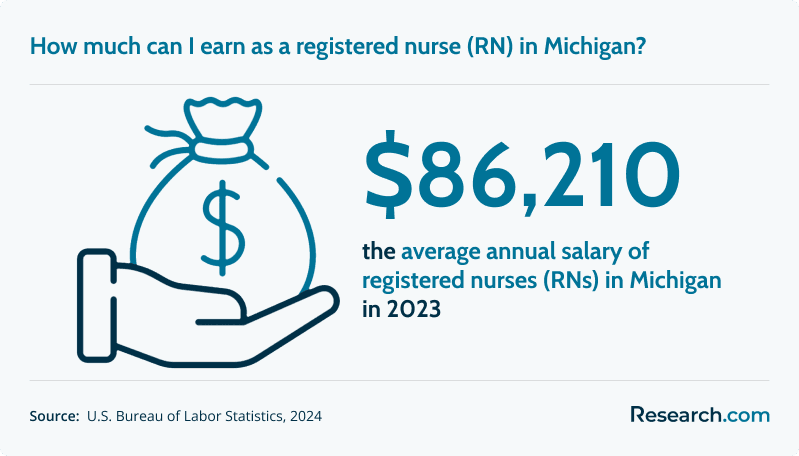
In 2023, registered nurses (RNs) in Michigan earned $86,210 per year on average. This is significantly higher than the average annual salary of all occupations in the state at $60,600.
What types of nursing licenses are available in Michigan?
Michigan nursing licenses are tied to scope of practice. Choosing the right license path depends on how quickly you want to enter the workforce, how much responsibility you want, and whether you plan to pursue advanced roles.
- Licensed Practical Nurse (LPN): This license is designed for graduates of approved practical nursing programs. LPNs focus on direct practical care, such as taking vital signs, assisting patients, documenting changes, and supporting treatment plans under appropriate supervision.
- Registered Nurse (RN): RNs complete either an ADN or BSN and pass the NCLEX-RN. They have a broader scope than LPNs and often handle assessments, care coordination, patient education, medication administration, and supervision of support staff.
- Advanced Practice Registered Nurse (APRN): APRNs complete graduate-level nursing education and earn national certification in a specialty such as nurse practitioner, nurse midwife, clinical nurse specialist, or nurse anesthetist. RNs planning this route may compare flexible bridge options, including online RN to MSN nursing programs.
Career planning should also include comparisons outside nursing when students are deciding among healthcare occupations. For example, reviewing state-by-state radiology tech salaries can help healthcare students weigh nursing against other allied health paths.
In 2023, nurse anesthetists were the highest-earning nurses in the state, earning around $219,050 per year on average. See the chart below for more salary details.
Can a Compact nurse practice in Michigan?
No. A nurse who holds only a multistate license through the Nurse Licensure Compact cannot practice in Michigan unless they obtain the appropriate Michigan nursing license. Michigan is not currently a member of the Nurse Licensure Compact, so compact privileges from another state do not authorize nursing practice in Michigan.
The Nurse Licensure Compact allows eligible RNs and LPNs in participating states to practice across state lines under one multistate license. Michigan is among the 11 states that have not adopted the compact. As a result, nurses moving to Michigan or accepting Michigan-based positions must follow the state’s licensure process rather than relying on compact status.
In 2020, Governor Gretchen Whitmer vetoed an effort to join the compact because of concerns about transferring regulatory authority outside the state. Later legislative discussions, including efforts supported by State Rep. Phil Green, show that the issue may continue to be revisited. Until the law changes, nurses should treat Michigan as a separate licensure state.
If Michigan eventually joins the compact, nurse mobility could improve, especially for nurses who live near state borders, travel frequently, or provide telehealth services across jurisdictions. For now, the safest approach is to verify current rules with the Michigan Board of Nursing before accepting any role involving Michigan patients.
Can you practice as a nurse without a license in Michigan?
No. Practicing as a nurse without a valid Michigan license is illegal and can expose the individual to disciplinary, civil, and criminal consequences. It also creates serious patient safety risks because nursing licensure exists to verify education, competency, ethical fitness, and accountability.
- Legal risk: Using a protected nursing title or performing licensed nursing duties without authorization can lead to penalties and may harm future eligibility for licensure.
- Patient safety risk: Unlicensed practice can place patients in danger because the individual has not met the state’s required education, examination, and screening standards.
- Career risk: Employers, licensing boards, and graduate programs may view unauthorized practice as a serious professional integrity issue.
Healthcare staffing shortages do not remove licensing requirements. Even as telehealth, accelerated education, and new care models develop, Michigan still requires nurses to hold the correct credential before practicing.
What is the state of nursing in Michigan?
Nursing in Michigan is stable but pressured. The state has a large RN workforce, strong demand across hospitals and long-term care settings, and continued need for nurses in underserved and rural communities. At the same time, retirements, patient complexity, chronic disease, and demand for community-based care continue to affect staffing.
Where nurses work in Michigan
Michigan nurses are employed across many settings, including hospitals, outpatient clinics, long-term care facilities, rehabilitation centers, home health agencies, public health departments, schools, correctional healthcare, behavioral health settings, and telehealth operations.
- Hospitals and health systems: These employers commonly hire RNs for acute care, emergency care, surgery, intensive care, maternity care, pediatrics, oncology, and specialty units.
- Long-term care and assisted living: Aging-related care creates demand for LPNs, RNs, nurse managers, wound care nurses, and geriatric specialists.
- Home health and community care: More care is being delivered outside hospitals, increasing demand for nurses who can work independently and coordinate services.
- Public health and schools: Nurses support prevention, health education, disease management, and care coordination for populations rather than only individual patients.
How salary and cost of living should factor into your decision
Michigan nursing salaries differ by region, employer, specialty, shift, and experience. Urban areas may offer higher pay, but living costs and commuting patterns can also affect take-home value. Before accepting a job or choosing a school, compare tuition debt, likely starting pay, local cost of living, and whether the employer offers tuition reimbursement or advancement support.
Advanced practice nurses may have stronger earning potential depending on specialty and setting. Nurses comparing advanced roles can review nurse practitioner salaries by state to understand broader compensation patterns.
Trends shaping nursing in Michigan
- Telehealth and remote monitoring: Nurses increasingly need comfort with digital documentation, virtual patient education, and remote care coordination.
- Geriatric and chronic disease care: Michigan’s aging population increases the need for nurses trained in complex medication management, mobility support, dementia care, and care transitions.
- Behavioral health demand: Mental health and substance use care require nurses who can communicate effectively, manage safety concerns, and work in interdisciplinary teams.
- Graduate education and leadership: Nurses interested in system-level roles may pursue advanced degrees, including fast DNP degree programs for leadership, clinical practice, and evidence-based care roles.
What is the job outlook for nursing in Michigan?
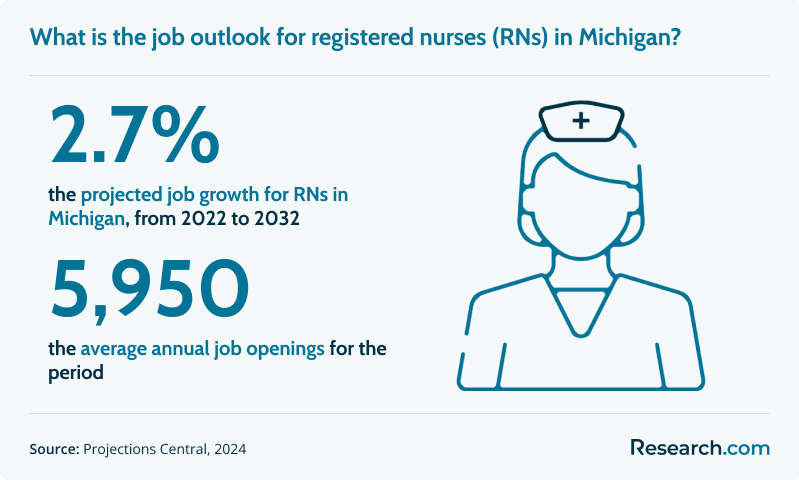
The employment outlook for registered nurses in Michigan is steady rather than explosive. The most recent data from Projections Central showed that employment of registered nurses is projected to grow by 2.7% from 2022 to 2032. Although this growth rate is slower than average, Michigan is still expected to have 5,950 average annual RN openings throughout the period.
Annual openings matter because jobs become available not only from growth but also from retirements, transfers, career changes, and turnover. For nursing students, this means the market can remain active even when the headline growth percentage is modest.
| Career Factor | What It Means in Michigan | How Students Should Respond |
| Projected growth | RN employment is projected to grow 2.7% from 2022 to 2032 | Do not rely only on growth rate; review annual openings and regional demand |
| Annual openings | Michigan expects 5,950 average annual RN openings | Build strong clinical experience and prepare early for NCLEX success |
| Salary | Average RN salary is $86,210 per year | Compare salary with tuition, loan debt, shift expectations, and local living costs |
| Shortage pressure | Michigan is projected to reach over 22,000 unfilled nursing positions by 2030 | Consider high-need settings such as long-term care, rural care, behavioral health, and primary care |
How can nurses diversify their healthcare career options in Michigan?
Nurses can broaden their options by combining clinical experience with skills in informatics, case management, quality improvement, education, public health, administration, or interdisciplinary care. Diversification is especially useful for nurses who want to reduce physical strain, move away from bedside schedules, or prepare for leadership.
One practical strategy is to learn how adjacent healthcare professions operate. For example, understanding how to become a pharmacist in Michigan can strengthen collaboration around medication safety, patient education, and care coordination. Nurses can also pursue targeted continuing education, join professional associations, volunteer for committees, or seek preceptor and charge nurse opportunities.
How can nurses advance their careers in Michigan?
Career advancement usually comes through a mix of education, certification, experience, and leadership responsibility. LPNs may bridge into RN or BSN programs, RNs may pursue specialty certification or graduate school, and experienced nurses may move into management, education, advanced practice, informatics, or quality roles.
For working LPNs, an online LPN to BSN pathway can be useful when the program is accredited, clinically approved, and designed for students who need scheduling flexibility. RNs aiming for advanced practice should evaluate prerequisites, clinical placement support, certification outcomes, and whether the program aligns with Michigan scope-of-practice rules.
What are the pathways to advanced practice nursing in Michigan?
Advanced practice nursing in Michigan requires more than RN experience. Nurses typically need graduate-level education, advanced clinical preparation, national certification, and state recognition for the specialty role. Common APRN paths include nurse practitioner, clinical nurse specialist, certified registered nurse anesthetist, and certified nurse midwife.
Students interested in primary care, family care, or specialty practice should review the nurse practitioner education requirements in Michigan before choosing a graduate program. Requirements can affect admissions planning, clinical hours, certification eligibility, and long-term practice authority.
What makes enrolling in an FNP program in Michigan a strategic career move?
A family nurse practitioner program can be a strong option for RNs who want to move into primary care, preventive care, chronic disease management, and patient assessment roles across the lifespan. FNP preparation can also support work in clinics, community health, telehealth, urgent care, and underserved areas.
The decision should be financial as well as professional. Tuition, clinical placement support, board certification preparation, and employer demand all affect value. Nurses comparing cost-conscious graduate options can start with affordable FNP programs and then verify accreditation, clinical requirements, and Michigan eligibility.
How can nurses expand their expertise through specialized certifications?
Specialized certifications help nurses document expertise beyond general licensure. They may support advancement in areas such as critical care, emergency nursing, oncology, pediatrics, geriatrics, wound care, case management, informatics, quality improvement, telehealth, and patient safety.
Certification is most valuable when it matches a clear career goal. A nurse seeking leadership in a hospital unit may benefit from a clinical specialty credential, while a nurse interested in revenue cycle, documentation, or administrative work may explore related training such as medical billing and coding in Michigan.
| Career Goal | Helpful Development Option | Why It Helps |
| Move into specialty bedside care | Clinical specialty certification | Shows focused competence in a patient population or care setting |
| Enter leadership | Charge nurse experience, BSN or MSN, management training | Builds supervision, staffing, and quality improvement skills |
| Shift toward non-bedside roles | Informatics, case management, quality, or coding-related training | Uses nursing knowledge in coordination, systems, and administrative work |
| Prepare for advanced practice | Graduate nursing degree and national certification | Meets education and credentialing expectations for APRN roles |
How can I become an LVN in Michigan?
Michigan generally uses the title Licensed Practical Nurse rather than Licensed Vocational Nurse. If you are searching for LVN information, the Michigan equivalent is usually the LPN pathway: complete an approved practical nursing program, pass the NCLEX-PN, and obtain Michigan licensure.
Students who want a step-by-step explanation of this practical nursing route can review how to become an LVN in Michigan, while keeping in mind that Michigan licensing terminology centers on LPN practice.
Do online nursing programs offer a competitive advantage in Michigan?
Online and hybrid nursing programs can be valuable for Michigan students who need flexibility, especially working adults, parents, and current LPNs or RNs returning to school. However, flexibility only helps if the program is properly accredited, approved for the intended license, and able to arrange valid clinical experiences.
Online coursework can work well for theory, leadership, research, informatics, and RN-to-BSN or graduate classes. Prelicensure nursing programs still require hands-on labs and supervised clinical practice. Students comparing remote options should review the best online nursing programs in Michigan and verify clinical placement policies before enrolling.
What are the continuing education and renewal requirements for maintaining a nursing license in Michigan?
Michigan nurses must keep their licenses active by following renewal rules established by the Michigan Board of Nursing. Renewal usually includes continuing education, compliance with required training topics, and timely submission of renewal materials.
Because renewal rules can change, nurses should not rely only on school advisors, employers, or old program handbooks. The safest approach is to check the current requirements for nursing licensure in Michigan before each renewal cycle.
- Track deadlines early. Missing renewal dates can interrupt employment eligibility.
- Keep documentation. Save continuing education certificates and training records in case of audit or employer review.
- Choose relevant CE topics. Courses in patient safety, ethics, pharmacology, specialty care, and technology can support both renewal and career growth.
- Monitor scope-of-practice updates. Changes in laws or regulations can affect what nurses may do in specific roles.
Which nursing programs in Michigan deliver a competitive advantage?
The strongest nursing program for you is not always the highest-ranked or most expensive one. A competitive program is accredited, approved for licensure, transparent about outcomes, strong in clinical placement, affordable relative to your goals, and aligned with the role you want.
Prospective students can use Research.com’s overview of the best nursing schools in Michigan as a starting point, but rankings should be combined with program-level research. Ask about NCLEX outcomes, clinical sites, faculty support, simulation labs, transfer credit, graduate placement, and total cost.
How can I specialize as a nurse midwife in Michigan?
To become a nurse midwife, an RN must complete graduate-level nurse-midwifery education, gain supervised clinical experience in women’s health and maternity care, and meet certification and state recognition requirements. Nurse midwives may work in prenatal care, labor and birth support, postpartum care, reproductive health, and family-centered care settings.
Because nurse-midwifery requirements are specialized, students should confirm that the graduate program prepares them for certification and Michigan practice. A detailed pathway is available in Research.com’s guide on how to become a nurse midwife in Michigan.
What opportunities are available for LPNs in Michigan?
LPNs in Michigan can work in long-term care, assisted living, rehabilitation, outpatient clinics, physician offices, home health, behavioral health, and some hospital-related settings. Their responsibilities vary by employer, but the role often includes practical bedside care, medication support within scope, documentation, patient observation, and communication with RNs and providers.
LPN practice can be a destination career or a first step toward RN licensure. Students who want a practical nursing entry route can compare online LPN programs in Michigan, but they should confirm that any online or hybrid option includes approved in-person clinical training.
What credentials are necessary to maintain licensure as a nurse in Michigan?
Initial licensure is only the first credentialing milestone. Michigan nurses must maintain their license through renewal, continuing education, and ongoing compliance with professional standards.
- Active nursing license: Nurses must hold the correct Michigan license for the role they perform.
- Continuing education records: CE documentation should be retained in case the state or employer requests proof.
- Required training: State-mandated topics, such as human trafficking training, must be completed when applicable.
- Professional conduct: Nurses must follow legal, ethical, and scope-of-practice standards to protect their license.
- Timely renewal: Allow enough time before expiration to complete requirements and correct any application issues.
How to choose the right nursing program in Michigan
Choosing a nursing program is one of the most important decisions in the licensure process. The wrong program can increase debt, delay graduation, limit clinical exposure, or create problems with licensure eligibility. Use the factors below to compare options carefully.
- Confirm approval and accreditation. Verify that the program is accepted for Michigan licensure and check whether it holds recognized nursing accreditation such as CCNE or ACEN.
- Match the degree to your goal. Choose an LPN program for practical nursing, an ADN or BSN for RN licensure, and a graduate program for advanced practice.
- Review NCLEX preparation. Ask for recent NCLEX-RN or NCLEX-PN pass rates and how the school supports students who are at risk academically.
- Evaluate clinical placements. Strong clinical partnerships can expose students to hospitals, long-term care, community health, specialty units, and diverse patient populations.
- Calculate total cost, not just tuition. Include fees, uniforms, books, equipment, exam costs, commuting, parking, childcare, lost work time, and loan interest.
- Check schedule flexibility. Working students should ask about evening, weekend, part-time, hybrid, or online formats, but should also confirm clinical scheduling expectations.
- Ask about transfer and bridge options. If you may continue from LPN to RN, ADN to BSN, or BSN to graduate study, transfer policies can affect time and cost.
- Look at support services. Tutoring, simulation labs, advising, mental health support, disability accommodations, and career services can affect completion.
- Compare advanced practice fit. RNs planning graduate education can research the best NP programs in Michigan and confirm specialty alignment before applying.
Common mistakes to avoid when becoming a nurse in Michigan
| Mistake | Why It Can Hurt You | Better Approach |
| Choosing a school without checking approval | You may graduate from a program that does not meet licensure requirements | Confirm state approval and accreditation before applying |
| Focusing only on tuition | Fees, supplies, clinical travel, and lost wages can change the real cost | Build a complete cost estimate before borrowing |
| Assuming online means fully remote | Prelicensure nursing requires in-person clinical and lab work | Ask exactly where and when clinicals occur |
| Ignoring NCLEX outcomes | Weak exam preparation can delay licensure | Review pass rates, remediation support, and exam preparation resources |
| Assuming Michigan is a compact state | A multistate license from another state does not authorize Michigan practice | Apply for Michigan licensure if you plan to work with Michigan patients |
| Counting on a guaranteed salary | Pay varies by region, employer, experience, specialty, and shift | Compare salary data with local job postings and employer benefits |
Questions to ask before enrolling in a Michigan nursing program
- Is the program approved for the Michigan license I want?
- Is the program accredited, and by which organization?
- What are the most recent NCLEX pass rates?
- Where are clinical placements located, and are students responsible for finding them?
- What is the total estimated cost from admission to licensure?
- How many students complete the program on time?
- Does the school offer tutoring, simulation labs, and NCLEX support?
- Can credits transfer into a BSN, MSN, or bridge program later?
- Does the program meet requirements if I plan to work outside Michigan?
- What career services are available after graduation?
Related Articles for Nearby States
- 2027 How to Become a Nurse in Ohio
- 2027 How to Become a Nurse in Indiana
- 2027 How to Become a Nurse in Wisconsin
- 2027 How to Become a Nurse in Illinois
- 2027 How to Become a Nurse in Minnesota
- 2027 How to Become a Nurse in Pennsylvania
- 2027 How to Become a Nurse in Kentucky
- 2027 How to Become a Nurse in West Virginia
- 2027 How to Become a Nurse in Iowa
- 2027 How to Become a Nurse in Missouri
References:
- nursejournal.org (10 May 2023). Michigan Nursing Schools and Programs. nursejournal.org
- michigan.gov (n.d.). Nursing. michigan.gov nursing licensure information
- Michigan Board of Nursing information; healthleadersmedia.com (06 Sep 2023). Michigan Legislator Tries Again for State to Join the Nurse Licensure Compact. healthleadersmedia.com
- Tacy, J., McElwain, S., & Fletcher, A. (2023). Strategies for success that led to 99.98% school of nursing retention. Journal of Nursing Education and Practice. https://doi.org/10.5430/jnep.v13n5p52
Key Insights
- Michigan requires licensure before nursing practice. You cannot legally work as an LPN, RN, or APRN in Michigan without meeting the state’s education, exam, application, background check, and renewal requirements.
- The right pathway depends on your career goal. An LPN program offers a shorter entry route, an ADN can lead to RN licensure in less time than a BSN, and a BSN or graduate degree may improve long-term advancement options.
- Michigan is not a Nurse Licensure Compact state. Compact nurses from other states must obtain Michigan licensure before practicing with Michigan patients.
- RN demand is steady even with modest growth. Registered nurse jobs are projected to grow by 2.7% from 2022 to 2032, with 5,950 average annual openings in Michigan.
- Program quality affects licensure and ROI. Before enrolling, verify approval, accreditation, NCLEX outcomes, clinical placement support, total cost, and transfer options.
- Specialization can improve career flexibility. Nurses who build skills in geriatrics, behavioral health, telehealth, informatics, leadership, or advanced practice may be better positioned for Michigan’s changing healthcare needs.
Other Things You Need to Know About Nursing in Michigan
Michigan nursing applicants must complete a fingerprint-based criminal background check through the Michigan State Police and the FBI before a license is issued. The Michigan Board of Nursing reviews the results as part of the licensure decision, and certain convictions can delay or block approval.
Foreign-trained nurses must have their credentials evaluated by the Commission on Graduates of Foreign Nursing Schools (CGFNS) and pass the NCLEX-RN exam. They also need a valid Michigan RN license to practice, which can be obtained after meeting these requirements.


![2027 Best Advanced Standing Online MSW Programs [CSWE Accredited] thumbnail](/uploads/Online_Advanced_Standing_MSW_301dbd5368.jpg)


