
2027 Average Radiology Tech Salary by State

Co-Founder and Chief Data Scientist
Radiology tech salary varies far more by location than many students expect. The same radiologic technology credential can lead to very different earnings, job availability, schedules, licensing steps, and living costs depending on whether you work in California, Mississippi, Puerto Rico, Alaska, or a major metro area such as San Francisco.
This guide helps you compare radiology tech salary by state, territory, city, employment concentration, and career direction. It is written for students choosing radiologic technology programs, new graduates deciding where to apply, and experienced radiologic technologists weighing relocation, specialization, or additional education. There are over 91,152 diagnostic radiologic technologists and 117,710 staff radiologic technologists currently employed in the U.S., but opportunity is not distributed evenly across the country.
The Bureau of Labor Statistics projects about 15,700 openings for radiologic and MRI technologists each year, on average, over the decade. Many of those openings are expected to come from retirements and workers transferring into other occupations. That makes radiologic technology a dependable healthcare path for many learners, but the best location depends on more than the largest posted salary.
Quick Answer: Radiology Tech Salary and Best Locations
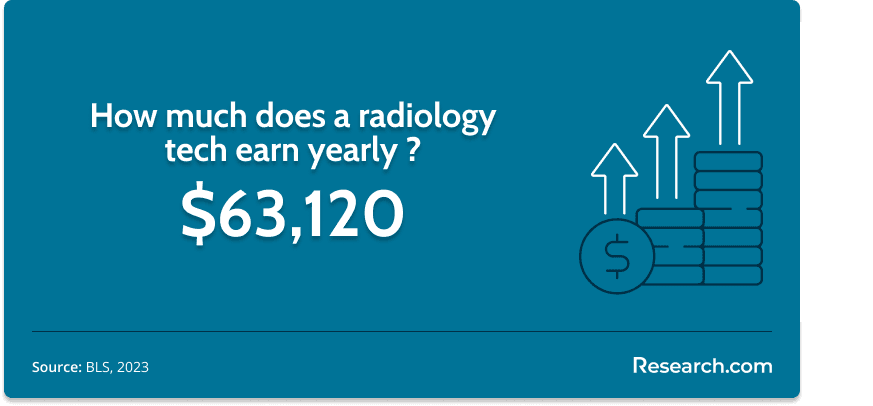
Radiologic technologists earn a median annual wage of $63,120, based on Bureau of Labor Statistics data. California has the highest average radiology tech salary at $103,150, while Puerto Rico has the lowest average salary at $31,490. Among metro areas, San Francisco-Oakland-Hayward, CA ranks highest at $131,140 per year.
| Question | Direct Answer | How to Interpret It |
| What is the national salary benchmark? | $63,120 median annual wage | Use this as a baseline when comparing local offers, not as a guaranteed income. |
| Which state pays radiology techs the most? | California at $103,150 | The salary is high, but housing, taxes, licensing, and competition must be considered. |
| Which territory reports the lowest pay? | Puerto Rico at $31,490 | Lower pay should be weighed against local expenses, openings, and career mobility. |
| Which metro area pays the most? | San Francisco-Oakland-Hayward, CA at $131,140 | City-level pay can exceed state averages, especially in expensive healthcare markets. |
| How many openings are expected? | About 15,700 each year, on average, over the decade | Openings reflect replacement needs, healthcare demand, and workers changing roles. |
What to Know Before Comparing Radiology Tech Salaries
- The national median annual wage for radiologic technologists is $63,120, according to Bureau of Labor Statistics data.
- California is the top-paying state for radiology techs, with an average salary of $103,150.
- Hawaii ($92,170) and Alaska ($87,180) show that smaller, geographically isolated markets can offer competitive wages.
- Puerto Rico has the lowest reported average salary at $31,490.
- San Francisco-Oakland-Hayward, CA is the highest-paying metro area for radiology techs, with an annual average of $131,140.
Article Roadmap
- Average radiology tech salary in the United States
- State and territory salary comparison for 2027
- Main factors that affect radiology tech pay
- Highest-paying states for radiology techs
- Lowest-paying states and territories for radiology techs
- Best-paying cities for radiology techs
- Lowest-paying cities for radiology techs
- States with the strongest concentration of radiology tech jobs
- States with the lowest concentration of radiology tech jobs
- Ways radiology techs can expand their career options
- Alternative career directions for radiology techs
- Challenges facing radiology techs today
- How a dual degree may support career growth
- Financial aid options for additional radiology tech education
- How interdisciplinary graduate study can broaden career options
- Trends shaping radiology tech careers
- How radiology tech salaries compare with other medical careers
- Practical steps to start a radiology tech career
- Professional development options for experienced radiology techs
What is the average salary for a radiology tech in the United States?
The Bureau of Labor Statistics lists the median annual wage for radiologic technologists at $63,120. This is the most useful national reference point because it comes from a federal labor source and allows students and workers to compare local salaries against a broad occupational benchmark.
Other compensation sources show similar figures. ZipRecruiter reports an average salary of $63,710 per year, while Salary.com lists an average of $64,238 per year. Because these estimates are close, they suggest a relatively consistent national salary picture across major salary datasets.
However, salary estimates are not job guarantees. Salary platforms may use employer postings, compensation surveys, public labor data, or internal models, and they may update at different times. Use them to understand the market, then verify pay directly through job postings, employers, recruiters, and local professional networks.
Radiologic technology is also worth comparing with other diagnostic imaging fields. Medical sonographers earn a median salary of $84,470 as of May 2023, which is higher than the radiology tech benchmark above. If you are still choosing an imaging pathway, compare radiologic technology programs with accelerated online sonography degree options before committing to one route.
| Source or Occupation | Reported Salary Figure | Best Use for Career Planning |
| Bureau of Labor Statistics | $63,120 median annual wage | Use as the main national benchmark for labor-market comparison. |
| ZipRecruiter | $63,710 average salary per year | Useful for reviewing salary patterns connected to job postings and market listings. |
| Salary.com | $64,238 average salary per year | Helpful for comparing compensation estimates from another salary model. |
| Medical sonographers | $84,470 median salary as of May 2023 | Useful if you are deciding between radiography and other imaging specialties. |
Complete List of Average Radiology Tech Salary by State and Territories for 2027
Radiology tech salary changes substantially from one state or territory to another. Local wages are shaped by healthcare demand, employer budgets, workforce supply, patient volume, cost of living, reimbursement conditions, and the difficulty of recruiting qualified technologists.
Use state salary averages as an initial filter, not as the final answer. A high-paying state can become less attractive once you factor in rent, transportation, taxes, exam fees, licensing costs, and job competition. A lower-paying state may still be financially reasonable if the cost of living is lower and steady openings are available.
- West Coast markets lead on salary: California has the highest average radiology tech salary at $103,150. Oregon and Washington also appear among stronger-paying states, reflecting the influence of large healthcare systems, higher living costs, and competitive labor markets. For students comparing healthcare majors, radiologic technology may be one of the practical college majors to evaluate.
- The Northeast remains a strong-paying region: Massachusetts, Connecticut, and New York report salaries from $85,330 to $93,270. Dense hospital networks, academic medical centers, and competitive hiring conditions can support higher compensation.
- Remote and island markets can pay well: Hawaii ($92,170) and Alaska ($87,180) demonstrate that a smaller population does not automatically mean low wages. Recruitment challenges and geographic constraints can raise pay.
- Many Southern and Midwestern states pay below the highest coastal markets: Mississippi ($53,660) and Arkansas ($59,470) show how lower living costs, smaller markets, and rural service areas may correspond with lower wages.
- Puerto Rico is the lowest reported location in the dataset: Puerto Rico reports an average salary of $31,490, reflecting a labor and healthcare market that differs substantially from most states.
| Salary Pattern | Examples in the Data | How to Use This Information |
| Highest-paying state markets | California, Massachusetts, Hawaii, Oregon, Washington | Compare gross salary with housing, transportation, licensing, and taxes. |
| Competitive Northeast salaries | Massachusetts, Connecticut, New York | Review hospital systems, union environments, and urban versus suburban openings. |
| Strong pay in remote markets | Hawaii, Alaska | Ask about relocation support, retention incentives, scheduling, and travel costs. |
| Lower-paying regional markets | Mississippi, Arkansas | Evaluate whether lower living expenses make the net salary more workable. |
| Lowest territory figure | Puerto Rico | Research local wages, career mobility, and employer options before making a decision. |
What factors influence the average salary of radiology techs by state?
Radiology tech pay is influenced by several overlapping factors. State averages reflect local economics, hospital capacity, patient demographics, employer competition, licensure rules, specialty demand, and the number of qualified technologists available in the area.
Regional labor-market conditions
The strongest salaries tend to appear on the West Coast, in parts of the Northeast, and in Hawaii. California leads the state rankings, Massachusetts benefits from a concentrated healthcare economy, and Hawaii often has to compete for a smaller labor pool.
Lower average pay is more common in some Southern and Midwestern markets. Arkansas, Mississippi, Nebraska, and South Dakota show how rural service areas, smaller healthcare systems, and lower regional costs can limit wage growth compared with coastal markets.
Healthcare demand and population needs
States with population growth, older residents, rural access challenges, or a high volume of diagnostic procedures may need more imaging professionals. Radiologic technology can be one of the shorter degree pathways that may lead to solid pay, but local demand still depends on the healthcare infrastructure where you plan to work.
Cost of living and net income
A large salary in California or Massachusetts may not stretch as far once rent, commuting, insurance, food, taxes, and childcare are included. Conversely, a lower salary in a more affordable region may leave more room in the monthly budget. Always compare estimated take-home pay, not just the annual wage.
Healthcare funding and reimbursement
Hospital budgets, insurance coverage, reimbursement rules, and public healthcare funding can affect staffing levels and pay. Facilities with tighter margins may have less flexibility to raise wages, even when they need imaging staff.
Demographic trends
An aging population generally increases the need for diagnostic imaging. Regions with older patient populations may need more radiologic technologists, especially in hospitals, outpatient imaging centers, emergency departments, and specialty clinics.
Credentials, modality training, and experience
Entry-level X-ray roles may pay differently from jobs that require MRI, CT, mammography, interventional radiology, or nuclear medicine experience. Technologists who can work across multiple imaging modalities may be more competitive in markets where employers need flexible staffing.
| Salary Factor | Effect on Pay | Question to Ask Before Moving |
| Cost of living | Higher wages may be offset by higher housing, transportation, and tax costs. | What would my realistic monthly budget look like near the employers hiring? |
| Employer setting | Hospitals, outpatient centers, urgent care clinics, and specialty practices may pay differently. | Where are most jobs located, and which settings offer the best benefits? |
| Specialty training | Advanced modalities can improve job competitiveness and career options. | Does the employer offer training in CT, MRI, mammography, or other modalities? |
| Licensure requirements | State rules can affect start dates, eligibility, fees, and paperwork. | What must I complete before I can legally work in this state? |
| Workforce supply | A crowded applicant pool can make even high-paying markets difficult to enter. | Are job postings aimed at new graduates, experienced techs, or specialists? |
Which states have the highest average salary for radiology techs?
The highest-paying states can offer salaries far above the national median, but they are not automatically the best financial choice. Before relocating, compare wages with rent, commuting time, state licensing requirements, clinical experience expectations, and the number of open positions that match your background.
According to BLS data, the top-paying states include:
- California: $103,150 per year. California offers major hospital systems and large medical centers, particularly in areas such as Los Angeles and San Francisco. The main trade-offs are high living costs and competition in popular metro areas.
- Massachusetts: $93,270 per year. Massachusetts has a strong healthcare sector, especially around Boston, and may provide strong long-term options for experienced technologists. Housing and daily expenses can be high.
- Hawaii: $92,170 per year. Hawaii combines high wages with a unique lifestyle, but relocation costs, limited openings, and the high price of housing and goods require careful planning.
- Oregon: $90,610 per year. Oregon offers strong pay and healthcare opportunities in markets such as Portland, with a cost profile that differs from California.
- Washington: $89,910 per year. Washington has significant healthcare employers and opportunities around Seattle, though urban living costs can reduce the value of the higher wage.
Which states and territories have the lowest average salary for radiology techs?
Lower-paying locations are not always poor choices. A lower salary may still support a reasonable lifestyle if housing is affordable, family support is nearby, commute times are manageable, and local employers provide stable benefits. The key is to compare net affordability and advancement potential.
Based on BLS data, the lowest-paying locations include:
- Puerto Rico: $31,490 per year. This lower wage reflects broader economic and healthcare labor-market differences.
- Mississippi: $53,660 per year. Pay is lower than in many states, but living costs may also be lower than in coastal markets.
- Alabama: $56,670 per year. Rural service areas, employer mix, and local demand for specialized imaging can influence wages.
- Arkansas: $59,470 per year. A smaller number of large medical centers may reduce salary competition among employers.
- Oklahoma: $65,810 per year. Pay reflects a mix of rural settings, smaller facilities, and local labor-market conditions.
| High-Pay State Strategy | Lower-Pay State Strategy |
| Look for higher nominal wages, large hospital systems, and specialty departments. | Look for affordability, shorter commutes, and stable local employer relationships. |
| Expect stronger competition in desirable metro areas. | Expect fewer large employers and potentially fewer advanced-modality roles. |
| Budget carefully for housing, taxes, transportation, licensure, and relocation. | Review advancement options, cross-training access, and long-term wage growth. |
| Best for applicants who can manage relocation costs and compete for urban roles. | Best for applicants who value community ties, lower expenses, or rural healthcare work. |
What are the top-paying cities for radiology techs?
Metro salary data is often more useful than state averages because most job searches happen in specific labor markets. California dominates the highest-paying city and regional list, but those wages should be compared with rent, commute time, licensing timelines, and the level of experience employers expect.
- San Francisco-Oakland-Hayward, CA: $131,140 per year. This is the highest-paying metro listed, supported by major medical employers, high living costs, and strong demand for skilled healthcare workers.
- San Jose-Sunnyvale-Santa Clara, CA: $129,360 per year. This Silicon Valley market has high labor costs and a competitive healthcare environment. It may also interest professionals who are drawn to health technology or who are considering a 1 year computer science degree online program.
- Santa Rosa, CA: $124,660 per year. Santa Rosa offers high pay within Northern California’s healthcare network.
- Stockton-Lodi, CA: $116,910 per year. This area provides strong wages with a different cost profile than many coastal California metros.
- Sacramento-Roseville-Arden-Arcade, CA: $115,640 per year. The state capital region includes a broad healthcare sector and multiple employment settings.
- Modesto, CA: $115,140 per year. Modesto offers high healthcare wages while generally differing from the expense profile of larger Bay Area markets.
- North Valley-Northern Mountains Region of California nonmetropolitan area: $105,480 per year. High pay in this nonmetropolitan area may reflect recruitment needs outside dense urban centers.
- Merced, CA: $105,380 per year. Merced combines a growing healthcare presence with a different affordability profile than many coastal cities.
- Santa Maria-Santa Barbara, CA: $103,510 per year. This area pairs high pay with a desirable coastal setting, which can also mean elevated living costs.
- Eastern Sierra-Mother Lode Region of California nonmetropolitan area: $103,450 per year. This region may appeal to technologists who want strong pay outside a major metropolitan environment.
What are the lowest paying cities for radiology techs?
The lowest-paying cities in the data are concentrated in Puerto Rico, with additional lower-paying areas in Mississippi and Alabama. These markets may still be suitable for workers with local ties or lower living expenses, but salary growth, employer stability, and specialty training access should be reviewed carefully.
If your local radiology tech salary does not support your goals, an additional healthcare-adjacent or business credential may provide flexibility. For example, a bookkeeping certification could support side work or a transition toward administrative roles outside direct imaging.
- Arecibo, PR: $28,120 per year. Smaller healthcare markets and limited openings can hold wages down.
- San German, PR: $27,390 per year. Compensation reflects local economic conditions, even if the area offers a different pace of life.
- Ponce, PR: $27,160 per year. Although Ponce is one of Puerto Rico’s larger cities, wages remain affected by broader economic pressures.
- Aguadilla-Isabela, PR: $27,100 per year. Fewer healthcare facilities can reduce competition for radiology tech labor.
- Mayaguez, PR: $27,090 per year. A smaller healthcare employment base contributes to lower average pay.
Outside Puerto Rico, several low-paying areas appear in Mississippi and Alabama.
- Hattiesburg, MS: $50,550 per year. Lower living costs may help offset wages, but long-term pay growth should be examined.
- Auburn-Opelika, AL: $50,440 per year. The area has a university-centered community, while healthcare pay remains comparatively modest.
- Southwest Mississippi nonmetropolitan area: $50,110 per year. Rural healthcare access needs may be significant, but fewer facilities can limit wages.
- Southeast Mississippi nonmetropolitan area: $49,310 per year. A smaller employer base and lower demand can affect compensation.
- Gadsden, AL: $49,050 per year. A smaller healthcare market contributes to a lower average salary.
Which states have the highest demand for radiology techs?
High demand and high salary are not the same thing. Some states have many radiology tech jobs relative to total employment but do not rank among the highest-paying markets. This can happen when imaging needs are high, but wages are limited by regional economics, reimbursement levels, or healthcare budgets.
Based on BLS employment per 1,000 jobs, the highest-concentration states include:
- West Virginia: 2.339. An older population and higher chronic disease burden can increase demand for diagnostic imaging.
- Mississippi: 2.336. Rural healthcare needs and access gaps help support demand for radiology techs.
- South Dakota: 2.096. Dispersed communities and a limited healthcare workforce can make available technologists especially important.
- Oklahoma: 1.983. Imaging professionals are needed across a range of urban and rural communities.
- Kentucky: 1.818. Demand is tied to healthcare needs in both cities and underserved areas.
- Maine: 1.813. An older population supports continued imaging demand.
- Iowa: 1.808. Rural communities require imaging access across a broad geographic area. Iowa is the only state on this list that belongs to the first half of states by radiology tech salary.
- Ohio: 1.798. A large healthcare system and broad patient base contribute to employment demand.
- Idaho: 1.766. Population growth and healthcare access needs support demand for radiologic technologists.
- North Dakota: 1.760. Geographic spread and healthcare access challenges increase the value of imaging professionals.
| Demand Indicator | What It Suggests | How to Use It |
| High employment per 1,000 jobs | Radiology techs make up a relatively strong share of the local workforce. | Look for stable employers, benefits, cross-training options, and advancement paths. |
| High salary with lower job concentration | Pay may be elevated because of competition, cost of living, or specialty shortages. | Do not assume there will be many entry-level openings just because pay is high. |
| Rural demand | Facilities may need technologists who can cover varied imaging responsibilities. | Ask whether the employer supports CT, MRI, mammography, or other cross-training. |
Which states have the lowest demand for radiology techs?
Some high-paying locations have relatively low employment concentration. California, Washington, Nevada, the District of Columbia, and Alaska show that strong wages do not always translate into easy hiring. In these markets, employers may prefer experienced technologists, specialty credentials, or applicants who can work less desirable shifts.
Based on employment per 1,000 jobs, the lowest-concentration locations include:
- Utah: 0.960. A younger population may reduce the relative need for imaging services compared with states that have older populations.
- Alaska: 1.029. A small, remote population limits the number of roles, even though employers may offer higher pay to recruit workers.
- Washington: 1.046. Employment concentration is comparatively low by this measure, and desirable markets may attract strong applicant pools.
- Nevada: 1.067. Population growth does not always produce a high concentration of radiology tech jobs if healthcare infrastructure is limited.
- District of Columbia: 1.096. A small geographic labor market and limited number of facilities affect job concentration.
- California: 1.096. Despite its large population and high salaries, California can be competitive because many technologists are drawn to the state.
If you are having trouble finding radiology tech roles in a competitive or low-concentration market, consider whether your healthcare experience could support a broader clinical or administrative path. Some professionals compare online clinical MSW programs, online NP programs, or a fast track healthcare administration degree when they want to expand beyond imaging.
Medical billing and coding is another healthcare-related option for workers interested in administrative or remote-friendly roles. Reported medical billing and coding salary ranges from $40,912 to $84,877, and some learners start by reviewing free billing and coding training before paying for a formal program.
How can radiology techs diversify their career paths for greater opportunities?
Radiology techs can improve career flexibility by adding skills beyond basic X-ray imaging. Diversification can be useful when local competition is high, when a technologist wants stronger pay potential, or when shift work and physical demands make a different direction more appealing.
Advanced imaging modalities
- Pursue training in MRI, CT scanning, mammography, interventional radiology, or nuclear medicine when those skills match employer demand in your region.
- Use specialty experience to qualify for roles that involve more advanced equipment, protocols, and technical decision-making.
Healthcare administration and operations
- Move into imaging department coordination, quality assurance, scheduling, compliance, workflow improvement, or supervisory roles.
- Consider healthcare administration education if your goal is management rather than direct patient imaging.
Teaching and clinical training
- Use experience to become a clinical preceptor, lab instructor, program trainer, or continuing education contributor.
- Help students build competence in patient positioning, radiation safety, equipment use, imaging protocols, and professional communication.
Administrative and business roles
- Transition into medical billing and coding, where imaging knowledge can support documentation, claims, and revenue cycle work. A medical billing and coding salary ranging from $40,000 to $84,000 may interest technologists who want more administrative flexibility.
- Explore medical device sales, imaging equipment education, or technical consulting if you enjoy technology, training, and communication.
Entrepreneurial and consulting options
- Advise clinics on imaging workflow, patient throughput, equipment use, or quality processes if you have substantial experience.
- Consider mobile imaging services for rural or underserved areas only after reviewing licensing, reimbursement, equipment costs, liability, and regulatory requirements.
| Expansion Option | Best Fit | Important Limitation |
| MRI, CT, or mammography specialization | Technologists who want to remain clinical while improving marketability. | Training, certification, and employer requirements can vary by state and facility. |
| Healthcare administration | Technologists interested in operations, leadership, compliance, or management. | Some roles may require a degree or prior supervisory experience. |
| Education and training | Experienced technologists who enjoy mentoring students and new staff. | Academic teaching roles may require additional credentials. |
| Medical billing and coding | Technologists seeking administrative, documentation, or remote-friendly work. | Pay and flexibility depend heavily on employer, certification, and experience. |
| Medical equipment sales or consulting | Technologists with strong product knowledge and communication skills. | Compensation may depend on sales results, travel, or client demand. |
What alternative career paths can radiology techs pursue?
Radiology techs develop transferable skills in anatomy, imaging workflow, patient care, radiation safety, documentation, equipment handling, and healthcare teamwork. Those skills can support moves into imaging informatics, department operations, healthcare administration, medical sales, education, compliance, or revenue cycle work.
If you want a nonclinical path that still draws on healthcare knowledge, compare short credential options such as affordable medical billing and coding programs. These programs may fit technologists who want to move toward coding, claims, documentation review, or administrative support.
What challenges do radiology techs face in the evolving healthcare landscape?
Radiology techs work in a field shaped by changing technology, patient expectations, safety standards, and documentation requirements. New imaging systems and digital workflows can improve care, but they also require ongoing learning while technologists manage busy clinical schedules.
- Technology changes: Technologists must learn new imaging systems, software tools, and workflow platforms.
- Patient volume and time pressure: Facilities often need efficient imaging without compromising patient safety or image quality.
- Radiation safety and compliance: Techs must follow strict exposure controls, protocols, and documentation rules.
- Physical demands: The job can involve standing, moving equipment, and helping position patients with limited mobility.
- Competitive hiring markets: High-paying regions can attract many applicants, making specialization and experience more valuable.
For broader context, compare radiology tech roles with other science and healthcare careers, including data on biology-related salaries.
Can a Dual Degree Enhance a Radiology Tech's Career?
A dual degree may help when it is connected to a specific career plan. Pairing radiologic technology experience with public health, healthcare administration, informatics, education, or business can support moves into leadership, policy, quality improvement, training, or population health roles.
The second degree should be chosen for fit, not prestige. Before enrolling, compare the degree with the job titles you want, employer requirements, licensure implications, cost, and expected return. If your interests include prevention, community health, or population-level healthcare, review affordable public health degrees online alongside your clinical background.
What financial assistance options can support further education and career growth in radiology technology?
Radiology techs considering additional education should look beyond tuition. Total cost can include fees, books, clinical placement expenses, commuting, lost work hours, exam costs, background checks, and whether the credits will transfer into a future degree.
- Ask your employer whether tuition reimbursement, paid modality training, or professional development funds are available for CT, MRI, mammography, leadership, or compliance education.
- Compare scholarships, grants, and federal student aid before relying on private loans.
- Confirm that an online or hybrid program is properly accredited and accepted by employers in your state.
- Review transfer policies if you may later complete a bachelor’s or graduate degree.
- If your goal is management, compare curriculum and total cost for an affordable healthcare administration degree online.
How can advanced interdisciplinary degrees expand a radiology tech's career?
Interdisciplinary degrees can broaden a radiology tech’s career options, but only when they match the next role. Healthcare administration, public health, informatics, business, education, and clinical degrees may support different kinds of advancement.
Some technologists consider a major career change into another licensed clinical profession. For example, online PharmD programs represent a very different clinical pathway and require careful review of prerequisites, admissions, licensure, cost, and long-term career fit.
What are the emerging trends in radiology tech careers?
Radiologic technology is changing as imaging systems become more digital, AI-supported tools enter workflows, and remote interpretation becomes more common. These changes do not remove the need for skilled technologists. They make accuracy, patient care, image quality, protocol knowledge, and adaptability even more important.
- Teleradiology and remote interpretation: Images may be read off-site, making proper positioning, protocols, image quality, and digital transmission essential.
- Artificial intelligence tools: AI may support image review and workflow prioritization, but technologists remain central to patient interaction, safety, positioning, and image capture.
- Mobile imaging: Portable imaging services can support rural communities, long-term care facilities, emergency response, and patients who cannot easily travel.
- Specialized imaging techniques: Technologies such as 3D mammography and molecular imaging may create opportunities for technologists who complete additional training.
- Flexible education formats: More learners compare hybrid and online radiology tech programs while balancing coursework, work schedules, and required clinical training.
The practical lesson is that radiology techs who keep learning new modalities, systems, and workflow tools are likely to have more flexibility than those who rely only on entry-level training.
What are the factors that influence radiology tech salaries compared to other medical careers?
Radiology tech salaries differ from other healthcare roles because of education length, certification requirements, licensing rules, patient volume, work setting, regional demand, shift expectations, and the value of specialty skills. An entry-level technologist in a small clinic may have a very different pay path than a technologist with advanced modality experience in a high-cost metro.
When comparing radiologic technology with other medical careers, do not focus only on headline salary. Also evaluate the time needed to qualify, clinical training requirements, exam costs, licensing steps, physical workload, schedule expectations, liability, advancement options, and lifestyle fit. For a broader comparison, review highest paying medical jobs and weigh pay against training time and responsibility.
How can you start a radiology tech career with accessible pathways and tips?
The typical path is to complete an accredited radiologic technology program, finish supervised clinical training, pass the required certification exam, and meet state licensure requirements. Because state and employer rules vary, planning early can prevent costly delays.
- Choose an accredited program: Many students begin with an Associate’s Degree in Radiologic Technology, which is commonly structured as a 2-year entry-level route. A Bachelor’s Degree in Radiologic Sciences may be useful for advanced, leadership, or educational goals. If admissions access is a concern, compare the easiest radiology programs to get into while still checking accreditation, outcomes, and clinical quality.
- Complete clinical training: Clinical rotations teach patient positioning, radiation safety, equipment operation, imaging protocols, and patient communication.
- Prepare for certification and licensure: Many employers expect ARRT certification, and states may require additional licensure. Verify rules in the state where you plan to work.
- Develop job-ready skills early: Communication, empathy, attention to detail, anatomy knowledge, comfort with technology, and professionalism all matter in daily practice.
- Specialize after building a foundation: MRI, CT, mammography, and other modalities can expand opportunities once you have clinical experience.
- Use professional networks: Organizations such as the American Society of Radiologic Technologists can help with continuing education, professional updates, and career development.
| Career Step | What to Do | Mistake to Avoid |
| Program research | Confirm accreditation, clinical sites, outcomes, certification eligibility, and state alignment. | Choosing a program only because it is cheap, nearby, or convenient. |
| Admissions preparation | Review prerequisites, GPA expectations, background checks, immunizations, and health requirements. | Applying without understanding clinical placement requirements. |
| Clinical rotations | Use clinical placements to build references, confidence, and employer contacts. | Treating clinical training as just a graduation requirement. |
| Certification and licensure | Check ARRT steps and state-specific rules before finishing school. | Assuming one state’s requirements apply everywhere. |
| First job search | Compare salary, shift, benefits, commute, training support, and advancement options. | Accepting the highest hourly rate without evaluating the full offer. |
What advanced professional development opportunities can boost a radiology tech's career?
Experienced radiology techs can strengthen their careers through modality certification, cross-training, leadership education, teaching preparation, and continuing education. The best option depends on whether you want to stay clinical, supervise teams, teach, or move into a related healthcare role.
- Advanced modalities: CT, MRI, mammography, vascular imaging, and interventional radiology can broaden clinical opportunities.
- Ultrasound training: Some technologists explore sonography through an online ultrasound tech school or hybrid program, depending on clinical placement requirements.
- Leadership development: Training in healthcare operations, quality improvement, compliance, scheduling, and supervision can support department-level advancement.
- Teaching preparation: Experienced technologists may move into clinical instruction, lab teaching, or academic support roles.
- Technology skills: Familiarity with imaging software, digital workflows, AI-assisted tools, and healthcare data systems can improve adaptability.
Common Mistakes to Avoid When Evaluating Radiology Tech Salary
- Comparing only annual salary: A high wage can be misleading if rent, taxes, commuting, insurance, and licensing costs are also high.
- Ignoring job concentration: Some states pay well but have fewer radiology tech roles per 1,000 jobs.
- Assuming online programs automatically meet requirements: Radiologic technology requires hands-on clinical training, and state eligibility must be verified.
- Skipping accreditation research: Accreditation can affect certification eligibility, employer acceptance, transfer credit, and future education options.
- Overlooking modality training: An employer that supports CT, MRI, mammography, or other cross-training may offer better long-term value than a slightly higher starting wage.
- Treating averages as promises: Published salary figures do not account for your experience, employer type, shift, credentials, benefits, or local competition.
Questions to Ask Before Choosing a State, City, or Program
- What is the average radiology tech salary in the specific state and metro where I want to work?
- How does that wage compare with local rent, transportation, taxes, insurance, and other living costs?
- Are employers hiring entry-level technologists, or do most postings require experience or advanced modalities?
- Does the state require a separate license beyond national certification?
- Will the program make me eligible for ARRT certification and state licensure?
- Where are the clinical sites, and how far would I need to travel for rotations?
- Do local employers offer cross-training in CT, MRI, mammography, or other modalities?
- What benefits, shift differentials, overtime policies, and tuition reimbursement options are available?
- Can I afford relocation after accounting for moving expenses, licensing timelines, and the cost of living?
Key Insights
- Radiologic technologists earn a median annual wage of $63,120, but state and metro salary differences can significantly affect career planning.
- California has the highest average state salary at $103,150, while San Francisco-Oakland-Hayward, CA leads metro areas at $131,140 per year.
- Puerto Rico reports the lowest average salary at $31,490, and several of the lowest-paying cities are also located there.
- High pay does not always mean abundant openings. Some high-paying states have lower employment concentration and stronger applicant competition.
- Cost of living, licensure, employer setting, shift structure, specialty training, and experience should be reviewed before relocating.
- Radiology techs can improve flexibility by adding MRI, CT, mammography, interventional radiology, or other modality skills.
- Before enrolling in a radiology tech program, verify accreditation, clinical placement quality, certification eligibility, and state licensing requirements.
References:
- 10 Best States for Diagnostic Radiologic Technologists in 2024 - ZIPPIA. (2024, April 5). https://www.zippia.com/diagnostic-radiologic-technologist-jobs/best-states/
- Baker, M. (2024, May 5). Rad Tech Salaries and Job Security as Medical Imaging Demands Rise. Advantis Medical. Retrieved June 4, 2024, from https://www.advantismed.com/blog/rad-tech-salary
- Occupational Employment and Wage Statistics - 29-2034 Radiologic Technologists and Technicians. (2024, May). U.S. Bureau of Labor Statistics. Retrieved June 4, 2024, from https://www.bls.gov/oes/current/oes292034.htm#st
- Occupational Outlook Handbook - Radiologic and MRI Technologists. (2024, May). U.S. Bureau of Labor Statistics. Retrieved June 4, 2024, from https://www.bls.gov/ooh/healthcare/radiologic-technologists.htm
- Salary.com. (2024). Radiology tech Salary | Salary.com. https://www.salary.com/research/salary/alternate/radiology-tech-salary
Other Things You Should Know About Radiology Tech Salary by State
In 2027, the job outlook for radiology techs is projected to grow by 9%, according to the Bureau of Labor Statistics. Increasing demand for diagnostic imaging services will drive employment growth in hospitals, clinics, and physician offices, resulting in more opportunities across states.
Yes. Many employers pay more for ARRT-certified radiologic technologists because the credential signals passed exam standards and clinical competence. ARRT certification requires an accredited program, exam eligibility, and continuing education to stay active, which can improve pay in higher-wage states.
Education level and certifications can significantly impact salaries for radiology techs. Those with advanced certifications or degrees often earn more. In 2027, specialized certifications in areas like MRI or CT scanning could enhance earning potential across states.


