2027 Addiction Counseling vs. Psychology Degree Programs: Explaining The Difference

Co-Founder and Chief Data Scientist
Choosing between an addiction counseling degree and a psychology degree is not just a choice of major. It determines how long you will study, what licenses you may need, which clients you can serve, how much clinical independence you may have, and what salary range is realistic. The confusion is understandable: both fields deal with behavior, mental health, assessment, and treatment, but they prepare students for different kinds of work.
This guide is for students comparing addiction counseling, substance use counseling, clinical psychology, counseling psychology, and related behavioral health programs. You will learn how the degrees differ, what credentials each path may require, how online programs fit into licensure planning, what career outcomes are possible, and how to decide which route matches your goals, budget, timeline, and preferred type of client work.
Quick answer: addiction counseling vs. psychology degree programs
An addiction counseling degree is usually the more direct route if you want to work with people affected by substance use disorders, recovery, relapse prevention, and co-occurring behavioral health challenges. A psychology degree is broader and can lead to clinical practice, research, assessment, school-based work, business applications, and specialized roles, but becoming a licensed psychologist generally requires a doctoral degree.
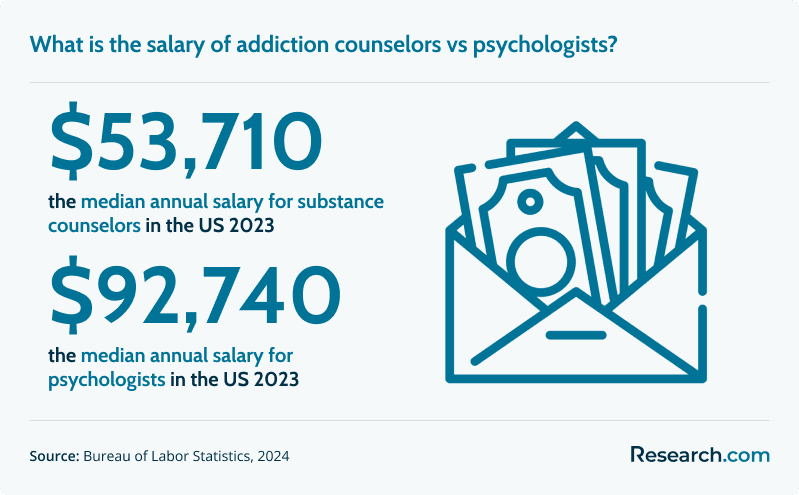
The trade-off is speed versus scope. Addiction counseling can offer a faster path into direct service roles, often at the bachelor’s or master’s level depending on state rules. Psychology takes longer when the goal is independent clinical practice, but it can provide wider career flexibility and higher median pay. The Bureau of Labor Statistics reports a median annual salary of $53,710 for substance abuse, behavioral disorder, and mental health counselors and $92,740 for psychologists.
Key Things You Should Know About Addiction Counseling vs Psychology Degree Programs
- The two degrees do not lead to the same license. Addiction counseling credentials are typically tied to substance use disorder treatment and state-specific counseling rules, while psychologist licensure generally requires a PhD or PsyD, supervised training, and a licensing exam.
- Salary differences are substantial. Addiction counselors earn a median annual salary of $53,710, while psychologists earn $92,740, according to the Bureau of Labor Statistics. The gap reflects differences in education level, scope of practice, supervision requirements, and employment setting.
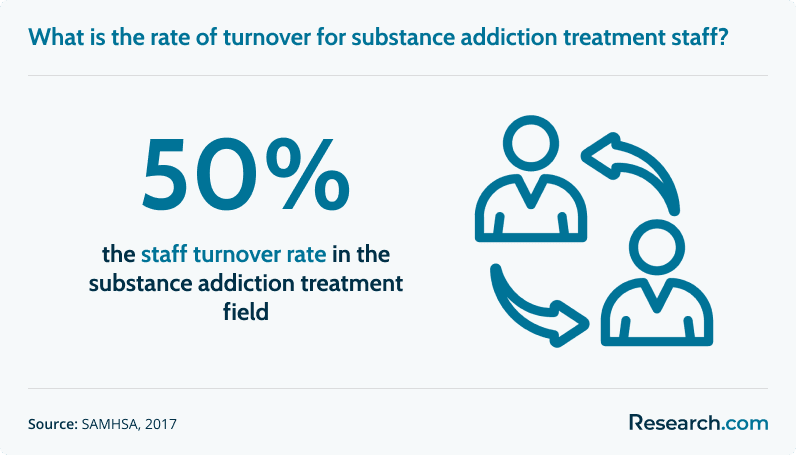
- Addiction treatment work can be demanding. The Substance Abuse and Mental Health Services Administration found that 50% of substance addiction treatment staff leave their positions annually, often because of burnout, high caseloads, and lower pay.
- Many psychology students still prefer applied work over research. A survey found that 92% of psychology students viewed counseling as a possible career path, while 25% considered research. Another 50% considered applied settings, and 42% considered child-related work.
- Location matters. California has 54,660 addiction counselors employed, while Texas and Florida also show high demand. State licensing rules, local funding, and treatment infrastructure can strongly affect opportunity.
- What is the main difference between addiction counseling and psychology?
- What degree levels are available in addiction counseling and psychology for 2027?
- What education do addiction counselors and psychologists need?
- What licenses and certifications are required?
- Can you complete these degrees online?
- How do the programs prepare students for clinical work?
- Can addiction counselors become psychologists later?
- What jobs can graduates pursue?
- How strong is the job outlook?
- How much can addiction counselors and psychologists earn?
- Which degree is the better fit?
- When does Christian counseling make sense?
- How should you evaluate degree ROI?
- Is online applied behavior analysis another option?
- Can forensic psychology strengthen counseling expertise?
- Why is accreditation essential for online counseling programs?
- How can you move faster toward a counseling career?
- How can an LPC credential expand career options?
- How can technology support counseling career growth?
What is the main difference between addiction counseling and psychology?
Addiction counseling is a specialized counseling field focused on substance use disorders, recovery planning, relapse prevention, client motivation, family impact, and co-occurring mental health concerns. Psychology is a broader discipline that studies behavior, cognition, emotion, development, mental illness, assessment, and research methods. Both fields can involve clinical work, but they differ in depth of specialization, educational requirements, and legal scope of practice.
| Comparison Point | Addiction Counseling Degree | Psychology Degree |
| Primary focus | Substance use disorders, recovery support, relapse prevention, and treatment planning | Human behavior, mental processes, diagnosis, assessment, therapy, research, and applied psychology |
| Typical clinical goal | Help clients reduce or stop harmful substance use and build recovery skills | Assess, diagnose, study, and treat a wider range of mental health and behavioral concerns |
| Common degree path | Associate, bachelor’s, or master’s, depending on state rules and target credential | Bachelor’s, master’s, and often a doctorate for psychologist licensure |
| Licensure pattern | State-specific addiction counselor certification or licensure, often tied to supervised experience | Doctoral-level state psychologist licensure for independent practice |
| Best fit for | Students who want direct work in addiction treatment and recovery services | Students who want broad behavioral science training, assessment skills, research options, or psychologist licensure |
- Education requirements are different. Psychology students may stop at a bachelor’s or master’s for some applied roles, but licensed psychologist roles generally require a doctoral degree. Addiction counseling programs may qualify graduates for certain entry-level or licensed roles at the bachelor’s or master’s level, depending on the state.
- Licensing rules are not interchangeable. Psychologists typically need a PhD or PsyD and must pass the Examination for Professional Practice in Psychology. Addiction counselors follow state-specific credentialing pathways, which may include exams, supervised hours, and certification through professional organizations.
- The scope of practice is narrower in addiction counseling. Addiction counselors concentrate on substance use treatment, recovery planning, psychoeducation, relapse prevention, and behavior change. Psychologists may conduct psychological testing, diagnose a wider range of disorders, provide psychotherapy, and work in research or academic settings.
- The training emphasis differs. Addiction counseling programs often highlight motivational interviewing, group counseling, case management, ethics in substance use treatment, and 12-step facilitation. Psychology programs usually include statistics, research design, cognitive processes, developmental psychology, psychopathology, assessment, and clinical models.
- Earnings reflect the training gap. The Bureau of Labor Statistics reports that addiction counselors earn $53,710 annually, while psychologists earn a median annual salary of $92,740.
If your main goal is to support people in recovery as soon as possible, addiction counseling may be the more direct option. If you want a broader mental health career with assessment, research, teaching, or independent psychologist practice as a possibility, psychology is usually the more flexible route, though it requires more schooling.
What degree levels are available in addiction counseling and psychology for 2027?
Both fields offer multiple academic entry points, but each degree level leads to different outcomes. A short program can help you enter support roles, while graduate education is usually needed for independent clinical work. Before enrolling, check your state’s licensing board because the same degree title may qualify graduates differently from one state to another.
| Degree Level | Addiction Counseling | Psychology | Best Use Case |
| Associate | Introduces substance use disorders, helping skills, ethics, and recovery concepts | Covers introductory psychology, human development, and basic research concepts | Entry-level support work or transfer into a bachelor’s program |
| Bachelor's | May support certification or licensure in some states and prepares students for treatment support roles | Builds broad knowledge in behavior, cognition, statistics, and research skills | Case management, behavioral health support, graduate school preparation, or related human services roles |
| Master's | Often needed for licensed addiction counselor roles and more advanced clinical responsibility | May lead to non-psychologist counseling, research, school, organizational, or human services roles depending on the program and state | Clinical preparation, specialization, and supervised practice eligibility |
| Doctoral | Less common, but available for advanced specialization, leadership, research, or teaching | Required for independent psychologist licensure and many assessment-focused roles | Licensed psychologist practice, academic careers, research, and advanced clinical work |
- Associate degrees can be useful if you want a low-cost starting point or plan to transfer credits. They usually do not provide enough preparation for independent counseling practice.
- Bachelor's degrees are stronger entry points for behavioral health work. Students comparing cost and flexibility may review options such as an online addiction counseling degree, but they should confirm whether the curriculum aligns with their state credentialing rules.
- Master's degrees are often the practical minimum for students who want a clinical counseling career with stronger mobility. They may include practicum or internship requirements and supervised experience planning.
- Doctoral degrees are central to psychologist licensure. A PhD may emphasize research as well as clinical training, while a PsyD is often more practice-oriented, though exact structure varies by institution.
The safest way to compare programs is to start with the career title you want, then work backward from state requirements. Degree names can sound similar, but licensing boards care about accreditation, coursework, supervised hours, exams, and field placement quality.
What education do addiction counselors and psychologists need?
The educational difference is one of the biggest decision points. Addiction counseling usually allows earlier entry into the workforce, while psychology requires a longer academic path for students aiming to become licensed psychologists. That extra time can increase debt and delay full-time earnings, but it can also open access to broader roles and higher median pay.
| Requirement | Addiction Counselor | Psychologist |
| Typical minimum education | Bachelor’s or master’s, depending on the state and credential level | Doctoral degree for licensed psychologist practice |
| Common undergraduate major | Addiction studies, counseling, psychology, social work, or human services | Psychology or a closely related behavioral science field |
| Graduate training | Counseling methods, substance use treatment, ethics, assessment, group work, and supervised practice | Assessment, diagnosis, psychotherapy, statistics, research, clinical practicum, and internship training |
| Typical time investment | Four to six years for many bachelor’s-to-master’s pathways | Eight or more years when doctoral education and postdoctoral training are included |
| Accreditation considerations | CACREP or NAADAC alignment may matter for counseling preparation | APA accreditation is important for many psychology doctoral pathways |
- Start with accreditation, not the program title. A degree called addiction counseling, clinical mental health counseling, psychology, or behavioral health may not meet licensing requirements automatically. Review the exact accreditor and curriculum.
- Ask how supervised experience is built into the program. Clinical programs should explain practicum, internship, site placement expectations, supervision arrangements, and state eligibility clearly.
- Expect more in-person requirements at the doctoral level. Many psychology doctoral programs include face-to-face clinical training, assessment supervision, residencies, and internship expectations.
- Online counseling options can work, but only if they meet credentialing rules. Students considering a counseling degree online accredited by recognized bodies should verify whether online coursework, field placements, and supervision are accepted in the state where they plan to practice.
A practical approach is to contact the licensing board before applying. Ask whether the program’s degree title, accreditation, supervised experience, and exam preparation align with the credential you want. Admissions staff can be helpful, but licensing boards are the final authority.
What licenses and certifications are required?
Licensure protects clients by setting minimum education, supervised experience, examination, and ethics standards. Addiction counselors and psychologists both need formal credentials for many clinical roles, but the required degree level and exams are different. Because states use different titles and rules, students should treat the information below as a comparison framework rather than a substitute for state board guidance.
Addiction counselor licensing and certification
- State rules control the license. Many states require a bachelor’s or master’s degree, supervised clinical experience, and a passing score on a recognized exam. Graduate students may find that CACREP accredited programs are useful when comparing counseling pathways.
- Professional certifications can strengthen a resume. NAADAC and NBCC offer credentials that may signal advanced preparation. NAADAC lists certifications like the Master Addiction Counselor (MAC) credential, which can be relevant for experienced professionals.
- Supervised hours vary. Addiction counseling credentials often require documented post-degree or field-based practice hours under an approved supervisor.
Psychologist licensing and certification
- Psychologist licensure usually requires a doctorate. Candidates commonly complete a PhD or PsyD, supervised internship or postdoctoral hours, and the Examination for Professional Practice in Psychology.
- Board certification is optional but meaningful. The American Board of Professional Psychology offers specialty board certification that can demonstrate advanced competence in a defined practice area.
- Assessment authority can be a major distinction. Psychologists often receive deeper preparation in psychological testing and diagnosis than master’s-level counselors, though exact scope depends on state law.
| Requirement | Addiction Counselor | Psychologist |
| Minimum Degree Required | Bachelor’s or Master’s | Doctorate (PhD or PsyD) |
| Licensing Exam | Varies by state (e.g., IC&RC, NAADAC exams) | EPPP (Examination for Professional Practice in Psychology) |
| Supervised Experience | 2,000–4,000 hours (varies by state) | 1,500–2,000 postdoctoral hours |
| Certifications Available | NAADAC (e.g., MAC), NBCC (e.g., NCC, CCMHC) | ABPP (Board Certification, optional) |
| Regulating Bodies | State licensing boards, NAADAC, NBCC | State psychology boards, APA, ABPP |
Both professions usually require continuing education after licensure. Ethics, documentation, cultural responsiveness, telehealth rules, and evidence-based treatment updates are common continuing education areas. The key mistake to avoid is assuming a degree automatically equals eligibility for a license.
Can you complete these degrees online?
Yes, many addiction counseling and psychology degrees are available online, especially at the associate, bachelor’s, and master’s levels. Online study can be a practical option for working adults, parents, rural students, and career changers. The important question is not whether the lectures are online; it is whether the program’s accreditation, coursework, practicum, internship, and supervision structure satisfy the requirements in the state where you want to work.
Addiction counseling programs are often more adaptable to online or hybrid delivery because supervised fieldwork can sometimes be arranged locally. Students comparing the best online addiction counseling degree programs should ask how the school approves placement sites, verifies supervisors, documents hours, and supports students who live outside the institution’s home state.
Online psychology degrees are also common, but the pathway becomes more complicated for students pursuing doctoral-level psychologist licensure. Doctoral psychology programs frequently include in-person clinical training, residencies, assessment labs, or internships. A fully online bachelor’s in psychology may be appropriate for graduate school preparation or applied non-licensed roles, but it does not by itself qualify a graduate to practice as a psychologist.
| Online Program Factor | Why It Matters | Question to Ask |
| Accreditation | Licensure boards and employers may require recognized institutional or programmatic accreditation | Is the program accredited in a way my state licensing board accepts? |
| Field placement support | Clinical credentials usually require supervised practice with real clients | Will the school help me secure approved practicum or internship sites near me? |
| State authorization | Some schools cannot enroll students from every state or may not meet every state’s requirements | Is this program authorized for my state, and does it meet my state’s licensure coursework rules? |
| Total cost | Tuition is only one part of the price; fees, travel, books, exams, and unpaid fieldwork matter too | What is the full estimated cost through graduation and credentialing? |
| Flexibility | Working students need predictable scheduling, but clinical hours may still occur during business hours | Can I complete required fieldwork while maintaining my job? |
Cost matters, but the lowest tuition is not always the best deal. Students looking for the cheapest masters in counseling should compare accreditation, licensure alignment, completion support, field placement quality, and transfer credit rules before choosing a program.
How do the programs prepare students for clinical work?
Clinical preparation is where the difference between the two fields becomes clear. Addiction counseling training is usually built around practical intervention with clients affected by substance use disorders. Psychology training, especially at the graduate and doctoral levels, usually covers a wider clinical and scientific foundation, including assessment, diagnosis, research interpretation, and multiple therapeutic models.
- Supervised experience is central in both fields. Addiction counseling students may train in rehabilitation centers, hospitals, community agencies, outpatient clinics, or recovery programs. Psychology students may complete practicums and internships focused on assessment, diagnosis, therapy, and case conceptualization. Students comparing related therapy tracks may also want to understand what is the difference between MFT and LMFT, since marriage and family therapy has its own licensure structure.
- Addiction counseling emphasizes substance use treatment skills. Coursework often includes motivational interviewing, relapse prevention, group counseling, screening and assessment, family systems, case management, and recovery-oriented care.
- Psychology programs usually cover a broader clinical toolkit. Students may study psychodynamic therapy, cognitive-behavioral therapy, dialectical behavior therapy, neuropsychological concepts, psychological testing, and evidence-based interventions for different disorders.
- Client populations differ. Addiction counseling students focus heavily on substance use and co-occurring conditions. Psychology students may work with anxiety, depression, trauma, developmental concerns, learning issues, serious mental illness, behavioral challenges, and other clinical presentations.
- Ethics and law are not optional. Addiction counseling programs often address confidentiality rules such as HIPAA and 42 CFR Part 2. Psychology programs also cover confidentiality, informed consent, testing ethics, research ethics, and diagnostic standards.
| Clinical Training Area | Addiction Counseling Degree | Psychology Degree |
| Supervised clinical experience | Practicum or internship work in treatment centers, hospitals, outpatient programs, or community agencies | Clinical practicums and internships that may include therapy, assessment, diagnosis, and case consultation |
| Therapeutic methods | Motivational interviewing, CBT, relapse prevention, group counseling, and recovery planning | CBT, DBT, psychodynamic approaches, assessment-based treatment planning, and broader intervention models |
| Typical client focus | People experiencing substance use disorders and co-occurring behavioral health issues | Clients with a wider range of mental health, developmental, cognitive, and behavioral concerns |
| Legal and ethical training | Confidentiality, treatment records, mandated reporting, boundaries, and substance use treatment regulations | Testing ethics, research ethics, diagnosis, confidentiality, informed consent, and professional standards |
| Licensure preparation | Designed around state addiction counselor credentialing and supervised practice requirements | Doctoral pathways prepare students for psychologist licensure, internship, postdoctoral hours, and the EPPP |
Students should also compare addiction counseling and psychology with neighboring fields. For example, understanding what is the difference between MSW and MFT degree programs can help clarify whether you prefer community systems and social services, family therapy, substance use treatment, or psychological assessment.
Can addiction counselors become psychologists later?
Yes. An addiction counselor can later become a psychologist, but it is not a simple license upgrade. It usually requires substantial additional education, including a psychology doctoral program, supervised clinical training, and completion of psychologist licensing requirements. Prior counseling experience may make a candidate stronger, but it does not normally replace the doctoral training required for psychologist licensure.
A typical transition may involve completing prerequisite psychology coursework, earning or using a relevant master’s degree, applying to a PhD or PsyD program, completing doctoral practicum and internship requirements, and then finishing postdoctoral supervised hours before taking the EPPP. Counselors moving into psychology may also need deeper preparation in psychological testing, research methods, statistics, diagnosis, and broader mental health treatment.
| Transition Step | Why It Matters |
| Review doctoral admissions requirements | Programs may require psychology prerequisites, research experience, strong recommendations, or specific graduate coursework |
| Confirm credit transfer limits | Prior counseling credits may not shorten the doctoral timeline as much as expected |
| Prepare for research expectations | PhD programs may emphasize research productivity, while PsyD programs may still require research literacy and dissertations |
| Plan financially | Doctoral study can delay full-time income and may add tuition, fees, travel, and internship-related costs |
| Check state psychology board rules | Licensure depends on meeting board-approved education, training, exam, and supervised hour requirements |
This transition makes the most sense for addiction counselors who want to conduct psychological assessments, qualify for psychologist licensure, teach, conduct research, or broaden their clinical scope beyond substance use treatment.
What jobs can graduates pursue?
Addiction counseling degrees and psychology degrees can both lead to meaningful behavioral health careers, but the job market looks different depending on education level. Addiction counseling graduates commonly move into treatment-oriented roles. Psychology graduates may work in clinical, research, business, education, social service, or applied behavioral science settings, though licensed psychologist roles require advanced training.
| Career Path | Common Degree Background | Typical Work Setting | Notes |
| Substance abuse counselor | Addiction counseling, counseling, psychology, social work, or human services | Rehab centers, outpatient clinics, hospitals, correctional settings, community agencies | Licensure or certification requirements vary by state |
| Recovery coach or peer support role | Certificate, associate, bachelor’s, or lived-experience-based credential depending on employer and state | Recovery organizations, treatment programs, community nonprofits | Often focuses on support, navigation, and accountability rather than independent therapy |
| Case manager | Human services, psychology, social work, counseling, or addiction studies | Community mental health, hospitals, nonprofits, social service agencies | Connects clients with treatment, housing, benefits, medical care, and support services |
| Clinical psychologist | Doctoral psychology degree | Hospitals, private practice, universities, clinics, integrated care, schools | Requires doctoral education, supervised training, and state licensure |
| School, counseling, or clinical psychology roles | Graduate or doctoral psychology pathway depending on role and state | Schools, health systems, counseling centers, universities | Scope depends heavily on state credentialing and employer requirements |
| Research or applied psychology role | Psychology bachelor’s, master’s, or doctorate depending on responsibility level | Universities, companies, research firms, healthcare organizations | Can include behavioral research, user experience, market research, or program evaluation |
Collisson & Eck (2021) found that 92% of psychology students viewed counseling as a viable career path. In the same research, 50% considered applied settings such as schools, hospitals, or community programs; 42% considered child-related work; 25% considered business; and 25% considered research. These figures show why psychology attracts students who want flexibility, even when they are not yet sure whether they want clinical practice, research, or applied behavioral work.
Some psychology graduates pursue specialized areas such as careers in cognitive psychology, where the work may connect human behavior with artificial intelligence, user experience, learning, decision-making, and behavioral analysis.
The best choice depends on the type of work you want to do every week. If you want direct recovery-focused counseling, addiction counseling is more targeted. If you want more room to shift between clinical, research, organizational, or academic roles, psychology offers broader possibilities.
How strong is the job outlook?
Demand for behavioral health professionals is shaped by mental health awareness, access to treatment, insurance coverage, substance use trends, school-based services, healthcare integration, and public funding. Both addiction counseling and psychology have positive employment outlooks, but the pace of projected growth differs.
Projected growth for addiction counselors
The Bureau of Labor Statistics projects 19% employment growth for substance abuse, behavioral disorder, and mental health counselors from 2023 to 2033, which is much faster than the average for all occupations. This demand is connected to the opioid crisis, wider recognition of substance use disorders as treatable conditions, and the expansion of mental health and addiction services. Students comparing specialties can review in demand therapy specialization areas to understand how addiction counseling fits within broader counseling careers.
Projected growth for psychologists
The Bureau of Labor Statistics projects 7% employment growth for psychologists from 2023 to 2033. Clinical, counseling, and school psychologists are expected to remain relevant in healthcare, education, community settings, and private practice. Specialized areas such as neuropsychology and industrial-organizational psychology may offer different opportunities depending on location, credentials, and employer needs.
What affects job opportunities?
- State and region. California leads with 54,660 addiction counselors employed, while states like Texas and Florida also have high demand. Local treatment systems and public funding can influence hiring.
- Credential level. Master’s-level licensure usually improves clinical opportunities for addiction counselors. Doctoral licensure is essential for independent psychologist practice.
- Work setting. Hospitals, government agencies, schools, private practices, outpatient programs, and nonprofits can offer different pay, caseloads, supervision, and advancement paths.
- Burnout risk. Addiction treatment can involve high caseloads, crisis situations, relapse cycles, and administrative demands. The SAMHSA finding that 50% of substance addiction treatment staff leave their positions annually is an important factor to weigh.
- Technology and integrated care. Telehealth, electronic health records, remote supervision tools, and collaborative care models are changing how mental health and addiction services are delivered.
Addiction counseling may provide faster workforce entry and strong projected demand. Psychology usually requires more education, but it can offer broader mobility across clinical, academic, research, school, and organizational settings.
How much can addiction counselors and psychologists earn?
Earning potential depends on education, license level, employer, specialization, state, experience, and whether a professional works in private practice, hospitals, schools, government, or nonprofit settings. Median salaries are helpful benchmarks, but they are not guarantees for any individual graduate.
| Occupation | Reported Median or Average Salary | Important Context |
| Substance abuse, behavioral disorder, and mental health counselors | $53,710 median annual salary | Reported by the Bureau of Labor Statistics as of 2023; earnings can vary by setting, license, and location |
| Psychologists | $92,740 median annual salary | Reported by the Bureau of Labor Statistics; doctoral-level roles often require more years of education and supervised training |
| Clinical, counseling, and school psychologists | $90,130 average | Reported by the Bureau of Labor Statistics; pay differs by employer, specialization, and state |
| Grief counseling specialization | $50,000 to over $80,000 | A grief counselor salary can vary based on experience, location, employer, and credentials |
Psychologists generally have higher earning potential, but they also spend more time in school before independent practice. Addiction counselors may begin working sooner, which can reduce opportunity cost, especially for students who choose affordable programs, maintain employment while studying, or advance into supervisory and specialized roles.
How to think about salary realistically
- Compare lifetime cost, not only starting pay. A higher salary may come after many additional years of tuition, training, internships, and delayed full-time income.
- Look at employer type. Government agencies and hospitals may pay differently from outpatient clinics or nonprofits.
- Consider burnout and retention. A job with higher caseloads and lower supervision may not be sustainable even if it helps you enter the field quickly.
- Account for licensure costs. Exams, supervision, continuing education, background checks, and application fees can add to the total cost of becoming credentialed.
- Avoid assuming private practice income. Private practice revenue depends on referrals, insurance panels, business expenses, location, and scope of license.
Which degree is the better fit?
The right choice depends on the work you want to do, the amount of time you can spend in school, your budget, your tolerance for research and assessment training, and your preferred client population. A useful decision is not “Which degree is better?” but “Which degree gets me to the role I actually want with an acceptable cost, timeline, and licensing path?”
| Choose Addiction Counseling If... | Choose Psychology If... |
| You want to specialize in substance use disorder treatment and recovery support | You want broad training in behavior, cognition, emotion, assessment, and research |
| You prefer a faster route into direct client service roles | You are willing to pursue graduate or doctoral education for broader clinical authority |
| You want to work in rehab centers, outpatient treatment, community programs, correctional settings, or recovery services | You may want to work in clinical practice, schools, research, academia, business, hospitals, or specialized assessment |
| You are comfortable with the emotional demands of addiction treatment work | You are interested in diagnosis, testing, treatment planning, research interpretation, or specialized psychology practice |
| You want a targeted degree tied closely to one treatment population | You want a degree that can support several possible career directions |
Questions to ask before choosing a program
- What exact job title do I want after graduation? Substance abuse counselor, licensed addiction counselor, LPC, clinical psychologist, school psychologist, research assistant, and case manager all have different requirements.
- Does this program meet my state’s licensing rules? Confirm with the licensing board, not only the admissions page.
- How much supervised experience will I need after graduation? Ask about the number of hours, approved supervisors, documentation, and whether paid roles can count.
- What is the total cost through licensure? Include tuition, fees, books, travel, exam fees, supervision fees, unpaid internship time, and lost wages.
- What happens if I move states? License portability can be complicated, especially for counseling credentials.
- How does the school support field placements? A program is much less valuable if students are left to find clinical sites without meaningful help.
- What are the program’s completion, exam, and employment outcomes? Ask for data when available, and be cautious of vague promises.
Common mistakes to avoid
- Choosing based only on tuition. A cheap program that does not meet licensure rules can become expensive if you need extra coursework later.
- Assuming online means easier. Online clinical degrees still require fieldwork, documentation, supervision, and rigorous assessment.
- Ignoring accreditation. Accreditation can affect licensure, transfer credits, employer recognition, and graduate school options.
- Confusing counseling, psychology, social work, and therapy licenses. Similar job duties do not mean identical legal scopes of practice.
- Relying only on rankings. Rankings can help you create a shortlist, but licensure alignment, placement support, cost, and outcomes matter more.
- Assuming salary outcomes are guaranteed. Median salaries do not predict your first job offer, local pay scale, caseload, or private practice income.
When does Christian counseling make sense?
A faith-integrated counseling pathway may be appropriate for students who want to serve clients in churches, ministries, faith-based nonprofits, pastoral counseling settings, or religiously affiliated community organizations. A master in Christian counseling can combine counseling concepts with spiritual formation, pastoral care, and faith-sensitive approaches to client support.
Students should be careful, however, not to assume that every Christian counseling degree leads to state counseling licensure. Some programs are designed for ministry or pastoral care rather than licensed clinical practice. Before enrolling, ask whether the degree meets the coursework, practicum, internship, and accreditation requirements for the credential you want.
How should you evaluate degree ROI?
Return on investment in addiction counseling or psychology depends on more than salary. A realistic ROI review includes tuition, fees, books, technology costs, commute or residency costs, exam fees, supervision expenses, time away from full-time work, and the number of years before you can qualify for independent practice.
Students comparing related counseling fields may also review the most affordable MFT online programs to understand how costs differ across counseling, marriage and family therapy, psychology, and addiction-focused pathways. Affordability matters, but it should be weighed against accreditation, licensure eligibility, field placement quality, and employment outcomes.
| ROI Factor | Why It Matters |
| Time to licensure | Longer pathways may delay earnings, especially for psychology students pursuing doctoral licensure |
| Total program cost | Tuition alone may exclude fees, books, supervision, travel, and unpaid fieldwork |
| Median salary | Addiction counselors and psychologists have different reported median earnings, but individual pay varies |
| Transfer credit policy | Accepted transfer credits can reduce cost and time, while rejected credits can extend the degree |
| License portability | If you plan to move, state-specific rules may affect long-term career flexibility |
Is online applied behavior analysis another option?
Students who are drawn to child-focused behavioral interventions may also consider applied behavior analysis. ABA is distinct from addiction counseling and general psychology because it concentrates on observable behavior, intervention plans, data collection, and behavior change strategies. It is often associated with work involving autism spectrum disorder, developmental delays, and behavioral challenges.
Flexible programs such as applied behavior analysis masters programs online may appeal to working professionals who want to prepare for the Board Certified Behavior Analyst exam while completing supervised fieldwork. ABA can be a strong fit for students who want structured, evidence-based behavioral intervention in schools, clinics, homes, or developmental service settings rather than broad counseling or psychologist training.
Can forensic psychology strengthen counseling expertise?
Forensic psychology may be useful for counseling professionals who want to understand behavior in legal, correctional, victim services, risk assessment, or court-connected settings. It does not replace addiction counseling or psychologist licensure, but it can add specialized knowledge about assessment, criminal justice systems, trauma, competency-related questions, and offender treatment contexts.
Students interested in the intersection of mental health and law may compare options such as affordable online forensic psychology masters. Before enrolling, confirm whether the degree is intended for career advancement, doctoral preparation, law enforcement-adjacent work, or clinical licensure support.
Why is accreditation essential for online counseling programs?
Accreditation is one of the most important quality checks for online counseling and psychology-related programs. It can affect licensure eligibility, transfer credits, employer acceptance, graduate school admission, and access to federal financial aid. A program can be convenient and affordable but still be a poor choice if the credential does not meet professional standards.
When reviewing the cheapest online LPC programs, look beyond tuition. Ask whether the school is institutionally accredited, whether the counseling program has relevant programmatic accreditation, how field placements are approved, whether graduates qualify for the license you want, and whether the curriculum includes all state-required content areas.
How to choose a program step by step
- Identify your target role. Decide whether you want to become an addiction counselor, licensed professional counselor, psychologist, case manager, recovery coach, researcher, school-based professional, or applied behavioral specialist.
- Check your state board first. Find the official education, supervised hour, exam, and application requirements for that role.
- Shortlist only accredited schools. Verify institutional and programmatic accreditation through official accreditor or agency sources.
- Compare field placement support. Ask whether the school finds sites, approves sites, or leaves the process to the student.
- Calculate total cost. Include tuition, fees, textbooks, travel, exams, supervision, background checks, and unpaid clinical hours.
- Review outcomes carefully. Ask about graduation rates, licensure exam pass rates, field placement completion, and employment support when available.
- Speak with working professionals. Interview addiction counselors, psychologists, supervisors, and recent graduates to understand real caseloads, stressors, and advancement options.
- Choose the degree that fits your actual plan. Do not enroll in a broad psychology degree if your goal requires a counseling license, and do not choose addiction counseling if you ultimately want psychologist-level assessment authority.
How can you move faster toward a counseling career?
The fastest legitimate route is the one that meets licensure requirements without unnecessary detours. Accelerated formats, transfer credits, bridge programs, year-round enrollment, and carefully planned practicum schedules may reduce completion time, but they should not replace required supervised experience or accredited coursework.
Students who want a shorter route should review how to become a counsellor quickly and then compare that advice with their state board’s rules. A compressed program is only useful if it still qualifies graduates for the credential they need.
How can an LPC credential expand career options?
An LPC credential can broaden opportunities for graduates who want to provide professional counseling in community mental health, outpatient clinics, private practice settings, hospitals, and integrated care environments. It signals advanced counseling preparation, supervised clinical experience, and commitment to ethical practice.
Students comparing addiction counseling with broader counseling licensure should review What is an LPC? to understand how LPC education, scope of practice, supervision, and salary considerations differ from addiction-specific credentials and psychology degrees.
How can technology support counseling career growth?
Technology is changing how counseling students train and how professionals deliver care. Telehealth platforms, virtual case simulations, electronic health records, online supervision tools, digital screening instruments, and adaptive learning systems can help students build skills and maintain access to continuing education. These tools can be useful, but they do not remove the need for ethical judgment, supervised practice, cultural competence, and state-compliant documentation.
Students planning an efficient career path can combine flexible online coursework with approved field placements and licensure planning. For additional planning, review the shortest path to becoming a counselor while confirming that every step aligns with the license you want.
Key Insights
- Addiction counseling is narrower but more direct. It is best for students who want to work specifically with substance use disorders, recovery, relapse prevention, and treatment support.
- Psychology is broader but usually longer. A psychology degree can lead to clinical, research, academic, school, organizational, or applied roles, but licensed psychologist practice generally requires a PhD or PsyD.
- The salary gap is real, but so is the education gap. BLS data shows $53,710 as the median annual salary for substance abuse, behavioral disorder, and mental health counselors and $92,740 for psychologists.
- Licensure should drive your program choice. Do not rely only on a school’s degree title. Check accreditation, coursework, supervised hours, exams, and state board approval before enrolling.
- Online programs can be worthwhile when they are properly aligned. Flexibility is valuable, but online students still need approved clinical placements, supervision, and state-compliant training.
- Demand is strong, especially for counselors. BLS projects 19% growth for substance abuse, behavioral disorder, and mental health counselors and 7% growth for psychologists from 2023 to 2033.
- Burnout should be part of the decision. The addiction treatment workforce faces high turnover, with SAMHSA reporting that 50% of substance addiction treatment staff leave their positions annually.
- The best degree is the one that fits your target role, timeline, and state rules. Start with the job you want, confirm licensing requirements, compare total cost, and choose the program that gets you there without avoidable detours.
References:
- American Psychological Association. (2008, September 3). Psychology careers guide. apa.org.
- Basics of Addiction Counseling Desk Reference: Module II: Addiction Counseling Theories, Practices, and Skills (11th ed.). (2017). NAADAC.
- Bureau of Labor Statistics. (2024, August 29). Psychologists. bls.gov.
- Bureau of Labor Statistics. (2024, April 3). 21-1018 substance abuse, behavioral disorder, and mental health counselors. bls.gov.
- CACREP. (2019, October 11). Section 5: Addiction counseling. cacrep.org.
- CACREP. (2024). Results from a national survey of accredited programs. cacrep.org.
- Stringer, H. (2024, January 1). Psychologists are innovating to tackle substance use by building new alliances in treatment efforts. apa.org.
Other Things You Should Know About Addiction Counseling & Psychology Degree Programs
In 2027, an Addiction Counseling degree focuses on understanding addiction, treatment strategies, and client support, including courses on substance abuse and recovery practices. A Psychology degree provides a broader study of human behavior and mental processes, covering topics like abnormal psychology, cognitive processes, and research methods.
Most states require the Licensed Alcohol and Drug Counselor credential, often called LADC or CADC, plus supervised clinical hours, which can range from 2,000 to 6,000 depending on the state board. Some states also require a national exam through IC&RC or NAADAC’s MAC test.