
2027 What Is the Average Salary Outlook with MPH Degree?

Co-Founder and Chief Data Scientist
An MPH degree is a career decision, not just an academic credential. If you are comparing public health, healthcare administration, epidemiology, community health, or health policy roles, the key question is whether a Master of Public Health will improve your job options, salary potential, and ability to work on population-level health problems.
This guide explains what an MPH can lead to, how much MPH graduates may earn, which industries and states pay more, what specializations are available, how admissions and costs work, and how to decide whether the degree fits your goals. It is designed for prospective graduate students, working healthcare professionals, career changers, and public health employees who want a clearer return-on-investment picture before applying.
Quick answer: What are the benefits of having an MPH degree?
- An MPH can prepare graduates for roles such as health educator, community health worker, public health nurse, environmental health scientist, epidemiologist, public health consultant, biostatistician, and health policy analyst.
- Reported MPH-related salaries vary widely. Graduates may earn between $48,000 and $154,000 per year depending on job title, specialization, employer, experience, and location.
- Labor market demand is favorable in several MPH-aligned occupations, with epidemiologists projected to grow 19% and health educators 7% from 2023 to 2033.
- The degree is usually most valuable for people who want to work on disease prevention, health equity, health data, policy, program management, environmental health, or population health strategy.
- Average MPH degree salary for 2027
- Highest-paying industries for MPH graduates
- Highest-paying states for MPH-related careers
- Ways to improve your MPH salary potential
- MPH specializations and how to choose one
- Career paths available with an MPH degree
- Job outlook for MPH degree graduates
- Typical MPH admission requirements
- Cost of completing an MPH degree
- Certifications to consider with an MPH
- How practical experience strengthens MPH career outcomes
- Affordable MPH options that still protect quality
- Public health competencies that support advancement
- How interdisciplinary credentials can expand your options
- Financial aid options for MPH students
- Whether an MPH degree is worth it
- How accelerated business programs can complement an MPH
- How to choose the right MPH program
What is the average MPH degree salary for 2027?
MPH salary outcomes depend heavily on the role you pursue. A broad MPH degree salary range is $45,000 to $110,000, but some positions and industries pay above that range. Pay is shaped by specialization, employer type, years of experience, region, management responsibility, and whether the role is data-heavy, clinical-adjacent, policy-focused, or administrative. Students comparing public health leadership with healthcare business roles may also want to review MBA healthcare administration salary expectations.
The most practical way to evaluate MPH earning potential is to look at common occupations rather than one single average. Public health roles differ substantially in responsibilities and compensation.
| MPH-related role | Typical focus | Reported salary figure |
| Community Health Workers | Connect communities with health services, outreach programs, and prevention resources | Median annual wage of approximately $48,200 |
| Health Education Specialists | Create and deliver programs that encourage healthier behaviors and improve community wellness | Median salary of about $62,860 per year |
| Epidemiologists | Study disease patterns, outbreaks, risk factors, and prevention strategies | Median annual wage of $81,390 |
| Medical and Health Services Managers | Lead healthcare departments, facilities, programs, budgets, and operations | Median annual wage of $110,680 |
Salary aggregators also show variation. PayScale reports that people with an MPH degree have an average annual salary of approximately $73,000. Salary.com indicates that MPH holder pay varies by job title, experience, and other employment factors.
The chart below compares national medians for several roles that MPH degree graduates may pursue.
What are the top-paying industries for MPH degree graduates?
MPH graduates do not all compete in the same labor market. Some work in local health departments, while others move into pharmaceutical companies, research organizations, hospitals, consulting, insurance, nonprofits, or federal agencies. This differs from career paths tied to technical healthcare data programs such as healthcare informatics masters degrees, where employer demand may center more directly on health IT systems and analytics infrastructure.
The following industries are among the highest-paying for selected MPH-related occupations.
| Role | Top-paying industries listed | Annual pay figures |
| Epidemiologists | Pharmaceutical and Medicine Manufacturing; Grantmaking and Giving Services; Scientific Research and Development Services; Offices of Physicians | $154,610; $135,530; $126,970; $124,750 |
| Health Education Specialists | Merchant Wholesalers, Nondurable Goods; Wholesale Trade Agents and Brokers; Federal Government, excluding schools and hospitals; Scientific Research and Development Services | $144,580; $131,810; $114,490; $84,800 |
| Community Health Workers | Scientific Research and Development Services; Home Health Care Services; Grantmaking and Giving Services; Insurance Carriers | $76,140; $66,100; $65,040; $64,790 |
| Medical and Health Services Managers | Wholesale Trade Agents and Brokers; Pharmaceutical and Medicine Manufacturing; Scientific Research and Development Services; General Medical and Surgical Hospitals | $254,660; $231,070; $228,170; $145,390 |
The main takeaway is that industry choice can matter as much as job title. Research, pharmaceuticals, federal work, and management-focused settings tend to create higher-paying opportunities than some entry-level community roles, although mission fit and job stability should also factor into your decision.
What are the top-paying states for MPH degree graduates?
Location can significantly change MPH-related earnings. Higher pay may reflect cost of living, employer concentration, public health funding, research activity, federal presence, or large healthcare systems. A high salary in one state does not always mean higher disposable income, so compare compensation with housing, commuting, taxes, and local job availability.
Based on 2023 BLS data, the following states are listed as top-paying locations for four common MPH-aligned roles.
| Role | Top-paying state | Other high-paying states listed |
| Community Health Workers | District of Columbia – $65,510/year | New Mexico ($63,900), Rhode Island ($63,660) |
| Health Education Specialists | District of Columbia – $106,100/year | Maryland ($101,800), Georgia ($95,140) |
| Epidemiologists | Wisconsin – $121,150/year | Massachusetts ($114,300), Washington ($113,790) |
| Medical and Health Services Managers | New York – $179,160/year | D.C. ($170,710), Delaware ($164,190) |
States with major public agencies, research employers, universities, hospital networks, or specialized health services may offer stronger compensation and more advancement opportunities. If your interests include workplace safety, environmental exposure, compliance, and organizational risk, learning how to become an environmental health and safety manager can help you compare another public-health-adjacent route.
The chart below compares the highest-paying state for each role MPH graduates may enter.
How can I increase my MPH degree salary potential?
The strongest MPH salary outcomes usually come from combining public health knowledge with a marketable specialty. General public health skills are useful, but employers often pay more for candidates who can analyze data, manage programs, lead teams, design policy, evaluate interventions, or work in regulated healthcare and research environments. Similar to the way combined clinical and management expertise can expand job opportunities for doctors with MBA degrees, an MPH can become more powerful when paired with a clear professional niche.
| Strategy | Why it can help | Best fit for |
| Choose a high-value concentration | Areas such as biostatistics, epidemiology, and health informatics can align with data-driven and research-focused jobs | Students who enjoy statistics, research design, surveillance, or health data |
| Build research or policy experience | Federal agencies, global health organizations, and policy groups often value applied experience | Students targeting government, consulting, advocacy, or international work |
| Add a recognized certification | Credentials such as CHES or CPH may help demonstrate specialized competence | Graduates entering competitive public health education, program, or generalist roles |
| Move into management | Program director, department lead, and health services manager roles often involve higher responsibility and higher pay | Professionals with leadership, budgeting, and operations skills |
| Target higher-paying employers and regions | Pharmaceuticals, scientific research, hospitals, and certain states may pay more for similar expertise | Graduates who are geographically flexible or open to private-sector work |
Some MPH graduates also build careers at the intersection of public health and the environment. Reviewing environmental engineer salary information can be useful if you are considering environmental exposure, water quality, air quality, infrastructure, or occupational health as part of your long-term path.
What specializations are available in MPH degrees?
MPH specializations help you translate a broad degree into a clearer career direction. The best concentration is not automatically the highest-paying one; it should match the type of work you want to do every day, the employers you plan to target, and the skills you are willing to build deeply.
| MPH specialization | What it emphasizes | Good fit if you want to... |
| Epidemiology | Disease patterns, causes, outbreaks, surveillance, and prevention | Investigate health trends, conduct research, or work on infectious and chronic disease prevention |
| Biostatistics | Statistical methods used in health and biological data | Analyze datasets, support research, or move toward quantitative public health roles |
| Environmental Health Sciences | Environmental risks that affect human health | Work on pollution, exposure, climate-related health risks, occupational health, or community safety |
| Health Policy and Management | Health policy development, healthcare systems, management, and service delivery | Lead programs, analyze policy, manage healthcare operations, or influence public health systems |
| Social and Behavioral Sciences | Health behavior, social factors, community needs, and intervention design | Design health promotion campaigns or work directly with communities |
| Global Health | Health issues that cross national borders | Work with international organizations, global disease programs, or cross-border health initiatives |
| Community Health | Local prevention, outreach, wellness, and access to services | Improve health outcomes in specific populations or underserved communities |
Students interested in economic drivers of healthcare may look for MPH programs with health economics coursework. A separate degree in economics can offer broader training for roles that are less tied to public health practice and more focused on economic analysis, markets, or policy modeling.
What are the career paths for MPH degree graduates?
An MPH can lead to jobs in government, nonprofit organizations, hospitals, universities, research centers, consulting firms, insurance companies, and private healthcare organizations. The degree is interdisciplinary, so graduates may work in education, data analysis, policy, environmental health, disease surveillance, program management, or community outreach.
| Career path | Primary responsibilities | Common employer settings |
| Epidemiologist | Study disease causes and patterns to support prevention and response | Public agencies, research centers, hospitals, universities |
| Health Educator | Plan and deliver programs that encourage healthier behaviors | Community organizations, schools, health departments, nonprofits |
| Public Health Consultant | Advise organizations on public health strategy, program design, and policy implementation | Consulting firms, nonprofits, agencies, healthcare organizations |
| Environmental Health Scientist | Evaluate environmental factors that may harm human health and recommend controls | Government agencies, laboratories, environmental organizations, industry |
| Biostatistician | Analyze health data to inform research, policy, and program decisions | Universities, research organizations, pharmaceutical companies, public agencies |
| Health Policy Analyst | Assess laws, regulations, programs, and proposals affecting public health outcomes | Think tanks, government, advocacy groups, healthcare systems |
| Community Health Worker | Help communities access care, services, education, and prevention resources | Local health departments, nonprofits, clinics, community programs |
Graduates who like data, mapping, environment, and policy may also consider an environmental data analyst career path. This route can connect public health training with environmental monitoring, exposure analysis, and evidence-based community interventions.
The versatility of an MPH is one of its biggest strengths, but that versatility also means students should choose courses, internships, and projects intentionally instead of assuming the degree alone will define their career.
What is the job outlook for MPH degree graduates?
The job outlook for many MPH-related roles is positive, especially in healthcare management, epidemiology, community outreach, and prevention-focused work. Demand is connected to aging populations, interest in preventive care, the need for stronger public health systems, and the continued importance of data-informed health decision-making.
U.S. Bureau of Labor Statistics projections for 2023 to 2033 include the following growth rates:
| Occupation | Projected growth | Why demand may continue |
| Medical and Health Services Managers | 29% growth | Healthcare organizations need managers who can coordinate services, operations, staff, data, and compliance |
| Epidemiologists | 19% growth | Public and private organizations need expertise in disease prevention, research, surveillance, and emerging health threats |
| Community Health Workers | 13% growth | Communities need help connecting people to services, especially in underserved areas |
| Health Education Specialists | 7% growth | Employers and agencies continue to use education and prevention strategies to improve health and manage costs |
Environmental health is another area influencing public health work. If you are considering roles connected to ecosystems, exposure, and population health, reviewing environmental biologist education requirements can help you understand whether additional science preparation may be needed.
Overall, MPH graduates are entering a labor market with multiple growth areas, but job outcomes will still depend on specialization, experience, location, and the ability to apply public health methods in real settings.
What are the requirements for admission to MPH degree?
MPH admissions requirements vary by school, but most programs look for evidence that applicants can handle graduate-level writing, quantitative work, health-related problem solving, and professional collaboration. Students often ask, “Is public health a hard major?” The honest answer is that it can be demanding because it combines science, statistics, ethics, policy, communication, and real-world population health challenges.
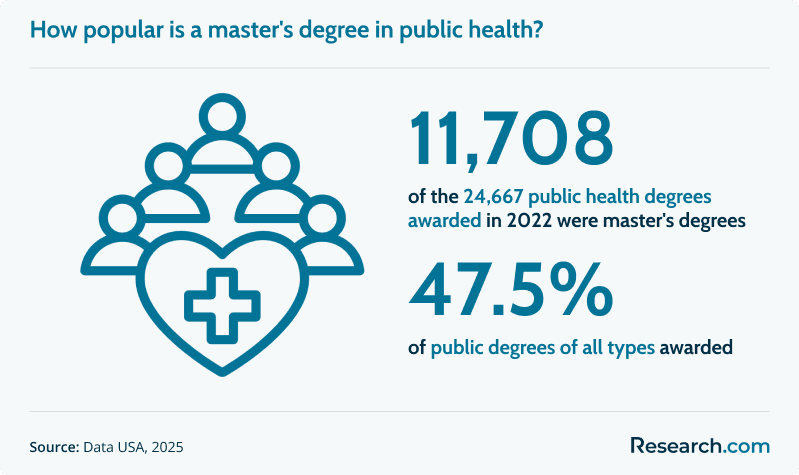
Public health graduate education remains a substantial field. Approximately 11,700 MPH degrees were awarded in 2022, accounting for 47.5% of public health master's degrees conferred that year.
| Admission component | What programs commonly expect | How to strengthen your application |
| Bachelor's Degree | A completed undergraduate degree from an accredited institution | Show how your academic background connects to public health goals |
| Academic Performance | A minimum GPA, often around 3.0 | Address weaknesses with strong recent coursework or professional achievements |
| Standardized Tests | Some programs may require GRE scores, although many have moved away from this requirement | Confirm each school’s current policy before spending time or money on testing |
| Prerequisite Coursework | Courses in mathematics, biology, or health-related sciences may be required | Complete missing prerequisites before applying when possible |
| Work Experience | Some schools prefer relevant health, research, nonprofit, or community experience | Highlight measurable responsibilities, not just job titles |
| Letters of Recommendation | Typically two to three letters from academic or professional references | Choose recommenders who can speak to your analytical ability, service mindset, and reliability |
| Statement of Purpose | An essay explaining your goals and reason for pursuing an MPH | Be specific about your intended concentration, population, or public health problem |
How much does it cost to complete an MPH degree?
The average cost to complete a Master of Public Health degree ranges from $24,000 to $60,000. The final price depends on public versus private school status, residency classification, online or campus format, fees, living costs, and how long you take to finish. According to 2024 data, average graduate tuition for a public health program is $24,621 at public institutions and significantly higher at private universities.
| Cost category | Amount or note | What to check before enrolling |
| Tuition | $24,000 to $60,000 overall range; $24,621 average graduate tuition at public institutions | Whether the published rate includes all required credits and fees |
| Books and supplies | ~$1,200 per year | Whether digital materials, software, or statistical tools are extra |
| Room and board | ~$12,300 annually at public institutions | Whether online study could reduce relocation or housing costs |
| Additional living expenses | ~$3,800–$5,000 | Transportation, childcare, technology, and practicum-related travel |
| Certification or licensing fees | Varies by state and profession | Whether your target job requires or rewards an added credential |
Online and part-time options may reduce indirect expenses, especially housing and commuting. Students comparing MPH programs with healthcare management pathways may also review affordable online master's in healthcare administration programs to decide whether public health, administration, or a hybrid career direction offers the better fit.
Cost should not be evaluated by tuition alone. A lower-priced MPH may be a poor value if it lacks accreditation, practicum support, career services, or coursework in your target specialization. A more expensive program may be reasonable if it provides strong employer connections, flexible scheduling, and relevant applied experience.
Should I pursue additional certifications alongside an MPH degree?
Additional certifications can be useful when they match your target role. They are not automatically necessary for every MPH student, and collecting credentials without a plan can waste money. The right certification should fill a specific skills gap, help meet employer expectations, or support a move into a specialized area such as health education, public health practice, data analysis, emergency preparedness, quality improvement, or clinical-adjacent work.
Credentials such as CHES and CPH may help some MPH graduates show professional readiness. Other technical training can be helpful only when it clearly supports your role. For example, online ultrasound tech certification is more relevant to clinical imaging pathways than to most population health jobs, but it may offer context for professionals who work closely with clinical screening programs or healthcare delivery teams.
| Ask this before adding a certification | Why it matters |
| Do job postings in my target field request it? | Employer demand is a stronger signal than general advice |
| Will it teach a skill my MPH program does not cover? | The credential should add capability, not duplicate coursework |
| Is the certification recognized by public health employers? | Some credentials carry more market value than others |
| Can I afford the exam, renewal, and continuing education requirements? | Ongoing costs can affect the credential’s value |
How does practical experience improve career prospects in an MPH program?
Practical experience is often the difference between knowing public health concepts and being ready to use them. Internships, practicums, applied research, community projects, and agency-based fieldwork help students turn classroom learning into evidence-based action. They also create references, work samples, and professional contacts that can matter during a job search.
Look for MPH programs that offer structured placements with health departments, hospitals, nonprofits, research teams, or community organizations. If your career interests include healthcare operations, reimbursement, or administrative data, technical training from the best medical billing and coding schools may help you understand another part of the healthcare system, although it should not replace core public health field experience.
Are there affordable options that do not compromise quality?
Yes, but affordability should be judged alongside accreditation, curriculum fit, faculty support, practicum quality, completion flexibility, and career outcomes. A low tuition price is helpful only if the program can still prepare you for the roles you want.
Online MPH programs may reduce commuting, relocation, and campus-based costs. However, students should verify whether online learners receive the same advising, practicum placement support, library access, and career services as campus students. To compare lower-cost options, review cheap MPH online programs and then confirm each school’s accreditation and specialization availability directly with the institution.
What key competencies accelerate career progression in public health?
Public health advancement usually depends on more than subject knowledge. Employers often look for professionals who can interpret data, communicate clearly, manage projects, lead partnerships, and make decisions in complex settings. As public health work becomes more technology-enabled, digital literacy and data fluency are increasingly important.
| Competency | How it supports career growth |
| Data analysis | Helps professionals interpret epidemiological findings, evaluate programs, and support evidence-based policy |
| Strategic planning | Supports leadership roles that require setting goals, allocating resources, and measuring outcomes |
| Communication | Allows public health professionals to translate technical findings for communities, executives, policymakers, and funders |
| Project management | Improves the ability to deliver programs on time, within budget, and across multiple partners |
| Interdisciplinary collaboration | Helps teams address problems that involve medicine, policy, environment, education, economics, and social services |
Professionals who want to move toward administration may also compare MPH skills with the highest paying careers in healthcare administration, especially if they are interested in operations, executive leadership, or healthcare system management.
How can interdisciplinary qualifications enhance your public health career?
Interdisciplinary training can expand your career options when it connects directly to the population or setting you want to serve. Public health problems often overlap with education, housing, environment, business, sports, policy, economics, and healthcare delivery. Adding another discipline can make you more effective if it gives you practical tools for program design, leadership, community engagement, or evaluation.
For example, students interested in wellness programming, physical activity initiatives, or community recreation may compare MPH training with the cheapest online sports management degree options. The goal is not to collect unrelated degrees, but to build a coherent profile that supports a specific career path.
What financial aid options are available for MPH degree students?
MPH students may be able to reduce out-of-pocket costs through federal aid, institutional support, assistantships, scholarships, and work-related benefits. The best approach is to compare net cost, not just listed tuition.
- Federal Student Loans: Graduate students may qualify for Direct Unsubsidized Loans and Direct PLUS Loans through the William D. Ford Federal Direct Loan Program.
- Institutional Scholarships and Grants: Universities may offer merit-based or need-based awards. Johns Hopkins Bloomberg School of Public Health provides the Welch Scholarship to all new online/part-time MPH students, significantly reducing tuition costs.
- Teaching and Research Assistantships: Some schools provide stipends or tuition remission in exchange for teaching, research, or administrative support.
- External Scholarships: Public health associations, nonprofits, employers, and foundations may offer awards for graduate public health students. MPHProgramsList.com provides lists of scholarship opportunities.
- Work-Study Programs: The Federal Work-Study Program offers part-time employment for students with financial need.
Complete the Free Application for Federal Student Aid, known as the FAFSA, if you want access to federal financial aid. Also ask each school’s financial aid office for a program-specific estimate that includes tuition, fees, expected living costs, assistantship availability, and scholarship deadlines.
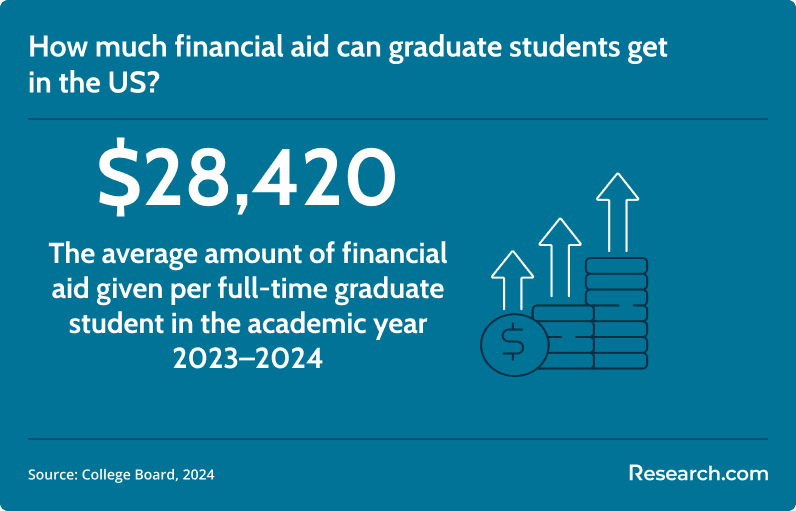
The image below shows the average amount of financial aid graduate students in the United States may receive.
Is an MPH degree worth it?
An MPH degree can be worth it if your career goal requires graduate-level public health skills and you choose a program with reasonable cost, relevant specialization options, applied experience, and strong career alignment. It is less likely to be worth it if you enroll without a clear goal, choose an unaligned concentration, ignore total costs, or assume the degree alone guarantees a high salary.
From a financial perspective, the degree has meaningful upside but also real cost. The average cost of an MPH degree ranges from $24,000 to $60,000. Graduates may earn from $48,000 as community health workers to over $110,000 as medical and health services managers. Cost of living also matters: the cost of living in the U.S. averages over $4,100/month for a family of four and $1,170/month for a single person, making stable income an important consideration.
Job growth strengthens the case for some students. Projected growth rates include 13% for community health workers, 19% for epidemiologists, and 29% for health services managers by 2033. These figures suggest opportunity, but individual results will still depend on role selection, experience, geography, employer type, and specialization.
| An MPH may be a strong fit if... | You may want another path if... |
| You want to work on population health, prevention, policy, epidemiology, health equity, or community programs | You mainly want clinical patient care and need a licensure-based clinical degree |
| You are interested in government, nonprofit, research, healthcare system, or global health work | You are primarily focused on corporate management without a public health focus |
| You can choose a specialization tied to real job postings | You are unsure what public health role you want and have not researched employers |
| You can manage the cost through savings, employer support, scholarships, assistantships, or affordable tuition | The total debt would be difficult to repay based on your target salary |
Students who prefer business-focused healthcare leadership may also compare MPH options with affordable online master's in healthcare administration programs. For those motivated by community health, prevention, health data, and systems-level change, an MPH remains a practical and mission-driven graduate degree.
How can accelerated business programs complement an MPH degree?
Business training can strengthen an MPH when your career goal includes budgeting, operations, entrepreneurship, program leadership, consulting, or executive decision-making. Public health leaders often need to manage limited resources, justify funding, lead teams, and communicate with stakeholders who expect financial and operational clarity.
An accelerated business option such as the fastest business degree online may complement public health training for professionals who want stronger management skills. This combination can be especially relevant for program directors, healthcare administrators, nonprofit leaders, consultants, and public health entrepreneurs.
What graduates say about MPH salary outcomes
-
: "
After finishing my MPH, I was hired as an epidemiologist with a starting salary of $78,000. The best part is that the work feels connected to real improvements in people’s lives. Maritn
"
-
: "
My online MPH let me keep working full-time while completing the program. Within six months, I stepped into a management role paying over $100,000 annually without relocating or attending on campus. Rick
"
-
: "
I began as a community health worker earning under $50K. After earning the MPH, my pay increased to $70K and continues to grow. The degree helped me access opportunities I had not considered before. Annalise
"
How do I choose the right MPH program?
Choosing an MPH program should start with your target career, not a school name alone. The right program should offer the concentration, field experience, faculty support, schedule, cost structure, and career services that match your goals.
| Program factor | Why it matters | Questions to ask |
| Accreditation | Accreditation helps signal that the program meets recognized public health education standards | Is the MPH program accredited by a recognized public health authority? |
| Curriculum fit | Your courses should match your intended role and specialization | Does the program offer epidemiology, biostatistics, policy, environmental health, global health, or community health options? |
| Practicum support | Applied experience can improve job readiness | Does the school help online and campus students secure field placements? |
| Faculty expertise | Faculty connections and research areas can influence mentorship and opportunities | Are faculty members active in the public health areas I care about? |
| Format and flexibility | Working students may need online, part-time, or evening options | Can I complete requirements without interrupting my current job? |
| Total cost | Fees, books, travel, and living expenses affect ROI | What is the full estimated cost after aid, not just tuition? |
| Career services | Public health hiring often depends on networks, fieldwork, and applied skills | What job search support, employer relationships, and alumni outcomes are available? |
Affordability matters, but compare it with quality and career fit. Students exploring lower-cost healthcare training options may also review affordable online medical billing and coding schools, though those programs lead to different career outcomes than an MPH.
Common mistakes to avoid when choosing an MPH
- Choosing only by ranking or reputation: A famous program is not automatically the best fit if it lacks your preferred concentration or practicum support.
- Ignoring accreditation: Always verify whether the program meets recognized public health education standards before applying.
- Looking only at tuition: Fees, housing, lost income, transportation, and fieldwork costs can change the real price.
- Assuming online programs are all equal: Compare advising, faculty access, practicum placement, and career services for online students.
- Picking a specialization too late: Your concentration affects internships, research projects, networking, and job applications.
- Assuming salary outcomes are guaranteed: The degree can improve options, but role, location, experience, and employer type drive actual pay.
- Skipping employer research: Review job postings before enrolling so you know which skills, software, certifications, and experience employers want.
Key Insights
- An MPH is most valuable when it is tied to a specific public health career goal, such as epidemiology, health education, policy, community health, environmental health, or healthcare management.
- MPH-related earnings vary widely. Graduates may earn between $48,000 and $154,000 per year, while medical and health services managers have a median salary of $110,680.
- Specialization matters. Data-focused, research-focused, policy-focused, and management-focused paths can lead to different salaries and employers.
- Demand is strong in several MPH-aligned fields. Epidemiologists are projected to grow 19% from 2023 to 2033, and medical and health services managers are projected to grow 29%.
- Cost requires careful planning. The average MPH tuition at public institutions is $24,621, and total program costs can range from $24,000 to $60,000.
- Location can affect compensation. New York is listed as the top-paying state for medical and health services managers, offering up to $179,160.
- Online MPH programs can be a practical option for working students, but only if they offer strong accreditation, fieldwork support, faculty access, and career services.
- The best MPH choice balances mission fit, affordability, specialization, applied experience, and realistic job outcomes.
References:
- Bureau of Labor Statistics. Community Health Workers.
- Bureau of Labor Statistics. Epidemiologists.
- Bureau of Labor Statistics. Health Education Specialists.
- Bureau of Labor Statistics. Healthcare Occupations.
- Bureau of Labor Statistics. Medical and Health Services Managers.
- Bureau of Labor Statistics. Occupational Employment and Wage Statistics: Community Health Workers.
- Bureau of Labor Statistics. Occupational Employment and Wage Statistics: Epidemiologists.
- Bureau of Labor Statistics. Occupational Employment and Wage Statistics: Health Education Specialists.
- Bureau of Labor Statistics. Occupational Employment and Wage Statistics: Medical and Health Services Managers.
- College Tuition Compare. Public Health Program Tuition.
- Data USA. General Public Health.
- Education Data Initiative. Average Cost of College.
- Numbeo. Cost of Living in United States.
Other Things You Should Know About the MPH Degree Salary
In 2027, industries such as pharmaceuticals, healthcare consulting, and government healthcare agencies offer the highest salaries for MPH graduates. Roles within these sectors typically demand more specialized expertise, which contributes to their higher compensation compared to other public health fields.
Biostatistics and epidemiology often pay the highest starting salaries for MPH graduates in 2027 because employers value strong data analysis skills. Roles in hospitals, pharmaceutical companies, and government agencies commonly require a master’s degree plus experience with statistical software such as SAS or R.
In 2027, the geographical location significantly influences the salary of MPH graduates. Regions with higher living costs and demand for public health professionals, like urban and coastal areas, generally offer higher salaries compared to rural regions. Additionally, states with robust public health programs often provide more competitive salary packages.


