
2027 Economics Degree Programs: Costs, Requirements & Job Opportunities

Co-Founder and Chief Data Scientist
Choosing an economics degree is really a decision about how you want to understand and influence the world. Economics students study how people, businesses, and governments allocate scarce resources, then use that knowledge to analyze markets, policy, inequality, inflation, trade, and growth. That makes the degree useful for careers in public policy, research, business strategy, finance, consulting, and data-driven roles.
This guide breaks down what an economics degree covers, which students it fits best, how long it takes, what it costs, what you can do with it, and how to compare online and campus options. You will also see current program examples, common admission requirements, likely career paths, and the questions you should ask before committing to a school.
Quick answer: Is an economics degree worth it?
An economics degree is worth considering if you want a strong quantitative and analytical foundation that can lead to roles in government, consulting, finance, data analysis, research, and policy. It is especially valuable if you enjoy working with data, spotting patterns, and explaining how markets or public systems behave. It is less ideal if you want a highly job-specific undergraduate path with a narrow professional license attached, because economics is broad and often works best when paired with internships, research, coding, statistics, or a second field.
The best return usually comes from students who choose an accredited program, build technical skills early, and match the degree with a target career path. Salary outcomes can be strong, but they vary widely by role, geography, graduate study, and experience.
Top reasons students choose economics
- An economics degree can lead to work in government agencies, research organizations, nonprofits, and private companies.
- Graduates often move into economist, analyst, consulting, policy, or finance-related roles.
- The field rewards strong math, reasoning, and communication skills.
- Specialized study can support graduate school in economics, public policy, law, business, or data-focused fields.
What an economics degree program actually teaches
An economics program studies how goods, services, labor, and capital move through markets and institutions. At the undergraduate level, the curriculum usually starts with microeconomics and macroeconomics, then moves into statistics, econometrics, mathematical methods, and applied policy analysis. More advanced programs add research methods, game theory, labor economics, public economics, international economics, and data-oriented coursework.
In practical terms, economics is not just about memorizing theories. Students learn how to read datasets, test assumptions, interpret evidence, and explain why a market or policy outcome happened. That is why employers often value economics graduates for roles that require logic, numerical fluency, and clear communication.
Who should consider an economics degree?
An economics degree tends to fit students who want flexibility rather than a single fixed career track. It is a strong choice if you are interested in public issues, financial systems, business behavior, or data analysis and you want a degree that can support multiple paths after graduation.
It may also be a good fit if you are considering graduate study later. Economics is a common foundation for master’s and Ph.D. programs, and it can also support applications to law school, public policy programs, business school, and analytics programs.
Who should think carefully before choosing economics
- Students who want a mostly hands-on vocational degree with minimal theory may find economics too abstract.
- Students who dislike math, statistics, or data interpretation may struggle in upper-level coursework.
- Students who need a direct path to a licensed profession should compare economics with fields such as accounting, nursing, education, or engineering.
- Students who do not plan to pair the degree with internships, coding, research, or graduate study may have fewer clearly defined entry points into the job market.
What can you do with an economics degree?
An economics degree can support careers in the public sector, private sector, and nonprofit space. Many graduates work in policy analysis, economic consulting, market research, financial analysis, banking, risk assessment, data analysis, and business strategy. Some continue on to graduate school, where they may specialize further and qualify for research or teaching roles.
Because the degree builds transferable skills, many employers see economics graduates as adaptable hires. The most common career advantage is not a single job title, but the ability to move between industries that rely on evidence-based decision-making.
| Career area | Typical work | Why economics helps |
| Government and public policy | Evaluate policy choices, forecast outcomes, and analyze social impact | Strong grounding in incentives, data, and policy trade-offs |
| Consulting | Analyze business or market problems and recommend actions | Useful for problem-solving and evidence-based recommendations |
| Finance | Assess risk, build forecasts, and analyze markets | Supports quantitative thinking and market analysis |
| Data and analytics | Interpret data, build models, and report findings | Econometrics and statistical reasoning translate well |
| Graduate study | Advance into research, academia, law, policy, or specialized business roles | Provides a strong analytical base for advanced study |
How much can economics majors earn?
Salary depends heavily on the role, employer, location, and whether you earn an advanced degree. The U.S. Bureau of Labor Statistics (BLS) reports a median annual wage of $115,730 for economists and notes that the lowest 10% earn less than $65,650, while the highest 10% earn $218,250. Those figures show why economics can be financially attractive, but they do not guarantee outcomes for every graduate.
It is also important to compare economics with related careers. Some students use the degree to enter roles that pay differently from economist positions, such as financial analyst, management analyst, data analyst, or personal financial advisor. Those paths can offer strong income potential, but pay scales vary substantially.
Featured economics degree programs for 2027
The schools below are included because they offer well-known economics programs and a range of undergraduate and graduate options. If you are comparing schools, use this list as a starting point rather than a final answer. Fit, cost, accreditation, research access, location, and career goals matter just as much as prestige.
How we evaluate schools
Research.com reviews programs using data from the IPEDS database, Peterson’s database, the Distance Learning Licensed Data Set from the College Scorecard database, and the National Center for Education Statistics. For details on how rankings are assembled, visit our methodology page.
1. Harvard University
Harvard University offers a highly regarded economics path at both the undergraduate and graduate levels. The undergraduate program serves students with a wide range of interests and has a large faculty covering many subfields. Harvard also offers several Ph.D. programs connected to economics, including Business Economics, Public Policy, and Health Policy, which are designed for research and teaching careers.
- Program Length: Four years (undergraduate); Five to six years (Ph.D.)
- Tracks/concentrations: Economics (undergraduate); Business Economics, Public Policy, and Health Policy (graduate)
- Estimated Cost: $54,269 (undergraduate tuition per year); $14,048 to $54,032 (graduate tuition per year)
- Required Credits to Graduate: 128 (undergraduate); no information available (Ph.D.)
- Accreditation: New England Commission of Higher Education (NECHE)
2. Columbia University
Columbia University provides a broad economics curriculum with both standard and interdisciplinary options. Its general economics major is joined by five interdisciplinary majors, which can help students tailor study to academic or career interests. The department uses a scientific approach to microeconomics and macroeconomics, and graduate students can choose the M.A. or Ph.D. program. The M.A. program suits students aiming for economics careers, while the Ph.D. is aimed at academic and research-oriented students.
- Program Length: Four years (undergraduate); Two years (MA); Five to six years (Ph.D.)
- Tracks/concentrations: Economics (undergraduate); Economics, Financial Economics, Joint with Math, Joint with Philosophy, Joint with Political Science, Joint with Statistics (undergraduate); no information available (graduate)
- Estimated Cost: $68,400 (undergraduate tuition and fees per year); $41,914 (M.A. tuition per semester); $26,788 (Ph.D. tuition per semester)
- Required Credits to Graduate: 124 points (undergraduate); 22 credits (MA); no information available (Ph.D.)
- Accreditation: Middle States Commission on Higher Education (MSCHE)
3. Stanford University
Stanford University’s undergraduate economics program introduces students to the economic side of modern society and trains them to analyze economic problems and public policy. The major offers seven specializations so students can shape the degree around specific interests. Stanford also offers graduate study through its Ph.D. program, where students may specialize in two areas of interest and earn a master’s degree along the way. There is no standalone master’s degree in economics at Stanford.
- Program Length: Four years (undergraduate); Three to five years (Ph.D.)
- Tracks/concentrations: Behavioral & Experimental, Finance, International & Development, Policy, Research, Strategy (undergraduate); Behavioral & Experimental, Development Economics, Econometric Methods with Causal Inference, Econometrics, Economic History, Environmental, Resource and Energy Economics, Finance, Industrial Organization, International Trade & Finance, Labor Economics, Market Design, Microeconomic Theory, Macroeconomics, Political Economy, Public Economics (Ph.D.)
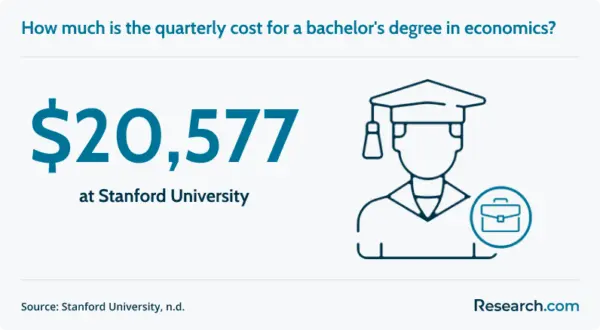
- Estimated Cost: $20,577 (undergraduate tuition per quarter); $38,160 to $58,746 (graduate tuition per quarter)
- Required Credits to Graduate: 80 units (undergraduate); no information available (Ph.D.)
- Accreditation: Western Association of Schools and Colleges Senior College and University Commission (WSCUC)
4. Yale University
Yale University’s Department of Economics offers undergraduate and graduate paths for students who want a rigorous study of decision-making, resources, and incentives. The undergraduate program strengthens critical thinking and data analysis skills, while the one-year master’s program focuses on international and development economics. Students who want doctoral study can pursue the Ph.D. program and choose from several specializations.
- Program Length: Four years (undergraduate); One year (master’s); Six years (Ph.D.)
- Tracks/concentrations: Economics & Mathematics, Computer Science & Economics (undergraduate); International and Development Economics (MA); Development Economics, Econometrics, Economic History, Economic Theory, Financial Economics, Industrial Organization, International Trade, Labor Economics, Macroeconomics, Political Economy, Public Economics (Ph.D.)
- Estimated Cost: $64,700 undergraduate tuition and fees per year); $48,300 (graduate tuition per year)
- Required Credits to Graduate: 36 (undergraduate), no information available (graduate)
- Accreditation: New England Commission of Higher Education (NECHE)
5. University of Chicago
The University of Chicago’s undergraduate economics program is known for its analytical rigor and its strong emphasis on mathematics and statistics. Students can choose business economics or data science to align the degree with their goals, and the department also offers several graduate economics programs. This is a strong fit for students who want a very technical economics education.
- Program Length: Four years (undergraduate); One to two years (master’s); Five to six years (Ph.D.)
- Tracks/concentrations: Standard Track, Business Economics, Data Science (undergraduate); M.A. in the Social Sciences, Masters in Computational Social Science (master’s); Ph.D. in Economics, Ph.D. in Financial Economics (Ph.D.)
- Estimated Cost: $21,715 (undergraduate tuition per quarter); $21,715 (graduate tuition per quarter)
- Required Credits to Graduate: 42 (undergraduate); no information available (graduate)
- Accreditation: Higher Learning Commission (HLC)
6. Massachusetts Institute of Technology (MIT)
The Economics Department at the Massachusetts Institute of Technology (MIT) offers three undergraduate major options: Economics, Mathematical Economics, and Computer Science, Economics, and Data Science. The curriculum is demanding and built around quantitative reasoning, communication, and problem-solving. At the graduate level, MIT offers a Ph.D. program in Economics, a Master of Science in Economics, and a Master of Applied Science in Data, Economics, and Development Policy.
- Program Length: Four years (undergraduate); Five years (M.E.); Five to six years (Ph.D.)
- Tracks/concentrations: Economics, Mathematical Economics, and Computer Science, Economics, and Data Science (undergraduate); Computer Science, Economics, and Data Science; Data, Economics, and Design of Policy (master’s); Development, Econometrics, Finance, Industrial Organization, International, Labor, Macroeconomics, Organizational, Political Economy, Public Finance, Theory (Ph.D.)
- Estimated Cost: $59,750 (undergraduate tuition per year); $29,875 (graduate tuition per term)
- Required Credits to Graduate: No information available
- Accreditation: New England Commission of Higher Education (NECHE)
7. Princeton University
Princeton University’s undergraduate economics program combines technical training with research. Students work with faculty advisors on the Junior Paper and Senior Thesis, which gives them experience developing a long-form research project. The department also offers a selective Ph.D. program for students interested in advanced research.
- Program Length: Four years (undergraduate); Five years (Ph.D.)
- Tracks/concentrations: Economics (undergraduate); No information available (Ph.D.)
- Estimated Cost: $62,400 (undergraduate tuition per year); $4,320 to $59,710 (graduate tuition per year)
- Required Credits to Graduate: 45 units (undergraduate); No information available (Ph.D.)
- Accreditation: Middle States Commission on Higher Education (MSCHE)
8. Northwestern University
Northwestern University’s undergraduate economics program trains students to apply economic analysis, evaluate policy, work with empirical evidence, and communicate clearly about complex issues. Students also complete two related courses outside economics to broaden their perspective. Northwestern offers a selective four-year BA/MA option for qualified majors and a Ph.D. program spanning several fields.
- Program Length: Four years (undergraduate); Four to six years (Ph.D.)
- Tracks/concentrations: Economics (undergraduate); Development Economics, Econometrics, Economic History, Health Economics, Financial Economics, Industrial Organization, Labor and Public Economics, Macroeconomics, Microeconomic Theory (Ph.D.)
- Estimated Cost: $21,629 (undergraduate tuition per quarter); $4,672 to $18,689 per quarter (graduate tuition)
- Required Credits to Graduate: 45 (undergraduate); No information available (Ph.D.)
- Accreditation: Higher Learning Commission (Higher Learning Commission)
9. University of Michigan Ann Arbor
The University of Michigan offers an undergraduate economics major that covers both theory and applied work. Students build quantitative strength, analytical ability, and professional readiness. At the graduate level, the Department of Economics offers the Master of Arts degree in Applied Economics (M.A.E) and the Ph.D. program. Students in the doctoral program may also earn an embedded M.A. in Economics.
- Program Length: Four years (undergraduate); Three to four semesters (M.A.E.); Five to six years (Ph.D.)
- Tracks/Concentrations: Economics (undergraduate); Applied Economics (M.A.E.); Microeconomic Theory, Econometrics, Macroeconomics, Finance, History, International Economics, Development, Public Finance, Industrial Organization, Labor, And Natural Resources (Ph.D.)
- Estimated Cost: $8,448 to $9,529 (in-state undergraduate tuition for a full term); $13,596 (in-state graduate tuition for a full term)
- Required Credits to Graduate: 30 (undergraduate); 38 (M.A.E.); No information available (Ph.D.)
- Accreditation: Higher Learning Commission (Higher Learning Commission)
10. Vanderbilt University
At Vanderbilt University, students can major in economics through a program built around analytical thinking, quantitative reasoning, and real-world application. The undergraduate path prepares students for work in private firms, public policy, and research, while the department’s Ph.D. program lets students focus on two areas of interest.
- Program Length: Four years (undergraduate); Five years (Ph.D.)
- Tracks/concentrations: Economics (undergraduate); Microeconomic Theory, Macroeconomic Theory, Econometrics, Economic Development, Economic History, Health Economics, Industrial Organization, International Economics, Labor Economics, Money and Financial Institutions, Public Economics (Ph.D.)
- Estimated Cost: $61,618 (undergraduate tuition per year); $2,281.00 (graduate tuition per credit hour)
- Required Credits to Graduate: 33 (undergraduate); No information available (Ph.D.)
- Accreditation: Southern Association of Colleges and Schools Commission on Colleges (SACSCOC)
How long does it take to finish an economics degree?
Most bachelor’s degrees in economics take four years, while master’s programs usually take one to three years. Doctoral study often takes five or more years, depending on the school, your research progress, and whether the program includes an embedded master’s degree. Some accelerated or flexible formats can shorten or extend the timeline.
Transfer credits, part-time enrollment, and course availability can also change how long the degree takes. If you plan to work while studying, look for programs that publish clear scheduling policies and completion expectations.
Online economics degree vs. on-campus economics degree
Both formats can be academically strong, but they serve different needs. Online economics programs are often better for working adults, caregivers, and students who need scheduling flexibility. Campus programs are often better for students who want direct access to faculty, in-person networking, research groups, and campus resources.
| Factor | Online program | On-campus program |
| Schedule | Often flexible and may be asynchronous | Usually fixed and in person |
| Best for | Working adults, commuters, parents, and self-directed learners | Traditional students and those who want more face-to-face support |
| Networking | Can be strong, but usually more virtual | Often easier through clubs, events, and faculty access |
| Cost | May reduce commuting and housing costs | Can involve more campus-related expenses |
| Structure | Requires self-discipline and time management | More built-in structure and routine |
Online degrees are not automatically easier, and campus programs are not automatically better. The right choice depends on how you learn, how much flexibility you need, and whether the program is properly accredited.
What does an economics degree cost?
Tuition varies widely by school type, location, and whether the program is public or private. Based on the schools reviewed here, a top-ranked undergraduate economics program can cost about $70,000 per year in tuition and fees. Some schools charge much less, especially public universities for in-state students, while elite private universities often charge significantly more.
For example, Stanford University lists an estimated $20,577 per quarter for undergraduate tuition, while graduate tuition ranges from $38,160 to $58,746 per quarter depending on the number of units taken. Costs should always be checked directly with the school because tuition, fees, and credit-load rules can change.
When comparing programs, do not focus only on sticker price. Also evaluate aid, scholarship eligibility, housing, transportation, opportunity cost, and whether the program’s outcomes justify the total investment.
What financial aid options can economics students use?
Many schools offer merit aid, need-based aid, and department-level funding. Graduate students may also qualify for research assistantships, teaching assistantships, fellowships, or tuition discounts, depending on the institution. For undergraduates, federal aid, state aid, institutional scholarships, and private scholarships can help reduce out-of-pocket costs.
Students should also look outside their school for outside funding opportunities. The financial aid and scholarships resource can be a useful place to start if you want to compare private options.
Examples of scholarship opportunities
Future Leaders in Finance Scholarship
- Package: $1,000
- Eligibility: Open to students who are at least 18 years old and enrolled in high school, college, trade school, or graduate school with at least a 2.8 GPA. It is designed to encourage financial literacy and planning.
The Barron Prize
- Package: $10,000
- Eligibility: Awarded to 25 young leaders each year. It is open to students under the 18 who have made notable contributions to their community and the environment.
Horatio Alger Association National Scholarship
- Package: $25,000
- Eligibility: Granted to 106 high school juniors each year. It honors students who have shown perseverance and achievement despite adversity.
What do you need to get into an economics degree program?
Admission requirements vary by school, but many programs look for a strong academic background in math and analytical subjects. Some universities require or strongly recommend prior coursework in economics, calculus, statistics, or related areas. For example, the University of California, Berkeley expects prerequisite coursework in economics, calculus, statistics, and intermediate economic theory, or proof that those courses are in progress.
Schools also usually ask for standard application materials. International applicants may need to submit English proficiency scores as well.
Common admission requirements
- Proof of graduation. This may be a high school diploma or equivalent credential.
- Official transcripts. Schools often use these to review GPA, course rigor, and prerequisite completion.
- TOEFL or IELTS. International applicants may be asked to provide one of these scores, depending on the school.
- Application fee. Fees are usually nonrefundable.
What classes are usually included in an economics degree?
Most economics programs combine core courses, supporting quantitative classes, and electives. A typical curriculum begins with introductory microeconomics and macroeconomics, then moves into statistics, econometrics, and advanced applied topics. Schools often add concentration-specific coursework for students who want a policy, finance, or data focus.
At the University of Chicago, for example, the curriculum includes five class types:
- Core
- Methods
- Empirical Analysis
- Perspectives
- Electives
This structure helps students gain both theoretical grounding and practical analytical skills.
What specializations can economics students pursue?
Specialization options are more common at the graduate level, although some undergraduate programs offer track choices or related minors. Students often choose specializations based on the kind of problems they want to solve after graduation.
- Business Economics
- Economics in the Developing World
- Policy
- Economics of Cities
- Market Structure and Firm Strategy
- Poverty and Inequality
- Economics of Jobs
- International Macro-Finance/Macroeconomics of Financial Markets
- Managerial Economic Analysis
- Economics of Organization
- Economic History
- Data Analytics and Economic Analysis
- Behavior and Strategy
How to choose the right economics degree program
The best economics program is not always the most famous one. Start by identifying your target outcome: policy work, graduate school, data analytics, consulting, finance, or a broader business role. Then compare schools based on curriculum, faculty interests, research opportunities, internship support, flexibility, cost, and accreditation.
If you want to apply economics outside the field itself, look for programs with minors, joint majors, or concentration options that connect to business, math, statistics, data science, political science, or public policy. Those combinations often improve job versatility.
Questions to ask before you enroll
- Is the school properly accredited?
- Does the program offer enough math, statistics, and econometrics for my goals?
- Are internships, research, or capstone projects built into the curriculum?
- Will an online format meet my licensing, graduate school, or employer expectations?
- How much debt would I need to take on, and what salary range would I realistically need to repay it?
- Do alumni from this program move into the careers I want?
Can an economics degree help with accounting careers?
Yes, an economics degree can strengthen accounting-related career options because it builds the quantitative reasoning, data interpretation, and financial analysis skills that employers value. These skills can be useful in auditing, budgeting, forecasting, and evaluating company performance. That said, if your main goal is accounting, you should compare economics with a dedicated accounting degree or review the highest paying accounting jobs to understand which path aligns better with licensure and employer expectations.
How are technology and AI changing economics programs?
Economics departments are placing more emphasis on data analytics, coding, modeling, and digital tools because employers increasingly expect graduates to work with real datasets and not just theory. Many students now benefit from learning software used in forecasting, visualization, and empirical research. AI tools can help with preliminary analysis, but they do not replace the need to understand causation, policy trade-offs, and statistical judgment.
Students who want a more technical edge should look for coursework in econometrics, programming, and data science. Related specialized degrees, such as the online masters in taxation, show how analytics and digital tools are influencing adjacent business and policy fields as well.
Should students consider accelerated economics pathways?
Accelerated options may be useful for students who want to enter the job market sooner or move directly into graduate study. They can reduce time in school, but they also leave less room for internships, study abroad, research, or part-time work. That trade-off matters in economics, where practical experience often strengthens job prospects.
Some schools also offer accelerated or related business pathways such as the accounting and finance accelerated degree format. These can make sense for students who already know they want a finance-heavy career and are comfortable with a faster pace.
What careers are available after an economics degree?
Economics graduates can move into a wide range of roles. Some jobs are directly tied to economics, while others use the same analytical skill set in adjacent fields. Among the ideal jobs for economic majors are the following.
- Policy Analyst. Policy analysts review economic trends, forecast effects, and assess how government choices may influence institutions, organizations, and industries. The job often overlaps with public policy and political analysis, making related study in political degree programs useful for some students.
- Personal Finance Advisor. Personal finance advisors help clients manage saving, insurance, and investments to meet short- and long-term goals. A degree in finance may be a better fit for students who want a more specialized path into this work.
- Economic Consultant. Economic consultants study businesses, industries, or disputes and use data to support recommendations or legal analysis.
- Economist. Economists examine how goods, services, and resources move through an economy. They study data, identify trends, and evaluate policy or market behavior.
- Quantitative Analyst. Quantitative analysts use statistical and mathematical methods to solve financial and risk-management problems. They are often hired by investment firms, banks, and insurers.
How fintech trends are influencing economics careers
Fintech has expanded the kinds of problems economics graduates can help solve. Areas such as blockchain, digital payments, algorithmic lending, decentralized finance, and smart contracts all need people who can interpret incentives, risk, regulation, and market behavior. This is creating more demand for graduates who combine economic theory with quantitative and technical skills.
Students interested in this space should look for coursework or experiences related to coding, data analysis, and financial systems. If you want a more specialized route, explore degrees in cryptocurrency that connect economic reasoning to digital finance.
What is the job outlook for economics graduates?
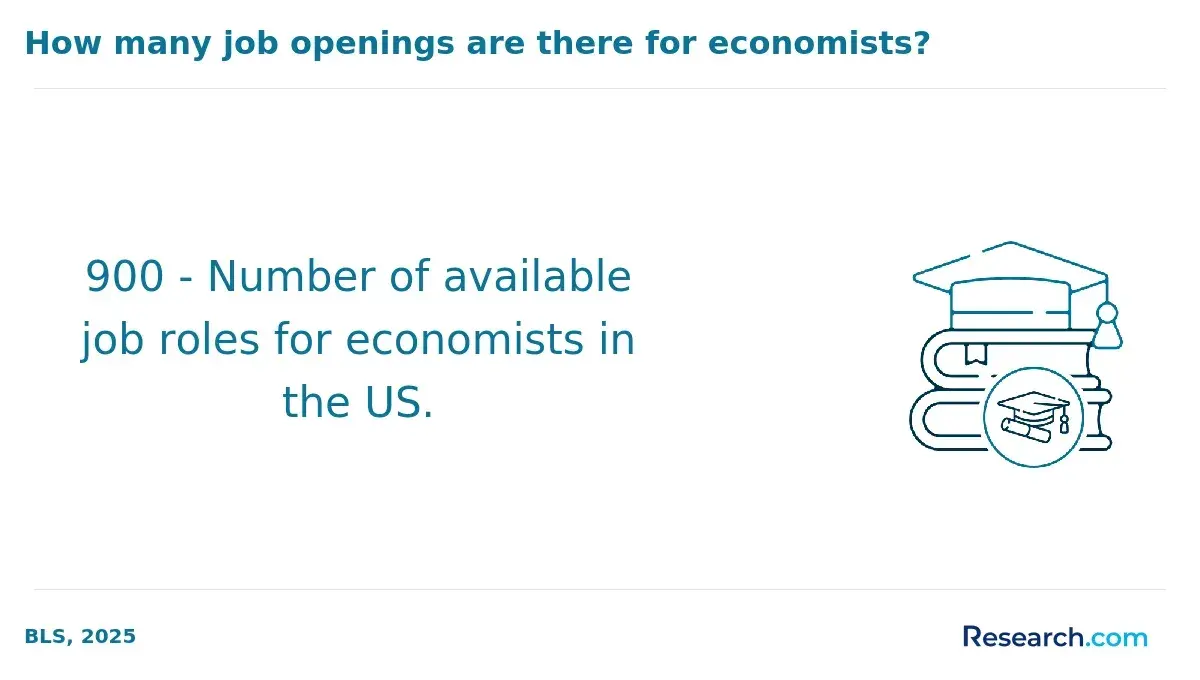
The job market for economics majors depends on the role they pursue. The BLS expects some economics-related jobs to grow more slowly than average, while others tied to analytics and data may expand faster. That means students should think carefully about whether they want to be a pure economist or use economics as a foundation for a broader analytics career.
For example, demand can be influenced by public budgets, business cycles, regulation, and the wider adoption of data-driven decision-making. Students who add technical tools such as SQL, Python, R, or statistics may widen their opportunities beyond traditional economics roles.
What are the main challenges of studying economics?
Economics can be demanding because it combines theory, math, statistics, and research. Students often need to translate abstract ideas into measurable relationships, which can be difficult at first. Upper-level courses may require more comfort with calculus, statistical inference, and model-building than many students expect.
Time management is another common challenge. Economics majors often juggle coursework, research, internships, and job preparation at the same time. Students who stay organized, use office hours, and look for tutoring or peer study groups tend to adapt more successfully.
How economics programs connect theory to real-world practice
Strong programs do more than teach models. They give students chances to apply concepts to policy debates, market data, and real business questions. Case studies, research papers, internships, and capstone projects help students test theory against actual conditions.
When comparing schools, look for signs that the program values applied learning. That can include faculty research, economics labs, data projects, internship support, or partnerships with government and industry. If a program is mostly theoretical without applied work, you may need to create your own experience outside class.
How economics differs from business and finance
Economics, business, and finance overlap, but they train students for different questions.
| Field | Main focus | Best for students who want to... |
| Economics | Study markets, incentives, policy, and resource allocation | Analyze systems and explain why outcomes occur |
| Business | Run organizations and manage operations, marketing, and strategy | Work directly in company management and administration |
| Finance | Handle investments, capital, valuation, and financial decision-making | Work in banking, corporate finance, or investing |
If you like frameworks, models, and evidence-based reasoning, economics may be the better fit. If you want a more immediate business or investment focus, business or finance may be more practical.
Are online economics degrees respected?
Yes, an online economics degree can be well respected if it comes from an accredited institution with a strong curriculum. Employers usually care more about accreditation, school reputation, skills, and experience than whether the classes were online or on campus. The degree is strongest when the program has rigorous coursework, accessible faculty, and outcomes that align with the student’s goals.
Online study can be a smart option for adults who need flexibility, but students should verify whether the program includes enough support, faculty interaction, and career services. For those looking to reduce cost, the cheapest regionally accredited online colleges can be worth comparing.
What is the return on investment for an economics degree?
The return on investment depends on what you study, where you enroll, how much debt you take on, and what job you pursue after graduation. Economics can offer a strong ROI when the degree leads to a role with solid pay and growth potential, especially if the student keeps borrowing manageable and builds marketable skills during school.
ROI is usually strongest when the program is accredited, financially realistic, and matched to a concrete career plan. Adding a second skill set, such as data analysis, accounting, policy, or coding, can improve the value of the degree in the job market. If you are weighing business-focused alternatives, you may also want to compare it with an online BA business administration path.
How economics degrees prepare students for leadership
Economics develops habits that matter in leadership: strategic thinking, evidence-based decision-making, and comfort with complexity. Leaders in business, government, and nonprofits often need to evaluate trade-offs, allocate resources, and explain decisions clearly. Economics training supports those skills.
Group work, presentations, research projects, and data analysis also help students practice collaboration and communication. Those are essential when leading teams or managing projects in the workplace.
- Strategic thinking: Students learn to look beyond immediate outcomes and consider system-wide effects.
- Analytical reasoning: They practice turning data into decisions.
- Problem-solving: They learn to evaluate multiple options before choosing a path.
- Policy awareness: They gain insight into how rules and incentives shape behavior.
- Teamwork: They build experience working through complex problems with others.
Common mistakes to avoid when choosing an economics program
- Choosing a school without confirming accreditation.
- Assuming every online program meets the needs of employers or graduate schools.
- Focusing only on tuition and ignoring aid, living costs, and loan debt.
- Skipping programs with strong quantitative training when the target job requires it.
- Relying on prestige alone instead of outcomes, fit, and access to applied experience.
- Ignoring transfer-credit policies, especially if you may switch schools later.
Practical steps to choose the right economics degree
- Define your goal first: policy, research, data, finance, consulting, or graduate school.
- Check whether the school is properly accredited.
- Review the curriculum for statistics, econometrics, and research methods.
- Compare total cost, not just tuition.
- Look for internships, capstones, research opportunities, or employer connections.
- Decide whether you need online flexibility or campus networking.
- Ask what graduates do after completion and whether the program has clear placement outcomes.
Key Insights
- An economics degree is most valuable for students who want a flexible, quantitative, and policy-aware education.
- The degree can lead to work in government, consulting, finance, analytics, and research, but outcomes depend on skills and experience.
- Salary potential can be strong, especially for economist and data-heavy roles, but earnings vary widely by job and education level.
- Online programs can be respected if they are accredited and rigorous, but they require strong self-discipline.
- Cost matters, but so do accreditation, curriculum depth, internship access, and long-term career fit.
- Students who pair economics with data science, coding, statistics, or another specialty usually have stronger job options.
- The best program is the one that matches your target career, budget, and learning style—not just the highest ranking school.
References:
- U.S. Bureau of Labor Statistics. (2024, April 25). 15-2051 Data Scientists. Bureau of Labor Statistics. Retrieved January 15, 2024, from https://www.bls.gov/oes/current/oes152051.htm
- U.S. Bureau of Labor Statistics. (2024, April 25). 19-3011 Economists. Bureau of Labor Statistics. Retrieved January 15, 2024, from https://www.bls.gov/oes/current/oes193011.htm
- U.S. Bureau of Labor Statistics. (2024, April 25). 13-2052 Personal Financial Advisors. Bureau of Labor Statistics. Retrieved January 15, 2024, from https://www.bls.gov/oes/current/oes132052.htm
- U.S. Bureau of Labor Statistics. (2024, September 6). Data Scientists : Occupational Outlook Handbook: : U.S. Bureau of Labor Statistics. Retrieved January 13, 2024, from https://www.bls.gov/ooh/math/data-scientists.htm
- U.S. Bureau of Labor Statistics. (2024, September 6). Financial Analysts : Occupational Outlook Handbook: : U.S. Bureau of Labor Statistics. Retrieved January 13, 2024, from https://www.bls.gov/ooh/business-and-financial/financial-analysts.htm
- U.S. Bureau of Labor Statistics. (2024, September 6). Management Analysts : Occupational Outlook Handbook: : U.S. Bureau of Labor Statistics. Retrieved January 13, 2024, from https://www.bls.gov/ooh/business-and-financial/management-analysts.htm
- U.S. Bureau of Labor Statistics. (2024, September 6). Personal Financial Advisors : Occupational Outlook Handbook: : U.S. Bureau of Labor Statistics. Retrieved January 13, 2024, from http://bls.gov/ooh/business-and-financial/personal-financial-advisors.htm
- U.S. Bureau of Labor Statistics. (2024, September 6). Political Scientists : Occupational Outlook Handbook: : U.S. Bureau of Labor Statistics. Retrieved January 13, 2024, from https://www.bls.gov/ooh/life-physical-and-social-science/political-scientists.htm
- Zippia. (2024, July 21). Best Colleges and Degrees For Economists. Zippia. Retrieved January 15, 2024, from https://www.zippia.com/economist-jobs/education
Other Things You Should Know About Economics Degree Programs
Most economics programs expect at least high school algebra, functions, and statistics, and many ask for calculus readiness before enrollment. Some universities require a minimum grade in Grade 12 math or an SAT/ACT math benchmark, because first-year microeconomics and econometrics use quantitative analysis.
Economics graduates in 2027 are favored in industries such as finance, consulting, technology, and government. These sectors value the analytical and quantitative skills that economics programs emphasize, providing diverse career opportunities with potential for advancement.
Understanding key theoretical frameworks and methodologies, like supply-demand analysis or econometrics, is crucial for economics students in 2027. These tools allow students to analyze data and solve complex economic problems, preparing them for diverse careers in finance, public policy, or research.
Economics degree programs in 2027 integrate real-world data and analytical tools by emphasizing quantitative methods, econometrics, and the use of software like R and Python. Hands-on projects and case studies help students apply theories to contemporary economic problems, ensuring they gain practical skills essential for the job market.


