2027 How To Become A Physician Assistant

Co-Founder and Chief Data Scientist
Becoming a physician assistant requires more than choosing a healthcare major and applying to graduate school. You need the right prerequisites, patient care experience, an accredited PA program, certification, and state authorization to practice. For many students, the biggest challenge is knowing how to sequence those steps without wasting time or money.
This guide explains how to become a physician assistant for 2027, what the career involves, how much PAs can earn, what education is typically required, and how to compare PA programs. It is designed for high school students planning ahead, college students preparing for PA school, career changers from allied health roles, and working clinicians considering advancement.
Quick Answer: How Do You Become a Physician Assistant?
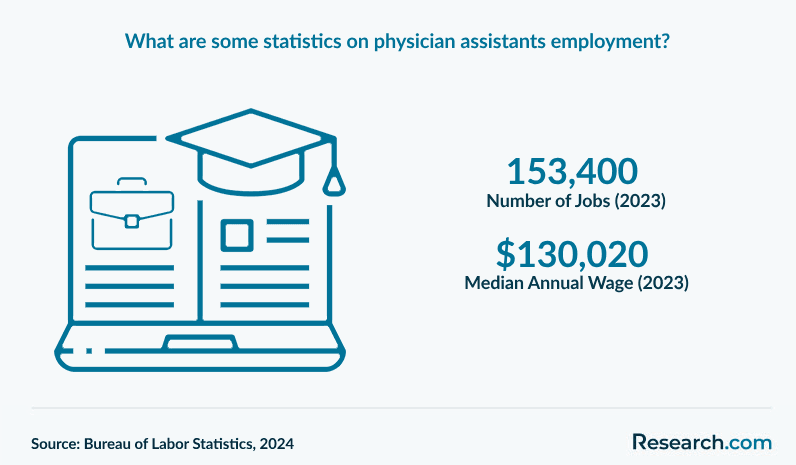
To become a physician assistant, you typically complete a bachelor’s degree with science prerequisites, gain healthcare or patient care experience, graduate from an accredited master’s-level PA program, pass the Physician Assistant National Certifying Exam, and meet state practice requirements. The Bureau of Labor Statistics lists a master’s degree as the typical entry-level education for physician assistants, and reports a median annual salary of $130,020.
Key Things You Should Know About Becoming a Physician Assistant for 2027
- Strong earning potential: Physician assistants earn a median annual salary of approximately $130,000, with the BLS reporting $130,020 as the median salary.
- Fast employment growth: PA employment is projected to grow by 28%, far above the 4% average growth rate for all occupations.
- Broad demand across settings: PAs work in hospitals, outpatient clinics, specialty practices, emergency care, and underserved communities where access to medical providers is limited.
- Graduate-level preparation: A master’s degree from an accredited PA program is the standard pathway into the profession.
- Room for specialization and leadership: Experienced PAs may move into specialty practice, administration, education, research, or doctoral-level leadership roles, with listed examples reaching $140,000 to $150,000.
- Why Become a Physician Assistant?
- Physician Assistant Salary and Job Outlook
- Skills Physician Assistants Need
- Steps to Start a PA Career for 2027
- Should PAs Consider a Doctorate?
- How to Choose a PA Program
- How PAs Can Advance Their Careers
- Legal Responsibilities and Risk Management
- How to Prepare for the PANCE
- Moving from Clinical Practice into Leadership
- Using Sonography Skills in PA Practice
- Alternative Careers for PAs and PA Applicants
- Using an Accelerated Biology Degree Before PA School
- Healthcare Administration Training for PA Leaders
- Best Undergraduate Pathways for PA School
- Ways to Finance PA Education
- Online Training for Practice Management
- How Public Health Training Can Support a PA Career
Why Become a Physician Assistant?
A physician assistant is a licensed medical professional who evaluates patients, diagnoses conditions, orders and interprets tests, develops treatment plans, prescribes medication where allowed, and works as part of a healthcare team. The role appeals to people who want direct patient care, medical decision-making, and career flexibility without following the full physician training route.
What Physician Assistants Do Day to Day
PA responsibilities vary by specialty, state rules, employer policies, and supervising or collaborating physician arrangements. In a typical clinical role, a PA may see patients independently, review histories, perform physical exams, assist in procedures, provide follow-up care, educate families, and coordinate referrals.
| PA responsibility | What it looks like in practice | Why it matters |
| Patient evaluation | Taking histories, performing exams, and identifying symptoms that need follow-up | Accurate assessments help patients receive timely care |
| Diagnosis and treatment planning | Ordering tests, interpreting results, and recommending treatment options | PAs support faster clinical decisions across busy healthcare settings |
| Procedural support | Assisting with suturing, injections, wound care, or specialty-specific procedures | Hands-on skills expand a PA’s usefulness in clinics, emergency departments, and surgical teams |
| Patient education | Explaining medications, lifestyle changes, follow-up instructions, and warning signs | Clear guidance can improve adherence and reduce avoidable complications |
| Team collaboration | Working with physicians, nurses, pharmacists, therapists, and administrators | Modern healthcare depends on coordinated care, not isolated decision-making |
Personal and Professional Rewards
The PA career can be meaningful for people who value direct service, complex problem-solving, and long-term patient relationships. You may care for people during stressful moments, help families understand treatment choices, and contribute to better access in communities that need more clinicians.
Salary, Stability, and Advancement Potential
The BLS reports a physician assistant median annual salary of $130,020, and the occupation combines clinical responsibility with strong labor market demand. PAs who want to compare advanced clinical and leadership earnings across healthcare may also review Research.com’s guide to DNP salary by specialty, especially if they are weighing PA advancement against other graduate healthcare routes.
Physician Assistant Salary and Job Outlook
The employment outlook for physician assistants is one of the strongest reasons students consider this path. The BLS projects PA employment to grow by 28% from 2023 to 2033, compared with 4% for all occupations. The demand is tied to factors such as population aging, preventive care needs, and the use of team-based care models.
Reports also identify PAs as the second-best healthcare job, reflecting the occupation’s combination of compensation, demand, responsibility, and career mobility. However, salary can vary by state, specialty, employer type, experience level, and schedule. Students comparing healthcare careers should avoid assuming that a national median guarantees a specific offer in their local market.
| Career factor | What the available data says | How to use it when deciding |
| Median salary | $130,020 per year according to the BLS | Use this as a national benchmark, then research local employer pay |
| Projected employment growth | 28% from 2023 to 2033 | Strong growth supports the case for PA school, but admission remains competitive |
| Average growth for all occupations | 4% | The PA outlook is substantially faster than the labor market average |
| Career ranking | Named the second-best healthcare job in cited reports | Rankings can be useful, but they should not replace program, cost, and fit analysis |
If you are still comparing healthcare and behavioral health fields, salary guides such as Research.com’s overview of child and adolescent psychology salary can help you understand how different patient-care careers compare in training length, scope, and compensation.
Skills Physician Assistants Need
Successful PAs need more than strong grades in science courses. They must combine clinical reasoning, procedural skill, communication, judgment, and emotional steadiness in settings where patients may be anxious, ill, or in pain.
Clinical and Technical Skills
- Medical knowledge: PAs need a working understanding of anatomy, physiology, pathology, pharmacology, and evidence-based treatment across common and complex conditions.
- Diagnostic reasoning: The job requires connecting symptoms, exam findings, test results, and patient history to reach appropriate clinical decisions.
- Procedure readiness: Depending on specialty, PAs may perform or assist with injections, suturing, wound care, emergency interventions, or surgical support.
- Documentation accuracy: Clear medical records support continuity of care, billing, legal compliance, and team communication.
- Technology comfort: PAs regularly use electronic health records, telehealth platforms, diagnostic tools, and clinical decision-support resources.
Interpersonal and Professional Skills
- Communication: PAs must explain conditions and treatment options in language patients can understand while also communicating precisely with clinicians.
- Empathy: Patients are more likely to trust care plans when they feel heard, respected, and treated as people rather than cases.
- Problem-solving: Clinical work often requires quick prioritization, especially when symptoms are unclear or resources are limited.
- Leadership: Even without a formal management title, PAs may coordinate care, guide medical assistants, support nurses, and help teams work efficiently.
- Ethical judgment: Confidentiality, informed consent, scope of practice, and documentation standards are part of daily professional responsibility.
How to Start Your Career as a Physician Assistant for 2027
The most common PA pathway begins with undergraduate preparation, prerequisite science courses, healthcare experience, and admission to a master’s-level PA program. Some students begin in allied health roles before applying, while others enter from biology, nursing, public health, exercise science, or other health-related majors.
A related associate’s degree can help you enter healthcare sooner, but it does not qualify you to work as a physician assistant. If you are comparing allied health tracks before committing to PA school, you may also find it useful to review other patient-care education options, including accelerated speech pathology programs online.
Typical PA Career Timeline
| Stage | Main goal | Decision to make |
| Undergraduate preparation | Complete a bachelor’s degree and required science coursework | Choose a major that helps you finish prerequisites while maintaining strong academic performance |
| Healthcare experience | Build exposure to patient care and clinical environments | Select roles that strengthen your application and confirm that clinical work fits you |
| PA program admission | Apply to accredited PA programs that match your goals and budget | Compare accreditation, clinical rotations, cost, location, and outcomes |
| Graduate PA education | Complete classroom, lab, and clinical training | Use rotations to test specialties and build professional references |
| Certification and practice authorization | Prepare for the PANCE and meet state requirements | Track deadlines, documentation, and continuing certification obligations |
What Can You Do with an Associate’s Degree Before PA School?
Medical Assistant: $35,850
A medical assistant role can provide early exposure to clinical workflows, patient intake, scheduling, exam preparation, and provider support. It is often a practical option for students who want healthcare experience before applying to graduate programs.
Emergency Medical Technician (EMT): $36,650
EMTs provide urgent care in emergency situations, deliver first aid, assess patients quickly, and transport them to medical facilities. This role can strengthen decision-making, composure, and patient-contact experience.
What Can You Do with a Bachelor’s Degree Before PA School?
Registered Nurse (RN): $77,600
A nursing bachelor’s degree can lead to RN practice, where you provide patient care, administer medications, monitor conditions, and coordinate with interdisciplinary teams. Students who already hold an associate’s degree in nursing may compare bridge options such as 9 month RN-BSN online programs before deciding whether PA school or nursing advancement is the better fit.
Healthcare Administrator: $100,980
Healthcare administrators manage operations, staffing, budgets, compliance, and service improvement in healthcare organizations. If your long-term goal leans more toward leadership than clinical practice, graduate nursing or administration options, including the easiest MSN program, may be worth comparing with PA education.
Can You Become a Physician Assistant with Only a Certificate?
No. A certificate may help you qualify for entry-level healthcare support work, but it does not meet the education standard for PA practice. Physician assistants typically need a master’s degree from an accredited PA program, supervised clinical training, certification, and state authorization.
| Credential | Can it lead directly to PA practice? | Best use |
| Certificate | No | Entry-level healthcare exposure or a support role |
| Associate’s degree | No | Allied health work and patient care experience |
| Bachelor’s degree | No, but it is commonly required before PA school | Prerequisites, academic preparation, and competitive graduate admission |
| Master’s-level PA program | Yes, when paired with certification and state requirements | Standard professional pathway into PA practice |
Is a Doctorate the Right Move for Career Advancement?
A doctorate is not the standard entry requirement for becoming a physician assistant, but it may make sense for experienced PAs who want roles in education, research, administration, policy, or high-level clinical leadership. The key question is whether the degree supports a specific career outcome, not whether it simply looks impressive.
Before enrolling, compare the cost, time commitment, employer expectations, and whether a doctoral credential will change your responsibilities or compensation. Working PAs who need flexible study options can review online doctoral programs as part of a broader comparison of advanced healthcare credentials.
How Do I Choose the Right Physician Assistant Program?
The best PA program is not automatically the highest-ranked or most expensive one. It is the program that is accredited, fits your prerequisites, offers strong clinical placements, prepares students for certification, and makes financial sense for your situation.
| Program factor | What to check | Why it matters |
| Accreditation | Confirm the program is properly accredited for PA education | Accreditation affects certification eligibility and professional credibility |
| Prerequisites | Review required coursework, GPA expectations, and healthcare experience rules | Missing one prerequisite can delay your application cycle |
| Clinical rotations | Ask where rotations occur and which specialties are included | Clinical placement quality affects training depth and networking |
| PANCE preparation | Request exam preparation support and outcome information | Certification readiness is central to entering practice |
| Total cost | Include tuition, fees, books, commuting, relocation, and living expenses | The cheapest tuition is not always the lowest total cost |
| Student support | Look for advising, remediation policies, wellness resources, and career services | PA programs are demanding, and support can affect persistence |
When comparing costs, look beyond tuition alone. It can help to review how other healthcare programs present expenses, such as Research.com’s guide to medical billing and coding online courses cost, so you build a complete budget rather than relying on advertised prices.
How Can I Advance My Career as a Physician Assistant?
Career advancement as a PA usually comes from a mix of clinical experience, specialty expertise, leadership ability, continuing education, and sometimes additional graduate study. You do not need to leave patient care to grow, but you should be intentional about the roles you pursue.
Physician Assistant Certifications and Apprenticeship Programs
Additional credentials can help PAs document expertise in a specialty or prepare for responsibilities in emergency medicine, surgery, dermatology, digital health, or practice operations. The National Commission on Certification of Physician Assistants offers specialty certificates that may strengthen a PA’s professional profile when aligned with experience and employer needs.
Apprenticeship-style learning, structured mentorship, and specialty onboarding can also be valuable. In many clinical environments, advancement depends not only on credentials but on whether you can safely handle higher-acuity patients, collaborate with specialists, and document care thoroughly.
What Can You Do with a Master’s as a Physician Assistant?
Clinical Specialist: $140,000
A PA with advanced specialty experience may work in areas such as cardiology or orthopedics, managing complex cases and collaborating closely with physicians and specialty teams.
Healthcare Administrator: $120,000
Some PAs move into operations, staffing, quality improvement, policy implementation, and service-line management. This path is best for clinicians who enjoy systems thinking as much as patient care.
What Can You Do with a Doctorate as a Physician Assistant?
Director of Clinical Education: $150,000
This role involves building clinical training experiences, coordinating curricula, supporting faculty, and helping prepare future PAs for practice.
Healthcare Researcher: $130,000
Healthcare researchers study care delivery, clinical outcomes, patient safety, or evidence-based practice. PAs considering research, teaching, or executive leadership may also compare doctoral healthcare options such as easy DNP programs when evaluating long-term academic routes.
Which Certification Is Best for Physician Assistants?
The best certification depends on your specialty, employer expectations, and career goal. A PA working in emergency medicine needs different proof of expertise than a PA moving into dermatology, surgery, administration, or clinical education. Before paying for a credential, ask whether it is recognized by employers in your target specialty and whether it supports a role you realistically plan to pursue.
How Do Physician Assistants Navigate Legal Responsibilities and Manage Risk?
Physician assistants work within state practice rules, employer policies, payer requirements, and professional standards. Risk management is not limited to avoiding lawsuits; it also includes safe documentation, appropriate supervision or collaboration, informed consent, patient privacy, and timely escalation when a case exceeds your scope or experience.
- Know your scope: Understand what your state and employer allow you to do independently and what requires physician involvement.
- Document clearly: Record findings, reasoning, patient communication, follow-up instructions, and consultations accurately.
- Maintain malpractice coverage awareness: Know whether coverage is employer-provided, what it includes, and when additional protection may be needed.
- Stay current: Practice laws, institutional policies, and specialty protocols can change.
- Use multidisciplinary knowledge: PAs working closely with medication management teams may benefit from understanding pharmacy-related regulations; one way to explore that context is through resources on an accredited online pharmacy school.
How Can I Effectively Prepare for the Physician Assistant National Certifying Exam?
Preparing for the Physician Assistant National Certifying Exam requires a plan that begins before graduation. The strongest approach is to review core content consistently, use practice questions to identify weak areas, and simulate exam pacing rather than relying only on passive reading.
- Map your study calendar: Divide topics such as anatomy, pharmacology, clinical medicine, and procedures into manageable review blocks.
- Use question banks strategically: Track missed questions by topic so your study time targets actual gaps.
- Review clinical reasoning: Focus on how symptoms, history, exam findings, and diagnostics connect.
- Study with peers carefully: Group study works best when it involves explaining reasoning, not just sharing notes.
- Protect your routine: Sleep, food, and pacing matter during a high-stakes exam period.
Students still building foundational healthcare knowledge may compare accelerated allied health resources such as a fast track medical assistant program, but PANCE preparation should center on PA-level clinical content and official exam expectations.
Can Physician Assistants Transition Effectively into Leadership Roles?
Yes. PAs can move into leadership when they pair clinical credibility with management skills. Common leadership paths include lead PA, department coordinator, clinical educator, quality improvement leader, operations manager, and healthcare administrator.
The transition is easier when you can read budgets, evaluate staffing needs, manage conflict, understand compliance, and communicate with executives. PAs considering management should compare leadership compensation and responsibilities with benchmarks such as health administration salary to decide whether an administrative track fits their goals.
Can Integrating Diagnostic Medical Sonography Boost My Clinical Practice?
Diagnostic medical sonography can strengthen a PA’s assessment skills in settings where imaging knowledge supports faster, better-informed decisions. It is not necessary for every PA, but it may be useful for clinicians in emergency care, women’s health, cardiology, orthopedics, or procedural specialties.
Before investing in sonography training, ask whether your employer will allow you to use the skill, whether additional credentialing is required, and whether the training aligns with your specialty. Research.com’s overview of the best sonography programs can help you understand how imaging curricula are structured.
Alternative Career Options for Physician Assistants
Not everyone who starts on a PA pathway ultimately becomes a PA, and not every PA remains in direct clinical care forever. Your medical knowledge can support roles in consulting, writing, informatics, operations, education, public health, or entrepreneurship.
If you are still exploring nonclinical or public-service paths, comparing very different degrees can clarify your priorities. For example, asking what can you do with a homeland security degree may help you decide whether your interests lean more toward healthcare, public safety, policy, or organizational leadership.
What Else Can Physician Assistants Do?
- Healthcare consultant: Consultants help organizations improve workflows, quality, compliance, patient access, and operational performance.
- Medical writer: Medical writers translate clinical information for journals, healthcare companies, patient education materials, and digital health platforms.
- Health informatics specialist: Informatics professionals use clinical data, technology systems, and process improvement to support better care delivery.
- Entrepreneur: Some PAs launch clinics, consulting practices, education services, healthcare products, or technology-enabled care models.
- Behavior analyst: Clinicians interested in behavioral health can explore BCBA online masters programs and compare that route with PA practice, especially if they want to focus on behavioral intervention planning.
Can an Accelerated Biology Degree Program Give Me a Competitive Edge Before PA School?
An accelerated biology degree can be useful if it helps you complete core science prerequisites efficiently while maintaining strong grades. PA admissions committees often look closely at academic readiness, and biology coursework can support preparation in anatomy, physiology, microbiology, genetics, and lab-based reasoning.
The risk is speed without depth. A faster program only helps if you can handle the workload, earn competitive grades, and still gain healthcare experience. Students comparing efficient undergraduate routes can review the fastest biology degree online to understand how accelerated formats may fit PA school planning.
How Can Advanced Healthcare Administration Training Strengthen PA Leadership?
Healthcare administration training can help PAs move from individual patient care into team leadership, budgeting, compliance, quality improvement, and strategic operations. This training is most useful for PAs who want to influence how care is delivered, not only how individual patients are treated.
Because many PAs continue working while building leadership skills, flexible formats can matter. Research.com’s guide to a healthcare administration degree online can help clinicians compare accelerated administration pathways.
Which Undergraduate Pathway Best Prepares You for PA School?
The best undergraduate pathway is one that lets you complete PA prerequisites, earn strong grades, gain patient care experience, and build a convincing application. There is no single required major, but science-heavy programs often make prerequisite planning easier.
| Undergraduate option | Potential advantage | Watch out for |
| Biology | Strong match for life science prerequisites and lab training | May still require planning for healthcare experience outside class |
| Nursing | Direct patient care exposure and clinical responsibility | Students should compare whether RN advancement or PA school better matches their goals |
| Public health | Population health, prevention, policy, and community health perspective | May require additional lab science planning |
| Exercise science | Useful foundation for anatomy, movement, rehabilitation, and sports medicine interests | Prerequisite coverage varies by school |
| Healthcare administration | Good for future leadership interests | Usually needs careful science prerequisite planning |
Students who want a flexible science foundation can compare an online bachelors biology degree with campus-based options, but they should confirm lab requirements and PA school prerequisite acceptance before enrolling.
What Physician Assistants Say About Their Careers
“Becoming a physician assistant has allowed me to affect patients’ lives in practical, immediate ways. I value the hands-on work and the chance to collaborate with a broad medical team.” — Jessica
“I chose the PA route because I wanted strong career prospects, but the variety of cases and constant learning are what keep me committed to the work.” — Michael
“The most meaningful part of being a PA is knowing that patients rely on you during vulnerable moments. That sense of responsibility gives the career purpose.” — Aisha
How Can I Finance My PA Education Effectively?
PA education can involve tuition, fees, books, equipment, clinical travel, background checks, exam costs, and living expenses. A smart financing plan starts before you apply, because program length and location can significantly affect total cost.
- Complete the financial aid process early: Ask each program what federal, institutional, private, and healthcare-specific funding options may be available.
- Compare total cost of attendance: Tuition alone does not show relocation, commuting, clinical rotation, or lost income costs.
- Ask about scholarships and service programs: Some healthcare funding options may be connected to service commitments or specific practice areas.
- Limit unnecessary borrowing: Borrow based on a realistic budget, not the maximum amount offered.
- Evaluate lower-cost healthcare stepping-stones carefully: Reviewing medical assistant certification online cost may help you budget for an entry-level role, but PA school itself requires graduate-level investment.
How Can Supplementary Online Training Enhance My Practice Management Skills?
Online training in billing, coding, informatics, reimbursement, and practice management can be valuable for PAs who want leadership roles or who work in clinics where operational efficiency affects patient access. These skills do not replace PA clinical preparation, but they can make you more effective in administrative conversations.
If you want to understand revenue cycle basics, compliance workflows, or documentation requirements, compare accredited options such as the best online medical billing and coding schools before choosing a short course or certificate.
Can a Public Health Degree Enhance My PA Career?
A public health degree can strengthen a PA career when your goals include prevention, community health, policy, epidemiology, health education, or program leadership. An MPH can be especially useful for PAs working with underserved populations, chronic disease prevention, quality improvement, or health systems planning.
It is not necessary for every PA. If your goal is direct clinical specialization, specialty training may be more relevant. If your goal includes population-level impact, research, or healthcare policy, compare affordable MPH programs online with other graduate options.
Common Mistakes to Avoid When Planning a PA Career
| Mistake | Why it can hurt you | Better approach |
| Choosing a program without checking accreditation | Accreditation affects eligibility, credibility, and professional preparation | Verify accreditation before applying or paying deposits |
| Focusing only on tuition | Fees, living expenses, travel, and lost income can change the real cost | Compare full cost of attendance across programs |
| Assuming any healthcare job will strengthen an application equally | Some roles provide more meaningful patient care exposure than others | Choose experience that builds clinical maturity and aligns with PA admissions expectations |
| Ignoring prerequisite details | Missing or expired courses can delay admission | Create a prerequisite checklist for every target school |
| Relying only on rankings | A highly ranked program may not fit your location, cost, rotations, or support needs | Use rankings as one input, not the final decision |
| Assuming salary outcomes are guaranteed | Pay varies by specialty, region, employer, and experience | Research local job postings and speak with practicing PAs |
Questions to Ask Before Applying to PA School
- Is the program accredited for PA education?
- Which prerequisites are required, and do any have expiration rules?
- How does the program evaluate patient care or healthcare experience?
- Where do students complete clinical rotations?
- What support is available for struggling students?
- How does the program prepare students for the PANCE?
- What is the full cost of attendance, including clinical travel and living expenses?
- Does the program’s location match where you may want to build professional connections?
- What specialties or practice settings do graduates commonly enter?
- How will loan repayment fit with realistic PA salary expectations?
Key Insights
- Becoming a physician assistant usually requires a master’s-level PA program, certification, and state practice authorization; certificates and associate’s degrees can support early healthcare experience but do not qualify someone for PA practice.
- The occupation offers strong labor market indicators, including a BLS median annual salary of $130,020 and projected employment growth of 28% from 2023 to 2033.
- Program choice matters. Accreditation, prerequisites, clinical rotations, PANCE preparation, student support, and total cost should carry more weight than reputation alone.
- The best undergraduate major is the one that helps you complete prerequisites, earn strong grades, and gain relevant patient care experience without unnecessary delays.
- Career growth can come through specialty practice, leadership, education, research, public health, administration, or selected certifications—but each added credential should support a defined goal.
- Before committing to PA school, compare cost, time, admission competitiveness, local job markets, and your preferred type of patient care work.
References:
- Barton Associates. (2024, January 5). Interesting facts about physician Assistants | PA Fun Facts. Barton Associates - the Locum Tenens Jobs & Staffing Leader. https://www.bartonassociates.com/locum-tenens-resources/physician-assistant-facts/
- Bureau of Labor Statistics. (2023, May). Occupational Outlook Handbook - Physician Assistants. BLS. Retrieved December 30, 2024, from https://www.bls.gov/ooh/healthcare/physician-assistants.htm
- National Commission on Certification of Physician Assistants. (2023). Statistical Profile of Board Certified Physician Assistants. NCCPA. Retrieved December 30, 2024, from https://www.nccpa.net/wp-content/uploads/2024/05/2023-Statistical-Profile-of-Board-Certified-PAs5_3_24.pdf
- NCCPA. (2022). Statistical Profile of Board Certified PAs. Retrieved December 30, 2024, from https://www.nccpa.net/wp-content/uploads/2023/04/2022-Statistical-Profile-of-Board-Certified-PAs.pdf
- PA Named #2 Best Health Care Job by U.S. News & World Report. (2024, January). AAPA.org. Retrieved December 30, 2024, from https://www.aapa.org/news-central/2024/01/pa-named-2-best-health-care-job-by-u-s-news-world-report-2/
Other Things You Should Consider About Becoming a Physician Assistant
To practice as a Physician Assistant in 2027, you'll need to pass the Physician Assistant National Certifying Exam (PANCE) after graduating from an accredited PA program. Maintaining certification requires completing 100 hours of continuing medical education every two years and passing the Physician Assistant National Recertifying Exam (PANRE) every ten years.
In 2027, aspiring Physician Assistants need a bachelor's degree, preferably in a healthcare-related field. Prerequisites typically include coursework in biology, chemistry, and psychology. Additionally, candidates should have healthcare experience, often obtained through roles such as a paramedic or nurse.