
2027 Best Online Clinical Psychology Degree Programs

Co-Founder and Chief Data Scientist
The demand for mental healthcare has grown significantly in the past few years, with 56% of psychologists now reporting an inability to take on new patients. This phenomenon has moved many students to enter clinical psychology programs, which teach fundamental abilities in the discipline.
If you are considering a career in clinical psychology, it may be helpful for you to learn more about this field. In this guide, we explore the best online clinical psychology programs and more key information, like career paths you can pursue with this degree.
What are the benefits of getting a degree in Online Clinical Psychology Degree?
- Online programs combine online instruction and in-person practicums to prepare students for careers in psychology.
- Clinical psychology graduates can work in various settings, including hospitals, private practices, and corporate healthcare providers.
- You can earn a median of $90,130 by becoming a psychologist.
What can I expect from an Online Clinical Psychology Program?
Clinical psychology is a branch of psychology that focuses on the evaluation, diagnosis, and treatment of mental health issues. People with conditions like anxiety, depression, mood disorders, and more seek the help of professionals in this field.
Online clinical psychology programs introduce students to research-backed therapies and strategies they can use to treat patients. While online learning offers flexibility for studying therapy techniques, hands-on experience is vital. Many online clinical psychology programs address this by partnering with nearby healthcare facilities for supervised placements.
Some universities offer a standalone master’s in clinical psychology, while others have tracks within a general psychology degree or offer a master’s in clinical mental health counseling. If you want to become licensed, remember to check that a program meets your state’s licensing requirements before you enroll.
Where can I work with a clinical psychology degree?
According to the U.S. Bureau of Labor Statistics (BLS), most clinical psychologists are employed by private practices, hospitals, and healthcare centers. However, your career options will not be limited to clinical or counseling jobs. As a clinical psychology graduate, you can also work in the academe as a professor or a researcher. Alternatively, you can use your skills in corporate settings by pursuing HR or consultant roles.
How much can I make with a clinical psychology degree?
Clinical psychology graduates can look forward to relatively high wages once licensed. BLS reports show that clinical and counseling psychologists earn a median of $90,130, nearly twice the national median wage. However, the pay scale is very wide. The bottom 10% of earners in these roles bring home less than $42,760 a year, while the top 10% earn over $168,790.
- List of the Best Online Clinical Psychology Programs for 2027 List of Programs
- How long does it take to complete a clinical psychology program? Completion Time
- How does an online clinical psychology program compare to an on-campus program? Online vs. On-campus
- What is the average cost of a clinical psychology program? Program Cost
- What are the financial aid options for students enrolling in a Clinical Psychology program? Financial Aid Options
- What are the prerequisites for enrolling in a clinical psychology program? Admission Prerequisites
- What courses are typically in a clinical psychology program? What courses are typically in a clinical psychology program?
- What types of specializations are available in online clinical psychology programs? What types of specializations are available in online clinical psychology programs?
- How to choose the best clinical psychology program? How to choose the best clinical psychology program?
- What career paths are available for graduates of clinical psychology programs? What career paths are available for graduates of clinical psychology programs?
- What are the licensing and certification requirements in clinical psychology? What are the licensing and certification requirements in clinical psychology?
- What career opportunities await you with a doctorate in clinical psychology? What career opportunities await you with a doctorate in clinical psychology?
- How can I assess affordability and quality in online clinical psychology programs? How can I assess affordability and quality in online clinical psychology programs?
- What is the earning potential in forensic psychology? What is the earning potential in forensic psychology?
Best Online Clinical Psychology Programs for 2027: How to Compare Your Options
Choosing an online clinical psychology program is not just a question of convenience. It affects your eligibility for licensure, the type of clients you may be able to serve, how much supervised fieldwork you complete, and how much debt you may take on before entering the mental health workforce. The decision is especially important because many programs advertised as “clinical psychology” actually prepare students for related counseling credentials, such as Licensed Professional Counselor (LPC), Licensed Clinical Professional Counselor, or Licensed Marriage and Family Therapist (LMFT), rather than independent practice as a licensed psychologist.
This guide is designed for prospective graduate students comparing online, hybrid, and campus-based pathways in clinical psychology, counseling psychology, and clinical mental health counseling. You will find a ranked program list, practical comparison points, cost and timeline guidance, admissions expectations, licensure considerations, career paths, and questions to ask before enrolling.
Quick Answer: What Should You Know Before Choosing an Online Clinical Psychology Program?
The best online clinical psychology program is the one that matches your intended license, state requirements, budget, schedule, and preferred specialization. Most master’s-level online programs in this area take about two years of full-time study, though part-time formats can take longer. Tuition among the ranked programs ranges from $449 to over $1,700 per credit. Many programs include online coursework plus in-person residencies, practicums, internships, or local clinical placements.
If your goal is to become a licensed clinical psychologist, confirm whether you need a doctorate in your state. If your goal is to become a counselor or marriage and family therapist, look closely at CACREP accreditation, supervised fieldwork requirements, and whether the curriculum meets your state’s licensure rules.
How We Ranked Online Clinical Psychology Programs
Research.com reviewed online and hybrid graduate programs that prepare students for clinical psychology, clinical mental health counseling, counseling psychology, or closely related mental health practice pathways. The ranking process considered program structure, accreditation, cost information, curriculum relevance, field experience requirements, and publicly available institutional data.
To build the ranking, our team reviewed information from the IPEDS database, Peterson’s database, the Distance Learning Licensed Data Set available through the College Scorecard database, and the National Center for Education Statistics. For a broader explanation of how Research.com evaluates schools and programs, review our ranking methodology.
Online Clinical Psychology Programs at a Glance
| School | Program Focus | Length | Credits or Units | Listed Cost | Accreditation Listed |
| Pepperdine University | LPC path or LMFT path | 27 months | 62-68 units | $1,875 per unit | Western Association of Schools and Colleges (WSCUC) |
| Northwestern University | Counseling Psychology | 18 months full-time; 36 months part-time | 68 quarter hours | $5,387 per unit (3-4 credits) | Council for Accreditation of Counseling and Related Educational Programs (CACREP) |
| The Chicago School | Clinical Mental Health Counseling | Less than four years | 60 | $1,368 per credit | Council for Accreditation of Counseling and Related Educational Programs (CACREP) |
| Palo Alto University | General, Forensic Psychology, Ph.D. Prep, Tech and Mental Health | Two years | 39-47 units | $638 per unit | Council for Accreditation of Counseling and Related Educational Programs (CACREP) |
| University of the Cumberlands | Clinical Mental Health Counseling | Two to three years | 60 | $449 per credit hour | Council for Accreditation of Counseling and Related Educational Programs (CACREP) |
| Divine Mercy University | Marriage and Family Studies, Leadership, Pre-PhD, Human Services Counseling, Bioethics, Self-designed | 16 to 30 months | 66 | $925 per credit | Council for Accreditation of Counseling and Related Educational Programs (CACREP) |
| Liberty University | Clinical Mental Health Counseling | Two and a half to three years | 60 | $565 full-time per hour rate; $615 part-time per hour rate | Council for Accreditation of Counseling and Related Educational Programs (CACREP) |
| Saybrook University | Humanistic psychology and non-clinical or license-expansion paths | Two to three years | 33-36 | $1,590 per credit | Council for Accreditation of Counseling and Related Educational Programs (CACREP) |
| Capella University | Applied Research, Clinical Counseling, Forensic Psychology | Two years | 53-74 | $495 per credit | Council for Accreditation of Counseling and Related Educational Programs (CACREP) |
| Walden University | Addiction Counseling, Forensic Counseling, General Program, Marriage, Couple, and Family Counseling, Military Families and Culture, Telehealth Counseling, Private Practice, and Supervision, Trauma and Crisis Counseling | 33 months to three years | 90-96 quarter credits | $515 per quarter hour | Council for Accreditation of Counseling and Related Educational Programs (CACREP) |
Ranked Online Clinical Psychology and Counseling Programs
Pepperdine University
Pepperdine University offers an online clinical psychology master’s program with two professional routes: Licensed Clinical Counselor (LPC) preparation and Licensed Marriage and Family Therapist (LMFT) preparation. The curriculum emphasizes applied psychotherapy, community-based clinical preparation, multicultural counseling, substance abuse treatment, and social factors that shape mental health outcomes. Students who want a practice-oriented program with a clear counseling or family therapy direction may find this structure useful.
- Program Length: 27 months
- Tracks/concentrations: LPC path, LMFT path
- Estimated Cost: $1,875 per unit
- Required Credits to Graduate: 62-68 units
- Accreditation: Western Association of Schools and Colleges (WSCUC)
Northwestern University
Counseling@Northwestern is Northwestern University’s online master of arts in counseling program. It includes two admission pathways: the Standard Program for applicants with a psychology background and the Bridge to Counseling Program for students whose bachelor’s degree is in another field. Both pathways use theory, counseling practice, and evidence-based approaches to prepare students for clinical mental health counseling work.
- Program Length: 18 months (full-time), 36 months (part-time)
- Tracks/concentrations: Counseling Psychology
- Estimated Cost: $5,387 per unit (3-4 credits)
- Required Credits to Graduate: 68 quarter hours
- Accreditation: Council for Accreditation of Counseling and Related Educational Programs (CACREP)
The Chicago School
The Chicago School’s online clinical mental health counseling master’s program is built around broad preparation for counseling practice. The curriculum addresses the eight content areas identified by the National Board of Certified Counselors (NBCC), which are important for students preparing for master’s-level licensure. Students should note that the program also requires two in-person residencies, so travel planning and added costs should be part of the decision.
- Program Length: Less than four years
- Tracks/concentrations: Clinical Mental Health Counseling
- Estimated Cost: $1,368 per credit
- Required Credits to Graduate: 60
- Accreditation: Council for Accreditation of Counseling and Related Educational Programs (CACREP)
Palo Alto University
Palo Alto University offers an online master’s in clinical mental health counseling that combines coursework in psychology, wellness, social justice, education, and vocational well-being. Students also complete two in-person residencies designed to strengthen clinical interviewing and hands-on counseling skills before fieldwork. Its concentration options may appeal to students who want a counseling degree with a more defined specialty direction.
- Program Length: Two years
- Tracks/concentrations: General, Forensic Psychology, Ph.D. Prep, Tech and Mental Health
- Estimated Cost: $638 per unit
- Required Credits to Graduate: 39-47 units
- Accreditation: Council for Accreditation of Counseling and Related Educational Programs (CACREP)
University of the Cumberlands
The University of the Cumberlands provides an online master’s in clinical mental health counseling for students seeking preparation in individual, group, and family counseling. The program is designed to build practical counseling skills for work with clients across different stages of life. Among the ranked options, it has the lowest listed per-credit cost.
- Program Length: Two to three years
- Tracks/concentrations: Clinical Mental Health Counseling
- Estimated Cost: $449 per credit hour
- Required Credits to Graduate: 60
- Accreditation: Council for Accreditation of Counseling and Related Educational Programs (CACREP)
Divine Mercy University
Divine Mercy University’s online Master of Science in Counseling combines standard counseling preparation with a Catholic-Christian framework. The program may be a fit for students who want clinical counseling training shaped by faith-informed ethical and service commitments. Graduates are prepared for counseling, advocacy, and community leadership roles that require strong professional judgment.
- Program Length: 16 to 30 months
- Tracks/concentrations: Marriage and Family Studies, Leadership, Pre-PhD, Human Services Counseling, Bioethics, Self-designed (free choice of electives)
- Estimated Cost: $925 per credit
- Required Credits to Graduate: 66
- Accreditation: Council for Accreditation of Counseling and Related Educational Programs (CACREP)
Liberty University
Liberty University’s online master’s program in clinical mental health counseling is structured for students pursuing Licensed Professional Counselor (LPC) preparation. Coursework focuses on counseling methods, mental health promotion, and services for diverse communities. Prospective students should compare the program’s field placement expectations with the licensure requirements in the state where they plan to practice.
- Program Length: Two and a half to three years
- Tracks/concentrations: Clinical Mental Health Counseling
- Estimated Cost: $565 (full-time per hour rate), $615 (part-time per hour rate)
- Required Credits to Graduate: 60
- Accreditation: Council for Accreditation of Counseling and Related Educational Programs (CACREP)
Saybrook University
Saybrook University’s M.A. in Psychology is best understood as a flexible psychology program for professionals who want non-clinical roles, research preparation, teaching-related opportunities, consulting work, or additional study connected to an existing license. Students should verify whether the specific pathway they choose supports their intended credential, since not every psychology master’s program is designed for initial clinical licensure.
- Program Length: Two to three years
- Tracks/concentrations: Consciousness, Spirituality, and Integrative Health; Creativity, Innovation, and Leadership; Existential, Humanistic, and Transpersonal Psychology; Psychophysiology; Generalist
- Estimated Cost: $1,590 per credit
- Required Credits to Graduate: 33-36
- Accreditation: Council for Accreditation of Counseling and Related Educational Programs (CACREP)
Capella University
Capella University’s online clinical psychology master’s program includes specializations in applied research, clinical counseling, and forensic psychology. The program emphasizes assessment, psychotherapy concepts, clinical methods, and a scientific approach to mental and behavioral health. Students comparing Capella with counseling-focused programs should pay close attention to which specialization aligns with licensure or non-licensure career goals.
- Program Length: Two years
- Tracks/concentrations: Applied Research, Clinical Counseling, Forensic Psychology
- Estimated Cost: $495 per credit
- Required Credits to Graduate: 53-74
- Accreditation: Council for Accreditation of Counseling and Related Educational Programs (CACREP)
Walden University
Walden University offers an online master’s program in clinical mental health counseling with several specialization choices. Its learning model includes virtual and in-person training experiences, allowing students to practice counseling skills while interacting with faculty and classmates. The wide range of concentrations may be useful for students who already know the population or practice setting they want to serve.
- Program Length: 33 months to three years
- Tracks/concentrations: Addiction Counseling; Forensic Counseling; General Program; Marriage, Couple, and Family Counseling; Military Families and Culture; Telehealth Counseling, Private Practice, and Supervision; Trauma and Crisis Counseling
- Estimated Cost: $515 per quarter hour
- Required Credits to Graduate: 90-96 quarter credits
- Accreditation: Council for Accreditation of Counseling and Related Educational Programs (CACREP)
What Graduates Say About Studying Clinical Psychology Online
- Sarah: "I enrolled in an online clinical psychology program while keeping my full-time job. The workload was demanding, especially at night and on weekends, but the flexibility helped me move toward work that feels meaningful to me."
- Brian: "After leaving the military, I wanted to support people working through trauma. Online study gave me the structure I needed without forcing me to pause my transition back to civilian life."
- Maria: "Traditional classrooms were not the best fit for how I learn. Studying online gave me more control over my environment and helped me stay focused on the material."
Key Findings
- Many online “clinical psychology” master’s programs are actually counseling or clinical mental health counseling programs that prepare students for LPC, LMFT, or related master’s-level licensure rather than psychologist licensure.
- Program length varies widely, from accelerated formats of 16 months to part-time options that may take three years or more.
- Among the ranked programs, listed tuition ranges from $449 to over $1,700 per credit, but total cost also depends on fees, residencies, field placement expenses, and required materials.
- CACREP accreditation is especially important for students pursuing counseling licensure, while institutional accreditation also matters for financial aid, transferability, and employer recognition.
- Before enrolling, students should contact their state licensing board and ask the program whether graduates in their state have met academic requirements for licensure.
How Long Does an Online Clinical Psychology Program Take?
Many online psychology master’s programs, including clinical psychology and clinical mental health counseling programs, take about two years of full-time study. Part-time enrollment usually extends that timeline, while accelerated formats may shorten it for students who can manage a heavier course load. Divine Mercy University, for example, lists a program length of 16 months that can extend to 30 months part-time.
| Enrollment Format | Typical Fit | What to Watch For |
| Full-time | Students who can prioritize graduate study and complete fieldwork on a tighter schedule | Less flexibility for full-time workers; practicum and internship hours may affect work schedules |
| Part-time | Working adults, caregivers, military-affiliated students, or career changers | Longer time to graduation and possibly more semesters of fees |
| Accelerated | Students with strong academic preparation and room for intensive coursework | Higher weekly workload and less margin for delays in field placement |
Online vs. On-Campus Clinical Psychology Programs: Which Format Fits You?
Online and campus-based clinical psychology programs often cover similar academic subjects, but the experience can feel very different. The best format depends on your schedule, learning style, access to clinical placement sites, and need for in-person support.
Online programs are commonly hybrid rather than fully remote. Coursework may be delivered online, while practicum, internship, residencies, or clinical skills training must be completed in person. Many students complete supervised placements near where they live, which can reduce the need to relocate. This flexibility is one reason online programs often appeal to working adults and students with family or military responsibilities.
Campus programs usually provide more fixed schedules, regular face-to-face interaction, and easier access to faculty offices, labs, clinics, and peer learning. They may be a stronger fit for students who want frequent in-person mentoring or who learn best through live discussion and structured routines.
| Factor | Online or Hybrid Program | On-Campus Program |
| Schedule | Often more flexible, especially when courses are asynchronous | Usually follows set class times and campus calendars |
| Clinical training | Often arranged locally, with possible in-person residencies | May use campus-affiliated clinics or local partner sites |
| Peer interaction | Virtual discussion, video meetings, and occasional residencies | Regular in-person contact with classmates and faculty |
| Best for | Students balancing school with work, caregiving, relocation limits, or military life | Students who want structured in-person learning and campus resources |
| Main risk | Assuming “online” means no in-person requirements | Less flexibility and possible relocation or commuting costs |
How Much Does an Online Clinical Psychology Program Cost?
Based on the programs reviewed in this ranking, tuition for top online clinical psychology and related counseling programs ranges from $449 to over $1,700 per credit. The University of the Cumberlands has the lowest listed per-credit cost among these options and may be relevant for students comparing the most affordable psychology degree online pathways.
Online study can reduce some expenses, such as relocation, commuting, and campus housing. However, students should not assume that an online program is automatically inexpensive. Graduate mental health programs may include technology fees, background checks, liability insurance, residency travel, supervision-related costs, testing fees, books, and materials for assessment or clinical courses.
When comparing tuition, calculate the full program cost rather than focusing only on the advertised per-credit rate. A lower credit price may not be the lowest total cost if the program requires more credits, multiple residencies, or extra fees.
| Cost Category | Why It Matters | Question to Ask |
| Tuition per credit or unit | This is the largest visible cost, but it does not show the whole price | What is the total tuition for all required credits or units? |
| Fees | Technology, graduation, clinical placement, and student service fees can add up | Which fees are mandatory each term? |
| Residency expenses | Hybrid programs may require travel, lodging, meals, and time away from work | How many in-person sessions are required, and where are they held? |
| Field placement costs | Students may need background checks, immunizations, transportation, or insurance | What costs should students expect before practicum or internship? |
| Licensure and exam costs | Graduation is not the final expense for most clinical careers | Which post-graduation exams, applications, and supervised hours are required? |
What Financial Aid Is Available for Clinical Psychology Students?
Graduate students in clinical psychology, counseling, and related fields may be able to use federal, institutional, employer-based, military, or private funding sources. According to the National Center for Education Statistics, 74% of graduate students received some aid in one school year.
Students in master’s programs or PsyD online programs commonly explore the following funding options:
- Scholarships
- Grants
- Federal student loans, typically accessed through FAFSA
- Work-study opportunities
- Fellowships
- Private loans
Before borrowing, compare expected total debt with the type of license you are pursuing, the time required for supervised experience after graduation, and the salaries typical for your intended role and location.
What Are the Admission Requirements for Online Clinical Psychology Programs?
Admission standards vary by institution, but most online clinical psychology and counseling master’s programs ask for evidence that applicants can handle graduate-level study and understand the responsibilities of mental health work. Common requirements include an application form, application fee, transcripts, recommendations, and a statement of purpose.
- Bachelor’s Degree. Graduate programs require an undergraduate degree. Many applicants come from psychology backgrounds, and current Zippia figures show that 40% of clinical psychologists majored in clinical psychology. Some programs also consider applicants from related disciplines, including students with a bachelor’s degree in biology, especially when they have completed prerequisite psychology coursework.
- Official Transcripts and GPA. Schools generally request official transcripts from all prior colleges. Many programs list a minimum GPA, often between 3.0 and 3.5.
- Letters of Recommendation. Applicants are often asked for two to three letters from professors, supervisors, employers, or professionals who can speak to their readiness for graduate training and client-facing work.
- Personal Statement. A strong statement explains why you want clinical training, what populations or settings interest you, what relevant experience you bring, and how the program fits your licensure or career plan.
What Courses Are Common in Clinical Psychology Programs?
Course titles differ by school, but most clinical psychology, counseling psychology, and clinical mental health counseling curricula include a shared foundation in human behavior, assessment, ethics, research, intervention, and supervised practice. Students should also check whether the program includes all coursework required by their state licensing board.
- Introduction to Counseling. Students learn core helping skills, including interviewing, active listening, rapport-building, case conceptualization, and professional communication with clients.
- Principles of Psychology. This course introduces major theories, research traditions, and clinical perspectives that shape modern psychological practice.
- Behavioral Neuroscience. Students study how biological and physiological processes influence emotion, cognition, stress, sleep, learning, and behavior.
- Abnormal Psychology. This course examines mental health disorders, diagnostic frameworks, contributing factors, and evidence-based treatment approaches for conditions such as anxiety, depression, eating disorders, and sleep-wake disorders.
- Practicum in Clinical Psychology. Students pursuing licensure need supervised client-facing experience. Practicum placements usually take place in clinical or community settings and commonly last 9-12 months or 2-3 semesters.
What Specializations Are Available in Online Clinical Psychology Programs?
A specialization should connect directly to the clients, settings, or credentials you want after graduation. Popular options include:
- Cognitive and Behavioral Psychology
- Clinical Neuropsychology
- Trauma and Crisis Intervention
- Counseling Psychology
Some programs also offer forensic psychology, addiction counseling, telehealth counseling, marriage and family counseling, military family support, and technology-focused mental health tracks. Before selecting a concentration, ask whether it affects licensure eligibility, required fieldwork, or your ability to continue into doctoral study.
How to Choose the Best Online Clinical Psychology Program
A strong program should match your state’s licensure rules, your preferred population, your budget, and your need for flexibility. Do not rely on the program title alone. Compare the details behind the degree.
1. Confirm the License the Program Is Designed For
Ask whether the program prepares graduates for LPC, LMFT, school psychology, doctoral study, research, or another pathway. If your long-term goal is to become a licensed clinical psychologist, confirm whether a master’s degree is enough in your state or whether you will need a doctoral degree.
2. Check Accreditation Carefully
Look for institutional accreditation and any relevant programmatic accreditation. For counseling programs, CACREP accreditation can be important for licensure portability and employer recognition. For psychology pathways, review whether the program’s accreditation and curriculum meet the expectations of your state board. Schools may also hold accreditation from regional or institutional accreditors such as the Higher Learning Commission (HLC).
3. Review In-Person Requirements
Many online programs require residencies, intensives, practicums, internships, or supervised placements. Make sure you know whether travel is required and whether the school helps students find placements in their state.
4. Compare Outcomes, Not Just Reputation
A familiar university name can be helpful, but it is not enough. Request licensure exam pass rates, placement support information, field placement completion rates, student satisfaction data, and graduate employment outcomes when available.
5. Calculate Total Cost and Return on Investment
Compare tuition, fees, travel, books, supervision costs, and the time it may take to become fully licensed after graduation. If affordability is a top priority, also compare related counseling options such as affordable online master's in counseling programs.
| Choose This Type of Program If... | Consider Another Option If... |
| You want to become a licensed counselor and the program aligns with your state’s LPC requirements | You specifically want to be licensed as a psychologist and the program is master’s-level only |
| You can complete local fieldwork and attend required residencies | You cannot travel or cannot complete supervised hours during business or clinical-site schedules |
| You need flexibility while working or caring for family | You need daily in-person support, campus labs, or a highly structured classroom setting |
| The school provides transparent cost, placement, and licensure information | The program will not confirm whether it meets requirements in your state |
What Career Paths Are Available With a Clinical Psychology Degree?
Graduates may pursue a range of psychology career opportunities, but available roles depend heavily on degree level, specialization, state licensure, and supervised experience. Many master’s-level graduates pursue counseling or therapy credentials, while independent clinical psychologist roles usually require more advanced training.
- Licensed Clinical Psychologist. Clinical psychologists assess, diagnose, and treat mental health conditions. In many states, this pathway requires doctoral-level education and licensure.
- School Psychologist. School psychologists support students’ academic, behavioral, social, and emotional development in educational settings.
- Neuropsychologist. Neuropsychologists evaluate cognitive and behavioral changes linked to brain injury, neurological conditions, or developmental concerns.
- Forensic Psychologist. Forensic psychologists apply psychological knowledge in legal, correctional, investigative, and court-related contexts.
- Marriage and Family Therapist. MFTs help couples and families address relational patterns, communication challenges, and mental health concerns connected to family systems.
What Are the Licensing and Certification Requirements in Clinical Psychology?
Licensure requirements are set by each state, so students should verify rules before enrolling. In general, clinical psychology licensure involves completing the required degree, gaining supervised clinical experience, passing the Examination for Professional Practice in Psychology (EPPP), and meeting continuing education requirements after licensure. Counseling and marriage and family therapy licenses have their own education, supervised hours, and exam rules.
Because requirements differ across states and credentials, contact the licensing board in the state where you plan to practice. Ask the school for written confirmation that the curriculum meets academic requirements for that state. For a practical look at day-to-day responsibilities in the field, read our guide to what clinical psychologists do.
What Can You Do With a Doctorate in Clinical Psychology?
A doctorate can open advanced options beyond master’s-level counseling roles. Graduates may pursue clinical leadership, psychological assessment, academic teaching, research design, policy work, consulting, and supervision roles. Experienced professionals may direct clinics, lead research centers, mentor trainees, or help develop mental health programs for institutions and communities. To compare advanced psychology career paths, see what you can do with a doctorate in psychology.
How Can You Balance Affordability and Quality?
Do not choose a program based on the lowest tuition alone. A cost-effective program still needs proper accreditation, licensure alignment, adequate supervised training, student support, and transparent outcomes. Compare tuition, fees, required credits, residency expenses, financial aid, and the program’s record of helping students complete fieldwork. Students focused on lower-cost psychology graduate options can also review online clinical psychology masters programs with affordability in mind.
What Is the Job Market for Clinical Psychology Graduates?
Mental health demand remains a major factor shaping career interest in psychology and counseling. In a recent survey, the American Psychological Association reported that many psychologists saw more patients seeking help for anxiety disorders (68%), disorders connected to trauma and stressors (50%), and sleep-wake disorders (46%). Higher demand does not guarantee a specific salary or job, but it does signal continued need for qualified mental health professionals.
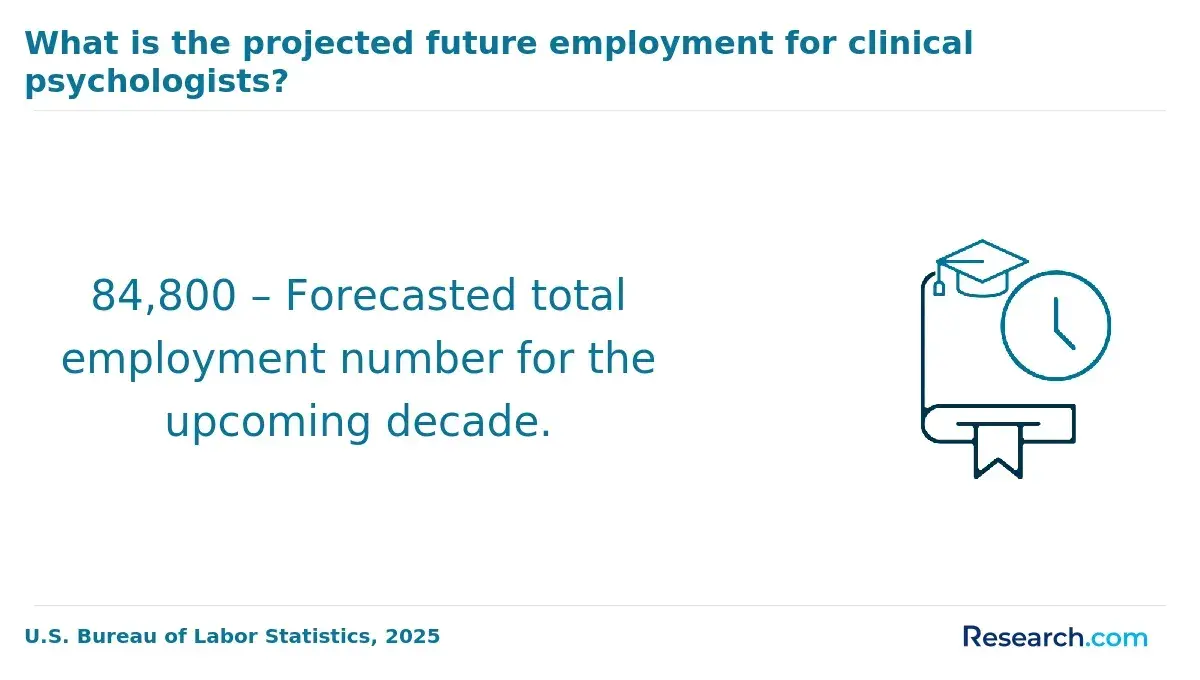
BLS projections also point to strong growth for psychologists from 2024 to 2034. Clinical and counseling psychologists are projected to see 11% job growth, compared with the 3% average. The chart below shows projected growth for psychologist roles during the forecast period.
Is a Psychology Degree the Only Route to Becoming a Therapist?
A psychology bachelor’s degree is a common starting point, but it is not the only educational background that can lead to therapy or counseling work. Some students enter graduate counseling, social work, marriage and family therapy, or related programs after studying another field. What matters most is whether the graduate program meets the academic and supervised experience requirements for the license you want. For a closer look at nontraditional routes, see our guide on whether you can be a therapist without a bachelor's degree in psychology.
What Activities Can Strengthen Your Clinical Psychology Training?
Graduate coursework matters, but relevant experience can make you a stronger student and a more competitive candidate for practicum, internship, and post-graduation roles. Consider activities that build client awareness, research literacy, ethical judgment, and professional networks.
- Volunteer work. Look for opportunities with mental health clinics, crisis lines, hospitals, shelters, schools, or nonprofit organizations serving people with behavioral health needs.
- Internships. Seek supervised experiences in hospitals, counseling centers, community agencies, private practices, or related human services settings.
- Research projects. Work with faculty, join a research lab, or participate in psychology student organizations to strengthen your understanding of evidence-based practice.
- Professional associations. Membership in groups such as the American Psychological Association (APA) or state psychological associations can provide networking, conferences, continuing education, and field updates.
- Peer support and study groups. Collaborative groups can help students process difficult material, prepare for clinical skills courses, and build professional communication habits.
Is a Clinical Psychology Degree Worth It?
A clinical psychology or clinical mental health counseling degree can be worth it for students who are committed to mental health work, understand the licensure process, and choose a program that fits their state requirements and financial situation. The path can lead to meaningful work with individuals, couples, families, students, service members, trauma survivors, and communities facing behavioral health challenges.
The degree is less likely to be worth it if you choose a program without checking licensure alignment, underestimate fieldwork demands, or borrow heavily without understanding the earning potential for your intended credential. If you are still deciding whether psychology is the right academic investment, review this broader guide on whether a psychology degree is worth it.
What Ethical and Legal Issues Do Clinical Psychology Students Study?
Ethics and legal responsibility are central to clinical training. Students typically study confidentiality, informed consent, mandated reporting, professional boundaries, documentation, cultural humility, scope of practice, and appropriate use of assessment and therapy techniques. Supervised clinical placements give students opportunities to apply ethical decision-making in real cases while receiving feedback from licensed professionals. Advanced routes, including neuropsychology doctoral programs online, may add specialized ethical issues related to assessment, cognitive testing, disability, and brain-behavior relationships.
Key Skills You Can Build in a Clinical Psychology Program
Clinical psychology and counseling programs combine theory with practical skill development. Whether you plan to become a counselor, continue into doctoral study, or work in research or human services, the following competencies are central:
- Assessment and diagnostic reasoning: Students learn to use interviews, observations, case histories, and standardized tools to understand client concerns and develop treatment plans.
- Therapeutic techniques: Programs may introduce approaches such as Cognitive Behavioral Therapy (CBT), psychodynamic concepts, mindfulness-based methods, and other evidence-informed interventions.
- Research and data analysis: Students study research design and evidence-based practice so they can evaluate psychological findings and apply them responsibly.
- Ethical and professional practice: Training emphasizes confidentiality, boundaries, legal duties, supervision, documentation, and professional conduct.
- Cultural competence: Students learn to consider culture, socioeconomic status, identity, disability, trauma history, and lived experience when working with clients.
- Communication and interpersonal skills: Clinical work requires clear listening, empathy, accurate reflection, and the ability to explain complex psychological concepts in accessible language.
- Crisis intervention: Programs may prepare students to recognize acute distress, respond to safety concerns, and use appropriate referral and intervention procedures.
- Psychological testing and measurement: Students may learn how assessments measure cognitive, emotional, behavioral, and personality functioning, depending on the program’s scope.
If you are at the beginning of your academic path and not ready for graduate study, an associate degree in psychology online can introduce foundational concepts before bachelor’s and graduate-level clinical preparation.
Step-by-Step: How to Choose the Right Clinical Psychology Program
- Identify your end goal. Decide whether you want to become a licensed counselor, marriage and family therapist, school psychologist, clinical psychologist, researcher, consultant, or doctoral applicant.
- Check state licensure rules first. Review your state board’s education, credit, practicum, internship, exam, and supervised-hour requirements before making a shortlist.
- Match programs to the license. Ask admissions staff which licenses the program is designed to support and in which states graduates commonly seek licensure.
- Verify accreditation. Confirm institutional accreditation and any relevant programmatic accreditation, such as CACREP for counseling programs.
- Review field placement support. Ask whether the school secures placements, helps identify sites, or expects students to find their own supervisors.
- Calculate total cost. Include tuition, fees, books, technology, residency travel, fieldwork expenses, exam fees, and possible lost work hours.
- Compare outcomes. Request licensure exam pass rates, graduation rates, internship placement information, alumni outcomes, and student support details when available.
- Talk to current students or alumni. Ask about workload, faculty responsiveness, placement support, and whether the online format feels organized.
Can Additional Certifications Improve Your Clinical Psychology Career Options?
Supplemental certifications can help graduates develop specialized skills, but they should complement—not replace—the education required for licensure. For example, training in applied behavior analysis may be useful for professionals interested in behavioral interventions, autism services, or school and developmental settings. Students comparing cost-conscious options can review cheapest BCBA online programs, while still checking accreditation, supervised experience expectations, and whether the credential fits their long-term license or role.
Common Mistakes to Avoid When Choosing a Program
| Mistake | Why It Can Hurt You | Better Approach |
| Assuming every “clinical psychology” master’s leads to psychologist licensure | Many master’s programs prepare students for counseling credentials, not independent psychologist licensure | Confirm the exact license or credential the program supports |
| Choosing only by tuition | Low tuition may be offset by extra credits, fees, travel, or weak placement support | Compare total cost and licensure outcomes |
| Ignoring state requirements | A program may meet requirements in one state but not another | Contact your state licensing board before applying |
| Overlooking in-person requirements | Residencies and fieldwork can affect work schedules, travel budgets, and family responsibilities | Ask for a complete list of all required in-person activities |
| Relying only on rankings | A highly ranked program may not fit your specialization, schedule, budget, or license | Use rankings as a starting point, then verify fit |
| Assuming salary outcomes are guaranteed | Earnings depend on role, location, license, experience, setting, and demand | Research local job postings and licensing timelines |
How Can a Forensic Psychology Specialization Support Clinical Practice?
Forensic psychology connects mental health knowledge with legal and criminal justice settings. A specialization in this area can help students understand risk assessment, behavior in legal contexts, court-related documentation, correctional populations, and consultation with attorneys or agencies. It may be useful for clinicians who want to work in correctional facilities, victim services, legal consulting, competency-related evaluations, or criminal justice reform. Students exploring lower-cost specialized options can compare a cheap online master's degree in forensic psychology with broader clinical programs to see which path better supports their intended credential.
What Is the Earning Potential in Forensic Psychology?
Forensic psychology compensation varies by role, employer, education level, license, consulting work, and location. Some professionals work in public agencies, while others combine clinical practice with legal consultation or expert services. Because salary can differ widely across settings, students should review current labor market information and role-specific salary data before choosing a specialization. For a deeper look at compensation and career options, see our guide to forensic psychologist salary.
Questions to Ask Before You Enroll
- Which license does this program prepare graduates to pursue?
- Does the curriculum meet education requirements in the state where I plan to practice?
- Is the program CACREP-accredited, APA-aligned, regionally accredited, or otherwise recognized for my intended path?
- How are practicum and internship placements arranged?
- Are there required campus visits, residencies, or intensives?
- What is the total estimated program cost, including fees and travel?
- What percentage of students graduate, complete fieldwork, and pass required licensing exams?
- Can I speak with current students or recent graduates?
- What support is available for online students, including advising, placement coordination, library access, and career services?
- If I move after graduation, how portable is the credential?
Key Insights
- The right online clinical psychology program depends on your target license, not just the program name.
- Many ranked programs are clinical mental health counseling programs, so students seeking psychologist licensure should verify whether doctoral study is required.
- Online does not always mean fully remote; expect supervised fieldwork and possible in-person residencies.
- Tuition among ranked programs ranges from $449 to over $1,700 per credit, but total cost depends on credits, fees, travel, and licensure expenses.
- CACREP accreditation matters for many counseling pathways, while institutional accreditation affects financial aid eligibility and academic credibility.
- Before applying, contact your state licensing board and ask each program for written licensure alignment information.
- A program is most valuable when it combines affordability, accreditation, strong field placement support, relevant specialization options, and transparent graduate outcomes.
References:
- U.S. Bureau of Labor Statistics. (2025). 19-3033 Clinical and Counseling Psychologists. Bureau of Labor Statistics. https://www.bls.gov/oes/current/oes193033.htm
- U.S. Bureau of Labor Statistics. (2025). Psychologists : Occupational Outlook Handbook: : U.S. Bureau of Labor Statistics. https://www.bls.gov/ooh/life-physical-and-social-science/psychologists.htm
- Zippia. (n.d.). Best Colleges and Majors for Clinical Psychologists. Zippia. https://www.zippia.com/clinical-psychologist-jobs/education
Other Things You Should Know About Online Clinical Psychology Programs
Many online clinical psychology programs require 300 to 600 practicum hours before graduation. Doctoral programs often add a predoctoral internship of 1,500 to 2,000 hours, completed at an approved site under licensed supervision. State licensing boards usually set the final hour totals.
In 2027, online clinical psychology degree programs typically require students to complete a supervised internship, often around 600 hours, which must comply with American Psychological Association (APA) standards to ensure practical experience in the field.
Online clinical psychology programs in 2027 frequently use platforms like Canvas or Blackboard for course management, Zoom for live sessions, and SPSS for statistical analysis. These tools facilitate interactive learning and provide essential resources for coursework and research activities.


