2027 Fastest Online School Psychology Degree Programs

Co-Founder and Chief Data Scientist
School psychology plays a vital role in shaping the mental health and academic success of students, making it an essential profession in today’s educational landscape. As the demand for qualified school psychologists continues to grow, many aspiring professionals are seeking flexible and efficient ways to enter the field.
Earning a degree online offers the convenience of studying from home while balancing personal and professional responsibilities. And for those eager to make an impact sooner, choosing an accelerated online program can significantly shorten the path to graduation and licensure.
In this article, we’ll guide you through some of the fastest online school psychology degree programs, helping you find the right fit for your goals, timeline, and lifestyle.
What are the benefits of obtaining a fast online school psychology degree?
- In-Demand Career with Meaningful Impact: School psychologists help support students’ academic, emotional, and social well-being, making it a fulfilling career with strong job stability across K–12 schools.
- Faster Path to Licensure and Employment: Accelerated online psychology programs allow students to complete their degrees in less time than traditional programs, helping them enter the workforce—and start earning—more quickly.
- Flexible Learning for Busy Adults: Online psychology programs make it easier to balance coursework with work or family obligations, removing the need to relocate or commute.
- Competitive Salary Potential: According to the U.S. Bureau of Labor Statistics, school psychologists earn a median salary of $86,930 per year, with even higher pay available in certain states and school districts.
What can I expect from an accelerated online school psychology degree program?
An accelerated online school psychology degree program is designed to deliver the same high-quality education as a traditional program—but in a shorter time frame. These programs are ideal for motivated learners who want to fast-track their careers without sacrificing the depth or rigor of their training.
Here’s what you can typically expect:
- Condensed Course Schedules: Courses are often delivered in 6- to 8-week formats instead of traditional 16-week semesters, allowing students to complete more credits in less time.
- Intensive but Flexible Learning: While the pace is faster, the online format gives students the flexibility to study around their work and life commitments, often with asynchronous lectures and assignments.
- Fieldwork and Practicum Requirements: Despite being online, these programs still include essential in-person components such as supervised practicums or internships in local school settings, arranged in collaboration with the program.
- Eligibility for Certification or Licensure: Most accelerated online school psychology degrees meet state or national standards, preparing graduates to pursue licensure or certification as school psychologists. Always check your state’s specific requirements to ensure alignment.
Where can I work with an online school psychology degree?
An online school psychology degree prepares graduates for a variety of roles focused on supporting students’ learning, behavior, and mental health. While many professionals work directly in schools, the skills gained from this degree can be applied in several settings.
Here are some common workplaces for school psychology graduates:
- Public and Private K–12 Schools: The most common setting, where school psychologists work directly with students, teachers, and families to address academic, emotional, and behavioral challenges.
- School District Offices: Some professionals take on leadership or administrative roles, overseeing student services, coordinating special education programs, or implementing district-wide interventions.
- Private Practice or Counseling Centers: With additional licensure, school psychologists can work independently or with mental health teams to provide testing, therapy, and educational evaluations.
- Hospitals and Pediatric Clinics: In medical settings, school psychologists may collaborate with healthcare providers to assess developmental or learning issues and support treatment planning.
- Colleges and Universities: Opportunities also exist in higher education, including roles in student support services or teaching and research positions for those with advanced degrees.
How much can I make with an online school psychology degree?
An online school psychology degree typically prepares you to pursue licensure or certification in the U.S., setting you up for a rewarding career with solid earning potential. Salary varies based on geography, experience, and setting, but according to recent data from the United States Bureau of Labor Statistics, the mean annual wage for school psychologists as of 2024 is $93,610.
Meanwhile, the median annual wage for school psychologists is $86,930. The annual 10th percentile wage is $60,880, the 25th percentile wage is $73,240, the 75th percentile wage is $108,210, and the 90th percentile wage is $132,320.
The highest-paying industries for these professionals are child care services, educational support services, employment services, and elementary and secondary schools. States who pay school psychologists the highest salaries are Colorado, California, New Mexico, New York, and Washington.
- List of the Fastest Online School Psychology Degree Programs for 2027 List of Programs
- How long does it typically take to earn an online school psychology degree? Completion Time
- What are the prerequisites for enrolling in an online school psychology degree program? Requirements
- What is the average cost of an online school psychology degree program? Cost
- What are the financial aid options for students enrolling in an online school psychology degree program? Financial Aid
- What courses are typically included in an online school psychology degree program? Courses
- How can I choose the best among the fastest accelerated online school psychology degree programs? How can I choose the best among the fastest accelerated online school psychology degree programs?
- What are the differences between a traditional and an online school psychology degree program? Online vs. On-Campus
- What career paths are available for graduates with an online school psychology degree? What career paths are available for graduates with an online school psychology degree?
- What is the job outlook for graduates of online school psychology degree programs? Job Outlook
- How do I verify the quality of an online school psychology degree program? How do I verify the quality of an online school psychology degree program?
- How are practical training and networking opportunities integrated into online school psychology programs? How are practical training and networking opportunities integrated into online school psychology programs?
Fastest Online School Psychology Degree Programs for 2027
If you want to become a school psychologist, speed matters—but it cannot come at the expense of licensure eligibility, supervised fieldwork, or program quality. Online and hybrid school psychology programs can reduce commuting and make graduate study more manageable for working adults, but most still require in-person practicum and internship experiences because school psychology is a hands-on profession.
This guide is for students comparing accelerated online school psychology programs, current educators considering a move into student mental health services, and psychology graduates who want the shortest responsible route into school-based practice. You will learn which programs offer faster timelines, what those programs require, how online study works in a field that requires direct assessment and intervention, and how to judge whether a fast program is actually a smart choice.
Students still exploring broader online psychology and social science options may also want to compare these programs with the fastest online social sciences degree pathways before committing to a licensure-focused school psychology track.
Quick Answer: What Is the Fastest Online Path to School Psychology?
The fastest practical online route to school psychology is usually a specialist-level pathway that combines graduate coursework with required supervised field experience. Many licensure-oriented programs include two years of coursework followed by a one-year internship, although some accelerated formats compress the academic portion into a shorter schedule. A master’s degree alone may not qualify graduates for school psychologist licensure, so students should confirm whether the program includes the Ed.S., credential, internship, and state-specific requirements needed for practice.
The key decision is not simply “Which program is shortest?” It is “Which accelerated program gets me to the credential I need without creating licensure problems later?”
How Research.com Evaluates These Programs
Research.com rankings are built from institutional research and data review using sources such as the IPEDS database, Peterson's database, including its Distance Learning Licensed Data Set, the College Scorecard database, and the National Center for Education Statistics. These sources help verify school characteristics, distance learning options, cost information, and institutional context.
Because school psychology is a credential-driven field, this ranking focuses on graduate programs that allow students to specialize in school psychology. Readers should treat any ranking as a starting point, not a final decision. Before applying, confirm accreditation, state licensure alignment, internship expectations, and whether the program is accepted by the state where you plan to work. More details about Research.com’s approach are available in the methodology section.
Fastest Online School Psychology Programs at a Glance
| School | Program | Stated Timeline | Credits | Important Format Notes |
| Fort Hayes State University | MS and Ed.S. in School Psychology | 3 years full-time | 66 credits | Online coursework with a 5-day summer workshop and a one-year supervised internship |
| Fresno Pacific University | Online MA in School Psychology with Pupil Personnel Services credential | 2 years | 62 | Fully online synchronous coursework with in-person field internships |
| Eastern Washington University | Online Ed.S. in School Psychology | 2 years | 107 | Weekly synchronous online classes, a required three-day campus training, and a 1,200-hour internship |
| Stephen F. Austin State University | Master of Arts in School Psychology | 2 years coursework, 1 year internship | 63 | Zoom track with synchronous class attendance and a full-time internship |
| Capella University | Online MS in School Psychology | 21 months | 53 | Asynchronous online coursework with two in-person residencies; not designed by itself for school psychologist licensure or certification exams |
1. Fort Hayes State University
Fort Hayes State University offers a combined graduate route for students who want both a Master of Science and an Education Specialist degree in School Psychology. The sequence is designed to be completed in 3 years of full-time study, with two years of coursework followed by a one-year internship. This structure matters because many school psychology roles require specialist-level preparation rather than only a standalone master’s degree.
The program is delivered online, with one required 5-day summer workshop focused on child appraisal. Students complete 66 credits covering foundational psychology, school-based assessment, intervention, and specialist-level preparation. After finishing the MS portion and passing a comprehensive exam, students continue into the Ed.S. phase and complete a supervised school-based internship of 1,200 hours.
- Location: Hays, KS
- Program Length: 3 years full-time (2 years coursework + 1 year internship)
- Credits Required: 66 credits
- Cost: $350 per credit
- Accreditation: Higher Learning Commission
2. Fresno Pacific University
Fresno Pacific University offers an online MA in School Psychology with a Pupil Personnel Services credential and presents the curriculum from a Christian perspective. The program includes a six-semester fast-track option and uses a fully online synchronous format, which means students attend live virtual classes rather than completing all work independently on their own schedule.
Although the academic coursework is online, internships must be completed in person in the field. Graduates who complete the required credential preparation can pursue work as school psychologists in public school settings, subject to applicable state and credential requirements.
- Location: Fresno, CA
- Program Length: 2 years
- Credits Required: 62
- Cost: $770 per credit
- Accreditation: California Commission on Teaching Credentialing
3. Eastern Washington University
Eastern Washington University provides an online Ed.S. in School Psychology for students who need a format compatible with professional responsibilities. Courses meet through weekly synchronous online sessions, so students should be prepared for scheduled class attendance rather than a fully self-paced experience.
The program includes a required three-day on-campus training and an internship. Students can choose an accelerated track that completes coursework in two years rather than following the standard three-year plan. Both tracks conclude with a 1,200-hour internship, which is a major time commitment and should be planned early with employer, family, and financial considerations in mind.
- Location: Cheney, WA
- Program Length: 2 years
- Credits Required: 107
- Cost: $433 per credit
- Accreditation: National Association of School Psychologists (NASP)
4. Stephen F. Austin State University
Stephen F. Austin State University offers a Master of Arts in School Psychology built around a practitioner-scientist training model. The curriculum emphasizes applied practice, the ability to read and interpret scientific literature, and the use of applied research methods in school-based settings.
The program includes a Zoom track that allows students to participate in classes synchronously. Students complete 63 semester hours, including two years of coursework and a one-year, full-time internship. Graduates may pursue licensure as a Licensed Specialist in School Psychology (LSSP) and certification as a National Certified School Psychologist (NCSP), depending on completion of all applicable requirements.
- Location: Nacogdoches, TX
- Program Length: 2 years coursework, 1 year internship
- Credits Required: 63
- Average Tuition: $8,000
- Accreditation: National Association of School Psychologists (NASP)
5. Capella University
Capella University offers an online MS in School Psychology designed to introduce students to assessment, intervention, and support strategies for students’ behavioral, mental, and academic needs. The important limitation is that this MS degree by itself is not intended to make students eligible to sit for a school psychologist licensure or certification exam.
For students who want a faster graduate entry point before continuing into an Ed.S. or PsyD, this program may be useful. The format includes asynchronous online coursework and two in-person residencies for applied skill development.
- Location: Minneapolis, MN
- Program Length: 21 months (additional 1–2 years for Ed.S. if pursued)
- Credits Required: 53
- Cost: $525 per credit
- Accreditation: Higher Learning Commission
How Long Does an Online School Psychology Degree Usually Take?
Online school psychology programs vary by degree level, pace, and field placement structure. The classroom portion may be accelerated, but supervised experience remains a fixed and significant requirement in most licensure-oriented pathways.
- Master’s plus Educational Specialist programs: This is one of the most common school psychology routes. A standard online pathway often takes 3 years when coursework, practicum, and a full-time internship are included.
- Psy.D. or Ph.D. programs: Doctoral options are usually designed for students seeking advanced clinical, leadership, academic, or research roles. These programs often require 4 to 6 years, depending on enrollment status and program design.
- Accelerated formats: Some schools shorten the timeline with compressed courses, continuous enrollment, or coordinated field placements. Students comparing psychology-focused accelerated options can review an accelerated psychology masters program to understand how faster graduate schedules may work.
Even when coursework is online, fieldwork is not optional. Practicum and internship requirements can affect the total completion time, especially if students need to secure an approved local site, align their schedule with school calendars, or complete supervised hours while working.
What Are the Typical Admission Requirements for Online School Psychology Programs?
Admission requirements differ by school and degree level, but most online school psychology programs evaluate whether applicants have the academic foundation, communication skills, and professional maturity needed for graduate-level work with children, families, and educators.
- Bachelor’s degree: Applicants generally need a completed bachelor’s degree from an accredited institution. A background in psychology, education, child development, or a related field may help, but many programs consider applicants from other majors.
- Minimum GPA: Many programs set a minimum undergraduate GPA around 2.75 to 3.0, while more selective programs may expect stronger academic records.
- Letters of recommendation: Schools commonly request 2–3 letters from professors, supervisors, or professional contacts who can speak to the applicant’s readiness for graduate study and suitability for school-based work.
- Statement of purpose: Applicants are usually asked to explain why they want to study school psychology, why the online format fits their situation, and how the program connects to their career goals.
- Relevant experience: Work or volunteer experience with children, schools, special education, counseling, or mental health services may strengthen an application, especially for competitive or accelerated programs.
Some programs may request GRE scores, although many online and accelerated programs have moved away from this requirement. Always check the admissions page for each school rather than assuming requirements are the same across programs.
Students who are still deciding on a specialization should understand the difference between educational psychology vs school psychology. In simple terms, educational psychology is more centered on how people learn, while school psychology focuses more directly on student mental health, behavior, assessment, and school-based intervention.
The following chart compares median annual wages for school psychologists with other psychologist roles. Salary should not be the only factor in choosing a specialty, but it can help students understand how different psychology paths compare.
What Does an Online School Psychology Degree Cost?
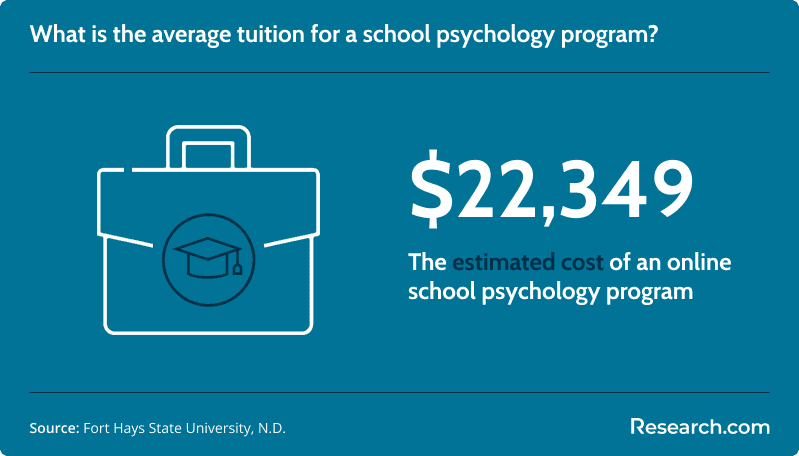
Online school psychology tuition depends on the institution, credit load, degree level, residency policy, and required in-person experiences. A fast program is not automatically cheaper; a shorter schedule can reduce time-related costs, but higher per-credit tuition or travel requirements can offset those savings.
- Average total tuition: Online school psychology programs typically fall between $18,000 and $45,000 in total tuition. Accelerated programs may cost less overall when they shorten enrollment time, while doctoral-level Psy.D. or Ph.D. programs often exceed $60,000.
- Cost per credit: Tuition commonly ranges from $300 to $700 per credit, with some public universities offering lower pricing for in-state or online-only students.
- Extra expenses: Students should plan for technology fees, assessment tools, books, and travel for required residencies, practicums, or internships. These costs can add $1,000 to $3,000.
- Funding options: Scholarships, federal aid, assistantships, and employer tuition support may reduce out-of-pocket costs.
When comparing tuition, do not evaluate school psychology like a general graduate degree. A program may look affordable but have limited licensure alignment, weak placement support, or additional residency costs. If you are comparing different graduate fields, a human resource management online master’s degree may have a very different cost structure because it does not carry the same supervised school-based licensure requirements.
What Financial Aid Options Are Available for Online School Psychology Students?
Online graduate students often qualify for many of the same funding sources as campus-based students. The best approach is to combine federal aid research, school-specific scholarships, employer benefits, and public service repayment options before deciding how much to borrow.
- Federal student aid: Eligible students can complete the Free Application for Federal Student Aid (FAFSA). Graduate students often use Direct Unsubsidized Loans and may also consider Graduate PLUS Loans.
- Scholarships and grants: Universities may offer merit-based or need-based awards for online learners. Students can also look for field-specific funding through organizations such as the National Association of School Psychologists (NASP), state education agencies, and psychology-related scholarship programs.
- Graduate assistantships and fellowships: These are more common in campus programs, but some online or hybrid programs may offer research, teaching, or service-based funding.
- Employer tuition reimbursement: Current educators, paraprofessionals, behavior specialists, or school employees should ask whether their employer supports graduate study tied to hard-to-fill school roles.
- State and loan forgiveness programs: Graduates working in high-need schools or underserved communities may be able to pursue Public Service Loan Forgiveness (PSLF) or Teacher Loan Forgiveness, depending on role, employer, and eligibility rules.
Students comparing psychology specializations may also find funding leads by reviewing adjacent fields, including accelerated online addiction psychology degrees. Always contact the financial aid office before applying so you know scholarship deadlines, loan limits, and whether aid applies to online enrollment.
What Courses Are Included in an Online School Psychology Program?
Online school psychology programs combine graduate psychology coursework with applied training in assessment, consultation, law, intervention, and supervised school practice. The exact curriculum varies, but licensure-oriented programs generally include both academic courses and field-based requirements.
| Course Area | What Students Learn | Why It Matters in Practice |
| Foundations of School Psychology | Professional roles, ethical standards, legal responsibilities, and school-based service models | Clarifies what school psychologists do and how they work within education systems |
| Child and Adolescent Development | Cognitive, social, emotional, and physical development from childhood through adolescence | Helps professionals interpret behavior and learning needs in developmental context |
| Psychological Assessment and Testing | Administration, scoring, and interpretation of standardized assessments | Supports decisions related to learning needs, cognitive functioning, and emotional concerns |
| Behavioral and Academic Interventions | Evidence-based strategies for learning problems, behavior concerns, and social-emotional needs | Prepares graduates to design and monitor student support plans |
| Special Education Law and Advocacy | Special education procedures, IEPs, IDEA, and Section 504 | Ensures students understand legal protections and school responsibilities |
| Multicultural and Diversity Issues in Education | Cultural, linguistic, socioeconomic, and community factors affecting students | Builds competence for serving diverse school populations fairly and effectively |
| Practicum and Internship | Supervised school-based experience, including a full-time internship that is typically 1,200 hours | Turns academic knowledge into supervised professional practice, similar in structure to fieldwork-heavy programs such as the fastest online eds degree in special education programs |
The table below shows states with severe school psychologist shortages based on students per school psychologist. These states have more than 2,000 students for every school psychologist. NASP recommends a ratio of 1:500. Maine and Connecticut are the only states listed as meeting that recommended ratio, with 207 and 475 students for every school psychologist, respectively.
| State | No. of Students for Every School Psychologist |
| Alabama | 106,950 |
| Mississippi | 10,611 |
| New Mexico | 8,863 |
| Oklahoma | 3,968 |
| Louisiana | 2,859 |
| Arkansas | 2,570 |
| Texas | 2,243 |
| Florida | 2,023 |
| Georgia | 2,018 |
How to Choose the Best Accelerated Online School Psychology Program
The best accelerated program is the one that gets you to the right credential efficiently, not merely the one with the shortest advertised timeline. Students comparing accelerated psychology programs online should pay special attention to accreditation, licensure alignment, and field placement support because school psychology has stricter practice requirements than many general psychology tracks.
| Decision Factor | What to Check | Why It Matters |
| Accreditation and approval | Confirm regional accreditation, NASP alignment or approval when relevant, and state credential acceptance | Licensure boards and school districts may not recognize programs that do not meet required standards |
| Licensure fit | Ask whether graduates meet requirements in the state where you plan to work | Online programs may serve students nationally, but school psychology credentials are state-specific |
| Internship support | Find out who helps locate placements and what supervision is required | A 1,200-hour internship can delay graduation if placement planning is weak |
| Course delivery | Compare synchronous, asynchronous, and hybrid requirements | Live weekly classes may work well for some students but be difficult for others with fixed work schedules |
| Total cost | Include tuition, fees, travel, assessment materials, and lost work time during internship | The cheapest tuition rate may not produce the lowest total cost |
| Student support | Ask about advising, faculty access, online library resources, career services, and exam preparation | Accelerated study leaves less room for poor advising or delayed responses |
Questions to Ask Before You Apply
- Does this program qualify graduates for school psychologist licensure or certification in my state?
- Is the program NASP-approved or aligned with NASP standards?
- Who is responsible for arranging practicum and internship placements?
- Are online students eligible for the same scholarships and support services as campus students?
- How many in-person residencies, campus visits, or workshops are required?
- Can I complete the internship while working, or will I need to reduce employment?
- What happens if I move to another state before graduation?
Online vs. Traditional School Psychology Programs: What Is Different?
Online and traditional school psychology programs usually aim for the same professional outcome: preparation for supervised practice and, when designed appropriately, school psychology credentialing. The main differences involve delivery format, scheduling, campus requirements, and how students complete field placements.
| Feature | Online Program | Traditional Campus Program |
| Course delivery | Virtual classes, which may be synchronous, asynchronous, or a mix of both | In-person classes held on campus at scheduled times |
| Flexibility | Often better for working adults, caregivers, and students outside commuting range | More structured but less flexible for students with full-time work or family obligations |
| Pacing | May include accelerated tracks or year-round scheduling | Often follows a fixed academic calendar |
| Networking | Requires more intentional participation in virtual meetings, discussion boards, and professional events | Provides more frequent face-to-face interaction with faculty and peers |
| Fieldwork | Often completed at approved sites near the student’s location | May rely on established local placement partnerships near campus |
Online psychology programs can be legitimate and respected when they are properly accredited, academically rigorous, and aligned with licensure expectations. Students asking Are online psychology degrees legitimate? should focus less on the word “online” and more on accreditation, outcomes, supervision, and whether employers or licensing bodies recognize the credential.
The chart below shows the top-paying states for school psychologists in the U.S. Keep in mind that salary comparisons do not account for each state’s cost of living.
What Careers Can You Pursue With an Online School Psychology Degree?
Most graduates pursue school-based roles, but school psychology training can also support work in district administration, assessment, behavioral services, research, and related mental health pathways. Career options depend heavily on the degree earned, state licensure, certifications, and any additional credentials.
- School Psychologist in K–12 schools: School psychologists assess students, support special education processes, design interventions, consult with teachers, and collaborate with families.
- District-level school psychology consultant: These professionals may serve multiple campuses, support assessment systems, train staff, and help coordinate districtwide mental health or behavioral initiatives.
- Behavioral intervention specialist: This role focuses on behavior plans, classroom supports, and intervention strategies for students with behavioral challenges.
- Educational diagnostician or assessment coordinator: With the proper certification, graduates may conduct cognitive and academic assessments and help guide eligibility and placement decisions.
- Mental health or clinical counselor: Additional licensure may allow graduates to move into counseling roles in private practice, community clinics, hospitals, or youth-serving agencies.
- Researcher or postsecondary educator: Graduates with advanced degrees such as an Ed.S., Psy.D., or Ph.D. may teach, conduct research, or contribute to school psychology training and policy.
For a deeper look at roles, settings, and advancement options, review Research.com’s guide to careers in school psychology.
What Is the Job Outlook for Online School Psychology Graduates?
The employment outlook for school psychologists has two sides. National growth projections are modest, but many districts still face serious staffing shortages and student mental health needs that create demand for qualified professionals.
The U.S. Bureau of Labor Statistics projects school psychologist employment to grow by about 1% from 2023 to 2033, compared with the 4% average projected across all occupations. O*NET reports approximately 3,600 annual job openings through 2033, largely related to retirements and turnover.
NASP recommends 1 school psychologist for every 500 students, yet many states have far higher ratios. The shortage is especially visible in states where the ratio exceeds 2,000-to-1, including Texas, New Mexico, Alabama, and Mississippi. In practical terms, this means job opportunity can vary substantially by state, district budget, credential requirements, and willingness to work in underserved regions.
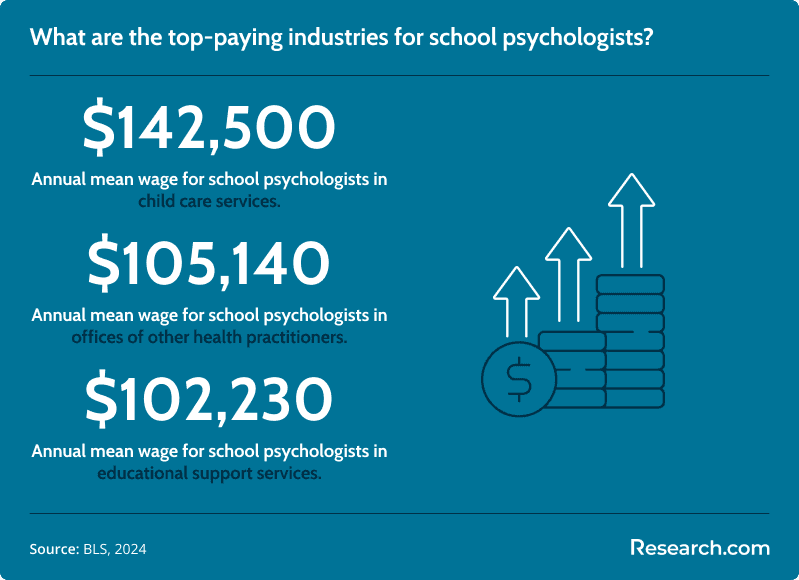
Some states with severe shortages—such as Alabama, New Mexico, Georgia, Colorado, Utah, and Arizona—may offer more openings and competitive compensation. Reported offers can range from $142,500 to $102,230 annually, but students should verify local salary schedules, contract terms, and cost of living before making relocation decisions.
Students should rely on official labor-market and licensure information before making career decisions. Anecdotal discussions, including this school psychology forum thread, can provide personal perspectives but should not replace state data, district postings, or licensing board guidance.
It can also help to compare school psychology with other psychology roles. Research.com’s overview of what psychology jobs are in demand can help students evaluate stability, specialization, and earning potential across the field.
How Do You Verify the Quality of an Online School Psychology Degree?
Quality checks are essential before enrolling in any online school psychology program. Start by verifying institutional accreditation, then confirm whether the school psychology curriculum meets the requirements for the state where you want to work. Do not assume that a nationally available online program automatically satisfies every state’s licensure or credential rules.
- Check accreditation directly: Confirm the school’s institutional accreditation and whether the program has relevant school psychology recognition or approval.
- Contact your state licensing or credentialing authority: Ask whether the program’s degree, internship, and coursework meet state requirements.
- Review field placement policies: Determine whether the school helps secure approved practicum and internship sites or expects students to arrange placements independently.
- Ask about graduate outcomes: Request licensure, certification, internship, and employment information when available.
- Compare true cost: Include tuition, fees, required travel, assessment materials, and the income impact of internship scheduling.
Students balancing quality and affordability can use Research.com’s guide to the most affordable psychology degree online as a broader cost-comparison resource, while still checking whether any specific school psychology program meets licensure needs.
Student Perspectives on Accelerated Online School Psychology Study
- : "The accelerated online format helped me continue working while moving through the degree faster than I expected. The coursework was flexible, but the internship still required careful planning and strong time management. Being able to apply assessment and intervention concepts directly with students made the program feel immediately relevant. — Rachel"
- : "I worried that an online program would not feel hands-on enough for school psychology, but the combination of virtual instruction, faculty feedback, and local fieldwork made the experience practical. The biggest advantage was access to instructors and classmates outside my region while still completing supervised experience near home. — Julius"
- : "The fast pace was demanding, especially while balancing family responsibilities, but finishing sooner helped me move into the profession earlier. The online structure gave me control over when I studied, while the fieldwork kept the training connected to real school settings. — Bella"
How Do Online Programs Handle Practical Training and Professional Networking?
Online school psychology programs cannot be entirely virtual because students must learn to work with real children, educators, families, and school systems. Programs commonly combine online coursework with local practicum and internship placements, virtual supervision, assessment training, case discussions, and live class meetings.
Networking also requires initiative. Online students should attend virtual career events, participate in cohort meetings, seek mentorship from faculty and supervisors, and join professional organizations. Students interested in behavior-focused credentials may also compare school psychology training with options such as the cheapest online BCBA programs, especially if their career goals include behavioral intervention or applied behavior analysis.
Should You Add Therapy or Counseling Credentials?
Additional therapy credentials can be useful, but only if they match your career goals and state licensure plans. A school psychology degree is designed primarily around assessment, consultation, intervention, and student support in educational settings. If you want to provide broader counseling or therapy services outside schools, you may need a separate license or additional graduate preparation.
Students interested in family systems, counseling, or clinical service delivery can explore accredited online MFT programs. Before adding another credential, compare accreditation, supervised hours, state licensure requirements, total cost, and whether the additional pathway will meaningfully expand your employment options.
Common Mistakes to Avoid When Choosing a Fast Online School Psychology Program
- Choosing speed over licensure fit: A shorter program is not helpful if it does not qualify you for the credential required in your state.
- Assuming “online” means fully remote: School psychology programs almost always require in-person practicum, internship, residencies, or workshops.
- Comparing only tuition: Travel, fees, assessment materials, and reduced work hours during internship can change the real cost.
- Ignoring internship logistics: A 1,200-hour internship requires early planning, site approval, supervision, and schedule flexibility.
- Relying only on rankings: Rankings can help identify options, but state licensure boards and employer requirements should guide the final decision.
- Assuming salary outcomes are guaranteed: Pay varies by state, district, contract, credentials, experience, and cost of living.
Key Insights
- The fastest responsible online route to school psychology is usually an accelerated specialist-level pathway, not just the shortest master’s program.
- Licensure alignment matters more than program speed. Always verify requirements with the state where you plan to work.
- Online school psychology programs still require in-person training, including practicum and internship experiences.
- Costs should be evaluated as total cost, not only tuition per credit. Include fees, travel, assessment tools, and internship-related income changes.
- BLS projects about 1% employment growth from 2023 to 2033, but shortages in many states create real hiring demand for qualified, properly credentialed school psychologists.
- NASP-aligned preparation, strong field placement support, and clear state credential pathways are key signs of a program worth serious consideration.
References:
- Carlton, G. (2025, July 9). 4 Steps to Becoming a School Psychologist. Psychology.org.
- Drexel University School of Education. (n.d.). How to Become a School Psychologist. Drexel.edu.
- National Association of School Psychologists. (2025, February). State Shortages Data Dashboard. NASP.
- National Center for Education Statistics. (2024). Common Core of Data - American Public Schools. NCES.
- O*NET OnLine. (2025, July 1). National Employment Trends | 19-3034.00 - School Psychologists. onetonline.org.
- United States Bureau of Labor Statistics. (2025, July 24). Occupational Employment and Wage Statistics Query System. BLS.
- United States Bureau of Labor Statistics. (2024, April 3). Occupational Employment and Wage Statistics | 19-3034 School Psychologists. BLS.
- United States Bureau of Labor Statistics. (2025, April 18). Occupational Outlook Handbook | Psychologists. BLS.
- Zippia. (2025, January 8). School Psychologist Education Requirements. Zippia.com.
Other Things You Should Know About the Fastest Online School Psychology Degree Programs
Many do not carry CACREP accreditation, because CACREP accredits counseling programs, not school psychology degrees. For school psychology, look for programs aligned with NASP standards and, for licensure, approval by your state education agency or psychology board. Accreditation status is listed in program materials and on accreditor websites.
In 2027, the fastest online school psychology degree programs offer a variety of field experiences through virtual simulations, local school placements, and supervised internships, ensuring students gain practical skills under expert guidance, akin to on-campus experiences.
Prerequisites often include a bachelor's degree in psychology or a related field, a minimum GPA of 3.0, and qualifying GRE scores. Some programs may also require prior coursework in developmental psychology or statistics to ensure readiness for advanced study in 2027.