2027 Best NASP Accredited Online School Psychology Programs

Co-Founder and Chief Data Scientist
Choosing an online school psychology program is not just a question of convenience. For most students, the bigger issue is whether the program can lead to certification, supervised fieldwork, and real employment in schools. That is why NASP recognition matters: it signals that a program follows professional preparation standards used in school psychology and may make the path to credentialing more straightforward.
This guide is for prospective graduate students comparing online, hybrid, master’s, specialist, and certification-focused school psychology options. It explains what NASP-accredited online school psychology programs include, how long they take, what they cost, how fieldwork works, and how to compare programs before applying. It also highlights ranked options for 2027, common mistakes to avoid, and practical questions to ask admissions advisors before committing.
Quick answer: Are NASP-accredited online school psychology programs worth considering?
Yes, a NASP-accredited or NASP-approved online school psychology program can be a strong option if it meets your state credentialing requirements, provides supervised practicum and internship support, and fits your schedule and budget. Online coursework can be flexible, but school psychology training still requires in-person fieldwork, usually in schools or related educational settings.
- Graduates commonly pursue work as school psychologists, educational consultants, behavioral specialists, or student mental health support professionals in schools and education-related organizations.
- Online study can make graduate training more accessible while still requiring applied practice through practicum, externship, or internship placements.
- The median annual salary for school psychologists was $84,940 in 2024, though earnings vary by state, employer, credentials, and experience.
What can I expect from an online school psychology degree?
An online school psychology degree prepares students to support children and adolescents with learning, behavioral, social, and emotional needs. Although didactic coursework may be online, the profession is practice-based, so students should expect supervised field experiences in schools or approved community settings.
The curriculum typically includes child and adolescent development, psychoeducational assessment, behavioral intervention, consultation, ethics, research methods, and culturally responsive practice. Assignments often require students to analyze case studies, design intervention plans, interpret assessment data, and practice consultation strategies with teachers, families, and school teams.
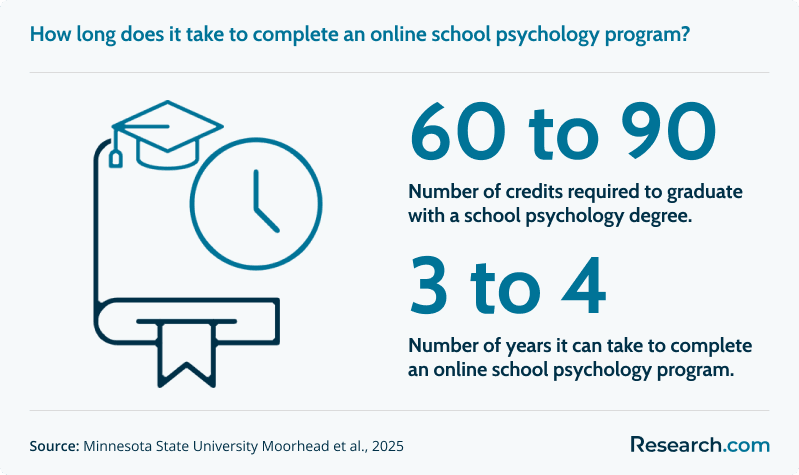
Tuition for online school psychology programs commonly ranges from $400 to $1,200 per credit hour. Many programs require 60 to 90 credit hours, depending on whether the credential is a master’s, specialist, or doctoral pathway. Most students finish in 2 to 4 years, with part-time enrollment usually extending the timeline.
| Program feature | What it usually means for students | Why it matters |
| Online coursework | Lectures, discussions, assignments, and some assessments are completed remotely. | Useful for working adults or students who cannot relocate. |
| Practicum or fieldwork | Students complete supervised experience in schools or approved agencies. | Essential for developing assessment, consultation, and intervention skills. |
| Internship or externship | Many programs require an extended supervised placement before graduation. | Often connected to state certification or licensure eligibility. |
| NASP alignment | The program follows recognized preparation standards for school psychology. | Can simplify credential review and improve employer confidence. |
Where can I work with an online school psychology degree?
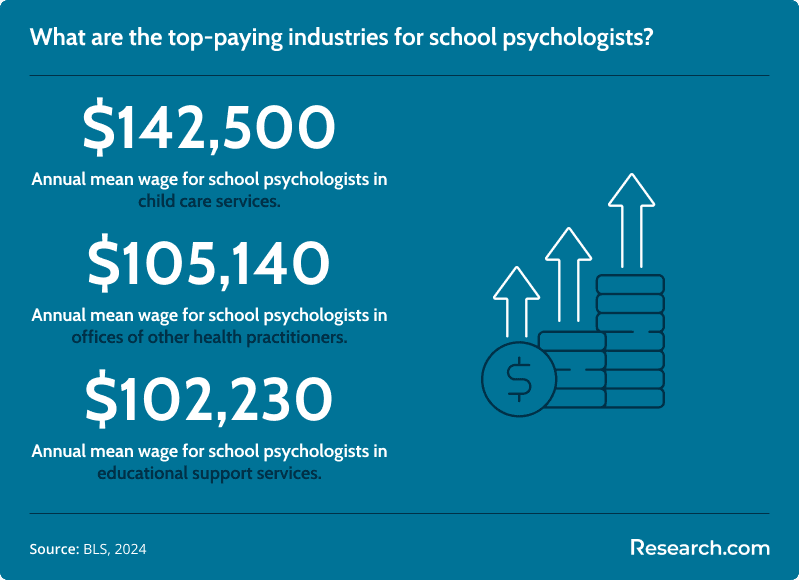
Most graduates use their training in K-12 education, where school psychologists help evaluate students, support special education decisions, consult with teachers, and develop academic or behavioral interventions. Some professionals also work in higher education, education agencies, health practices, local government programs, or consulting roles.
According to 2024 BLS data, the industries with the highest employment for school psychologists include:
- Elementary and Secondary Schools: 53,050 jobs, the largest employment setting for this occupation.
- Educational Support Services: 3,650 jobs, often involving district-level or multi-school support.
- Colleges, Universities, and Professional Schools: 1,330 jobs, including higher education counseling, assessment, or training roles.
- Offices of Other Health Practitioners: 870 jobs, typically connected to mental health or assessment services outside schools.
- Local Government, excluding schools and hospitals: 660 jobs, often supporting public programs that serve children and families.
How much can I make with an online school psychology degree?
The annual median salary for school psychologists was $84,940 in 2024. Median pay is the midpoint: half of workers earned more, and half earned less. Your actual salary will depend on your employer, state, years of experience, degree level, certification status, and whether you work in a public school, private setting, university, clinic, or consulting role.
Entry-level school psychologists may start around $60,000 annually. Professionals with advanced credentials, specialized expertise, or significant experience can earn over $100,000. Location can also affect pay, particularly in states with higher living costs or stronger demand, such as California, New York, or Texas.
Typical salary ranges by setting include:
- Elementary and Secondary Schools: $80,000–$90,000 per year.
- Private Practice or Health Clinics: Salaries can exceed $100,000 with experience and specialization.
- Colleges and Universities: Generally range between $70,000–$85,000 annually.
- Best NASP-accredited online school psychology programs for 2027
- How long does an online school psychology program take?
- Online vs. on-campus school psychology programs
- Average cost of online school psychology programs
- Financial aid for online school psychology students
- Admission requirements for online school psychology programs
- Common courses in an online school psychology program
- School psychology specializations available online
- Can an online school psychology degree lead to high-paying roles?
- Student support services in online school psychology programs
- How to choose the best online school psychology program
- Additional certifications for school psychologists
- Challenges of online school psychology programs
- Research opportunities in online school psychology programs
- How online programs are adapting to future challenges
- Career paths for online school psychology graduates
- Advanced mental health specializations
- Return on investment for online school psychology degrees
- Employer views of online school psychology degrees
- Job market for school psychology graduates
- Accelerated online training pathways
- Interdisciplinary collaboration in online school psychology programs
How do we rank schools?
Research.com uses a data-informed ranking process designed to help students compare programs with more transparency. Sources used in our review include the IPEDS database, Peterson’s database, the College Scorecard, and the National Center for Education Statistics. These resources help identify online school psychology programs with relevant accreditation, academic structure, cost information, and student-focused indicators. Readers should still confirm current accreditation, tuition, fieldwork requirements, and state credentialing rules directly with each institution.
Best NASP Accredited Online School Psychology Programs for 2027
The programs below are useful starting points for students seeking NASP-accredited or NASP-approved online and hybrid school psychology pathways. Before applying, verify whether each program meets credentialing requirements in the state where you plan to work.
| School | Program format and focus | Credits | Cost | Accreditation |
| Minnesota State University Moorhead | Combined master’s and specialist preparation with emphasis on data-based decisions, equity, consultation, academic intervention, and mental health services in PreK-12 settings. | 33 | $596.35 per credit | NASP |
| Idaho State University | Online Educational Specialist degree with live classes, research opportunities, small class sizes, full-time or part-time options, and no entrance exams or dissertation. | 64 | $5,761 per year for residents, $15,316 per year for non-residents | NASP until 2027 |
| Loyola Marymount University | NASP-approved preparation for California school settings, with training in assessment, intervention, evidence-based practice, and fieldwork leading toward credentials such as NCSP and LEP. | 63 | $1,632 per credit | NASP |
| New Jersey City University | Master’s in Educational Psychology plus Professional Diploma in School Psychology, built around urban education needs, 300 hours of fieldwork, and 1,200 hours of externship. | 66 | $850.39 per credit | NASP |
| Eastern Washington University | Hybrid Ed.S. pathway for working professionals, combining online coursework with annual in-person sessions and training in ethical practice, culturally responsive assessment, and evidence-based intervention. | 107 | $433 per credit | NASP |
1. Minnesota State University Moorhead
Minnesota State University Moorhead offers a NASP-accredited pathway that combines master’s and specialist-level school psychology preparation. The program develops skills in data-based decision-making, equity-centered practice, consultation, academic intervention, and school-based mental health support. Graduates are prepared to serve PreK-12 learners and collaborate with educators and families to build healthier school environments.
- Required Credits to Graduate: 33
- Cost: $596.35 per credit
- Accreditation: NASP
2. Idaho State University
Idaho State University offers an online Educational Specialist degree in School Psychology with NASP accreditation until 2027. Students attend interactive live classes, may participate in research, and can choose full-time or part-time enrollment. The program does not require entrance exams or a dissertation and is designed to prepare professionals who can support students’ academic and psychological well-being in PreK-12 schools.
- Required Credits to Graduate: 64
- Cost: $5,761 per year for residents, $15,316 per year for non-residents
- Accreditation: NASP
3. Loyola Marymount University
Loyola Marymount University provides NASP-approved school psychology training focused on students’ academic, social, and emotional development. The curriculum includes evidence-based strategies and extensive fieldwork in assessment, intervention, and school support systems. Graduates may be prepared for California school psychology roles and credentials such as the Nationally Certified School Psychologist (NCSP) and Licensed Educational Psychologist (LEP).
- Required Credits to Graduate: 63
- Cost: $1,632 per credit
- Accreditation: NASP
4. New Jersey City University
New Jersey City University offers a 66-credit sequence that leads to a master’s in Educational Psychology and a Professional Diploma in School Psychology. The program includes 300 hours of fieldwork and 1,200 hours of externship, with a focus on preparing practitioners for urban education contexts. Graduates may be eligible for school psychologist certification in New Jersey, New York, and nationally.
- Required Credits to Graduate: 66
- Cost: $850.39 per credit
- Accreditation: NASP
5. Eastern Washington University
Eastern Washington University offers a hybrid Ed.S. program designed for working professionals. Students complete online coursework and attend annual in-person sessions. The curriculum emphasizes ethical decision-making, culturally sensitive assessment, evidence-based interventions, and collaboration with schools and families to address academic and behavioral needs.
- Required Credits to Graduate: 107
- Cost: $433 per credit
- Accreditation: NASP
How long does it take to complete an online school psychology program?
A master’s or specialist-level online school psychology program usually takes 2 to 4 years for full-time students. The timeline depends on the degree level, required credits, course load, practicum structure, and whether the program includes a yearlong internship. Students looking for shorter psychology graduate options may also compare the best one year psychology master's programs online, although those programs may not meet school psychology credentialing requirements.
The early part of the program typically covers foundational content such as child development, learning theory, assessment, ethics, and legal issues in schools. Later coursework usually moves into consultation, intervention, research, crisis response, and advanced assessment practice.
Many programs require an internship of about 1,200 hours, often completed across one academic year. This supervised experience allows students to work directly with students, educators, families, and school support teams.
Part-time students may need up to 4 years, depending on course availability and field placement timing. Accelerated psychology degree online options can reduce the timeline but may be difficult to balance with work, family responsibilities, and internship expectations.
| Enrollment path | Typical timeline | Best for | Main trade-off |
| Full-time | 2 to 4 years | Students who can prioritize coursework and fieldwork. | Faster completion, but heavier weekly workload. |
| Part-time | Up to 4 years | Working adults or caregivers needing schedule flexibility. | More manageable pace, but longer time to graduation. |
| Accelerated | Shorter than a standard pathway when available | Highly prepared students who can handle intensive study. | Less scheduling flexibility and limited room for delays. |
How does an online school psychology compare to an on-campus program?
Online and on-campus school psychology programs can both prepare students for certification or licensure when they meet NASP standards and state requirements. The difference is usually not academic quality by itself; it is how coursework, fieldwork placement, peer interaction, and campus access are delivered.
| Factor | Online school psychology program | On-campus school psychology program | Decision point |
| Schedule flexibility | Coursework may be asynchronous, synchronous, or a mix of both. | Classes usually meet at set times on campus. | Online is often better for students balancing work or family obligations. |
| Peer and faculty interaction | Communication occurs through video meetings, discussion boards, email, and virtual office hours. | Students interact in classrooms, labs, events, and informal campus settings. | On-campus may fit students who prefer face-to-face networking. |
| Fieldwork | Students usually complete placements near their location, with program approval. | Students may use established local school partnerships tied to the campus. | Online students should ask how placement sites are approved and supported. |
| Cost considerations | May reduce commuting, relocation, housing, and meal plan expenses. | Can involve additional campus-related costs. | Compare total cost, not only tuition. |
Some students prefer hybrid models, especially when parts of the curriculum benefit from in-person supervision or practice. Related options include hybrid PsyD programs, which combine remote coursework with required campus-based learning.
If your long-term goal is clinical assessment or therapy rather than school-based practice, compare school psychology with clinical psychology before applying. The list of APA accredited clinical psychology programs can help you understand how that route differs.
What is the average cost of online school psychology programs?
The average cost of online school psychology programs often falls between $9,000 and $20,000 per year. Tuition varies by school type, residency status, credit requirements, and whether the program charges a flat online rate or separate in-state and out-of-state rates.
Public universities may cost about $9,000 to $12,000 per year for in-state students. Private schools and out-of-state rates may be closer to $15,000 to $20,000 per year. Students comparing lower-cost options can also review a cheap online psychology degree, but they should verify whether a lower-cost psychology program specifically leads to school psychology credentialing.
Full-time students may pay $4,500 to $10,000 per semester, depending on the credit load. Part-time students can spread tuition over more semesters, which may help with budgeting but can extend the time before graduation.
Additional expenses may include technology fees of $100 to $300 per semester, textbooks costing $500 to $1,000 annually, travel for fieldwork, background checks, testing fees, and possible supervision-related costs.
| Cost category | Amount stated | What to ask before enrolling |
| Annual tuition | $9,000 to $20,000 per year | Is this the full program rate, or does it vary by residency? |
| Per-credit tuition | $400 to $1,200 per credit hour | How many total credits are required for graduation and credential eligibility? |
| Semester tuition | $4,500 to $10,000 per semester | Does the amount change if I enroll part-time? |
| Technology fees | $100 to $300 per semester | Are online platform, proctoring, or software fees separate? |
| Books and materials | $500 to $1,000 annually | Are assessment kits, testing materials, or digital subscriptions required? |
The chart below illustrates the most common degree levels for school psychologists, as reported by Zippia in 2025.
What are the financial aid options for students enrolling in an online school psychology program?
Online school psychology students may qualify for federal aid, scholarships, state funding, employer tuition assistance, or private loans. Aid availability depends on enrollment status, institutional eligibility, program type, and personal financial circumstances. Students pursuing a psychology degree online should always confirm that the program participates in the aid sources they plan to use.
- Federal Student Aid
- FAFSA: The Free Application for Federal Student Aid is the usual starting point for grants, federal loans, and work-study eligibility.
- Pell Grants: Eligible students can receive up to $7,395 in 2024-2025, and this funding does not need to be repaid.
- Scholarships
- American Psychological Association (APA) Scholarships: APA funding opportunities may support psychology students, including those enrolled online.
- NASP Scholarships: The National Association of School Psychologists offers scholarships and awards for students entering the profession.
- University-Specific Scholarships: Many institutions offer departmental, graduate, or online student scholarships that can reduce out-of-pocket costs.
- Employer Tuition Assistance
- Employees working in education, counseling, behavioral health, or related fields should ask whether their employer provides tuition reimbursement or professional development funding.
- State Grants and Loans
- Some states offer grant or loan programs for students entering high-need professions. Students can also review options such as the TEACH Grant or State Workforce Development Grants.
- Private Loans
- Private lenders such as Sallie Mae or SoFi may fill funding gaps, but these loans can have high interest rates and repayment terms that differ from federal loans.
What are the prerequisites for enrolling in an online school psychology program?
Admission requirements vary, but most online school psychology programs expect applicants to show academic readiness, relevant experience, and a clear commitment to working with children and schools.
- Educational Background
- Bachelor's Degree: Applicants usually need a bachelor’s degree from an accredited college or university. A psychology major is helpful but not always required if the applicant has related coursework in psychology, education, statistics, or human development.
- Minimum GPA: Many programs look for a GPA of about 3.0. Some may consider lower GPAs when the applicant has strong experience, recommendations, or prerequisite coursework.
- Application Materials
- Transcripts: Official transcripts are typically required from every postsecondary institution attended.
- Letters of Recommendation: Programs often ask for two to three letters from faculty, supervisors, or professionals who can speak to the applicant’s readiness.
- Personal Statement: Applicants usually submit an essay explaining their interest in school psychology, career goals, and fit with the program.
- Relevant Experience
- Work or Volunteer Experience: Experience in schools, youth programs, counseling, special education, behavioral health, or child-focused settings can strengthen an application.
- Standardized Test Scores
- GRE Scores: Some programs still request GRE scores, but many online school psychology programs have removed or waived this requirement. Check each school’s current policy.
What courses are typically in an online school psychology program?
Online school psychology coursework is built around assessment, intervention, consultation, ethics, and student support. The goal is to prepare graduates to identify learning and behavioral needs, interpret data, collaborate with school teams, and recommend appropriate supports.
- Foundations of School Psychology: Introduces the profession’s history, legal responsibilities, ethical standards, and role in educational systems.
- Child and Adolescent Development: Examines cognitive, emotional, social, and behavioral development from childhood through adolescence. This topic also overlaps with child psychologist schooling.
- Behavioral Assessment and Intervention: Teaches students to evaluate behavior patterns and design interventions for classroom, social, or emotional concerns.
- Psychoeducational Assessment: Covers the administration and interpretation of standardized assessments used to evaluate cognitive, academic, and emotional functioning.
- Consultation and Collaboration: Focuses on working with teachers, families, administrators, and other professionals to develop practical support plans.
- Research Methods and Statistics: Builds skills for reading research, evaluating evidence, and applying data-informed practices in schools.
- Crisis Intervention and Prevention: Prepares students to respond to bullying, violence, trauma, natural disasters, and other urgent school situations.
What types of specializations are available in online school psychology programs?
Specializations allow students to focus their training on particular student populations, intervention methods, or school needs. Not every program offers formal concentrations, so applicants should compare electives, practicum sites, faculty expertise, and certification pathways.
- Behavioral and Emotional Disorders: Focuses on students with ADHD, anxiety, conduct concerns, emotional regulation needs, or disruptive behavior patterns.
- Educational Psychology: Explores how students learn, including motivation, classroom environments, instructional methods, and learning barriers.
- Early Childhood Psychology: Centers on children from birth to age eight, early intervention, developmental milestones, and family-centered support.
- Crisis and Trauma Intervention: Prepares students to support prevention, response, and recovery after bullying, natural disasters, violence, or traumatic events.
- Neuropsychology: Looks at the relationship between brain function, behavior, learning, and emotional health.
- Applied Behavior Analysis (ABA): Uses behavior modification principles to support learners with autism, developmental disabilities, or behavioral challenges.
The chart below lists the top-paying states for school psychologists, as reported by the BLS in 2024.
Can an online school psychology degree lead to high-paying roles?
An online school psychology degree can support access to higher-paying roles when the program is accredited, the graduate earns the required credentials, and the professional builds experience in assessment, consultation, intervention, or leadership. Higher earnings are more likely for practitioners with advanced degrees, specialized certifications, strong field experience, and employment in better-paying states or settings. Students comparing long-term earning potential may also review highest paying careers in psychology to understand how school psychology compares with other psychology-related paths.
What student support services are available in online school psychology programs?
Strong student support is especially important in online school psychology because students must coordinate coursework, technology, supervision, and local field placements. Useful services may include academic advising, technical help, career counseling, internship placement guidance, faculty mentoring, tutoring, writing support, online library access, and virtual peer collaboration spaces. Students focused on affordability can also compare master's psychology online options, but should confirm whether those programs meet school psychology credentialing expectations.
How to choose the best online school psychology program?
The best online school psychology program is the one that matches your credentialing goals, state requirements, budget, learning style, and fieldwork needs. A low tuition rate or high ranking is not enough if the program does not help you qualify for the role you want.
- Confirm accreditation: Look for recognition by the National Association of School Psychologists (NASP) and regional institutional accreditation. Ask whether the program’s approval applies to the specific online or hybrid pathway you plan to enroll in.
- Check state credentialing alignment: Ask whether graduates are eligible for certification or licensure in the state where you intend to work.
- Review the curriculum: Make sure coursework covers assessment, intervention, consultation, ethics, research, diversity, and crisis response.
- Evaluate field placement support: Ask whether the school finds placements, approves student-found sites, or requires students to secure their own practicum and internship locations.
- Compare total cost: Include tuition, fees, textbooks, technology costs, travel, background checks, assessment materials, and lost work time during internship.
- Assess flexibility: Determine whether classes are asynchronous, live online, hybrid, weekend-based, or cohort-based.
- Look at student services: Prioritize programs with advising, career support, licensure guidance, technical assistance, and accessible faculty.
- Ask about outcomes: Request information on graduation rates, internship placement, credential pass rates, and alumni employment where available.
Questions to ask before applying
| Question | Why it matters |
| Is the exact online or hybrid program NASP-accredited or NASP-approved? | Accreditation can affect credential review, employer confidence, and professional mobility. |
| Will this program meet school psychologist requirements in my state? | State rules differ, and online programs may not automatically qualify graduates everywhere. |
| How are practicum and internship placements arranged? | Fieldwork is essential and can be difficult if the school provides limited local support. |
| What is the full cost of attendance? | Fees, books, technology, travel, and fieldwork expenses can change the true price. |
| Are classes live, self-paced, or hybrid? | The format must match your work schedule and learning preferences. |
| What student support is available to online learners? | Advising, faculty access, and career services can affect persistence and job readiness. |
What additional certifications can further advance a school psychologist’s career?
Additional credentials can help school psychologists build specialized expertise, especially in behavior intervention, counseling, assessment, crisis response, or leadership. For example, training in applied behavior analysis can be valuable for professionals working with students with autism, developmental disabilities, or significant behavioral needs. Students interested in this route can compare affordable online ABA master's programs to see how ABA preparation may complement school psychology training.
What are the challenges of online school psychology programs?
Online school psychology programs can be flexible, but they are not easy. Students must manage graduate-level coursework while arranging supervised in-person training, staying engaged with faculty and peers, and meeting state-specific credential requirements. The biggest risk is choosing a program that is convenient online but weak in placement support, accreditation, or licensure alignment. Students comparing doctoral-level alternatives may also review least expensive PsyD programs, but PsyD pathways serve different professional goals than school psychology specialist programs.
Common mistakes to avoid
| Mistake | Why it can hurt you | Better approach |
| Choosing a program without checking NASP status | You may face extra hurdles for certification or employment. | Verify NASP recognition and institutional accreditation before applying. |
| Assuming online means fully remote | School psychology requires supervised in-person fieldwork. | Ask exactly where and how practicum, externship, and internship hours are completed. |
| Comparing tuition only | Fees, books, travel, and internship costs can substantially change affordability. | Request a full cost breakdown from the program. |
| Ignoring state credentialing rules | A program may not meet requirements where you plan to work. | Contact the state credentialing body before enrolling. |
| Relying only on rankings | A highly ranked program may not fit your schedule, state, or fieldwork needs. | Use rankings as a starting point, then evaluate fit and outcomes. |
| Assuming salary outcomes are guaranteed | Pay varies by location, employer, credentials, and experience. | Compare local job postings and public salary schedules when estimating ROI. |
What research opportunities do online programs offer for academic advancement?
Many online school psychology programs include research methods coursework, faculty-led projects, literature reviews, case studies, and applied research assignments. Students may also participate in virtual research seminars, use digital libraries, or collaborate with faculty through online research platforms. Those who want to continue into research-heavy doctoral study can explore psychology PhD programs online after completing foundational graduate preparation.
How are online school psychology programs adapting to future challenges?
Online school psychology programs are increasingly using virtual simulations, telehealth-informed training, digital collaboration tools, and data-based assessment methods to prepare students for changing school environments. These tools do not replace in-person fieldwork, but they can help students practice consultation, documentation, and decision-making before working with students in real settings. Professionals interested in related child-focused roles can review child psychology careers and salaries for broader career context.
What career paths are available for graduates of an online school psychology program?
Graduates of online school psychology programs most often work in schools, but the skill set can also apply to consulting, higher education, behavioral support, research, crisis response, and some clinical or private settings with additional licensure. Students exploring nontraditional options can also compare alternative jobs for school psychologists.
- School Psychologist: Evaluates students, supports special education processes, designs interventions, and works with teachers and families.
- Educational Consultant: Advises schools, districts, or organizations on assessment, curriculum, student support, and mental health initiatives.
- College or University Counselor: Supports students in higher education with academic, emotional, or career-related concerns.
- Behavioral Specialist: Designs and monitors behavior interventions in schools, healthcare organizations, private practices, or community settings.
- Researcher: Contributes to studies on learning, assessment, child development, mental health, or school-based interventions.
- Crisis Intervention Specialist: Helps schools and communities respond to traumatic events, safety concerns, and acute student needs.
- Private Practice Psychologist: Works independently with children, teens, or families when additional licensure requirements are met.
- Corporate Trainer or Consultant: Applies expertise in learning, behavior, and assessment to employee development or workplace wellness.
If you are deciding between school-based work and clinical practice, it can help to understand how many years to become a clinical psychologist before selecting a graduate pathway.
Can an online school psychology degree support advanced mental health specializations?
An online school psychology degree can provide a foundation for broader mental health specialization, but additional education, supervision, and licensure may be required for clinical therapy roles. Some students use school psychology training as a base for crisis intervention, family support, behavioral health, or counseling-adjacent work. Those interested in marriage and family therapy can compare MFT online programs to understand how that credential differs from school psychology.
Does an online school psychology degree offer a strong return on investment?
The ROI of an online school psychology degree depends on total cost, completion time, credential eligibility, salary expectations, and the job market in the state where you plan to work. A lower-cost program may offer strong value if it is accredited, supports fieldwork, and leads to certification. A more expensive program may still make sense if it provides strong placement support, specialized training, and clear credential outcomes. Students comparing related psychology paths can also review cheap forensic psychology master's programs online, but the career outcomes differ from school psychology.
Do employers value online school psychology degrees?
Employers generally care less about whether coursework was online and more about whether the program is accredited, whether the graduate completed supervised fieldwork, and whether the candidate is eligible for the required credential. NASP-accredited online programs can be respected when they demonstrate rigorous assessment, intervention, consultation, ethics, and internship preparation. Professionals who want additional counseling-related credentials may compare cheapest online LPC programs, but LPC preparation is a separate pathway with different licensure rules.
What is the job market for graduates with an online school psychology degree?
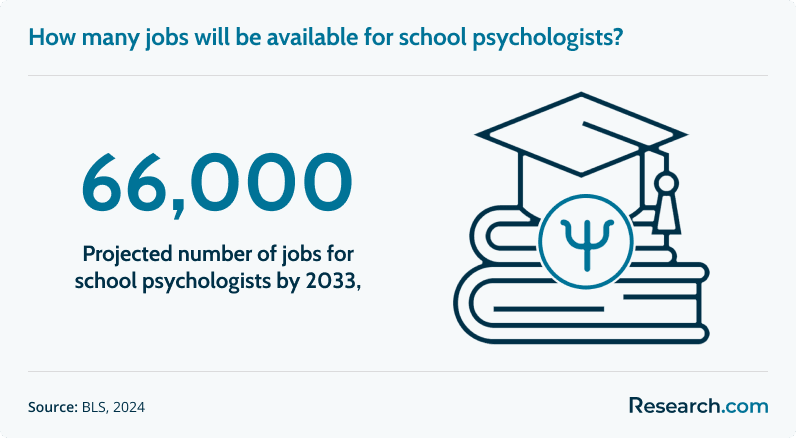
The job market for school psychology graduates remains strong. According to 2024 BLS data, there will be 66,000 school psychologist jobs by 2033. Zippia data reported over 16,373 school psychologists employed in the US, while the American Psychological Association has emphasized the need for more professionals in the field.
Demand is tied to schools’ growing focus on student mental health, early identification of learning difficulties, behavioral support, crisis response, and special education services. Districts, private schools, clinics, government programs, and education support organizations may need professionals who can combine assessment, consultation, and intervention skills.
Job market trends affecting school psychologists
- Greater attention to student mental health: Schools increasingly need professionals who can help identify and respond to academic, emotional, and behavioral concerns.
- Need for early intervention: Assessment and support services are central to addressing learning disabilities and behavior challenges before they worsen.
- Roles beyond traditional schools: Clinics, government programs, colleges, and private practices may hire professionals with school psychology expertise.
- Flexible employment models: Some graduates pursue consulting, part-time, remote-adjacent, or multi-site roles depending on credentialing and employer needs.
- Competitive but variable salaries: The median annual salary was $84,940 in 2024, but pay depends on region, credentials, employer, and experience.
What do graduates say about online school psychology programs?
-
: "
"I appreciated the hands-on learning opportunities in my online school psychology program, which allowed me to work directly with students while still managing my full-time job. The balance between virtual coursework and fieldwork gave me the flexibility I needed without sacrificing the quality of my education. Knowing I could gain real-world experience while still completing my degree was a huge relief." – Jennie
"
-
: "
"Studying online allowed me to interact with professionals nationwide, expanding my perspectives on education and psychology. The community of students and faculty, even in an online setting, was incredibly supportive and collaborative, which helped me stay motivated. I felt like I was part of something bigger, even though it was all online." – Penelope
"
-
: "
"The online school psychology program I enrolled in helped me become more confident in managing school-wide mental health programs. While the degree gave me the knowledge I needed, the real value came from learning how to engage with different communities and build relationships with kids. I'm now more prepared than ever to make a meaningful difference in the schools I work with." – Hassan
"
Can online programs provide accelerated training pathways?
Some online school psychology programs may offer faster pathways for students with strong academic preparation or relevant professional experience. These options can shorten coursework sequencing, but they still must preserve required competencies, fieldwork, and NASP-aligned training standards. Students considering faster doctoral preparation can also review an accelerated PsyD program, while keeping in mind that PsyD programs and school psychology specialist programs often lead to different roles.
How can online programs foster interdisciplinary collaboration?
School psychologists frequently work with teachers, counselors, nurses, social workers, administrators, families, and community providers. Online programs can support this collaboration through group projects, case-based learning, virtual consultation practice, crisis response simulations, and interdisciplinary electives. Students interested in related behavioral health areas may explore degrees in substance abuse counseling as part of broader professional development, especially when working with students and families facing complex challenges.
Key Insights
- NASP accreditation is one of the most important filters when comparing online school psychology programs because it signals alignment with professional preparation standards.
- Online school psychology programs are not fully remote in practice. Coursework may be online, but practicum, externship, and internship experiences usually require in-person supervised work.
- Most online school psychology programs at the master’s or specialist level take 3-4 years and often require 60-70 credits, depending on the degree structure.
- Students should expect significant fieldwork. Many programs include 1,200 hours of fieldwork or externship experience.
- Costs vary widely. The average cost of an online school psychology program is about $300 to $1,000 per credit hour, while many programs fall between $9,000 and $20,000 per year.
- School psychologists earned a median annual salary of $84,940 in 2024, but salaries are not guaranteed and depend on location, employer, credentials, and experience.
- The job outlook is favorable, with 66,000 jobs expected to be available by 2033.
- The best program is not always the cheapest or highest ranked. Choose the option that matches your state credentialing rules, field placement needs, schedule, and total budget.
References:
- Bureau of Labor Statistics (BLS). (2024a). 19-3034 School Psychologists. Occupational Employment and Wages. BLS.
- Bureau of Labor Statistics (BLS). (2024b). Psychologists. Occupational Outlook Handbook. BLS.
- Sohn, E. (2024). There’s a strong push for more school psychologists. Monitor on Psychology, 55(1), 72. APA.
- Zippia. (2025a). School Psychologist Demographics and Statistics in the US. Zippia.
- Zippia. (2025b). School Psychologist Salary. Zippia.
Other Things You Should Know About NASP Accredited Online School Psychology Programs
Admission requirements typically include a bachelor's degree, official transcripts, letters of recommendation, a statement of purpose, and GRE scores. Some programs may also require relevant work experience or an interview. Requirements can vary, so it's important to check specific program details.
NASP-accredited programs require supervised fieldwork, including a practicum and a full-time internship. NASP standards call for at least 1,200 internship hours, with direct supervision from a qualified school psychologist or university supervisor and documented experiences in schools serving diverse students.