
2027 Dual Degree Programs in Psychology: Benefits, Program Length & Tracks

Co-Founder and Chief Data Scientist
Dual degree programs in psychology appeal to students who want more than a single academic focus. According to the National Center for Education Statistics (NCES), nearly 130,000 bachelor’s degrees in psychology were awarded in the United States in 2021–22, representing about 6% of all bachelor’s awards. This level of demand highlights the value of psychology as a core field, and pairing it with another discipline can offer even broader opportunities.
In this article, I will outline what a psychology dual degree involves, including benefits, program length, cost considerations, and available specializations. I will also share examples of popular program combinations and explain how they connect to future career options and the current job market. By the end, you will have a clear understanding of how these programs can be both academically rigorous and strategically rewarding.
Key Things You Should Know About a Psychology Dual Degree Program
- Psychology dual degree programs typically take 5–7 years to complete, with accelerated BA–MA paths averaging 5 years and doctoral pairings like PhD/JD lasting 6 years or more.
- These programs may offer tracks in clinical, organizational, developmental, health, or research psychology, aligning specialization with the student’s chosen partner discipline.
- Specializations such as clinical practice, organizational behavior, and health psychology ensure the psychology curriculum complements fields like business, education, or public health.
- Pairing options include PsyD/MBA, BA/MSW, BA/MPH, and PhD/JD, each combining psychological training with complementary fields to expand professional opportunities.
- What can I expect from a psychology dual degree? Degree Overview
- What are the main benefits of pursuing a psychology dual degree? Main Benefits
- How long does it take to complete a psychology dual degree? Program Length
- What is the average cost of a psychology dual degree? Program Cost
- What are the prerequisites for enrolling in a psychology dual degree? What are the prerequisites for enrolling in a psychology dual degree?
- What types of tracks and specializations are available in a psychology dual degree? What types of tracks and specializations are available in a psychology dual degree?
- What are examples of psychology dual degree programs? Program Examples
- What career paths are available for graduates of a psychology dual degree? Career Paths
- How much can I make with a psychology dual degree? Salary Potential
- Are there any limitations to pursuing a psychology dual degree? Are there any limitations to pursuing a psychology dual degree?
- What is the job market for graduates of a psychology dual degree? Job Outlook
- Can a psychology dual degree support a career in behavior analysis? Can a psychology dual degree support a career in behavior analysis?
Psychology Dual Degrees: What to Expect Before You Apply
A psychology dual degree is for students who want psychology training plus another professional credential without completing two programs entirely separately. Instead of earning only one degree with a second major, students complete the requirements for two separate degrees, such as psychology and counseling, psychology and public health, psychology and law, psychology and business, or psychology and social work.
This path matters because many psychology-related careers now sit at the intersection of mental health, education, healthcare administration, law, data, and community services. A dual degree can help students prepare for those hybrid roles, but it also adds complexity: two curricula, two sets of requirements, higher costs, more advising needs, and, in some cases, licensure rules that must be checked carefully.
This guide explains how psychology dual degree programs work, how long they take, what they cost, which specializations are common, what careers they can support, and how to decide whether the added workload is worth it. It also highlights the questions students should ask before enrolling so they do not choose a program that fails to match their career or licensing goals.
Quick answer: Is a psychology dual degree worth it?
A psychology dual degree can be worth it if your career goal clearly requires both psychology knowledge and training in another field, such as public health, law, education, social work, or healthcare leadership. It is less useful if you are unsure about your target profession, if the second degree does not improve your licensure options, or if the added cost outweighs the career benefit.
| Decision point | What it means for students |
| Best fit | Students with a defined interdisciplinary goal, such as behavioral health leadership, school counseling, forensic psychology, public health programming, or clinical social work. |
| Main advantage | Two credentials can often be completed with some shared credits, reducing duplication compared with earning each degree separately. |
| Main risk | Students may underestimate workload, tuition, fieldwork requirements, and licensure restrictions. |
| Typical timeline | About 5 years for some bachelor’s-to-master’s tracks and 5–7 years for many doctoral or professional combinations. |
| Key question | Will both degrees directly help you qualify for the job, license, or doctoral/professional path you want? |
What is a psychology dual degree?
A psychology dual degree is an academic pathway in which a student earns two separate diplomas through an integrated plan of study. It differs from a double major because a double major usually results in one degree, while a dual degree produces two credentials. Some courses may count toward both programs, but students still have to satisfy the core requirements of each degree.
Program formats vary by level. Some colleges offer bachelor’s-to-master’s tracks that let psychology majors begin graduate work before finishing the undergraduate degree. Other universities offer graduate or professional pairings, such as a PsyD and MPH, a PhD and JD, or psychology combined with business, education, or social work.
Because timelines depend heavily on the degree combination, students often compare this decision with other time-to-completion questions, such as how long criminal justice school takes. The same principle applies: the name of the degree matters less than the curriculum structure, transfer policy, clinical or fieldwork requirements, and whether credits can overlap.
Students should expect demanding coursework, research expectations, advising from more than one department, and practical training such as internships, practica, clinical placements, or field education. The strongest programs make the sequence clear from the beginning so students know when they will complete each milestone.
Main Benefits of a Psychology Dual Degree
The value of a psychology dual degree comes from combining behavioral science with another discipline in a way that supports a specific career outcome. The benefit is not simply “more education.” The second degree should help you qualify for roles, licensing pathways, leadership responsibilities, or doctoral/professional study that a standalone psychology degree would not fully support.
- Broader professional preparation: Students learn psychology alongside another applied field, such as education, law, business, public health, or social work. This can be useful in roles that require both people-centered insight and systems-level decision-making.
- Potential time savings: Integrated programs may allow selected credits to count toward both credentials, which can shorten the total path compared with completing one degree first and then applying to another program later.
- Stronger career flexibility: Graduates may be able to pursue roles in counseling, behavioral health administration, public health, policy, school systems, social services, organizational leadership, or forensic settings.
- Better preparation for advanced study: Students who complete rigorous interdisciplinary training may be better prepared for doctoral, professional, or licensure-focused programs that value research, applied practice, and cross-field knowledge.
- Expanded networks: Dual degree students often work with faculty, supervisors, internship sites, and peers across two academic communities, which can increase access to mentorship and field experience.
Students considering counseling-related pathways should also verify whether the program’s credentials match state licensure expectations. Questions about which counseling accreditation is best are especially important for students who plan to become licensed counselors or enter regulated mental health roles.
| Benefit | When it matters most | What to verify |
| Shared coursework | You want to reduce duplicated credits across two programs. | Which courses cross-count and whether the policy is guaranteed in writing. |
| Licensure preparation | You plan to work in counseling, social work, school psychology, or clinical practice. | Whether the degree meets state-specific license requirements. |
| Leadership potential | You want management roles in clinics, nonprofits, healthcare, or behavioral health organizations. | Whether the second degree includes administration, finance, policy, or supervision training. |
| Interdisciplinary specialization | You want to work in forensic, educational, public health, or organizational settings. | Whether internships, field placements, and electives match that specialty. |
The chart below adds useful context by showing psychology bachelor’s completion patterns, including modest growth through 2020–21 followed by a sharper contraction over the last two years.
How Long Does a Psychology Dual Degree Take?
A standalone bachelor’s degree typically takes about 4 years, many master’s programs take 2–3 years, and doctoral psychology training averages 5–7 years depending on specialization (NCES, 2023). A dual degree can reduce duplication by allowing some coursework to apply to both programs, but it does not eliminate the academic, research, clinical, or professional requirements tied to each credential.
| Dual degree format | Typical completion time stated in available examples | What affects the timeline |
| Bachelor’s-to-master’s psychology pathway | About 5 years in some combined BA–MA models. | Whether graduate credits can begin before the bachelor’s degree is finished. |
| Dual master’s pairing | Often about 3 years full-time when psychology is paired with fields such as social work or public health. | Course overlap, field education, practicum hours, and full-time enrollment. |
| Doctoral and professional pairing | Commonly 5–7 years, depending on program design. | Dissertation, qualifying exams, clinical training, law or professional school requirements. |
| PsyD + MPH model | Often 4–5 years full-time, with some part-time paths extending to 6 years. | Clinical placements, public health coursework, capstone or practicum requirements. |
| Part-time or interrupted study | May extend to 7–8 years or longer in complex doctoral pathways. | Reduced course loads, clinical scheduling, leaves of absence, or delayed research milestones. |
Fairleigh Dickinson University reports a BA–MA psychology pathway that can be completed in 5 years by cross-applying 15 credits between undergraduate and graduate study. Cornell University describes a dual PhD in psychology with a JD in law designed for 6 years, combining doctoral research, legal coursework, and professional requirements.
Students comparing accelerated formats may also look at other fields where overlapping coursework shortens completion time, such as the shortest online master’s degree options in human resource management. The lesson is the same across disciplines: acceleration depends on the number of shared credits and the sequence of required courses.
In practical terms, most psychology dual degree students should plan for a longer and more structured path than a single degree. The time savings can be meaningful, but only if the program has a clear degree map and enough course availability to keep students on schedule.
How Much Does a Psychology Dual Degree Cost?
The cost of a psychology dual degree depends on the institution, degree level, enrollment status, number of shared credits, and whether the program includes clinical, legal, public health, or professional school tuition. Integrated programs can be less expensive than earning two degrees sequentially, but they are not automatically low-cost.
| Cost factor | Available example or figure | Why it matters |
| Shared credits | Fairleigh Dickinson University reports that BA–MA students may reduce total cost by roughly $10,000–$15,000 compared with separate enrollment (Fairleigh Dickinson University, 2024). | Shared credits are one of the clearest ways a dual degree can lower the total bill. |
| Public vs. private tuition | NCES data shows graduate tuition at private nonprofit universities averaged $26,000 in 2022–23, compared with $13,000 at public institutions (NCES, 2023). | Institution type can have a larger impact than the dual degree structure itself. |
| Master’s-level integration | Neumann University explains that some integrated master’s pairings take 3 years rather than 4, removing a full year of graduate tuition (Neumann University, 2023). | Shorter duration can reduce tuition, fees, transportation, and living expenses. |
| Doctoral or professional combinations | Cornell University’s PhD/JD pathway can exceed $200,000, though the integrated design avoids some duplicated enrollment (Cornell University, 2024). | Professional-school tuition can make these pathways expensive even when time is saved. |
| Additional required expenses | Practicum fees, licensure exams, required software, and placement-related costs can add $2,000–$5,000 (Rutgers University, 2024). | Students should budget beyond tuition and mandatory university fees. |
Cost-conscious students should compare total program price, not just per-credit tuition. Ask whether tuition changes after moving from undergraduate to graduate status, whether graduate assistantships are available, whether summer terms are required, and whether clinical or field placements create travel costs.
Some students reduce expenses by beginning at a lower-cost institution, using transfer credits, or comparing online and hybrid options before committing to a dual pathway. Veterans and military-connected students may also want to compare affordable online bachelor’s degree options for veterans before transferring into a combined or graduate-level program.
The chart below provides additional context by showing the gender distribution of psychology bachelor’s graduates in the United States, a field that has long enrolled more women than men.
Psychology Dual Degree Admission Requirements
Admission to a psychology dual degree is often more selective than admission to a single program because applicants must satisfy expectations from two departments or professional schools. A student may be academically eligible for psychology but still need to meet separate standards for law, business, education, public health, counseling, or social work.
- GPA and academic standing: Many 4+1 BA–MA pathways expect junior standing and a GPA of 3.0 or higher. Fairleigh Dickinson specifies 12 psychology credits, a 3.0 GPA, and application before 80 credits are completed. Penn State Harrisburg’s MA requires a 3.0 GPA in the last 60 credits plus at least 18 psychology credits.
- Psychology prerequisites: Graduate study commonly expects prior coursework in statistics and research methods. Some programs may also expect abnormal psychology, developmental psychology, or other foundational courses.
- Testing policies: The American Psychological Association reports a sharp decline in GRE requirements since 2020–21, and Cornell’s MA does not accept GRE scores. However, pairings with law or business may still require exams such as the LSAT or GMAT.
- Separate admission decisions: Some pathways require approval from both units. Cornell’s PhD in Psychological Sciences with a JD in law requires admission by the Graduate Field of Psychology and the Law School.
- Fieldwork clearances: Programs with clinical, school, social service, or healthcare placements may require background checks, drug screenings, TB testing, immunizations, or other site-specific documentation.
Applicants should treat dual degree planning as a sequence of milestones, similar to the way students ask, what do I need to become a neurologist? The pathway is not just “get admitted and take classes.” It involves prerequisites, exams or test waivers, supervised experience, professional standards, and sometimes state licensing requirements.
| Question to ask admissions | Why it matters |
| Do I apply to both degrees at the same time or after completing certain credits? | Some programs allow early admission, while others require a second application later. |
| Which courses count toward both degrees? | This determines whether the program actually saves time or money. |
| What happens if I am accepted into one program but not the other? | You need to know whether you can continue in a single-degree option. |
| Are GRE, LSAT, GMAT, or other exams required? | Testing requirements can affect cost, timeline, and application strategy. |
| Does the program meet licensure requirements in my state? | This is essential for counseling, psychology, school, and social work careers. |
Common Psychology Dual Degree Tracks and Specializations
Most psychology dual degree programs are built around a career-focused pairing. The psychology side may emphasize clinical practice, research, human development, behavioral health, organizational behavior, or quantitative methods, while the second degree supplies the professional context.
| Track or specialization | Common pairing | Best for students interested in |
| Clinical or counseling psychology | Psychology with counseling, social work, or clinical training. | Assessment, therapy, mental health services, community practice, or supervised clinical roles. |
| Industrial-organizational psychology | Psychology with business, management, or human resources. | Workplace behavior, employee assessment, organizational change, leadership, and consulting. |
| Developmental or educational psychology | Psychology with education, counseling, or school-based training. | Learning, child and adolescent development, school interventions, and student support services. |
| Neuroscience or health psychology | Psychology with public health, medicine-adjacent fields, or behavioral medicine. | Health behavior, epidemiology, prevention, chronic illness, and behavioral health programs. |
| Research and quantitative methods | Psychology with data, policy, doctoral preparation, or assessment-focused programs. | Research design, psychometrics, evaluation, evidence-based practice, and doctoral study. |
The American Psychological Association identifies industrial and organizational psychology as one of the fastest-growing psychology specializations (APA, 2024). Students drawn to that area may compare dual degree options with a fast-track online master’s in industrial-organizational psychology to decide whether a second degree is necessary or whether a focused graduate program is enough.
Rutgers’ PsyD/MPH model incorporates behavioral medicine and epidemiology, while programs at institutions such as George Mason and Augusta emphasize advanced statistics, research design, and psychometrics. Penn State and Arizona State list developmental coursework as central to graduate psychology training. These examples show why the specialization should be chosen after the student defines the target career, not before.
Examples of Psychology Dual Degree Programs
Universities build psychology dual degree programs around fields where understanding human behavior improves practice, leadership, policy, or service delivery. The examples below show how different pairings can lead to very different career directions.
| Program example | Institution | How the pairing is used |
| PsyD/MBA dual degree | Widener University | Combines clinical psychology with business management for students interested in healthcare leadership, consulting, private practice administration, or executive roles. |
| BA/MSW dual degree | Rutgers University | Allows psychology undergraduates to move toward social work training focused on clinical practice, case management, advocacy, and policy. |
| MA in Psychology in Education and EdM in Counseling Psychology | Columbia University Teachers College | Links psychology and education through counseling, learning theory, school-based interventions, and student support. |
| BA/MPH dual degree | Boston University and Rutgers | Connects psychology with public health preparation in health promotion, epidemiology, prevention, and policy development. |
| Dual PhD/JD in psychology and law | Cornell University | Integrates doctoral psychology research with legal training for work in academia, forensic analysis, policy, or legal consulting. |
Some universities also combine healthcare, leadership, and behavioral science in related interdisciplinary pathways. Students interested in management roles may compare psychology-business options with guides on RN to MBA career opportunities to understand how different professional backgrounds lead into healthcare leadership.
Career Paths for Psychology Dual Degree Graduates
A psychology dual degree can prepare graduates for roles that require both behavioral expertise and knowledge of another system, such as schools, courts, healthcare organizations, public agencies, nonprofits, or businesses. Career outcomes depend strongly on the second degree, licensure eligibility, supervised experience, and state rules.
| Career path | Relevant dual degree combination | Typical work focus |
| Clinical director in behavioral health | PsyD/MBA or psychology plus healthcare administration. | Overseeing programs, budgets, staffing, quality standards, and patient-care operations. |
| Licensed clinical social worker | Psychology plus MSW. | Providing counseling, case management, crisis support, advocacy, and community-based services. |
| School counselor or school-based mental health professional | Psychology plus counseling or education. | Supporting students, coordinating interventions, advising families, and working with teachers. |
| Public health program manager | Psychology plus MPH. | Designing prevention programs, evaluating health initiatives, supporting epidemiological work, and managing community wellness projects. |
| Forensic consultant or policy analyst | Psychology plus JD or public policy training. | Applying behavioral research to legal decision-making, policy analysis, advocacy, or forensic consultation. |
Students focused on school or counseling careers should compare degree titles carefully because not every psychology program leads to counseling licensure. Reviewing accredited online counselor education programs can help clarify how counseling-specific curricula differ from general psychology training.
The strongest career fit usually comes when the second credential solves a specific professional problem. For example, an MPH can support population-level mental health work, an MBA can support clinic leadership, an MSW can support social work licensure, and a JD can support law-related research or advocacy.
Psychology Dual Degree Salary Outlook
Salary outcomes for psychology dual degree graduates vary widely because the degree can lead into several different occupations. A dual degree does not guarantee a higher salary, but it may help graduates qualify for specialized, supervisory, administrative, or interdisciplinary roles that are associated with higher pay ranges in some fields.
| Occupation | Median annual wage | Highest 10% | How a dual degree may help |
| Psychologists | $94,310 in May 2024 | More than $141,910 | A pairing such as PsyD/MBA may support supervisory, administrative, or specialized clinical roles. |
| Social workers | $61,330 | More than $94,910 | Psychology plus MSW training can support advanced clinical practice or agency leadership. |
| School and career counselors and advisors | $65,140 | More than $101,210 | Psychology combined with counseling or education can strengthen preparation for school-based support and administrative responsibilities. |
| Medical and health services managers | $117,960 | More than $210,140 | Psychology plus public health, business, or healthcare leadership training can support management roles. |
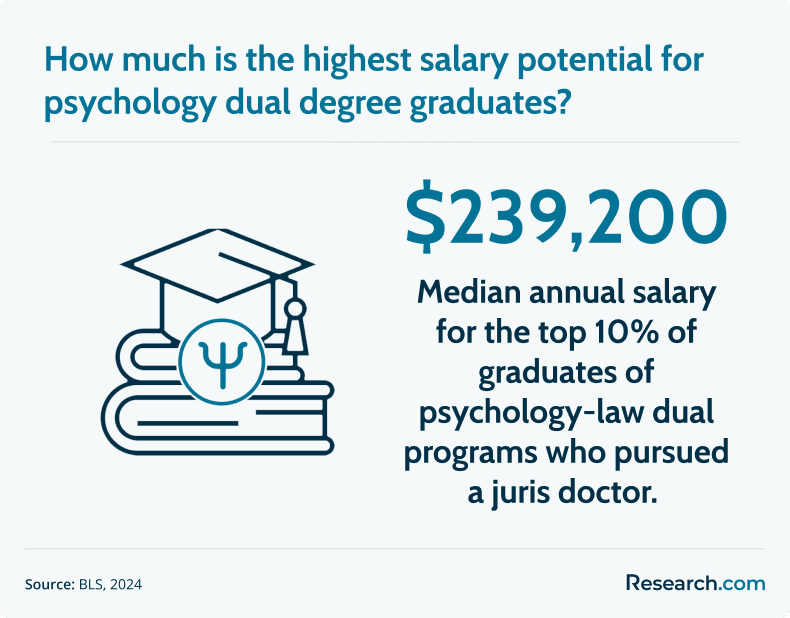
| Lawyers | $151,160 | More than $239,200 | Psychology-law training may be useful in specialized legal practice, policy analysis, forensic work, or academia. |
These figures show that psychology dual degree graduates may enter fields with pay scales ranging from the $60,000s to more than $200,000 annually. Actual earnings depend on occupation, location, licensure, employer type, experience, and whether the graduate enters clinical practice, management, law, education, or public health.
Before choosing a program for income potential, students should verify whether the degree is recognized by employers and licensing boards. Reviewing psychology program accreditation is an important step because accreditation can affect eligibility for internships, doctoral admission, licensure, and competitive employment.
The chart below provides a 2024 median annual pay benchmark for psychologists, one of the most common career categories connected to advanced psychology training.
Limitations and Trade-Offs of a Psychology Dual Degree
A psychology dual degree can create opportunity, but it also adds pressure. Students may be managing two advising systems, two academic calendars, two sets of graduation requirements, and sometimes two separate professional cultures. The challenge is not only doing more work; it is staying aligned with a clear career goal while requirements become more complex.
- Heavier workload: Dual degree students often take advanced courses earlier and may have less room for electives or schedule changes.
- More complicated advising: Mistakes in course sequencing can delay both degrees if departments do not coordinate well.
- Licensure uncertainty: Psychology, counseling, social work, education, and clinical roles may follow different state rules. A program that works in one state may not satisfy requirements elsewhere.
- Higher total cost: Even with shared credits, professional or doctoral pairings can be expensive, especially when fees, placements, and exams are included.
- Less flexibility to change goals: If a student later decides not to use the second degree, the added coursework may not produce enough value.
Students considering doctoral clinical training but needing more scheduling flexibility may compare campus programs with online PsyD programs. However, flexibility should never replace due diligence on accreditation, supervised clinical training, internship match expectations, and state licensure eligibility.
Job Market Outlook for Psychology Dual Degree Graduates
The job market for psychology dual degree graduates depends on the occupation they enter. These programs can connect to psychology, social work, counseling, education, healthcare management, and law, so employment growth varies by field. The strongest outlooks in the available data are connected to behavioral health and healthcare management.
| Occupation | Projected employment growth | Annual openings |
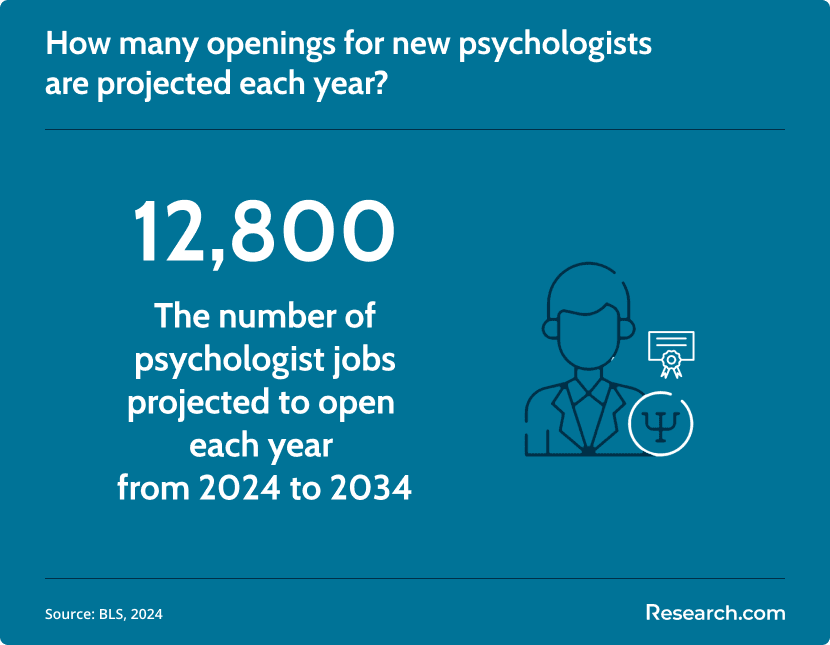
| Psychologists | 6% from 2024 to 2034 | About 12,800 openings each year |
| Social workers | 6% from 2024 to 2034 | Around 63,800 openings annually |
| Substance abuse, behavioral disorder, and mental health counselors | 17% from 2022 to 2032 | About 42,000 openings each year |
| School and career counselors and advisors | 4% from 2022 to 2032 | Roughly 26,600 annual openings |
| Medical and health services managers | 23% from 2022 to 2032 | About 54,700 openings annually |
| Lawyers | 4% from 2022 to 2032 | Around 39,100 openings each year |
Behavioral health and healthcare management show especially strong momentum, while education and law have steadier growth patterns. For students, the key takeaway is that the second degree should connect to a real labor market path, not just personal interest. A psychology-public health pairing, for example, points toward different employers than a psychology-law or psychology-business pairing.
What Graduates Say About Psychology Dual Degree Programs
- : "My psychology and public health program put me on a rural clinic outreach project while I was still in school. That experience became my first full-time role after graduation, and it showed me how research can become practical support for real communities. — Arturo"
- : "The psychology and business combination helped me see wellness as both a service and an organization that has to be managed well. I started a small wellness venture with classmates, and the program gave me the language for both client impact and business planning. — Patrice"
- : "Studying psychology and law changed how I advocate for children in foster care. I now work with attorneys to keep mental health needs visible in legal decisions. The work is difficult, but the dual training helps me bridge two systems that do not always communicate well. — Rami"
How to Decide Whether a Psychology Dual Degree Is Right for You
The best way to evaluate a psychology dual degree is to start with the career outcome and work backward. A dual degree should solve a specific problem: qualify you for a license, prepare you for leadership, support a specialized field, or shorten the route to two credentials you already know you need.
- Define the target role first. Write down the job titles you want and check whether they require licensure, certification, supervised hours, or a specific accredited degree.
- Map each degree to that role. Identify what the psychology degree contributes and what the second degree contributes. If one degree does not clearly add value, reconsider the pathway.
- Check accreditation and licensure. Contact state licensing boards when applicable. Do not rely only on a school’s general marketing language.
- Ask for the official course sequence. Confirm which classes are required, which credits overlap, and when fieldwork or clinical placements occur.
- Calculate total cost. Include tuition, fees, books, software, exams, transportation, placement expenses, and lost income if full-time study limits work hours.
- Compare with alternatives. A certificate, standalone master’s, focused online program, or sequential degree may be better if it meets the same goal with less cost or risk.
Common Mistakes to Avoid
| Mistake | Why it can hurt you | Better approach |
| Choosing a dual degree because it sounds impressive. | Extra credentials do not automatically improve employment or salary outcomes. | Choose the pathway only if both degrees support a clear role or license. |
| Ignoring accreditation. | Accreditation can affect licensure, transferability, internship eligibility, and employer recognition. | Confirm institutional and programmatic accreditation before applying. |
| Looking only at tuition. | Fees, exams, travel, software, placements, and delayed earnings can change the real cost. | Build a full cost estimate for every year of the program. |
| Assuming online or hybrid study meets licensure rules. | Some states require specific supervised experiences, course content, or residency components. | Check state board rules and ask the program for written licensure disclosures. |
| Underestimating scheduling complexity. | Course conflicts across departments can delay graduation. | Request a term-by-term plan and ask how often required courses are offered. |
| Relying only on rankings. | A highly ranked school may still be a poor fit for your specialty, budget, or licensing state. | Compare outcomes, placement support, faculty fit, accreditation, and affordability. |
Can a Psychology Dual Degree Support a Career in Behavior Analysis?
A psychology dual degree can support a future in behavior analysis when the coursework includes behavioral assessment, intervention planning, research methods, ethics, and supervised practical experience aligned with certification expectations. Psychology provides a strong foundation in learning, development, cognition, and behavior, but students who want to become Board Certified Behavior Analysts should verify the exact educational and fieldwork requirements before enrolling.
Students interested in this route may compare dual degree options with affordable online BCBA master’s programs. A focused BCBA-aligned master’s pathway may be more direct for some students, while a psychology dual degree may be useful for those who also want broader preparation in counseling, education, social work, or public health.
References:
- American Psychological Association. (2024). Admission criteria for graduate psychology programs are changing. https://www.apa.org/monitor/2024/06/admission-criteria-graduate-psychology-programs
- American Psychological Association. (2024, April 15). Industrial and Organizational Psychology. https://www.apa.org/ed/graduate/specialize/industrial
- American Psychological Association. (2025). Graduate psychology programs rely less on standardized tests. https://www.apa.org/monitor/2025/06/graduate-psychology-standardized-tests
- Bureau of Labor Statistics. (2024). Lawyers: Occupational Outlook Handbook. U.S. Department of Labor. https://www.bls.gov/ooh/legal/lawyers.htm
- Bureau of Labor Statistics. (2024). Psychologists: Occupational Outlook Handbook. U.S. Department of Labor. https://www.bls.gov/ooh/life-physical-and-social-science/psychologists.htm
- Bureau of Labor Statistics. (2024). Social Workers: Occupational Outlook Handbook. U.S. Department of Labor. https://www.bls.gov/ooh/community-and-social-service/social-workers.htm
- Columbia University Teachers College. (2025). Master of Arts and Master of Education psychology programs. https://www.tc.columbia.edu/psychology/
- Cornell University. (2024). Dual Ph.D./J.D. Program in Psychology and Law. https://psychology.cornell.edu/phd-jd-developmental-psych-law
- Fairleigh Dickinson University. (2024). BA–MA in Psychology combined degree program. https://www.fdu.edu/program/ba-ma-psychology-combined-degree
- National Center for Education Statistics. (2023). Undergraduate Degree Fields. U.S. Department of Education, Digest of Education Statistics. https://nces.ed.gov/programs/coe/indicator/cta
- Neumann University. (2023). What are Dual Bachelor’s and Master’s Degree Programs? https://learn.neumann.edu/neuperspectives/what-are-dual-bachelors-and-masters-degree-programs
Key Insights
- A psychology dual degree is most valuable when both credentials are tied to a specific career, license, or leadership path.
- Typical timelines range from about 5 years for some bachelor’s-to-master’s programs to 5–7 years for many doctoral or professional pairings.
- Shared credits can reduce duplication, but students should still budget for tuition, fees, clinical or fieldwork costs, exams, and possible travel.
- Accreditation and state licensure rules are critical. Do not assume a psychology dual degree automatically qualifies you for counseling, social work, school, or clinical practice.
- The strongest career outcomes usually come from intentional pairings: psychology plus public health for population mental health, psychology plus MBA for behavioral health leadership, psychology plus MSW for social work practice, and psychology plus JD for law-related work.
- Before enrolling, ask for the official course map, credit-sharing policy, placement requirements, licensure disclosures, and total cost estimate in writing.
Other Things You Should Know About Psychology Dual Degree Programs
Many psychology dual degree programs do not require the GRE in 2027, especially at universities using test-optional admissions. When required, schools usually ask for official scores from the GRE General Test and set their own minimums for competitive review.
In 2027, most dual degree programs in psychology require the GRE (Graduate Record Examination) for admission. Some specialized tracks may demand additional tests, like the GMAT, especially if the dual degree combines psychology with business studies.


