
2027 CACREP vs. MPCAC Accreditation: Master's in Counseling Program Options

Co-Founder and Chief Data Scientist
With thousands of master’s degrees in counseling recently awarded nationwide, many students are trying to determine which accreditation will best support their professional goals. The challenge lies in the fact that both CACREP and MPCAC accrediting bodies set quality standards, but their recognition and outcomes can differ in important ways.
How does program accreditation affect licensure, career opportunities, and future educational pathways? This article breaks down the distinctions between CACREP accreditation and MPCAC accreditation to help students make informed decisions about their counseling education.
Key Things You Should Know About CACREP vs. MPCAC Accreditation
- Some states require CACREP accreditation, while others accept MPCAC accreditation, which can influence where graduates are allowed to practice.
- CACREP accreditation emphasizes counselor education standards, while MPCAC accreditation focuses more broadly on clinical mental health counseling.
- Some federal agencies and doctoral programs specifically prefer CACREP accreditation, while others recognize MPCAC accreditation as a valid pathway.
- How do CACREP and MPCAC accreditation standards compare for 2027? CACREP vs. MPCAC
- Which accreditation is more common among top-ranked counseling schools? Accreditation
- How does MPCAC accreditation affect career opportunities compared to CACREP? Career
- How does MPCAC structure its counseling curriculum compared to CACREP? Curriculum
- Do counseling program accreditation types affect financial aid eligibility? Financial Aid
- Which states currently recognize MPCAC-accredited master’s programs for licensure? MPCAC States
- Which states require CACREP accreditation for counseling licensure? CACREP States
- Are CACREP-accredited counseling programs available online? Are CACREP-accredited counseling programs available online?
- Do MPCAC-accredited schools offer fully online master’s in counseling programs? Do MPCAC-accredited schools offer fully online master’s in counseling programs?
- What additional factors should be considered in selecting an accredited counseling program? What additional factors should be considered in selecting an accredited counseling program?
- Which accreditation better strengthens professional identity as a counselor? Which accreditation better strengthens professional identity as a counselor?
- Do Employers Value CACREP and MPCAC Accreditations Equally? Do Employers Value CACREP and MPCAC Accreditations Equally?
Choosing between a CACREP-accredited and an MPCAC-accredited counseling master’s program is not just an academic preference. It can affect how easily you qualify for state licensure, what kind of clinical training you receive, how employers read your degree, and whether your program fits your long-term plans in counseling, psychology, school settings, community mental health, or doctoral study.
This guide explains how CACREP and MPCAC accreditation compare in 2027, where each credential tends to be strongest, and what students should check before enrolling. You will learn how the two standards differ in curriculum, licensure alignment, online availability, financial aid considerations, employer recognition, and professional identity so you can choose the pathway that best matches your state, career goals, and preferred training model.
Quick answer: CACREP vs. MPCAC accreditation
CACREP is usually the clearer choice for students whose main goal is counseling licensure, especially in states or employment settings that explicitly recognize CACREP-accredited training. MPCAC can be a strong option for students who want a counseling degree with deeper grounding in psychological science, multicultural practice, research, and evidence-based clinical work, but students must verify state licensure rules before enrolling.
| Decision point | CACREP accreditation | MPCAC accreditation |
| Best fit | Students focused on becoming licensed professional counselors and seeking a standardized counseling curriculum | Students interested in counseling programs with stronger psychology, research, diversity, and clinical science emphasis |
| Licensure alignment | More commonly tied to counseling licensure boards and state counseling requirements | Can support licensure in many cases, but students may need to confirm additional state-specific requirements |
| Curriculum style | More uniform across programs because CACREP uses a highly standardized counselor education model | More flexible across institutions, often allowing psychology-oriented or specialized coursework |
| Online availability | More widely available in online and hybrid counseling master’s formats | Less commonly fully online because many programs emphasize in-person clinical training |
| Professional identity | Centered on the professional counselor role | Often bridges counseling practice with psychological science and clinical research |
How do CACREP and MPCAC accreditation standards compare for 2027?
CACREP and MPCAC both evaluate master’s-level counseling-related programs, but they are built around different training philosophies. CACREP is rooted in counselor education and is designed to create consistency across counseling programs in areas such as human development, assessment, ethics, helping relationships, group work, and supervised field experience.
MPCAC also reviews graduate counseling and psychology programs, but its standards place more visible weight on psychological foundations, clinical reasoning, diversity, research literacy, and evidence-based practice. This makes MPCAC especially relevant for programs that sit closer to applied psychology, counseling psychology, or clinical mental health preparation.
For students in 2027, the most important difference is practical: CACREP is generally more directly connected to counseling licensure pathways, while MPCAC may be more attractive when a student wants counseling preparation that remains closely connected to psychology. The right choice depends less on which accreditor sounds more prestigious and more on whether the program meets the rules in the state where the student plans to practice.
This distinction often mirrors the broader difference between clinical psychology and counseling psychology programs. CACREP usually reflects a counselor education model, while MPCAC more often fits programs that emphasize psychological theory, research-informed treatment, and clinical flexibility.
| Area of comparison | What CACREP emphasizes | What MPCAC emphasizes |
| Academic orientation | Professional counseling identity and counselor education standards | Psychological science, counseling practice, and clinical foundations |
| Consistency across programs | High standardization across accredited programs | Greater room for institutional specialization |
| Licensure usefulness | Often the more direct route where CACREP is named by state boards | Potentially useful, but state-by-state verification is essential |
| Student who may benefit most | A student who wants the cleanest pathway into professional counseling practice | A student who wants counseling training with stronger psychology and research integration |
Which accreditation is more common among top-ranked counseling schools?
CACREP accreditation is more common among nationally visible master’s in counseling programs than MPCAC accreditation. Its longer history, closer connection to counseling licensure, and broad recognition by counseling boards have made it the more familiar accreditation for students comparing professional counseling programs.
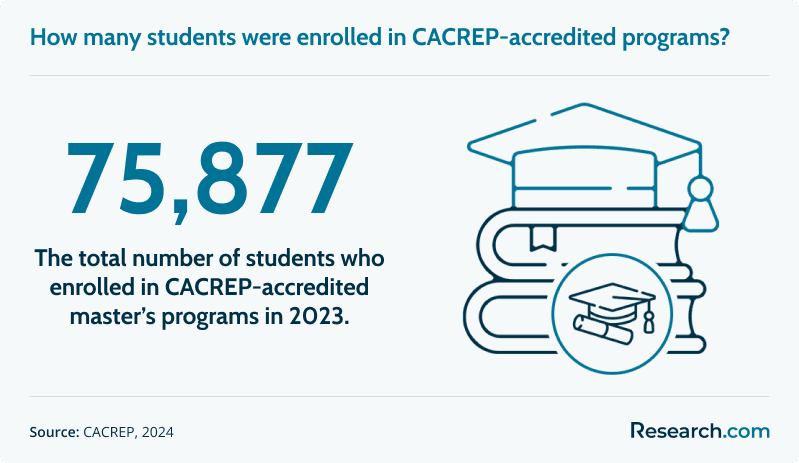
According to CACREP, over 75,000 students were enrolled in CACREP-accredited master’s programs in 2023. That figure helps explain why students searching for counseling degrees encounter CACREP more often in program descriptions, licensure disclosures, and admissions materials.
MPCAC accreditation is less widespread among counseling programs, but it remains a meaningful option. It is often found at universities with strong applied psychology, counseling psychology, or clinical training traditions. For students considering doctoral study in psychology or research-informed clinical work, MPCAC may offer a better academic fit than a counseling program built strictly around a traditional counselor education model.
Students comparing program speed and delivery format will usually find more CACREP options online, including accelerated pathways such as the shortest master’s in educational counseling online programs. However, speed should not outweigh licensure fit, supervised field placement quality, or state board recognition.
| If your priority is... | Accreditation to examine first | Why it matters |
| Becoming a licensed professional counselor as efficiently as possible | CACREP | It is more frequently referenced in counseling licensure rules and employer expectations. |
| Studying counseling through a psychology-centered lens | MPCAC | Its standards place stronger emphasis on psychological science and evidence-based clinical practice. |
| Finding the widest range of online programs | CACREP | CACREP-accredited online and hybrid programs are easier to find than fully online MPCAC options. |
| Preparing for possible doctoral work in psychology | MPCAC | The curriculum may include more research, diversity, and psychology-oriented coursework. |
How does MPCAC accreditation affect career opportunities compared to CACREP?
Both CACREP-accredited and MPCAC-accredited programs can prepare graduates for mental health careers, but they may not create the same licensing experience. CACREP graduates often have a more predictable path when a state board or employer specifically names CACREP in its requirements. That can reduce uncertainty when applying for supervised post-master’s hours, licensure exams, or counseling roles.
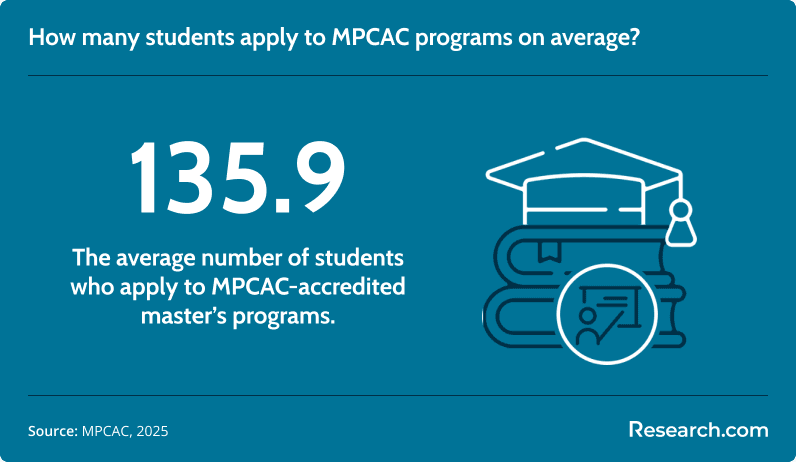
MPCAC graduates may have strong clinical preparation, especially when their programs emphasize psychological assessment concepts, multicultural competence, research literacy, and evidence-based interventions. According to MPCAC, accredited programs attract, on average, over 130 applicants per institution, which reflects student interest in this training model. The trade-off is that some graduates may need to document coursework more carefully or complete extra requirements depending on the state.
Cost and delivery format can also affect career planning. Students comparing tuition-sensitive options may find more online CACREP choices, including affordable CACREP-accredited counseling programs online. MPCAC programs may be more concentrated in campus-based or hybrid settings, so students should compare relocation costs, commuting, field placement access, and work schedule flexibility.
| Career consideration | CACREP pathway | MPCAC pathway |
| State counseling licensure | Often easier to verify because many boards are familiar with CACREP standards | May qualify, but students should request written confirmation from the state board before enrolling |
| Federal or public-sector counseling roles | Can be advantageous where CACREP is specifically preferred or recognized | May still be valued, especially when the role emphasizes clinical psychology-informed services |
| Community mental health practice | Strong fit for professional counseling roles | Strong fit when the program meets licensure requirements and includes robust supervised training |
| Doctoral preparation | Useful for counseling-focused doctoral routes | Potentially stronger for students interested in psychology-related doctoral study or research-heavy programs |
How does MPCAC structure its counseling curriculum compared to CACREP?
CACREP-accredited programs follow a structured counselor education framework. They include eight core areas, along with supervised practicum and internship requirements. This standardization helps students and licensing boards understand what a CACREP degree includes, regardless of which accredited institution awarded it.
MPCAC-accredited programs also require supervised clinical preparation, but their curriculum often gives institutions more room to build programs around psychological science, multicultural counseling, research-informed practice, and specialized clinical interests. This can be valuable for students who want a counseling degree that includes broader psychology training rather than a narrower professional counseling sequence.
Students evaluating flexible clinical programs may also compare adjacent pathways such as fast-track MFT online master’s programs. The main lesson is the same across counseling-related fields: curriculum structure matters because licensure boards, practicum sites, and employers look closely at what training a graduate actually completed.
| Curriculum feature | CACREP-accredited programs | MPCAC-accredited programs |
| Core coursework | Organized around standardized counselor education domains | Often combines counseling skills with psychological theory and clinical science |
| Field training | Requires supervised practicum and internship experiences | Also requires supervised clinical experiences, with program-specific structure |
| Elective flexibility | Can vary, but the required counseling core is highly defined | Often allows more room for institutional specialization and psychology-focused electives |
| Best academic fit | Students who want a clearly defined professional counseling curriculum | Students who want counseling preparation blended with psychology, research, and diversity-focused training |
Do counseling program accreditation types affect financial aid eligibility?
Students should separate programmatic accreditation from financial aid eligibility. In most cases, access to federal student aid depends on the institution’s eligibility and the student’s own aid status, not only on whether the counseling program is CACREP- or MPCAC-accredited. Before enrolling, students should confirm that the institution participates in federal aid programs and that the specific program is eligible.
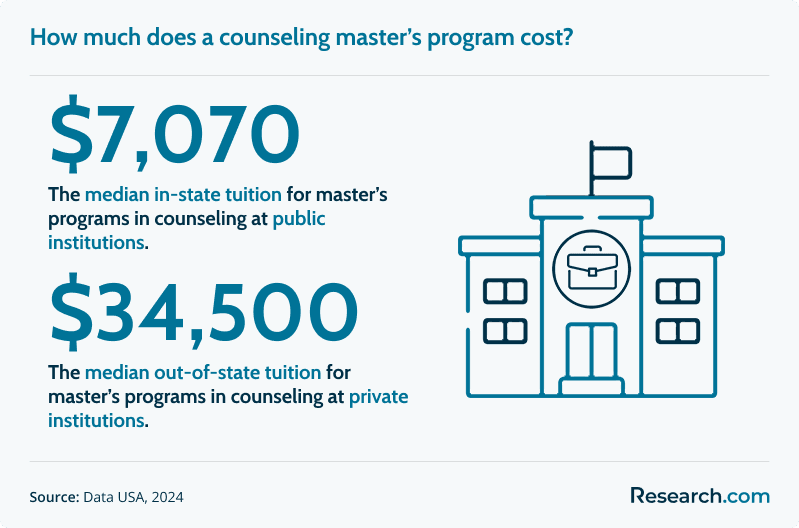
Program cost can vary widely regardless of accreditation type. National data cited in the original analysis show that median tuition for in-state public institutions is just over $7,000 per year, while private institutions average around $34,500. This difference can have a larger effect on total debt than whether a program is CACREP- or MPCAC-accredited.
Students trying to limit cost should compare tuition, fees, field placement expenses, travel requirements, books, technology fees, and the length of the program. Faster options, such as fast-track online master’s in school counseling programs, may reduce time in school, but they are only a good value if they meet the student’s licensure and career requirements.
| Cost factor | Why it matters | Question to ask before enrolling |
| Institutional aid eligibility | Federal aid usually depends on the school and program’s eligibility status. | Is this specific counseling program eligible for federal financial aid? |
| Total tuition | Published tuition may not include fees, residency costs, or repeated fieldwork expenses. | What is the estimated total program cost from enrollment to graduation? |
| Field placement costs | Practicum and internship may require commuting, background checks, insurance, or reduced work hours. | What costs do students typically incur during practicum and internship? |
| Program length | A shorter program may save time, but only if it satisfies licensing requirements. | Will this timeline still meet my state board’s coursework and supervised training rules? |
Which states currently recognize MPCAC-accredited master’s programs for licensure?
MPCAC reports that its accredited master’s programs are currently recognized in more than 20 states. The largest concentrations named in the available data include New York with 10 programs, Pennsylvania with 9, and Massachusetts with 5. Other states with multiple MPCAC-accredited programs include California, Georgia, Maryland, and Wisconsin, while Arizona, Oklahoma, and Hawaii have one program each.
Recognition does not always mean automatic licensure. State boards can require specific coursework, supervised hours, exams, background checks, and post-degree clinical experience. A student considering an MPCAC-accredited program should check the licensing board in the state where they intend to work, not only the state where the university is located.
This step is especially important for students comparing flexible or distance-based options such as a fast-track counseling psychology degree online. Before committing, students should ask the program for a state-by-state licensure disclosure and then verify that information directly with the licensing board.
- Identify the exact license you want, such as licensed professional counselor, mental health counselor, or school counselor.
- Find the licensing board for the state where you plan to practice.
- Compare the board’s coursework, practicum, internship, and supervised experience requirements with the program curriculum.
- Ask the program whether recent graduates have successfully obtained licensure in your target state.
- Save written documentation from the school and the licensing board before enrolling.
Which states require CACREP accreditation for counseling licensure?
CACREP-accredited programs are widely recognized across all 50 states, but students should not assume that every state uses the same language or applies the same rules. Some states explicitly reference CACREP, some accept equivalent coursework, and others evaluate degrees through detailed course-by-course standards.
Available program counts show that Texas has 35 CACREP-accredited institutions, Pennsylvania has 25, and New York has 24. Other states with significant availability include Illinois with 23, Ohio with 20, and North Carolina with 18. These numbers show how deeply CACREP is embedded in many counseling education markets.
States with smaller populations may have fewer CACREP-accredited options. Vermont, Delaware, and Wyoming are examples where students may find only one or two available programs. In those cases, online CACREP-accredited programs may be especially important for students who cannot relocate.
For prospective students, CACREP often provides a more predictable counseling licensure route, especially in regions where state boards, universities, and employers are accustomed to CACREP standards. Students who need flexible admissions options may also compare broader college access resources, including online colleges with no SAT or ACT requirement, while remembering that graduate counseling programs set their own admissions criteria.
Are CACREP-accredited counseling programs available online?
Yes. Students can find CACREP-accredited counseling master’s programs in online and hybrid formats. These programs must still meet CACREP standards, which means online coursework does not remove the need for supervised practicum and internship experiences. Students usually complete those clinical requirements at approved sites in or near their communities.
Online CACREP programs are useful for working adults, students in rural areas, military-connected students, and learners who cannot relocate. Research and professional discussion around online learning in counseling education also show why programs must pay close attention to clinical skill development, supervision quality, and counseling self-efficacy rather than treating online delivery as a simple convenience.
The key advantage of CACREP online programs is portability. Because the accreditation standards are consistent, students may have an easier time showing state boards that their coursework and fieldwork meet recognized counseling education expectations. Still, online students should verify licensure alignment in their target state before enrolling.
Students who are exploring several career pivots may find it helpful to compare how accredited training functions across fields. For example, resources on nonmedical career alternatives for biology majors show a similar principle: the best credential depends on the career outcome, not just the subject area printed on the degree.
Do MPCAC-accredited schools offer fully online master’s in counseling programs?
Fully online MPCAC-accredited counseling programs are less common than online CACREP-accredited programs. MPCAC’s emphasis on psychological foundations, clinical formation, and supervised practice often fits programs with in-person or hybrid components. Some institutions may offer flexible coursework, but students should expect clinical experiences to require direct supervision and approved placement settings.
Demand for flexible graduate education may encourage more hybrid MPCAC options over time. For now, students choosing MPCAC should pay careful attention to residency requirements, campus visits, practicum placement rules, and whether the school helps distance learners secure approved clinical sites.
This gradual shift toward flexible formats is visible in many academic areas, including programs such as an online master’s degree in database management. Counseling, however, has additional clinical and licensure constraints, so students should not assume that a program can be completed fully online unless the school clearly states how fieldwork and supervision are handled.
What additional factors should be considered in selecting an accredited counseling program?
Accreditation is a starting point, not the full decision. A strong counseling program should also offer clear licensure disclosures, qualified faculty, dependable field placement support, transparent costs, strong student advising, and a curriculum that fits the student’s intended practice area.
Students should also compare specialization options. For example, a student interested in relational and family systems work may want to review online marriage and family therapy programs in addition to counseling programs. The best program is the one that matches the license, client population, and practice setting the student actually wants.
| Selection factor | Why it should influence your decision | What to ask the school |
| Licensure disclosure | A program may be accredited but still not satisfy every state’s requirements. | Does this program meet licensure requirements in the state where I plan to practice? |
| Field placement support | Practicum and internship quality directly affect clinical readiness. | Does the school place students, approve student-found sites, or require students to locate sites independently? |
| Faculty expertise | Faculty backgrounds shape the program’s clinical model, research opportunities, and supervision culture. | Who teaches clinical courses, and what licenses or professional experience do they hold? |
| Format and schedule | Online convenience can be offset by strict residency or fieldwork requirements. | Are there campus visits, synchronous class meetings, or daytime practicum expectations? |
| Total cost | Tuition alone does not show the full financial commitment. | What are the complete tuition, fee, travel, technology, and clinical placement costs? |
| Graduate outcomes | Licensure exam pass rates, employment patterns, and completion rates help reveal program performance. | What outcomes do recent graduates report, and how are those outcomes verified? |
How to choose between CACREP and MPCAC: a practical step-by-step process
- Start with the license. Identify the exact credential required for your intended job title in your state.
- Check the state board first. Do this before relying on admissions materials, rankings, or general program pages.
- Compare curriculum line by line. Make sure required courses match state board categories, especially assessment, ethics, diagnosis, human development, practicum, and internship.
- Ask about field placements. A program’s accreditation matters less if you cannot secure an approved practicum or internship site.
- Evaluate delivery format honestly. Online coursework may be flexible, but counseling training still requires live supervision, client contact, and documented clinical hours.
- Calculate total cost. Include tuition, fees, travel, books, technology, insurance, background checks, and possible income reduction during internship.
- Look at your long-term plan. Choose CACREP if your priority is a direct counseling licensure route. Consider MPCAC if you want a psychology-informed program and have confirmed licensure compatibility.
Common mistakes students make when comparing CACREP and MPCAC
| Mistake | Why it can cause problems | Better approach |
| Choosing a program only because it is accredited | Accreditation does not automatically guarantee licensure in every state. | Verify state board requirements before applying. |
| Assuming online programs are easier | Clinical programs still require supervised practice, documentation, and professional performance standards. | Ask how practicum and internship are arranged for online students. |
| Looking only at tuition | Fees, travel, field placement costs, and time away from work can change the real price. | Request a full cost estimate through graduation. |
| Relying only on rankings | A highly visible program may not fit your state, schedule, specialization, or budget. | Use rankings as one input, not the final decision tool. |
| Ignoring professional identity | CACREP and MPCAC can shape how you are trained and how you describe your role. | Choose the model that matches how you want to practice. |
| Assuming salary or employment outcomes are guaranteed | Outcomes depend on location, license, experience, employer type, and labor market conditions. | Ask for recent graduate outcomes and compare them with your local job market. |
Which accreditation better strengthens professional identity as a counselor?
CACREP tends to build a more explicitly counselor-centered professional identity. Its standards emphasize counselor education, ethics, professional roles, counseling organizations, and preparation for licensed professional counseling practice. This structure can help students see themselves clearly as members of the counseling profession.
MPCAC can also support a strong professional identity, but the identity may be broader. Graduates may see themselves as clinicians whose work is informed by counseling skills, psychological science, multicultural competence, and research-based practice. For some students, that blended identity is exactly what they want.
The difference matters because professional identity affects how students choose internships, explain their training to employers, select professional associations, and plan future education. CACREP aligns closely with counseling-focused pathways and organizations such as national counseling credentialing bodies. MPCAC may appeal more to students who want to remain connected to both counseling and psychology traditions.
Similar identity questions appear in other graduate pathways. For example, educators weighing the benefits of an EdS degree must also consider how the credential will shape their professional role, advancement options, and long-term career direction.
Do employers value CACREP and MPCAC accreditations equally?
Employers usually consider accreditation along with licensure status, supervised experience, specialization, interview performance, references, and fit for the role. CACREP may carry more immediate recognition in traditional counseling jobs, especially where employers regularly hire licensed professional counselors or where state rules clearly favor CACREP-accredited preparation.
MPCAC may be valued in settings where employers appreciate psychology-informed clinical training, multicultural practice, evidence-based treatment, or research-oriented preparation. The accreditation may be especially relevant when the role blends counseling services with broader behavioral health or applied psychology work.
The strongest candidates usually combine an appropriate accredited degree with licensure readiness, strong internship experience, and a clear explanation of their clinical competencies. Students comparing adjacent psychology pathways, including accelerated psychology programs online, should use the same test: will this credential qualify me for the work I actually want to do?
What graduates say about CACREP vs. MPCAC accreditation
- : "I chose a CACREP-accredited program because my state’s licensure process was easier to understand with that accreditation. The curriculum was clearly organized, and my practicum and internship requirements were built into the degree plan. When I began applying for jobs, employers already knew what CACREP meant, which helped me explain my preparation with confidence. For my goal of becoming a professional counselor, the structure was exactly what I needed. — Elena"
- : "My MPCAC-accredited program appealed to me because it connected counseling practice with psychological science, diversity training, and research. I liked having room in the curriculum for courses that supported my work in community mental health. I did have to pay close attention to licensure requirements, but the program gave me a strong foundation for both practice and possible doctoral study. — Marc"
- : "When I compared both accreditations, I realized they were useful for different reasons. CACREP gave me the most direct route for the license I wanted, and that mattered more to me than program flexibility. Several classmates were also interested in public-sector counseling jobs where CACREP recognition was helpful. The biggest benefit was certainty: I knew the program was designed around accepted counseling standards. — Rachel"
References
- CACREP. (2024). 2023 Vital Statistics Report. cacrep.org.
- Data USA. (2024). Mental Health Counseling. datausa.io.
- MPCAC. (2024). Annual Data 2024. mpcacaccreditation.org.
- MPCAC. (2025, June 27). Accredited Programs. mpcacaccreditation.org.
- NCES. (2023). Bachelor’s, master’s, and doctor’s degrees conferred by postsecondary institutions, by sex of student and field of study: Academic year 2021-22. nces.ed.gov.
- NCES. (2024). COE - Graduate Degree Fields. nces.ed.gov.
Key Insights
- CACREP is generally the safer choice for students who want the most direct route to professional counseling licensure.
- MPCAC can be a strong fit for students who want counseling training grounded in psychological science, multicultural competence, and evidence-based practice.
- Neither accreditation should be chosen in isolation. State licensure rules, practicum requirements, internship placement support, total cost, and career goals matter just as much.
- Online CACREP-accredited programs are more common than fully online MPCAC-accredited programs, but all counseling students should expect supervised clinical training requirements.
- Financial aid eligibility usually depends on the institution and program eligibility, not simply the CACREP or MPCAC label.
- Before enrolling, students should confirm licensure alignment directly with the state board where they plan to practice and keep written documentation.
- The best accreditation depends on the intended outcome: choose CACREP for a counseling-centered licensure path, and consider MPCAC when psychology-informed clinical training better supports your goals.
Other Things You Should Know About CACREP vs. MPCAC Accreditation
CACREP accreditation is not mandatory for practicing counseling in 2027. However, it is often preferred by employers and may be required for certain licenses. MPCAC accreditation also holds value, focusing on psychological and cultural aspects. The choice impacts career opportunities and specialization areas.
In 2027, completing a non-CACREP or non-MPCAC accredited program might limit licensure options in certain states, potentially requiring additional steps to meet certification standards. Graduates may face hindered employment opportunities where specific accreditations are preferred or mandated.
Graduating from a non-accredited program can limit your options, especially in states that require CACREP accreditation for licensure. Employers and doctoral programs may also view accredited degrees more favorably, since accreditation signals a certain level of rigor and standardization. Without CACREP or MPCAC accreditation, you may face additional requirements, such as completing supplemental coursework or documenting supervised hours. While it is still possible to work as a counselor in some settings, opportunities may be more restricted. For this reason, accreditation should be a major factor in your decision-making process.


