2027 LPC Counseling Licensure Requirements in Illinois

Co-Founder and Chief Data Scientist
Becoming a Licensed Professional Counselor in Illinois is not just a matter of finishing graduate school. You need the right counseling-related degree, required coursework, supervised experience, exam approval, and an application that meets Illinois Department of Financial and Professional Regulation expectations. For many students, the confusing part is not deciding whether counseling is meaningful work—it is figuring out which credential, timeline, and program choice will actually lead to licensure.
This guide explains the Illinois LPC path in practical terms: what degree can qualify, which courses matter, how supervised hours work, which exams are required, how to apply, and how LPC licensure can affect your career options. It is written for students comparing counseling programs, graduates preparing for licensure, and out-of-state counselors trying to understand Illinois requirements.
Quick answer: How do you become an LPC in Illinois?
To become an LPC in Illinois, you generally need a qualifying master’s or doctoral degree in counseling or a closely related field, required counseling coursework, supervised counseling experience, and a passing score on an approved national exam such as the National Counselor Examination. Illinois also distinguishes between the LPC credential and the more advanced Licensed Clinical Professional Counselor credential, which is important for anyone who wants independent clinical practice.
| Requirement area | What Illinois applicants should plan for | Why it matters |
| Graduate education | A counseling or closely related graduate degree, with at least 48 semester hours currently referenced and a move toward 60 semester hours by July 2026 | Your degree and transcript determine whether your application can move forward |
| Coursework | Core counseling subjects such as human development, ethics, assessment, counseling theory, group counseling, research, psychopathology, addictions, and practicum or internship | Missing coursework can delay approval or require extra classes |
| Supervised experience | Illinois requirements discussed in this guide include 1,680 supervised hours for LPC-related experience and 3,360 supervised hours for advanced clinical credentialing | Supervision is what connects classroom training to real client care |
| Exams | The National Counselor Examination is commonly required; the CRCC exam may serve as an alternative for rehabilitation counseling applicants | Exam approval and score reporting can affect your licensure timeline |
| Application | Submit transcripts, forms, verification documents, exam information, and the $150 non-refundable fee to IDFPR | Incomplete documentation is one of the most common causes of delay |
Key Things to Know About LPC Counseling Licensure Requirements in Illinois
- Your graduate program matters more than its title alone. A master’s degree in counseling or a related field with at least 48 semester hours can be a starting point, but the transcript must show that the curriculum lines up with Illinois counseling standards.
- Supervised experience is a major part of the licensing pathway. Illinois counseling applicants should understand the difference between supervised requirements tied to LPC practice and the 3,360 supervised hours associated with higher clinical credentialing.
- Exams are not optional checkpoints. Passing the National Counselor Examination, or an accepted alternative in specific cases, demonstrates that you have the professional knowledge expected of counselors in Illinois.
- Licensure planning should begin before enrollment. The safest strategy is to compare programs by accreditation, coursework alignment, practicum structure, exam preparation, and Illinois eligibility—not just tuition or convenience.
- What graduate degree do you need for Illinois LPC licensure?
- Which courses are required for LPC licensure in Illinois?
- How many supervised counseling hours do Illinois LPC applicants need?
- Which licensing exams are required in Illinois?
- How do you submit an Illinois LPC application?
- How long does the Illinois LPC path usually take?
- What counseling licenses are available in Illinois?
- Can an out-of-state counselor transfer a license to Illinois?
- What is the demand for LPCs in Illinois?
- How can LPC licensure support career growth?
- What can LPCs in Illinois expect from the salary outlook?
- What is the fastest way to become a counselor in Illinois?
What degree is required to become an LPC in Illinois?
Illinois LPC applicants need graduate-level preparation in counseling or a closely connected mental health discipline. The key issue is not only whether the degree sounds relevant, but whether the program includes the academic areas and clinical training Illinois expects. Before enrolling, ask the school to confirm in writing whether its curriculum is designed to meet Illinois professional counselor licensure requirements.
- Master’s degree in counseling: This is the most direct academic route for most applicants. A counseling master’s program should cover counseling theory, ethics, assessment, human development, group work, practicum, and internship.
- Doctoral degree in a related field: A doctorate in counseling, psychology, rehabilitative counseling, or a closely related area may qualify when the transcript satisfies the state’s content expectations. This path may also support future teaching, research, supervision, or specialized clinical roles.
- Accredited graduate programs: Programs from regionally accredited institutions, and programs aligned with recognized counseling standards such as CACREP, are often easier to evaluate because their curricula are structured around professional counseling competencies.
- Closely related fields: Graduate degrees in areas such as educational psychology or marriage and family counseling may be considered if the coursework matches Illinois requirements. Applicants from related fields should expect closer transcript review.
| Degree path | When it may make sense | Risk to check before enrolling |
| Master’s in counseling | You want the most straightforward academic preparation for LPC eligibility | Confirm the program includes Illinois-required coursework and supervised field experience |
| Clinical mental health counseling program | You plan to work in community mental health, hospitals, agencies, telehealth, or private practice settings after further credentialing | Verify whether the program prepares students for the NCE and Illinois application documentation |
| Marriage and family counseling-related graduate degree | You want to focus on couples, family systems, or relationship-based counseling | Make sure the degree satisfies professional counseling requirements, not only marriage and family therapy requirements |
| Psychology or educational psychology graduate degree | You already have a related degree and want to determine whether it can support LPC eligibility | Course gaps may require additional graduate classes |
| Rehabilitation counseling degree | You want to work with clients with disabilities, vocational barriers, or rehabilitation needs | Check whether the CRCC exam route fits your background and goals |
The most practical move is to compare the program’s course list against Illinois licensing categories before you apply. If you are choosing between campus and online options, prioritize licensure alignment over convenience.

What core coursework is required for LPC licensure in Illinois?
Illinois expects LPC applicants to show broad graduate preparation in professional counseling. A strong program should train you to understand clients across the lifespan, apply counseling theories, assess needs, work ethically, serve diverse populations, and complete supervised fieldwork. Missing one required content area can create delays, so transcript planning matters.
- Human Growth and Development: Covers emotional, cognitive, social, and psychological development across life stages so counselors can understand client needs in context.
- Counseling Theory: Introduces the major counseling models that guide treatment planning, counselor-client relationships, and intervention choices.
- Counseling Techniques: Builds practical helping skills, including interviewing, goal setting, intervention selection, and evidence-informed client support.
- Group Dynamics, Processing, and Counseling: Explains how groups form, function, and change, along with methods for facilitating therapeutic or psychoeducational groups.
- Appraisal of Individuals: Teaches assessment concepts and tools used to evaluate client functioning, strengths, risks, and treatment needs.
- Research and Evaluation: Prepares counselors to interpret research, evaluate programs, and use evidence responsibly in practice.
- Professional, Legal, and Ethical Responsibilities: Focuses on confidentiality, boundaries, mandated reporting, scope of practice, documentation, and ethical decision-making.
- Social and Cultural Foundations: Addresses culture, identity, equity, social systems, and the counselor’s responsibility to work effectively with diverse clients.
- Lifestyle and Career Development: Covers career counseling, vocational development, life planning, and transitions that affect client well-being.
- Practicum/Internship: Requires supervised field experience, including a minimum of 100 clock hours and 40 hours of direct client contact in Illinois.
- Psychopathology and Maladaptive Behavior: Examines mental health disorders, diagnosis, symptoms, and treatment considerations.
- Addictions: Introduces substance use, behavioral addictions, co-occurring concerns, prevention, and treatment principles.
- Family Dynamics: Explores family systems, relationship patterns, communication, and counseling approaches used with families.
These courses are not simply boxes to check. They form the minimum academic foundation for safe and ethical practice. Illinois has also referenced a recent update requiring a minimum of 60 semester hours, which makes it especially important for students to confirm how their program is handling curriculum changes.
If you are still comparing pathways, it can also help to understand broader timelines and expenses for licensure. Research.com’s guide to how long it takes to become a licensed counselor can help you think through program length, tuition planning, and the sequencing of school, exams, and supervised work.
| Question to ask a program | Why the answer matters |
| Does your curriculum meet Illinois LPC educational requirements? | A general counseling degree may not automatically satisfy every state-specific category |
| How many semester hours are included? | Illinois requirements reference at least 48 semester hours and a transition to 60 semester hours by July 2026 |
| Does the practicum or internship meet Illinois expectations? | Fieldwork documentation is often needed during licensure review |
| Do online students receive placement support in Illinois? | Online coursework is only useful if you can complete supervised fieldwork that meets state expectations |
| Who verifies licensure alignment for students? | You need a clear contact, not vague marketing language |
How many supervised counseling hours are required for LPC licensure in Illinois?
Supervised counseling experience is where graduate training becomes applied professional skill. Illinois requirements discussed for LPC licensure include a total of 1,680 hours of supervised clinical professional counseling experience completed across a minimum of 48 weeks. Applicants should also understand that the advanced LCPC pathway involves additional supervised experience, often discussed as 3,360 supervised hours.
- Direct client contact: At least half of the 1,680 hours, or 840+ hours, must involve direct counseling services. Telehealth sessions may count when they use an audio-visual connection and meet supervision expectations.
- Supervision: Candidates should plan for at least one hour of supervision each week with a qualified supervisor, such as an LCPC, LCSW, psychologist, or psychiatrist. Supervision may occur individually or in a small group, depending on the setting and rules.
- Indirect professional work: The remaining hours may include documentation, case consultation, treatment planning, professional development, and related activities conducted under appropriate oversight.
- Timing: Supervised hours must begin after all master’s degree coursework, including practicum and internship, has been completed. Hours earned too early may not count.
The quality of supervision matters as much as the number of hours. A good supervisor helps you connect theory to practice, recognize ethical issues early, improve documentation, and build professional judgment. Before accepting a supervised position, ask whether the site has experience documenting hours for Illinois licensing applicants.
-
: "
“I learned quickly that supervision was not just a signature on a form. Weekly case review helped me understand risk, boundaries, cultural context, and how to make better clinical decisions.”
"
| Supervision planning issue | What to confirm before you start |
| Supervisor qualification | Make sure the supervisor’s license type is accepted for Illinois counseling supervision |
| Hour tracking | Use a consistent log for direct contact, indirect work, supervision dates, and setting details |
| Telehealth rules | Confirm whether sessions meet audio-visual and documentation expectations |
| Employment setting | Ask whether the agency, hospital, school, or practice has supported Illinois licensure candidates before |
| Weekly supervision | Do not rely on informal check-ins if the requirement expects structured supervision |
What exams are required for LPC licensure in Illinois?
Illinois uses national examinations to assess whether counseling applicants have the knowledge expected for professional practice. The exam process can take time because applicants may need approval, registration, testing, and score reporting before the licensure file is complete.
- National Counselor Examination: The NCE is the standard exam route for many Illinois LPC applicants. It is a computer-based test with 200 multiple-choice questions across core counseling domains, including human development, helping relationships, assessment, career development, group work, ethics, and research.
- Commission on Rehabilitation Counselor Certification Exam: The CRCC exam may be accepted as an alternative for applicants with rehabilitation counseling preparation. This route is most relevant for candidates whose training focuses on counseling people with disabilities and rehabilitation-related needs.
Exam preparation should begin before graduation. Review your program’s pass-rate support, practice exam resources, faculty advising, and whether coursework maps clearly to exam content. Students comparing programs can use Research.com’s list of online counseling degree programs as a starting point, but should still verify Illinois licensure alignment directly with each school.
| Exam | Best fit | Decision point |
| National Counselor Examination | Most professional counseling applicants | Check when you are eligible to register and how scores are sent to Illinois |
| CRCC exam | Rehabilitation counseling applicants | Confirm that your education and career goal fit this alternative route |
How do you apply for LPC licensure in Illinois?
The Illinois LPC application process is document-driven. Your goal is to show IDFPR that your education, fieldwork, exam status, and identity materials meet state requirements. Build your application carefully; missing transcripts, unclear practicum records, or incomplete forms can slow the review.
- Finish a qualifying graduate degree: Complete a master’s or doctoral degree in counseling or a closely related field from a regionally accredited institution. Make sure your practicum or internship is documented.
- Pass the National Counselor Examination: Complete the NCE or an accepted alternative if applicable. Candidates may take the exam near the end of graduate study or after graduation, and registration plus score reporting may take about eight weeks total.
- Collect required records: Request official transcripts, practicum or internship verification, exam information, and any supplemental materials needed to explain related-field coursework.
- Submit the IDFPR application: Use the online system to create an account, complete Form PC, upload documents, and submit the application. Processing can take up to four months.
- Pay the application fee: Include the $150 non-refundable fee through the approved online payment process or by check or money order if that option applies.
- Respond to background or verification requests: If IDFPR asks for additional information, respond promptly. Applicants with prior convictions, name changes, or out-of-state licenses may need extra documentation.
- Wait for review and issuance: Once IDFPR has the complete file and fee, the department reviews the application. Approval allows you to practice under the LPC credential within the limits of Illinois rules.
Application checklist for Illinois LPC candidates
- Official graduate transcript showing degree conferral
- Course descriptions or syllabi if your degree is in a related field
- Practicum or internship documentation
- Exam score information or exam approval materials
- Completed IDFPR application forms
- $150 non-refundable application fee
- License verification if you have held a counseling license in another state
- Additional explanations or background documentation if requested
How long does it take to be a Licensed Professional Counselor in Illinois?
The full route to becoming a Licensed Professional Counselor in Illinois typically takes 6 to 8 years when you include undergraduate education, graduate school, supervised experience, exam steps, and application processing. The exact timeline depends on whether you study full time, whether your graduate program is already aligned with Illinois requirements, how quickly you complete supervision, and how long IDFPR takes to review your file.
- Bachelor’s degree: Most students spend four years completing an undergraduate degree. Common majors include psychology, human services, sociology, social work, or another behavioral science field.
- Master’s in counseling: A graduate counseling program usually takes two to three years and includes advanced coursework, practicum, internship, and preparation for licensure exams.
- Supervised clinical experience: The supervised practice phase may take one to two years. The original timeline discussed at least 960 hours of supervised practice, while other Illinois requirements in this guide reference 1,680 hours and 3,360 hours depending on credential stage and scope.
- NCE approval and testing: The exam approval and registration process may take around two months before a candidate can sit for the test and have results reported.
- Licensure application review: Once all materials are submitted, IDFPR application processing can take up to four months.
| Stage | Typical time referenced | How to avoid delays |
| Bachelor’s degree | Four years | Use electives to build a foundation in psychology, research, human development, and helping professions |
| Graduate counseling degree | Two to three years | Choose a program that clearly maps to Illinois LPC coursework |
| Supervised experience | One to two years | Start tracking hours immediately and confirm supervisor eligibility before beginning |
| Exam process | Around two months for approval steps | Register early and follow score-reporting instructions carefully |
| IDFPR review | Up to four months | Submit a complete file with official documents the first time |
-
: "
“The timeline felt long, but each stage changed how I worked with clients. Graduate classes gave me language, supervision gave me judgment, and the application process taught me to document everything.”
"
What types of LPC licenses are offered in Illinois?
Illinois uses more than one professional counselor credential. Understanding the difference is essential because the LPC and LCPC do not represent the same level of independence. Students who ultimately want private practice or independent clinical authority should plan beyond the initial LPC credential.
- Licensed Professional Counselor: The LPC is generally the earlier professional counseling credential. It requires appropriate graduate education and a qualifying exam, and it allows counseling practice under supervision rather than fully independent clinical practice.
- Licensed Clinical Professional Counselor: The LCPC is the advanced clinical credential in Illinois. It requires additional supervised experience, two years of supervised experience, and a clinical exam. LCPCs may practice independently and can supervise LPCs.
| Credential | Primary purpose | Practice implication |
| LPC | Entry professional counseling credential after graduate preparation and exam completion | Practice is supervised and does not provide the same independence as LCPC status |
| LCPC | Advanced clinical counseling credential | Supports independent clinical practice, supervision roles, and private practice opportunities |
If your long-term interest is relationship counseling or family systems work, you may also want to compare counseling licensure with related graduate options such as online master’s programs in marriage and family counseling. Make sure any program you choose aligns with the specific license you intend to pursue.
Does Illinois have LPC reciprocity with other states?
Illinois does not provide automatic LPC reciprocity with other states. An out-of-state counselor cannot assume that an active license elsewhere will immediately authorize practice in Illinois. Instead, the counselor must apply through a license by endorsement process and show that their education, exams, license history, and experience are comparable to Illinois standards.
Applicants by endorsement should be prepared to submit verification of their current license, official graduate transcripts, and proof of a master’s or doctoral degree in counseling. Illinois currently requires at least 48 semester hours in graduate coursework, with an increase to 60 hours by July 2026. If the applicant’s degree or supervised experience does not match Illinois expectations, IDFPR may require additional documentation or coursework.
Out-of-state applicants must also show exam completion. Illinois references the National Counselor Examination and the National Clinical Mental Health Counseling Examination for endorsement review. As of September 2024, Illinois is not part of the ACA Counseling Compact, and it does not offer broad waivers or provisional practice simply because a counselor is licensed elsewhere.
Questions out-of-state counselors should ask before moving to Illinois
- Does my graduate transcript include every Illinois-required counseling content area?
- Do I have at least 48 semester hours now, and will the 60 semester hour standard by July 2026 affect me?
- Which exams have I passed, and will Illinois accept them for endorsement?
- Can my previous supervisors verify hours in the format Illinois requires?
- Do I need additional coursework before applying?
What is the demand for LPCs in Illinois?
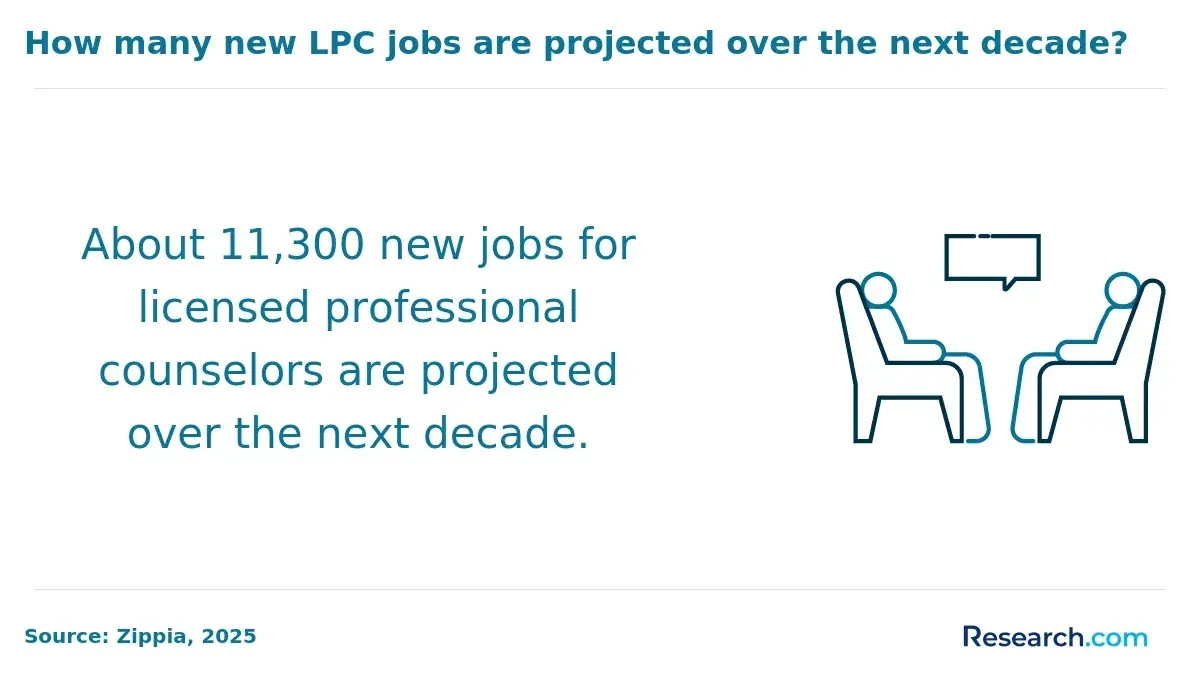
Demand for licensed counselors in Illinois is shaped by several forces: growing public attention to mental health, continued need in schools and community agencies, behavioral health workforce shortages in some areas, and wider use of telehealth. Illinois also includes large urban markets such as Chicago as well as rural communities where access to mental health care may be more limited.
LPCs and LCPCs may find opportunities in community mental health centers, schools, hospitals, substance use treatment programs, employee assistance programs, private practices, nonprofit agencies, and telehealth organizations. Demand is often strongest for counselors who can work with children and families, crisis needs, trauma, substance use, and culturally diverse client populations.
Prospective students should not choose this career based only on broad demand claims. Instead, look at the specific market where you want to work, the credential employers require, and whether job postings ask for LPC, LCPC, school counseling credentials, bilingual skills, addiction training, or telehealth experience. If cost is a major concern, reviewing affordable CACREP-accredited online counseling programs can help you compare options while keeping licensure alignment in focus.
| Work setting | Common counseling focus | Credential issue to check |
| Community mental health agency | Assessment, therapy, crisis support, case coordination, and referrals | Some roles may accept LPC supervision status; others prefer or require LCPC |
| School or educational setting | Student counseling, academic stress, family coordination, prevention programs | School counseling roles may require separate school-related credentials |
| Hospital or integrated care setting | Behavioral health screening, treatment planning, discharge support, crisis work | Clinical experience and independent licensure may be preferred |
| Private practice | Individual, family, couples, or specialty therapy services | Independent practice generally points toward LCPC credentialing |
| Telehealth provider | Remote counseling, intake, therapy, and continuity of care | Verify Illinois practice rules, documentation standards, and supervision requirements |
How does LPC licensure affect career growth in Illinois?
LPC licensure can make a major difference in career mobility because it signals that you have met a state-recognized standard for education, testing, ethics, and supervised practice. It may open doors to counseling roles that are not available to unlicensed graduates, but the largest career expansion often comes from advancing from LPC to LCPC.
- Broader job eligibility: Illinois has over 1,100 LPC job listings, reflecting opportunities across agencies, schools, hospitals, and behavioral health organizations.
- Route toward independent practice: LPC status can be a step toward LCPC licensure, which is especially important for counselors who want independent clinical authority or private practice.
- Improved compensation potential: Licensed status can support access to roles with stronger pay structures, benefits, and, at advanced levels, insurance billing opportunities. Salary outcomes still depend on location, employer, specialty, and experience.
- Future supervision roles: Counselors who progress beyond LPC status may eventually supervise newer counselors, lead clinical teams, or move into program management.
- Specialization options: LPCs may build focused expertise in school counseling, family counseling, addictions, trauma, crisis response, or career counseling. Students interested in school-based work can compare options such as affordable online school counseling degrees.
- Professional trust: State licensure gives employers and clients a clear way to verify training, ethical obligations, and scope of practice.
- Continuing education: Illinois requires 30 hours of continuing education every two years, helping counselors stay current with ethics, clinical methods, and regulatory expectations.
Is LPC licensure worth it in Illinois?
LPC licensure is usually worth pursuing if you want to work directly in professional counseling roles in Illinois and eventually move toward clinical independence. It may not be the best fit if your goal is social work, psychology licensure, school-only counseling, or marriage and family therapy under a different credential. The right choice depends on your preferred clients, setting, scope of practice, and willingness to complete supervised experience after graduate school.
| Choose the Illinois LPC path if... | Consider a different path if... |
| You want to provide counseling services in mental health, agency, hospital, telehealth, or private practice settings | You want to become a licensed psychologist and conduct psychological testing or doctoral-level clinical practice |
| You are comfortable completing supervised practice after graduate school | You want the fastest possible entry into a helping role without graduate licensure requirements |
| You plan to progress toward LCPC for independent practice | You specifically want social work roles involving case management, policy, and social service systems |
| You want a counseling-focused curriculum centered on therapy, ethics, assessment, and human development | You want a school-only role and need a credential designed specifically for public school counseling |
What is the salary outlook for LPCs in Illinois?
Salary for Licensed Professional Counselors in Illinois varies by setting, location, specialization, credential level, and experience. Entry-level LPCs may earn less than independently licensed LCPCs, especially in private practice or roles that require advanced clinical responsibility. Urban areas such as Chicago and nearby suburbs may offer different compensation patterns than rural communities, but pay should always be evaluated alongside benefits, supervision quality, caseload expectations, and advancement opportunities.
When reviewing salary information, avoid assuming that licensure guarantees a specific income. Instead, compare local job postings, employer requirements, insurance billing expectations, and whether the role requires LPC or LCPC status. For a broader career planning view, see Research.com’s guide on how to become a mental health counselor in Illinois.
What do LPCs in Illinois say about their career?
- My training at Northeastern Illinois University gave me a strong counseling foundation and helped me understand the communities I now serve. Working in a local school has been demanding, but it lets me support students through academic pressure, family concerns, and emotional growth. The diversity across Illinois keeps me learning and makes cultural awareness central to my work. - Emma
- Loyola University Chicago shaped the way I think about mental health in educational settings. When I started counseling students, I saw how academic stress, friendships, family expectations, and mental health needs often overlap. Illinois schools have given me room to keep developing professionally while doing work that feels useful to my community. - Allan
- Illinois State University helped me build the skills I needed for school counseling. Working with students and families in Illinois has shown me how culture, income, and community resources affect counseling needs. The work can be challenging, but seeing students gain confidence and stability keeps me committed to the profession. - Desmond
What is the fastest way to become a counselor in Illinois?
The fastest responsible route is to choose a licensure-aligned graduate program from the start, complete coursework without gaps, schedule practicum and internship early, prepare for the exam before graduation, and secure a qualified supervised placement as soon as you are eligible. You cannot skip state requirements, but you can avoid unnecessary delays caused by missing courses, weak documentation, or choosing a program that was not designed for Illinois licensure.
Accelerated formats, year-round enrollment, transfer-friendly policies, and strong field placement support can shorten the overall timeline. However, speed should never come at the expense of accreditation, supervised training quality, or exam preparation. For a focused breakdown, review Research.com’s guide to the fastest way to become a counselor in Illinois.
Related Articles for Nearby States
- 2027 LPC Counseling Licensure Requirements in Indiana
- 2027 LPC Counseling Licensure Requirements in Wisconsin
- 2027 LPC Counseling Licensure Requirements in Iowa
- 2027 LPC Counseling Licensure Requirements in Missouri
- 2027 LPC Counseling Licensure Requirements in Kentucky
- 2027 LPC Counseling Licensure Requirements in Michigan
- 2027 LPC Counseling Licensure Requirements in Minnesota
- 2027 LPC Counseling Licensure Requirements in Ohio
- 2027 LPC Counseling Licensure Requirements in Tennessee
- 2027 LPC Counseling Licensure Requirements in Arkansas
Common mistakes to avoid when pursuing LPC licensure in Illinois
| Mistake | Why it can hurt you | Better approach |
| Choosing a program based only on tuition or convenience | A cheaper or more flexible program can still leave you with missing licensure coursework | Verify Illinois LPC alignment before enrolling |
| Assuming any psychology-related degree qualifies | Related degrees may lack required counseling courses or fieldwork | Ask for a transcript review or written licensure mapping |
| Starting supervised hours before you are eligible | Hours completed too early may not count | Confirm the timing rules before logging hours |
| Using an unqualified supervisor | Supervision may be rejected if the supervisor does not meet Illinois criteria | Confirm license type and supervision authority before accepting a placement |
| Waiting too long to prepare for the NCE | Exam delays can push back application submission | Begin review during the final year of graduate study |
| Assuming out-of-state licensure transfers automatically | Illinois does not offer automatic reciprocity | Prepare for endorsement review and possible additional documentation |
| Confusing LPC with LCPC | The credentials differ in independence and scope | Plan your long-term path if private practice or independent clinical work is your goal |
Key Insights
- Illinois LPC licensure depends on more than earning a counseling degree; your transcript, fieldwork, exam record, and application materials all matter.
- A counseling master’s degree is usually the most direct academic route, but related graduate degrees may qualify only if they include the required counseling content areas.
- Illinois requirements discussed for counseling applicants include 1,680 supervised hours for LPC-related experience and 3,360 supervised hours for advanced clinical credentialing, so applicants should distinguish LPC from LCPC planning.
- The NCE is the primary exam route for many applicants, while the CRCC exam may apply to rehabilitation counseling candidates.
- Out-of-state counselors should not rely on reciprocity. Illinois uses endorsement review and, as of September 2024, is not part of the ACA Counseling Compact.
- The best way to reduce delays is to choose a licensure-aligned program, track supervised hours carefully, verify supervisor qualifications, and submit a complete IDFPR application.
- LPC licensure can open counseling job opportunities, but LCPC status is typically the stronger credential for independent clinical practice, supervision, and private practice goals.
References:
- LPC vs. LCPC Licensing in Illinois | INSIGHT Digital Magazine https://www.thechicagoschool.edu/insight/career-development/difference-lpc-lcpc-licensing-illinois/
- LPC vs. LCSW vs. LMHC: What’s the Difference? - Counseling Degrees Online https://www.counselingdegreesonline.org/lcsw-vs-lpc-vs-lmhc
- Mental Health Counselor Licensure by State- LMHC, LPC, LCPC | William James https://www.williamjames.edu/academics/counseling/clinical-mental-health-counseling-ma-online/licensure/LMHC-LPC-by-state.html
- LPC vs LMHC: Your State Determines Your Licensure Type https://onlinemftprograms.com/lpc-vs-lmhc/
- Decoding counselor alphabet soup: LPC, LPCC, LMHC, and more https://www.psychotherapynotes.com/decoding-counselor-alphabet-soup-lpc-lpcc-lmhc/
- Counseling Licensure | Department of Counseling and Higher Education | Northern Illinois University https://www.cedu.niu.edu/cahe/resources/counseling/licensure.shtml
- IDFPR | Professional Counselor https://idfpr.illinois.gov/profs/profcounselor.html
- Counselor Licensure Application https://www.ilcounseling.org/page/counselor_licensure_application
- Requirements To Become A Licensed Counselor In Illinois https://www.psychology.org/counseling/licensure/illinois/
Other Things You Need to Know About Becoming a Counselor in Illinois
The Illinois licensing authority for LPC applicants is the Department of Financial and Professional Regulation, often called IDFPR. It reviews education, supervised experience, and exam documentation before issuing the license. Applicants must submit materials through IDFPR’s licensure process and follow its current application requirements.
In 2027, LPC licensure in Illinois requires completion of a master's or doctoral degree in counseling or a related field with at least 48 semester hours. Coursework must include topics like counseling theory and practice, ethics, human growth, and psychopathology.