
2027 Clinical Psychology vs. Counseling Psychology Degree Programs: Explaining The Difference

Co-Founder and Chief Data Scientist
Choosing between clinical psychology and counseling psychology is not just a question of which degree sounds more interesting. It affects the type of clients you will serve, the training you will need, the settings where you are most likely to work, and how long it may take to become licensed. The decision matters because the need for mental health care remains substantial: in 2022, an estimated 59.3 million adults in the United States experienced any mental illness, but only 50.6% received treatment.
This guide explains how clinical psychology and counseling psychology differ, where they overlap, what degree programs usually include, how licensure works, and how to evaluate salary, job outlook, accreditation, online study, and cost. It is written for students comparing psychology graduate programs, career changers exploring mental health careers, and professionals deciding whether to pursue advanced credentials.
Quick Answer: Clinical Psychology vs. Counseling Psychology
Clinical psychology is generally the better fit if you want to diagnose and treat serious mental health disorders, conduct psychological assessments, work in hospitals or specialized clinics, or pursue research-heavy doctoral training. Counseling psychology is usually a better match if you want to help clients manage stress, relationships, identity concerns, career transitions, and emotional well-being through therapy, prevention, and strengths-based interventions.
Both fields can lead to licensure as a psychologist, and both typically require a doctoral degree for independent practice. However, some counseling-related roles may be available with a master's degree, depending on the state, job title, and scope of practice.
Key Things You Should Know About Clinical Psychology vs. Counseling Psychology Degree Programs
- The core distinction is focus. Clinical psychology places more emphasis on assessment, diagnosis, psychopathology, and treatment of mental disorders. Counseling psychology also addresses mental health concerns but usually gives more attention to adjustment, development, life stress, identity, relationships, and well-being.
- The education path is long for licensed psychologists. Most clinical and counseling psychologists need a doctoral degree. Around 48% of professionals feel that to perform in the job, one needs postdoctoral training. Some counseling roles may be possible with a master's degree, but title, independence, and scope of practice depend on state rules.
- Demand is projected to increase. The number of clinical and counseling psychologists is expected to grow by 13% from 2023 to 2033, adding 10,200 new jobs. Growth is tied to broader recognition of mental health needs and greater use of psychological services.
- Pay depends heavily on setting and location. The average salary for clinical and counseling psychologists in 2023 was $106,600. Psychologists in scientific research roles earned an average of $131,050, while those in individual and family services earned $91,160.
- Work settings are diverse. Clinical and counseling psychologists work in private practice, hospitals, schools, outpatient centers, research organizations, and other healthcare environments. The largest employer in 2023 was offices of other health practitioners, with 28,960 psychologists earning an average salary of $114,900.
- Clinical Psychology vs. Counseling Psychology: What is the difference?
- What are the key theoretical orientations in clinical and counseling psychology?
- What research opportunities exist in clinical and counseling psychology?
- How do you become a clinical psychologist for 2027?
- How do you become a counseling psychologist for 2027?
- What can I expect from clinical psychology degree programs?
- What can I expect from counseling psychology degree programs?
- Where do clinical and counseling psychologists work?
- How Can Additional Certifications Advance Your Psychology Career?
- What is the fastest way to become a licensed counselor?
- What are the biggest challenges in clinical and counseling psychology careers?
- How do accreditation and certification standards influence program quality?
- Can online education meet the training needs of aspiring psychologists?
- How does ongoing professional development influence career success in clinical and counseling psychology?
- What are the financial considerations for psychology degree programs?
- What makes online counseling programs a cost-effective option?
- How much do clinical and counseling psychologists earn?
- What is the job outlook for graduates of clinical psychology and counseling psychology?
- Clinical Psychology vs. Counseling Psychology: How do you choose?
Clinical Psychology vs. Counseling Psychology: What is the difference?
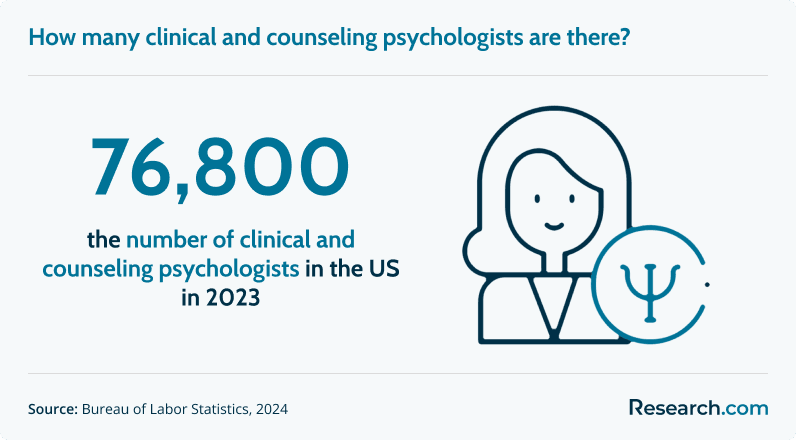
In 2023, there were 76,800 clinical and counseling psychologists in the US. Although these two specialties share many skills, they are not identical. Both involve psychotherapy, assessment, ethical practice, research literacy, and supervised clinical training, but they tend to prepare students for different kinds of client concerns and professional environments.
Side-by-Side Comparison
| Factor | Clinical Psychology | Counseling Psychology |
| Main emphasis | Diagnosis, psychological assessment, psychopathology, and evidence-based treatment of mental health disorders | Therapy, adjustment, prevention, personal development, emotional health, and life challenges |
| Common client concerns | Serious or complex conditions such as schizophrenia, major depression, bipolar disorder, trauma, and severe anxiety | Stress, relationships, grief, career decisions, identity development, transitions, and moderate mental health concerns |
| Typical training style | Often more assessment-intensive and research-oriented, especially in PhD programs | Often more client-centered, developmental, multicultural, and wellness-focused |
| Common work settings | Hospitals, psychiatric facilities, specialty clinics, academic medical centers, research institutions, and private practice | College counseling centers, community clinics, schools, private practice, career centers, and healthcare settings |
| Best fit for students who... | Want to evaluate, diagnose, and treat complex mental disorders or combine practice with research | Want to provide therapy for life challenges, emotional concerns, identity issues, and personal growth |
Focus and Client Needs
Clinical psychologists are commonly trained to work with people experiencing significant mental health disorders. Their education often gives substantial attention to diagnostic interviews, psychological testing, treatment planning, risk assessment, and interventions backed by research. They may collaborate with psychiatrists, physicians, social workers, nurses, and other care providers in medical or behavioral health systems.
Counseling psychologists also assess and treat mental health conditions, but their professional identity often centers on helping clients function better in everyday life. They may work with people facing relationship strain, academic pressure, job changes, cultural identity concerns, grief, stress, and emotional adjustment. Counseling psychology often highlights strengths, resilience, prevention, multicultural competence, and the client’s social context.
Education and Licensure
Both careers usually require a doctorate in psychology, such as a PhD or PsyD, for independent practice as a licensed psychologist. State requirements vary, but licensure generally includes graduation from an appropriate program, supervised clinical experience, and a passing score on the Examination for Professional Practice in Psychology (EPPP). Some counseling-related jobs may be available with a master's degree, but those roles may lead to different licenses than psychologist licensure.
Work Environments and Career Paths
Clinical psychologists are more likely to conduct formal assessments, provide diagnosis-driven treatment, and work in settings connected to healthcare systems. Counseling psychologists are often found in educational, community, and private practice environments where therapy, development, and adjustment are central. These are tendencies, not absolute rules; many professionals in both fields provide therapy, conduct research, supervise trainees, teach, and work in private practice.
How This Differs From Psychiatry
Students comparing psychology careers should also understand the psychologist vs psychiatrist distinction. Psychologists typically provide therapy, assessment, diagnosis, consultation, and research-based interventions. Psychiatrists are physicians who complete medical training and can prescribe medication.
Which Path Fits Which Goal?
- Choose clinical psychology if you are drawn to serious mental illness, psychological testing, inpatient or hospital-based care, neuropsychology, forensic assessment, or research-intensive doctoral study.
- Choose counseling psychology if you want to focus on therapy, identity and development, adjustment, college mental health, multicultural counseling, career issues, and strengths-based care.
- Compare both carefully if your goal is private practice therapy, because either field can support that goal depending on the program, practicum opportunities, licensure preparation, and state requirements.
What are the key theoretical orientations in clinical and counseling psychology?
Theoretical orientation is the framework a psychologist uses to understand a client’s difficulties and choose an intervention. It affects how a clinician asks questions, sets goals, structures sessions, interprets symptoms, and measures progress. Students comparing the clinical psychologist vs mental health counselor path should pay attention to orientation because it influences training, supervision, and the types of clients a program prepares students to serve.
Common Theoretical Approaches
| Orientation | How It Is Used | Where It Often Appears |
| Psychodynamic | Explores unconscious patterns, early relationships, defenses, and recurring emotional conflicts | Clinical and counseling programs, with frequent use in longer-term therapy and complex cases |
| Cognitive-behavioral therapy (CBT) | Targets links between thoughts, emotions, behaviors, and symptoms through structured strategies | Both fields, especially evidence-based treatment training |
| Humanistic and person-centered | Emphasizes empathy, autonomy, self-understanding, acceptance, and personal growth | Especially common in counseling psychology and therapy-focused programs |
| Multicultural and social justice approaches | Considers culture, identity, discrimination, systems, and context in psychological care | Both fields, with strong emphasis in counseling psychology |
| Integrative | Combines methods from multiple theories to match client needs, diagnosis, goals, and setting | Widely used in contemporary practice across both specialties |
Psychodynamic and Cognitive-Behavioral Approaches
Psychodynamic approaches, influenced by early psychoanalytic theory, focus on internal conflicts, attachment patterns, and experiences that shape current behavior. They may be used in both fields, but clinical psychology programs often connect them to complex diagnosis and longer-term treatment planning.
CBT is widely taught in both clinical and counseling psychology because it is structured, teachable, and frequently used in treatment planning. Given that 59.3 million adults in the US experienced any mental illness in 2022 and only about half received treatment, scalable and evidence-based interventions such as CBT are especially important in mental health service delivery.
Humanistic, Developmental, and Integrative Models
Counseling psychology programs often emphasize person-centered, developmental, and strengths-based models. These approaches can be useful for clients dealing with stress, identity, self-esteem, career uncertainty, family conflict, and major life transitions. Young adults ages 18-25 experience the highest prevalence of any mental illness at 36.2%, which makes flexible approaches especially relevant for college counseling, early-career adults, and transitional life stages.
Why Orientation Matters When Choosing a Program
Before applying, review faculty interests, practicum sites, supervision models, and course descriptions. A program that emphasizes assessment and severe mental illness may feel very different from one centered on multicultural counseling, college mental health, or developmental therapy. Neither is automatically better; the right fit depends on the work you want to do.
What research opportunities exist in clinical and counseling psychology?
Research is not separate from practice in psychology. It shapes diagnosis, therapy methods, prevention programs, assessment tools, supervision models, and public policy. Students who want to publish, teach, run clinical trials, evaluate interventions, or work in academic medicine should compare research expectations before choosing a degree path.
Clinical Psychology Research
Clinical psychology research often focuses on serious mental illness, diagnostic accuracy, treatment outcomes, neuropsychology, health psychology, suicide risk, trauma, and intervention science. With 15.4 million adults in the US experiencing a serious mental illness (SMI) in 2022, research in this area has direct implications for hospitals, community clinics, crisis care, and long-term treatment systems.
Counseling Psychology Research
Counseling psychology research often studies resilience, identity, multicultural counseling, vocational development, coping, prevention, college mental health, group therapy, and life transitions. Because young adults ages 18-25 have the highest rates of any mental illness at 36.2%, counseling psychology research can be especially relevant to schools, universities, early-career adults, and community programs.
Research Expectations in PhD and PsyD Programs
Students asking what can you do with a PhD in psychology should know that research is one of the major reasons to choose a PhD. PhD students may work on grant-funded studies, publish with faculty, conduct dissertation research, or participate in clinical trials. PsyD programs usually include research training as well, but they often place comparatively greater emphasis on direct clinical preparation.
Questions to Ask About Research Fit
- Do faculty members study the populations or problems you care about?
- Are students expected to publish, present, or assist with grant-funded work?
- Does the program support both quantitative and qualitative methods?
- Are research assistantships, labs, or clinical research placements available?
- Do graduates enter academia, medical centers, private practice, or applied research roles?
How do you become a clinical psychologist for 2027?
Becoming a clinical psychologist requires a sequence of academic training, supervised clinical experience, and licensure. The path is demanding because clinical psychologists are trained to assess, diagnose, and treat mental health conditions in a legally and ethically regulated profession.
Typical Path to Clinical Psychologist Licensure
| Stage | What Happens | What to Watch For |
| Bachelor's degree | Students build a foundation in psychology, statistics, research methods, human development, and abnormal psychology | Strong grades, research experience, clinical exposure, and faculty recommendations can strengthen graduate applications |
| Doctoral degree | Students complete a doctorate in psychology, usually a PhD or PsyD | Check accreditation, internship match preparation, faculty fit, funding, and clinical placement quality |
| Practicum and internship | Students provide supervised services in clinics, hospitals, counseling centers, or related settings | Make sure placements align with your intended specialty and state licensure expectations |
| Postdoctoral supervised experience | Graduates complete supervised professional practice before licensure | Requirements vary by state, so confirm the rules where you plan to practice |
| Licensing exam | Candidates pass the Examination for Professional Practice in Psychology (EPPP) | Some states may require ethics, law, or jurisprudence exams in addition to the EPPP |
Education Requirements for Clinical Psychologists
The main graduate credential is a doctoral degree, either a PhD or PsyD. A PhD often emphasizes research, statistics, teaching, scholarship, and clinical practice. A PsyD usually places more weight on clinical training and professional practice. Students generally begin with a bachelor's degree in psychology or a related field. Some doctoral programs accept applicants after undergraduate study, while others prefer or require graduate-level preparation.
Doctoral programs typically take four to seven years to complete and include study in psychopathology, psychological assessment, research design, ethics, diversity, and evidence-based therapy. Students also complete supervised practicum experiences and internships in settings such as hospitals, clinics, private practices, or community mental health agencies.
Licensing Requirements for Clinical Psychologists
After doctoral study, aspiring clinical psychologists must complete a one-year postdoctoral supervised experience before applying for licensure. Every state sets its own requirements, but candidates generally must pass the EPPP and satisfy supervised practice and ethics standards. Some states require additional exams covering state law or professional rules.
How long does it take to become a clinical psychologist?
From undergraduate enrollment to full licensure, the process typically takes ten to twelve years. The timeline is long, but it prepares psychologists to work with complex clinical concerns, conduct assessments, and provide treatment within regulated healthcare and mental health systems. In 2022, there were 5,507 clinical psychology degrees awarded in the US.
How do you become a counseling psychologist for 2027?
Counseling psychologists are trained to help clients address emotional, social, developmental, relational, educational, and career-related concerns. Their preparation includes therapy skills, psychological assessment, ethics, diversity, research, and supervised clinical experience.
Typical Path to Counseling Psychologist Licensure
| Stage | What Happens | Decision Point |
| Bachelor's degree | Students complete foundational coursework in psychology, development, research, and human behavior | Choose electives, internships, or volunteer work that expose you to counseling or mental health settings |
| Graduate preparation | Students may pursue a master's degree or enter a doctoral program, depending on admissions requirements | If your goal is psychologist licensure, confirm whether the program leads to that pathway |
| Doctoral study | Students complete PhD or PsyD training in counseling psychology | Compare multicultural training, practicum sites, faculty expertise, and internship outcomes |
| Supervised experience | Graduates complete one to two years of supervised postdoctoral experience before licensure | State rules differ, so plan around the jurisdiction where you intend to work |
| Examination and licensure | Candidates pass the EPPP and meet state-specific rules | Some states also require exams on ethics, law, or professional practice |
Education Requirements for Counseling Psychologists
A doctorate in psychology, usually a PhD or PsyD, is typically required to practice independently as a counseling psychologist. Some people enter counseling-related work with a master's degree, but that route may lead to a counselor license rather than psychologist licensure, depending on state law and program design.
Students usually begin with a bachelor’s degree in psychology or a related discipline. Doctoral programs usually take four to six years to complete and include coursework in psychotherapy, assessment, multicultural counseling, ethics, research, group work, and human development. Practicums and internships help students apply classroom learning in supervised settings.
Students looking for flexible undergraduate or graduate preparation may consider accelerated online degrees before applying to advanced psychology programs. However, students should not assume speed replaces supervised clinical training. Licensure still depends on completing required graduate education, approved field experiences, and state examinations.
Licensing Requirements for Counseling Psychologists
After completing doctoral training, counseling psychologists must complete one to two years of supervised postdoctoral experience before licensure. They must also pass the EPPP. State boards may require additional exams, documentation of clinical hours, ethics training, background checks, and continuing education for renewal.
How long does it take to become a counseling psychologist?
The full path commonly takes eight to twelve years, including undergraduate study, graduate education, supervised experience, and licensure. In 2022, there were around 10,225 counseling degrees awarded in the US.
What can I expect from clinical psychology degree programs?
Clinical psychology programs train students to understand mental disorders, conduct assessments, use evidence-based treatment methods, interpret research, and practice ethically with diverse clients. The curriculum becomes much more practice-focused and specialized at the doctoral level.
Common Courses in Clinical Psychology Programs
Students often encounter statistics and research design early, which is why questions such as does a psychology degree require math matter before enrollment. Clinical psychology is not only about therapy; it also requires measurement, data interpretation, and research literacy. Common course areas include:
- Psychopathology: Covers the classification, symptoms, causes, and treatment of psychological disorders.
- Cognitive-behavioral therapy: Introduces structured interventions used to address thoughts, behaviors, emotions, and symptoms.
- Psychological assessment: Teaches students how to administer, score, interpret, and report assessment results responsibly.
- Neuropsychology: Examines connections between brain function, behavior, cognition, and mental health.
- Ethics and professional practice: Reviews confidentiality, informed consent, boundaries, documentation, mandated reporting, and legal responsibilities.
Clinical Training and Specializations
Clinical psychology students complete supervised training through practicums, internships, and often postdoctoral experiences. Bachelor’s students may gain exposure through labs, volunteer roles, or entry-level behavioral health work, while graduate students deliver supervised services in real clinical environments. Common specialization interests include forensic psychology, trauma, health psychology, neuropsychology, child and adolescent psychology, and severe mental illness.
What a Clinical Psychology Degree Can and Cannot Do
| Degree Level | Possible Use | Important Limitation |
| Bachelor's | Entry-level behavioral health, research assistant, case support, or preparation for graduate school | Does not qualify graduates to practice independently as psychologists |
| Master's | Preparation for doctoral study or certain supervised mental health roles depending on the program and state | May not lead to psychologist licensure |
| Doctorate | Required pathway for most licensed clinical psychologist roles | Still requires internship, supervised experience, examination, and state licensure |
What can I expect from counseling psychology degree programs?
Counseling psychology programs prepare students to provide therapy, understand human development, support emotional health, work across cultures, and help clients manage personal, social, academic, relational, and career challenges. The field is often grounded in a developmental and strengths-based view of people rather than a diagnosis-only model.
Common Courses in Counseling Psychology Programs
- Counseling theories: Introduces major approaches such as person-centered, cognitive-behavioral, psychodynamic, and integrative therapy.
- Multicultural counseling: Examines how culture, identity, power, community, and social context affect mental health and therapy.
- Group counseling: Teaches students how to plan, facilitate, and evaluate group therapy or support groups.
- Crisis and trauma intervention: Covers immediate support, stabilization, safety planning, and referral practices for clients in acute distress.
- Lifespan development: Studies psychological growth, relationships, identity, and challenges from childhood through later adulthood.
Practical Training and Career Preparation
Graduate counseling psychology programs normally include supervised practicum and internship experiences. Students may train in schools, universities, community clinics, hospitals, private practices, or counseling centers. Specialization options may connect to areas such as the marriage and therapy career path, substance abuse counseling, career counseling, college counseling, or trauma-informed practice.
How Counseling Psychology Programs Differ From Clinical Programs
The overlap is significant, but the center of gravity is different. Clinical psychology programs tend to emphasize diagnosis, assessment, severe mental illness, and treatment research. Counseling psychology programs tend to emphasize therapy relationships, client strengths, development, multicultural practice, and life adjustment. Students who want a broad therapy-focused career should compare practicum sites, faculty expertise, and licensure outcomes rather than relying on the program title alone.
Where do clinical and counseling psychologists work?
Clinical and counseling psychologists work across healthcare, education, research, community service, and private practice. The right environment depends on your preferred client population, tolerance for administrative work, desire for independence, interest in assessment, and comfort with medical or institutional systems.
Common Work Settings
- Private practice: Psychologists may provide therapy, assessment, consultation, supervision, and services for individuals, couples, families, or groups.
- Healthcare facilities: Psychologists work in offices of other health practitioners (28,960 employed, average salary $114,900) and offices of physicians (6,720 employed, $113,970), often as part of interdisciplinary care teams.
- Outpatient care centers: These centers employed 7,430 psychologists and paid an average salary of $107,500 while providing services that do not require inpatient hospitalization.
- Hospitals and community services: General medical and surgical hospitals employed 4,220 psychologists with an average salary of $101,450, while individual and family services employed 6,560 psychologists with an average salary of $91,160. This is around the same amount as a behavior analyst salary per year.
Geographic Distribution of Employment
Employment and pay vary by state. California had the largest number of clinical and counseling psychologists, with 11,840 employed. New York followed with 7,290, Illinois with 4,930, Texas with 4,240, and Massachusetts with 3,360. Salaries also differed by location: California reported an average of $132,410 per year, while Texas psychologists earned $82,420 on average.
Choosing a Work Setting
| If You Prefer... | Consider... | Why It May Fit |
| Complex diagnosis and team-based care | Hospitals, specialty clinics, psychiatric facilities | These settings often involve assessment, severe symptoms, and coordination with other providers |
| Autonomy and flexible scheduling | Private practice | Private practice may offer control over caseload, specialty, and business model |
| Student and young adult mental health | College counseling centers, schools, training clinics | These roles often focus on adjustment, identity, stress, and developmental concerns |
| Research and teaching | Universities, academic medical centers, research organizations | These environments support studies, publications, supervision, and program evaluation |
| Remote service delivery | Telehealth or virtual private practice | Students exploring how to become an online therapist should review state telehealth rules, supervision requirements, and insurance policies |
How Can Additional Certifications Advance Your Psychology Career?
Certifications and specialized training can help psychologists build deeper expertise after their core degree and licensure pathway are in place. They do not replace licensure, but they may strengthen competence in areas such as trauma-informed care, neuropsychological assessment, forensic work, applied behavior analysis, substance use, or telehealth practice.
For example, professionals who want to deepen behavior analysis expertise may compare online behavior analysis masters programs with their existing clinical or counseling background. The best option depends on the credential required for the role, state rules, supervision requirements, and whether the program aligns with the services you want to provide.
When Additional Credentials Make Sense
- You want to serve a specialized client population, such as children, veterans, trauma survivors, or justice-involved clients.
- Your employer values a specific certification for promotion, reimbursement, or service expansion.
- You need structured training in a method not fully covered in your graduate program.
- You plan to build a private practice around a defined niche.
What is the fastest way to become a licensed counselor?
The fastest route depends on what license you mean. Becoming a licensed psychologist usually requires a doctorate, supervised experience, and the EPPP. Becoming a licensed counselor may follow a master's-level pathway, depending on the state and credential. Students who want to enter counseling work sooner should compare counselor, therapist, psychologist, social worker, and marriage and family therapist pathways before enrolling.
Accelerated programs can reduce time in coursework, but they cannot eliminate required supervised clinical experience or state board rules. Before choosing a shortcut, review the quickest way to become a counselor and confirm that the program is recognized by the licensing board in the state where you plan to practice.
Fast Does Not Always Mean Better
| Common Assumption | Risk | Better Approach |
| The shortest program is the best value | It may not meet licensure standards or provide enough clinical preparation | Verify accreditation, supervised hour requirements, and graduate outcomes |
| Any counseling degree leads to licensure | Some degrees are academic or non-licensure tracks | Ask the program directly which license its curriculum is designed to support |
| Online study removes in-person requirements | Clinical placements, supervision, and exams may still be required | Confirm practicum and internship expectations before applying |
What are the biggest challenges in clinical and counseling psychology careers?
Clinical and counseling psychology can be meaningful work, but it is not easy. Psychologists may manage large caseloads, emotionally intense sessions, crisis situations, documentation demands, insurance requirements, ethical dilemmas, and changing regulations. The work requires empathy, but it also requires boundaries, consultation, and sustainable self-care.
Major Career Challenges
- Emotional strain: Repeated exposure to trauma, grief, crisis, or severe distress can increase burnout risk if clinicians do not have support and boundaries.
- Administrative load: Documentation, treatment plans, insurance communication, compliance, and scheduling can take substantial time.
- Ethical complexity: Confidentiality, mandated reporting, dual relationships, telehealth, and risk assessment require careful judgment.
- Continuing competence: Psychologists must keep up with research, treatment guidelines, technology, and state rules.
- Business pressure: Private practice can involve marketing, billing, record systems, taxes, and payer negotiations.
Students who want to broaden practice options may also review What is an LPC degree? to understand how licensed professional counselor pathways differ from psychologist training.
How do accreditation and certification standards influence program quality?
Accreditation is one of the most important filters when comparing psychology and counseling programs. It signals that a program or institution has been reviewed against established academic or professional standards. More importantly, accreditation can affect internship eligibility, licensure, financial aid, transferability, and employer recognition.
What to Verify Before Applying
- Is the institution accredited by a recognized accreditor?
- If you are pursuing psychologist licensure, is the doctoral program accredited by the American Psychological Association (APA) where applicable?
- Does the program publicly report outcomes such as internship placement, licensure results, attrition, and completion?
- Will the curriculum meet requirements in the state where you plan to practice?
- Are practicum and internship placements supervised by qualified professionals?
Students seeking a faith-integrated counseling education can compare options such as Christian masters in counseling, but they should still confirm licensure alignment, accreditation, supervision structure, and whether the program matches their professional goals.
Can online education meet the training needs of aspiring psychologists?
Online and hybrid education can be useful for psychology students, especially for coursework, theory, research methods, and flexible scheduling. However, clinical competence cannot be built through online lectures alone. Aspiring psychologists and counselors still need supervised practicum, internship, assessment practice, direct client contact, and feedback from qualified supervisors.
Online vs. Campus Psychology Training
| Format | Advantages | Limitations |
| Online coursework | Flexible scheduling, reduced commuting, access for students outside major campus areas | May still require local placements, residencies, or in-person assessment training |
| Hybrid programs | Combines remote classes with campus sessions or supervised clinical components | Travel and scheduling may still be required |
| Campus programs | More direct access to faculty, labs, clinics, peers, and campus-based training sites | May require relocation, commuting, or less scheduling flexibility |
Students comparing cost-conscious therapy pathways may review most affordable MFT programs online. Regardless of format, the key question is whether the program meets licensing requirements in your state and provides high-quality supervised clinical training.
How does ongoing professional development influence career success in clinical and counseling psychology?
Graduation and licensure are not the end of professional learning. Clinical and counseling psychologists need continuing education to maintain competence, renew licenses, respond to new research, use technology responsibly, and meet evolving ethical and legal standards.
Professional Development That Can Matter
- Advanced training in evidence-based therapies
- Workshops on trauma, suicide risk, assessment, ethics, or cultural humility
- Supervision or consultation groups
- Specialty certifications where relevant
- Training in telehealth, documentation, privacy, and emerging technology
- Conference participation and professional association involvement
Students still deciding which mental health route to pursue can compare the shortest path to begin working as a counselor with longer psychologist pathways. The faster route may be appropriate for some goals, but it should be weighed against scope of practice, long-term career plans, and licensure requirements.
What are the financial considerations for psychology degree programs?
Psychology training can involve tuition, fees, books, technology, transportation, application fees, test preparation, background checks, relocation, unpaid or low-paid practicum hours, internship travel, supervision costs, and licensing expenses. A lower advertised tuition does not always mean the lowest total cost.
Cost Factors to Compare
| Cost Factor | Why It Matters | Question to Ask |
| Tuition and fees | This is the largest visible cost for most students | What is the total program cost, not just the per-credit price? |
| Funding | Assistantships, scholarships, fellowships, and tuition remission can change affordability | How many students receive funding, and for how long? |
| Clinical placement expenses | Travel, background checks, insurance, and scheduling can add costs | Does the school help secure placements, or must students find their own? |
| Time away from full-time work | Doctoral and internship requirements can affect income during training | Can the program realistically be completed while working? |
| Licensure and exam costs | Graduates may need exams, applications, supervision, and renewals | What post-graduation costs should I budget for? |
Students considering specialized graduate study may compare an affordable online master's degree in forensic psychology with campus options, but affordability should always be weighed alongside licensure fit, faculty expertise, practicum quality, and career relevance.
What makes online counseling programs a cost-effective option?
Online counseling programs can reduce relocation and commuting costs and may make graduate study more realistic for working adults. They can also widen access for students who do not live near a campus-based program. Cost-effectiveness, however, depends on more than format. The program must still provide rigorous coursework, appropriate supervision, licensure-aligned clinical experiences, and student support.
When Online Counseling Programs May Be Cost-Effective
- You can complete coursework without relocating.
- The program helps arrange approved practicum or internship placements near you.
- Tuition, fees, and clinical placement costs are transparent.
- The curriculum is designed for the license you plan to pursue.
- You can balance coursework with employment without delaying graduation excessively.
Students focused on affordability can review the cheapest online LPC programs, but price should never be the only selection factor. A low-cost program that does not meet state licensing rules can become expensive if you need additional coursework later.
How much do clinical and counseling psychologists earn?
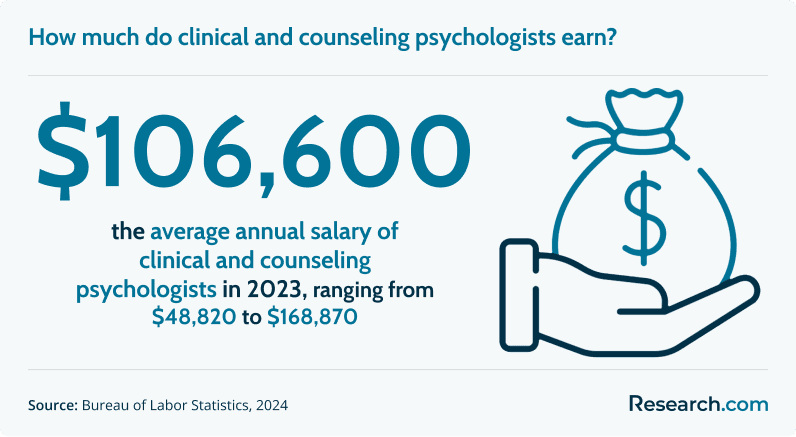
Clinical and counseling psychologist salaries vary by industry, state, experience, specialization, employer, and practice model. In 2023, the average annual salary was $106,600. Earnings ranged from $48,820 for entry-level positions to $168,870 for top earners. There were 76,800 professionals working in this field.
Industries with the Highest Salaries
Some of the highest paying psychology jobs are connected to research, healthcare, specialty practice, and advanced assessment. Scientific research and development services reported an average salary of $131,050. Specialty hospitals and physician offices can also offer strong compensation, especially for psychologists with advanced training, assessment expertise, or specialized clinical experience.
Where Psychologists Earn the Most
Salary also depends on geography. New Jersey had an average salary of $148,370, followed by California at $132,410, Oregon at $129,4700, and Rhode Island at $120,720. Higher-paying regions often reflect local demand, cost of living, payer mix, healthcare infrastructure, and concentration of hospitals, research institutions, or private clinics.
Salary Growth and Career Prospects
Psychologists can improve earning potential by building specialized assessment skills, pursuing high-demand clinical niches, gaining supervisory experience, entering research or healthcare settings, or developing a sustainable private practice. Still, salary outcomes are never guaranteed; they depend on licensure, market conditions, employer type, location, and the quality of professional experience.
What is the job outlook for graduates of clinical psychology and counseling psychology?
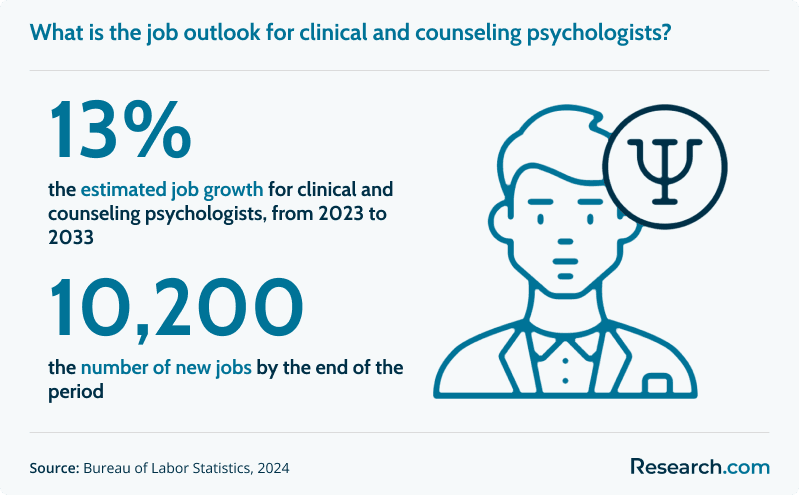
The employment outlook for clinical and counseling psychologists is positive. From 2023 to 2033, employment in these fields is projected to increase by 13%, adding an estimated 10,200 new jobs. This growth reflects continued need for psychological services in healthcare, schools, community settings, outpatient centers, and private practice.
Factors Driving Job Growth
- Unmet mental health needs: In 2022, 59.3 million US adults had a mental illness, and only 50.6% received treatment.
- Greater acceptance of care: More individuals, schools, employers, and healthcare systems recognize the value of mental health treatment.
- Integration with healthcare: Psychologists increasingly work alongside medical professionals in outpatient, hospital, and primary care settings.
- Demand for assessment and specialized care: Psychological testing, trauma treatment, child and adolescent services, and evidence-based interventions remain important areas of need.
- Telehealth and hybrid services: Remote care can expand access, though providers must follow licensing, privacy, and state practice rules.
How AI and Technology May Affect the Field
Technology is changing how psychologists document care, communicate with clients, deliver telehealth, manage practices, and access research. AI tools may support administrative tasks, screening, note organization, or clinical decision support, but they do not replace professional judgment, ethical responsibility, diagnosis, or the therapeutic relationship. Students should expect employers to value both clinical competence and comfort with secure, responsible technology use.
Clinical Psychology vs. Counseling Psychology: How do you choose?
The best choice depends on your interests, not on which title sounds more prestigious. Clinical psychology and counseling psychology can both lead to meaningful careers, but they prepare students with different emphases. Your decision should connect your preferred clients, work environment, training style, and long-term licensure goals.
Choose Clinical Psychology If...
- You want to assess, diagnose, and treat complex mental health disorders.
- You are interested in psychological testing, neuropsychology, forensic evaluation, or hospital-based care.
- You want a research-intensive doctoral experience or academic career option.
- You are comfortable with severe symptoms, crisis work, and interdisciplinary healthcare teams.
Choose Counseling Psychology If...
- You want to focus on therapy, adjustment, growth, identity, stress, and life transitions.
- You are drawn to college counseling, community practice, career counseling, or multicultural work.
- You prefer a developmental and strengths-based approach to mental health.
- You want to help clients improve functioning and well-being, not only reduce symptoms.
Consider Another Mental Health Path If...
- You want to prescribe medication; psychiatry or another medical pathway may be more appropriate.
- You want a master's-level route to therapy licensure; counseling, social work, or marriage and family therapy may fit better than psychologist licensure.
- You want to work quickly in a helping role and do not need the psychologist title.
- You are not prepared for the time, cost, research, and supervised training required for doctoral-level practice.
The Role of Dual Degree Programs
Dual degree programs may fit students who want to combine psychology with public health, social work, business, education, law, neuroscience, or another field. They can support specialized goals, but they also add complexity, time, and cost. Before choosing one, ask whether the second degree clearly improves your intended career path.
Questions to Ask Before Choosing a Program
| Question | Why It Matters |
| Does the program prepare graduates for licensure in my state? | Licensure rules vary, and an out-of-state or online program may not automatically qualify you |
| Is the program accredited in the way my career goal requires? | Accreditation can affect licensure, internships, funding, and employer recognition |
| What populations and settings do students train in? | Practicum quality may matter as much as coursework |
| What are the program’s outcomes? | Ask about completion, internship placement, licensure, employment, and debt |
| How much supervised experience will I receive? | Hands-on training is essential for competence and licensure |
| How will I pay for the degree? | Funding, assistantships, living costs, and lost income can affect ROI |
Common Mistakes to Avoid
- Choosing based only on the program title. Review curriculum, practicum sites, faculty expertise, and licensure outcomes.
- Assuming all online programs meet state requirements. Always check with the licensing board where you plan to practice.
- Ignoring accreditation. Accreditation can affect licensure, internships, financial aid, and credibility.
- Focusing only on tuition. Include fees, clinical placement costs, supervision, exam costs, relocation, and lost income.
- Assuming salary outcomes are guaranteed. Pay varies by employer, state, specialization, experience, and practice model.
- Overlooking research fit. For doctoral students, faculty mentorship and research alignment can shape the entire graduate experience.
Here's What Graduates Have to Say About Their Clinical Psychology vs. Counseling Psychology Degree Program Choices
- I wanted a counseling psychology path because I was already working in human services and needed a program that fit around my job. Online coursework helped me keep working while building stronger therapy skills. The most valuable part was being able to connect what I learned in class with real client support in my case management role. That connection made the training feel practical, not abstract. Jennifer
- Clinical psychology appealed to me because I wanted to understand both treatment and the science behind serious mental illness. My program pushed me hard in research methods, assessment, and evidence-based care. That preparation now helps me every day in a psychiatric hospital, where clinical decisions need to be thoughtful, ethical, and grounded in data. Dave
- I expected clinical psychology to be demanding, but I did not expect to become so interested in research and assessment. My program helped me connect with professionals in forensic settings, which shaped my specialization. I now conduct psychological assessments for the court system, and the training gave me the confidence to work in a high-stakes environment. Jordan
Key Insights
- Clinical psychology and counseling psychology overlap, but they are built around different emphases: clinical psychology leans toward diagnosis, assessment, severe mental illness, and treatment research, while counseling psychology leans toward therapy, development, adjustment, multicultural practice, and well-being.
- Most licensed psychologist roles require doctoral training. Nearly 92% of clinical and counseling psychologists reported that either a doctoral degree (44%) or post-doctoral training (48%) was necessary for new hires.
- The field has strong projected demand. With 76,800 clinical and counseling psychologists working in the US in 2023 and expected 13% job growth from 2023 to 2033, the profession is positioned for continued expansion.
- Salary can be strong but varies widely. Clinical and counseling psychologists earned an average annual salary of $106,600 in 2023, with top professionals making up to $168,870. Scientific research and development services offered an average salary of $131,050.
- Work setting matters. Offices of other health practitioners accounted for 28,960 jobs, outpatient care centers for 7,430 jobs, and hospitals for 4,220 jobs, showing that psychologists can build careers in many environments.
- Location affects earnings. The highest-paying states for clinical and counseling psychologists in 2023 included New Jersey ($148,370), California ($132,410), and Oregon ($129,470), while Texas ($82,420) had a lower average salary despite its large workforce.
- The best program is not always the fastest or cheapest. Before enrolling, verify accreditation, licensure alignment, supervised training quality, faculty fit, costs, and graduate outcomes.
References:
- American Foundation for Suicide Prevention. (2025). Suicide statistics. Retrieved March 17, 2025, from AFSP.
- American Psychological Association. (2025). A career in clinical or counseling psychology. Retrieved March 17, 2025, from APA.
- American Psychological Association. (2025). Pursuing a career in counseling psychology. Retrieved March 17, 2025, from APA.
- Bureau of Labor Statistics. (2024). Occupational employment and wages, May 2023 - 19-3033 clinical and counseling psychologists. Retrieved March 17, 2025, from BLS.
- Bureau of Labor Statistics. (2024). Psychologists. Retrieved March 17, 2025, from BLS.
- National Institute of Mental Health. (2025). Mental illness. Retrieved March 17, 2025, from NIMH.
Other Things You Should Know About Clinical Psychology vs. Counseling Psychology Degree Programs
The job outlook for graduates with degrees in both Clinical and Counseling Psychology remains promising in 2027. With a growing emphasis on mental health services, professionals can find opportunities in hospitals, private practices, schools, and community agencies. The Bureau of Labor Statistics predicts continued growth in demand for psychologists.
When choosing between Clinical and Counseling Psychology programs in 2027, consider your career goals, research interests, and desired setting. Clinical programs focus on severe mental health issues and research, while Counseling programs emphasize client well-being and vocational guidance. Evaluate program accreditation and faculty expertise for an informed decision.
In 2027, Clinical Psychology graduates typically find opportunities in hospitals, mental health clinics, or academia, focusing on diagnosing and treating mental disorders. Counseling Psychologists often work in community organizations, schools, or private practice, emphasizing helping clients with life stresses and improving overall well-being.


