
2027 MHA vs. MBA: Explaining the Difference

Co-Founder and Chief Data Scientist
Choosing between a Master of Health Administration (MHA) and a Master of Business Administration (MBA) is really a choice between two leadership paths. An MHA is built for people who want to manage healthcare organizations, improve care delivery, and work inside a highly regulated industry. An MBA is designed for professionals who want broader business mobility across areas such as finance, consulting, technology, operations, marketing, or entrepreneurship.
This decision matters because graduate credentials are becoming more common. Statista (2023) projects that approximately 1,000,460 students will earn their master’s diploma by 2031. A master’s degree alone may not be enough to stand out; the degree has to match the industry, role, and leadership problems you want to solve.
This guide compares MHA vs. MBA programs by curriculum, admissions, timing, cost considerations, career paths, salary outlook, accreditation, online learning, and return on investment. The goal is to help you choose the degree that fits your career direction instead of picking the one that sounds more prestigious.
Quick Answer: MHA vs. MBA
An MHA is usually the stronger fit if your goal is to lead hospitals, clinics, health systems, long-term care facilities, or healthcare policy organizations. An MBA is usually the better choice if you want a flexible business credential that can transfer across industries, including finance, consulting, technology, product management, operations, and entrepreneurship.
| Decision Factor | MHA | MBA |
| Best for | Healthcare leadership and administration | Broad business management across industries |
| Common employers | Hospitals, clinics, health systems, outpatient centers, government agencies | Corporations, consulting firms, financial institutions, tech companies, startups |
| Curriculum emphasis | Health policy, healthcare operations, compliance, quality improvement, healthcare finance | Finance, marketing, strategy, operations, leadership, analytics |
| Career flexibility | More specialized toward healthcare | More portable across sectors |
| Reported salary reference | $117,960 average annual salary for MHA holders (BLS, 2024) | $165,372 average annual salary for MBA holders (ZipRecruiter, n.d.) |
Key Things You Should Know About MHA vs. MBA
- MBA graduates commonly move into corporate fields such as finance, consulting, technology, product management, and operations, while MHA graduates are more likely to work in hospitals, clinics, healthcare systems, or related public health settings.
- MBA coursework usually emphasizes general business functions, including finance, marketing, organizational strategy, operations, and analytics. MHA coursework is centered on healthcare policy, ethics, hospital administration, health information systems, regulation, and quality improvement.
- The average annual salary for MBA holders is $165,372 (ZipRecruiter, n.d.), while MHA holders earn an average of $117,960 (BLS, 2024). These figures are broad references, not guaranteed outcomes, and actual earnings depend on role, employer, location, experience, and industry.
- What are the key differences between MHA vs. MBA?
- What bachelor's degree do you need to pursue an MHA or an MBA?
- What are the main responsibilities of MHA vs. MBA professionals?
- What are the core subjects in MHA vs. MBA programs?
- How long does it take to complete a MHA vs. MBA program for 2027?
- What specializations can you choose in the MHA vs. MBA programs?
- What skills will you develop in a MHA vs. MBA program?
- What are the admission requirements for MHA vs. MBA programs?
- What are the cost and financial aid differences for MHA vs. MBA programs?
- What is the salary outlook for MHA vs. MBA graduates?
- Can pursuing an additional advanced degree benefit your career?
- What is the return on investment (ROI) for MHA vs. MBA programs?
- What are the career paths for MHA vs. MBA graduates?
- MHA vs. MBA: Which is better for you?
- Why is accreditation crucial for MHA vs. MBA programs?
- Can online learning enhance your leadership prospects?
- How do alumni networks and career services impact long-term career success?
What are the key differences between MHA vs. MBA?
The central difference is specialization. An MHA prepares students to manage healthcare organizations, while an MBA teaches broader business management skills that can be used in many industries. That distinction affects what you study, who you meet, where you intern, what jobs you target, and how employers interpret your degree.
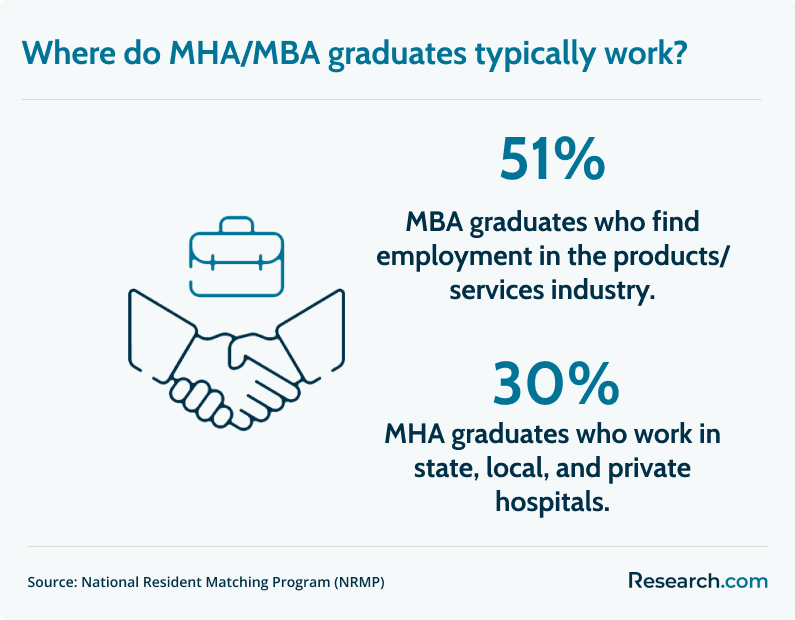
Industry direction is also different. Fifty-one percent of MBA graduates find employment in the product/services industry, while 30% of MHA graduates aim to work in state, local, or private hospitals (BLS, 2024). Those figures show why the “better” degree depends less on prestige and more on where you want to build expertise.
| Category | MHA | MBA |
| Primary focus | Healthcare administration, healthcare systems, patient care operations, regulation, and policy | General business leadership, strategy, finance, marketing, operations, and organizational growth |
| Best-fit student | Someone committed to healthcare leadership or public health administration | Someone seeking business mobility across multiple industries or functions |
| Typical network | Healthcare executives, hospital leaders, policy professionals, clinical administrators | Corporate managers, entrepreneurs, consultants, finance professionals, technology leaders |
| Career risk | Less flexible if you later want to leave healthcare entirely | Less specialized if you want employers to see deep healthcare-sector preparation |
| Decision question | Do you want healthcare to be the center of your career? | Do you want a credential that can support several business directions? |
- Choose an MHA for healthcare depth: The degree is designed around hospitals, clinics, health systems, long-term care organizations, compliance, care quality, reimbursement, and patient-centered operations.
- Choose an MBA for wider business range: The degree is suited for professionals who want to work in finance, consulting, technology, consumer products, operations, marketing, or entrepreneurship.
- Compare the network, not only the curriculum: MBA cohorts often include professionals from many industries, while MHA programs usually concentrate more heavily on healthcare leaders and administrators.
- Think about future pivots: If you want to keep several industries open, an MBA may be more adaptable. If you want to build credibility specifically in healthcare leadership, an MHA may send a clearer signal.
What bachelor's degree do you need to pursue an MHA or an MBA?
Most MHA and MBA programs do not require one single undergraduate major, but your bachelor’s degree can affect how prepared you feel in your first semester. A health-related background can make MHA coursework more familiar, while a business or quantitative background can make MBA coursework easier to enter. However, many programs admit students from varied academic backgrounds if they show leadership potential, academic readiness, and a clear career purpose.
For an MHA, the most useful undergraduate preparation often comes from health, science, public health, or healthcare administration fields. Common bachelor’s degrees that can support MHA study include:
- BS in Biology
- BS in Nursing
- BS in Healthcare Management
- BS in Healthcare Administration
- BS in Public Health
For an MBA, undergraduate preparation can come from business, economics, finance, marketing, liberal arts, engineering, technology, or other fields. If you are planning your application strategy, Research.com’s MBA program application guide can help you understand how schools evaluate candidates. Common undergraduate degrees for MBA applicants include:
- BS in Business Administration
- BA in Economics
- BS in Finance
- BS in Marketing
- BA in Liberal Arts
If your MBA interest is tied to analytics, data strategy, or decision science, it may also help to review how compensation varies in analytics-focused roles. Research.com’s guide to business analytics salary can give you additional career context before you choose a specialization.
What are the main responsibilities of MHA vs. MBA professionals?
MHA and MBA graduates may both manage people, budgets, projects, and strategy, but the operating environment is different. MHA professionals must understand healthcare delivery, patient safety, regulation, reimbursement, and clinical workflows. MBA professionals are more likely to manage growth, profitability, market competition, financial performance, product strategy, or operational efficiency across a broader range of organizations.
| MHA Professionals Often Manage | MBA Professionals Often Manage |
| Daily operations in hospitals, clinics, outpatient centers, or healthcare systems | Business strategies designed to increase revenue, market share, efficiency, or competitive position |
| Healthcare budgets, patient billing, insurance claims, reimbursement requirements, and department-level financial planning | Budgets, forecasts, cost controls, financial models, investment decisions, and business performance targets |
| Compliance with healthcare regulations, including HIPAA and other patient privacy requirements | Cross-functional execution across marketing, operations, finance, human resources, IT, and sales |
| Coordination among physicians, nurses, administrators, executives, patients, and external regulators | Market research, customer strategy, product development, organizational change, and operational improvement |
| Implementation of health policies, quality improvement initiatives, safety protocols, and care delivery standards | Data-informed decisions about pricing, expansion, staffing, product launches, partnerships, or process redesign |
Cost is often part of the decision, especially for students who want a healthcare leadership credential without taking on unnecessary debt. If affordability is a major factor, compare tuition and fees across the cheapest online MHA programs before committing to a school.
What are the core subjects in MHA vs. MBA programs?
MHA and MBA programs both teach leadership, finance, strategy, and management, but they apply those concepts to different problems. In an MHA, the questions are usually healthcare-specific: How can a hospital reduce wait times? How should a clinic manage compliance risk? How can a health system improve outcomes while controlling costs? In an MBA, the questions are broader: How should a company enter a new market? How should a product be priced? How can a firm scale operations or improve margins?
| MHA Core Subject | What It Helps You Learn |
| Healthcare Management | How hospitals, clinics, and health systems are organized, financed, staffed, and evaluated |
| Health Policy and Ethics | How laws, ethics, patient rights, public policy, and system reform influence healthcare decisions |
| Healthcare Finance | How healthcare organizations budget, handle reimbursement, manage claims, and plan financially |
| Healthcare Quality Improvement | How to improve patient safety, care quality, workflow efficiency, compliance, and outcomes |
| Health Information Systems | How electronic health records, data systems, privacy practices, and technology support care delivery |
| MBA Core Subject | What It Helps You Learn |
| Accounting and Financial Management | How to interpret financial statements, build budgets, evaluate performance, and make financial decisions. If accounting credentials are part of your plan, compare CPA vs. master’s in accounting options carefully. |
| Marketing Management | How to understand customers, position products, build brands, analyze markets, and plan digital or traditional campaigns |
| Operations Management | How to improve supply chains, workflows, process quality, logistics, and operational efficiency |
| Organizational Behavior | How leadership, motivation, culture, teamwork, and communication affect performance. Students interested in people-centered leadership can also explore organizational leadership degree jobs. |
| Strategic Management | How organizations compete, allocate resources, evaluate markets, and make long-term decisions |
Delivery format can also affect your learning experience. Before enrolling, compare the difference between online and on campus MBA programs, then apply the same questions to MHA programs: how often will you interact with faculty, how internships are arranged, whether career services support online students, and how group work is handled.
How long does it take to complete a MHA vs. MBA program for 2027?
Full-time students can traditionally complete an MHA or MBA in 2 years (Coursera, 2025). Both programs typically require 60 credit hours, though some accelerated or online options may shorten completion time to as little as 12–18 months. Part-time formats are common among working professionals and may take 3 or more years depending on course load, academic calendar, and program design.
Program Length for MBA and MHA: Full-Time, Part-Time, Accelerated, and Executive
| Program Type | Typical Completion Time | Typical Schedule |
| Full-Time | 21 months to 2 years | Full course load |
| Part-Time | 2 to 5 years | Night and weekend classes |
| Accelerated | 11 to 16 months | Full course load |
| Executive | 2 years | Night and weekend classes |
| Dual Degree | 2+ years | Full course load |
Sources: Coursera, 2025; University of Minnesota School of Public Health, 2025; NYU Wagner, 2025; LSU Online, 2025.
When comparing timelines, do not look only at the shortest possible completion time. Ask whether the program includes internships, residencies, capstone projects, clinical exposure, consulting projects, or required campus visits. A faster program may be valuable if you already have experience, but students changing careers may benefit from a longer format that includes networking and applied projects.
What specializations can you choose in the MHA vs. MBA programs?
A specialization should connect directly to the kind of role you want after graduation. In an MHA, specialization choices usually point toward a specific part of the healthcare system. In an MBA, concentrations usually point toward a business function or industry. This matters because your concentration can influence internships, electives, networking circles, and early job targets.
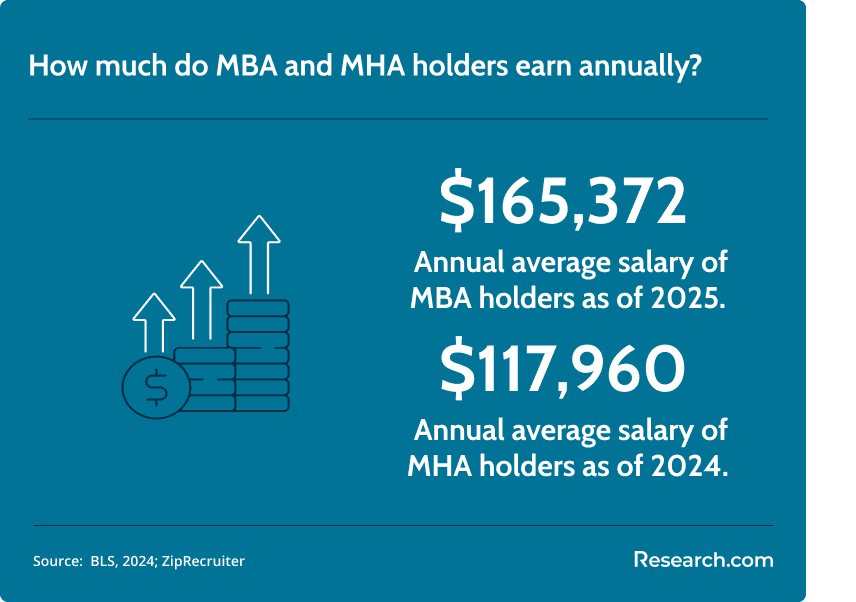
Salary can also shape the decision, but it should not be the only factor. MHA holders earn an average annual salary of $117,960, while MBA holders average $165,372 (ZipRecruiter, n.d.). The more useful question is whether the degree’s typical career pathway aligns with the work you actually want to do.
| MHA Specialization | Best For Students Interested In |
| Health Informatics | Electronic health records, clinical data systems, healthcare technology, and digital decision support |
| Hospital Administration | Hospital operations, staffing, compliance, budgeting, service lines, and executive administration |
| Policy and Public Health | Healthcare legislation, population health, public programs, advocacy, and community health strategy |
| Long-Term Care Management | Nursing homes, rehabilitation centers, assisted living organizations, and elder care administration |
| Global Health Systems | International healthcare models, cross-border health policy, and global care delivery challenges |
| MBA Specialization | Best For Students Interested In |
| Finance | Investment banking, corporate finance, valuation, financial planning, and capital strategy |
| Marketing | Brand management, customer research, demand generation, digital campaigns, and market positioning |
| Entrepreneurship | Launching ventures, scaling startups, evaluating business models, and leading innovation |
| Supply Chain Management | Logistics, procurement, global sourcing, operations strategy, and process optimization |
| Business Analytics | Data-driven strategy, forecasting, AI-supported analysis, and business intelligence. Students focused on this path can compare the best MBA in data science degree programs. |
What skills will you develop in a MHA vs. MBA program?
Both degrees develop leadership, communication, analysis, and decision-making skills. The difference is the environment in which those skills are practiced. MHA programs train students to make decisions where patient safety, compliance, reimbursement, staffing, and health outcomes are central. MBA programs train students to solve business problems involving markets, growth, profitability, competition, operations, and organizational performance.
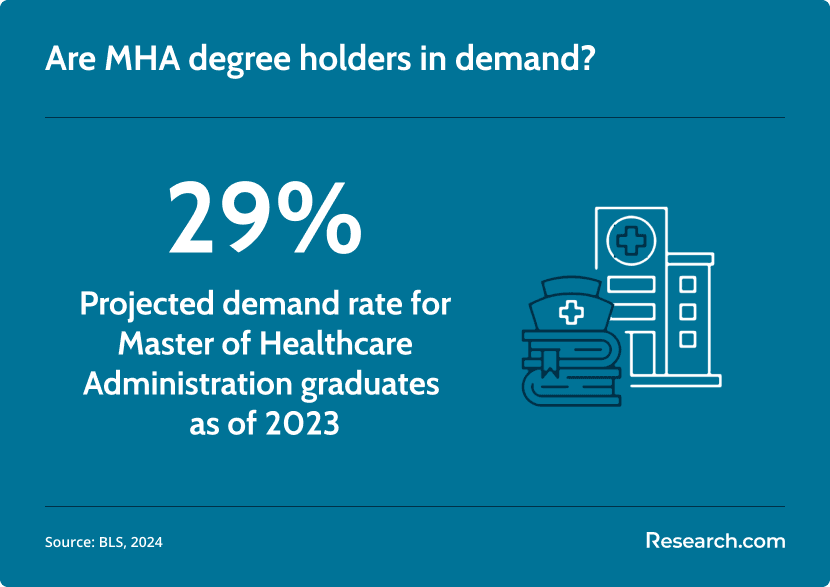
In an MHA program, a job demand of 29% for MHA holders (BLS, 2024) highlights why healthcare leadership skills remain important. Students commonly develop the ability to:
- Interpret healthcare policy: Understand how laws, ethics, reimbursement rules, and regulatory expectations affect patient care and organizational decisions.
- Improve patient-centered operations: Design workflows that support better outcomes, stronger satisfaction, safer care, and more efficient service delivery.
- Manage compliance risk: Work within HIPAA, CMS guidelines, accreditation standards, and other healthcare-specific requirements.
- Lead across clinical and administrative teams: Communicate with physicians, nurses, administrators, executives, insurers, and community stakeholders.
- Respond to crises: Help organizations prepare for emergencies, public health disruptions, cyber incidents, staffing pressures, or operational breakdowns.
In an MBA program, students usually build a broader management toolkit that can be applied across organizations. Common skills include:
- Financial analysis: Read financial statements, evaluate budgets, forecast performance, and assess investment or expansion decisions.
- Strategic thinking: Analyze competitors, markets, customer needs, internal capabilities, and long-term growth options.
- People leadership: Build teams, manage conflict, motivate employees, shape culture, and guide organizational change.
- Marketing and sales judgment: Understand customer behavior, value propositions, pricing, brand positioning, and go-to-market strategy.
- Global business perspective: Evaluate international markets, cross-cultural leadership challenges, supply chains, and global competition.
If you want an MHA but are worried about admissions selectivity, review the easiest MHA online programs to get into and compare them by accreditation, student support, curriculum quality, and outcomes rather than accessibility alone.
What are the admission requirements for MHA vs. MBA programs?
Admissions requirements differ by school, but the two degrees often evaluate applicants through different lenses. MHA programs typically look for evidence that the applicant understands healthcare settings or is serious about healthcare leadership. MBA programs usually place heavier emphasis on leadership potential, analytical readiness, professional achievements, and career goals across business contexts.
| Requirement | MHA Programs May Emphasize | MBA Programs May Emphasize |
| Bachelor’s degree | Usually required; health sciences, public health, nursing, biology, or healthcare administration can be helpful | Usually required; business, economics, finance, liberal arts, technology, engineering, or other majors may be accepted |
| Work experience | Healthcare, clinical, nonprofit, public health, or administrative experience can strengthen the application | Professional experience, leadership, management exposure, entrepreneurship, or measurable business impact can help |
| Test scores | Some schools may request standardized test scores, while others may offer waivers | GMAT or GRE scores may be considered, though some programs have test-optional or waiver policies |
| Statement of purpose | Should explain commitment to healthcare leadership and the problems the applicant wants to address | Should connect career goals to business leadership, industry direction, and post-MBA plans |
| Letters of recommendation | Often strongest when written by healthcare supervisors, faculty, or leaders who can speak to service, judgment, and leadership | Often strongest when written by managers, executives, clients, or faculty who can speak to leadership, analysis, and performance |
If you are considering doctoral study later, it may help to understand how advanced leadership credentials are evaluated. Research.com’s guide to doctorate in organizational leadership salary can provide a broader benchmark for long-term academic and leadership planning.
What are the cost and financial aid differences for MHA vs. MBA programs?
Cost comparisons should include more than tuition. Fees, books, technology requirements, travel, residencies, exam preparation, lost income, and time away from work can change the real price of either degree. Financial aid can also differ: MHA students may find healthcare-focused scholarships, fellowships, employer partnerships, or service-linked opportunities, while MBA students may encounter employer sponsorships, merit aid, assistantships, fellowships, or executive education support.
| Cost Factor | Questions to Ask |
| Tuition and fees | Is the quoted tuition per credit, per semester, or for the full program? Are online students charged additional technology fees? |
| Program format | Will you need to reduce work hours, relocate, travel for residencies, or attend required campus sessions? |
| Internships and practicums | Does the school help place students, or are you expected to secure your own site? |
| Employer support | Does your employer offer tuition reimbursement, sponsorship, paid study time, or promotion pathways after graduation? |
| Scholarships and loans | What grants, scholarships, assistantships, federal loans, or private financing options are available? |
| Opportunity cost | How much income, experience, or career progress might you give up while enrolled? |
Students comparing cost-efficient graduate options across disciplines may also want to review Research.com’s resource on affordable online English master's degrees to see how affordability factors can vary by field and program structure.
What is the salary outlook for MHA vs. MBA graduates?
Salary potential differs because MHA and MBA graduates often enter different labor markets. MHA graduates are more commonly evaluated within healthcare administration, while MBA graduates may enter corporate sectors where pay can vary widely by industry, role, company size, geography, and performance incentives.
According to the US Bureau of Labor Statistics (2024), MHA holders working in government earned a median annual wage of $132,620, those in hospitals made $130,690, and those in outpatient care centers made $106,990. If you are comparing healthcare-related roles more broadly, Research.com’s guide to the public health jobs with the highest salaries can help you evaluate adjacent career options.
The Wharton School of the University of Pennsylvania (n.d.) reports higher salary figures in several MBA career sectors. MBA holders in legal and professional services earned $215,000, those in consulting roles brought in $190,000, and those in financial services averaged $175,000 annually.
These numbers are useful for comparison, but they should not be treated as promises. Salary depends on experience, location, employer type, prior credentials, internship pipeline, negotiation, industry conditions, and whether compensation includes bonuses or equity.
I've created a chart that breaks down MBA salaries by industry to help you visualize how earning potential varies across different career paths.
Can pursuing an additional advanced degree benefit your career?
An MHA or MBA may be enough for many leadership roles, but some professionals later add another advanced degree to move into research, academia, executive education, public policy, consulting, or specialized organizational leadership. The value depends on your target role. A doctoral credential may be useful if you want to teach, publish, lead applied research, influence policy, or compete for senior roles that require deeper scholarly or analytical preparation.
Before adding another degree, ask whether the credential is required, preferred, or simply nice to have. Additional education can improve credibility in some settings, but it can also add cost and delay career progress if it does not connect to a clear goal. If you are exploring faster doctoral routes, Research.com’s guide to accelerated doctoral programs in education can help you compare streamlined options.
What is the return on investment (ROI) for MHA vs. MBA programs?
ROI is not just the difference between tuition and future salary. A stronger evaluation includes total program cost, debt, income lost while studying, time to promotion, employer support, salary growth, job stability, industry fit, and how much the degree improves your access to roles you could not realistically get otherwise.
| ROI Question | Why It Matters |
| Will this degree qualify me for specific roles I cannot access now? | A degree has stronger ROI when it opens a clear career door rather than simply adding another credential. |
| How much debt will I take on? | High borrowing can reduce the benefit of a salary increase, especially if advancement takes several years. |
| Can I keep working while enrolled? | Part-time and online formats may reduce opportunity cost, but they can extend the timeline. |
| Does the program have strong employer relationships? | Internships, fellowships, residencies, consulting projects, and alumni networks can influence job outcomes. |
| Is the degree aligned with my industry? | An MHA may offer stronger healthcare credibility, while an MBA may support broader business mobility. |
MBA graduates may enter higher-paying corporate sectors, while MHA graduates may benefit from healthcare leadership demand and sector-specific advancement. The better ROI is the one that matches your target career, not necessarily the one with the higher headline salary. Students who want to strengthen quantitative preparation before graduate management study may also explore an accelerated online bachelors degree in mathematics as one possible path to deeper analytical skill-building.
What are the career paths for MHA vs. MBA graduates?
An MHA usually leads toward healthcare administration, healthcare consulting, health policy, and system operations. An MBA can lead toward corporate management, consulting, finance, technology, product leadership, operations, or entrepreneurship. Some roles overlap, especially in healthcare consulting, hospital strategy, healthcare finance, digital health, and health technology companies.
| MHA Career Path | Typical Focus |
| Hospital Administrator | Manages hospital operations, compliance, staffing coordination, budgeting, and service delivery |
| Health Services Manager | Oversees departments, medical practices, or service lines while balancing care quality and regulations |
| Clinic Director | Leads outpatient or specialty care facilities with attention to patient access, operations, and community needs |
| Policy Analyst (Health Focus) | Evaluates healthcare laws, reforms, programs, and policy proposals for agencies, nonprofits, or think tanks |
| Long-Term Care Administrator | Directs nursing homes, assisted living facilities, or rehabilitation centers, including staffing, budgets, and care quality |
| MBA Career Path | Typical Focus |
| Management Consultant | Advises organizations on strategy, operations, performance improvement, restructuring, or growth |
| Financial Analyst or Manager | Works on budgeting, forecasting, investment strategy, valuation, financial planning, or corporate finance |
| Product Manager | Coordinates product strategy, development, launch planning, customer feedback, and cross-functional execution |
| Operations Manager | Improves supply chains, logistics, manufacturing, workflows, vendor management, and cost efficiency |
| Entrepreneur or Startup Founder | Builds, funds, launches, and scales a business using finance, marketing, leadership, and strategy skills |
MHA vs. MBA: Which is better for you?
Neither degree is universally better. The better choice is the one that fits your target industry, preferred responsibilities, risk tolerance, and long-term professional identity. If you want to become known as a healthcare leader, an MHA may be the more direct signal. If you want a credential that can help you move between industries or business functions, an MBA may offer more flexibility.
| Choose an MHA If... | Choose an MBA If... |
| You want to manage hospitals, clinics, health systems, or public health organizations | You want career options across several industries or business functions |
| You are interested in healthcare compliance, policy, reimbursement, care quality, and patient outcomes | You are interested in strategy, finance, marketing, consulting, product leadership, or entrepreneurship |
| You prefer mission-driven environments where operational decisions affect care delivery | You prefer competitive business environments focused on growth, profitability, innovation, and scale |
| You want a graduate network concentrated in healthcare administration | You want a broader professional network across corporate sectors |
| You are confident healthcare is where you want to build your leadership career | You want the option to pivot if your industry interests change |
If you are a military spouse or dependent, also compare schools that offer flexible support, transfer policies, and online options. Research.com’s guide to military spouse online college programs can help you identify programs designed for mobile and service-connected learners.
Why is accreditation crucial for MHA vs. MBA programs?
Accreditation is one of the most important quality checks when comparing MHA and MBA programs. It signals that a school or program has been reviewed against recognized academic standards. It may also affect credit transfer, financial aid eligibility, employer recognition, doctoral admissions, and professional credibility.
For MHA programs, look carefully at whether the curriculum, faculty, experiential learning, and career outcomes align with healthcare administration expectations. For MBA programs, evaluate both institutional accreditation and business-school reputation, especially if you are targeting competitive fields such as consulting, finance, or product management.
| Accreditation Question | Why You Should Ask It |
| Is the institution accredited by a recognized accreditor? | This can affect financial aid, transfer credit, employer acceptance, and graduate-school eligibility. |
| Does the program have field-relevant recognition? | Program-level reputation can matter in healthcare administration and business hiring markets. |
| Are online and campus students covered under the same accreditation? | Students should confirm that the credential carries the same academic standing regardless of delivery format. |
| Do employers in my target field recognize this school? | A credential is more useful when hiring managers, alumni, and industry partners understand its value. |
If you are comparing accredited online graduate options across leadership fields, Research.com’s list of the most affordable online EdD programs can offer additional perspective on cost and credential evaluation.
Can online learning enhance your leadership prospects?
Online MHA and MBA programs can be valuable for working adults who need flexibility, but online format alone does not guarantee convenience or career advancement. The quality of the program matters more than the delivery method. A strong online program should offer accessible faculty, structured peer interaction, applied projects, career services, advising, and opportunities to connect with employers or alumni.
Online learning may be especially useful if you need to keep working while enrolled, live far from major campuses, travel frequently, or want to apply course concepts directly to your current job. However, you should ask how group work, internships, residencies, networking, and career coaching are handled for online students. For business leaders considering executive formats, an online executive MBA may provide a flexible route for professionals who already have substantial work experience.
How do alumni networks and career services impact long-term career success?
Career services and alumni networks can strongly influence the practical value of an MHA or MBA. The coursework gives you knowledge, but networks often help you access internships, fellowships, informational interviews, mentorship, referrals, and employer insight. This is especially important in competitive MBA hiring pipelines and healthcare leadership pathways where experience, reputation, and relationships matter.
| Career Support Feature | What to Look For |
| Alumni network | Active alumni in your target industry, region, and job function |
| Career coaching | Support for resumes, interviews, salary negotiation, career pivots, and job-search strategy |
| Employer partnerships | Hospitals, health systems, consulting firms, corporations, startups, or agencies that recruit from the program |
| Internships and residencies | Structured placement support, especially for MHA students and career changers |
| Recruiting events | Industry panels, networking nights, case competitions, job fairs, and alumni mentorship programs |
Students interested in interdisciplinary graduate paths can also compare how different professional networks function in other fields, including library and information science. Research.com’s guide to a cheap MLIS degree online can provide a useful point of comparison for evaluating online graduate support systems.
Common Mistakes to Avoid When Choosing Between an MHA and an MBA
| Mistake | Better Approach |
| Choosing the degree with the higher average salary without considering fit | Compare the roles, industries, and day-to-day work you actually want after graduation. |
| Assuming an MBA automatically works for healthcare leadership | If healthcare administration is your main goal, compare MBA healthcare concentrations against dedicated MHA programs. |
| Ignoring accreditation | Verify institutional and program reputation before applying, especially for online programs. |
| Looking only at tuition | Include fees, travel, lost income, residency requirements, materials, and financing costs. |
| Relying only on rankings | Use rankings as one input, but also check career outcomes, curriculum fit, employer ties, faculty expertise, and student support. |
| Assuming online programs are easier | Ask about workload, participation expectations, group projects, exams, internships, and required live sessions. |
| Overlooking career services | Choose programs with strong advising, employer access, alumni mentoring, and practical placement support. |
Current Trends Affecting MHA and MBA Students
Healthcare and business leadership are both changing quickly. MHA students should expect growing attention to health information systems, data privacy, care quality, cost control, staffing constraints, patient experience, and regulatory compliance. MBA students should expect employers to value analytics, AI literacy, digital transformation, operational resilience, and evidence-based strategy.
AI and automation are not replacing the need for leaders, but they are changing what strong leaders need to understand. MHA graduates may need to evaluate digital health tools, health data governance, and technology-supported care models. MBA graduates may need to interpret analytics outputs, lead AI-enabled teams, and make decisions when markets and operations change quickly.
The practical takeaway is simple: choose a program that teaches both leadership fundamentals and modern decision-making. Look for coursework, projects, or electives in analytics, information systems, ethics, regulation, and technology adoption, especially if you plan to move into senior management.
Questions to Ask Before You Enroll
- What jobs do recent graduates actually get, and in which industries?
- Does the curriculum match the roles I want within healthcare or business?
- How strong are the program’s employer partnerships and alumni network?
- Are internships, residencies, consulting projects, or capstones built into the degree?
- What is the total cost after tuition, fees, travel, materials, and lost income?
- Can I complete the program while working, and how demanding is the weekly workload?
- Does the school provide career support to online, part-time, and executive students?
- Is the institution accredited, and does the credential carry credibility with target employers?
- Will this degree help me reach a specific role, or am I choosing it because it sounds impressive?
Key Insights
- An MHA is the more focused choice for healthcare administration, hospital leadership, health systems management, long-term care, healthcare policy, and patient-centered operations.
- An MBA is the more flexible choice for professionals who want options in consulting, finance, technology, operations, marketing, product management, or entrepreneurship.
- 51% of MBA graduates head to the product/services industry, while 30% of MHA graduates aim to work in state, local, or private hospitals.
- MBA holders earn an average annual salary of $165,372, while MHA holders average $117,960 per year, but salaries vary by role, employer, location, experience, and industry.
- Full-time students can traditionally complete an MHA or MBA in 2 years, though accelerated, executive, part-time, and dual-degree formats can change the timeline.
- MHA holders working in government earned a median annual wage of $132,620, while those in hospitals made $130,690, and outpatient care centers averaged $106,990.
- MBA holders in legal and professional services earned $215,000, consulting roles brought in $190,000, and financial services averaged $175,000 annually.
- The best degree is the one tied to a clear career outcome. Pick an MHA if you want healthcare depth; pick an MBA if you want broader business mobility.
- Before enrolling, verify accreditation, total cost, career services, experiential learning, online support, and graduate outcomes. Those factors often matter as much as the degree title.
References:
- Coursera. (n.d.). How long does it take to get an MBA? Coursera.org. Retrieved 5 May 2025.
- LSU Online. (n.d.). Master of Health Administration (MHA). Online.lsu.edu. Retrieved 5 May 2025.
- NYU Wagner. (n.d.). Online MHA: Frequently asked questions. Onlinemha.wagner.nyu.edu. Retrieved 5 May 2025.
- Statista. (n.d.). Employment background of North American MBA applicants. Statista.com. Retrieved 5 May 2025.
- Statista. (n.d.). Number of master's degree recipients in the U.S. Statista.com. Retrieved 5 May 2025.
- University of Minnesota School of Public Health. (n.d.). MHA degree information. Sph.umn.edu. Retrieved 5 May 2025.
- University of Pennsylvania Wharton School. (n.d.). Industry choices: Full-time MBA. Statistics.mbacareers.wharton.upenn.edu. Retrieved 5 May 2025.
- US Bureau of Labor Statistics. (n.d.). Medical and health services managers. U.S. Department of Labor. Bls.gov. Retrieved 5 May 2025.
- ZipRecruiter. (n.d.). MBA salary. Ziprecruiter.com. Retrieved 5 May 2025.
Other Things You Need to Know About MHA vs. MBA Degree Programs
For 2027 admissions, MHA programs often require a bachelor's degree in health-related fields, while MBA programs may require any undergraduate degree. Some MHA programs might prefer healthcare experience. Both typically need GMAT/GRE scores and a statement of purpose.
In 2027, MHA programs emphasize healthcare management and policy, while MBAs focus on broad business skills applicable across industries. MHA graduates often pursue roles in healthcare administration, whereas MBA graduates seek diverse leadership roles in various sectors such as finance, marketing, and operations.
MBA programs usually ask for GMAT or GRE scores, while many MHA programs waive test scores or treat them as optional. Some schools still request a resume, statement of purpose, and two or three recommendation letters, but the exam policy is set by each university.


