
2027 Best Online Colleges for Military Spouses & Dependents

Co-Founder and Chief Data Scientist
Choosing an online college as a military spouse or dependent is not the same as choosing a traditional campus program. A school may look affordable or flexible on paper, but frequent PCS moves, deployment schedules, changing state licensure rules, transfer-credit problems, and benefit eligibility can quickly affect whether the program actually works for a military-connected family.
This guide is designed for military spouses, dependents, and families comparing online colleges for 2027. It explains which schools offer strong online options, what costs and aid programs to review, how online programs compare with campus programs, which degrees are more portable, and what questions to ask before enrolling. The goal is simple: help you choose a program that can move with you, protect your credits, support your career goals, and make responsible use of military education benefits.
Education remains a major opportunity for military families, but barriers persist. Recent studies indicate that 89% of military spouses and dependents have participated in some form of college education, while only 30% have earned a bachelor's degree. That gap makes program selection especially important. The right online college can improve continuity; the wrong one can lead to lost credits, higher costs, or a credential that does not match your career plans.
Quick Answer: What should military spouses and dependents look for in an online college?
The best online colleges for military spouses and dependents combine regional accreditation, flexible online delivery, clear transfer-credit policies, military benefits support, portable degree options, and career services that understand relocation and remote work. Cost matters, but it should not be the only factor. Students should also confirm whether the program accepts GI Bill benefits, participates in MyCAA when applicable, offers military tuition discounts, and provides advising for state licensure if the degree leads to a regulated profession.
- Online college can support career mobility, with earnings ranging from $49,192 to $80,132 annually depending on education level and field of study.
- Common fields for military-connected students include business administration (27%), healthcare (19%), and IT (14.4%), all of which may offer flexible or portable career options.
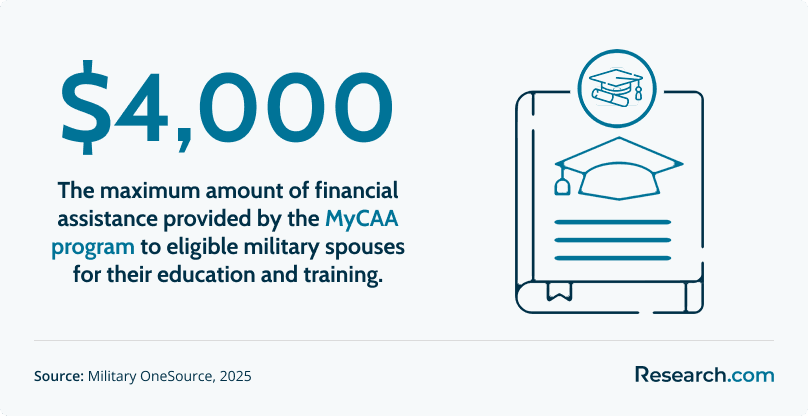
- Online tuition in this guide ranges from $4,477 to $58,293, while eligible military spouses may receive up to $4,000 through MyCAA and eligible dependents may use transferred GI Bill benefits.
Best Portable Online Degree Areas for Military Spouses and Dependents in 2027
Before comparing schools, it helps to understand which online degree areas tend to work well for military families. The strongest options are usually programs that can lead to remote-friendly work, employment across multiple states, or careers with broad employer demand. Fast, affordable, high-acceptance online programs can be useful, but students should still verify accreditation, transfer policies, and whether the credential fits their long-term plan.
1. Business Administration
Business administration is one of the most versatile online degree choices because it can apply to management, operations, finance, marketing, entrepreneurship, and nonprofit roles. For military spouses who may need to change employers after relocation, a broad business degree can make it easier to shift industries without starting over academically.
2. Information Technology
Information technology programs are often a strong fit for students seeking remote or hybrid roles. Online IT coursework may cover cybersecurity, systems administration, software development, cloud tools, networking, and technical support. Students should compare whether programs include hands-on labs, industry certification preparation, and career support for entry-level technology roles.
3. Healthcare Administration
Healthcare administration focuses on the business, policy, finance, and operations side of healthcare organizations. It may be a practical choice for students who want to work in healthcare without pursuing a clinical license. Because healthcare employers exist in nearly every region, this field can be more geographically flexible than some specialized careers.
4. Nursing
Online nursing programs can help current nurses advance, complete bridge programs, or pursue leadership and specialized roles. However, nursing is heavily regulated, so military spouses must confirm clinical placement requirements and state licensure rules before enrolling. A program that is convenient online may still require in-person clinical work or state-specific approvals.
5. Criminal Justice
Criminal justice degrees may prepare students for roles in law enforcement support, corrections, investigations, legal services, security, public administration, or victim advocacy. Military dependents and spouses should review whether the degree supports civilian career goals beyond sworn law enforcement, especially if relocation may affect local hiring timelines.
6. Psychology
Psychology programs introduce students to human behavior, research methods, development, mental health concepts, and social science analysis. A bachelor’s degree in psychology can support roles in human services, case management, research support, or business settings, but licensed counseling and clinical roles usually require graduate education and state-specific licensure.
7. Early Childhood Education
Early childhood education can be a good match for students interested in child development, preschool education, childcare administration, curriculum planning, and family services. Because teaching and childcare credentials can vary by state, students should ask each school how the program handles relocation, field experience, and licensure portability.
8. Human Resources
Human resources programs teach hiring, employee relations, training, compensation, compliance, and organizational development. HR can be appealing for military spouses because many employers need HR support and some roles can be performed remotely. Students should look for programs that include employment law, HR analytics, and internship or project-based learning opportunities.
9. Accounting
Accounting is a practical online degree for students who enjoy financial records, tax preparation, auditing, budgeting, or business analysis. It can lead to work in corporate, nonprofit, government, or small-business settings. Students interested in CPA eligibility should confirm state education requirements before choosing a program.
10. Marketing
Marketing programs cover branding, consumer behavior, advertising, analytics, content strategy, and digital campaigns. Because many marketing tasks can be completed online, this degree can support portable work. Students should prioritize programs that include analytics tools, portfolio development, and real-world campaign projects.
- Best online colleges for military spouses and dependents in 2027
- How long online programs usually take
- Online vs. on-campus programs for military families
- Average cost and cost factors
- Financial aid for military spouses and dependents
- Advanced online degrees and leadership pathways
- Academic quality and accreditation in online colleges
- Online doctoral degrees for military-connected students
- Accelerated doctoral programs and career advancement
- Accelerated programs and faster degree completion
- How student success is measured
- Admission requirements
- In-demand online degree programs
- How to choose the right online college
- Career services for military spouses and dependents
- Job outlook after earning an online degree
List of the Best Online Colleges for Military Spouses & Dependents for 2027
How do we rank the programs?
Our ranking approach is intended to help students compare online colleges using transparent, education-focused data rather than marketing claims. Research.com evaluates schools using information from established sources, including the IPEDS database, Peterson's database, the College Scorecard database, and The National Center for Education Statistics. These sources help assess affordability, admissions, institutional quality, and student-relevant outcomes. You can review the broader ranking process on Research.com's methodology page.
1. University of Florida
The University of Florida is a strong option for military-connected students who want a public university with flexible online programs and recognized military support. UF offers services that can help spouses and dependents continue their education from different locations, and eligible students may benefit from out-of-state fee waivers and participation in the Yellow Ribbon Program.
- Total Tuition Cost: $4,477
- Acceptance Rate: 23%
- Accreditation: Southern Association of Colleges and Schools Commission on Colleges
2. Liberty University
Liberty University offers a large online catalog and several military-focused benefits for eligible spouses and dependents. These include a 15% tuition discount, free electronic textbooks for undergraduate courses, and a no-cost review of military training for possible college credit. Students may also receive support when deployments or military obligations disrupt coursework.
- Total Tuition Cost: $15,417
- Acceptance Rate: 99%
- Accreditation: Southern Association of Colleges and Schools Commission on Colleges
3. University of Central Florida
The University of Central Florida (UCF) provides online programs supported by advising, success coaching, and career services. Military spouses and dependents may find UCF useful if they want a large public university with online infrastructure and benefit support through programs such as the Yellow Ribbon Program and GI Bill.
- Total Tuition Cost: $6,368
- Acceptance Rate: 41%
- Accreditation: Southern Association of Colleges and Schools Commission on Colleges
4. Pennsylvania State University
Pennsylvania State University offers online learning through Penn State World Campus, which can be especially useful for students who need academic continuity during relocation. Military-connected learners can work with advisers familiar with military education benefits, and the school offers options such as Military Grant-in-Aid and in-state tuition rates regardless of residency.
- Total Tuition Cost: $15,400
- Acceptance Rate: 92%
- Accreditation: Middle States Commission on Higher Education
5. Oregon State University
Oregon State University offers over 110 online degree programs, giving military spouses and dependents a wide range of academic choices. Courses are taught by the same faculty who teach on campus, and the online format can help students continue progressing even when military life requires a move.
- Total Tuition Cost: $10,425
- Acceptance Rate: 84%
- Accreditation: Northwest Commission on Colleges and Universities
6. Kansas State University
Kansas State University supports military-connected online students through benefits such as MyCAA participation, military tuition assistance, priority course enrollment, and application fee waivers. K-State also provides access to a Military Student Services Coordinator, which can help spouses and dependents navigate online learning and benefit questions.
- Total Tuition Cost: $9,632
- Acceptance Rate: 95%
- Accreditation: Higher Learning Commission
7. Drexel University
Drexel University provides online programs supported by the Center for Military and Veteran Services. Military spouses and dependents may receive academic advising, career counseling, Yellow Ribbon Program access, reduced tuition rates, and guidance on transferring GI Bill® benefits when eligible.
- Total Tuition Cost: $58,293
- Acceptance Rate: 80%
- Accreditation: Middle States Commission on Higher Education
8. University of Massachusetts - Amherst
The University of Massachusetts-Amhers offers online learning options that may fit students balancing military family responsibilities with school. The university participates in MyCAA for eligible spouses pursuing approved licenses or credentials in portable career fields. UMass Global also offers 100% tuition assistance for undergraduate programs to spouses of active duty service members and reservists.
- Total Tuition Cost: $16,591
- Acceptance Rate: 64%
- Accreditation: WASC Senior College and University Commission
9. University of Michigan-Ann Arbor
The University of Michigan-Ann Arbor supports military spouses and dependents through veteran and military services. Eligible military-connected students may qualify for in-state tuition rates and receive help understanding VA education benefits, including the Post-9/11 GI Bill® and the Survivors' and Dependents' Educational Assistance Program.
- Total Tuition Cost: $19,058
- Acceptance Rate: 18%
- Accreditation: Higher Learning Commission
10. Walden University
Walden University offers over 80 online degree programs for military personnel and their families. Its online format includes flexible scheduling and 24/7 access to coursework. Eligible military-connected students may also receive a 15% military tuition discount and possible academic credit for military experience.
- Total Tuition Cost: $10,552
- Acceptance Rate: 100%
- Accreditation: Higher Learning Commission
How long does it take to complete an online program for military spouses & dependents?
Completion time depends on the credential level, transfer credits, prior learning, course load, and whether the program is self-paced or term-based. Military spouses and dependents should also account for possible interruptions from PCS moves, deployments, caregiving responsibilities, and changes in employment.
| Credential Type | Typical Time Frame | Best Fit |
| Certificate Programs | 4–6 months | Students seeking fast job preparation in fields such as medical billing, IT support, or office administration. Students exploring healthcare office roles may also want to learn what medical billers and coders do. |
| Associate Degrees | 18–24 months | Learners who want a shorter college credential, a transfer pathway, or MyCAA-aligned training in a portable field. |
| Bachelor’s Degrees | 3–4 years | Students preparing for professional roles that require a four-year degree or those who plan to pursue graduate school later. |
| Master’s Degrees | 1–2 years | Working adults seeking promotion, specialization, or a career change. Some students compare 6 month master's degree online options when speed is a priority. |
| Self-Paced Programs | Flexible Duration | Students who need to pause, accelerate, or slow down coursework because of military family schedules. |
Transfer credits can significantly affect time to completion. Before enrolling, ask for a written transfer-credit evaluation and confirm whether credits from previous colleges, exams, professional training, or military-related learning can reduce your remaining requirements.
How does an online college program compare to an on-campus program for military spouses & dependents?
For many military families, online education offers better continuity than campus-based study. However, on-campus programs can still be valuable when students need labs, clinical placements, face-to-face networking, or local licensure support. The better choice depends on your mobility, program requirements, career field, and learning style.
| Aspect | Online Program | On-Campus Program |
| Relocation Impact | Usually easier to continue after a move because coursework is remote | May require withdrawal, transfer, commuting changes, or credit reevaluation |
| Support Services | Often includes virtual advising, online tutoring, military benefit support, and remote career services | May provide in-person advising and campus resources, but military-specific support varies by school |
| Degree Program Variety | Can offer broad access to programs, including MyCAA-eligible options | Limited to programs available at the local campus or within commuting distance |
| Cost | May reduce commuting, housing, parking, and relocation-related academic disruption costs | Can include campus fees, transportation, housing, and other location-based expenses |
| Course Structure | May be asynchronous, synchronous, self-paced, or accelerated | Typically follows scheduled class meetings with in-person interaction |
When online learning makes the most sense
- You expect to relocate before completing the program.
- You need asynchronous coursework because of work, caregiving, or deployment schedules.
- You are pursuing a field that can be learned effectively online, such as business, IT, accounting, HR, or healthcare administration.
- You want to use benefits without being tied to one local campus.
When campus learning may be better
- Your program requires labs, studios, teaching placements, or clinical hours that are easier to arrange locally.
- You learn better through face-to-face instruction and in-person accountability.
- You are entering a licensed field and need close coordination with state requirements.
- You want campus networking, student organizations, or local employer connections.
What is the average cost of online college programs for military spouses & dependents?
Online college costs vary widely by school type, residency rules, degree level, program fees, transfer credits, and military benefits. In this guide, listed tuition ranges from $4,477 to $58,293. The lowest advertised tuition is not always the lowest final cost, so students should compare the full price after fees, books, transfer credits, scholarships, and military-specific discounts.
- Public vs. private institutions: Public universities often cost less, especially when military-connected students qualify for in-state tuition or fee waivers. The University of Florida lists tuition at $4,477, while Drexel University lists tuition at $58,293.
- Residency policies: Some public schools reduce or waive out-of-state charges for eligible military families. This can be a major savings factor for students who move frequently.
- Online delivery: Online programs may reduce commuting, housing, and campus-related expenses. Students looking for maximum scheduling control may also compare self paced online colleges.
- Fees and materials: Technology fees, textbooks, proctoring fees, background checks, lab kits, and clinical placement costs can change the final price. Some schools reduce costs with free digital textbooks or waived application fees.
- Credit transfer: Generous transfer-credit policies can lower both time and cost, but only if the school accepts the credits toward your major requirements rather than only as electives.
The comparison below provides additional context on tuition among online colleges serving military spouses and dependents.
What are the financial aid options for military spouses & dependents?
Military spouses and dependents may qualify for federal student aid, institutional scholarships, military-specific discounts, transferred benefits, and targeted career funding. Eligibility rules can be strict, so confirm requirements before enrolling and keep written records of benefit approvals.
| Aid Option | Who It May Help | What to Check Before Using It |
| My Career Advancement Account Scholarship Program (MyCAA) | Eligible military spouses pursuing approved licenses, certifications, or associate degrees in portable career fields | MyCAA provides up to $4,000 in financial assistance; verify program eligibility before committing. |
| Military Tuition Discounts | Military spouses and dependents attending participating schools | Discount amounts vary, and some cannot be stacked with other aid. |
| Spouse-Specific Scholarships | Military spouses pursuing degrees, certificates, or professional training | Organizations such as the National Military Family Association and Hope For The Warriors offer awards ranging from $500 to $2,500. |
| Public Service Loan Forgiveness | Borrowers working in qualifying public service roles | PSLF requires 120 qualifying monthly payments under a qualifying repayment plan for eligible Direct Loans. |
| Transferred Post-9/11 GI Bill Benefits | Eligible children or spouses when the service member transfers unused benefits | The service member must have at least six years of service and commit to four additional years. |
| Dependent Scholarships | Children of veterans or service members | Programs such as the American Legion Legacy Scholarship and AMVETS Children/Grandchildren Scholarship provide awards ranging from $4,000 to $20,000. |
| State-Specific Tuition Benefits | Military dependents attending public colleges in participating states | Benefits may include in-state rates, fee waivers, or scholarships, but rules vary by state. |
Financial aid questions to ask before enrolling
- Does this program qualify for MyCAA, GI Bill benefits, or transferred benefits?
- Can I combine institutional scholarships with military tuition discounts?
- Will changing duty stations affect my tuition rate?
- Are textbooks, technology fees, background checks, and exam fees included in the published tuition?
- What happens to my benefits if I need to pause or drop a course?
Can advanced online degrees open new leadership pathways for military spouses and dependents?
Advanced online degrees can help military spouses and dependents move toward leadership, management, research, education, healthcare administration, business strategy, or organizational development roles. They may be especially useful for students who already have work experience and need a graduate credential to qualify for promotion or specialized positions.
The main advantage is flexibility. A well-designed online graduate program can allow students to continue studying through relocations, employment changes, and family responsibilities. However, advanced degrees also require a larger time and financial commitment, so students should compare expected career benefits with total cost, program reputation, and employer requirements. Those interested in executive leadership or organizational change may compare online PhD programs leadership as one possible pathway.
How Do Online Colleges Ensure Academic Quality and Accreditation?
Accreditation is one of the most important checks for any online college. Accredited institutions are reviewed by recognized accrediting bodies that examine areas such as academic standards, faculty qualifications, student support, assessment practices, and institutional resources. For military-connected students, accreditation also matters because it can affect transfer credits, financial aid eligibility, employer recognition, and graduate school admission.
Students should verify accreditation directly through official sources rather than relying only on a school’s marketing page. Also check whether a specific program has specialized accreditation when required for the field. For example, education, nursing, counseling, business, and healthcare programs may have separate professional accreditation or approval expectations. Students considering language or humanities pathways can also compare options such as the best online English degree programs while reviewing institutional quality indicators.
Are advanced online doctoral degrees a viable choice for military spouses and dependents?
Online doctoral programs can be viable for military spouses and dependents when the program format, dissertation support, residency requirements, and career goals align. Doctoral study is demanding, and relocation can add complexity, so students should ask whether the program requires campus visits, synchronous sessions, research placements, internships, or state-specific fieldwork.
Doctoral degrees may support advanced roles in education, healthcare, business, leadership, public service, or applied research. They are not always necessary for career advancement, though, so prospective students should compare a doctoral degree with alternatives such as a master’s degree, graduate certificate, professional certification, or employer-sponsored training. Cost-conscious students interested in education leadership may review the most affordable EdD programs as part of their research.
Can accelerated online doctoral programs fast track career advancement for military spouses and dependents?
Accelerated doctoral programs may shorten the path to completion by using compressed course schedules, structured dissertation milestones, and focused advising. This can appeal to military spouses and dependents who want a faster credential while balancing relocation and family responsibilities.
Speed should not be the only deciding factor. A shorter program still needs strong faculty support, clear research expectations, transparent costs, and recognized accreditation. Students should also confirm whether accelerated pacing is realistic with their work and family obligations. If time to completion is a major factor, researching 2 year EdD programs can help students understand how fast-track doctoral pathways are structured.
Can Accelerated Programs Expedite Degree Completion for Military Spouses and Dependents?
Accelerated online programs can help students finish faster by condensing coursework, offering more start dates, accepting transfer credits, or using competency-based assessments. This format can be useful when a spouse or dependent needs to complete a credential before a move, career transition, or benefit deadline.
However, faster programs can also be more intense. Students should compare weekly workload, course length, assignment pace, and support availability before enrolling. In technical or quantitative fields, program quality and tutoring access are especially important. For example, students seeking a faster route in a quantitative discipline might compare an accelerated online bachelor's mathematics degree with traditional online bachelor’s options.
How is Student Success Measured for Military Spouses & Dependents?
Graduation rates matter, but they do not tell the whole story for military-connected students. Because military families often face relocation, schedule disruption, benefit changes, and employment instability, student success should be measured through several indicators.
- Retention and persistence: Do students continue from term to term, including after moves or interruptions?
- Transfer-credit acceptance: Does the school help students avoid repeating completed coursework?
- Employment outcomes: Do graduates move into jobs related to their degree or advance in their current field?
- Student support usage: Are advising, tutoring, military benefits counseling, and career services accessible online?
- Satisfaction and fit: Do military spouses and dependents report that the program works with their lifestyle?
Students should ask colleges for outcomes by program when available, especially in fields with specific career goals. For example, someone researching library and information science may want to compare student support and outcomes among the best affordable online MLIS programs.
What are the admission requirements for online colleges for military spouses and dependents?
Admission requirements vary by school, degree level, and major. Military spouses and dependents should review both general admission rules and program-specific requirements before applying. Common requirements include the following:
- High school diploma or GED: Undergraduate applicants usually need proof of high school completion or an equivalent credential.
- Official transcripts: Schools commonly require transcripts from high school and any colleges previously attended.
- Minimum GPA: Some colleges set GPA thresholds. For example, Franklin University requires a 2.5 GPA for undergraduates and 3.0 for graduate students.
- Proof of military affiliation: Applicants may need documentation such as the military sponsor’s orders, a Certificate of Eligibility, a military ID, or a DD Form 214 when applicable.
- Transfer-credit documents: Students with prior coursework may need transcripts, syllabi, course descriptions, or prior learning documentation.
- Program-specific requirements: Nursing, education, counseling, and other regulated programs may require prerequisite courses, background checks, exams, fieldwork, or licensure-related documentation.
Students interested in counseling or behavioral health should also research state rules early. For example, if you are considering addiction counseling, review what the requirements are to be a substance abuse counselor in the state where you plan to work.
What are the in-demand online college degree programs for military spouses and dependents?
The most useful online degree is not always the most popular one. Military spouses and dependents should look for programs that match employer demand, allow career mobility, and fit the student’s realistic schedule. The fields below are commonly pursued by military-connected students because they can support broad or portable career paths.
| Degree Area | Share Noted | Why It May Fit Military Families |
| Business Administration | 27% | Business degrees can apply across industries and locations. Students seeking advanced business credentials may also research online DBA programs. |
| Healthcare-Related Degrees | 19% | Healthcare roles exist in many communities, and administrative or billing roles may be more portable than some clinical paths. Graduate students comparing healthcare leadership outcomes may review MBA healthcare management salary information. |
| Information Technology | 14.4% | IT can support remote work, contract work, and roles that transfer across employers and regions. |
| Education | 10% | Education degrees can lead to teaching, training, curriculum, or childcare roles, but licensure rules matter. Students deciding on classroom age groups can compare elementary vs secondary education. |
| Trades and Vocational Programs | 2% | Short-term technical credentials can support faster employment. Students interested in skilled trades may compare top HVAC certification programs online. |
How to Choose the Best Online College for Military Spouses & Dependents
The right school is the one that fits your life, benefits, career path, and transfer situation. A program can be highly ranked and still be a poor fit if it does not accept your credits, support your licensure goals, or work with your military family schedule.
- Verify accreditation first. Choose a school with recognized accreditation and confirm whether your specific program needs professional accreditation. Research.com’s guide to a military friendly online college can help you compare institutions designed for military-connected learners.
- Match the program to a portable career. Look beyond the degree title. Ask what jobs graduates pursue, whether remote or hybrid work is common, and whether licensure rules could limit relocation flexibility.
- Request a transfer-credit evaluation before enrolling. Do not rely on verbal estimates. Ask how many credits apply to your major, how many count as electives, and how many courses remain.
- Compare total cost after benefits. Calculate tuition, fees, books, technology costs, exam fees, clinical costs, and lost credits. Then subtract confirmed aid, not estimated aid.
- Check military support services. Look for advisers who understand MyCAA, GI Bill benefits, military tuition discounts, deployment interruptions, and spouse employment challenges.
- Confirm course format. Asynchronous courses may work better across time zones, while synchronous courses may provide more structure. Know what you are signing up for.
- Ask about career services. Strong programs should offer resume help, interview preparation, employer connections, internship support, and guidance for remote or portable careers.
Common mistakes to avoid
| Mistake | Why It Can Hurt You | Better Approach |
| Choosing only by tuition | A low tuition rate may not include fees, books, lost credits, or licensure barriers. | Compare total cost after confirmed financial aid and transfer credits. |
| Ignoring accreditation | Credits may not transfer, employers may question the credential, and aid eligibility may be affected. | Verify institutional and programmatic accreditation before applying. |
| Assuming online means self-paced | Some online programs require live attendance or strict weekly deadlines. | Ask whether courses are asynchronous, synchronous, accelerated, or competency-based. |
| Overlooking state licensure | Nursing, teaching, counseling, and similar fields may not transfer easily across states. | Contact the program and state licensing boards before enrolling. |
| Relying only on rankings | A highly ranked school may not match your benefits, schedule, or career goal. | Use rankings as a starting point, then compare fit, support, and outcomes. |
What career services are available for military spouses and dependents?
Career services are especially important for military spouses and dependents because employment plans may need to survive relocation, gaps in work history, changing local job markets, and licensing barriers. Look for both school-based services and military-connected career programs.
1. Spouse Education and Career Opportunities (SECO)
SECO provides military spouses with career coaching, education planning, training resources, job search support, and tools for exploring portable careers. It can also help spouses understand licensing issues and connect with employers that recognize the challenges of military family life.
2. Military Spouse Employment Partnership (MSEP)
MSEP is a Department of Defense initiative connecting military spouses with employers committed to recruiting, hiring, retaining, and promoting military spouse talent. It can be useful for students who want to align their degree plan with employers already interested in hiring military-connected applicants.
3. Hiring Our Heroes – Military Spouse Programs
Hiring Our Heroes offers workshops, networking opportunities, fellowship programs, and spouse-focused career development. Programs such as Amplify and the Military Spouse Professional Network can help students build connections while completing a degree. Students considering HR leadership may also explore why earn an MBA in HR.
4. MilSpouse eMentor Program
The MilSpouse eMentor program pairs military spouses with mentors who can provide career guidance, professional encouragement, and practical advice for navigating employment challenges tied to military life.
5. VA Career Resources
The Department of Veterans Affairs provides career resources for military and surviving spouses, including federal employment information, training resources, and job search support. VA programs can supplement a college’s career center, especially for students interested in public service or federal roles.
What is the job outlook for military spouses & dependents with an online college education?
Military spouses and dependents with online college credentials may be better positioned for roles that require postsecondary education, digital skills, and adaptable work experience. Targeted employment programs can also help. The Military Spouse Fellowship Program has reported a 91% job offer rate and an average starting salary of $68,000.
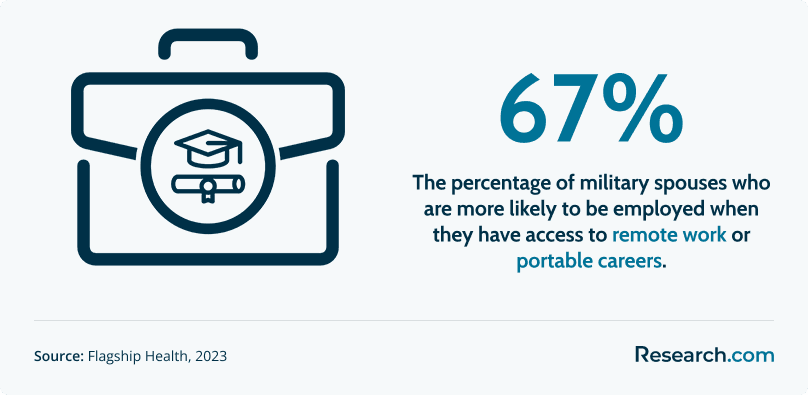
Online education can be particularly valuable when it builds skills that travel well across employers and locations. Business, healthcare administration, IT, education, accounting, HR, and digital marketing may offer more flexibility than careers tied to a single local employer. Studies have also shown that military spouses with access to remote or portable careers are 67% more likely to be employed than those without such opportunities.
Still, no degree guarantees a job or salary. Outcomes depend on the field, location, experience, networking, licensure, internships, and employer demand. Students should choose programs that provide practical projects, career coaching, resume support, and clear connections to real job roles.
Key Insights
- Accreditation is non-negotiable. Military spouses and dependents should verify institutional accreditation and, when relevant, program-specific approval before enrolling.
- Flexibility should be specific, not assumed. Ask whether courses are asynchronous, self-paced, accelerated, or live online, and confirm how the school handles moves or interruptions.
- Portable career alignment matters. Business administration, healthcare, IT, education, HR, accounting, and marketing can be practical options, but regulated fields require extra licensure research.
- Cost should be calculated after benefits and credits. Compare tuition, fees, books, transfer credits, military discounts, MyCAA, scholarships, and GI Bill benefits before deciding.
- Transfer policies can save or cost you time. Get a written evaluation showing exactly how previous credits apply to your degree requirements.
- Career services are part of ROI. Strong online colleges should offer military-aware advising, resume support, employer connections, and guidance for remote or relocation-friendly work.
- The best online college is the one that fits your military family reality. A good program should remain workable through relocation, schedule changes, and evolving career goals.
References:
- Flagship Health. (2023, August 24). Empowering military spouses through challenges and triumphs. Retrieved April 16, 2025, from Flagship Health.
- Hiring Our Heroes. (n.d.). Military spouse resources. Retrieved April 16, 2025, from Hiring Our Heroes.
- Military OneSource. (n.d.). College transfer credits. Retrieved April 16, 2025, from Military OneSource.
- Military OneSource. (n.d.). Going back to school as a military spouse. Retrieved April 16, 2025, from Military OneSource.
- Military Spouse. (n.d.). 5 best online degrees for military spouses. Retrieved April 16, 2025, from Military Spouse.
- Military OneSource. (n.d.). SECO and MSEP 101. Retrieved April 16, 2025, from
- U.S. Army. (n.d.). Military spouse education and career opportunities. Retrieved April 16, 2025, from Military OneSource.
- U.S. Bureau of Labor Statistics. (2024, October 25). The Economics Daily. Retrieved April 16, 2025, from U.S. Bureau of Labor Statistics.
- U.S. Department of Veterans Affairs. (n.d.). Career resources for military and surviving spouses. Retrieved April 16, 2025, from U.S. Army.
- U.S. Department of Veterans Affairs. (n.d.). Education and careers for veterans and family caregivers. Retrieved April 16, 2025, from U.S. Department of Veterans Affairs.
- U.S. Department of Veterans Affairs. (n.d.). Post-9/11 GI Bill benefits transfer. Retrieved April 16, 2025, from U.S. Department of Veterans Affairs.
- U.S. Department of Veterans Affairs. (n.d.). Transferred GI Bill benefits. Retrieved April 16, 2025, from U.S. Department of Veterans Affairs.
- U.S. Department of Labor. (2024). Military spouses fact sheet. Retrieved April 16, 2025, from U.S. Department of Labor.
- U.S. Department of the Interior. (n.d.). Military spouse employment partnership. Retrieved April 16, 2025, from U.S. Department of the Interior
- U.S. Department of Veterans Affairs. (2025). VA offers extensive resources for military spouses. VA News. Retrieved April 16, 2025, from U.S. Department of Veterans Affairs.
Other Things You Should Know About Online Colleges for Military Spouses & Dependents
Yes. A service member can transfer Post-9/11 GI Bill benefits to an eligible spouse or dependent after serving at least 6 years and agreeing to serve 4 more. The VA approves the transfer, and online students may use the benefit at accredited colleges that accept it.
Admission requirements often include proof of military connection, such as a military ID or a service member's documentation. Some colleges may ask for high school transcripts or standardized test scores. Verify with each institution for specific 2027 criteria and deadlines.
Top online colleges like Arizona State University, University of Maryland Global Campus, and Liberty University provide robust financial aid packages, including scholarships and tuition discounts specifically designed for military spouses and dependents in 2027. These programs enhance affordability and access to quality education.


