
2027 How Long Does It Take to Earn a Bachelor’s Degree Online?

Co-Founder and Chief Data Scientist
Choosing an online bachelor’s degree is no longer just a convenience decision. For many students, it is a question of time, cost, transfer credits, work schedules, career goals, and whether the program will be respected by employers or graduate schools. Online bachelor’s programs can make college more accessible, but they are not all equally flexible, affordable, or career-focused.
This guide explains how online bachelor’s degrees work, how long they usually take, what affects completion time, how to compare program formats, and what to check before enrolling. It is designed for first-time college students, working adults returning to school, associate degree holders, military learners, parents, and anyone comparing online undergraduate options for 2027.
Quick Answer: Is an Online Bachelor’s Degree a Good Option?
An online bachelor’s degree can be a practical choice if the school is properly accredited, the program fits your schedule, and the curriculum supports your career or graduate school goals. A typical online bachelor’s degree is generally completed within four years, but transfer credits, accelerated terms, prior learning credit, and year-round enrollment can shorten the timeline. Online programs are especially useful for students who need flexibility, but they require strong time management and careful program selection.
What are the benefits of getting a bachelor’s degree online?
- Online students may be able to reduce completion time through transfer credits, accelerated course formats, or prior learning assessments.
- Workers with a bachelor’s degree can earn an average of $1,493 weekly, though actual earnings vary by field, location, experience, and employer.
- Online programs can make it easier to study while managing employment, caregiving, military service, or other responsibilities.
Affordable Quick Online Degree Programs With High Acceptance Rates for 2027
The best online bachelor’s degree for you depends on more than speed or admission odds. You should also consider whether the field requires licensure, in-person clinical work, internships, technical equipment, or a graduate degree for advancement. The programs below are common online options for students seeking practical career pathways.
1. Nursing
Online nursing programs usually combine remote coursework with required clinical or practicum experiences in approved healthcare settings. Students study topics such as anatomy, physiology, pharmacology, patient assessment, and nursing theory while developing supervised care skills. Graduates may pursue registered nurse roles in hospitals, clinics, long-term care facilities, public health agencies, and community healthcare organizations, depending on licensure requirements and program type.
2. Computer Science
A computer science bachelor’s degree focuses on how software, algorithms, data systems, and computing tools are designed and applied. Students commonly study programming, data structures, software engineering, operating systems, cybersecurity concepts, and artificial intelligence foundations. Projects may include building applications, testing code, designing algorithms, or developing software systems. Graduates often pursue roles in software development, cybersecurity, data analysis, artificial intelligence, and related technology fields.
3. Healthcare Administration
Healthcare administration programs prepare students to manage operations, compliance, finance, people, and services in healthcare organizations. Coursework often includes healthcare law, ethics, finance, strategic planning, human resources, and health information systems. Some programs include internships or applied projects in hospitals, clinics, insurers, or healthcare agencies. Graduates may work as healthcare administrators, department managers, health information managers, or consultants.
4. Management
A management degree develops leadership, planning, communication, decision-making, and team coordination skills that apply across industries. Students usually take courses in organizational behavior, strategic management, human resources, operations, business ethics, and finance. Case studies, group projects, simulations, or internships help students practice business problem-solving. Career paths can include management roles in marketing, operations, finance, entrepreneurship, human resources, and general administration.
5. Management Information Systems
Management information systems programs connect business operations with technology strategy. Students learn how organizations use databases, enterprise systems, analytics, cybersecurity practices, and project management methods to improve performance. Coursework may involve systems analysis, database design, information security, business analytics, and IT management. Graduates may pursue roles as MIS analysts, IT consultants, database administrators, business systems analysts, or systems managers.
6. Economics
Economics programs teach students how markets, incentives, policies, and resource decisions affect individuals, organizations, and economies. Typical courses include microeconomics, macroeconomics, econometrics, statistics, economic theory, and policy analysis. Students may complete research projects, analyze data, build economic models, or participate in simulations. Graduates can seek opportunities in banking, finance, government, consulting, research, and policy analysis.
7. Accounting
Accounting bachelor’s programs emphasize financial reporting, auditing, taxation, cost analysis, and managerial accounting. Students study accounting principles, tax rules, auditing methods, financial analysis, accounting information systems, and business law. Practical assignments may involve preparing financial statements, analyzing financial data, using accounting software, or reviewing audit scenarios. Graduates often pursue roles as accountants, auditors, tax specialists, budget analysts, or financial analysts in public, private, government, or nonprofit settings.
8. Special Education
Special education degrees prepare future educators to support students with disabilities and diverse learning needs. Coursework usually covers educational psychology, inclusive instruction, assessment, behavior management, individualized education planning, and instructional adaptation. Most programs include supervised fieldwork or practicum experiences in school settings. Graduates may become special education teachers, behavior interventionists, educational consultants, or program coordinators, depending on state licensure rules.
9. Business Administration
Business administration is a broad degree for students who want a flexible foundation in finance, marketing, accounting, management, operations, and organizational behavior. Online programs may include internships, simulations, consulting-style projects, or capstone assignments. Graduates can pursue entry-level and mid-level roles in marketing, operations, finance, sales, entrepreneurship, consulting, and business support functions.
10. Social Work
Social work bachelor’s programs focus on helping individuals, families, groups, and communities address social, behavioral, economic, and health-related challenges. Students often study human behavior, social welfare policy, counseling methods, case management, ethics, and social justice. Field placements in social service organizations are commonly required. Graduates may work in child welfare, healthcare, mental health, community services, or substance abuse treatment settings, subject to state requirements and role limitations.
- How long does an online bachelor’s degree take?
- Online vs. traditional bachelor’s programs
- Online bachelor’s curriculum structure
- Transfer credits accepted by online programs
- Accelerated online bachelor’s degrees explained
- Self-paced online bachelor’s programs
- Career benefits of online bachelor’s degrees
- Accreditation and quality checks
- How to choose the right online program
- Time management strategies for online studentsSelf-paced program comparison
- Hands-on learning in online bachelor’s programs
- Using an online associate degree toward a bachelor’s
- How to accelerate without lowering quality
- Academic integrity in online programs
- Technical requirements for online learning
- Online bachelor’s degree costs
- Certifications after an online bachelor’s degreeCost planning details
- Networking opportunities in online programs
- Support services for online bachelor’s studentsAdditional student resourcesOnline learner support
Key Findings
- An online bachelor’s degree is generally completed within four years, but accelerated schedules, transfer credits, and prior learning credit can reduce the timeline.
- Time to completion matters to many online students: 58% identify it as one of the top factors when selecting an online program.
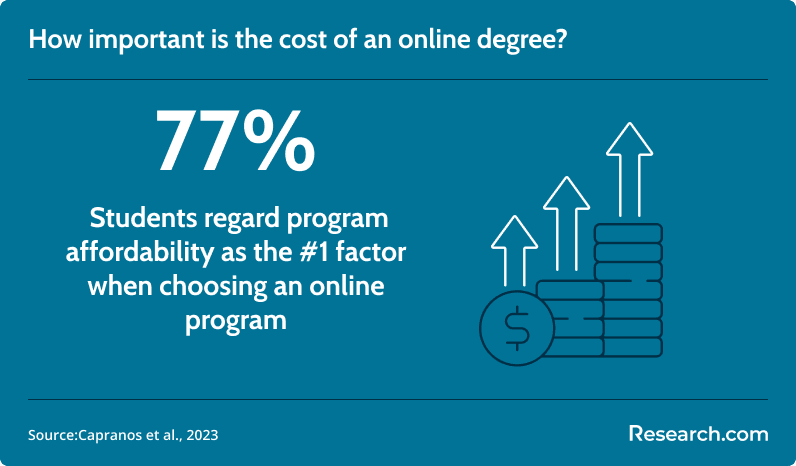
- Affordability is the leading selection factor, with 77% of learners citing it when choosing an online program.
- Distance learning is now a mainstream part of undergraduate education: 54.4% of undergraduate learners at four-year and two-year institutions took at least one or all distance courses in 2022.
- Not every activity works equally well online. Most students prefer in-person lab work (71%), while 59% prefer completing research online.
How long does it take to earn a bachelor’s degree online?
A bachelor’s degree online generally takes four years for a first-time, full-time student who enters without transfer credits. The actual timeline can be shorter or longer depending on your enrollment pace, number of accepted transfer credits, course availability, major requirements, and whether the program uses standard semesters, shorter accelerated terms, or self-paced courses.
| Student situation | Typical impact on completion time | What to verify before enrolling |
| First-time full-time student | Usually follows the standard four-year bachelor’s timeline | Course sequence, general education requirements, and whether courses are offered every term |
| Transfer student | May finish faster if previous credits apply to the new degree | Official transfer evaluation, maximum transfer credit policy, and major-specific equivalencies |
| Part-time student | May take longer because fewer courses are completed each term | Minimum enrollment rules, financial aid eligibility, and course rotation |
| Accelerated student | May finish faster through compressed terms and more frequent start dates | Weekly workload, academic support, accreditation, and refund deadlines |
| Self-paced student | May move faster or slower depending on motivation and program rules | Maximum course access period, exam rules, faculty availability, and completion deadlines |
Students should avoid choosing a program based only on the advertised timeline. A degree may be marketed as fast, but required prerequisites, limited course availability, clinical placements, or transfer credit restrictions can affect the real completion date.
How do online bachelor’s degree programs differ from traditional ones?
Online and campus-based bachelor’s programs can lead to the same degree level, but the learning experience is different. The biggest differences involve delivery format, scheduling, interaction, technology requirements, and how much structure the student receives. For many learners, these differences are what make an online degree worth getting; for others, they may create challenges.
| Factor | Online bachelor’s degree | Traditional campus bachelor’s degree |
| Class delivery | Uses learning platforms, recorded lectures, live video sessions, discussion boards, and digital assignments | Relies mainly on in-person classes, labs, campus meetings, and physical classrooms |
| Schedule | Often offers asynchronous, evening, accelerated, or flexible options | Usually follows set class times and a campus-based academic calendar |
| Interaction | May include video meetings, forums, group projects, email, chat, and virtual office hours | Offers face-to-face access to classmates, faculty, campus events, and in-person services |
| Student responsibility | Requires strong self-direction, planning, and comfort with digital tools | Provides more built-in structure through scheduled classes and campus routines |
| Support services | May include online tutoring, virtual advising, remote library access, tech support, and digital career services | Often includes in-person advising, tutoring centers, libraries, career offices, and campus facilities |
The right format depends on how you learn best. Students who need flexibility and can manage deadlines independently may do well online. Students who depend on in-person accountability, live discussion, or physical campus resources may prefer a traditional or hybrid format.
How is the curriculum structured in an online bachelor’s degree program?
An online bachelor’s curriculum usually includes general education courses, major requirements, electives, and a capstone, internship, practicum, portfolio, or project when required by the field. Whether you are comparing the cheapest online psychology degree options or a demanding technical program, the core academic structure often mirrors campus-based degrees, though the delivery method is adapted for online learners.
- Asynchronous coursework: Students complete readings, recorded lectures, discussion posts, quizzes, and assignments on their own schedule within set deadlines.
- Synchronous sessions: Some courses require live video meetings, presentations, discussions, labs, or instructor-led review sessions.
- Learning management systems: Programs usually use digital platforms for lectures, grades, submissions, exams, discussion boards, group work, and announcements.
- Applied learning components: Depending on the major, students may complete simulations, virtual labs, fieldwork, internships, clinical placements, portfolios, or capstone projects.
In 2022, 54.4% of undergraduate students in the U.S. took at least one distance course as part of their program (NCES, 2023b). The chart below shows the share of students who enrolled exclusively in distance education courses.
What types of credits are accepted for transfer to a bachelor’s degree online?
Online bachelor’s programs may accept transfer credits from accredited community colleges, four-year institutions, military education, professional training, standardized assessments, certification programs, vocational coursework, prior learning assessments, or portfolio reviews. The exact policy varies by school, major, grade earned, course age, accreditation status, and whether the credits match degree requirements.
General education credits often transfer more easily than major-specific credits. For example, a student moving from the cheapest online bachelor's degree in education to computer science may find that writing, math, or humanities credits transfer, while education-specific courses may not apply to the new major.
| Credit source | How it may apply | Common limitation to check |
| Community college coursework | Often applies to general education or lower-division requirements | Maximum transfer credits and course equivalency rules |
| Previous four-year college credits | May apply to general education, electives, or major requirements | Minimum grade, accreditation, and age of coursework |
| Military training | May count toward electives or specific requirements | School evaluation policy and documentation requirements |
| Professional certifications | May support credit for technical or career-focused coursework | Whether the credential has been approved for academic credit |
| Prior learning portfolio | May award credit for documented college-level learning | Assessment fees, faculty review, and credit caps |
Before enrolling, request an official transcript audit from each school you are seriously considering. Do not rely only on a verbal estimate from admissions. The audit should show which credits transfer, which requirements they satisfy, and how many credits you still need to graduate.
What are accelerated bachelor’s degree online programs?
Accelerated online bachelor’s programs are designed for students who want to complete courses on a faster schedule than a standard 16-week semester. Many use compressed terms that last five to eight weeks, with multiple start dates throughout the year. This format can help motivated students make steady progress, especially if they already have transfer credits.
The trade-off is intensity. Shorter terms usually mean more weekly reading, assignments, projects, exams, and discussions. Students who work full time or have heavy family responsibilities should review the weekly workload carefully before enrolling in multiple accelerated courses at once.
| Accelerated format | Best for | Potential risk |
| Five- to eight-week courses | Students who can focus intensely for shorter periods | Falling behind quickly if deadlines are missed |
| Year-round enrollment | Students who want fewer long breaks between terms | Limited recovery time between courses |
| Transfer-heavy degree completion | Students with previous college credit | Credits may not apply as expected without a formal audit |
| Competency or self-paced options | Students with strong prior knowledge and self-discipline | Less structure may make progress harder for some learners |
How do self-paced programs differ from other online programs?
Self-paced programs give students more control over when they move through course material. While this model is common in the cheapest online graduate programs and other advanced online options, some undergraduate programs also use self-paced or competency-based formats.
- Flexibility: Standard online courses often require students to meet weekly deadlines with a cohort. By contrast, online college courses self paced may allow students to complete lessons, assignments, or exams within a broader window.
- Course access: Self-paced courses may release most or all materials at the start of the term, while traditional online classes often unlock content weekly or biweekly.
- Interaction: Many self-paced courses rely heavily on recorded content and independent work, while cohort-based online classes may include more frequent discussions, live meetings, and peer interaction.
- Accountability: Self-paced learning can be efficient for disciplined students, but it can be difficult for learners who need regular instructor reminders or fixed class meetings.
How do online bachelor's degree programs enhance long-term career success?
Online bachelor’s programs can support career growth when they combine credible academics with practical skill development. Strong programs build career readiness through applied projects, internship options, employer-aligned assignments, faculty feedback, career advising, resume support, and networking opportunities. Some students also choose an accelerated bachelor's degree online to enter or advance in the workforce sooner.
Career value depends heavily on the field. Degrees tied to licensed professions, such as nursing, education, and social work, must meet specific state or professional requirements. Degrees in business, technology, and healthcare administration may depend more on internships, portfolios, certifications, software skills, and relevant work experience.
What accreditation and quality assurance measures should I consider for an online bachelor’s degree program?
Accreditation is one of the most important checks before enrolling in any online bachelor’s degree. It affects credit transfer, financial aid eligibility, employer recognition, graduate school admission, and licensure preparation. Students should verify that the institution is accredited by a recognized agency and, when relevant, that the specific program holds specialized accreditation or approval.
- Institutional accreditation: Confirms that the college or university has met broad academic and operational standards.
- Programmatic accreditation: Applies to certain fields, such as nursing, education, business, social work, and other regulated or profession-specific areas.
- Licensure alignment: Essential for programs that prepare students for regulated careers, especially if the student plans to work in a different state.
- Outcome transparency: Look for clear information on graduation, retention, job placement, licensure exam performance, and student support.
- Faculty qualifications: Review whether instructors have appropriate academic credentials, industry experience, and online teaching experience.
If you plan to continue beyond the bachelor’s level, also review whether the undergraduate program prepares students for graduate pathways, including options such as 1 year master's programs online.
How do I choose the right online bachelor’s degree program?
The right online bachelor’s degree is the one that fits your academic background, budget, schedule, learning style, and career goal. Rankings and advertisements can be useful starting points, but they should not replace a careful review of accreditation, curriculum, transfer policy, student services, total cost, and outcomes.
| Question to ask | Why it matters | What to request from the school |
| Is the school properly accredited? | Accreditation affects transfer credits, aid, employment, and graduate study | Accreditation agency name and verification source |
| How many of my credits will transfer? | Transfer credit can significantly change cost and completion time | Official transcript evaluation |
| What is the full cost, including fees? | Tuition alone may not show the true price | Program cost sheet with technology, course, and proctoring fees |
| Are courses asynchronous, synchronous, or both? | Schedule format affects working adults and caregivers | Sample course schedule and attendance requirements |
| Does the program meet licensure requirements? | Critical for nursing, teaching, social work, and similar fields | State authorization and licensure disclosure |
| What career support is available online? | Career services can affect internships, job searches, and networking | Details on virtual advising, job boards, employer events, and resume help |
Students planning for advanced study should also consider how a bachelor’s program fits into a longer education plan, including graduate or doctoral routes such as the fastest doctorate degree.
What are the best strategies for managing time effectively in an online bachelor’s degree program?
Online learning gives students flexibility, but that flexibility can create problems when deadlines are not visible in daily life. Successful online students usually build structure before the term begins rather than waiting until assignments pile up.
- Map the full term early: Add quizzes, exams, papers, discussion deadlines, live sessions, and project milestones to one calendar.
- Create fixed study blocks: Treat online coursework like scheduled class time, even if lectures are recorded.
- Break large assignments into smaller steps: For example, divide a major paper into topic selection, research, outline, draft, revision, and final submission.
- Prioritize difficult tasks first: Complete high-value or complex assignments before easier discussion posts or routine tasks.
- Avoid multitasking during coursework: Switching between work, family tasks, social media, and class materials can reduce focus and slow progress.
- Use planning tools: Digital calendars, task boards, reminder apps, and time trackers can help students manage overlapping deadlines.
- Control distractions: Choose a consistent study location, silence unnecessary notifications, and tell others when you are unavailable.
- Build in breaks: Short planned breaks can help prevent burnout, especially during accelerated terms.
- Contact instructors early: Ask for clarification before confusion turns into missed work.
Are there opportunities for hands-on learning in bachelor’s degree online programs?
Yes, many online bachelor’s programs include hands-on learning, but the format depends on the major. Business, technology, and social science programs may use simulations, case studies, research projects, group consulting assignments, virtual labs, or portfolio work. Healthcare, nursing, education, and social work programs often require in-person clinical placements, fieldwork, practicums, or supervised experiences.
Some programs use virtual labs, at-home kits, augmented or virtual reality, interactive exercises, and remote collaboration tools. However, students should check whether hands-on requirements can be completed near their location or require travel to campus or an approved site.
According to EDUCAUSE research (McCormack, 2023), most students preferred on-site classes for lab work (71%) and group activities (69%). Students were more likely to prefer online formats for less hands-on activities, including research (59%) and exams (57%). The chart below summarizes these student preferences.
Can an online associate degree pave the way for a bachelor’s degree?
Yes. An online associate degree can be a cost-conscious starting point for students who plan to transfer into a bachelor’s program. This pathway may help students complete general education courses first, explore a major, and reduce the number of credits needed later. Students comparing this route can review schools with the cheapest online associate's degrees as part of their planning.
The key is transfer alignment. Before choosing an associate degree, confirm whether the credits will transfer into the intended bachelor’s program and whether the schools have an articulation agreement. A low-cost associate program may not save money if many credits fail to apply.
Can I accelerate my online bachelor's degree without compromising quality?
You can accelerate an online bachelor’s degree without sacrificing quality if the program remains accredited, academically rigorous, well-supported, and transparent about expectations. The goal is not simply to finish fast; it is to finish with a credential that supports your next step.
- Use transfer credits strategically after receiving an official evaluation.
- Choose accelerated terms only if you can handle the weekly workload.
- Take year-round courses if your schedule allows sustained study.
- Ask whether prior learning, military training, or certifications may count for credit.
- Review whether academic advising helps students avoid unnecessary courses.
- Compare options using a resource such as colleges with accelerated programs.
A warning: extremely short timelines may not be realistic for students with no prior credits, licensure-heavy majors, clinical requirements, or limited weekly study time.
How do online bachelor’s degree programs maintain academic integrity?
Accredited online programs protect academic integrity through policies, technology, assessment design, and faculty oversight. Common measures include plagiarism detection software, secure testing platforms, identity verification, remote proctoring, randomized exam questions, timed assessments, project-based evaluations, and clear academic honesty policies.
Academic integrity is especially important in accelerated formats because faster progress should not mean weaker standards. Even short programs, such as an associate degree in 6 months online, may use identity checks, proctored exams, and structured assessments to preserve credibility.
What are the technical requirements for online learning?
Online bachelor’s students need reliable technology before classes begin. Requirements vary by school and major, so students should review the program’s technology checklist rather than assuming a phone or basic tablet will be enough.
- Stable internet access suitable for video, uploads, exams, and learning platforms
- A compatible laptop, desktop computer, tablet, or other approved device
- Current operating system, adequate storage, and required security updates
- Updated web browser that works with the learning management system
- Webcam, headphones, and microphone for live sessions or proctored exams
- Productivity tools, file-sharing software, and messaging applications
- Program-specific software, especially in technical fields such as the cheapest online cyber security degree
How much does a bachelor’s degree online cost?
The cost of an online bachelor’s degree depends on the institution, program, residency rules, transfer credits, fees, books, technology costs, and financial aid eligibility. One estimate places online bachelor’s tuition at around $54,183 for public university tuition and $60,593 for private university tuition (Hanson, 2023).
Some institutions offer the cheapest online bachelor's degree options by charging online students a flat rate regardless of state residency. Others price programs by credit, course, term, semester, or full program. Students concerned about GPA or entrance exams may also compare online colleges with open enrollment.
Online students may avoid room, board, campus parking, commuting, and some physical campus costs. However, they may still pay technology fees, e-book fees, online course fees, proctoring fees, software fees, and graduation fees. This is why affordability is a major factor: 77% of U.S. students consider program affordability when choosing an online program (Capranos et al., 2023).
| Cost category | What to check | Why it matters |
| Tuition | Per-credit, per-course, term-based, or flat-rate pricing | Different pricing models can change the total cost |
| Transfer credits | How many credits apply to the degree | Accepted credits can reduce both time and tuition |
| Fees | Technology, online course, proctoring, graduation, and student service fees | Fees can make a low tuition rate less affordable |
| Books and materials | E-books, access codes, lab kits, software, or subscriptions | Required materials may vary widely by course |
| Financial aid | Federal, institutional, employer, military, and scholarship options | Aid can reduce out-of-pocket cost if the student qualifies |
Can additional certifications boost career prospects after an online bachelor's degree?
Certifications can strengthen an online bachelor’s degree when they add specific, job-relevant skills that the degree does not fully cover. They are especially useful in fields where employers value software proficiency, technical credentials, project management knowledge, data skills, healthcare administration knowledge, cybersecurity tools, or industry compliance training.
Students should choose certifications based on job postings in their target field, not simply because a credential sounds impressive. Short professional training through online courses may support career changes, promotions, or specialization without requiring another full degree.
Do online bachelor's degree programs offer networking opportunities?
Many online bachelor’s programs now include networking opportunities, though students may need to be more intentional than they would be on campus. Common options include virtual career fairs, alumni panels, student discussion communities, live webinars, employer information sessions, group projects, mentoring programs, and online student organizations.
Networking is particularly important for students pursuing career changes or shorter education-to-career pathways, including programs connected to quick schooling for good paying jobs. To evaluate networking quality, ask whether online students have access to the same employer events, alumni databases, internship postings, and career coaching as campus students.
What support services are available for bachelor’s degree online students?
Online students need more than recorded lectures. Strong support services can affect persistence, grades, confidence, and career preparation. In one report, 73% of online learners agreed that their program provided relevant online resources (Wright et al., 2022). Before enrolling, confirm which services are available remotely and during what hours.
- Academic advising: Helps students select courses, understand degree requirements, plan transfer credits, and stay on track for graduation.
- Virtual tutoring: Provides subject support, writing help, exam preparation, and assignment guidance.
- Online library access: Gives students digital databases, research tools, journals, e-books, and librarian assistance.
- Technical support: Helps resolve issues with learning platforms, logins, software, hardware, exams, and access codes.
- Career services: May include resume reviews, internship support, job search coaching, mock interviews, employer events, and networking resources.
- Disability services: Can provide accommodations such as extended test time, accessible course materials, captioning, assistive technology, or alternative formats.
- Mental health services: A study by Lister et al. (2023) indicates that mental health support for online students should include both individual assistance and institutional responsibility.
Common Mistakes to Avoid When Choosing an Online Bachelor’s Degree
- Ignoring accreditation: A low-cost or fast program is risky if credits do not transfer or the credential is not recognized.
- Looking only at tuition: Fees, books, proctoring, software, and lost transfer credits can change the real cost.
- Assuming all online programs are fully flexible: Some require live sessions, campus visits, labs, clinical placements, or fixed deadlines.
- Skipping the transfer audit: Admissions estimates are not the same as an official credit evaluation.
- Overloading accelerated courses: Short terms can be efficient, but taking too many at once can lead to poor performance.
- Not checking licensure rules: Nursing, teaching, social work, and similar fields may have state-specific requirements.
- Relying only on rankings: A highly ranked program may still be a poor fit if it lacks your major, schedule format, transfer policy, or career support needs.
- Assuming salary outcomes are guaranteed: Degree value depends on field, experience, location, labor market conditions, and individual performance.
Key Insights
- An online bachelor’s degree can be a strong option when it is accredited, affordable, flexible, and aligned with your career or graduate school plan.
- The standard timeline is generally four years, but transfer credits, accelerated terms, prior learning credit, and year-round study can shorten completion time.
- Affordability should be evaluated by total cost, not tuition alone. Include fees, materials, technology, transfer credit loss, and financial aid.
- Program format matters. Asynchronous, synchronous, accelerated, hybrid, and self-paced programs require different levels of structure and independence.
- Students in licensure-related fields must verify state requirements before enrolling, especially if they plan to work outside the school’s state.
- The best online programs provide more than coursework: advising, tutoring, tech support, library access, career services, accessibility accommodations, and mental health resources all matter.
- Fast completion should not come at the expense of academic quality. Confirm accreditation, faculty credentials, learning outcomes, assessment standards, and student support before choosing an accelerated pathway.
References:
- Capranos, D., Dyers, L., & Magda, A. J. (2023, June). Voice of the online learner 2023: Responding to students’ evolving preferences and concerns. Wiley University Services. https://universityservices.wiley.com/wp-content/uploads/2023/06/202306-VOL2023-report-WUNI-final.pdf
- Ma, J., & Pender, M. (2023). Education pays. College Board. https://research.collegeboard.org/media/pdf/education-pays-2023.pdf
- McCormack, M. (2023, August 28). 2023 students and technology report: Flexibility, choice, and equity in the student experience. EDUCAUSE. https://www.educause.edu/ecar/research-publications/2023/students-and-technology-report-flexibility-choice-and-equity-in-the-student-experience/introduction-and-key-findings
- National Center for Education Statistics. (2023a, May). Annual earnings by educational attainment. Condition of Education. https://nces.ed.gov/programs/coe/indicator/cba/annual-earnings
- National Center for Education Statistics. (2023b, December). Number and percentage of students enrolled in degree-granting postsecondary institutions, by distance education participation, location of student, level of enrollment, and control and level of institution: Fall 2021 and fall 2022. Digest of Education Statistics. https://nces.ed.gov/programs/digest/d23/tables/dt23_311.15.asp
- U.S. Bureau of Labor Statistics. (2023, September 6). Earnings and unemployment rates by educational attainment, 2023. Education Pays. https://www.bls.gov/emp/chart-unemployment-earnings-education.htm
- Wright, L., Capranos, D., Dyers, L., & Magda, A. J. (2022, July). Online learner experiences: The importance of cohesive design and learning communities to student satisfaction. Wiley University Services. https://universityservices.wiley.com/online-learner-experiences-the-importance-of-cohesive-design-and-learning-communities
Other Things You Should Know About Bachelor’s Degree Online
In 2027, the duration to complete an online bachelor’s degree can vary depending on factors such as prior credits, program structure, and the intensity of studies. Full-time students may finish in around 3-4 years, while part-time students might take longer. Accelerated programs can reduce this timeline significantly.
Yes. Schools often accept up to 90 transfer credits toward a 120-credit bachelor’s degree, which can remove one to two years of study. The final number depends on the institution’s transfer policy, course equivalency, and whether your previous credits were earned at an accredited college.
For 2027, most online bachelor’s degrees require around 120 credit hours to graduate. This typically translates to four years of full-time study. Some programs may allow acceleration or part-time options, impacting the timeframe based on credit completion rates.
Yes, you can take breaks during your online bachelor’s degree program, although the specifics may vary depending on the program and institution. Many online programs offer flexibility in scheduling, allowing you to take breaks between courses or terms. Moreover, online programs often accommodate part-time enrollment which can enable you to adjust your course load to fit your schedule and take breaks when necessary. However, it's essential to check with your program advisor or academic department to understand any break requirements.


